Chapter Three The Ten Mysterious Gates: The Grammar of Interidentity and Interpenetration
The operating rules of nonobstruction among phenomena are the ten mysterious gates. At the end of the previous chapter, we saw Chengguan's genealogical statement: the ten mysteries emerge from the contemplation of pervasive containment. The textual genealogy goes back another generation. The work establishing the list is Zhiyan's Ten Mysterious Gates of the Huayan One Vehicle, whose title carries the note “transmitting the teaching of the monk Dushun.”1 Fazang's Five Teachings retains the list and reenacts its method; his Record of Exploring the Mysteries establishes a new list. The Golden Lion still uses the old list. Both lists circulate under Fazang's name; no judgment is made here about their chronological order. First, the old and new lists side by side:
| Old ten mysteries (Zhiyan, T1868) | Perspective | New ten mysteries (Record of Exploring the Mysteries, fascicle one) |
|---|---|---|
| Gate of simultaneous completeness and correspondence | Correspondence | Gate of simultaneous completeness and correspondence |
| Gate of the realm of Indra's net | Analogy | Gate of free nonobstruction between breadth and narrowness |
| Gate of the simultaneous accomplishment of concealed and manifest | Conditions | Gate of mutual containment of one and many without sameness |
| Gate of the stable arrangement of minute mutual containment | Characteristics | Gate of free interidentity among dharmas |
| Gate of the distinct accomplishment of dharmas separated across ten times | Times | Gate of the simultaneous accomplishment of hidden and revealed |
| Gate of the stores endowed with virtues in purity and mixture | Practice | Gate of the stable arrangement of minute mutual containment |
| Gate of mutual containment of one and many without sameness | Principle | Gate of the dharmadhātu of Indra's net |
| Gate of free interidentity among dharmas | Function | Gate of disclosing the Dharma through phenomena to generate understanding |
| Gate of accomplished transformation through mind alone | Mind | Gate of the distinct accomplishment of dharmas separated across ten times |
| Gate of disclosing the Dharma through phenomena to generate understanding | Wisdom | Gate of host and companions perfectly illuminated and endowed with virtues |
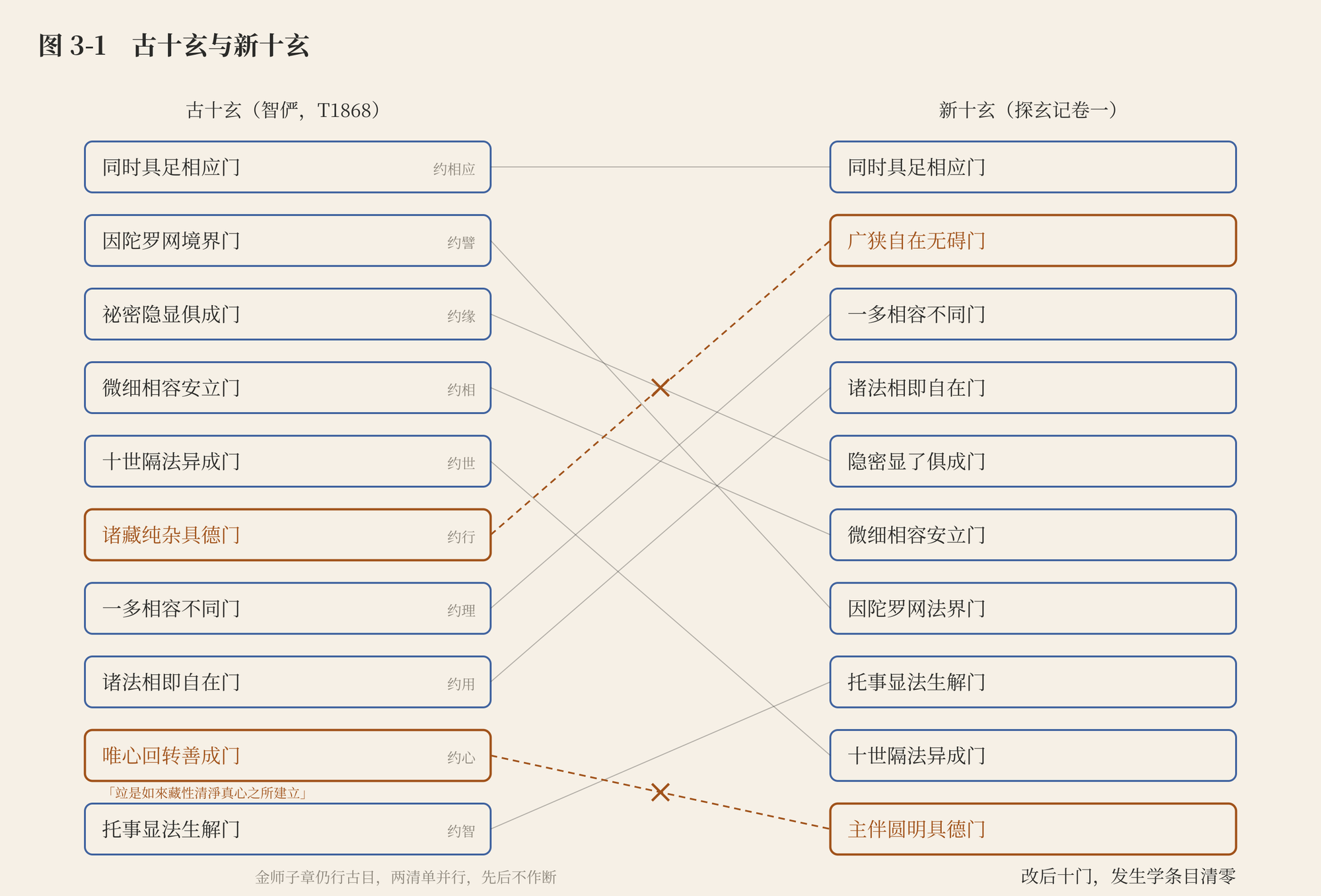
Apart from the order, there are two substantive changes. The gate of the stores endowed with virtues in purity and mixture is replaced by the gate of free nonobstruction between breadth and narrowness. The gate of accomplished transformation through mind alone is replaced by the gate of host and companions perfectly illuminated and endowed with virtues.2
The second change deserves separate weighing. Zhiyan's gate of transformation through mind alone states its position without restraint: “All the preceding meanings, teachings, gates, and so forth are established by the pure true mind of tathāgatagarbha-nature. Whether good or evil, they turn with mind, hence ‘accomplished transformation.’ There is no separate object outside mind, hence ‘mind alone.’”1 “Established by the true mind”: establishment is explicit production vocabulary. This gate assigns all the mechanisms of the preceding nine to one mind as its products. In revising the list, Fazang removes the entire gate and substitutes perfectly illuminated host and companions: one is taken as host and the rest as companions, a purely relational gate. The Record of Exploring the Mysteries does not state his motive. What can be verified is a fact about the list: none of the revised ten gates takes mind as its heading. Entries explaining how things originate drop to zero; all ten mysteries are now relational entries. Chapter Five records the three steps by which Chengguan and Zongmi invite mind back into Huayan. Here we first record a step in the opposite direction: Fazang had personally invited mind out of the ten mysteries. One exit and one entrance, two generations moving in opposite directions. Read together with Chapter Five's table of wording, this is the prehistory of the same shift.
The general plan, demonstrated in one petal. In listing the ten gates, the Five Teachings gives the first as the general plan: “First, the gate of simultaneous completeness and correspondence.” Ten meanings correspond simultaneously to constitute one dependent origination, without before or after.3 The Record of Exploring the Mysteries assigns ten pairs to each gate: teaching and meaning, principle and phenomena, object and wisdom, practice and stage, cause and result, environment and embodied being, substance and function, person and dharma, adversity and accord, response and stimulus. One gate contains all ten; every gate contains the others: “Wherever there is one gate, all are present.”2 It then runs through the ten gates with a single lotus petal. The petal's possession of the ten pairs is simultaneous completeness. “That petal pervades the dharmadhātu without destroying its original position” is freedom between breadth and narrowness. Extending itself to enter everywhere while containing everything within itself is mutual containment of one and many. “Relinquishing itself to be the same as others, it is wholly all those dharmas” is interidentity among dharmas. The demonstration continues through “each of the three times has three, all gathered into one thought,” the separation of dharmas across ten times.2 One petal demonstrates the entire apparatus, a precedent for the Golden Lion in Chapter Six: there a lion, here a petal.
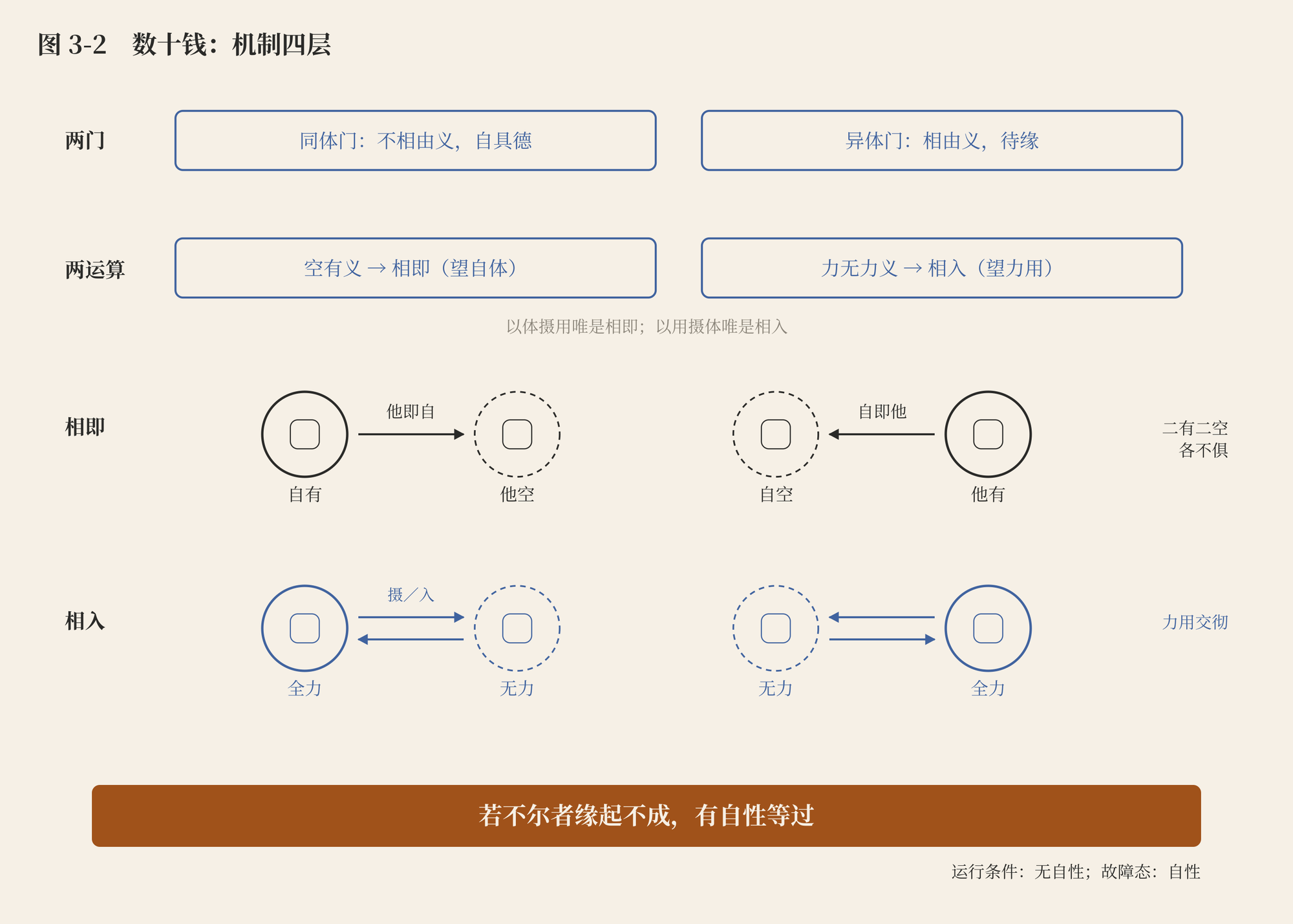
Counting ten coins: the mechanics of interidentity and interpenetration. Indra's net is the most famous analogy of the ten mysteries, but the coin analogy carries the most argumentative weight. The Five Teachings introduces its demonstration: “It is like the method of counting ten coins. Ten is used to correspond to a complete number and disclose inexhaustibility.”4 The mechanism has four layers, each explicitly stated.
The first layer distinguishes two gates. “Within the gates of dependent origination there are two meanings. First, not depending on one another, since each possesses virtues of its own … Second, depending on one another, as in awaiting conditions and the like. The first is the same-body gate; the second, the different-body gate.”4 The different-body gate concerns conditions in their mutual dependence; the same-body gate concerns what one condition itself possesses. The operations that follow run once through each gate.
The second layer distinguishes two operations. “All dependently arisen dharmas have two meanings. First, emptiness and existence, viewed in terms of their own body; second, power and lack of power, viewed in terms of efficacy. Through the first meaning, interidentity is possible; through the second, interpenetration is possible.”4 Interidentity is attached to emptiness and existence at the level of body; interpenetration to power and lack of power at the level of function. The two connectives have distinct scopes: the text first separates their grammar. One sentence concludes the division of labor: “When function includes body, there is no separate body, so there is only interpenetration. When body includes function, there is no separate function, so there is only interidentity.”4
The third layer gives the mechanism of interidentity. “In the first case, when this exists, the other must not exist, so the other is this. Why? Because the other has no nature and is constituted by this. Second, when this is empty, the other must itself exist, so this is the other … Because two existents cannot coexist, and two emptinesses cannot coexist, neither can fail to be identical with the other.”4 Only one term occupies the position of body at a time. If this exists, the other is empty; since the other has no nature and is constituted by this, the other is this. The reverse holds as well. Here the operative definition of “is” is given: yielding place and constituting in another's stead. Two existents cannot coexist; two emptinesses cannot coexist. Two terms standing side by side, each carrying its own body, are precisely what the mechanism excludes. Interidentity therefore cannot mean the numerical identity of two already constituted things. The mechanism provides no place for two embodied terms to appear simultaneously.
The fourth layer gives the mechanism of interpenetration. “This has full power, so it can contain the other. The other is wholly without power, so it can enter this … Since the account does not concern their own bodies, this is not interidentity. Their powers and functions permeate one another, so interpenetration is accomplished.”4 On the side of efficacy too, full allocation alternates with zero allocation. What has full power contains; what has none enters.
Beneath the four layers lie the operating conditions. Fazang repeatedly states that this machine of interidentity and interpenetration runs entirely on the absence of own-nature: “The one spoken of is not a one by own-nature, since it is constituted by conditions”; “thus all dependent origination is without own-nature. Why? Remove any one condition and nothing is constituted”; “only through naturelessness can the dependent origination of one and many be accomplished.”4 The weightiest statement specifies the failure state: “Otherwise dependent origination would not be established, and there would be the fault of own-nature and the like.”4 Own-nature appears in the operating manual as a failure state. If any term holds to its own body, yielding place and constituting in another's stead immediately become impossible; interidentity and interpenetration stop. Momentary cessation and dependence on many conditions among the six seed characteristics in Essay Twenty, and thusness not holding to own-nature in Chapter Five, are clauses against own-nature attached to components. This statement goes further: it makes absence of own-nature the operating condition of the whole grammar. Essay Eighteen's theorem says own-nature and dependent origination cannot stand together. The Five Teachings gives the engineering version of the same statement: once own-nature enters, my machine stops. The measuring instrument and the system coincide here down to their syntax, as in Essay Twenty's comparison with the Treatise on the Jewel in the Palm. There, a classical opponent points to the unresolved question; here, a classical legislator writes the theorem's content into the operating instructions for his own machine.
The positive argument that one is ten is also on record. Suppose one is not ten. Fazang gives two faults: “First, the fault that ten coins are not constituted. Why? If one is not ten, many ones do not constitute ten either. Why? Because each one is not ten”; “second, the fault that one does not constitute ten. Why? If one is not ten, ten cannot be constituted. Since ten is not constituted, the meaning of one is not established either. Why? If there is no ten, whose one is it?”4 Ten is accumulated from ones, and one is named relative to ten. Remove the relation expressed by “is,” and ten falls apart first; one then loses its name. The six characters 若無十是誰一, “if there is no ten, whose one is it?”, are classification by relational dependence in the form of the coin analogy.
Test points: the retention clauses. The second and third gates test how far the main text goes. The gate of mutual containment of one and many without sameness says: “Although this one contains many, still the one is not those many.”3 Containment is taken all the way, yet a qualification remains: the one is not those many. The gate's name itself carries “without sameness.” The cited sūtra verse does the same: “One Buddha land fills the ten directions; the ten directions enter one with nothing left over; yet the world's original characteristics are not destroyed.”3 Filling, entering, nothing left over: the language reaches its limit, and the final line preserves the original characteristics. The gate of free interidentity among dharmas makes the strongest statement: “One is all; all is one.” Yet it adds: “Although this one and these many freely contain and receive one another without obstruction, their bodies still differ.”3 Every step in counting ten coins carries the same kind of qualification: “There are ten within one … still, ten is not one”; “one, wholly without power, belongs to ten; still, one is not ten.”4 “Still” is this corpus's grammatical mark. Mutual containment, inclusion, and identity reach their limit, and every statement carries a “still.” Retention clauses appear in five places across two texts, all with the same signature: containment without sameness; inclusion without destroying original characteristics; interidentity with distinct bodies; ten in one, yet ten still not one.
Grammatical analysis. We now have two handles. Interpenetration is the mutual permeation of powers and functions: the function of this within that, mutual permeation at the functional level, E2 vocabulary. The Five Teachings itself has assigned it to power and lack of power. Interidentity literally suggests identity of body. If it really meant numerical identity, the consequences would be immediate. Identity transfers all properties; all things become one thing. The ten distinctions of the ten gates would be the first to collapse; Indra's thousand jewels would shrink to one. The ten mysterious gates would destroy their own tenfold character. The repeatedly preserved difference and nondestruction block precisely this reading. Only one compliant reading remains: “is” is the limiting expression of dependence in dependent origination. What makes a dharma this dharma depends on the network of dependent origination of all dharmas; remove one and the whole network is removed. Hence “one is all.” This reading is now more than the survivor of a process of elimination: the third layer of counting ten coins explicitly supplies it. The job of “is” is yielding and substitution at the positions of emptiness and existence. Neither the conditions of identity nor the clause restricting Leibniz's law is infringed. What is pushed to the limit is dependence's scope, not identity's meaning. This extends Essay Eighteen's classification by relational dependence to the entire domain. The six characters 若無十是誰一 can be pinned to the case as evidence.
Indra's net and the ten times. Indra's net is this grammar's most famous image. Zhiyan first explains it through an array of mirrors: “It is like many mirrors reflecting one another, with the images of the many mirrors seen within one mirror. Within these images, further images appear; within every image, further images appear again. Images thus appear layer upon layer, becoming inexhaustible upon inexhaustible.”1 The thousand jewels reflecting one another in the net of Indra's palace are the ornate version of the same mechanism. The mirror array's precursor appeared in the previous chapter: in the gate of pervasion and containment, when one mirror pervades nine, it also contains all nine within itself. Analogy and gate share a source. First record the analogy's mechanism. A jewel contains images, not the bodies of jewels. Mutual inclusion of images occurs at the representational level, while interidentity and interpenetration claim to occur at the level of existence. There is a gap between analogy and what it illustrates. Who pays for that gap depends on how far the main text's own wording goes. We have checked: the main text supplies “still” and nondestruction, taking the dependence reading. The gap is acknowledged by the analogy, not charged to the doctrine.
The gate of the distinct accomplishment of dharmas separated across ten times applies the same operation to the temporal axis. The nine times and ten times interidentify and interpenetrate without losing the characteristics of before and after. The Record of Exploring the Mysteries makes a statement at the level of legislation: “Since time has no separate body and is established in dependence on the flower, and the flower is unobstructed, time is likewise.”2 Time has no separate body; it is established in dependence on dharmas. The entire force of the gate of ten times starts here. Time inherits nonobstruction from dharmas; time itself occupies no ontological position. Compare this with real existence in the three times in Essay Fifteen. The Sarvāstivādins establish a dharma-body in each of the three times. Huayan explicitly denies time a separate body while allowing the ten times to contain one another. One guarantees time through ontology; the other fills time with relations. The difference in the standing of the two cases is precisely what Essay Eighteen's judgment marks out.
Draft verdict: the ten mysteries are an E2 construction that maximizes relations, with their own clause guarding the point of vulnerability. Three pieces of evidence are added: counting ten coins makes naturelessness the operating condition and own-nature the explicitly stated failure state; the new ten mysteries remove transformation through mind alone, leaving an entirely relational list; and time has no separate body, being established in dependence on dharmas. If later readers take “is” as numerical identity and interfuse away “without sameness,” the ten mysteries destroy themselves and fall within the stipulated scope. These findings pass to Chapter Seven.
References
References
-
Ten Mysterious Gates of the Huayan One Vehicle (T45, no. 1868, pp. 514a24, 515b18–516b12, 518b17–19; by Zhiyan; title note: “transmitting the teaching of the monk Dushun”). List of the ten gates: “First, the gate of simultaneous completeness and correspondence (in terms of correspondence without before and after). Second, the gate of the realm of Indra's net (in terms of analogy). Third, the gate of the simultaneous accomplishment of concealed and manifest (in terms of conditions). Fourth, the gate of the stable arrangement of minute mutual containment (in terms of characteristics). Fifth, the gate of the distinct accomplishment of dharmas separated across ten times (in terms of times). Sixth, the gate of the stores endowed with virtues in purity and mixture (in terms of practices). Seventh, the gate of mutual containment of one and many without sameness (in terms of principle). Eighth, the gate of free interidentity among dharmas (in terms of function). Ninth, the gate of accomplished transformation through mind alone (in terms of mind). Tenth, the gate of disclosing the Dharma through phenomena to generate understanding (in terms of wisdom).” Gate of transformation through mind alone: “All the preceding meanings, teachings, gates, and so forth are established by the pure true mind of tathāgatagarbha-nature. Whether good or evil, they turn with mind, hence ‘accomplished transformation.’ There is no separate object outside mind, hence ‘mind alone.’” Gate of Indra's net: “It is like many mirrors reflecting one another, with the images of the many mirrors seen within one mirror. Within these images, further images appear; within every image, further images appear again. Images thus appear layer upon layer, becoming inexhaustible upon inexhaustible.” ↩↩↩
-
Record of Exploring the Mysteries of the Huayan Sūtra, fascicle one (T35, no. 1733, pp. 123a28–c26), disclosure of the divisions of meaning and principle: “First, the gate of simultaneous completeness and correspondence; second, the gate of free nonobstruction between breadth and narrowness; third, the gate of mutual containment of one and many without sameness; fourth, the gate of free interidentity among dharmas; fifth, the gate of the simultaneous accomplishment of hidden and revealed; sixth, the gate of the stable arrangement of minute mutual containment; seventh, the gate of the dharmadhātu of Indra's net; eighth, the gate of disclosing the Dharma through phenomena to generate understanding; ninth, the gate of the distinct accomplishment of dharmas separated across ten times; tenth, the gate of host and companions perfectly illuminated and endowed with virtues. These ten gates share one dependent origination, unobstructed and perfectly interfused. Wherever there is one gate, all are present.” Ten pairs: “First, teaching and meaning fully present; second, principle and phenomena; third, object and wisdom; fourth, practice and stage; fifth, cause and result; sixth, environment and embodied being; seventh, substance and function; eighth, person and dharma; ninth, adversity and accord; tenth, response and stimulus fully present.” Petal demonstration: “That petal pervades the dharmadhātu without destroying its original position.” “Relinquishing itself to be the same as others, it is wholly all those dharmas.” Ten times: “Each of the three times has three, all gathered into one thought; hence ten times. Since time has no separate body and is established in dependence on the flower, and the flower is unobstructed, time is likewise.” ↩↩↩↩
-
Treatise on the Divisions of the Teaching and Meaning of the Huayan One Vehicle, fascicle four (T45, no. 1866, pp. 503a20, 505a13–27): “First, the gate of simultaneous completeness and correspondence.” “Second, the gate of mutual containment of one and many without sameness.” “Although this one contains many, still the one is not those many.” Sūtra verse: “One Buddha land fills the ten directions; the ten directions enter one with nothing left over; yet the world's original characteristics are not destroyed.” “Third, the gate of free interidentity among dharmas.” “One is all; all is one.” “Although this one and these many freely contain and receive one another without obstruction, their bodies still differ.” ↩↩↩↩
-
Treatise on the Divisions of the Teaching and Meaning of the Huayan One Vehicle, fascicle four (T45, no. 1866, pp. 503b1–504a12), the ten mysteries' method of unobstructed dependent origination: “It is like the method of counting ten coins. Ten is used to correspond to a complete number and disclose inexhaustibility.” Two gates: “Within the gates of dependent origination there are two meanings. First, not depending on one another, since each possesses virtues of its own … Second, depending on one another, as in awaiting conditions and the like. The first is the same-body gate; the second, the different-body gate.” Two operations: “All dependently arisen dharmas have two meanings. First, emptiness and existence, viewed in terms of their own body; second, power and lack of power, viewed in terms of efficacy. Through the first meaning, interidentity is possible; through the second, interpenetration is possible.” Interidentity: “In the first case, when this exists, the other must not exist, so the other is this. Why? Because the other has no nature and is constituted by this. Second, when this is empty, the other must itself exist, so this is the other … Because two existents cannot coexist, and two emptinesses cannot coexist, neither can fail to be identical with the other.” Interpenetration: “Second, in explaining efficacy, this has full power, so it can contain the other. The other is wholly without power, so it can enter this … Since the account does not concern their own bodies, this is not interidentity. Their powers and functions permeate one another, so interpenetration is accomplished.” General division of labor: “When function includes body, there is no separate body, so there is only interpenetration. When body includes function, there is no separate function, so there is only interidentity.” Operating conditions: “The one spoken of is not a one by own-nature, since it is constituted by conditions.” “Thus all dependent origination is without own-nature. Why? Remove any one condition and nothing is constituted.” “Only through naturelessness can the dependent origination of one and many be accomplished.” “Otherwise dependent origination would not be established, and there would be the fault of own-nature and the like.” Two faults: “First, the fault that ten coins are not constituted. Why? If one is not ten, many ones do not constitute ten either. Why? Because each one is not ten.” “Second, the fault that one does not constitute ten. Why? If one is not ten, ten cannot be constituted. Since ten is not constituted, the meaning of one is not established either. Why? If there is no ten, whose one is it?” Retention clauses: “There are ten within one … still, ten is not one.” “One, wholly without power, belongs to ten; still, one is not ten.” ↩↩↩↩↩↩↩↩↩↩