Chapter Five Nature-Arising: The Huayan Form of Tathāgatagarbha
Nature-arising is Huayan's name for its tathāgatagarbha line. Explaining the title of the chapter on the nature-arising of the Jewel-King Tathāgata, the Record of Exploring the Mysteries states the meaning in one passage: “The tathāgatagarbha chapter of the Treatise on Buddha-Nature says: ‘Coming from the stage of abiding in one's own nature to attainment of the fruit, one is called Tathāgata.’ What does not change is called nature; the disclosure of function is called arising. This is the arising of the Tathāgata's nature. Again, true principle is called ‘thus’ and ‘nature’; the disclosure of function is called ‘arising’ and ‘coming.’ Thus the Tathāgata is nature-arising.”1 Nature is what does not change; arising is the disclosure of function. Two readings stand together. The first reads nature-arising as what arises from the Tathāgata's nature; the second divides the two characters 如來, Tathāgata, themselves into nature and arising. The textual base lies in the chapter on the Tathāgata's appearance in the eighty-fascicle Huayan, entitled the chapter on the nature-arising of the Jewel-King Tathāgata in the old translation. This chapter draws its original passages from that chapter and the corresponding fascicle of the Record of Exploring the Mysteries, with recourse to the Awakening of Faith and Fazang's Commentary on Its Meaning, the Five Teachings, Chengguan's commentary and subcommentary, and Zongmi's Inquiry into the Origin of Humanity.
The arrangement of ten gates. In explaining this sūtra chapter, Fazang opens ten gates under its doctrinal purport: first, differentiated aspects; second, dependence and support; third, interfusion and inclusion; fourth, virtues of nature; fifth, definition; sixth, defilement and purity; seventh, cause and result; eighth, extension and restriction; ninth, limits; tenth, establishment.1 Four bear directly on this book's questions. First, a table:
| Gate | Fazang's answer | Its bearing on this book |
|---|---|---|
| One: differentiated aspects | Nature has three kinds—principle, practice, and fruit—and arising also has three | The threefold reference of nature-arising: distinguish levels before judging |
| Five: definition | Four meanings explain the different names nature-arising and dependent origination | The main verdict: does the grammar of arising mean manifestation or production? |
| Six: defilement and purity | Defilement belongs to ignorance; purity belongs to nature-arising | The divergence from Tiantai's nature-inclusion |
| Eight: extension and restriction | In the perfect teaching, Buddha-nature and nature-arising extend to both environment and embodied being | Nature in the insentient: the same question as in Essay Twenty-One |
Record the distinctions in the first gate: “Nature has three kinds: principle, practice, and fruit. Arising also has three.” Principle-nature is disclosed by a revealing cause, and this is called arising; practice-nature is fostered through the perfuming of hearing, and this is called arising. Fruit-nature “has no separate substance: it is that principle and practice, together with what cultivation produces, combined as fruit-nature when the stage of fruition is reached.” Its transformative function responding to capacities is called arising.1 Each of the three positions has its own nature and its own arising. From the very first gate, nature-arising has threefold reference. Fazang himself will not accept its being read as one undifferentiated metaphysical proposition.
The gate of definition is the most important self-explanation in the entire sūtra chapter. Fazang raises his own question. The text below explicitly says that “perfect awakening is accomplished through no small number of causes and conditions.” If causes and conditions are involved, why speak only of nature-arising? He gives four meanings:1
| Meaning | Original wording | Grammatical reading |
|---|---|---|
| One | “Responsive capacities have the full conditions, and arising is explained in relation to conditions. Once arisen, it turns away from conditions and accords with its own nature; therefore conditions are set aside and it is called only nature-arising” | After arising it no longer turns with conditions, so it is named from nature |
| Two | “Nature's substance cannot be spoken; if it is spoken, that is called arising” | Arising is the entry into sayability; speaking itself is arising |
| Three | “Although arising gathers conditions, conditions necessarily lack nature. The principle of naturelessness is disclosed at the site of conditions; therefore, in terms of disclosure, it is called only nature-arising” | Arising is the manifestation of the principle of naturelessness at the site of conditions |
| Four | “What is said to arise here is based solely on pure function, according with realization of true nature, and thus belongs to nature-arising” | The scope of arising is restricted to pure function |
The third meaning has the firmest grammar of the four: although arising gathers conditions, conditions necessarily lack nature, and the principle of naturelessness is disclosed at their site. “Nature” here refers to the principle of naturelessness. Nature-arising is that principle becoming manifest where conditions are. Fazang immediately cites a sentence as evidence: “As in ‘all dharmas are established from the root of nonabiding,’ and so forth.”1 This comes from the Vimalakīrti. Tiantai also cites it in establishing three thousand in a single thought: the two schools share a source here. Under the third meaning, the relation between nature-arising and dependent origination is immediately clear. The same event, viewed from conditions, is called dependent origination; viewed from the principle disclosed, it is called nature-arising. Principle adds no further thing.
The sūtra: three wordings in the obscuration model. The foundational passage in the chapter on appearance is the tenth of the ten aspects of the Tathāgata's mind. The text reads: “The Tathāgata's wisdom reaches everywhere. Why? There is no sentient being who does not possess the Tathāgata's wisdom. Only because of deluded conceptions, inversions, and attachments do they fail to realize it. If they leave deluded conceptions behind, all-knowing wisdom, natural wisdom, and unobstructed wisdom become present.”2 The analogy of the great sūtra scroll follows: “Suppose there were a great sūtra scroll equal in size to a three-thousand-great-thousand world-system,” recording everything in that world-system. The whole scroll, “although equal in size to the great-thousand world-system, is wholly contained within a single speck of dust.” A wise and discerning person sees it with the purified divine eye and “breaks open that speck, brings out this great sūtra, and lets all sentient beings receive its benefit.” The application of the analogy concludes with exceptional force: “The Tathāgata's wisdom is likewise immeasurable and unobstructed, able to benefit all sentient beings universally, fully present within the bodies of sentient beings. Yet ordinary fools, through deluded conceptions and attachments, neither know nor awaken to it and receive no benefit.”2 Finally, the Buddha twice exclaims at the wonder and teaches them the noble path, so that “within their own bodies they see the Tathāgata's vast wisdom, no different from the Buddha's.”
The grammar of this passage merits word-by-word attention. First, the negation of possession is itself negated: no sentient being does not possess it. The double negative preserves universality, leaving no exceptions. Second, failure to realize is attributed to deluded conceptions and attachments, not to lack. Lack must be supplied; covering must be removed. Two paths of cultivation divide at this wording. Third, after delusion is left behind, the verbs are becoming present, seeing, and bringing out, not obtaining or producing. All three wordings point to one model: obscuration. Wisdom is intrinsically present, delusive obstacles cover it, and practice removes the obstacles to disclose the original.
The Record of Exploring the Mysteries divides the analogy's application more finely, matching its three elements one by one: “Deluded thoughts have no substance and are as minute as dust; the virtues of nature are complete like the great sūtra scroll; delusion covers the true as dust conceals the sūtra.”3 Dust corresponds to deluded thoughts, the scroll to the virtues of nature, and concealment to covering. The mechanism is explicit: breaking the dust does not write the sūtra; bringing the sūtra out does not add to the scroll.
Fazang's argument for intrinsic possession. The obscuration model is a model, and a model needs an argument. Fazang supplies one in applying the analogy. Here it is in full: “Since it says there is no sentient being's body in which the Tathāgata's wisdom is not complete, we know that if there were one in whom it was not complete, that one would not count as a sentient being. How could there further be sentient beings without the nature? If all possess it, why do they not know? The explanation is: because of inversion. If, through inversion, they do not know, how is its existence known? The explanation is: if it did not exist beforehand, where could it be obtained when inversion is left behind? Since it says that wisdom arises when inversion is left behind, we clearly know that it is not absent.”3
The argument takes three steps. The first derives the negation of five distinct natures from the universal sentence. If no sentient being lacks the Tathāgata's complete wisdom within the body, anyone lacking it is already outside the count of sentient beings; there is no place for the category of beings without a nature. This directly targets the five distinct natures in Essay Twenty, a frontal strike marking Huayan's divergence from Faxiang. Its force rests entirely on the sūtra's double negative. The second step answers a natural question: if all already possess it, why do they not know? The answer is inversion. The third answers a tighter question: if they do not know, how is its presence known? Fazang's answer is the joint on which the whole case turns: if it did not exist beforehand, where could it be obtained when inversion is left behind? Since wisdom is said to arise when inversion is left behind, we clearly know it is not absent.
The logical form of this step must be clear. It reasons backward from a result. Wisdom arises at liberation; wisdom does not come into being from nothing; therefore it was already present. The premise is that being does not emerge from nonbeing. Check this premise against the fourfold refutation of arising in Essay Eighteen, Chapter Three, and trouble appears immediately. A result already present in its cause falls under arising from itself. The fault in such arising is that one dharma has two bodies: one called arising, the other that which arises. If Fazang reads wisdom's arising upon the removal of inversion as an instance of production, his argument traps itself.
The way out lies in his own wording: he does not read that arising as production. The entire point of the obscuration model is the distinction between manifestation and production. Manifestation requires no producer separate from what bears it, just as breaking dust to bring out a scroll does not require writing the scroll. The argument's condition of validity can therefore be fixed in one sentence. If the distinction between manifestation and production holds, the argument succeeds without incurring arising from itself. If the distinction fails, the argument immediately falls into that category. Whether it holds depends on the school's use of “arising” as a whole. The third meaning in the gate of definition has already assigned the word to manifestation: the principle of naturelessness is disclosed at the site of conditions. On the textual side, this is safe.
The foundation: one mind and two gates in the Awakening of Faith. The treatise underlying nature-arising is the Mahāyāna Awakening of Faith. Fazang wrote his Commentary on Its Meaning and classified it as the summit of the final teaching. The treatise states its position: “On the basis of the dharma of one mind, there are two gates … First, the gate of mind as thusness; second, the gate of mind as arising and ceasing. Each of these two gates comprehensively contains all dharmas. What does this mean? These two gates are inseparable.” Under the arising-and-ceasing gate comes the sentence of conjunction: “As for mind's arising and ceasing, there is an arising-and-ceasing mind in dependence on the tathāgatagarbha. The conjunction of what neither arises nor ceases with what arises and ceases, neither identical nor different, is called ālaya consciousness. This consciousness has two meanings: it can contain all dharmas and produce all dharmas.”4
Explaining the two gates, the Commentary on Its Meaning uses general and particular characteristics: “The gate of thusness is the general characteristic of defilement and purity. Outside the general characteristic there is no separate defilement or purity, so it can contain them comprehensively. As fine particles are the general characteristic of earthenware vessels, there are no separate vessels outside that general characteristic; all vessels are contained in the fine particles.” The arising-and-ceasing gate “is the particular characteristic of defilement and purity”; “further, this is thusness conjoining with conditions and transforming into dharmas. Since dharmas have no different substance, they in turn contain the gate of thusness, as earthenware vessels contain fine particles.”5 Fine particles and vessels contain one another. Contain the vessels through the particles, and no vessel is left out; contain the particles through the vessels, and no particle remains over. Fazang concludes: “Since these two gates equally contain all and are nondual, they can be called one mind.”5
This explanation supplies the chapter's weightiest piece of structural evidence. Each gate comprehensively contains all dharmas; what they contain is the same set of dharmas. One set, registered in two ways: the same set at different levels. The thusness gate registers the general characteristic; the arising-and-ceasing gate registers the particular characteristics. Their distinction is between class and instance, not between two sets of things. Fazang states the point completely elsewhere: “This one dharmadhātu in its entirety constitutes the arising-and-ceasing gate, and in its entirety constitutes the thusness gate.”5 In its entirety: the full amount on both sides, with no portion left outside either gate. If thusness were a substrate and dharmas its products, each gate could not comprehensively contain all dharmas. Some surplus of particular characteristics would have to remain outside the general characteristic. The text blocks that remainder.
The Commentary on Its Meaning has already declared what “one” in one dharmadhātu means: “One dharmadhātu means that the nondual true mind is one dharmadhātu. This is not the one of arithmetic.”5 Not the one of arithmetic: the same declaration as concerning “one” in Chapter Three's “one is all.” Huayan's two glosses of “one” point in the same direction.
The four characters 非一非異, “neither identical nor different,” in the conjunction sentence are the Vātsīputrīyas' old syntax. Essay Eighteen, Chapter Nine, judged the pudgala case: formulations of this kind remain predications, with their presuppositions intact. Their standing depends entirely on the level to which their use assigns them. Here the four characters have the Commentary on Its Meaning's explanation through general and particular characteristics beside them. They are placed at the level of registration, not at the level of entities, and therefore belong to a different category from the Vātsīputrīyas' usage.
The dispute over receiving perfuming: this chapter's central question. The perfuming section of the Awakening of Faith is the direct crossroads at which Huayan and Yogācāra part ways. The treatise posits four dharmas that perfume: “First, the pure dharma, called thusness. Second, the cause of all defilement, called ignorance. Third, the deluded mind, called karmic consciousness. Fourth, deluded objects, namely the six sensory objects.” It gives an analogy: “Worldly clothing has no fragrance in itself, but if someone perfumes it with incense, it acquires a fragrance.”4 The four dharmas operate in both directions: “Thusness, the pure dharma, has no defilement in itself, but through perfuming by ignorance it has defiled characteristics. Ignorance, the defiled dharma, has no pure karma in itself, but through perfuming by thusness it has pure function.”4 Thusness occupies both ends: it receives perfuming from ignorance and can perfume ignorance. The section on perfuming by thusness further distinguishes two kinds: “First, perfuming by its own substance and characteristics; second, perfuming by function.”4
Place these two statements before the two tables of qualifications quoted in Essay Twenty, Chapter Three, and the conflict is plain. Of the four conditions for receiving perfuming in the Establishment of Consciousness-Only, the third is perfumability: “If a dharma is autonomous, is not rigid in nature, and can receive habitual impressions, it is a recipient of perfuming. This excludes mental factors and unconditioned dharmas: dependent on others and rigid respectively, they are not recipients of perfuming.” Of the four conditions for perfuming, the first is arising and ceasing: “If a dharma is impermanent, can function, and can grow habitual impressions, it is a perfumer. This excludes the unconditioned, unchanged before and after and without a function of growth, so it is not a perfumer.”6 Thusness is an unconditioned dharma. Both tables expel the unconditioned from both positions, recipient and perfumer, each giving its reason: the rigid does not receive; the unchanging does not contribute.
| Position | Establishment of Consciousness-Only | Awakening of Faith |
|---|---|---|
| An unconditioned dharma as recipient of perfuming | Excluded: it fails the perfumability condition; the unconditioned is rigid | Allowed: “because there is the cause of the defiled dharma of ignorance, it perfumes thusness” |
| An unconditioned dharma as perfumer | Excluded: “the unconditioned is unchanged before and after and has no function of growth” | Allowed: “because there is the dharma of thusness, it can perfume ignorance” |
| Buddhahood as recipient of perfuming | Excluded: “the Tathāgata's pure eighth consciousness carries only old seeds and does not newly receive perfuming” | The question is not posed; Buddhahood does not fall within perfuming |
| Bearer of perfuming | Maturation consciousness, a conditioned continuum | One mind, spanning the gates of thusness and arising and ceasing |
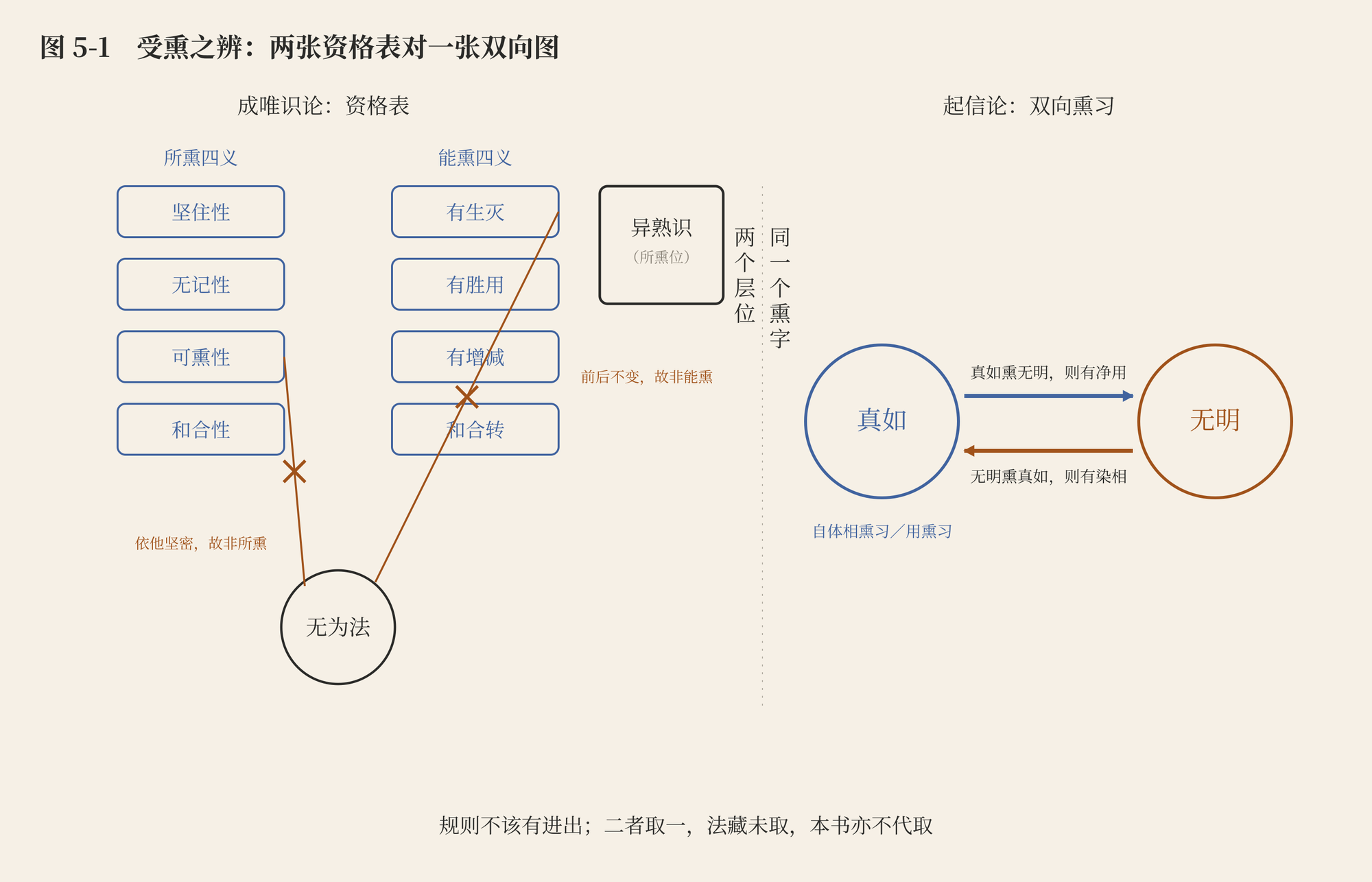
The two parties use the same word, “perfuming,” in different positions. Yogācāra's perfuming is a mechanical procedure at E2; both input and output remain within a conditioned continuum. The two qualification tables are its admission criteria. Perfuming in the Awakening of Faith spans thusness and ignorance, with one end on the unconditioned. The same name has different referents, so a single verdict of right or wrong will not settle it. The question is what job “perfuming” does in the Awakening of Faith: does it describe a mechanism or the grammar of a dependence relation?
Fazang himself is explicitly aware of the divergence. In fascicle two of the Five Teachings, the section on differences in mind and consciousness casts it as doctrinal classification. The initial teaching, “not yet having interfused true principle, says only that it remains still and does not make dharmas. Thus it establishes ālaya within the dependently arising and ceasing phenomena, its substance arising distinctly from seeds of karma and so forth.” The final teaching “obtains both meanings, principle and phenomena interfused, within this ālaya consciousness … since it allows thusness to follow perfuming and conjoin to constitute this root consciousness, unlike the preceding teaching's birth from seeds of karma and so forth.”7 “Remaining still and not making dharmas” is his characterization of Yogācāra's thusness; “following perfuming and conjoining to constitute this root consciousness” is his characterization of thusness in the Awakening of Faith. Set together, the two make the divergence into a step in the five teachings' hierarchy.
Once the step is established, Fazang immediately raises an objection to himself. This exchange is the passage in the entire essay that most deserves word-by-word reading:
Question: Since thusness is said to be a permanent dharma, how can it be said to follow perfuming in arising and ceasing? If arising and ceasing are allowed, how can it again be called still and permanent? Answer: When thusness is called permanent, this is not permanence as understood from the word. Why? When the sages call thusness still, they mean that while it follows conditions in making dharmas, it does not lose its own substance; hence it is called permanent. This permanence, which is not different from impermanence, is called inconceivable permanence. It does not mean the stillness imagined by mistaken conceptions, in which dharmas are not made.7
The move in the answer must be clear. He does not assert that thusness is permanent and can also arise and cease. He changes the meaning of permanence. When sacred teaching calls thusness still and permanent, what is permanent is its not losing its own substance while following conditions in making dharmas. This permanence is not different from impermanence and is called inconceivable permanence. The stillness imagined by attachment is the kind that does not make dharmas; that kind lies outside what the sages say. He then substantiates this with two phrases from the Śrīmālā: “‘Undefiled yet defiled’ discloses following conditions in making dharmas; ‘defiled yet undefiled’ discloses not losing its own nature while following conditions.” He concludes: “Thus the ultimate and the conventional have only two meanings, not two substances.”7
The three characters 無二體, “no two substances,” are a key piece of evidence in this chapter. If thusness and dharmas were two substances, one producing and the other produced, following conditions would be an act of production. Fazang explicitly says two meanings without two substances; following conditions and remaining unchanged thus become two descriptions of the same event. The Commentary on Its Meaning states the same point more directly: “Following perfuming, it turns and moves to constitute defilement and purity. Although defilement and purity are constituted, its nature remains unmoving. Only because it is unmoving can it constitute defilement and purity; thus the unmoving is also within the gate of movement.”5 Only because it is unmoving can it constitute defilement and purity: being unmoving is a condition for their constitution. No qualification to serve as raw material has been granted.
Fazang's own fourfold questions about thusness. Fascicle four of the Five Teachings, on the sameness and difference of the three natures, contains a discriminating exchange of questions and answers. The first gate, guarding against discriminative attachment, questions thusness formulation by formulation:
Question: Does thusness exist? Answer: No, because it follows conditions. Question: Does thusness not exist? Answer: No, because it does not change. Question: Does it both exist and not exist? Answer: No, because it has no two natures. Question: Does it neither exist nor not exist? Answer: No, because it possesses virtues.8
All four formulations are denied, and every denial gives thusness's own two meanings as its grounds. This is an unaltered use of the adjudicating machine in Essay Eighteen, Chapter Three, applied to the highest item in the school's own system. Fazang then sets up the gate of disclosing the faults of attachment, listing the faults of taking thusness as unqualifiedly existent under permanence and annihilation: “First, the fault of permanence: it would not follow conditions, would not be hidden in defilement, and would not await a revealing cause; hence it would fall into the fault of permanence.” Further, if it did not follow conditions to constitute defilement and purity, “the dharmas of defilement, purity, and so forth would have no support. Dharmas existing without support would again fall into permanence.”8
The positive formulation of the three natures' sameness and difference also appears in this fascicle: “The true has two meanings: first, unchanging; second, following conditions. The dependent has two meanings: first, seeming to exist; second, lacking nature. The imagined has two meanings: first, existing in mistaken conception; second, nonexistent in principle.” Through the true's unchanging, the dependent's lack of nature, and the imagined's nonexistence in principle, the three natures share one limit without difference: this is always the root without destroying the branches. Through thusness following conditions, the dependent seeming to exist, and the imagined existing in mistaken conception, they are also without difference: this is always the branches without moving the root. “Thus the true encompasses the deluded branches, and delusion penetrates the true source.”8 Fazang pairs this with a bright-mirror analogy: “A bright mirror displays defiled and pure things. Although it displays them, it never loses its brightness and purity. Only because it does not lose these can it display defiled and pure characteristics … Displaying pure dharmas does not increase its brightness; displaying defiled dharmas does not stain its purity.”8 The mirror's division of labor matches that of gold in the next chapter's Golden Lion, and is safer. A mirror displays images without supplying material; gold must supply material to make vessels. The material-cause reading cannot enter the mirror analogy here.
Consider three items together: the denial of all four formulations concerning thusness; the two faults incurred by attachment to existence or nonexistence; and the mirror analogy's supplying no material. All three come from Fazang himself, and all dismantle the same reading: thusness as a substance that stands independently and suffices to itself. Compare thusness point by point with Essay Eighteen's three D2 conditions, and the conclusion is clear. Fazang accepts unchanging only as permanence not different from impermanence. Following conditions directly cancels independence from anything else. The three characters “no two substances” cancel accomplishing something independently. Not one of the three holds. Thusness does not satisfy D2.
Nature-arising against nature-inclusion. The standard account locates the difference in character between the two schools' perfect teachings in purity and defilement. Tiantai's nature-inclusion holds the three thousand intrinsically present, with good and evil both included in nature; hence its doctrine of evil in nature. Huayan's nature-arising is based solely on pure function. Evil belongs on the side of deluded conditions and is left behind in returning to the source. The gate of defilement and purity in the Record of Exploring the Mysteries indeed says: “Defilement belongs to ignorance; purity belongs to nature-arising.”3
The standard account needs one addition. Under the same gate, Fazang poses another exchange that takes half the statement back:
Question: Are sentient beings and afflictions all nature-arising? Answer: They all are. Why? Because they are what is to be saved, what is to be cut off, and what is to be known. Thus there is nothing that is not nature-arising.3
Sentient beings and afflictions are all nature-arising because they are what is saved, cut off, and known. This answer includes defiled dharmas within nature-arising's scope, but as objects, not as virtues. The preceding answer had already left room for this. Fazang uses the analogy of an upturned boot worn as a hat to explain the relation between defilement and the true: “Because it goes against the true, it cannot be apart from the true; because it goes against the true, it does not belong to the true's function. It is like someone perversely wearing a boot as a hat. Turned upside down, it is still the boot, so it is not apart from the boot. Worn on the head as a hat, it is not the boot's function.”3 A boot worn on the head is still a boot, so it is not apart from the boot. That use on the head does not count as the boot's function, so it does not belong to the true's function.
The divergence can therefore be stated more precisely than in the standard account. It is not about whether nature-arising includes defilement: both schools include it. It concerns whether defilement counts as a virtue of nature. Tiantai lists evil among what belongs to nature, hence evil in nature. Huayan lists defilement as an object to be counteracted and gives it no place among nature's contents. In terms of Essay Eighteen's levels, Tiantai's three thousand is a taxonomic inventory. Good and evil occupy two slots on the same classificatory axis at E2, and nature-inclusion says the inventory is intrinsically present. Huayan confines “nature” to pure function, with defilement merely an object within its scope. Their E2 inventories are not far apart. The difference lies in the boundary they draw around “nature.”
Contemplating principle and cutting off the nine realms: a direct hearing. Later Tiantai's accumulated objections to Huayan begin at this boundary. The charge is contemplating principle and cutting off the nine realms. If the principle contemplated is solely pure, the defilement of the nine realms has no place within nature, so Buddhahood requires cutting off the nine realms first. Both sides' texts are now available, and the case can be heard in court.
First, the indictment itself. The charge appears twice in Zhili's Subcommentary on the Essentials of the Ten Gates of Nonduality. The first concerns methods of contemplation: “If one casts aside the mind of the aggregates and separately contemplates true nature, one squarely incurs the reproach of pointing one-sidedly to pure thusness, and further invites the criticism of contemplating principle and cutting off the nine realms.”9 The second identifies its target: “The name ‘numinous knowing’ is used specifically by Guifeng. It is neither disclosed through the aggregates themselves nor marked by development through cultivation. This is precisely the meaning of pointing one-sidedly to pure thusness, confining oneself to the true mind, and contemplating principle and cutting off the nine realms.”9 A final taunt says that if establishing the single word “knowing” sufficed for understanding and practice, “Tiantai would need to transmit only the General Preface to the Collected Explanations of Chan.”9 The proper sense of “cutting off” is also in the Subcommentary on the Essentials: “Afflictions and birth and death are the nine realms. Since only the mutual inclusion of the ten realms can be called perfect, how could the Buddha destroy or transform the nine? … Thus, in the perfect school, cutting off and realization, delusion and awakening, are discussed only in terms of defilement and purity, not in terms of good and evil or purity and foulness.”9 How could the Buddha destroy or transform the nine? If Buddhahood requires abolishing the nine realms, Zhili takes the meaning of perfection to have failed.
Tiantai has two legislative grounds. First, evil in nature, whose main passage appears in the Profound Meaning of Guanyin, in its discrimination of conditioning and revealing causes: “Question: Since conditioning and revealing causes have good as a virtue of nature, do they also have evil as a virtue of nature? Answer: They do.” The next question asks what icchantikas and Buddhas respectively cut off: “The icchantika entirely cuts off cultivated good, but good in nature remains; the Buddha entirely cuts off cultivated evil, but evil in nature remains.” Why can virtues of nature not be cut off? The answer states their status: “Nature's good and evil are only Dharma gates of good and evil. Nature cannot be altered; throughout the three times no one can destroy it, nor can it be cut off or demolished.” The Buddha's relation to evil is this: “Although the Buddha does not cut off evil in nature, he can penetrate evil. Through penetrating it, he is free in relation to evil … He extensively uses the Dharma gates of evil to transform and liberate sentient beings, using them all day without being defiled all day.”10 Second, the criterion for “is,” forged by the Subcommentary on the Essentials itself: “Know that our school's explanation of identity differs forever from that of other teachers. It is neither the joining of two things nor the flipping of front and back. Only when the thing itself is wholly the other can it be called identical. Why? Since afflictions and birth and death are cultivated evil, they are in their entirety the Dharma gates of evil in nature. Thus they need neither be cut off nor reversed. Other schools do not understand evil in nature … so their meaning of identity fails.”9
The specific accusation against Huayan lands on “following conditions.” The Subcommentary on the Essentials says: “Thus we know that the other school's highest perfection speaks only of nature-arising, not nature-inclusion. This deserves deep reflection.” It also records its contemporaries' shock: “When people saw me establish that principle in the distinct teaching has the meaning of following conditions, their ears were bewildered and their hearts startled.”9 An exchange preserved in the Record of the Venerable Siming's Teaching and Practice carries the move to its conclusion: “The vigorous use of the two principles, following conditions and remaining still, to distinguish the schools of nature and characteristics comes from Xianshou … In principle, following conditions is not ultimate perfection. That school itself still classifies it as the final teaching, short of the perfect. How could Tiantai's perfect be the same as its final? Know that whether remaining still or following conditions … both belong to the distinct teaching.”11 The preface to the Twenty Questions on Principle in the Distinct Teaching Following Conditions begins directly from Fazang's Commentary on the Meaning of the Awakening of Faith.11 The move must be clear. Zhili accepts in full Chapter Five's table of the divergence between stillness and following conditions. Fazang used it to assign Yogācāra to the initial teaching and place himself above it. Zhili repeats the classification, pins following conditions to the final teaching, and adds a further grade above it, making inclusion the perfect teaching. Following conditions answers how thusness relates to dharmas; inclusion answers what nature's register contains. Zhili's accusation can therefore be reformulated precisely: change only the relation without changing the entries, and the nine realms remain outside nature, leaving cutting them off as the sole route to Buddhahood.
The Diamond Scalpel case has another line of evidence, crossing the first. In establishing nature in the insentient, Zhanran uses Huayan's lever: “The doctrine of following conditions while remaining unchanged comes from the great teaching; the claim that wood and stone have no mind arises in the small school.” From this he reasons: “The myriad dharmas are thusness because it does not change; thusness is the myriad dharmas because it follows conditions. If you believe the insentient lacks Buddha-nature, does this not mean that the myriad dharmas lack thusness? … If you allow following conditions and remaining unchanged, yet still distinguish possession and nonpossession in the insentient, are you not contradicting yourself?”12 To allow following conditions and remaining unchanged while restricting Buddha-nature to the sentient is, for Zhanran, self-contradiction. Whom does this arrow strike? Chapter Five has already checked: Fazang extends the scope throughout the insentient; Chengguan narrows it. The passages in the Subcommentary Elaborating the Meaning denying awakening-nature to the insentient target precisely Zhanran's line. Thus the two cases cross. On nature-inclusion, Tiantai confronts Huayan along the whole front. On scope, Zhanran and Fazang stand together against Chengguan. Both arrows strike the same place. Contemplating principle and cutting off the nine realms explicitly names numinous knowing, used specifically by Guifeng; nature in the insentient meets the narrowing in the Subcommentary Elaborating the Meaning. Tiantai's fire lands entirely on the side of reception history; Fazang's legislation takes no hit. Zhili himself writes this into the indictment.
The verdict falls at three levels. First, the charge fails against the legislators. Fazang's gate of defilement and purity explicitly says that sentient beings and afflictions are all nature-arising, as what is saved, cut off, and known; its scope extends throughout the insentient, and following conditions does not lose its own nature. In the Huayan text, what “cutting off” operates on is deluded conditions—left behind in returning to the source, “because they are what is to be cut off.” Nowhere is the nature of the nine realms sentenced to death. Second, the charge holds against the reception history. Casting aside the mind of the aggregates, separately contemplating true nature, and numinous knowing without development through cultivation match the third and fourth generations in Chapter Five's table of shifts, item by item. As a diagnosis, contemplating principle and cutting off the nine realms is the same case history as this book's record of the turn toward a philosophy of mind. From the eighth through the eleventh centuries, the two schools wrote it down in succession. Third, both parties' legislation accepts its status as designation, and their difference resolves into two disputes over conceptual grammar. One concerns the breadth of nature's register. Tiantai records both good and evil as Dharma gates; the nature-evil text itself says “only Dharma gates of good and evil,” with “Dharma gates” serving as its own label for the level of registration. Penetrate evil without cutting it off: “penetrate” is an operative word. Huayan records only pure function, placing defilement in the position of an object. The other dispute concerns how tightly the grammar of “is” is drawn. Fazang explains it through emptiness and existence yielding place in counting ten coins; Zhili through the thing itself being wholly the other in the Subcommentary on the Essentials. The two operational definitions take opposite routes, each forming a school. Both are legislative choices within the scope of Essay Eighteen's definition-boundary clause. In neither school have the tools of sameness and difference overstepped. Registers and grammar may compete in merit; they do not warrant an ontological charge. The case closes here: directed at legislation, the charge fails; directed at reception history, it agrees with this book's verdict. The legislative examination of evil in nature itself—the full Profound Meaning of Guanyin case—belongs to the detailed exposition of Essay Twenty-One. A point-by-point treatment of the Twenty Questions on Principle in the Distinct Teaching Following Conditions and the Chapter on Reconciling Tiantai Teaching with the Awakening of Faith is recorded for that detailed exposition.
Three steps toward a philosophy of mind. After Fazang, the doctrine of nature-arising undergoes a shift that can be measured step by step: three generations of patriarchs, three sets of wording.
Fazang's wording has already been assembled: thusness is the general characteristic of defilement and purity; all four formulations receive a no; following conditions does not lose its own nature; two meanings without two substances. One further passage bears directly on what follows. The gate of extension and restriction in the Record of Exploring the Mysteries says: “In the perfect teaching, Buddha-nature and nature-arising both extend to environment and embodied being, as distinguished below. Thus Buddhahood comprises the three worlds; the bodies of lands and so forth are all Buddha bodies. Therefore, narrowly it concerns only Buddhahood; broadly it pervades the insentient.”3 The four characters 通遍非情, “pervades the insentient,” set Fazang's maximum scope for nature-arising: the insentient is included.
New words appear with Chengguan. His Commentary on the Huayan Sūtra, explaining the eighth of the ten profundities of the Buddha's domain, says: “Knowing is mind's substance. Discrimination is not true knowing, so it is not what consciousness cognizes. A momentary stirring is not true knowing either, so it is not mind's domain. Mind's substance is free of thoughts: it is not that there are thoughts to be eliminated. Hence its nature is originally pure … The single word ‘knowing’ is the gate of all mysteries. If one can empty oneself and comprehend it, one accords with the Buddha's domain.”13 The Subcommentary Elaborating the Meaning explains: “This sentence marks the point. The wisdom above was the realizing wisdom spoken of in relation to the Dharma realized. Now it speaks directly of the numinously knowing true mind, different from wood and stone, spanning both realizer and realized.” It further describes its method as “reconciling the Chan teachings of both Northern and Southern schools to communicate the sūtra's meaning,” and finally identifies the source: “‘The single word knowing is the gate of all mysteries’ is also a saying of Shuinan.”14
Three things happen at once. First, “knowing” is established alongside nature, and knowing is called mind's substance. Second, this knowing is distinguished by its difference from wood and stone, redrawing the boundary between sentient and insentient. Third, the sentence comes from Chan: Chengguan identifies the source himself, and the whole passage is written to reconcile the Northern and Southern schools.
The third has a direct consequence. Fascicle fifty-one of the Subcommentary Elaborating the Meaning contains a passage expressly intended to block the doctrine that all insentient things have Buddha-nature. Against those who argue for one shared nature in the insentient on the ground that thusness's own substance pervades everywhere, Chengguan judges that they “take identity too far, losing the distinction between sentient and insentient and destroying nature and characteristics.” He asks: “If the Nirvāṇa Sūtra's emptiness of the ultimate meaning encompasses both mind and objects, why does that sūtra distinguish tiles and rubble and say they lack the nature?” His own correct meaning is that “nature and characteristics are neither identical nor different, and sentient and insentient are also neither identical nor different.”14 Fascicle eighty is more categorical. Although Huayan speaks of the insentient attaining Buddhahood, this is an expression of the interfusion of nature and characteristics: “It does not mean that the insentient also has an awakening-nature and attains Buddhahood like the sentient. If its Buddhahood were allowed, this would entail its ability to cultivate causes. The insentient would turn sentient, and the sentient insentient, amounting to a wrong view.”14
Set Fazang's “pervades the insentient” beside Chengguan's “does not mean that the insentient also has an awakening-nature,” and the difference is plain. Its source can be reckoned precisely. If the nature of nature-arising is simply the principle of naturelessness, pervading the insentient presents no difficulty: principle does not select its objects. If “knowing” is added to that nature, knowing needs a knower, and the insentient is immediately pushed out. By taking numinous knowing, Chengguan gives up Fazang's maximum scope. This exchange is the most concrete measurement of intellectual history that the chapter can offer.
Zongmi goes a step further. The fifth teaching in his Inquiry into the Origin of Humanity, the One Vehicle teaching that discloses nature, opens: “All sentient beings have the true mind of original awakening, permanently abiding and pure from beginningless time, brilliantly undimmed, clearly and constantly knowing. It is also called Buddha-nature, also called tathāgatagarbha.”15 The section reconciling root and branches begins: “At first there is only one true numinous nature, neither arising nor ceasing, neither increasing nor decreasing, unchanging and unaltered. Sentient beings have slept in delusion from beginningless time, unaware of themselves. Because it is concealed, it is called tathāgatagarbha. In dependence on tathāgatagarbha, there are the characteristics of an arising-and-ceasing mind.” At the section's opening, another statement declares its position: “Although true nature is the root of the body, its arising has causes and reasons; bodily characteristics cannot suddenly form without cause.” Near the end comes “arising in reliance on the true.”15
The three generations' wording, side by side:
| Patriarch | Wording for nature | Wording for permanence | Scope |
|---|---|---|---|
| Fazang | Thusness as the general characteristic of defilement and purity; no to all four formulations; two meanings without two substances | Permanence not different from impermanence, called inconceivable permanence | Pervades the insentient |
| Chengguan | Knowing is mind's substance; the numinously knowing true mind differs from wood and stone | Mind's substance is free of thoughts; its nature is originally pure | Sentient and insentient are neither identical nor different; the insentient does not attain Buddhahood like the sentient |
| Zongmi | The true mind of original awakening; one true numinous nature | Permanently abiding and pure, clearly and constantly knowing, unchanging and unaltered | Sentient beings |
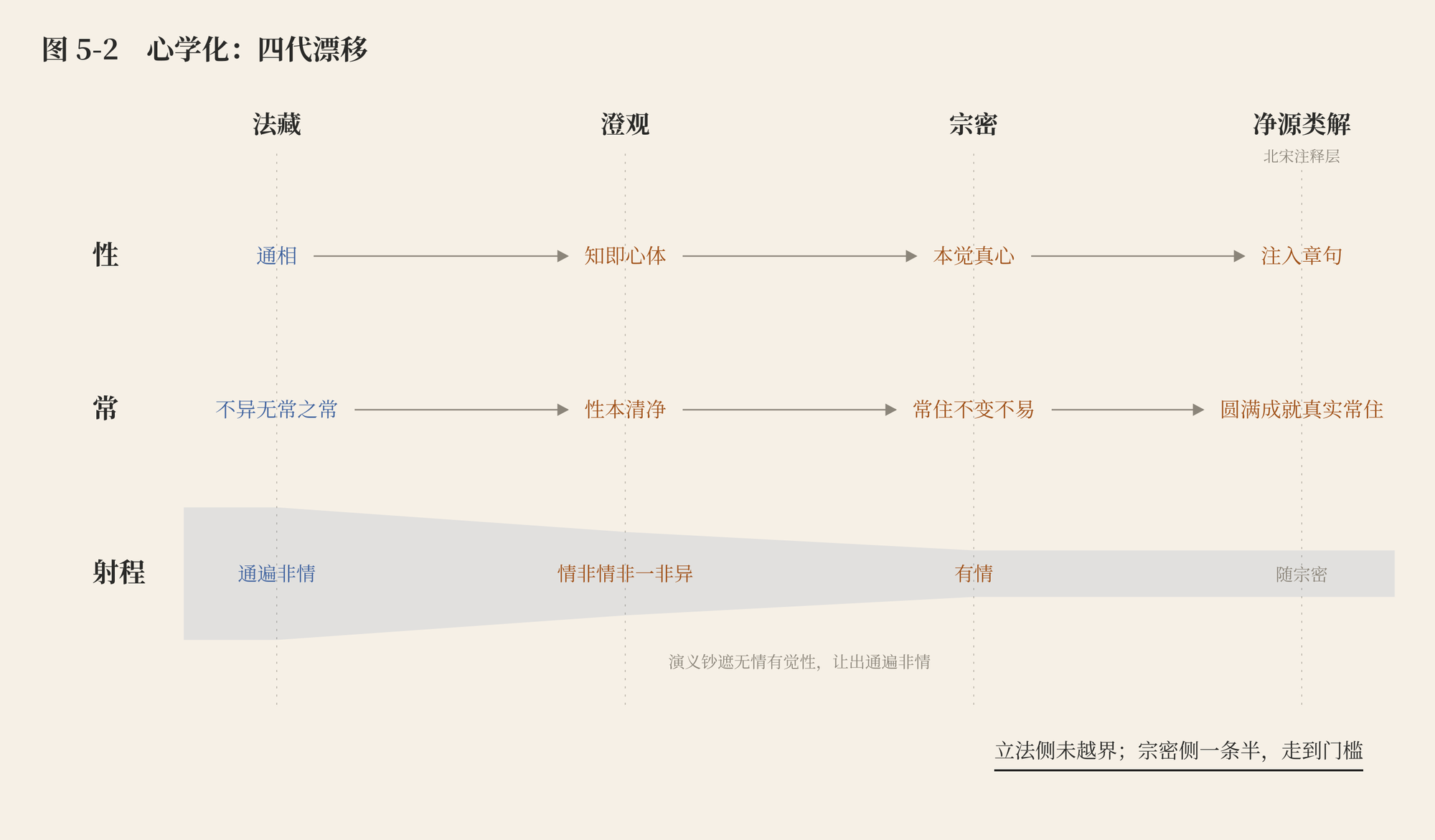
The direction of the shift is consistent. Nature moves from a general characteristic to mind's substance, from the principle of naturelessness to numinous knowing. Permanence moves from permanence not different from impermanence to permanent abiding, unchanging and unaltered. Scope contracts from pervading the insentient to sentient beings. Check again against Essay Eighteen's three D2 conditions. Fazang satisfies none, as verified in the preceding section. On Zongmi's side, the phrase “unchanging and unalterable” explicitly states the second condition; he still does not state the first and third. “Although true nature is the root of the body” gives it the position of a root, but “its arising has causes and reasons” simultaneously says that the root does not accomplish things alone; causes and reasons are needed. Zongmi therefore scores one and a half conditions, short of three. One sentence characterizes the result: Huayan's legislators have not crossed the boundary; its reception history has reached the threshold.
Examination in theorem form: the essay's second main verdict. The two readings diverge at the conjunction sentence of the Awakening of Faith and at “following conditions.”
The evidence for the conditional reading, item by item:
| Evidence | Source | What it establishes |
|---|---|---|
| Although arising gathers conditions, conditions necessarily lack nature; the principle of naturelessness is disclosed at their site | Third meaning in the gate of definition, Record of Exploring the Mysteries | Arising is assigned to manifestation, not production |
| Each gate comprehensively contains all dharmas; each constitutes it in its entirety | Awakening of Faith and Commentary on Its Meaning | One set of dharmas, registered at two levels |
| General and particular characteristics; fine particles and earthenware mutually contain each other | Commentary on Its Meaning | Thusness is a class-level term |
| No to all four formulations concerning thusness | Five Teachings, fascicle four | Thusness accepts no placement under the four formulations |
| Two meanings without two substances | Five Teachings, fascicle two | Following conditions and remaining unchanged are different descriptions of the same event |
| Only because it is unmoving can it constitute defilement and purity | Commentary on Its Meaning | Being unmoving occupies the position of a condition |
| A bright mirror displays defilement and purity without increase or stain | Five Teachings, fascicle four | Display without supplying material |
| Thusness does not hold to own-nature | Classified Explanation of the Golden Lion; see the next chapter | A clause against own-nature written by the legislative side itself |
The evidence for the production reading, also listed in full:
| Evidence | Source | What it points to |
|---|---|---|
| It can contain all dharmas and produce all dharmas | Awakening of Faith, gate of arising and ceasing | Explicit production wording |
| Defiled and pure dharmas have no substance of their own and depend on the true for establishment | Five Teachings, fascicle four | Asymmetry of dependence |
| Arising and ceasing necessarily depend on the true; thusness need not depend on arising and ceasing | Commentary on Its Meaning | A positive statement of asymmetrical dependence |
| As gold makes a ring: the ring is insubstantial, the gold real; it is solely gold arising | Record of Exploring the Mysteries, gate of interfusion and inclusion | An analogy of material cause |
| Although true nature is the root of the body; arising in reliance on the true | Inquiry into the Origin of Humanity | The wording of root and arising |
Weighing the two tables together yields three judgments.
First, the evidence for the production reading concentrates on analogy and asymmetry; that for the conditional reading, on definition and the four formulations. An analogy can bear only limited weight. The next chapter will extract the antidote accompanying the gold analogy. Asymmetry alone does not establish a substrate. The dependence between general and particular characteristics is already asymmetrical: a class does not depend on instances for establishment; an instance must be stated through a class. This is asymmetry between levels of registration. Explaining it through a substrate is an additional step.
Second, the branching point can be fixed on one word: arising. Read it as manifestation, and all the evidence for production can be reformulated conditionally. Read it as production, and thusness simultaneously occupies two forbidden positions in Essay Eighteen: E3 substrate and productive cause. Fazang has defined arising in the gate of definition, and his definition is manifestation. The verdict on the textual side can therefore be delivered: in its legislator's wording, nature-arising is a legitimate term within conditional vocabulary.
Third, the opening remains, and it is this essay's weightiest. The criterion in Essay Eighteen, Chapter Seven, applies: what says nothing of an object yet cannot be discarded is a rule; what says nothing of an object and can be discarded is merely empty talk. If thusness is only the principle of naturelessness, it falls on the indispensable side. It is a rule, pointing in the same direction as the preservation theorem. Yet the perfuming section of the Awakening of Faith places thusness in a mechanism with inputs and outputs, occupying both positions, perfumer and recipient. That position can be discarded: an account speaking only of manifestation and removal of obstacles would still work without it. A rule should have no inputs or outputs; something with inputs and outputs should not serve as a rule. Here lies the real difficulty in the dispute over receiving perfuming. If “perfuming” is taken seriously as a mechanism, thusness must have a changeable side. Essay Eighteen's prohibition on wording immediately applies: emptiness and thusness belong to the same category, fit only for preserving, enabling, and supporting, not for giving or producing. If “perfuming” is merely a metaphor for the grammar of dependence, the entire bidirectional structure of the Awakening of Faith's perfuming section loses its substantive referent and remains only a manner of speaking. One of the two must be chosen. Fazang did not choose; this book will not choose for him.
Draft verdict: nature-arising is a legitimate term within conditional vocabulary, on four grounds: the third meaning in the gate of definition, the comprehensive containment by each of the two gates, the fourfold questioning of thusness, and two meanings without two substances. Principle is a rule; the substrate reading has no warrant. The criterion in Essay Eighteen, Chapter Seven, applies. One question remains open, at the word “perfuming” in the dispute over receiving perfuming. Two readings coexist and the text does not choose. This is marked as the first point for expansion in the detailed exposition, with materials available in the Commentary on the Meaning of the Awakening of Faith and the commentaries of Chengguan and Zongmi. The turn toward a philosophy of mind is registered as a shift on the side of reception history. The table above compares three generations' wording: the legislators have not crossed the boundary; Zongmi has reached the threshold. Huayan's clause against own-nature appears in the next chapter, in one sentence of the Classified Explanation of the Golden Lion: thusness does not hold to own-nature. A thusness that cannot hold to own-nature cannot serve as a D2 substrate. This is another door closed by the legislative side's own hand. These findings pass to Chapter Seven.
References
References
-
Record of Exploring the Mysteries of the Huayan Sūtra, fascicle sixteen (T35, no. 1733, pp. 405a11–b28; by Fazang), explaining the chapter on the nature-arising of the Jewel-King Tathāgata: “The tathāgatagarbha chapter of the Treatise on Buddha-Nature says: ‘Coming from the stage of abiding in one's own nature to attainment of the fruit, one is called Tathāgata.’ What does not change is called nature; the disclosure of function is called arising. This is the arising of the Tathāgata's nature. Again, true principle is called ‘thus’ and ‘nature’; the disclosure of function is called ‘arising’ and ‘coming.’ Thus the Tathāgata is nature-arising.” Ten gates of doctrinal purport: “First, differentiated aspects; second, dependence and support; third, interfusion and inclusion; fourth, virtues of nature; fifth, definition; sixth, defilement and purity; seventh, cause and result; eighth, extension and restriction; ninth, limits; tenth, establishment.” Gate of differentiated aspects: “Nature has three kinds: principle, practice, and fruit. Arising also has three … The arising of fruit-nature means that this fruit-nature has no separate substance: it is that principle and practice, together with what cultivation produces, combined as fruit-nature when the stage of fruition is reached. Its transformative function responding to capacities is called arising.” The four meanings in the gate of definition: “First, the fruit-ocean's own substance has an unspeakably unspeakable nature. Responsive capacities have the full conditions, and arising is explained in relation to conditions. Once arisen, it turns away from conditions and accords with its own nature; therefore conditions are set aside and it is called only nature-arising. Second, nature's substance cannot be spoken; if it is spoken, that is called arising … Third, although arising gathers conditions, conditions necessarily lack nature. The principle of naturelessness is disclosed at the site of conditions; therefore, in terms of disclosure, it is called only nature-arising, as in ‘all dharmas are established from the root of nonabiding,’ and so forth. Fourth, if what arises resembles the characteristics of those conditions, it belongs to dependent origination. What is said to arise here is based solely on pure function, according with realization of true nature, and thus belongs to nature-arising.” ↩↩↩↩↩
-
Great Expanded Buddha Huayan Sūtra, fascicle fifty-one, chapter on the Tathāgata's appearance (T10, no. 279, pp. 272c4–273a1, 273b19–20; translated by Śikṣānanda), tenth aspect of the Tathāgata's mind: “The Tathāgata's wisdom reaches everywhere. Why? There is no sentient being who does not possess the Tathāgata's wisdom. Only because of deluded conceptions, inversions, and attachments do they fail to realize it. If they leave deluded conceptions behind, all-knowing wisdom, natural wisdom, and unobstructed wisdom become present.” Great sūtra scroll analogy: “Suppose there were a great sūtra scroll equal in size to a three-thousand-great-thousand world-system, recording everything in that world-system without omission … This great sūtra scroll, although equal in size to the great-thousand world-system, is wholly contained within a single speck of dust … He then devises a skillful means, breaks open that speck, brings out this great sūtra, and lets all sentient beings receive its benefit.” Application: “The Tathāgata's wisdom is likewise immeasurable and unobstructed, able to benefit all sentient beings universally, fully present within the bodies of sentient beings. Yet ordinary fools, through deluded conceptions and attachments, neither know nor awaken to it and receive no benefit.” “I shall teach them the noble path, enabling them forever to leave deluded conceptions and attachments behind, and within their own bodies see the Tathāgata's vast wisdom, no different from the Buddha's.” Verse: “The Buddha's wisdom is likewise / everywhere in sentient beings' minds; / entangled by deluded conceptions, / they neither awaken to it nor know it.” ↩↩
-
Record of Exploring the Mysteries of the Huayan Sūtra, fascicle sixteen (T35, no. 1733, pp. 405b4–406a1, 411c10–25). Gate of interfusion and inclusion: “Since practice arises in dependence on principle, practice is insubstantial and nature is real. When the insubstantial is exhausted and the real appears, arising is solely nature-arising … As gold makes a ring and so forth: the ring is insubstantial, the gold real; it is solely gold arising.” Gate of defilement and purity: “Defilement belongs to ignorance; purity belongs to nature-arising.” “Because it goes against the true, it cannot be apart from the true; because it goes against the true, it does not belong to the true's function. It is like someone perversely wearing a boot as a hat. Turned upside down, it is still the boot, so it is not apart from the boot. Worn on the head as a hat, it is not the boot's function.” “Question: Are sentient beings and afflictions all nature-arising? Answer: They all are. Why? Because they are what is to be saved, what is to be cut off, and what is to be known. Thus there is nothing that is not nature-arising.” Gate of extension and restriction: “In the perfect teaching, Buddha-nature and nature-arising both extend to environment and embodied being, as distinguished below. Thus Buddhahood comprises the three worlds; the bodies of lands and so forth are all Buddha bodies. Therefore, narrowly it concerns only Buddhahood; broadly it pervades the insentient.” Explaining the analogy of a speck containing a sūtra scroll: “The wisdom of Buddhahood does not differ from original awakening as the causal nature within sentient beings. Thus the cause within entanglement possesses the dharmas of the fruit outside entanglement. Cause and result are nondual in the perfect teaching; this meaning is not found in the other sacred teachings.” “Since it says there is no sentient being's body in which the Tathāgata's wisdom is not complete, we know that if there were one in whom it was not complete, that one would not count as a sentient being. How could there further be sentient beings without the nature? If all possess it, why do they not know? The explanation is: because of inversion. If, through inversion, they do not know, how is its existence known? The explanation is: if it did not exist beforehand, where could it be obtained when inversion is left behind? Since it says that wisdom arises when inversion is left behind, we clearly know that it is not absent.” “Deluded thoughts have no substance and are as minute as dust; the virtues of nature are complete like the great sūtra scroll; delusion covers the true as dust conceals the sūtra.” ↩↩↩↩↩↩
-
Mahāyāna Awakening of Faith (T32, no. 1666, pp. 576a4–b10, 578a14–b20; translated by Paramārtha): “To disclose the correct meaning: on the basis of the dharma of one mind, there are two gates. What are the two? First, the gate of mind as thusness; second, the gate of mind as arising and ceasing. Each of these two gates comprehensively contains all dharmas. What does this mean? These two gates are inseparable.” “As for mind's arising and ceasing, there is an arising-and-ceasing mind in dependence on the tathāgatagarbha. The conjunction of what neither arises nor ceases with what arises and ceases, neither identical nor different, is called ālaya consciousness. This consciousness has two meanings: it can contain all dharmas and produce all dharmas.” Perfuming section: “Further, through the perfuming of four kinds of dharma, defiled and pure dharmas arise without interruption. What are the four? First, the pure dharma, called thusness. Second, the cause of all defilement, called ignorance. Third, the deluded mind, called karmic consciousness. Fourth, deluded objects, namely the six sensory objects. Perfuming means this: worldly clothing has no fragrance in itself, but if someone perfumes it with incense, it acquires a fragrance. This is likewise. Thusness, the pure dharma, has no defilement in itself, but through perfuming by ignorance it has defiled characteristics. Ignorance, the defiled dharma, has no pure karma in itself, but through perfuming by thusness it has pure function.” “Because there is the cause of the defiled dharma of ignorance, it perfumes thusness.” “Because there is the dharma of thusness, it can perfume ignorance.” “Perfuming by thusness has two meanings. What are the two? First, perfuming by its own substance and characteristics; second, perfuming by function.” ↩↩↩↩
-
Commentary on the Meaning of the Mahāyāna Awakening of Faith, fascicle two (T44, no. 1846, pp. 251b25–252b5; by Fazang): “At the outset, ‘one mind’ means one tathāgatagarbha mind containing two meanings. First, the meaning of substance beyond characteristics: this is the gate of thusness … Second, the meaning of arising and ceasing in accordance with conditions: this is the gate of arising and ceasing. Following perfuming, it turns and moves to constitute defilement and purity. Although defilement and purity are constituted, its nature remains unmoving. Only because it is unmoving can it constitute defilement and purity; thus the unmoving is also within the gate of movement.” “The gate of thusness is the general characteristic of defilement and purity. Outside the general characteristic there is no separate defilement or purity, so it can contain them comprehensively. As fine particles are the general characteristic of earthenware vessels, there are no separate vessels outside that general characteristic; all vessels are contained in the fine particles.” “The gate of arising and ceasing is the particular characteristic of defilement and purity. Dharmas of particular characteristics are contained in arising and ceasing. Further, this is thusness conjoining with conditions and transforming into dharmas. Since dharmas have no different substance, they in turn contain the gate of thusness, as earthenware vessels contain fine particles. Since these two gates equally contain all and are nondual, they can be called one mind.” “Thusness is the gate of effacing characteristics and disclosing the real … Arising and ceasing is the gate of gathering principle to constitute phenomena … Since arising and ceasing necessarily depend on the true, principle is gathered without being lost. Since thusness need not depend on arising and ceasing, characteristics are effaced without being retained.” “One dharmadhātu means that the nondual true mind is one dharmadhātu. This is not the one of arithmetic.” “This one dharmadhātu in its entirety constitutes the arising-and-ceasing gate, and in its entirety constitutes the thusness gate.” ↩↩↩↩↩
-
Establishment of Consciousness-Only, fascicle two (T31, no. 1585, pp. 9c12–21; translated by Xuanzang). Third condition for receiving perfuming: “Perfumability. If a dharma is autonomous, is not rigid in nature, and can receive habitual impressions, it is a recipient of perfuming. This excludes mental factors and unconditioned dharmas: dependent on others and rigid respectively, they are not recipients of perfuming.” Supplementary discussion under the second condition: “Thus the Tathāgata's pure eighth consciousness carries only old seeds and does not newly receive perfuming.” First condition for perfuming: “Arising and ceasing. If a dharma is impermanent, can function, and can grow habitual impressions, it is a perfumer. This excludes the unconditioned, unchanged before and after and without a function of growth, so it is not a perfumer.” The full eight conditions are quoted in Essay Twenty, Chapter Three. ↩
-
Treatise on the Divisions of the Teaching and Meaning of the Huayan One Vehicle, fascicle two (T45, no. 1866, pp. 484c13–485a18; by Fazang), first distinction among what the teachings expound, differences in mind and consciousness: “According to the initial teaching, only the arising-and-ceasing meaning of ālaya consciousness is obtained. Not yet having interfused true principle, it says only that it remains still and does not make dharmas. Thus it establishes ālaya within the dependently arising and ceasing phenomena, its substance arising distinctly from seeds of karma and so forth.” “According to the final teaching, both meanings, principle and phenomena interfused, are obtained within this ālaya consciousness. Thus the treatise says only: the conjunction of what neither arises nor ceases with what arises and ceases, neither identical nor different, is called ālaya consciousness. It allows thusness to follow perfuming and conjoin to constitute this root consciousness, unlike the preceding teaching's birth from seeds of karma and so forth.” Questions and answers: “Question: Since thusness is said to be a permanent dharma, how can it be said to follow perfuming in arising and ceasing? If arising and ceasing are allowed, how can it again be called still and permanent? Answer: When thusness is called permanent, this is not permanence as understood from the word. Why? When the sages call thusness still, they mean that while it follows conditions in making dharmas, it does not lose its own substance; hence it is called permanent. This permanence, which is not different from impermanence, is called inconceivable permanence. It does not mean the stillness imagined by mistaken conceptions, in which dharmas are not made. Thus the Śrīmālā says: ‘undefiled yet defiled’ discloses following conditions in making dharmas; ‘defiled yet undefiled’ discloses not losing its own nature while following conditions. Through the first meaning, conventional truth is established; through the second, ultimate truth is established. Thus the ultimate and the conventional have only two meanings, not two substances.” ↩↩↩
-
Treatise on the Divisions of the Teaching and Meaning of the Huayan One Vehicle, fascicle four (T45, no. 1866, pp. 499a13–500b24), first division of meaning and principle, sameness and difference of the three natures: “The true has two meanings: first, unchanging; second, following conditions. The dependent has two meanings: first, seeming to exist; second, lacking nature. The imagined has two meanings: first, existing in mistaken conception; second, nonexistent in principle. Through the true's unchanging, the dependent's lack of nature, and the imagined's nonexistence in principle—through these three meanings—the three natures share one limit without difference. This is always the root without destroying the branches … Again, through thusness following conditions, the dependent seeming to exist, and the imagined existing in mistaken conception—through these three meanings—they are also without difference. This is always the branches without moving the root … Thus the true encompasses the deluded branches, and delusion penetrates the true source.” Bright-mirror analogy: “A bright mirror displays defiled and pure things. Although it displays them, it never loses its brightness and purity. Only because it does not lose these can it display defiled and pure characteristics … Displaying pure dharmas does not increase its brightness; displaying defiled dharmas does not stain its purity.” Gate of guarding against discriminative attachment: “Question: Does thusness exist? Answer: No, because it follows conditions. Question: Does thusness not exist? Answer: No, because it does not change. Question: Does it both exist and not exist? Answer: No, because it has no two natures. Question: Does it neither exist nor not exist? Answer: No, because it possesses virtues.” Gate of disclosing the faults of attachment: “If one takes thusness as unqualifiedly existent, there are two faults. First, the fault of permanence: it would not follow conditions, would not be hidden in defilement, and would not await a revealing cause; hence it would fall into the fault of permanence.” “Further, if it did not follow conditions to constitute defilement and purity, the dharmas of defilement, purity, and so forth would have no support. Dharmas existing without support would again fall into permanence, since defiled and pure dharmas have no substance of their own and depend on the true for establishment.” ↩↩↩↩
-
Subcommentary on the Essentials of the Ten Gates of Nonduality (T46, no. 1928, pp. 707a28–b21, 709c18–20, 713b24–c3, 715c1–4; by Zhili). Upper fascicle: “Know that our school's explanation of identity differs forever from that of other teachers. It is neither the joining of two things nor the flipping of front and back. Only when the thing itself is wholly the other can it be called identical. Why? Since afflictions and birth and death are cultivated evil, they are in their entirety the Dharma gates of evil in nature. Thus they need neither be cut off nor reversed. Other schools do not understand evil in nature, so they must turn evil into good and cut off evil to realize good … Since they cannot take evil in its entirety as evil, their meaning of identity fails.” “Afflictions and birth and death are the nine realms. Since only the mutual inclusion of the ten realms can be called perfect, how could the Buddha destroy or transform the nine? Only thus can one be said to penetrate the nonpath, with Māra's realm being the Buddha. Thus, in the perfect school, cutting off and realization, delusion and awakening, are discussed only in terms of defilement and purity, not in terms of good and evil or purity and foulness.” “If one casts aside the mind of the aggregates and separately contemplates true nature, one squarely incurs the reproach of pointing one-sidedly to pure thusness, and further invites the criticism of contemplating principle and cutting off the nine realms.” Lower fascicle: “The name ‘numinous knowing’ is used specifically by Guifeng. It is neither disclosed through the aggregates themselves nor marked by development through cultivation. This is precisely the meaning of pointing one-sidedly to pure thusness, confining oneself to the true mind, and contemplating principle and cutting off the nine realms.” “Tiantai would need to transmit only the General Preface to the Collected Explanations of Chan.” “Thus we know that the other school's highest perfection speaks only of nature-arising, not nature-inclusion. This deserves deep reflection.” “When people saw me establish that principle in the distinct teaching has the meaning of following conditions, their ears were bewildered and their hearts startled.” ↩↩↩↩↩↩
-
Profound Meaning of Guanyin, upper fascicle (T34, no. 1726, pp. 882c8–22; taught by Zhiyi, recorded by Guanding), discrimination of conditioning and revealing causes: “Question: Since conditioning and revealing causes have good as a virtue of nature, do they also have evil as a virtue of nature? Answer: They do.” “Question: What good and evil do icchantikas and Buddhas cut off? Answer: The icchantika entirely cuts off cultivated good, but good in nature remains; the Buddha entirely cuts off cultivated evil, but evil in nature remains.” “Nature's good and evil are only Dharma gates of good and evil. Nature cannot be altered; throughout the three times no one can destroy it, nor can it be cut off or demolished.” “Although the Buddha does not cut off evil in nature, he can penetrate evil. Through penetrating it, he is free in relation to evil, and so is not defiled by evil; cultivated evil cannot arise … Through this freedom, he extensively uses the Dharma gates of evil to transform and liberate sentient beings, using them all day without being defiled all day.” ↩
-
Record of the Venerable Siming's Teaching and Practice (T46, no. 1937, pp. 871c17–21, 874c12–14; compiled by Zongxiao). Exchange preserved in fascicle two: “The vigorous use of the two principles, following conditions and remaining still, to distinguish the schools of nature and characteristics comes from Xianshou; no such passage is found in Tiantai. In principle, following conditions is not ultimate perfection. That school itself still classifies it as the final teaching, short of the perfect. How could Tiantai's perfect be the same as its final? Know that whether remaining still or following conditions, insofar as they retain expedient means, both belong to the distinct teaching.” Fascicle three, Twenty Questions on Principle in the Distinct Teaching Following Conditions, with preface: “A scholar of our school asked me: ‘In the Subcommentary on the Essentials, do you establish that thusness in the distinct teaching has the meaning of following conditions?’ I said: ‘Yes.’ The guest said: ‘Master Fazang wrote a commentary explaining the Awakening of Faith, specifically establishing the two meanings of thusness, unchanging and following conditions …’” ↩↩
-
Diamond Scalpel (T46, no. 1932, pp. 782c16–26; by Zhanran): “The doctrine of following conditions while remaining unchanged comes from the great teaching; the claim that wood and stone have no mind arises in the small school.” “Thus you should know: the myriad dharmas are thusness because it does not change; thusness is the myriad dharmas because it follows conditions. If you believe the insentient lacks Buddha-nature, does this not mean that the myriad dharmas lack thusness? How could the term ‘myriad dharmas’ exclude even a speck of dust? How could the substance of thusness belong exclusively to self and other?” “If you allow following conditions and remaining unchanged, yet still distinguish possession and nonpossession in the insentient, are you not contradicting yourself?” ↩
-
Commentary on the Great Expanded Buddha Huayan Sūtra, fascicle fifteen (T35, no. 1735, pp. 612b28–c4; by Chengguan), explaining the eighth of the ten profundities in the chapter of the bodhisattvas' questions and clarifications: “Knowing is mind's substance. Discrimination is not true knowing, so it is not what consciousness cognizes. A momentary stirring is not true knowing either, so it is not mind's domain. Mind's substance is free of thoughts: it is not that there are thoughts to be eliminated. Hence its nature is originally pure. Sentient beings possess it equally, but some are obscured and do not know; therefore the Buddha discloses it so that all may awaken and enter. Since it is function identical with substance, the question is put in terms of knowing; since it is substance identical with function, the answer is given in terms of purity of nature. The single word ‘knowing’ is the gate of all mysteries. If one can empty oneself and comprehend it, one accords with the Buddha's domain.” ↩
-
Subcommentary Elaborating the Meaning of the Commentary on the Great Expanded Buddha Huayan Sūtra (T36, no. 1736, pp. 261b15–262a6, 400a18–b2, 628a18–21; by Chengguan). Fascicle thirty-four, explaining the preceding commentary passage: “The commentary's ‘eighth, knowing is mind's substance’: this sentence marks the point. The wisdom above was the realizing wisdom spoken of in relation to the Dharma realized. Now it speaks directly of the numinously knowing true mind, different from wood and stone, spanning both realizer and realized.” “From the commentary's ‘discrimination is not true knowing’ onward, the Chan teachings of both Northern and Southern schools are reconciled to communicate the sūtra's meaning. This sentence removes the Southern school's malady.” “‘The single word knowing is the gate of all mysteries’ is also a saying of Shuinan.” Fascicle fifty-one, excluding nature in the insentient: “This passage of the commentary blocks the mistaken attachment to the doctrine that all insentient things have Buddha-nature … If one speaks of the insentient as sharing one nature, one is somewhat closer to the school's meaning, but must still grasp the point. That position originally appeals to the pervasion of thusness's own substance, so that true nature is not two … I now say that this explanation takes identity too far, losing the distinction between sentient and insentient and destroying nature and characteristics. If the Nirvāṇa Sūtra's emptiness of the ultimate meaning encompasses both mind and objects, why does that sūtra distinguish tiles and rubble and say they lack the nature? … Now the correct meaning is directly disclosed: nature and characteristics are neither identical nor different, and sentient and insentient are also neither identical nor different.” Fascicle eighty: “Thus it is said that when one attains, all attain. It does not mean that the insentient also has an awakening-nature and attains Buddhahood like the sentient. If its Buddhahood were allowed, this would entail its ability to cultivate causes. The insentient would turn sentient, and the sentient insentient, amounting to a wrong view.” ↩↩↩
-
Inquiry into the Origin of Humanity (T45, no. 1886, pp. 710a11–14, 710b3–12; by Zongmi), third section, directly disclosing the true source: “Fifth, the One Vehicle teaching that discloses nature says that all sentient beings have the true mind of original awakening, permanently abiding and pure from beginningless time, brilliantly undimmed, clearly and constantly knowing. It is also called Buddha-nature, also called tathāgatagarbha. From beginningless time, deluded characteristics have obscured it, and they have not been aware of it themselves …” The scriptural evidence cited is the two passages from the chapter on the Tathāgata's appearance quoted above. Fourth section, reconciling root and branches: “Although true nature is the root of the body, its arising has causes and reasons; bodily characteristics cannot suddenly form without cause.” “At first there is only one true numinous nature, neither arising nor ceasing, neither increasing nor decreasing, unchanging and unaltered. Sentient beings have slept in delusion from beginningless time, unaware of themselves. Because it is concealed, it is called tathāgatagarbha. In dependence on tathāgatagarbha, there are the characteristics of an arising-and-ceasing mind. The conjunction of the true mind that neither arises nor ceases with deluded conceptions that arise and cease, neither identical nor different, is called ālaya consciousness.” “Arising in reliance on the true.” ↩↩