Chapter 7: Restraint and the Vacancies
What this chapter sets out to do. The preceding six chapters kept a running register; this chapter settles the account. The registered items fall into two groups. One consists of places where the system plainly could have taken one more step and did not: these are its acts of restraint. The other consists of places it cannot avoid leaving open: these are its vacancies. This chapter argues that the two groups overlap. Wherever the system stops, an unfilled position usually lies just beyond. Wherever it necessarily leaves a position empty, looking back reveals the very place where it earlier declined to reach. Chapter 1 established a standard for evaluating the system: where all four defining columns can be filled, there is phenomenology; where they cannot be filled but are filled anyway, there is metaphysics. This chapter concerns a third case: the columns cannot be filled, and the system does not fill them.
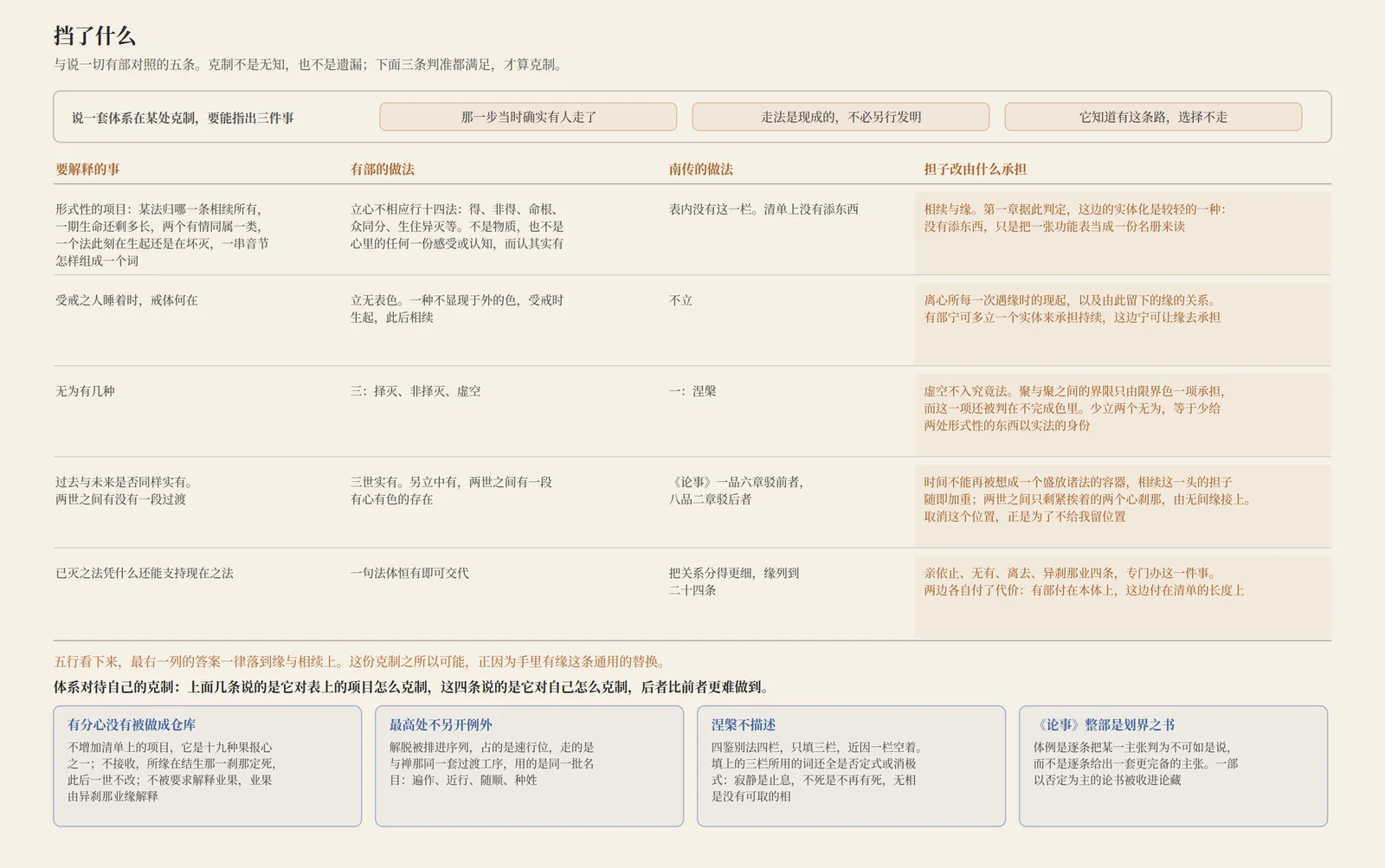
First, confine the meaning of “restraint.” Restraint is neither ignorance nor omission. To say that a system exercised restraint at a certain point, three things must be shown: someone at the time really did take that step; a ready-made route existed and did not have to be invented; and the system knew of the route and chose not to take it. Only where all three conditions are met does “restraint” apply. Whenever Part 14 speaks of Theravāda restraint, the frame of comparison is the one given in Chapter 1: Sarvāstivāda. The two schools have different inventories (eighty-two items in Theravāda and seventy-five in Sarvāstivāda), and more than half of the difference lies in the categories of materiality and of formations dissociated from consciousness.1 Those are precisely the two categories in which the schools differed over whether formal items should be established as phenomena. Every step taken by Sarvāstivāda was an option visible to Theravāda at the time. Only against that comparison can this inventory of restraint stand.
Restraint at the entrance. The first act of restraint is written into the program itself: the distinction between ultimate phenomena and concepts. Anything that can be discussed only as a whole and cannot be separately discerned at any moment is excluded from the table. Persons, vehicles, houses, directions, and shapes all remain on the side of concepts. This rule governs the entrance to the inventory, and governs it strictly. At one stroke it blocks most of the names used in the everyday world, including the concept “I.” It is unusual among the schools for a system claiming to enumerate everything that exists to establish such a threshold at the entrance. Chapter 3 applied the criterion concretely to materiality: can an item be separately taken as an object of insight contemplation? Chapter 4 used the same criterion. The most powerful test employed throughout this Part comes from this act of restraint.
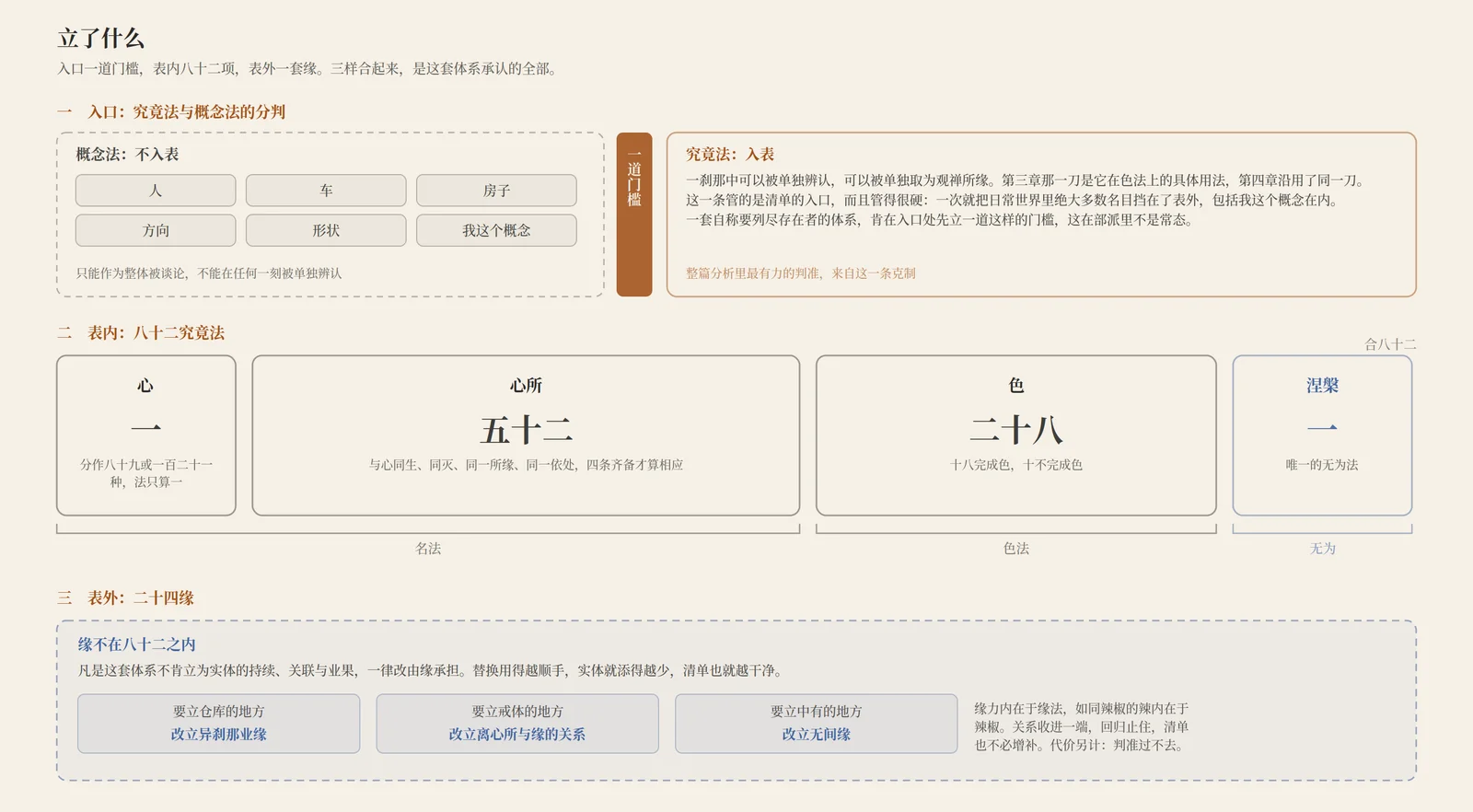
Restraint within the inventory. Once the entrance has been guarded, we can examine what the system does and does not add inside the table.
First, there is no category of formations dissociated from consciousness. The term should be unpacked before proceeding. “Formations” means conditioned constructions: everything conditioned that belongs neither to materiality nor to consciousness and its factors is gathered into this category. “Association” is a technical term in this system, meaning that two phenomena arise together, cease together, share one object, and share one base—the very relation between mental factors and consciousness. The sections below use the term in this sense. Taken together, formations dissociated from consciousness are things that are neither material nor any feeling or cognition in the mind, but that Sarvāstivāda nevertheless treats as real and arising and ceasing through conditions. In modern terms, the category contains formal items: which continuum a phenomenon belongs to, how much of a life remains, the fact that two beings belong to the same class, whether a phenomenon is now arising or breaking up, and how a sequence of syllables composes a word. Sarvāstivāda establishes fourteen such phenomena within the aggregate of formations, including acquisition, non-acquisition, life faculty, commonality, arising, duration, alteration, and cessation.2 Theravāda did not take this step. Chapter 1 accordingly judged that the Theravāda reification is the lighter kind: it adds nothing, but reads a table of functions as though it were a roster of things.
Second, unmanifest materiality is not posited. Sarvāstivāda must explain where the substance of a precept resides while a person who has undertaken it is asleep. Its answer is to establish a phenomenon: a kind of materiality that does not outwardly appear, arises when the precept is taken, and then continues. Theravāda does not establish it. The continuity of a precept is borne instead by the mental factor of abstinence arising whenever the relevant conditions occur, and by the relation of conditions left by those occurrences. Chapter 3 called this a clearly visible tradeoff. Sarvāstivāda prefers to add an entity to carry persistence; Theravāda prefers to make conditions carry it.
Third, only one unconditioned phenomenon is established. Sarvāstivāda establishes three: cessation through deliberation, cessation independent of deliberation, and space. Theravāda has only one unconditioned phenomenon, Nibbāna.1 Space does not enter its inventory of ultimates. The boundaries between material clusters are borne only by delimiting materiality, which is itself classified among non-concrete materiality. Establishing two fewer unconditioned phenomena means denying real status to two more formal items.
Fourth, the real existence of the three times is rejected, and no intermediate existence is established. Book I, Chapter 6 of the Kathāvatthu refutes the equal real existence of past and future; Book VIII, Chapter 2 refutes intermediate existence.34 Neither is an easy option. Without the real existence of the three times, time cannot be conceived as a container holding phenomena, and the burden on continuity immediately increases. Without an intermediate existence, only two adjacent mind-moments remain between two lives, with no buffer. Chapter 6 gave one reason for abolishing the intermediate existence: if it is a period with mentality and materiality, it is already a life in its own right. The more important reason follows. Any sustainer can easily be read as a self that crosses over; abolishing this position is precisely a way of leaving no place for a self.
Fifth, the length of the list of twenty-four conditions is itself an act of restraint. If the substance of a phenomenon is not permitted to persist, relations must be distinguished more finely. Decisive support, absence, disappearance, and asynchronous kamma conditions specifically explain how a phenomenon already ceased can still support a present one. Sarvāstivāda needs only the proposition that the substance of a phenomenon continues to exist. Chapter 5 judged that part of the length of the twenty-fourfold list comes from this choice. Both sides pay: Sarvāstivāda in ontology, Theravāda in the length of its inventory.
The system's restraint toward itself. The preceding items concern restraint over what enters the table. The following concern restraint over the system itself, which is harder to achieve.
First, the life-continuum was not made into a storehouse. Chapter 6 drew three boundaries. Life-continuum adds no item to the inventory: it is one of the nineteen resultant consciousnesses already included among the eighty-nine, and “life-continuum” names only a function it performs. It does not receive: its object is fixed at rebirth-linking and remains unchanged throughout the life, and it neither records nor has any place to record what happens in the present life. It is not required to explain kammic result, which is instead explained by asynchronous kamma condition. Together, the three boundaries hold down a position that could very easily have grown into a substrate. Chapter 6 already compared what grew in the same position elsewhere.
Second, no exception is opened at the highest point. Liberation is placed inside the sequence, occupies the javana phase, and follows the same transitional procedure and uses the same names as jhāna: preparation, access, conformity, and change-of-lineage. The system neither devises a special mechanism for it, elevates it outside the sequence, nor passes it over as ineffable. Chapter 4 identified this as major evidence. That a system creates no exception at its highest point shows confidence in its own notation and willingness to submit its highest claim to the same rules.
Third, Nibbāna is not described. Of the four defining columns, only three are filled for Nibbāna; proximate cause remains blank. Chapter 6 judged that the four defining devices are a machine built for conditioned phenomena. When an unconditioned phenomenon is placed in it, the machine stops by itself at the fourth column. It neither forces an entry nor rebuilds itself to accommodate the exception, but leaves the blank visible. Even the terms placed in the other three columns are all negative or privative: peace is cessation, deathlessness is the absence of further death, and signlessness is the absence of a sign that can be grasped. This is the minimum procedure for placing an item on a table without describing it.
Fourth, the Kathāvatthu in its entirety is a book of boundary-drawing. Its method is to rule, claim by claim, that a proposition “should not be stated thus,” rather than to supply a more complete proposition in every case.3 The inclusion in the Abhidhamma Piṭaka of a treatise whose predominant mode is negation itself shows the importance this school placed on stop lines. Its treatment of the Buddha's attributes is similarly restrained. Part 13, Chapter 6 distinguished three levels of omniscience and can be compared here.
The two kinds of restraint are not the same. Part 13, Chapter 7 treated the restraint of the early teaching: a refusal to answer. A set of questions was judged not fit to be declared, and the Buddha did not answer them. The restraint of Theravāda Abhidhamma is a refusal to posit: an entity is rejected. The two differ in nature and in what they can bear. Refusal to answer protects a way of asking and stops it before the question enters. Refusal to posit protects the purity of an inventory and stops an item before it enters the table. The difference appears at the end each cannot guard. When a refusal to answer is violated, the violation is visible because someone has answered what should not have been answered. A refusal to posit is harder to see being violated, because the inventory can remain unchanged while the items already in it are read as increasingly substantial. What later happened to this system happened here.
What supports this restraint? This book's judgment is that the restraint is real, but not supported by methodological self-consciousness. Across the treatises and commentaries, no general rule can be found stating why entities should not be multiplied. Each refusal has a specific reason, but the reasons do not refer to one another and are never distilled into a principle. Two other forces actually do the work. One is the discipline of transmission. The conservatism of recitational collection leads the school to retain duplicate names rather than merge entries: nine of the fifty-two conditions are two names for the same thing, retained only because each name adheres to the wording of a different discourse. The other is the anchor of practice. The taxonomy is continually used under contemplation; no one needs to add what contemplation cannot use.
Both discipline and anchor lie outside the system. Once the external restraint loosens, there is no brake within. Chapter 1 recorded a timeline: sabhāva was first used as a defining term for phenomena in the Paṭisambhidāmagga, and by the sixth-century commentator Mahānāma it was read as sat-bhāva, existence, thereby establishing the ontological reading.5 Not one cell was added to the inventory, but the meaning had shifted a level. This is exactly what a refusal to posit cannot prevent.
The system did have a ready-made brake, as Chapter 1 pointed out: the column for proximate cause among the four defining devices. No phenomenon for which a proximate cause can be entered can be self-sufficient. That column ties every phenomenon to conditions and is the part of the entire system least open to substantialization. Karunadasa's reverse reading stands on the same side. If arising, presence, and dissolution were treated as real phenomena, each would require a second-order characteristic, and so on infinitely; the Abhidhamma itself rejected that course.6 Yet the proximate-cause column is a formal requirement, not an announced principle. A format can govern the person filling the table; it cannot govern the person reading it.
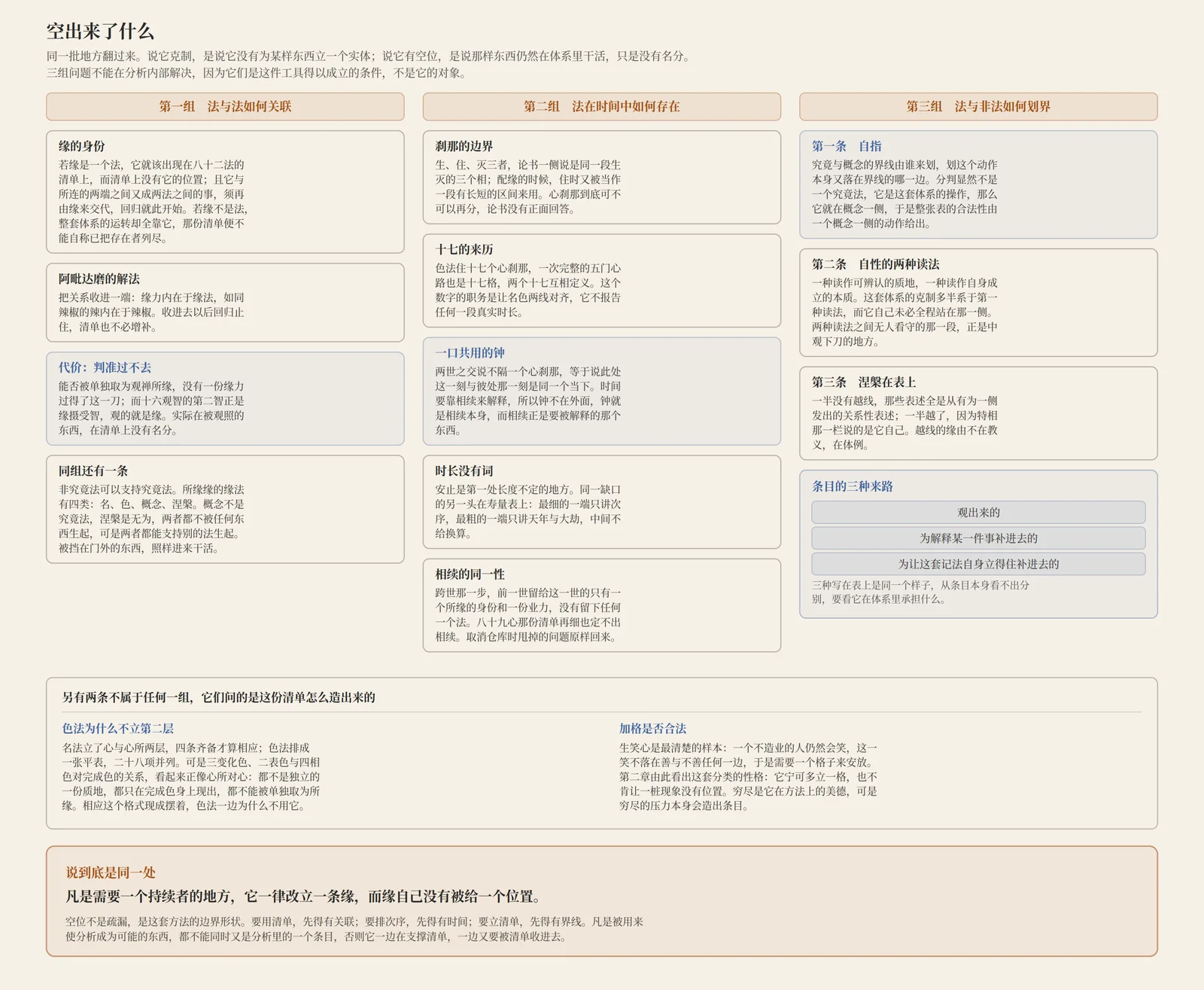
Turn the same places over and they are vacancies. The final sentence of Chapter 5 can serve directly as this chapter's thesis: avoidance works, and in the practical context it remains positively a virtue of restraint in metaphysical assertion; but what is avoided does not disappear and will eventually be written elsewhere. Restraint and vacancy are the same thing viewed from opposite ends. To call it restraint is to say that no entity was established for something. To call it a vacancy is to say that the same thing continues to work within the system without recognized status. The following sections gather the items registered in the preceding six chapters under the three questions posed in Chapter 1.
The full table first. Twelve items fall under the three groups; two more, which ask how the inventory itself was made, are appended at the end. The table is two rows finer than the exposition that follows: ordination substance and intermediate existence were each registered in Chapters 5 and 6, and the exposition folds them into the item on the continuum. The second column records what the system actually does at that place, not what it ought to do. Three rows read not addressed, which means that no corresponding statement is to be found in the treatises or the commentaries, not that this Part has passed the matter over.
| Vacancy | What the system actually does here | Registered in |
|---|---|---|
| 1 · Relation: whether a condition is itself a phenomenon | Conditioning force inheres in the conditioning phenomenon, as the heat of a chili inheres in the chili | Chapter 5 |
| 1 · Relation: a non-ultimate can support an ultimate | The column of object condition admits concepts and Nibbāna without further account | Chapter 5 |
| 2 · Time: the boundary of the moment | Arising, presence and dissolution are ruled three characteristics and not three parts, yet presence is treated as an interval possessing length when conditions are assigned | Chapters 4 and 6 |
| 2 · Time: the origin of seventeen | The seventeen mind-moments of materiality and the seventeen stations of the process define each other | Chapters 3 and 6 |
| 2 · Time: a shared clock | No clock is established outside; continuity itself serves as one | Chapters 4 and 6 |
| 2 · Time: no vocabulary for duration | Order at the finest scale, celestial years and aeons at the broadest, no conversion supplied between them | Chapters 4 and 6 |
| 2 · Time: the identity of the continuum | Within one life, rebirth-linking, life-continuum and death hold the same kind of consciousness with the same object; across lives, only the identity of an object and a kammic force are left | Chapter 6 |
| 2 · Time: persistence, ordination substance and kammic force | The mental factor of abstinence and conditional relations take the place of the first; asynchronous kamma condition takes the place of the second | Chapters 5 and 6 |
| 2 · Time: the passage between two lives | Proximity condition takes the place of an intermediate existence | Chapters 4 and 6 |
| 3 · Demarcation: who draws the line, and on which side the drawing itself falls | Not addressed | Chapter 1 |
| 3 · Demarcation: no firewall between the two readings of sabhāva | Not addressed | Chapter 1 |
| 3 · Demarcation: the place of Nibbāna on the table | The fourfold definition is filled in as the format requires, and the column of characteristic crosses the line | Chapter 6 |
| Further · Making the inventory: why materiality has no second tier | Not addressed | Chapter 3 |
| Further · Making the inventory: whether adding a cell is legitimate | It would rather establish one more cell than leave a phenomenon without a position | Chapter 2 |
First group: how does one phenomenon relate to another? The status of conditions is central. If a condition is a phenomenon, it should appear in the inventory of eighty-two, where it has no place. More seriously, once it acquires the status of a phenomenon, its connection to each of its two terms becomes a matter between two phenomena, and every such matter in this system must be accounted for by a condition. The regress begins. If a condition is not a phenomenon, the whole system nevertheless depends on it, and the inventory cannot claim to have exhausted what exists. The Abhidhamma's solution is to draw the relation into one term: conditioning force inheres in the conditioning phenomenon, as the heat of a chili inheres in the chili.7 This ends the regress without enlarging the inventory. Chapter 5 identified the cost: the criterion cannot be met. Chapter 3's line was whether an item can be taken separately as an object of insight contemplation. No conditioning force crosses that line. Yet the second of the sixteen insight knowledges is Knowledge of Discerning Conditions, which contemplates precisely conditions.8 Something actually contemplated has no recognized status in the inventory.
The same group contains another item, recorded in Chapter 5 and easily missed: a non-ultimate can support an ultimate. The conditioning phenomena under object condition are of four kinds—mentality, materiality, concepts, and Nibbāna. A concept is not ultimate and Nibbāna is unconditioned. Neither is produced by anything, yet both can support other phenomena in arising.8 The ultimate/conceptual distinction is the strictest act of restraint at the entrance, but in the column of conditions what was blocked at the door enters all the same and goes to work.
Second group: how does a phenomenon exist in time? This group contains the most items, and they are connected.
The boundary of the moment. A mind-moment has three submoments—arising, presence, and dissolution. The treatises say these are not three parts but three characteristics of one process of arising and cessation. Yet when conditions are assigned, the phase of presence is treated as an interval possessing length. The treatises never directly answer whether the mind-moment can be further divided. They provide a formulation that lets the system continue working without answering.
The origin of seventeen. Materiality lasts seventeen mind-moments, and a complete five-door process also has seventeen stations; the two seventeens define each other. Chapter 6 already separated the layers. Only the successive arising and ceasing of consciousnesses can count as measured. The two steps beyond that are not measurements: assuming every mind-moment to be of equal length, and making the lifespan of materiality fit the cognitive process without a seam. The function of the number is to align the mental and material lines, not to report an actual duration.
A shared clock. This is the preceding item enlarged. When Chapter 4 recorded it, the setting was the junction of two lives. A person ceases here, while elsewhere a rebirth-linking consciousness and a group of kamma-born materiality arise together. To say that not one mind-moment intervenes is to say that this instant here and that instant there form one present. Yet a mind-moment is only a unit of order, and the system provides no conversion between stations counted independently in two continua. Chapter 6 pushed the issue to its end: time must be explained by continuity, so the clock is not outside the continuum but is continuity itself—and continuity is precisely what needs explanation. The same assumption has already been used between mind and matter, when the stations in one mental continuum are used to measure materiality visible to many.
No vocabulary for duration. Absorption is the first place where length is variable and therefore the first place where the pure science of order that is cognitive-process theory becomes insufficient. The same gap appears from its other end in the table of lifespans: the finest scale speaks only of order, the broadest only of celestial years and aeons, and no conversion is supplied. The five hundred aeons among Non-percipient Beings are the cleanest manifestation of the gap. Not one consciousness occurs there, yet the material continuum is still counted on the scale of mind-moments.
The identity of the continuum. Without a storehouse, identity within one life is fixed by rebirth-linking, life-continuum, and death remaining the same kind of consciousness with the same object. Across lives, the previous life leaves the present one only the identity of an object and a kammic force, but no phenomenon. Chapter 6 therefore concluded that continuity is not a property of mentality: however detailed the inventory of eighty-nine consciousnesses, it cannot determine continuity. The problem shed when the storehouse was abolished returns unchanged, with only one word replaced.
Third group: how is phenomenon demarcated from non-phenomenon? This group has only three items, but they are the hardest.
The first is self-referential. Who draws the line between ultimate and concept, and on which side of the line does the act of drawing fall? The distinction itself is plainly not an ultimate phenomenon but an operation of the system, so it lies on the conceptual side. The legitimacy of the entire table is therefore supplied by an operation on the side of concepts. Chapter 1 posed the same issue another way: what is the status of an ultimate phenomenon itself? Is it a discerned quality, or something established in its own right?
The second is that no firewall separates two readings of intrinsic nature. The first reads sabhāva as a discernible quality; the second as a self-established essence. Chapter 1 judged that the system's restraint depends mostly on the first reading, but the system itself may not remain on that side throughout. The unguarded passage between the two readings is precisely where Madhyamaka cuts.
The third is Nibbāna on the table: an unconditioned phenomenon handed to a machine built for the conditioned. Chapter 6 divided the case in two. One half does not cross the line because its statements are all relational descriptions made from the conditioned side. The other does, because the characteristic column speaks about Nibbāna itself. The reason for crossing lies not in doctrine but in format. The table requires every item to be defined by the four devices; uniformity of format here outweighs the rule laid down in Part 13, Chapter 2.
Two further items belong to none of the three groups; they ask how this inventory was made. One is why materiality has no second tier. Mentality has two levels, consciousness and mental factors. A mental factor counts as associated with consciousness only when the two arise together, cease together, share one object, and share one base. Materiality is arranged as a flat list of twenty-eight coequal items. Yet the relation of the three mutable, two intimation, and four characteristic material phenomena to concrete materiality looks very much like that of mental factors to consciousness: none is an independent quality, each appears only in concrete materiality, and none can be separately taken as an object. The format of association was readily available. Why was it not applied on the material side? The other item is whether adding a cell is legitimate. Smile-producing consciousness is the clearest example: a person who no longer makes kamma still smiles, and that smile belongs neither to the wholesome nor the unwholesome, so a cell is needed to contain it. Chapter 2 used the case to identify the character of the taxonomy: it would rather establish one more cell than leave a phenomenon without a position. Exhaustiveness is a methodological virtue, but the pressure of exhaustiveness can itself produce entries.
Three origins of an entry. The preceding two items require a distinction, which this chapter now makes a criterion. Entries in the inventory have at least three origins: observed; supplied to explain a particular matter; and supplied to keep the notation itself standing. All three look alike once placed in the table, and cannot be distinguished from the entry itself. One has to ask what work it performs in the system. Chapter 4 already supplied examples of each. The exhaustive set of fifteen patterns is calculated: the material lifespan is first fixed at seventeen, then no more than fifteen past life-continuum moments are inferred. The allocation of three times of maturation across seven javanas looks as though the fourfold classification of kamma came first and positions were assigned afterward. By contrast, the two-stage division between five-door and mind-door processes, the correlation between object strength and process length, and the position of determining all accord with experience and do not look supplied afterward. The six pairs of twelve items in Chapter 2 belong to the third kind: a property that could be stated in one sentence is divided into twelve entries only because the table's format requires individual listing. All three origins occur. This is not an accusation against the system. It shows only that the inventory is neither a pure record of observation nor a pure result of deduction. It is a composite of both plus pressure from format. Deciding which entry belongs to which kind requires individual examination; this Part has offered several demonstrations only.
Why these vacancies are necessary. The three groups were not chosen arbitrarily. Analysis at the level of ultimate phenomena must answer how one phenomenon relates to another, how a phenomenon exists in time, and how phenomenon is demarcated from non-phenomenon. None of the three questions can be resolved from inside the analysis, because they are conditions under which the instrument is possible rather than objects of the instrument. An inventory can be used only if relations are already available; a sequence can be arranged only if time is already available; an inventory can be established only if its boundary is already available. Whatever makes analysis possible cannot simultaneously be one item analyzed, for it would then both support the inventory and have to be contained by it. The vacancies are therefore not oversights but the shape of the method's boundary. A more diligent commentary or more ingenious exegetes would leave the same three places empty. If something were truly placed there, it would necessarily no longer belong to analysis.
In the end, it is one place. Chapter 6 condensed the three costs into one sentence: wherever an enduring subject would otherwise be required, the system establishes a condition instead, but gives the condition itself no position. This sentence explains both halves of the present chapter. Restraint is possible because conditions supply a universal replacement: where a storehouse would be established, asynchronous kamma condition is established instead; where an ordination substance would be established, the mental factor of abstinence and conditional relations take its place; where an intermediate existence would be established, proximity condition takes its place. The more fluently the replacement operates, the fewer entities are added and the cleaner the inventory remains. The vacancy is necessary because the very thing used in the replacement has no position. The system's restraint and its vacancies are therefore not two entries but two faces of one: it transfers every ontological burden onto relations and then gives relations no ontological position.
Echoes of Part 13, Chapter 7. That chapter concerned leakage: questions the early teaching explicitly declined to answer were later expressed in other ways. This chapter concerns vacancies: things this analysis explicitly declined to establish still work within the system. They are two stages of one mechanism. At the first stage, a question is judged not fit to be asked and therefore has no answer. At the second, a system needs something in order to work but refuses to grant it recognized status, thereby leaving a position it uses but cannot name. What is left unsaid does not disappear because it was not said. In the hands of a later generation, it appears in another form. The places where Madhyamaka, Yogācāra, and tathāgatagarbha thought emerge can each be matched to a position on these two tables.
Data and grounds. This chapter introduces no new evidence. The basis for each item in the inventory of restraint appears in the main text and notes of Chapters 1 through 6. For the relevant parts of the Kathāvatthu, see the sources cited in Chapters 4 and 6; the comparison with Sarvāstivāda follows the five-category scheme of the Abhidharmakośa, while the reasons for its positions are left to Part 15. Two further items come from Chapters 7 and 9 of the Tabular Exposition:8 the former shows how the system gathers diverse terms into groups, and the latter how it distinguishes serenity from insight meditation. The misgivings listed in Part I, Part 3, Chapter 4 are developed here. That section's preliminary judgment was that the phenomenological portion of Theravāda Abhidhamma is outstanding, while its problems lie in reification and fixation. This chapter preserves the first half and revises the second. Reification does occur, but not in any announced doctrine; it occurs in the procedures of cataloguing and under the pressure of format. As for fixation, this book holds that it is a boundary of the analytical route itself rather than a failure peculiar to this school. That conclusion will not be established until the full register for the next Part is complete.
The handoff. The next Part concerns Sarvāstivāda, another set of answers to the same questions. Wherever this Part identifies a vacancy, the other side usually places an entity: the real existence of the three times fills the group concerning time, the enduring reality of a phenomenon's substance fills the identity of continuity, acquisition and unmanifest materiality fill persistence, and six causes and four conditions fill relation. Only by comparing the two can we decide whether these vacancies are omissions peculiar to Theravāda or boundaries of the analytical route itself. Farther ahead, Madhyamaka cuts at intrinsic nature and relations, Yogācāra supplies continuity and seeds, and tathāgatagarbha thought supplies an answer from the other end. Which vacancies each of those three routes addresses can be identified item by item only after both Parts have completed their registers. This Part and the next are therefore prerequisites for those that follow.
To the next Part. What does the other route establish when the same analysis is taken to its end?
References
References
-
Abhidharmakośabhāṣya, Chapter 1, Dhātunirdeśa. The Sarvāstivāda grouping of seventy-five phenomena (eleven material, one consciousness, forty-six mental factors, fourteen formations dissociated from consciousness, and three unconditioned phenomena) follows the five-category scheme of the Kośa. The three unconditioned are cessation through deliberation, cessation independent of deliberation, and space. This chapter uses only the comparison with the Theravāda eighty-two; the Sarvāstivāda reasons for establishing its categories will be treated in Part 15. ↩↩
-
For the Sarvāstivāda list of seventy-five phenomena and the fourteen formations dissociated from consciousness (acquisition, non-acquisition, commonality, the non-percipient result, non-percipient attainment, cessation attainment, life faculty, arising, duration, alteration, cessation, name-body, phrase-body, and syllable-body), see the arrangement in the Abhidharmakośa. The non-percipient result is also called non-perception. For another comparison between the Theravāda eighty-two and Sarvāstivāda seventy-five, see Noa Ronkin, Early Buddhist Metaphysics: The Making of a Philosophical Tradition. London: RoutledgeCurzon, 2005. ↩
-
Kathāvatthu. Book I, Chapter 6, Sabbam-atthī-ti kathā, refutes the equal real existence of past and future. English translation: Shwe Zan Aung and Mrs. Rhys Davids (trans.), Points of Controversy. London: Pali Text Society, 1915, I.6, “Of Everything as Persisting.” The work's method is to rule, proposition by proposition, that an opponent's claim “should not be stated thus” (na h'evaṃ vattabbe); on this basis the present chapter calls it a book of boundary-drawing. ↩↩
-
Kathāvatthu, Book VIII, Chapter 2, “Of an Intermediate State” (Antarābhavakathā): a refutation of intermediate existence (antarābhava). Theravāda therefore does not affirm one and holds that no mind-moment intervenes between death consciousness and rebirth-linking consciousness. Chapters 4 and 6 cited this section. ↩
-
Noa Ronkin, “The Rise of the Concept of Own-Nature (Sabhāva) in the Paṭisambhidāmagga.” Oxford Centre for Buddhist Studies, 2003. The reference is to the Saddhammappakāsinī, Mahānāma's approximately sixth-century commentary on the Paṭisambhidāmagga. Ronkin explicitly cites its analysis of sabhāva as sat-bhāva. Chapter 1 gave the detailed citation. ↩
-
Y. Karunadasa, The Theravāda Abhidhamma: Inquiry into the Nature of Conditioned Reality. Boston: Wisdom Publications, 2019; originally published by the Centre of Buddhist Studies, University of Hong Kong, 2010. Chapters 1 and 5 already cited the argument that treating arising, presence, and dissolution as real phenomena leads to an infinite regress. ↩
-
Bhikkhu Bodhi (general ed.), A Comprehensive Manual of Abhidhamma: The Abhidhammattha Sangaha of Ācariya Anuruddha. Kandy: Buddhist Publication Society, 1993. Its explanatory material in Chapter 8 states that conditioning force (paccaya-satti) inheres in the conditioning phenomenon and cannot exist apart from it, using the commentarial simile that “the hotness of chilies is inherent in the chilies.” Chapter 5 cited the point in detail. ↩
-
Tabular Exposition of the Abhidhammattha Saṅgaha (《摄阿毗达摩义论表解》), compiled by Venerable Mingfa, revised by Luo Qinglong, and published by Dhamma Rain Monastery. All numbers in Part 14 follow this work. Every item cited in this chapter has already appeared in the preceding six chapters; see their notes for sources. The chapter also draws on Chapter 7, “Compendium of Categories” (the compendia of the unwholesome, mixed categories, and the thirty-seven requisites of enlightenment), and Chapter 9, “Compendium of Meditation Subjects,” for the distinction between serenity and insight meditation and for Knowledge of Discerning Conditions among the sixteen insight knowledges. The itemized tables are not reproduced here; readers who need them should consult the work directly. ↩↩↩