Chapter 2: Nāma—A Taxonomy of Mental Phenomena
What this chapter does. The preceding chapter described the fourfold defining method as a defining machine. This chapter watches it process mind. The eighty-nine cittas are not eighty-nine minds but eighty-nine specifications produced by crossing several axes through the same kind of event. The fifty-two cetasikas are not fifty-two emotions but fifty-two functions that may accompany a single event. This chapter first explains in modern language what questions the two classifications answer, then presents the numbers and shows, point by point, how they are obtained. Apart from the overview, the chapter is essentially a reference list to be consulted when needed. It need not be read straight through.
Overview: what this classification says. Three sentences.
First, the primary division of the eighty-nine cittas is not about psychological types but kamma. The four classes (unwholesome, wholesome, result, and functional) are four kammic identities of the same psychological configuration: making kamma through greed, hatred, and delusion; making kamma through non-greed, non-hatred, and non-delusion; not making kamma but undergoing the maturation of kamma already made; and functioning normally without producing kamma. The first level therefore answers only three questions: how kamma is made, how its result is undergone, and why an arahant makes no new kamma.
Second, another axis is plane: sense sphere, fine-material sphere, immaterial sphere, and supramundane. The upper three levels are extremely regular. The fifteen fine-material-sphere cittas form a sequence of subtraction across five jhānas; the twelve immaterial-sphere cittas are the same citta with four objects; the eight supramundane cittas are the four paths and four fruits. Regularity leaves little to say. All irregularity lies among the fifty-four cittas of the sense sphere, so nearly the whole weight of this chapter falls there.
Third, the fifty-two cetasikas answer another set of questions: what all cittas share regardless of their ethical quality; what may be added; what all unwholesome cittas share and where they differ; what all wholesome cittas share and where they differ; and what is added or removed in the minds of noble ones and meditators in absorption.
Once these three sentences are in place, there is no need to rush to open any table. We already know what the classification is trying to do: locate an instance of consciousness in one cell according to its kammic identity, its plane, and the configuration of accompanying functions, thereby giving contemplation an identifiable point of application.
The following overview diagram gives the positions first. Its upper half groups cittas by kammic identity: those that make kamma, those that undergo results, and those attached to neither side. Kamma-making cittas connect to resultant cittas; the functional end is grounded and the line of kamma stops there. The lower half shows six classes of cetasikas, one per row, and the kinds of citta in which each can occur. The diagram gives no numbers, only a sense of position. The numbers and their reasons follow in later sections.
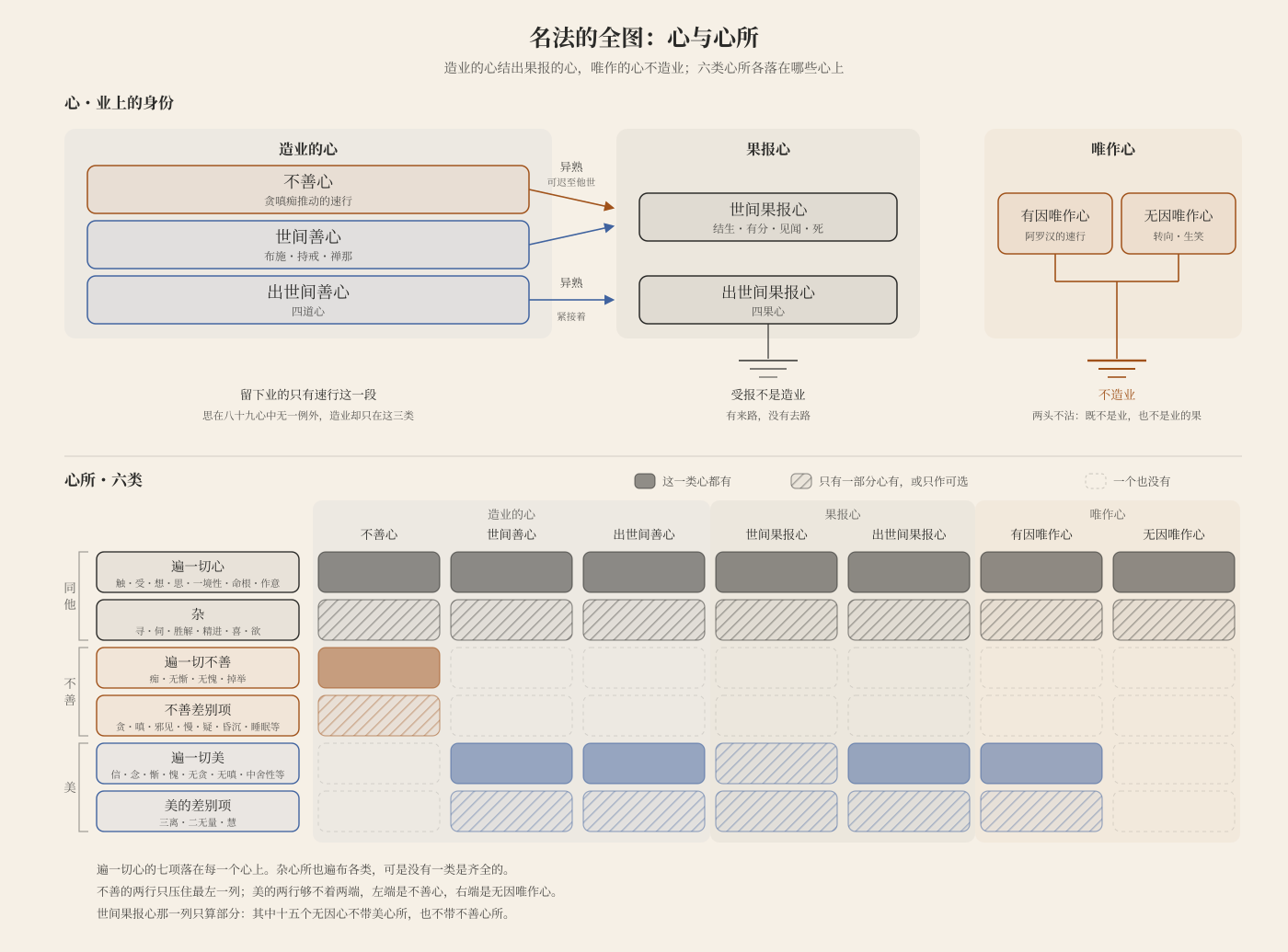
The four classes are four kammic identities. The four classes derive from the Dhammasaṅgaṇī. The first triad in the mātikā opening that work is wholesome, unwholesome, and indeterminate. The first two give ethical quality; the third gives neutrality. The neutral is then divided in two: what matures from past kamma is vipāka, commonly translated “result”; what is neither kamma nor its result is kiriya, functional. Thus the four classes.1
Why can kamma form the first level? The discourses define kamma in one sentence: “It is intention that I call kamma; having intended, one acts through body, speech, and mind.” The Chinese parallel asks, “How is kamma known? There are two kinds of kamma: intention and action after intention.”2 Intention is one of the cetasikas and is present without exception in all eighty-nine cittas. Yet not every citta makes kamma. If a classification is to mark the most important distinction at its first level, it is precisely this: in which cittas intention drives a complete volition, and in which does it merely complete the function of the present cell?
The name of the fourth class needs the most explanation. Kiriya literally means simply doing. Nārada's commentary is direct: the good deeds of Buddhas and arahants are called functional because kamma is not accumulated through them.3 One whose roots have been cut off still acts, teaches, goes on almsround, enters absorption, and answers questions. These actions are ethically good but no longer mature into results. The system establishes a separate class for such cittas.
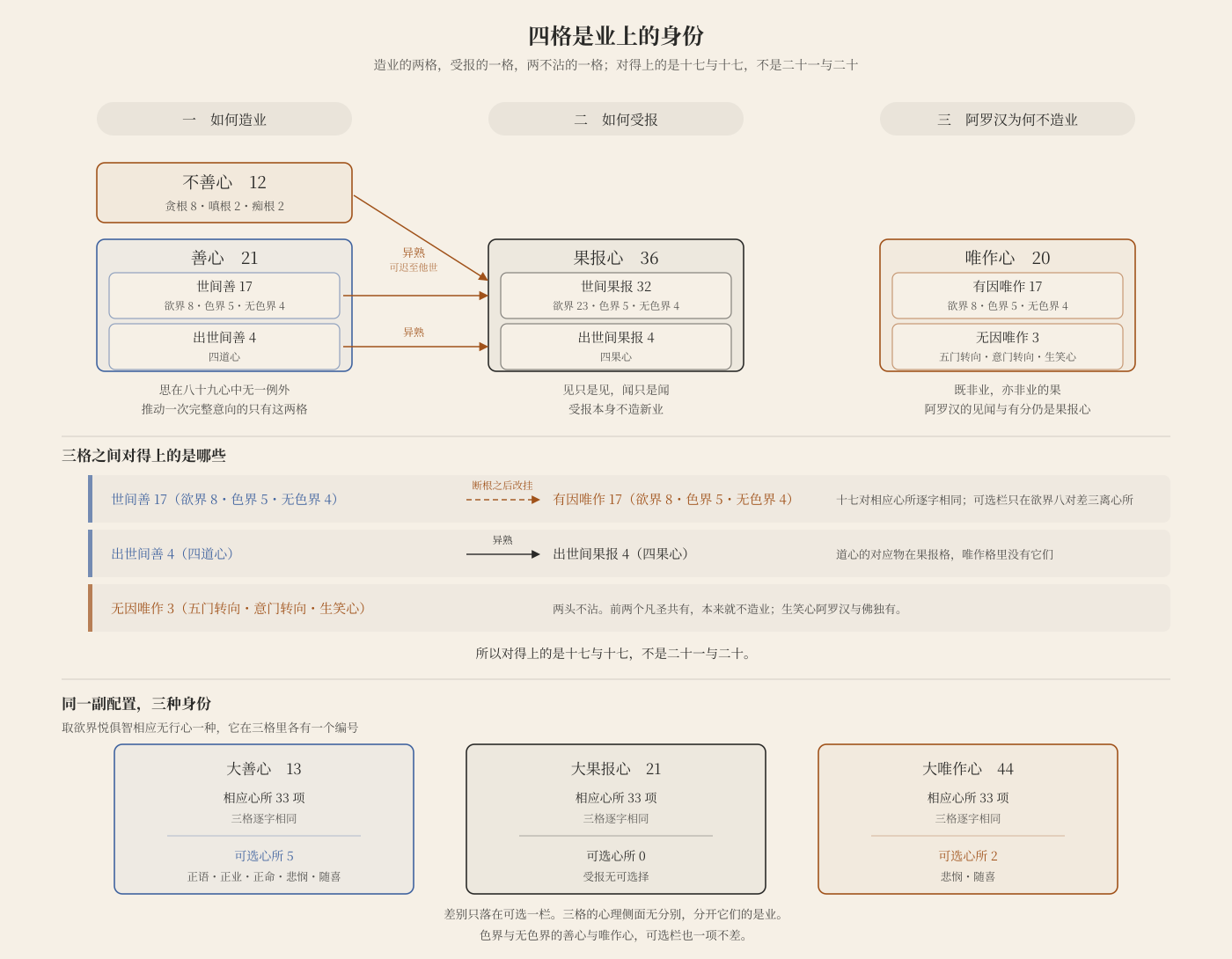
The same configuration, three identities. The four classes mark kammic identity, not psychological kind. The data show this directly.
Place three cittas side by side: the sense-sphere citta accompanied by joy, associated with knowledge, and unprompted. In the wholesome class it is number 13; in the resultant class, number 21; in the functional class, number 44. Their lists of associated cetasikas are word-for-word identical: thirty-three items, without one addition or omission. Their names, feeling, roots, and prompted or unprompted character are the same. They differ in only one column, optional cetasikas. The great wholesome citta has five optional factors—right speech, right action, right livelihood, compassion, and appreciative joy. The great functional citta retains compassion and appreciative joy. The great resultant citta has none.
The identical thirty-three items show that the three cittas do not differ psychologically. Since the difference lies only in the optional column, what differs there is what this level of classification actually governs.
The great resultant citta has no optional factor because undergoing a result is not an action and offers no choice. The great functional citta lacks the three abstinences because an abstinence requires something from which to abstain. An arahant does not encounter an impulse to lie that must be restrained, so restraint has nowhere to be placed. Compassion and appreciative joy remain because they are attitudes toward others and need not begin from an impulse in oneself that must be counteracted.
This comparison is the most important piece of evidence in the chapter. It shows why the term “nature” can mislead. Readers may hear unwholesome, wholesome, resultant, and functional as four psychological temperaments, when in fact the psychological configurations in three of the classes can be identical. What separates them is kamma.
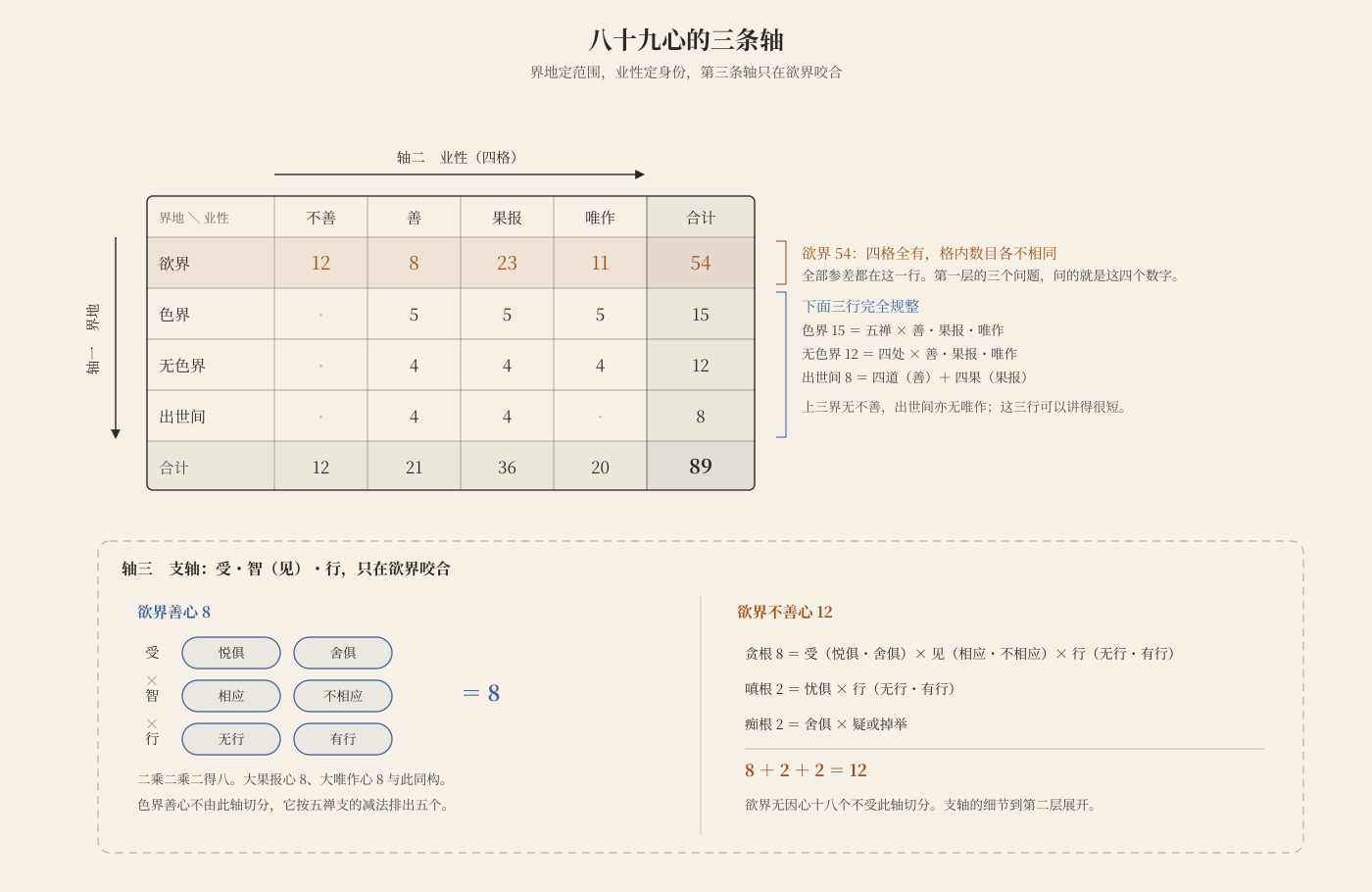
The three questions of the sense sphere. Crossing the four classes with the four planes gives the following table:
| Plane | Unwholesome | Wholesome | Resultant | Functional | Total |
|---|---|---|---|---|---|
| Sense sphere | 12 | 8 | 23 | 11 | 54 |
| Fine-material sphere | 5 | 5 | 5 | 15 | |
| Immaterial sphere | 4 | 4 | 4 | 12 | |
| Supramundane | 4 | 4 | 8 | ||
| Total | 12 | 21 | 36 | 20 | 89 |
The lower three rows are almost too regular to require comment: five in each fine-material class, four in each immaterial class, and only wholesome and resultant classes in the supramundane row. All irregularity lies in the first row.
The three questions at the primary level are therefore the questions answered by the four numbers in that row. Twelve plus eight answers how kamma is made; twenty-three answers how results are undergone; eleven answers what neither makes nor undergoes. The next three sections take them in turn.
How kamma is made: intention is universal, kamma is not. Twenty sense-sphere cittas make kamma: twelve unwholesome cittas and eight great wholesome cittas. They share one feature: in a cognitive process, their function is javana.
In Chapter 1's example of the phone, a complete five-door process used seventeen mind-moments, but only the seven javanas made kamma. Adverting, sense consciousness, receiving, investigating, and determining did not. Intention is present in every cell; kamma accumulates only in this segment. The weight of kamma is determined here as well. The same external act may be light or grave according to the cetasikas arising during javana (whether the citta is prompted or unprompted, accompanied by joy or by equanimity), not according to the act by itself.
Wholesome cittas in the higher planes also make kamma. The five wholesome fine-material cittas and four wholesome immaterial cittas make the kamma of absorption, whose result is birth in the corresponding plane. Part 13, Chapter 5 has already presented this correspondence from the discourses.4 The worldly kamma-making cittas therefore total twenty-nine: twelve unwholesome, eight wholesome sense-sphere, five wholesome fine-material, and four wholesome immaterial.
The four supramundane path cittas are also placed in the wholesome class, but they make another kind of kamma, discussed under the third question below.
How the cells before and after javana connect, how many javanas can arise in a process, and what is special about javana at death belong to Chapter 4's account of cognitive processes. This chapter need retain only the answer at the first level: twenty-nine cittas make kamma, not all eighty-nine.
How results are undergone: a technical form of “in the seen, only the seen.” The sense sphere has twenty-three resultant cittas, fifteen of them rootless. Rootless means that the citta is associated with none of the six roots—greed, hatred, delusion, non-greed, non-hatred, and non-delusion. Nārada adds a warning here: rootless does not mean causeless; it means only that these six roots are absent.3
The purest cells are the two sets of fivefold sense consciousness: eye-, ear-, nose-, tongue-, and body-consciousness, with one set resulting from wholesome kamma and the other from unwholesome kamma, ten cittas in all. Each has only seven cetasikas: contact, feeling, perception, intention, one-pointedness, vitality, and attention. Nothing else. No initial application, no sustained application, no decision, no energy, no joy.
The instruction to Bāhiya in the discourses says: in the seen there will be only the seen, in the heard only the heard, in the sensed only the sensed, and in the cognized only the cognized.5 Abhidhamma gives the sentence a technical form. There really is a moment whose entire content consists of those seven factors, before thought, decision, or effort has been added. The practical task is not to pile an eighth and ninth factor on top of it immediately afterward.
The distribution of feeling is also worth noticing at this level. Among the five sense consciousnesses, only body-consciousness bears pain or pleasure. Body-consciousness resulting from unwholesome kamma is painful; that resulting from wholesome kamma is pleasant. The other four are invariably accompanied by equanimity. However good or bad the objects of eye, ear, nose, and tongue, the resultant moment itself remains neutral; liking and disliking take shape only in later cells. This technical judgment is easy to overlook, but it directly supports the preceding instruction: at the moment of seeing, liking and disliking really have not yet appeared.
The remaining rootless resultant cittas are receiving and investigating. A receiving citta has ten cetasikas, adding initial application, sustained application, and decision to the seven. An investigating citta accompanied by equanimity likewise has ten; one accompanied by joy has eleven, adding joy. The eight rooted great resultant cittas have the fullest configurations, as many as thirty-three factors, but their optional column is invariably empty. Undergoing a result offers no options.
Why an arahant makes no kamma. This is the most instructive cell at the first level, because it is the one place in the system where the mechanism of kamma is switched off.
The discourses make the point in two ways. First, the Nidāna Sutta says that any action born of non-greed, non-hatred, and non-delusion is abandoned when greed has ended; its root has been cut off like a palm tree with its crown removed, incapable of future arising.6 Second, the Ariyamagga Sutta lists four kinds of kamma: dark with dark result, bright with bright result, dark-and-bright with dark-and-bright result, and neither dark nor bright with neither-dark-nor-bright result, leading to the end of kamma. The fourth is directly defined as the eightfold path.7 Together the two say the same thing: action remains after the roots have been cut, but no longer matures into result.
Abhidhamma turns this into a class. An arahant's javanas fall under neither wholesome nor unwholesome; they are functional. The twenty functional cittas divide in two: seventeen rooted functional cittas (the eight great functional cittas of the sense sphere, five of the fine-material sphere, and four of the immaterial sphere), and three rootless functional cittas.
The correspondence is seventeen to seventeen. Among the twenty-one wholesome cittas, the four supramundane path cittas have another destination. Path citta does have a result: the four fruit cittas in the resultant class. The functional class contains no counterparts for them. The remaining seventeen worldly wholesome cittas correspond one by one to the seventeen rooted functional cittas. Their associated cetasikas are word-for-word identical; their functions continue as before; only the function of making kamma is absent. The difference lies solely in the optional column, and only in the eight sense-sphere pairs: wholesome cittas have five optional factors, functional cittas two, with precisely the three abstinences missing. The five fine-material and four immaterial pairs are even more regular; their optional columns do not differ at all.8
Another point is easily misunderstood: an arahant is not left only with functional cittas. Seeing and hearing, bhavaṅga and death consciousness, remain resultant. They are the maturation of past kamma, and maturation continues normally. Only the kamma-making end has been closed; the result-receiving end stops only with the final death consciousness.
The remaining three rootless functional cittas touch neither side. They are the reason the twenty-one wholesome cittas and twenty functional cittas cannot be matched as complete sets: five-door adverting, mind-door adverting, and smile-producing consciousness. The first two are common to ordinary and noble persons; they never made kamma in the first place and simply direct the stream to a door. Smile-producing consciousness belongs only to arahants and Buddhas. One who makes no kamma still smiles, but the smile falls under neither wholesome nor unwholesome; a cell must therefore be reserved for it. Part I, Part 3, Chapter 4 explained the origin of this citta, and Chapter 7 will return to it.8 Such cases display the character of the classification: it would rather establish one more cell than leave a phenomenon without a position.
The three rootless functional cittas have different configurations of cetasikas, and the differences are meaningful. Five-door adverting has ten; mind-door adverting has eleven, adding energy. In a five-door process, mind-door adverting also performs the function of determining; making a selection requires effort, while mere adverting does not. Smile-producing consciousness has twelve, adding joy to the configuration of mind-door adverting.
The second level: how the twelve unwholesome cittas are counted. The first level answered how kamma is made and how results are undergone. The second gives details and possibilities: in how many ways can the same kind of act be performed? Begin with the unwholesome.
The twelve unwholesome cittas fall into three groups by root: eight rooted in greed, two in hatred, and two in delusion.
The eight greed-rooted cittas are the product of three binary axes. Feeling: accompanied by joy or by equanimity. View: associated or dissociated with wrong view. Prompting: unprompted or prompted. Two times two times two gives eight. The prompting axis deserves a sentence. Unprompted means spontaneous, without inducement; prompted means arising after encouragement or self-persuasion. The same act of greed, performed spontaneously or after persuading oneself, counts as two different cittas. The five prompted unwholesome cittas add sloth and torpor to their unprompted counterparts, because the hesitation itself carries inertia.
The two hatred-rooted cittas vary only on the prompting axis: accompanied by displeasure and associated with aversion, unprompted or prompted. Why is there no feeling axis? Hatred is necessarily accompanied by displeasure and cannot occur with joy or equanimity. Why no view axis? Wrong view belongs to the greed group and does not arise together with hatred.
The two delusion-rooted cittas are one accompanied by equanimity and associated with doubt, and one accompanied by equanimity and associated with restlessness. Their tables contain only fifteen cetasikas each, the fewest among the twelve unwholesome cittas. The citta associated with doubt lacks decision, because doubt is precisely the absence of decision. Both delusion-rooted cittas lack desire, because their shape is an absence of directed wanting.
Optional cetasikas record still finer possibilities. Conceit occurs only in the four greed-rooted cittas dissociated from wrong view, and even there need not arise. Wrong view and conceit do not occur together. Taking the five aggregates as self is view; comparing oneself as higher or lower than another is conceit. The two are mutually exclusive. Envy, avarice, and regret occur only in the two hatred-rooted cittas, and the three never co-occur. In a single moment one cannot envy what another has, hoard what one has oneself, and regret what one has done.
The final point must be explicit. Delusion, shamelessness, fearlessness of wrongdoing, and restlessness appear without exception in all twelve unwholesome cittas. Greed occurs in only eight, hatred in two. The common denominator of the unwholesome is neither greed nor hatred, but delusion.
It matters that shamelessness and fearlessness of wrongdoing are classified as necessary factors of every unwholesome citta. The discourses say that two bright qualities protect the world: moral shame and moral dread. Without them, the world would not recognize the order of parents, siblings, spouses, relatives, teachers, elders, and juniors, but would fall into inversion and confusion like animals.9 In this classification, an unwholesome citta is not merely a bad psychological state; it is simultaneously a failure of both defensive lines.
The symmetry of wholesome and resultant cittas, and one asymmetry. The eight wholesome sense-sphere cittas are parallel to the eight greed-rooted cittas along three axes: feeling (joy or equanimity), knowledge (associated or dissociated), and prompting (unprompted or prompted). Two times two times two gives eight. Association with knowledge means arising together with the cetasika of wisdom; dissociation means its absence.
The eight great resultant cittas correspond one for one to these eight. Their names, configurations, numbers, and associated cetasikas are identical. Again, the only difference is the optional column: five factors for a great wholesome citta, none for a great resultant citta. This is the most regular symmetry in the table.
One qualification is required. The symmetry registers an alignment of specifications between two classes. It does not mean that a particular grade of wholesome kamma necessarily produces the corresponding great resultant citta. Which citta a kamma matures into belongs to the rules of rebirth-linking and cognitive process, not to this chapter. Chapter 4 will address part of it.
The only asymmetry appears at the rootless resultant level: seven unwholesome-result cittas and eight wholesome-result cittas. The extra one is investigating consciousness accompanied by joy. The traditional explanation appeals to grades of object. An agreeable object can be divided further into agreeable and extremely agreeable, so wholesome result requires two investigating cittas, one accompanied by equanimity and one by joy. A disagreeable object has only one grade, so unwholesome result requires only one.8
The asymmetry records an experiential judgment: an exceptionally good experience differs in texture from an ordinarily good one, whereas an exceptionally bad experience receives no corresponding grade beyond the ordinarily bad. Whether the judgment is sound can be debated, but the system has unquestionably added one cell for an observation. This book holds that places like this disclose the working method of Abhidhamma more clearly than the regular regions do. Not all its numbers are deductions; some observations have been read from experience and then added to the table.
Why the upper three levels can be brief. Return to the plane axis. The fifteen fine-material, twelve immaterial, and eight supramundane cittas make thirty-five, nearly forty percent of the eighty-nine. Yet very little can be said about them because they are wholly regular.
Fine-material sphere. The five wholesome cittas are the first through fifth jhānas. Theravāda counts the state with sustained but not initial application as a separate jhāna, hence five rather than four. Their differences form a sequence of subtraction: thirty-three cetasikas in the first jhāna; thirty-two in the second, with initial application removed; thirty-one in the third, with sustained application removed; thirty in the fourth, with joy removed; and still thirty in the fifth, where pleasant feeling is replaced by equanimity and the number does not change. The five resultant and five functional cittas have the same pattern. In the table, abandoning jhāna factors is simply deletion one item at a time.10
One fact deserves separate attention. The thirty-three factors of the wholesome first-jhāna citta are word-for-word identical to those of the great wholesome sense-sphere citta accompanied by joy, associated with knowledge, and unprompted. Entering first jhāna adds no new cetasika. What changes is the object and degree of stability. Concentration is not a new psychological ingredient but another mode in which existing ingredients operate. The jhāna factors are, in the end, five factors already found among the seven universals and six occasionals (initial application, sustained application, joy, pleasant feeling, and one-pointedness), specially named.
Immaterial sphere. The four cittas take as objects infinite space, infinite consciousness, nothingness, and neither-perception-nor-non-perception. Each has thirty cetasikas. Their tables are word-for-word identical to one another and to the fifth-jhāna citta. Every distinction in depth among the four immaterial attainments lies in the object column; not one item of the configuration moves. In the language of Chapter 1, the object of the cut has changed, not the kinds of dhamma.
Supramundane. The eight cittas are four paths and four fruits. The tables of path and fruit cittas are again word-for-word identical, with thirty-three factors each. Compared with a great wholesome sense-sphere citta, they add right speech, right action, and right livelihood, and omit initial application, sustained application, and joy. Which of the latter three is absent depends on the jhāna on which the path or fruit is based. Because the eighty-nine-citta method does not distinguish the jhāna basis of path and fruit, its basic table lists only what all jhānas share.11 Supramundane cittas have no optional factors, for the reason given in the supplementary section below.
This produces the number 121. Each of the eight supramundane cittas is expanded across five jhānas, giving forty. Subtract the original eight from eighty-nine and add forty: 121. Only the supramundane cell is expanded; the other eighty-one cittas remain unchanged. Eighty-nine and 121 are therefore two counts of the same system, one coarse and one fine.10
The plane axis contains another easily missed fact. Of the twelve unwholesome cittas, the two hatred-rooted cittas can arise only in the sense sphere; the other ten can arise in all three spheres. Beings in the fine-material and immaterial spheres have no hatred, but conceit and wrong view remain. This is useful for judging practice: concentration can suppress an entire class of defilement while leaving another class intact.
For the fine-material and immaterial spheres as modes of existence, and the correspondence of jhāna with birth, see Part 13, Chapter 5. For the sequence of the four fruits and the definition of the arahant, see Part 13, Chapter 6. This chapter is concerned only with the position of these thirty-five cittas in the table.
Fourteen functions. Citta performs fourteen functions in cognitive processes: rebirth-linking, bhavaṅga, adverting, seeing, hearing, smelling, tasting, touching, receiving, investigating, determining, javana, registration, and death. The same citta may perform different functions on different occasions, while the same function may be performed by different cittas. The eight great resultant cittas, for example, perform rebirth-linking, bhavaṅga, death, and registration.
This chapter only lists the names. They become intelligible in Chapter 4. Rebirth-linking and death are two appearances of the same class of citta at the two ends of a life; bhavaṅga is the underlying current of continuity when no external object is taken; javana is the only segment that makes kamma. Apart from the cognitive process, discussion of functions yields only a noun list.11
Cetasikas: definition before list. The fifty-two cetasikas are defined not by their enumeration but by a restriction on what counts as associated with citta. The opening verse of Chapter 2 of the Saṅgaha gives four conditions: arising with citta, ceasing with citta, sharing its object, and sharing its base. Only when all four are met does a dhamma count as a cetasika.12
What the restriction excludes matters more than what it admits. It excludes any mental entity separately existing outside citta and any psychological container extending across moments. Cetasikas are merely aspects of the same event; the mind does not contain a stock of preexisting things. Chapter 1 said that citta is awareness itself and cetasikas are the functions that arise and cease with citta and share the same object. The four conditions are the criterion behind that statement.13
The closest passage in the discourses is the Vibhaṅga Sutta's definition of name: feeling, perception, intention, contact, and attention.14 Four of the five later became universal cetasikas; Abhidhamma added only one-pointedness and vitality. The Chinese parallel, Saṃyukta Āgama 298, takes another route, defining name as the four immaterial aggregates: feeling, perception, formations, and consciousness. The difference between the two transmissions marks Abhidhamma's choice precisely. It follows the Pāli line that enumerates mental factors item by item, not the line that groups them by aggregates.
The answers to the following four questions form a matrix: eighty-nine rows of cittas and fifty-two columns of cetasikas, each cell asking whether this factor is present in this citta. The whole matrix appears below, and the four questions then read it in sections. There is no need to identify every cell. Look only for three things: which regions are solid, which are entirely blank, and where the gaps fall. The horizontal bars at right show the number of cetasikas in each citta, from seven to thirty-three; the vertical bars below show the number of cittas in which each cetasika appears, from one to eighty-nine.
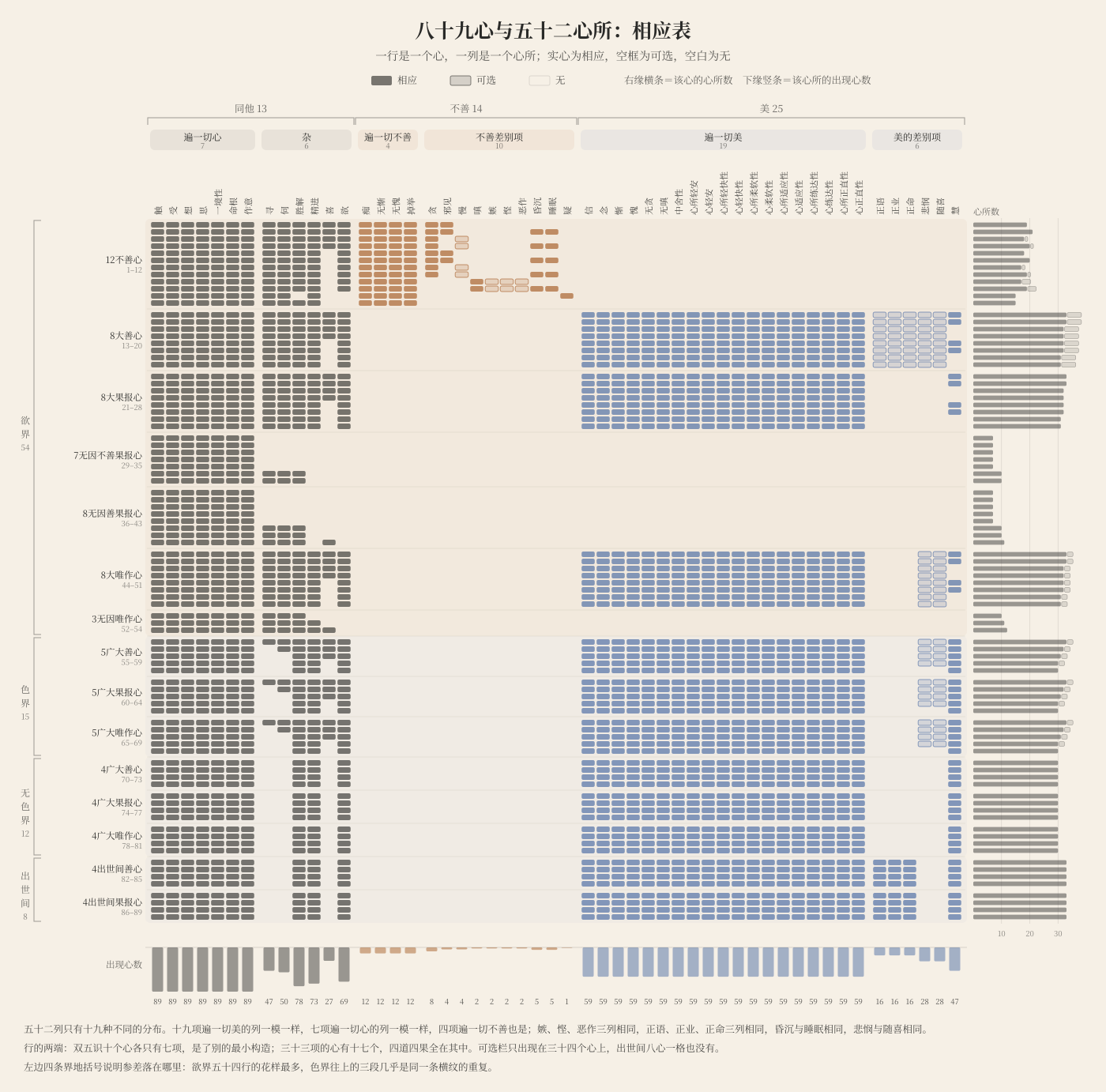
One fact is easier to see in the figure than in prose: the fifty-two columns have only nineteen distinct distributions. The nineteen universal beautiful factors have identical columns, as do the seven universals and the four universal unwholesome factors. In addition, envy, avarice, and regret share one pattern; right speech, right action, and right livelihood another; sloth and torpor another; compassion and appreciative joy another. This book holds that the pattern gives the data-level form of the preference for format discussed in Chapter 1. The format determines how long the list is; content determines how many distinct distributions it contains.
Question One: what all cittas share. Seven factors, called the universal cetasikas: contact, feeling, perception, intention, one-pointedness, vitality, and attention. Each occurs in every one of the eighty-nine cittas.
These seven form the minimal structure of cognition. The meeting of object and consciousness is contact. Reception of the object is feeling. Taking its mark is perception. Impulsion is intention. The one-to-one relation of mind and object is one-pointedness. The force maintaining the life of the mental phenomena in that moment is vitality. Directing the mind toward the object is attention. Without any one of them, the moment would not constitute a cognition. The two sets of fivefold consciousness described above contain only these seven: the minimal structure appearing by itself.
One discourse comes very close to the list. The Mūlaka Sutta gives a sequence: all dhammas are rooted in desire, originate in attention, arise from contact, converge on feeling, are headed by concentration, dominated by mindfulness, have wisdom as their highest state, liberation as their essence, and Nibbāna as their culmination.15 At least six of these are among the fifty-two cetasikas: desire, contact, feeling, mindfulness, one-pointedness or concentration, and wisdom. The discourse gives an outline; Abhidhamma gives a complete table. The difference is completeness, not kind.
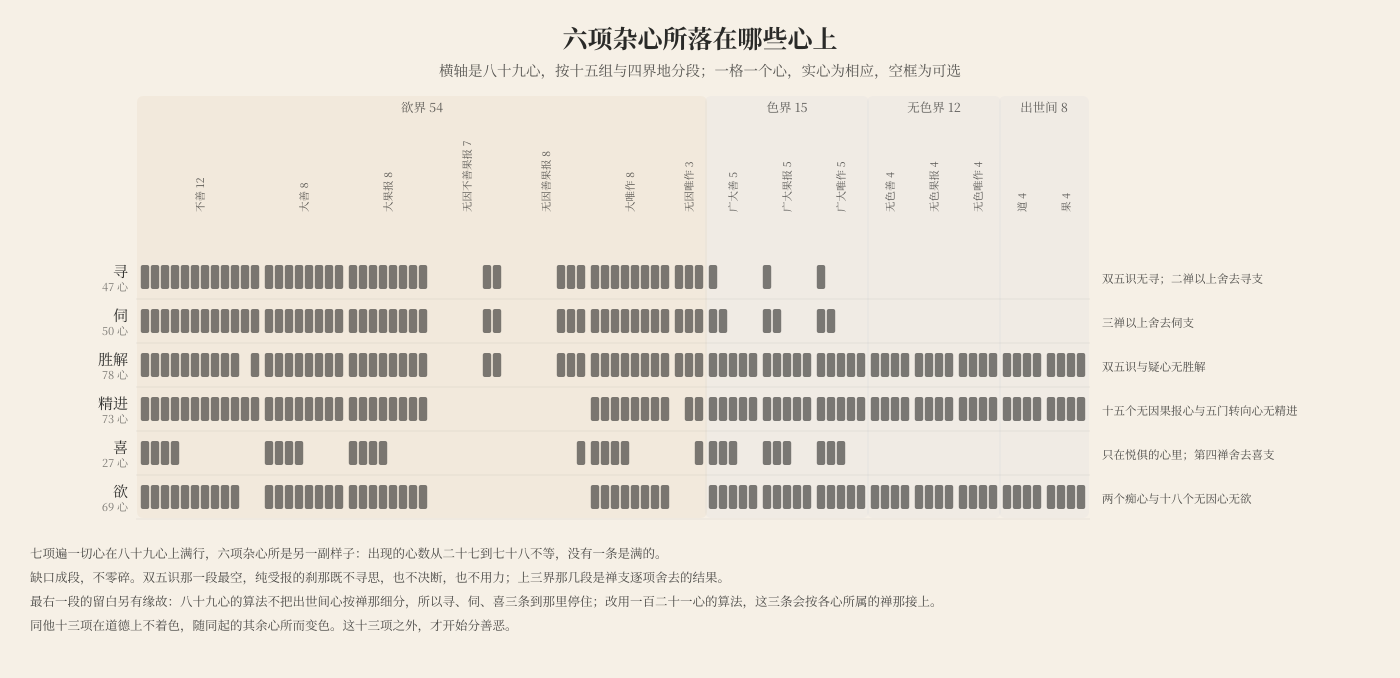
Question Two: what can be additionally combined. Six factors, called the occasional cetasikas: initial application, sustained application, decision, energy, joy, and desire. They do not occur in every citta, and their distributions differ: initial application in forty-seven, sustained application in fifty, decision in seventy-eight, energy in seventy-three, joy in twenty-seven, and desire in sixty-nine.
The first seven plus these six make thirteen, traditionally called the ethically variable cetasikas. Nārada explains the name aññasamāna: añña means other and samāna common; the thirteen are common to wholesome and unwholesome cittas. They are ethically uncolored in themselves and take their color from the other cetasikas with which they arise.3 The name answers the first two questions neatly. What all cittas share and what may be additionally combined are precisely the ethically neutral factors.
Every absence is meaningful, and read one by one they form an inverse explanation. The two sets of fivefold consciousness lack initial application, sustained application, decision, and energy: a moment of pure result neither thinks about, decides upon, nor exerts itself toward the object. The second jhāna and above lack initial application; the third and above lack sustained application, as jhāna factors are successively abandoned. A citta of doubt lacks decision because doubt is the absence of decision. The two delusion-rooted cittas and eighteen rootless cittas lack desire. The fifteen rootless resultant cittas and five-door adverting lack energy because undergoing a result and merely adverting require no effort. Joy occurs only in cittas accompanied by pleasure, while a pleasant fourth-jhāna citta lacks joy: that cell represents pleasure remaining after the jhāna factor of joy has been abandoned.
One blank must also be explained. The eighty-nine-citta method does not divide supramundane cittas by jhāna, so initial application, sustained application, and joy are blank in all eight. The totals forty-seven, fifty, and twenty-seven are counted on that basis. Under the 121-citta method, in which the paths and fruits are expanded according to their jhānas, these factors are restored where appropriate.
The six distributions appear side by side below, placing every gap just described on the figure.
Question Three: what all unwholesome cittas share, and where they differ. Four factors occur universally in the unwholesome: delusion, shamelessness, fearlessness of wrongdoing, and restlessness. Every one of the twelve unwholesome cittas has all four.
There are ten particular factors: greed in eight cittas; wrong view in four; conceit in four, and then only optionally; hatred in two; envy in two; avarice in two; regret in two; doubt in one; sloth in five; torpor in five. Four plus ten gives the fourteen unwholesome cetasikas.
The numbers themselves form a table of weights. The four universal factors show that every unwholesome moment is simultaneously a moment of delusion, shamelessness, fearlessness of wrongdoing, and distraction. Greed occupies only eight cittas, hatred two, doubt one. Greed and hatred, so often treated as representative defilements, are only particular factors in this table.
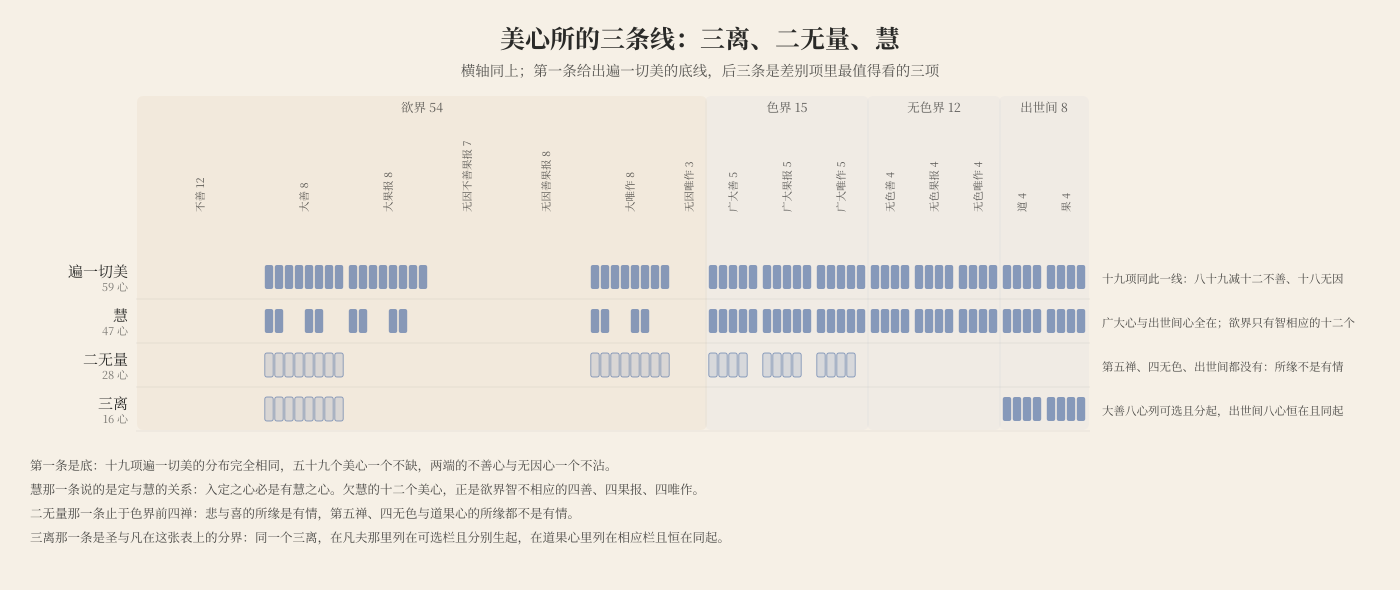
Question Four: what all beautiful cittas share, and where they differ. Nineteen factors, called the universal beautiful cetasikas, occur in all fifty-nine beautiful cittas: faith, mindfulness, moral shame, moral dread, non-greed, non-hatred, neutrality of mind; and six pairs, twelve items in all—tranquillity, lightness, malleability, wieldiness, proficiency, and rectitude, each divided into a mental-body side and a citta side.
The six pairs deserve one sentence. They repeat one point six times, then divide each repetition into a cetasika and citta column: freedom from disturbance, heaviness, rigidity, resistance, inexperience, and crookedness. This is the purest example of Abhidhamma's preference for format discussed in Chapter 1. A quality that could be stated in one sentence is divided into twelve entries because the table requires every item to be separately registered. In practice the twelve are never independently identified, yet each occupies its own cell.
There are six particular beautiful factors: right speech, right action, and right livelihood, together called the three abstinences; compassion and appreciative joy, called the two immeasurables; and wisdom. Nineteen plus six gives the twenty-five beautiful cetasikas.
The number fifty-nine beautiful cittas is obtained by subtraction: eighty-nine minus twelve unwholesome and eighteen rootless cittas leaves fifty-nine. Wisdom occurs in forty-seven. The twelve beautiful cittas lacking wisdom are exactly the four wholesome, four resultant, and four functional sense-sphere cittas dissociated from knowledge.
Supplementary question: the minds of noble ones and those in absorption. The three abstinences behave differently in two places; the difference marks the boundary between noble and ordinary persons in the table.
In the eight great wholesome cittas, right speech, right action, and right livelihood appear in the optional column. They arise separately, and only when there is something from which to abstain. Refraining from false speech is one event; refraining from taking what has not been given is another; they do not occur together. In the four paths and four fruits, the three appear in the associated column, invariably and together. Sixteen cittas contain the abstinences: eight great wholesome and eight supramundane. Right speech, action, and livelihood in an ordinary person are occasional restraints; in a noble person they are standing features of the structure. This is the trace left by the path factors in the cetasika table.16
The two immeasurables occupy the opposite position. Compassion and appreciative joy occur in twenty-eight cittas: the eight great wholesome and eight great functional cittas, and the wholesome, resultant, and functional cittas of the first four fine-material jhānas. They do not occur in fifth-jhāna cittas, the four immaterial cittas, or supramundane cittas. The reason has two levels. The objects of compassion and appreciative joy are sentient beings; those of the fifth jhāna and the immaterial attainments are not. The object of path and fruit cittas is Nibbāna, likewise not a sentient being. The other two of the four immeasurables already have other places: loving-kindness is non-hatred, equanimity is neutrality of mind. Both are among the nineteen universal beautiful factors and require no additional entries.
Wisdom follows another line: twelve sense-sphere cittas associated with knowledge (four great wholesome, four great resultant, and four great functional) together with all fifteen fine-material, all twelve immaterial, and all eight supramundane cittas. Twelve plus fifteen plus twelve plus eight gives forty-seven. Every sublime and supramundane citta is associated with wisdom. This is the table's position on the relation between concentration and wisdom: a citta in absorption necessarily contains wisdom. Whether that wisdom is used for insight is another question, one the table does not distinguish.
When the baseline of the universal beautiful factors is drawn together with these three lines of particular factors, the two boundaries in the supplementary question become visible. The abstinence line distinguishes noble from ordinary persons; the wisdom line distinguishes sublime from sense-sphere cittas.
Supramundane cittas have another special feature: their optional columns are always empty. Ordinary minds contain many optional factors because each wholesome act can take several configurations. Path and fruit cittas offer no options because each is an event with a fixed structure; every factor that should be present is present. The disappearance of options is itself a description.
How to use the list. The guide to this part has already explained how to read these chapters; one concrete sentence may be added. The list is a reference for contemplation: is this cell wholesome or unwholesome, rooted or rootless, accompanied by joy, equanimity, or displeasure, prompted or unprompted? Being able to identify the present event in the table is more useful than being able to recite the whole table.
Modern language is only an entrance. Translating joy as happiness, restlessness as anxiety, and neutrality of mind as even-mindedness may help a reader enter, but taking those translations literally turns cetasikas into emotions. Cetasikas and emotions operate at different scales. An emotion is an experience with duration and fluctuation that can be narrated; a cetasika is one aspect of a single moment. Twenty minutes of anger is, in this analysis, the succession of thousands of cognitive processes in which the cetasika of hatred repeatedly arises. Anger describes the whole region; hatred names one aspect of one moment within it. Conflate the two and the entire analysis immediately fails.
We must likewise avoid reading the four classes as value judgments. A resultant citta is not a good citta; a functional citta is not a superior citta. The classes mark kammic identity, not a hierarchy of minds. We have already seen that an arahant's functional citta and an ordinary person's wholesome citta may have identical configurations of cetasikas.
To Chapter 3. The catalogue of mind is now arranged; next comes its counterpart. The twenty-eight kinds of rūpa are not produced by crossing axes as the eighty-nine cittas are. Their organizing principle answers another question. The taxonomy of mind asks about kamma and result; the taxonomy of rūpa asks how a set of material phenomena constitutes a unit available to contemplation. The next chapter begins with the four great elements and derived matter.
References
References
-
The Dhammasaṅgaṇī, first of the seven Abhidhamma books, opens its mātikā with the triad wholesome, unwholesome, and indeterminate (kusalā dhammā, akusalā dhammā, abyākatā dhammā). The indeterminate is further divided into result (vipāka) and functional activity (kiriya). English translation: C. A. F. Rhys Davids, A Buddhist Manual of Psychological Ethics (London: Royal Asiatic Society, 1900; reprinted by the Pali Text Society). ↩
-
Nibbedhika Sutta (AN 6.63): “Cetanāhaṃ, bhikkhave, kammaṃ vadāmi. Cetayitvā kammaṃ karoti kāyena vācāya manasā.” English translation: Bhikkhu Bodhi, The Numerical Discourses of the Buddha (Boston: Wisdom Publications, 2012). The Chinese parallel is Madhyama Āgama 111, Dá Fànxíng Jīng: “How is kamma known? There are two kinds of kamma: intention and action after intention.” The wording agrees, and the parallel is secure. ↩
-
Nārada Mahā Thera, trans. and ed., A Manual of Abhidhamma (Abhidhammattha Saṅgaha) (Kandy: Buddhist Publication Society; many reprints). This chapter cites his explanations of kiriya and ahetuka in Chapter 1 and of aññasamāna in Chapter 2: añña means “other,” samāna “common.” ↩↩↩
-
The group AN 4.123–126 concerns the destinations corresponding to the four jhānas and four brahmavihāras and the divergent destinies of ordinary and noble practitioners. See Bodhi, Numerical Discourses, cited above. Chinese parallels to AN 4.123 and AN 4.124 are both found in Madhyama Āgama 168, Yìxíng Jīng. The current SuttaCentral parallels catalogue lists no strict Chinese counterparts for AN 4.125 and AN 4.126, and this audit located none that can be assigned with confidence. The Pāli texts of all four discourses have been verified. This part uses only the correspondence between jhāna and destination; see Part 13, Chapter 5 for details. ↩
-
Bāhiya Sutta (Ud 1.10): “Diṭṭhe diṭṭhamattaṃ bhavissati, sute sutamattaṃ...” (“In the seen, only the seen; in the heard, only the heard; in the sensed, only the sensed; in the cognized, only the cognized”). English translation: Ṭhānissaro Bhikkhu, Udāna, dhammatalks.org. Strictly speaking, Saṃyukta Āgama 312 is not a direct parallel to the Bāhiya narrative of Ud 1.10; it is the Chinese parallel to the Māluṅkyaputta Sutta (SN 35.95). SN 35.95 and Ud 1.10 share the “in the seen, only the seen” instruction. The relationship is therefore one of shared teaching, not a direct Chinese counterpart to Ud 1.10. ↩
-
Nidāna Sutta (AN 3.34): kamma born of non-greed, non-hatred, and non-delusion, once its root has been cut off, becomes like a palm tree with its crown removed and cannot arise again. See Bodhi, Numerical Discourses, cited above. The Pāli text and simile have been verified. The current SuttaCentral parallels catalogue lists no strict Chinese parallel, and this audit located none that can be assigned with confidence; no Chinese discourse number is therefore supplied. ↩
-
Ariyamagga Sutta (AN 4.237). Of the four kinds of kamma, the fourth is “neither dark nor bright, with neither-dark-nor-bright result, leading to the destruction of kamma,” and is directly defined as the eightfold path. Compare the four kinds of kamma in AN 4.232–235. See Bodhi, Numerical Discourses, cited above. ↩
-
Tabular Exposition of the Abhidhammattha Saṅgaha. All numbers in this part follow it. The citta-by-citta configurations of cetasikas, the optional columns, and the explanations of smile-producing and joyful investigating consciousness used here come from this work. The full tables of eighty-nine cittas and fifty-two cetasikas are not reproduced in the chapter; readers requiring cell-by-cell comparison should consult the source directly. ↩↩↩
-
Saṃyukta Āgama 1243: “Two bright qualities protect the world. What are the two? Moral shame and moral dread. If the world lacked these two bright qualities, it would not know the order of parents, brothers, sisters, spouses, relatives, teachers, elders, and juniors, but would be inverted and confused like the animal realm.” The Pāli counterpart is the Cariya Sutta (AN 2.9). ↩
-
Abhidhammattha Saṅgaha, Chapter 1, Cittasaṅgahavibhāga: the grouping of the eighty-nine cittas, the fivefold division of jhāna, and the relation between the counts of eighty-nine and 121. ↩↩
-
Bhikkhu Bodhi, general ed., A Comprehensive Manual of Abhidhamma: The Abhidhammattha Saṅgaha of Ācariya Anuruddha (Kandy: Buddhist Publication Society, 1993), combining the Pāli text with explanations by U Rewata Dhamma and Bhikkhu Bodhi. This chapter cites its discussions of the fourteen functions (kicca) and the jhāna basis of supramundane cittas. ↩↩
-
Abhidhammattha Saṅgaha, Chapter 2, Cetasikasaṅgahavibhāga, opening verse: “Ekuppāda-nirodhā ca, ekālambana-vatthukā; cetoyuttā dvipaññāsa, dhammā cetasikā matā.” The fifty-two dhammas associated with citta arise and cease together with it and share its object and base; these are called cetasikas. The division into thirteen ethically variable, fourteen unwholesome, and twenty-five beautiful cetasikas also comes from this chapter. ↩
-
Visuddhimagga, Chapter XIV, Khandha-niddesa: definitions of citta and cetasikas item by item, with the fourfold defining method applied to each. English translation: Bhikkhu Ñāṇamoli, The Path of Purification (Kandy: Buddhist Publication Society, 1975). ↩
-
Vibhaṅga Sutta (SN 12.2) defines name: “Vedanā, saññā, cetanā, phasso, manasikāro—idaṃ vuccati nāmaṃ.” English translation: Bhikkhu Bodhi, The Connected Discourses of the Buddha (Boston: Wisdom Publications, 2000). The Chinese parallel, Saṃyukta Āgama 298, defines name as the four immaterial aggregates (feeling, perception, formations, and consciousness), unlike the Pāli item's five-factor enumeration. The divergence is itself the evidence used here. ↩
-
Mūlaka Sutta (AN 10.58; compare the same question-and-answer form in AN 8.83 and AN 9.14): “Chandamūlakā, āvuso, sabbe dhammā, manasikārasambhavā sabbe dhammā, phassasamudayā sabbe dhammā...” English translation: Bodhi, Numerical Discourses, cited above. The Chinese parallel is Madhyama Āgama 113, Zhūfǎběn Jīng. The Pāli and Chinese versions differ slightly in number and sequence—the Pāli has ten items, the Chinese nine statements. This chapter uses only the six factors overlapping with the cetasika table. ↩
-
Y. Karunadasa, The Theravāda Abhidhamma: Its Inquiry into the Nature of Conditioned Reality (Somerville, MA: Wisdom Publications, 2018; originally Hong Kong: Centre of Buddhist Studies, University of Hong Kong, 2010), on the different behavior of the three abstinences (virati) in mundane wholesome and supramundane cittas. ↩