Chapter 4: Citta-vīthi: A Taxonomy of Mental Processes¶
What this chapter sets out to do. The preceding two chapters arranged two inventories, one of mentality and one of materiality. Once the inventories have been drawn up, one question remains unanswered: when these phenomena actually occur, in what order do they appear? The cognitive process (citta-vīthi) is this system's answer. It breaks a single cognition into a series of stations, specifying which kinds of consciousness can occupy each station, the order in which they succeed one another, and the conditions under which the process can or cannot run to completion.
This chapter has two main lines. One continues Chapter 2: at exactly which station is kamma made, at which step do wholesome and unwholesome kamma diverge, and through which stations does kamma already made return as result? The other concerns the practical use of the taxonomy. It supplies a workflow for contemplation: what is to be contemplated, and where intervention remains possible, must be located on this diagram. Apart from the overview and these two main lines, the chapter is largely a reference list. It may be consulted when needed and need not be read straight through.
The gist: what this taxonomy is saying. Three sentences.
First, a cognition is not completed in a single instant. It has to traverse a line with a fixed sequence of operations: an object impinges on a sense faculty; consciousness emerges from the life-continuum and adverts to it; it sees, receives, investigates, and determines; then comes the segment in which kamma is made, followed at the end by a brief aftertaste. Each step has its own station and function. If a step is missing, the cognition is incomplete.
Second, consciousness is serial. Only one consciousness occurs at a time; they do not run in parallel. What we call seeing and hearing at once is explained, in this system, as extremely rapid alternation.
Third, the interval between two cognitive processes is not empty. Life-continuum consciousness maintains continuity there. Rebirth-linking and death are placed on the same line; these three functions are collectively called process-freed consciousnesses. The junction between one life and the next lies here: as death consciousness ceases, rebirth-linking consciousness arises, with no intervening station. This is the Abhidhamma's direct answer to the problem of rebirth. A separate section at the end of this chapter treats it, and Chapter 6 continues the discussion.
The fifteen five-door patterns are listed below for consultation when needed. Even these three sentences alone, however, should make clear what the cognitive process is meant to explain: how a cognition proceeds step by step to completion, and at exactly which step kamma is made.
First, what it is not. A cognitive process is not an ancient version of a neural process. What it arranges is not a physical chain of signal transmission, but the phases into which a cognition appears divided when observed. Every station on the line is a consciousness. A consciousness is a mental phenomenon that has an object, is accompanied by associated mental factors, and performs a particular function. It has no location or velocity and occupies no space. To read five-door adverting as a signal reaching the thalamus, or receiving as processing in the primary cortex, is precisely the kind of preconception against which the guide to Part II warned.
Nor is a mind-moment a unit of time; it is a unit of order. To say that materiality lasts for seventeen mind-moments means that it lasts as long as seventeen consciousnesses successively arise and cease, not seventeen multiplied by some number of milliseconds. The Abhidhamma itself assigns no physical duration to a mind-moment. Conversions circulated in later commentaries and lecture notes are rhetoric, not measurement. This chapter will return to the point: here the entire system has order but no duration, and that gap is precisely what makes the section on absorption most revealing.
Mind-moments and non-parallelism. The life of one consciousness has three submoments: arising, presence, and dissolution. Together, the three constitute one mind-moment.1 Consciousnesses follow one another. Only when the preceding one has ceased does the next arise, with neither gap nor overlap.
This is the foundation of the entire doctrine of cognitive processes. Because consciousnesses do not run in parallel, a cognition must be arranged along a single line. Because there is no gap, something must fill the interval between two cognitions: the life-continuum. The definition of a cognitive process follows—a sequence of consciousnesses in a fixed order. “Fixed order” means that the system determines which station follows which; the succession is not random. This is also why the chapter has to consist largely of lists. There are only so many patterns, and they need simply be set out.
What kinds of cognitive process are there? Before treating them one by one, the following table gives the full set for ready reference. Its first eight rows are cognitive processes; the last lies outside cognitive process.
| Type | Door through which it begins | Pattern | Consciousnesses that occupy the javana phase | Key point |
|---|---|---|---|---|
| Five-door process | Eye, ear, nose, tongue, or body | Fifteen patterns | Twenty-nine sense-sphere javana consciousnesses | The complete form has seventeen mind-moments; the strength of the object determines its length, and an incomplete process falls back into the life-continuum partway through |
| Consequent mind-door process | Mind door | Six patterns, tabulated together with the next type | Twenty-nine sense-sphere javana consciousnesses | Follows a five-door process and takes up again the object just taken through the five doors; recognizing an object requires at least three such processes |
| Bare mind-door process | Mind door | Six patterns, tabulated together with the preceding type | Twenty-nine sense-sphere javana consciousnesses | Does not arise from a five-door process, but directly takes a mental object: a memory, concept, meditation image, or Nibbāna |
| Fine-material absorption process | Mind door | Transition through four or five stations | Five fine-material-sphere wholesome and five functional consciousnesses | The jhāna consciousness occurs only after preparation, access, conformity, and change-of-lineage; there is no registration |
| Immaterial absorption process | Mind door | Transition through four or five stations | Four immaterial-sphere wholesome and four functional consciousnesses | Uses the same transition as the fine-material process; its objects are the four immaterial attainments |
| Direct-knowledge process | Mind door | Transition through four or five stations | Wholesome or functional fifth-jhāna consciousness | Based on the fifth jhāna; the direct-knowledge consciousness arises only once and immediately falls back into the life-continuum |
| Path process | Mind door | Transition through four or five stations | Four path consciousnesses | “Change-of-lineage” is renamed “change-over” here; a path consciousness lasts one moment, and each of the four paths occurs only once in a lifetime |
| Fruition process | Mind door | Transition through four or five stations | Four fruition consciousnesses | Two or three fruition consciousnesses arise immediately after the path; after attainment, fruition attainment may also be entered separately |
| Process-freed consciousnesses (outside cognitive process) | Do not arise through a door | Do not form a cognitive process | Do not occupy the javana phase | Nineteen consciousnesses perform the three functions of rebirth-linking, life-continuum, and death; their object does not change within a life |
Two points in the table are worth remembering from the outset. First, the three sense-sphere types follow the fifteen-pattern and six-pattern schemes. The four types involving sublime or supramundane consciousness follow another scheme, using preparation, access, conformity, and change-of-lineage as their transition and never including registration. Second, the final row is not a cognitive process. It fills the intervals between processes and between lives, and a separate section near the end of this chapter will treat it.
The five-door process: seventeen moments. Begin with the most complete pattern. When a sufficiently strong object meets any of the five doors (eye, ear, nose, tongue, or body), the resulting pattern is:
life-continuum → past life-continuum → vibration of the life-continuum → arrest of the life-continuum → five-door adverting → fivefold sense consciousness → receiving → investigating → determining → javana × 7 → registration × 2 → life-continuum2
Counting from the past life-continuum to the second registration gives exactly seventeen mind-moments. The two life-continuum consciousnesses at the beginning and end form the background outside the cognitive process and are not counted.
Here is the sequence station by station. The life-continuum is the ordinary state of consciousness when no cognitive process is occurring; its object comes from the final cognitive process of the preceding life, not from the present. At the instant an object impinges on a sense faculty, the life-continuum has not yet reacted. One moment simply flows past; this is the past life-continuum. The life-continuum then trembles once: vibration of the life-continuum. A further moment cuts off its flow: arrest of the life-continuum. Five-door adverting turns toward the object, and the cognitive process properly begins. Fivefold sense consciousness arises: there is seeing or hearing, but as yet only sheer sight or sound, without any judgment. Receiving takes over what the sense consciousness has encountered. Investigating appraises it. Determining classifies it. Seven javanas then run in succession; this is the only segment of the entire line in which kamma is made. Finally two registrations savor a little aftertaste, and consciousness falls back into the life-continuum.
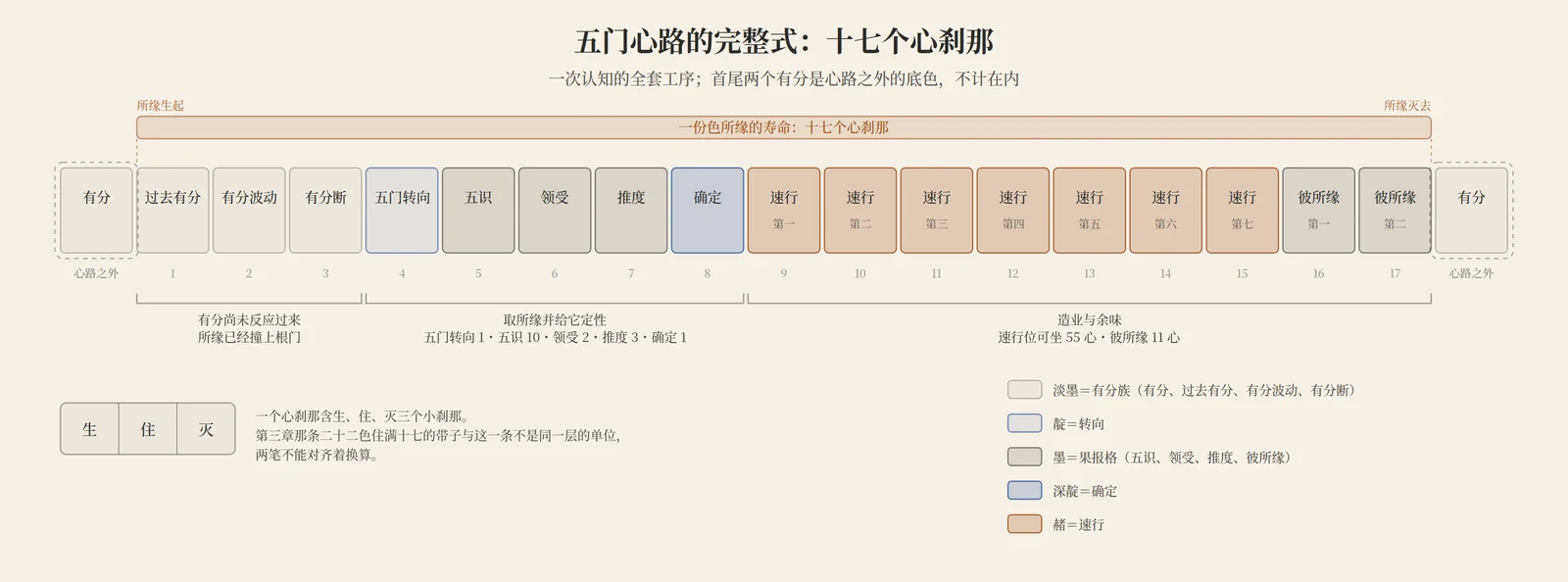
This station-by-station order is the framework for everything that follows in the chapter.
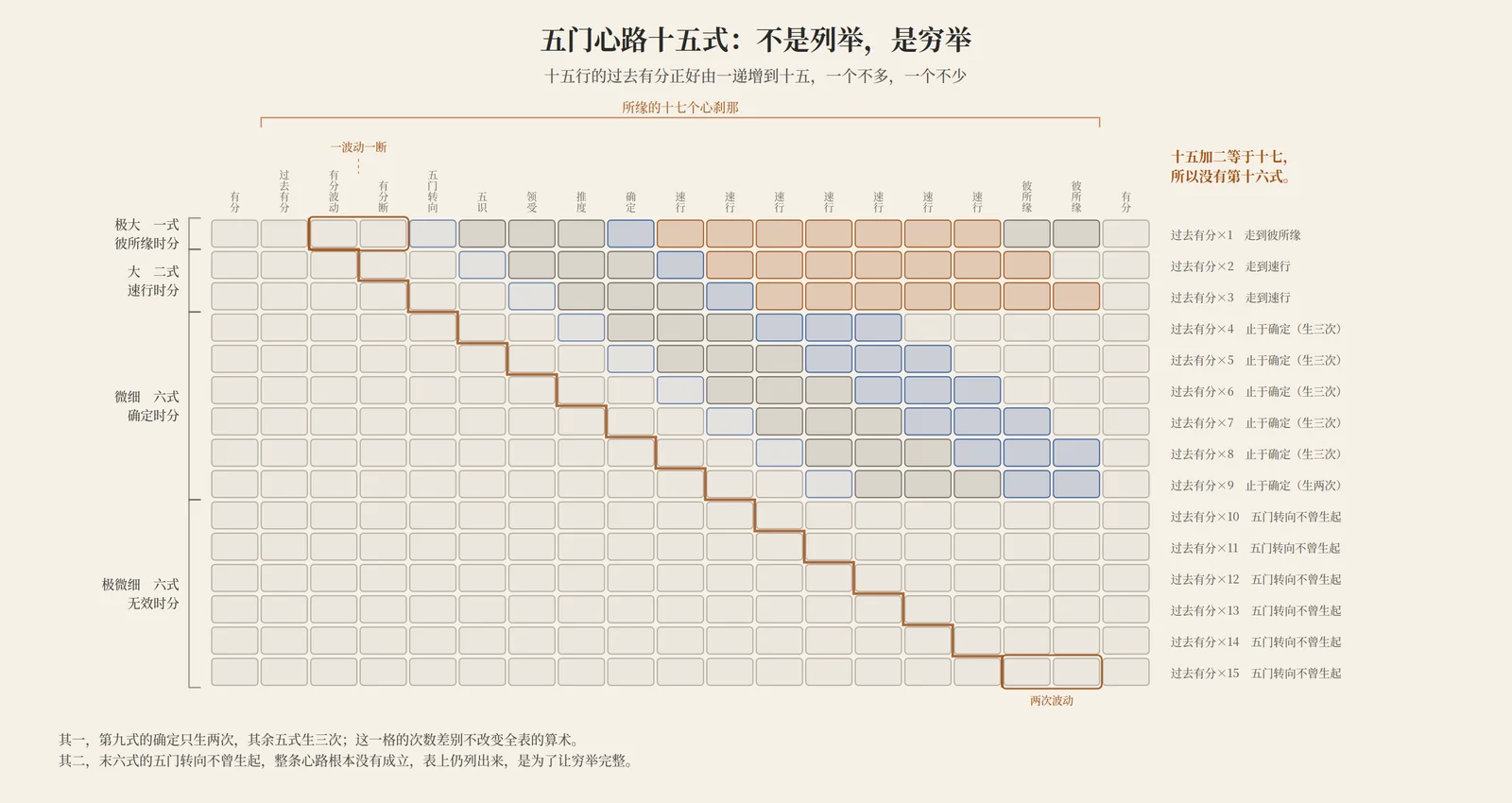
Why exactly fifteen patterns? The object is not always so strong. Its strength determines how far the cognitive process proceeds; when it cannot run to completion, it falls back into the life-continuum partway through. The Tabular Exposition divides objects into four degrees (very great, great, slight, and very slight) corresponding to four groups that together contain fifteen patterns.2
A very great object has one pattern: the complete seventeen-moment line above, which reaches registration and is therefore called the registration phase.
A great object has two patterns. All seven javanas run, but no registration follows; at the end consciousness falls directly into the life-continuum. This is therefore called the javana phase.
A slight object has six patterns. The process stops at determining, which arises three times in succession (only twice in the ninth pattern), and no javana occurs at all. This is therefore called the determining phase.
A very slight object has six patterns. Five-door adverting never arises; the life-continuum merely vibrates twice and resumes. No cognitive process has actually been established. This is therefore called the futile phase.
Fifteen is not a selection but an exhaustive count. Across the fifteen patterns, the number of past life-continuum moments runs from one through fifteen, neither more nor fewer.2 The reason is arithmetic. From the object's impingement on a sense door until its disappearance, only seventeen mind-moments are available. After the past life-continuum, at least two more stations must be occupied—either one vibration and one arrest, or two vibrations. Fifteen plus two makes seventeen. There can therefore be no more than fifteen past life-continuum moments, and a sixteenth pattern is impossible.
The conclusion is worth remembering: at this point the system has not merely selected fifteen representative cases; it has exhausted the possibilities. Here it is closed. Where the seventeen on which that closure depends comes from will be left until later in the chapter.
Seeing is not yet recognizing. What has been obtained when one five-door process ends? According to this system, only the visible object itself—not what we ordinarily mean when we say that we have seen a phone. A phone is a concept, and a concept is not an object of the five doors. The five-door process delivers only a raw patch of color and then falls back into the life-continuum. The mind door next takes over, and a succession of mind-door processes makes it into a cognition that can be put into words.
The exegetical tradition is explicit on this point. Immediately after the five-door process comes a mind-door process, which mentally takes up again the same object. Consciousness then falls back into the life-continuum, after which two more processes of the same type occur before the object is fully recognized.3 Later teaching organized this passage into three layers: the first mind-door process retakes what has just been seen; the second combines it with what was previously seen and derives a shape; the third supplies a name. Thus, roughly speaking, a complete account of a single glance requires one five-door process followed by at least three mind-door processes. A single seventeen-moment line is not enough.4
This point deserves separate emphasis because it is often passed over. When a textbook draws a seventeen-station diagram, readers can easily take it for the entire process of seeing. In fact, that diagram reaches only as far as the visible object. What ordinary speech calls seeing what something is is always a product of the mind door; the five doors supply only the raw material.
An earlier formulation in the discourses can be aligned with this account. The Madhupiṇḍika Sutta says that dependent on the eye and forms, eye consciousness arises; the meeting of the three is contact; with contact as condition there is feeling; what one feels, one perceives; what one perceives, one thinks about; what one thinks about, one reflects upon; what one reflects upon, one mentally proliferates.5 Feeling, perception, thinking, reflection, and proliferation form a line that continues to extend: its earlier part is still at the sense door, while its later part belongs wholly to the mind. The Abhidhamma's two-stage model divides this line into the five-door and mind-door portions and gives each a fixed pattern. The continuity between them is clear.
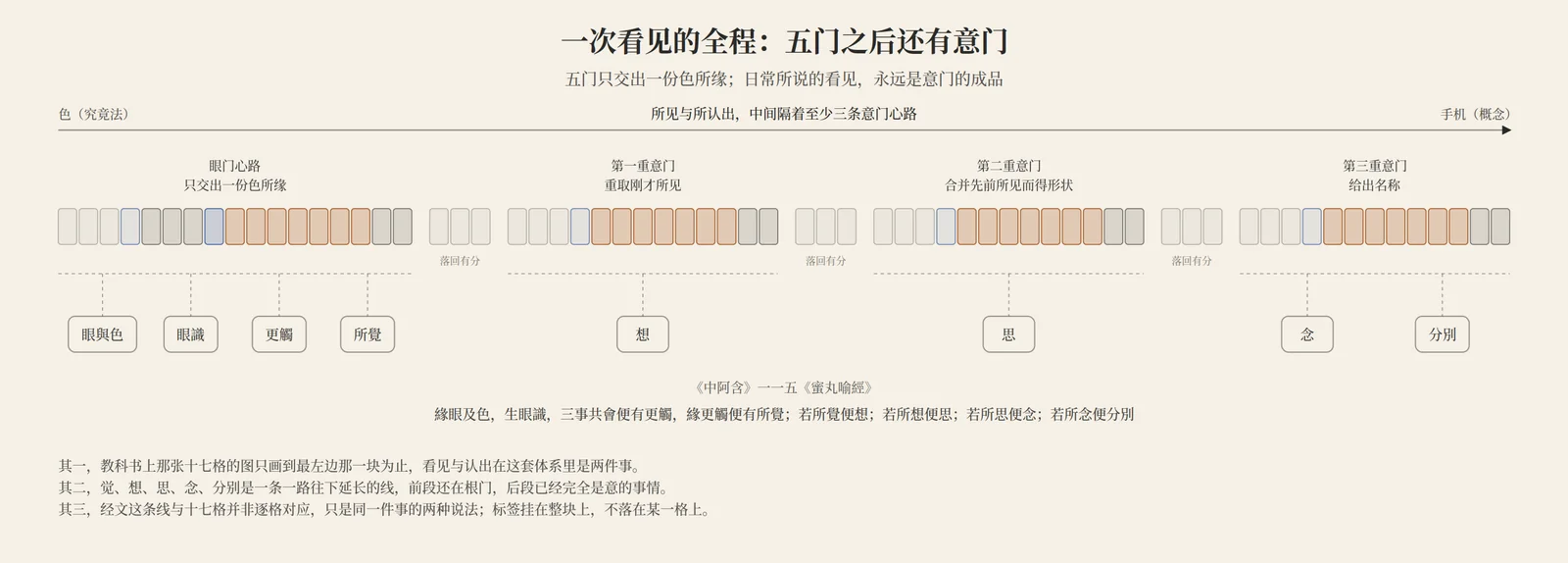
This also explains why the section on contemplation later in the chapter is located entirely at the mind door.
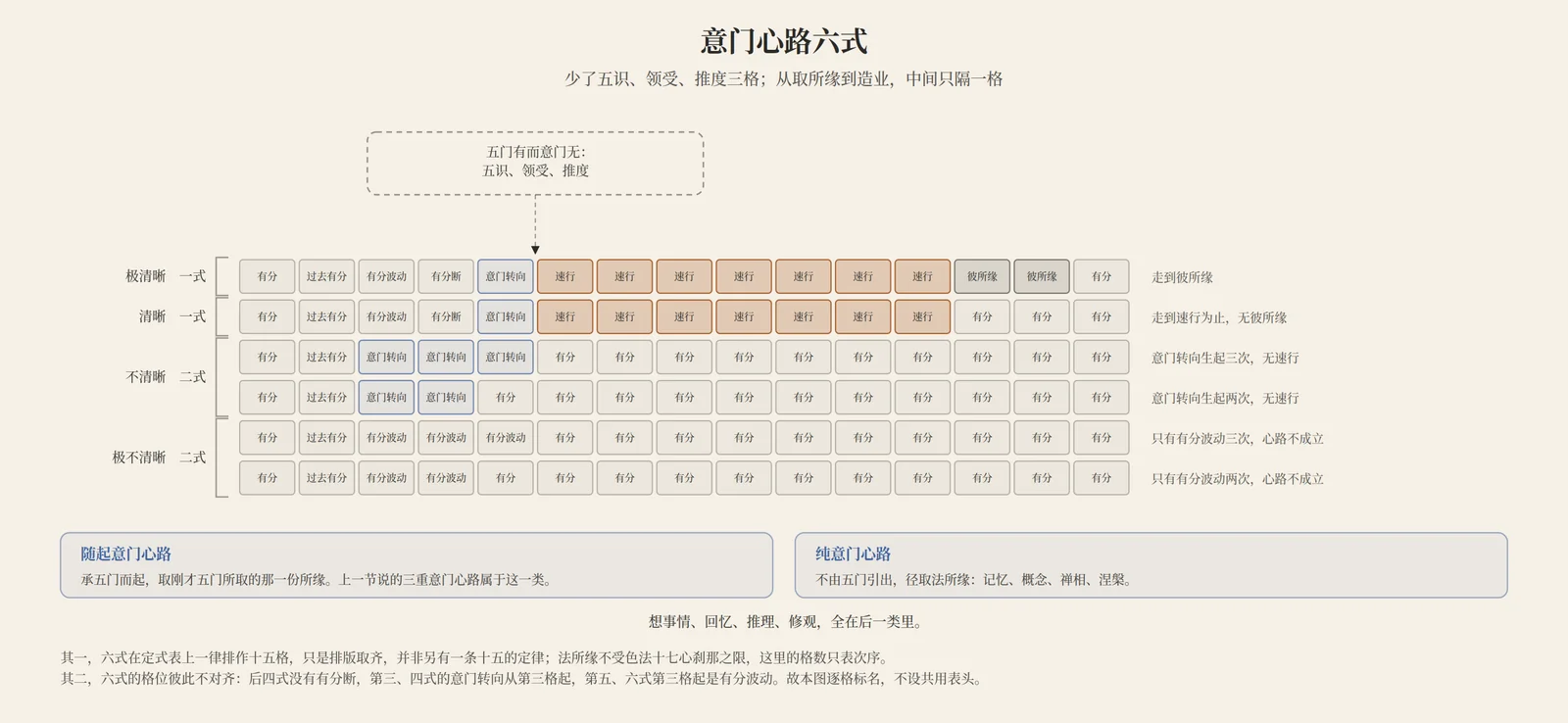
The mind-door process. There are six patterns, divided into four degrees according to the clarity of the object. A very clear object has one pattern, reaching registration. A clear object has one pattern, reaching javana. An obscure object has two patterns, in which mind-door adverting alone arises two or three times. A very obscure object has two patterns, in which only the life-continuum vibrates.2
Compared with the five-door process, the mind-door process has three fewer stations: no fivefold sense consciousness, no receiving, and no investigating. The object need not pass through reception and appraisal. After mind-door adverting, the process proceeds directly into javana. This is why the mind door is efficient, and also why it is prone to trouble: only one station lies between taking an object and making kamma.
Mind-door processes are themselves of two kinds. One arises in consequence of a preceding five-door process and takes the object just taken through that door; it is called a consequent mind-door process. The threefold series described in the preceding section belongs to this type. The other does not arise from a five-door process but directly takes a mental object—a memory, a concept, a meditation image, or Nibbāna. It is called a bare mind-door process. Thinking, remembering, reasoning, and insight practice all belong here.6
Kamma is made only in the javana segment. We can now resume the line from Chapter 2.
When Chapter 2 arranged the eighty-nine consciousnesses, it already established the division between kamma and result: resultant consciousnesses are the results of past kamma and do not produce new kamma; wholesome and unwholesome consciousnesses do. The cognitive process locates that division at concrete stations. In the entire five-door process, kamma is made only during javana. No other station makes kamma.
The numbers agree. Of the eighty-nine consciousnesses, fifty-five can perform javana: twelve unwholesome, eight great wholesome, eight great functional, one smile-producing, five fine-material-sphere wholesome, five fine-material-sphere functional, four immaterial-sphere wholesome, four immaterial-sphere functional, four path, and four fruition consciousnesses. None of the remaining thirty-four can enter the javana phase: tenfold sense consciousness, two receiving, three investigating, one five-door adverting, one mind-door adverting, eight great resultant, five fine-material-sphere resultant, and four immaterial-sphere resultant consciousnesses—exactly thirty-four, eighty-nine minus fifty-five.2
The count becomes immediately visible on the horizontal axis of eighty-nine consciousnesses used in Chapter 2. The following diagram retains that arrangement: its horizontal axis contains one consciousness per cell, divided into fifteen groups and four planes; a colored cell marks a consciousness that can occur in the javana segment. Two more diagrams below use the same axis—one for receiving the results of kamma and one for the fourteen functions. Viewed together, the three show which tasks the same consciousnesses can perform in the cognitive process.
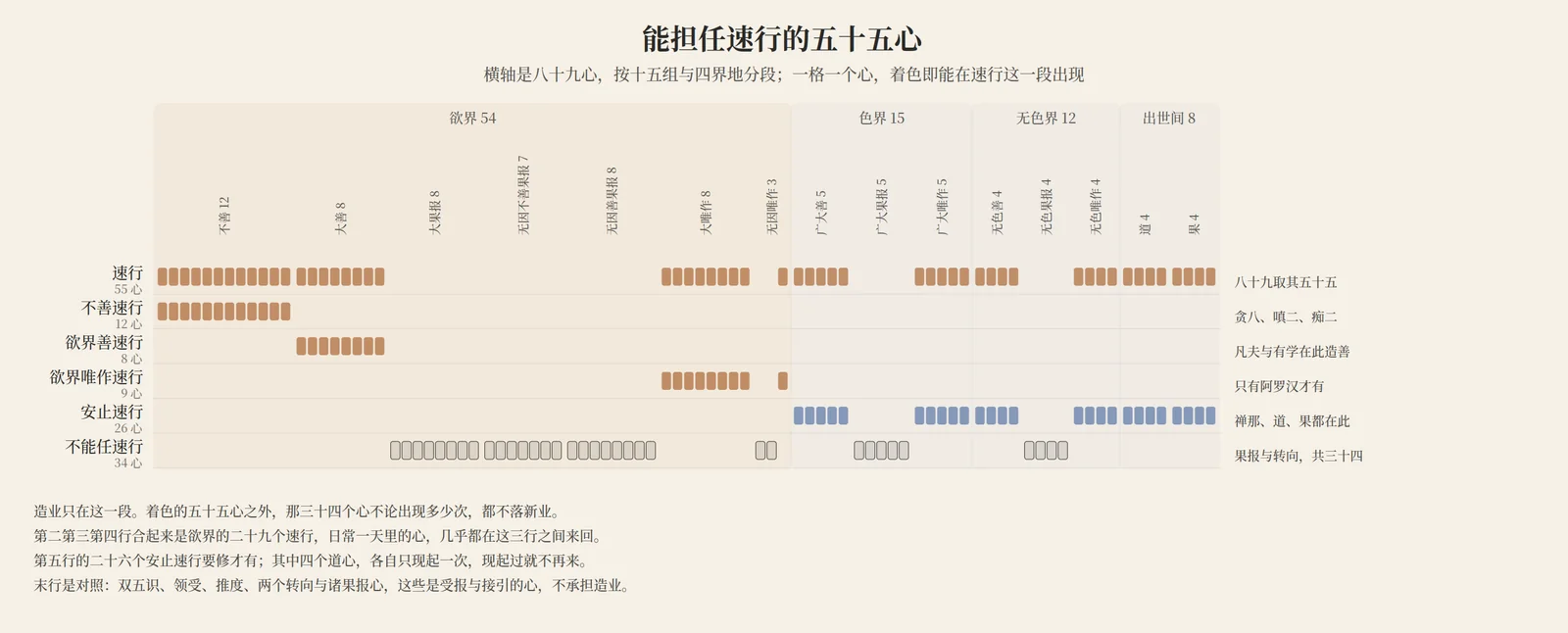
This comparison has a direct implication, half of which was already stated in Chapter 2 and can now be completed. Why does an arahant make no new kamma? Because functional consciousness, neither wholesome nor unwholesome, occupies the arahant's javana phase. “Functional” means precisely action that leaves nothing behind: the same position, the same seven moments, and the same configuration of mental factors, but no result is produced. The eight great functional, five fine-material-sphere functional, four immaterial-sphere functional, and smile-producing consciousnesses all belong to this category. The position has not changed; its nature has.
The fork lies at determining. At which station do wholesome and unwholesome kamma diverge?
In the fixed pattern, determining is the final station before javana, and its function is to classify the object. Whether the seven javanas that follow are wholesome or unwholesome depends on how it is classified at this station. The treatises assign the decisive role to attention: wise attention leads to the wholesome, unwise attention to the unwholesome.62
The position of this station matters. Every station before it is occupied by resultant consciousness. Fivefold sense consciousness, receiving, and investigating are all results of the maturation of past kamma; neither moral quality nor choice applies to them. The object's impingement on the door, its being seen, received, and appraised—these four steps are given and are not decided by the present person. Only at determining does some latitude first appear. Once that opening has passed, seven javanas run in succession and kamma has already been made.
The system thus locates the making of kamma within an exceedingly narrow space: on a line of seventeen stations, there is only one at which intervention is possible, and it comes late in the line. This conclusion has two uses. Looking backward, it explains why Chapter 2 attached the wholesome or unwholesome character of a consciousness to its configuration of mental factors rather than to its object. The object is a result and is not chosen; the configuration of mental factors belongs to the segment in which kamma is made. Looking forward, it identifies the point at which the section on contemplation will arrive, because this is the very station that practice can train.
One further qualification is needed. The six patterns for slight objects described above end at determining, without even one javana. Those six patterns mean that cognitions do exist which proceed only as far as classifying the object and make no kamma at all. These are not descriptions of an ideal state; they are plainly included in the table of fixed patterns.
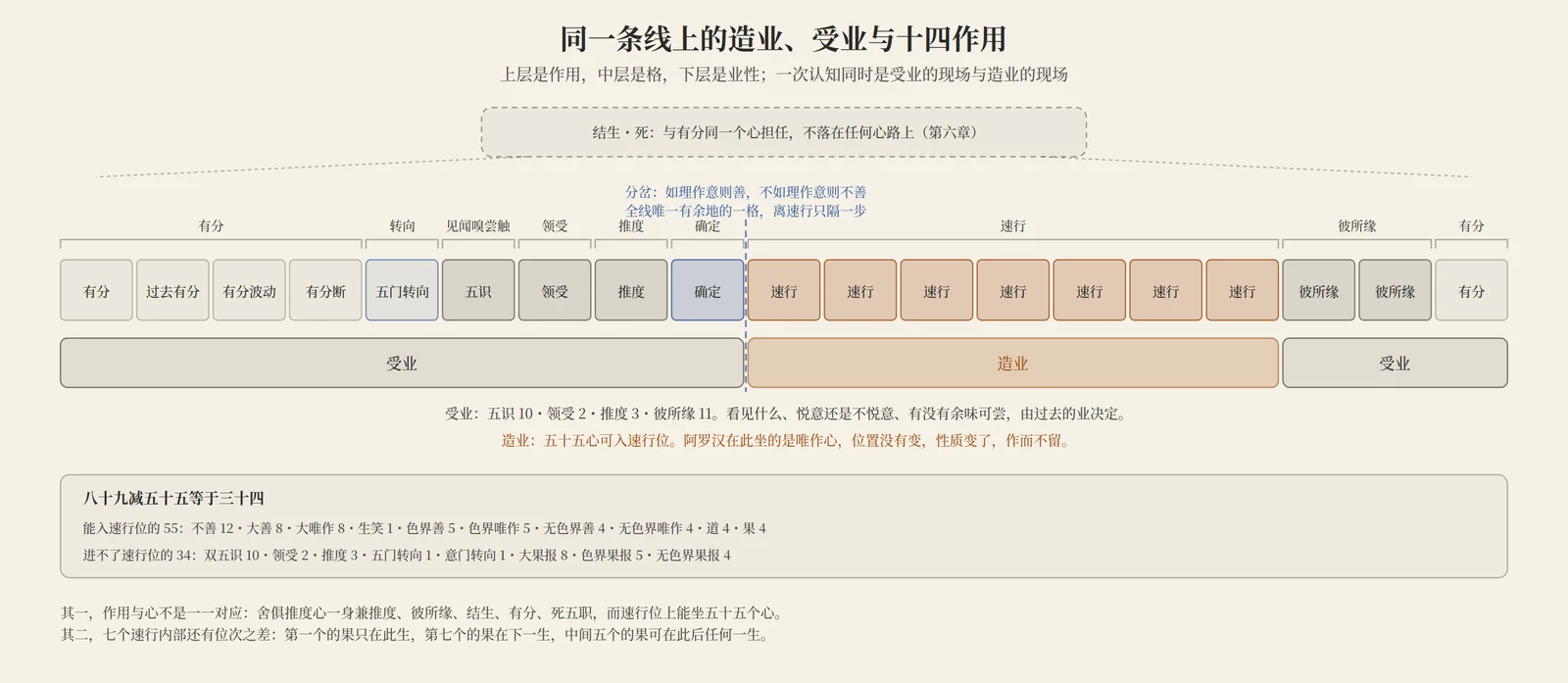
Seven javanas and three times of maturation. The treatises give no derivable reason why there are seven javanas. They say only that there are ordinarily seven and five at death.3 Later doctrine nevertheless put the number seven to use in classifying the time at which kamma matures.
The allocation is as follows. The first javana consciousness is the weakest. If its result matures, it can do so only in the present life, and is called immediately effective kamma. The seventh is next weakest; its result matures in the following life, and is called subsequently effective kamma. The results of the intervening five may mature in any later life until entry into Nibbāna, and they are called indefinitely effective kamma. Kamma that fails to mature when it could have done so becomes defunct kamma.32
This allocation joins the fourfold table of kamma by time of maturation in Chapter 2 to the cognitive process. In that chapter the four kinds were merely four labels. Here they become differences of position within a single series of seven javana consciousnesses. In one act of kamma, the first and seventh moments belong to different times of maturation, while the five between them form a further class.
This book's assessment should be explicit. It is a neat correspondence—so neat that it invites suspicion. Why is the first the weakest and the seventh the next weakest? Why are the five in between all equivalent? The treatises give no reason that can be independently tested. It looks more as though the fourfold classification of kamma came first and positions were then found for its categories among the seven javanas. Chapter 7 will return to this point.
At which stations are the results of kamma received? Kamma is made only during javana, but its results are distributed through the other parts of the cognitive process.
Within cognitive process, resultant consciousness occupies four places: the ten fivefold sense consciousnesses (seeing, hearing, smelling, tasting, and touching), the two receiving consciousnesses, the three investigating consciousnesses, and the eleven registration consciousnesses (the three investigating plus the eight great resultant consciousnesses).2 In a cognition, what is seen, whether the object is pleasant or unpleasant, and whether there is an aftertaste to savor are all determined by past kamma.
Outside cognitive process, resultant consciousness occupies three places: rebirth-linking, life-continuum, and death. These three functions belong to no cognitive process, yet they are the connective tissue between one process and the next and between one life and the next. The same consciousness performs all three and does not change within a single life. A separate section at the end of this chapter treats these functions; the details are left to Chapter 6.
The stations occupied by the thirty-six resultant consciousnesses can likewise be spread across the horizontal axis of eighty-nine. The point to notice in this diagram is the overlap in its final four rows: one equanimity-accompanied investigating consciousness occupies five places, and the eight great resultant consciousnesses occupy two.
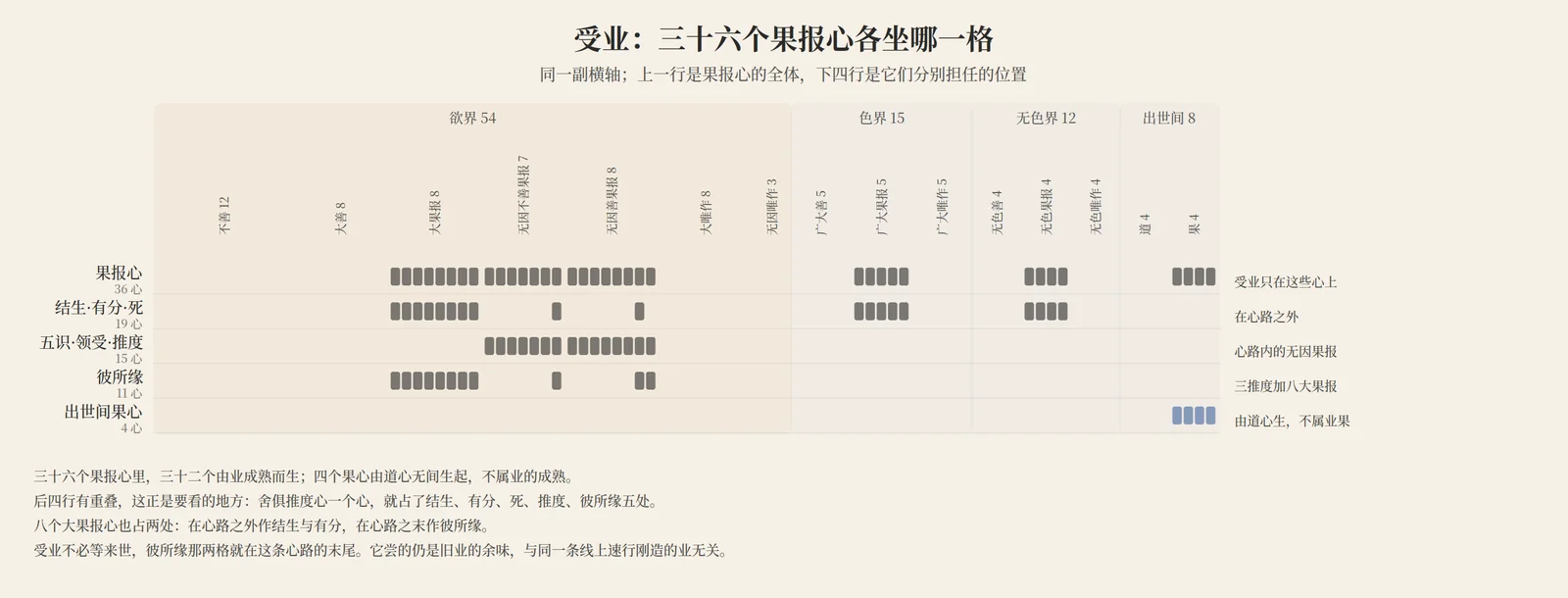
Putting these two locations together makes visually plain the statement from Chapter 2 that making kamma and receiving its results belong to different consciousnesses. The seven javana stations make kamma; the remaining stations receive its results. A single cognition is simultaneously the scene in which old kamma is received and new kamma is made. The two occur successively on the same line, receiving first and making later, with determining between them.
This is also where the first main line of the chapter arrives. Making kamma, making wholesome rather than unwholesome kamma, and receiving kamma are not three separate subjects in this system. They are three segments of one fixed pattern.
The fourteen functions within the cognitive process. Chapter 2 listed only the names of the fourteen functions and left their details to this chapter: rebirth-linking, life-continuum, adverting, seeing, hearing, smelling, tasting, touching, receiving, investigating, determining, javana, registration, and death. They can now be matched to the process. Eleven of the fourteen lie within cognitive process: adverting (five-door and mind-door adverting); seeing, hearing, smelling, tasting, and touching (performed by tenfold sense consciousness); receiving; investigating; determining; javana; and registration. The other three (rebirth-linking, life-continuum, and death) lie outside it.
Function and consciousness do not correspond one-to-one. One consciousness can perform several functions: an equanimity-accompanied investigating consciousness performs all five of investigating, registration, rebirth-linking, life-continuum, and death. Conversely, one function can be performed by several consciousnesses: fifty-five can occupy the javana phase. This is the concrete form of a point made in Chapter 2. The eighty-nine consciousnesses are an inventory classified by nature; the fourteen functions are an inventory classified by role. The two inventories are used crosswise.
The fourteen functions require only eight rows when spread across the same horizontal axis: rebirth-linking, life-continuum, and death are performed by the same nineteen consciousnesses, while seeing, hearing, smelling, tasting, and touching are performed by the same ten, so each set is combined into a single row.
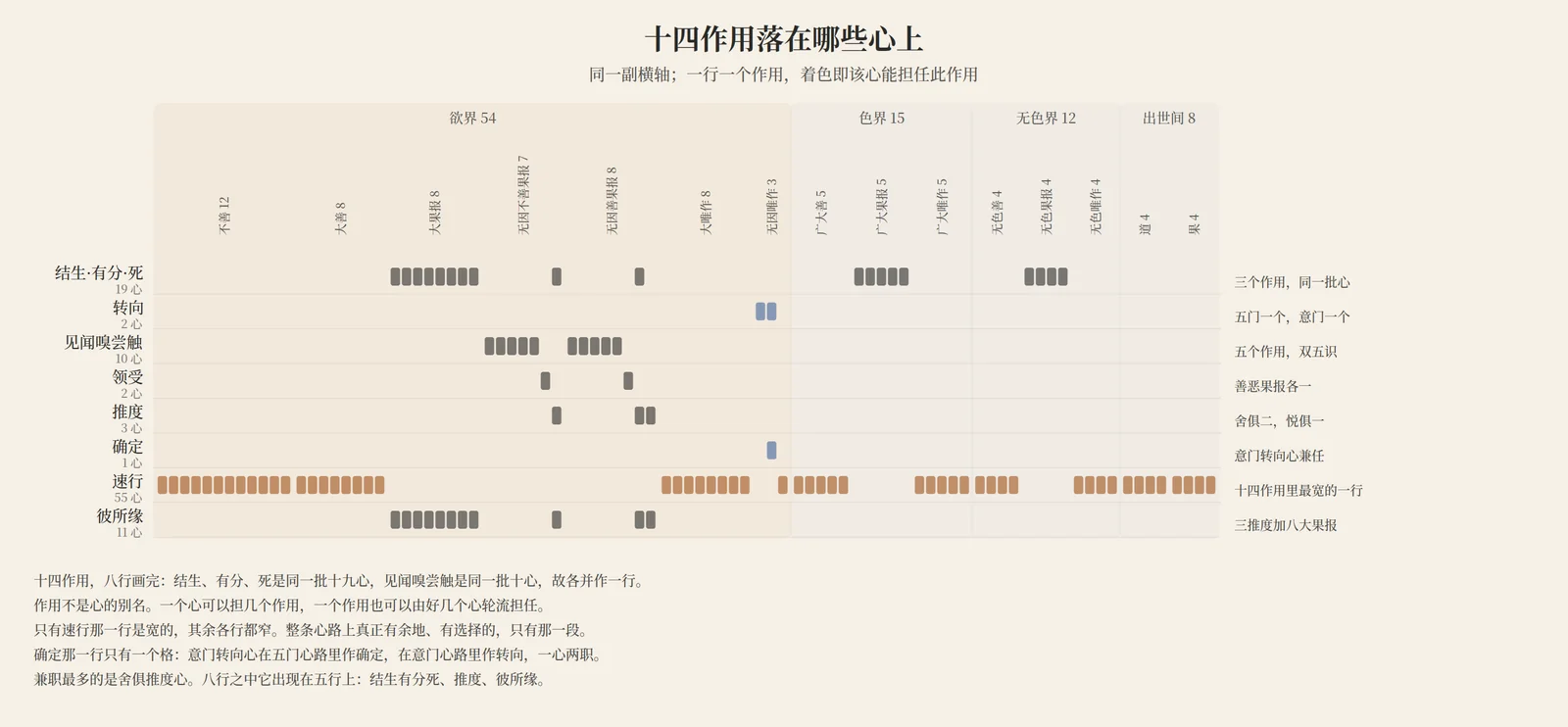
One feature of the diagram merits a pause: only the javana row is broad. Everywhere else the rows are narrow. In the entire cognitive process, that alone is where genuine latitude and choice exist.
The absorption process. Everything so far has concerned sense-sphere cognitive processes. The entry into jhāna through concentration follows another scheme.
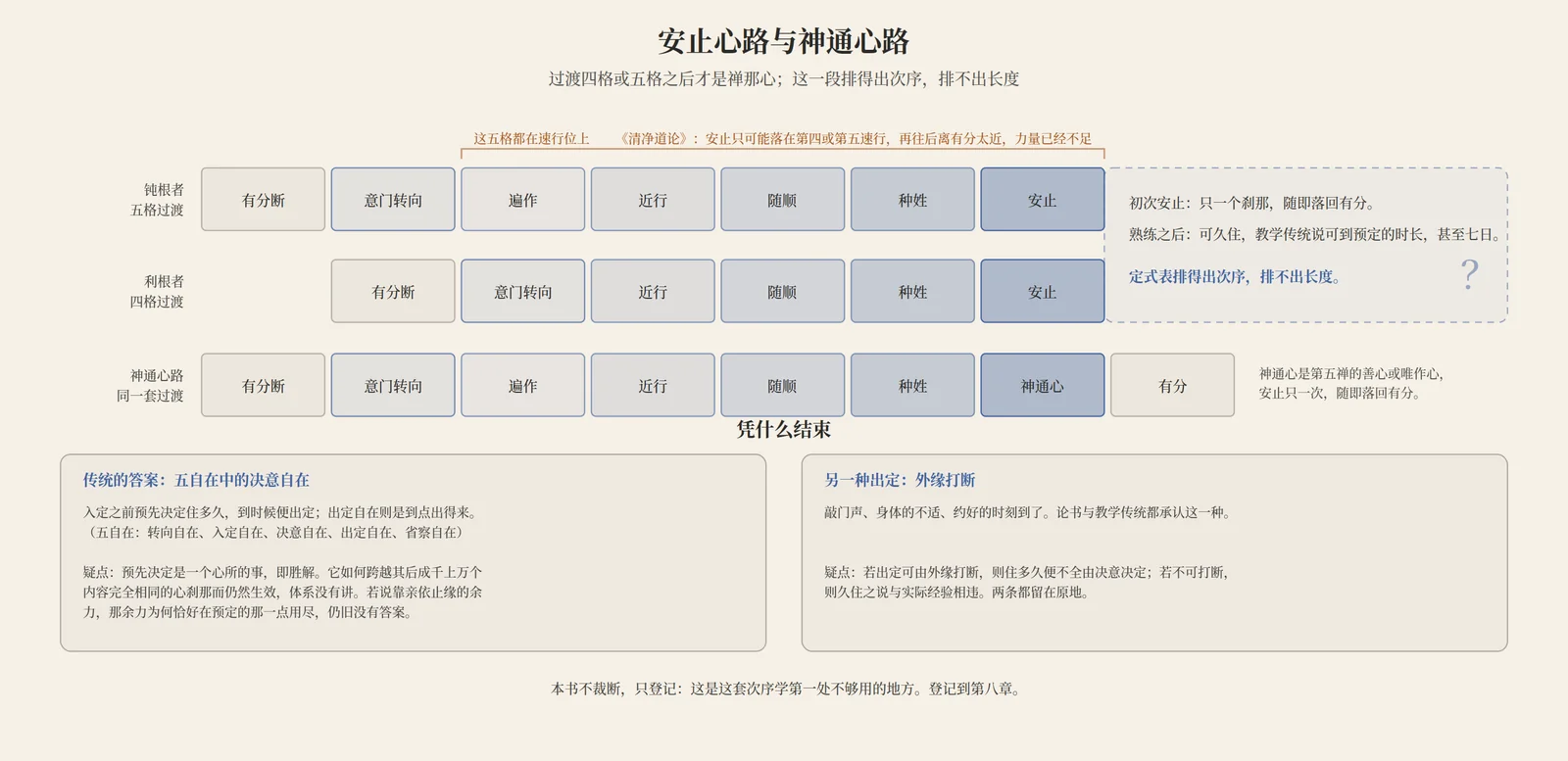
The pattern is this: after mind-door adverting come preparation, access, conformity, and change-of-lineage, followed by absorption. Preparation gets ready; access draws near; conformity harmonizes with what precedes and follows; change-of-lineage is the transition from sense-sphere to sublime consciousness; absorption is the jhāna consciousness itself. A person of quick faculties does not require preparation and passes through only four stations—access, conformity, change-of-lineage, and absorption. A person of slow faculties adds preparation before those four, making five in all.27
Chapter 4 of the Visuddhimagga imposes one restriction: absorption can occur only at the fourth or fifth javana, never later. The reason given is that consciousness has by then drawn too close to the life-continuum and no longer has sufficient strength to make the transition into absorption. The treatise offers the simile of a person who runs toward a cliff intending to leap across but tries to check the impetus only upon reaching the edge, when there is no longer enough momentum to jump.7
This section is for reference. Its two main points are that entry into jhāna requires a transition of four or five stations and cannot be made in a single leap, and that the number of transitional stations depends on whether the faculties are quick or slow.
How does absorption end? This is the most revealing point in the chapter.
On the first attainment of jhāna, absorption javana arises for only one moment and then immediately falls back into the life-continuum.73 The same applies to a direct-knowledge process: absorption occurs only once. After mastery, however, one may remain for a long time. The teaching tradition says that one may remain for a predetermined duration, even for seven days.2 Here is the problem: if the same absorption can last one moment or seven days, what makes it end?
First consider what resources the system itself provides. Every consciousness in the absorption series has the same object, the same nature, and the same associated mental factors. Nothing distinguishes one from the next, so nowhere in the table can the final one be marked. A table of fixed patterns can arrange order but not duration. “Javana × 7” can be written because seven is fixed; “continued absorption” has no number. Among the twenty-four conditions, the only remotely relevant one is decisive-support condition, but decisive support concerns strength, not length of time.
The tradition's answer is the five masteries: mastery in adverting, attainment, resolution, emergence, and review.76 Mastery in resolution is meant to govern precisely this matter. Before entering absorption, one resolves in advance how long to remain, and at the appointed time can emerge; mastery in emergence is the ability to come out at that time.
Yet this answer remains vague, and two points do not add up. First, the prior resolution belongs to a mental factor, decision. The system does not explain how it remains effective across the thousands upon thousands of subsequent mind-moments that are entirely identical in content. If the answer is the residual force of decisive-support condition, there is still no explanation of why that force should be exhausted at exactly the predetermined point. Second, treatises and teaching traditions alike acknowledge another way of emerging: interruption by an external condition, such as a knock at the door, bodily discomfort, or the arrival of an agreed time. If absorption can be interrupted from outside, its duration is not determined wholly by the resolution; if it cannot, accounts of prolonged absorption conflict with actual experience. Both difficulties remain.
This book's view is that this is not an oversight in the commentaries but a limit of the notation itself. The doctrine of cognitive processes is a pure science of order. Its entire expressive power lies in stating which station follows which. Once it has to say how long a station lasts, it has no vocabulary left. Sense-sphere cognitive processes avoid the problem because the length of each segment is fixed: seven javanas, two registrations, one or three determinings. A fixed number can be written into an order. Absorption is the first case in which the length is variable, and therefore the first case in which a science of order proves insufficient. Chapter 7 will discuss this point.
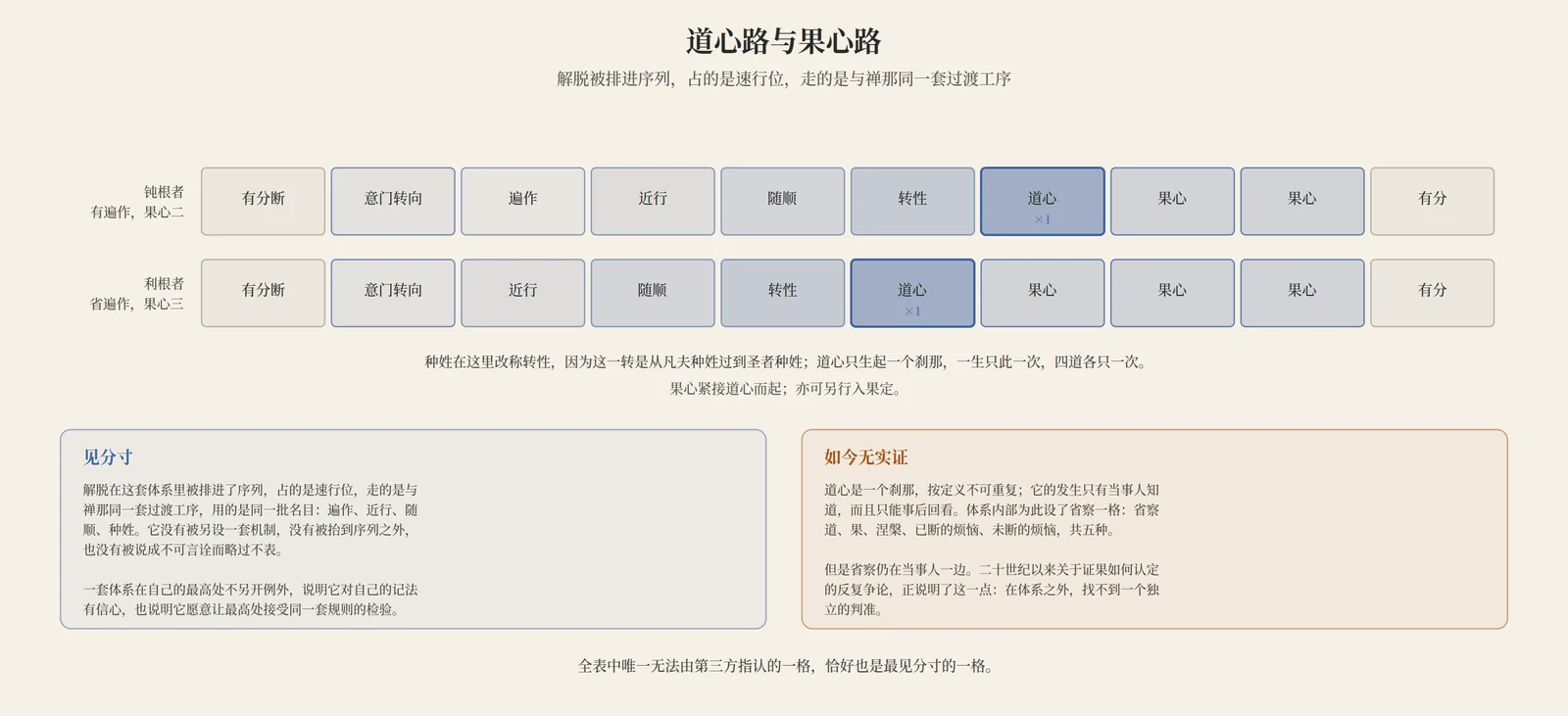
Path and fruition processes. The supramundane cognitive process has the same form as absorption: after mind-door adverting come preparation, access, conformity, and change-of-lineage; then one moment of path consciousness, followed by two or three fruition consciousnesses, after which consciousness falls back into the life-continuum. A person of quick faculties omits preparation and has three fruition consciousnesses; one of slow faculties includes preparation and has two. “Change-of-lineage” receives a different name here: “change-over,” because this transition passes from the lineage of worldlings to that of the noble ones.26
A path consciousness arises for only one moment and only once in a lifetime; each of the four paths occurs only once. This is the strictest rule in the entire system.
Two points require comment.
The first is the restraint shown here. Liberation is placed within the sequence. It occupies the javana phase and follows the same transitional procedure and the same set of labels as jhāna: preparation, access, conformity, and change-of-lineage. The system neither devises a separate mechanism for liberation, elevates it beyond the sequence, nor passes over it as ineffable. This is a restrained procedure. That a system creates no exception at its own highest point shows confidence in its notation and a willingness to let its highest claim be tested by the same rules. This is one of the principal pieces of evidence for Chapter 7's assessment of the system's restraint.
The second is that empirical confirmation is now unavailable. Path consciousness is a single moment and, by definition, cannot be repeated. Its occurrence is known only to the person concerned, and only in retrospect. The system provides a station of reviewing for this purpose: one reviews the path, fruition, Nibbāna, the defilements abandoned, and the defilements that remain—five kinds of review in all.2 But reviewing remains on the side of the practitioner. Repeated controversies since the twentieth century over how attainment of the paths and fruits is to be identified demonstrate the point: outside the system, there is no independent criterion.
Together these points produce an awkwardness in the chapter: the most restrained portion is also the portion least open to testing. This book does not infer that it was constructed; that claim would be equally unsupported. It records only that here the system writes its highest claim as one station in a sequence, and that this is the only station in the entire table which no third party can identify. Chapter 7 will treat both sides together.
The direct-knowledge process and the law of registration. The following two paragraphs are for reference and may be consulted when needed.
The direct-knowledge process is based on the fifth jhāna. Its pattern is preparation, access, conformity, and change-of-lineage, followed by one direct-knowledge consciousness, after which consciousness immediately falls back into the life-continuum. The direct-knowledge consciousness is a wholesome or functional consciousness of the fifth jhāna, and its object is the feat one wishes to perform.2
The law of registration is that registration occurs only in sense-sphere processes and only when the object is very great or very clear. There is no registration after sublime or supramundane consciousness. The eleven consciousnesses that can perform registration are the three investigating and eight great resultant consciousnesses. Which one occurs in a particular case depends on the nature of the object and the type of person making kamma; Chapter 4 of the Tabular Exposition supplies a dedicated table.2
Where does seventeen come from? The end of Chapter 3 left us with a number: the lifespan of materiality is seventeen mind-moments. This chapter supplies the other end of that number. A complete five-door process, from past life-continuum through the second registration, comprises exactly seventeen mind-moments.
The two seventeens are one and the same, but they define each other. Ask why materiality lasts seventeen mind-moments, and the answer is that a complete cognitive process has seventeen stations. Ask why a complete cognitive process has seventeen stations, and the answer is that its object can persist for only seventeen mind-moments and the process must finish before the object ceases. The latter proposition was the premise used above when the fifteen patterns were shown to be exhaustive: fifteen plus two equals seventeen, so there can be no more than fifteen. The inference itself holds, but its premise comes from the other side.
This chapter does not decide where the way out lies. Chapter 7 will discuss it.
Process-freed consciousness: no empty station between two lives. Everything above has occurred within cognitive processes. Three functions remain outside them: rebirth-linking, life-continuum, and death. Since they do not belong to any cognitive process, they are called process-freed consciousnesses. They appeared earlier in the section on receiving kamma, where only their number was given. What matters now is why they are important.
In discussing rebirth, the six destinations, and the three realms, Part 13 established one point: birth and rebirth cannot be bypassed in the early teaching. They are not a shell that can be removed while leaving the original teaching intact. Because they cannot be bypassed, every doctrinal system that claims completeness must provide them with a place in its notation. Here is where the Abhidhamma places them.
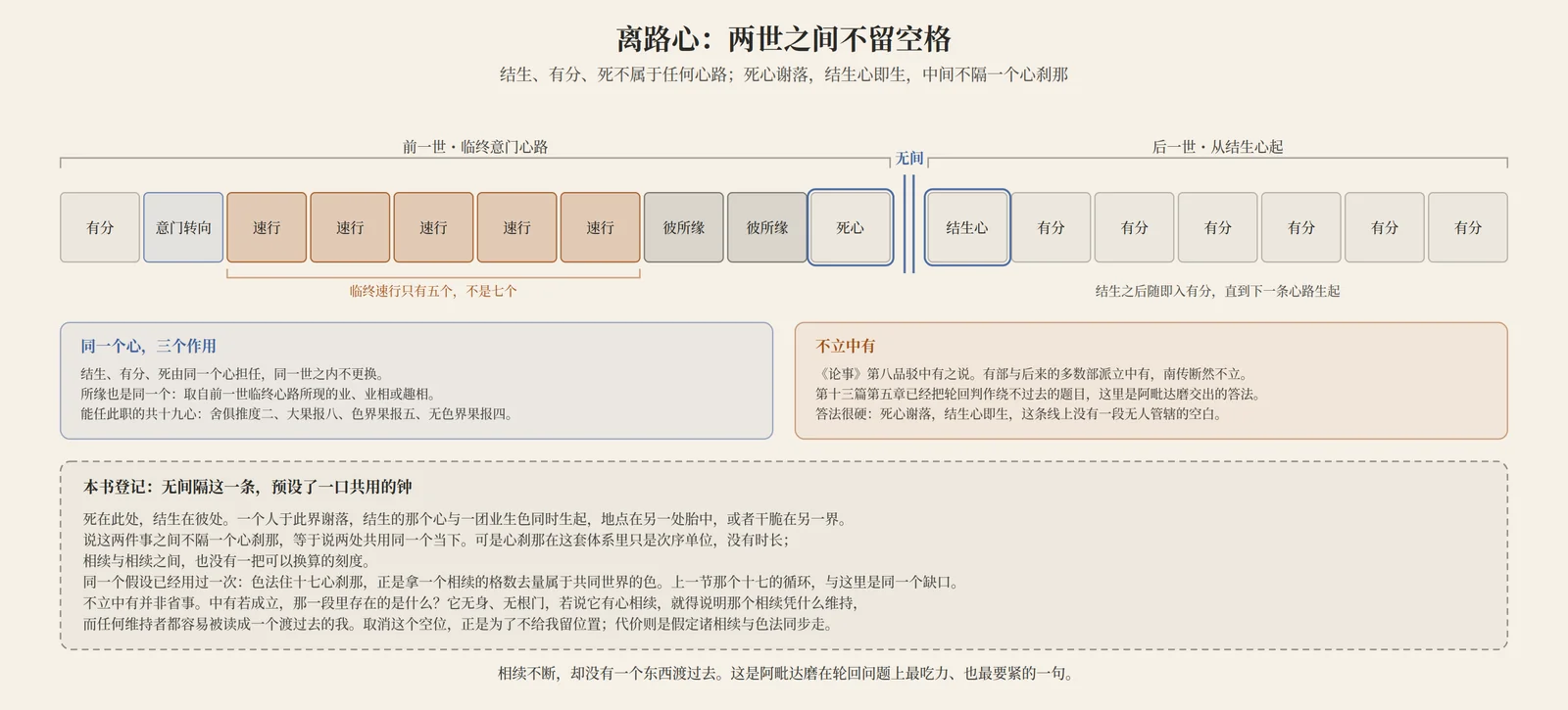
Its answer is as follows. Within one life, the same consciousness performs rebirth-linking, life-continuum, and death and takes the same object. That object is the kamma, sign of kamma, or sign of destiny that appeared in the last cognitive process of the previous life. Nineteen consciousnesses can perform these three functions: two equanimity-accompanied investigating, eight great resultant, five fine-material-sphere resultant, and four immaterial-sphere resultant consciousnesses.2 In the final cognitive process of a life there are only five javanas rather than seven. After them come two registrations and then death consciousness. As death consciousness ceases, rebirth-linking consciousness arises, with not one mind-moment between them.6
This absence of an interval is the key to the whole answer. Theravāda Abhidhamma leaves no latitude here: it recognizes no intermediate existence. Book VIII of the Kathāvatthu contains a section devoted to refuting the doctrine of an intermediate existence.8 The Sarvāstivādins and most later schools affirm one, holding that a transitional existence intervenes between death and rebirth. Theravāda categorically rejects it. The two lives meet in two adjacent mind-moments, the first belonging to this life and the second to the next.
Rejecting an intermediate existence is no mere simplification. If such an existence is admitted, what exists during it? It has no body and no sense faculties. If it is said to possess a mental continuum, one must explain what sustains that continuum, and any sustainer can easily be read as a self that crosses over. Removing the empty position is precisely a way of leaving no place for a self. The answer is uncompromising, but its cost is real.
This book registers one point here: immediate succession presupposes a shared clock.
Consider what immediate succession asserts. A person passes away in this realm; elsewhere, in another womb or perhaps an entirely different realm, a rebirth-linking consciousness arises simultaneously with a group of kamma-born material phenomena. To say that not one mind-moment intervenes between these events is to say that this instant here and that instant there belong to the same present. Yet in this system a mind-moment is only a unit of order, as explained at the beginning of the chapter; it has no duration. Nor does the system provide any conversion between the order within one continuum and the order within another. If stations are counted separately on two lines, what entitles us to align this station on one with that station on the other? For the claim to make sense, one must first assume that all continua move through a synchronized subjective time—that is, one must assume a global clock. The treatises do not state this assumption; without it, however, immediate succession cannot be formulated.
The same assumption has in fact already been used once. The claim in the preceding section that materiality lasts seventeen mind-moments measures materiality belonging to a shared world by the number of stations in one mental continuum. Materiality is seen in common; each mental continuum is private. Aligning the two likewise requires a shared clock. The same gap thus appears in two places: once between mind and matter, and once between this life and the next.
Chapter 7 will discuss this point. Chapter 6 continues with the details of rebirth-linking: the four planes and thirty-one realms, the three kinds of object at the end of life, and the kinds and lifespans of rebirth. Here the problem is merely marked: at the junction of two lives, a notation that insists on order alone and says nothing of duration has quietly to employ a measure of duration in order to speak at all.
Continuity is unbroken, yet nothing crosses over. This is the most difficult and important sentence in the Abhidhamma's answer to rebirth. The difficulty does not lie in the no-self half; that half is stated clearly. It lies in the continuity half—in what warrants saying that there is no gap between the two continua and that their join is exact.
Cognitive process and contemplation. This is the chapter's second main line. It will also settle the question left at the end of Chapter 3.
Is this taxonomy a record produced by contemplation, or an operating manual for contemplation? Both readings have advocates within the tradition. This book holds that it is both, and that the second use is the more concrete. The reason is that it gives contemplation three things.
The first is a location. Contemplation can occur only at the mind door. No station in a five-door process is available for it: fivefold sense consciousness is resultant; receiving and investigating are resultant; determining and javana, though present consciousnesses, are occupied in processing the present object. As explained above, a complete cognition consists of a five-door process plus a number of mind-door processes. Contemplation works in those mind-door processes. Knowledge of the Delimitation of Mind and Matter divides present experience into mental and material sides; Knowledge of Discerning Conditions asks after the conditions of each side. Both are activities of the mind door.2
The second is a point of purchase. Its location has already been established: the only latitude in a cognitive process lies at determining, one step before javana. This explains why mindfulness must be trained to be immediate and preconceptual. When it is actually needed, there is only that one station at which it can intervene, and the window is exceedingly brief. One station too late, the seven javanas have already run and kamma has already been made. In this diagram, guarding the sense doors has a precise meaning: ensuring that determining rests on wise attention. Whether one looks or does not look, hears or does not hear, is secondary.
The third is a sequence. The forty meditation subjects, seven purifications, and sixteen insight knowledges belong to Chapter 9 of the Tabular Exposition and will not be reproduced here.2 Only their relation to this chapter needs to be stated: the meditation subjects determine what is contemplated, the seven purifications determine the order of advance, and the sixteen insight knowledges are the diagnostic signs that appear successively during that advance. Only when these three schemes are combined with the taxonomy of cognitive processes do they form a complete set of working instructions.
One controversy must also be recorded. Can the details of a cognitive process actually be observed? Modern Theravāda texts offer two different formulations. Nyanaponika Thera says that an individual mind-moment is in practice so subtle as to be almost imperceptible, and that what experience can grasp is the “serial present” composed of a number of moments. Pa-Auk meditation teaching, by contrast, asks practitioners to discern how many consciousness-moments occur in each cognitive process and what types they are, thereby breaking down the compactness of mentality.9 These two sources suffice to show that the teaching claims differ, but not to generalize the disagreement into two clearly bounded institutional “traditions.” This book does not adjudicate. It only locates the disagreement: precisely at the question raised in the preceding paragraph, whether cognitive-process theory is a record of observation or a guide to observing. The disagreement exists because the taxonomy is used as both.
That disagreement also carries into this chapter the question raised in the last: which parts of this table of fixed patterns were observed, and which were supplied to make the notation internally coherent?
Several parts require scrutiny. The exhaustive set of fifteen patterns is calculated, not observed. The reasoning is clean, and its very neatness shows that it was derived from numbers: first the lifespan of materiality is set at seventeen, then the maximum of fifteen past life-continuum moments is inferred. The distribution of three times of maturation across seven javanas, as already noted, looks as though the fourfold classification of kamma came first and positions were assigned afterward. The treatises do not adequately explain the restriction that registration occurs only in the sense sphere and only with the strongest objects. This book takes it to perform a boundary-setting function, preventing the registration station from having to be filled everywhere.
Conversely, some parts do not look like supplements. The two-stage model of five-door and mind-door processes corresponds to the line in the Madhupiṇḍika Sutta and to everyday experience: seeing and recognizing really are different. That the strength of an object determines the length of a cognitive process likewise accords with experience; a very weak stimulus may leave only a disturbance that never takes definite shape. The position of determining is corroborated by the practical discipline of mindfulness.
The criterion for distinguishing these groups is the same as in Chapter 3: whether each item can be separately identified in contemplation. The conclusion is left to Chapter 7.
Handing the question to Chapter 5. The cognitive process arranges the order in which consciousnesses succeed one another, but does not explain what makes succession itself possible. Why does adverting follow the life-continuum? Why must receiving follow fivefold sense consciousness? The table of fixed patterns records the result; its reason lies outside the table. That is the work of conditions. The next chapter treats the twenty-four conditions.
References¶
References
-
Abhidhammattha Saṅgaha, Chapter 4, “Compendium of the Cognitive Process” (Vīthisaṅgahavibhāga): the definition of one mind-moment as three submoments; the classification of six kinds of cognitive process; the correlation between the strength of an object and the length of a cognitive process; and the restriction on registration. The passage on the mind-moment reads: “Uppādaṭṭhitibhaṅgavasena khaṇattayaṃ ekacittakkhaṇaṃ nāma” (the three submoments of arising, presence, and dissolution constitute one consciousness-moment). See Chapter 4, §6 of A Comprehensive Manual of Abhidhamma. ↩
-
Tabular Exposition of the Abhidhammattha Saṅgaha (《阿毗达摩义论表解》), Chapter 4, “Compendium of the Cognitive Process,” and Chapter 9, “Compendium of Meditation Subjects.” All numbers in Part 14 follow this work. Material taken from it in this chapter includes the twelve members of cognitive process; the complete patterns of the fifteen five-door and six mind-door processes and their grouping by strength of object; the counts of fifty-five javana and eleven registration consciousnesses; the sequences of absorption, supramundane, and direct-knowledge processes; the scope and detailed table of the law of registration; it is not an independent historical source, and the Tabular Exposition remains authoritative. The pattern-by-pattern and meditation-subject tables are not reproduced here; readers who need them should consult the work directly. ↩↩↩↩↩↩↩↩↩↩↩↩↩↩↩↩↩
-
Nārada Mahā Thera (trans. & ed.), A Manual of Abhidhamma (Abhidhammattha Saṅgaha). Kandy: Buddhist Publication Society, various reprints. This chapter draws on three notes to Chapter 4: the statement that a mind-door process must follow a five-door process (“Then there arises a mind-door thought-process perceiving the aforesaid visible object mentally”) followed, after another lapse into the life-continuum, by two further processes of the same kind before the object is recognized; the statement that javana ordinarily occurs as “seven thought-moments, or, at times of death, five”; and the statement that absorption javana arises only once on the first attainment of jhāna and in the exercise of direct knowledge. In the fourfold classification of kamma by time of maturation, the first javana is said to be weakest and its result to mature only in the present life (immediately effective kamma); the seventh is next weakest and its result matures in the next life (subsequently effective kamma); the results of the middle five may mature in any later life until entry into Nibbāna (indefinitely effective kamma); otherwise the kamma becomes defunct. ↩↩↩↩
-
The requirement of multiple mind-door processes after a five-door process appears in the standard teaching tradition surrounding Chapter 4 of the Abhidhammattha Saṅgaha. It holds that after an eye-door process at least three mind-door processes are needed before the object is recognized: the first retakes what was seen, the second combines it with what was previously seen and derives a shape, and the third supplies a name. This account comes from later instructional notes, not the root treatise itself. The root text says only that the consequent mind-door process arises following the five-door process; the division into three belongs to the explanatory layer, as the main text marks. ↩
-
Madhupiṇḍika Sutta (MN 18), with a Chinese parallel at Madhyamāgama 115, Mifanyu Jing (《蜜丸喻經》). The Chinese reads: “Dependent on the eye and forms, eye consciousness arises; with the meeting of the three there is contact; dependent on contact there is feeling; what is felt is perceived; what is perceived is thought about; what is thought about is reflected upon; what is reflected upon is proliferated” (緣眼及色,生眼識,三事共會便有更觸,緣更觸便有所覺;若所覺便想;若所想便思;若所思便念;若所念便分別), following the edition at Zhuang Chunjiang's Āgama website (agama.buddhason.org). For the Pali, see Bhikkhu Ñāṇamoli and Bhikkhu Bodhi (trans.), The Middle Length Discourses of the Buddha. Boston: Wisdom Publications, 1995. Part 13, Chapter 4 cited this discourse to describe the sequence beginning with contact; here it is used to compare the two-stage division between the five doors and the mind door. ↩
-
Bhikkhu Bodhi (general ed.), A Comprehensive Manual of Abhidhamma: The Abhidhammattha Sangaha of Ācariya Anuruddha. Kandy: Buddhist Publication Society, 1993. This chapter draws on its explanatory material in Chapters 4 and 9 for the distinction between consequent and bare mind-door processes; the role of wise and unwise attention at determining in making the subsequent javanas wholesome or unwholesome; the four transitional stations of preparation, access, conformity, and change-of-lineage in absorption and supramundane processes and the difference between persons of quick and slow faculties; and the names and content of the five masteries. ↩↩↩↩↩
-
Visuddhimagga, Chapter 4, “Description of the Earth Kasiṇa” (Pathavīkasiṇa-niddesa): the four stations of preparation, access, conformity, and change-of-lineage before absorption, with three preparatory moments for one of quick faculties and four for one of slow faculties; the rule that absorption can occur only at the fourth or fifth javana and no later because consciousness then lies too near the life-continuum and lacks sufficient strength, illustrated by a person running toward a precipice and trying to check the impetus at its edge; the first absorption lasting only one mind-moment before falling back into the life-continuum; and the five masteries (vasī). English translation: Bhikkhu Ñāṇamoli (trans.), The Path of Purification. Kandy: Buddhist Publication Society, 1975. ↩↩↩↩
-
Kathāvatthu, Book VIII, Chapter 2, “Of an Intermediate State” (Antarābhavakathā): a refutation of intermediate existence (antarābhava). Theravāda therefore does not affirm an intermediate existence and holds that no mind-moment intervenes between death consciousness and rebirth-linking consciousness. English translation: Shwe Zan Aung and Mrs. Rhys Davids (trans.), Points of Controversy. London: Pali Text Society, 1915. For the Sarvāstivāda and the intermediate existence accepted by most later schools, see Part 15, on Sarvāstivāda philosophy, which remains in planning. ↩
-
The first formulation appears in Nyanaponika Thera, Abhidhamma Studies: Buddhist Explorations of Consciousness and Time, ed. Bhikkhu Bodhi. Kandy: Buddhist Publication Society, 1998, printed p. 30: the individual “moment present” is in practice almost imperceptible, while ordinary experience apprehends a “serial present” composed of several moments. The second appears in Pa-Auk Tawya Sayadaw, Knowing and Seeing, 2nd ed. Pa-Auk Forest Monastery, 2003, introduction, printed p. 21: practitioners are to discern the number and types of consciousness-moments in each cognitive process in order to break down the compactness of mentality; the practical procedure for discerning mentality is given in Lecture Five. These works represent two positions in modern texts. This chapter neither generalizes them into consistent positions of entire institutions or lineages nor adjudicates their standards for insight knowledge. ↩