Chapter 6: Continuity: Time, Rebirth, and the End of Continuity
What this chapter sets out to do. The preceding four chapters each laid out an inventory: mentality, materiality, cognitive processes, and conditions. Beneath all four runs the same supporting beam—continuity. Chapter 1 listed it as the third of three questions and said that it runs through Chapters 4, 5, and 6. Chapter 4 stopped at the junction between two lives and Chapter 5 at proximity condition; both handed the remainder here. This chapter adds no new inventory. Instead, it places pressure on that supporting beam from three directions: time, rebirth, and Nibbāna. Where the beam holds is where the strength of the system lies. Where it does not, this book records the difficulty and passes it to Chapter 7.
First, the full weight of the word “continuity.” No-self is not an attitude but an engineering constraint. Once the possessor has been removed, everything that seems to require a possessor must be explained in another way. Memory, the consequences of action, whether a person remains the same person, and whether anything follows death are elsewhere borne together by an enduring subject. There is no such subject here, so each of the four must find its own conditions. Continuity is the system's general answer: nothing persists; there is only continuation from one moment to the next. The whole Abhidhamma can be read as an unfolding of this sentence. Because this beam bears weight, it should be stress-tested.
The first direction: time. Begin at the smallest end. One mind-moment is divided into three submoments: arising, presence, and dissolution (uppāda, ṭhiti, bhaṅga). The lifespan of materiality is seventeen mind-moments, or fifty-one submoments. The root treatise writes it as one plus forty-nine plus one: one submoment of arising, forty-nine of presence, and one of dissolution.1
A question immediately arises. If the mind-moment is the smallest unit of time, how can it be divided into three parts? If it can be so divided, there must be something smaller, and the claim to minimality fails.
The three submoments may not be treated as parts. The treatises handle the issue as follows: the three submoments are not three parts but three characteristics of one process of arising and cessation. Chapter 3 followed the same route in treating the four material characteristics. Integration, continuity, aging, and impermanence of materiality are not four additional things; they are the beginning, middle, and end of the seventeen-moment process. To assign them a separate lifespan would be to assign a lifespan to lifespan itself.1 The three submoments receive the same treatment. Arising is not the first third of a moment, but the moment insofar as it arises; dissolution is not the final third, but the moment insofar as it ceases.
This book holds that the maneuver is internally coherent, while noting its cost. A characteristic cannot be treated as a part because infinite division would immediately follow. Yet in the system's actual operation, the phase of presence is not merely a manner of speaking; it bears real weight. Postnascence condition requires the materiality supported to remain in its own phase of presence, or the condition cannot be applied.2 Registration that takes the object of a five-door process must likewise occur during the span before that material object has entirely ceased. And the very count that materiality lasts seventeen mind-moments is produced by counting its phase of presence. Something that may not be treated as a part is treated, when conditions are assigned, as an interval possessing length.
This book therefore records a first point: the boundary of the moment. The treatises do not directly answer whether a mind-moment is divisible. They provide a formulation that lets the system continue to work without answering. Chapter 7 will discuss it.
The two ends of the number seventeen. The end of Chapter 3 left us with a number: materiality lasts seventeen mind-moments. Chapter 4 supplied its other end: a complete five-door process, from past life-continuum through the second registration, lasts exactly seventeen mind-moments. The two seventeens define each other.
The nature of this circle must be understood. It is not an error. It is a convention. The system needs a common scale so that the mental and material lines can be placed on the same table and can condition one another. Seventeen is the point at which that scale is fixed. It is fixed by making both sides state it, while permitting neither to define it independently of the other.
This book's judgment is that the number is not wholly without an origin in measurement, but neither of the two steps that supports it derives from measurement.
Only one segment can count as measured: consciousnesses arise and cease one after another, and the next arises only after the preceding one has ceased. The tradition holds that this sequence can be identified in contemplation. Whether each station can be separately discerned was recorded in Chapter 4, where two lines of meditation teaching differ. The mind-moment as a unit of counting has its source only here.
Two steps go beyond this. The first is uniformity. The notation assumes that every mind-moment is of equal length. Rebirth-linking, life-continuum, five-door adverting, javana, and registration each occupy one station, and every station has the same length. The treatises offer no argument for this rule, nor is it easy to see what such an argument could be. Contemplation can report at most order and succession; comparing lengths requires an external ruler, and the system has none. Equal length looks more like a prerequisite for using the scale than a result read from contemplation.
The second step is the join. The lifespan of materiality exactly equals the length of a complete five-door process: the two seventeens fit without a seam. If seventeen had been measured, this agreement would itself require explanation. As a definition, it requires none, because it was defined that way. Of the two steps, the stipulative character is clearest here.
The function of seventeen is therefore to align the mental and material lines. It does not report any actual duration. This point becomes important in the next section, because at the junction of two lives this notation of order alone must meet another notation that speaks only of duration.
Time is not a container. Book I, Chapter 6 of the Kathāvatthu, “Of Everything as Persisting,” refutes the claim that past and future exist just as truly as the present and that phenomena manifest according to their position in the three times.3 Theravāda does not accept the claim. The consequence is greater than it appears: if past and future are not real, time cannot be imagined as a container that holds phenomena. Nor do phenomena move from a future compartment into a present one and then into a past one.
What, then, is time? In this system, time is the order read from continuity and has no other status. There is first the arising and ceasing of one moment after another, and only then can earlier and later be spoken of. There is no preexisting timeline upon which phenomena are successively placed.
This places the entire burden on continuity. Another system can say that two consciousnesses are ordered because they occupy different positions on a timeline. That cannot be said here, because the axis is itself read from their order. Continuity therefore cannot be explained by time; on the contrary, time must be explained by continuity. The point recorded at the end of Chapter 4 (that immediate succession presupposes a shared clock) now reveals its true weight. The clock is not outside the continuum; the clock is continuity itself, and continuity is exactly what needs to be explained.
The first test therefore yields the following result. At the three points of the submoments, the number seventeen, and the real existence of the three times, the system does not collapse. At each point it is sustained by the same move: something that appears to have an internal structure is redescribed as a characteristic without internal structure. The more smoothly this move works, the more clearly it shows that the beam of continuity may not be dismantled for inspection.
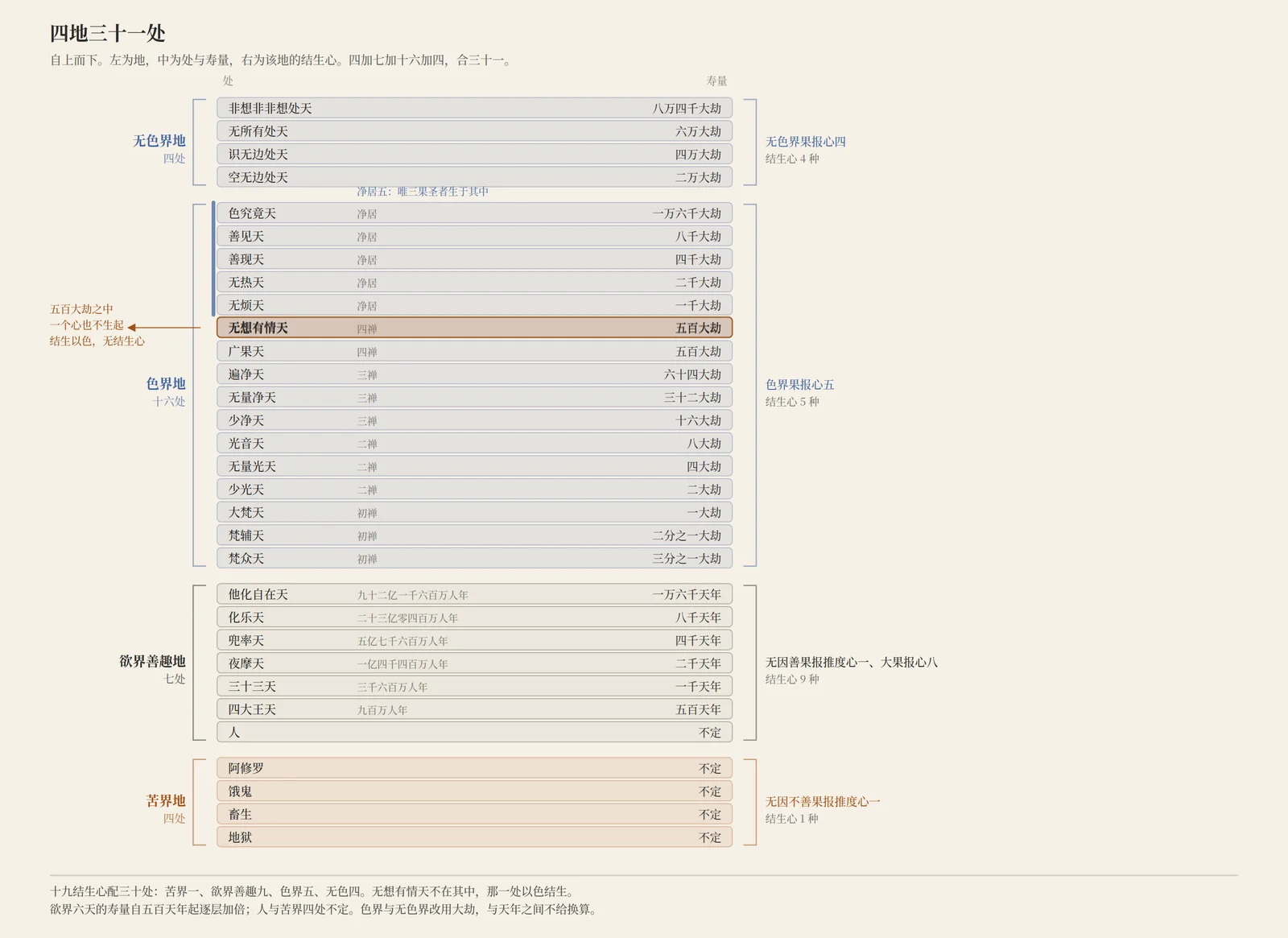
The second direction: rebirth. When continuity crosses the boundary of one life, it is rebirth. The treatises arrange its destinations in a table.45
| Plane | Realms | Number |
|---|---|---|
| Woeful plane | Hell beings, animals, hungry ghosts, asuras | Four |
| Sense-sphere happy-destination plane | Human beings, Gods of the Four Great Kings, Gods of the Thirty-three, Yāma gods, Contented gods, Gods Who Delight in Creating, Gods Who Wield Power over Others' Creations | Seven |
| Fine-material-sphere plane | Three of the first jhāna (Brahmā's Retinue, Brahmā's Ministers, Great Brahmās); three of the second jhāna (Limited Radiance, Measureless Radiance, Streaming Radiance); three of the third jhāna (Limited Glory, Measureless Glory, Refulgent Glory); seven of the fourth jhāna (Great Reward, Non-percipient Beings, and the five Pure Abodes) | Sixteen |
| Immaterial-sphere plane | Base of Infinite Space, Base of Infinite Consciousness, Base of Nothingness, Base of Neither Perception nor Non-perception | Four |
The four planes contain thirty-one realms. The first two together form the sense sphere, with eleven realms. The five Pure Abodes are Aviha, Atappa, Sudassa, Sudassī, and Akaniṭṭha; only non-returners are reborn there.
Lifespans. Every realm in the table also carries a number. In the six sense-sphere heavens, lifespan is measured in celestial years and doubles at every level.5
| Realm | Lifespan | Equivalent in human years |
|---|---|---|
| Gods of the Four Great Kings | Five hundred celestial years | Nine million |
| Gods of the Thirty-three | One thousand celestial years | Thirty-six million |
| Yāma gods | Two thousand celestial years | One hundred and forty-four million |
| Contented gods | Four thousand celestial years | Five hundred and seventy-six million |
| Gods Who Delight in Creating | Eight thousand celestial years | 2.304 billion |
| Gods Who Wield Power over Others' Creations | Sixteen thousand celestial years | 9.216 billion |
The fine-material and immaterial spheres use great aeons rather than celestial years.5
| Realm | Lifespan in great aeons |
|---|---|
| Brahmā's Retinue | One third |
| Brahmā's Ministers | One half |
| Great Brahmās | One |
| Limited Radiance, Measureless Radiance, Streaming Radiance | Two, four, eight |
| Limited Glory, Measureless Glory, Refulgent Glory | Sixteen, thirty-two, sixty-four |
| Great Reward, Non-percipient Beings | Five hundred |
| Aviha, Atappa, Sudassa, Sudassī, Akaniṭṭha | One thousand, two thousand, four thousand, eight thousand, sixteen thousand |
| Base of Infinite Space, Base of Infinite Consciousness, Base of Nothingness | Twenty thousand, forty thousand, sixty thousand |
| Base of Neither Perception nor Non-perception | Eighty-four thousand |
The lifespans of human beings and beings in the four woeful realms are not fixed.4
Two systems of timekeeping coexist. The lifespan table deserves a pause. A mind-moment, as stated above, does not report duration but only order. In this table, however, the units are celestial years and great aeons, and every entry is a duration. At its finest end the same system speaks only of order, and at its broadest only of duration, without providing a conversion between them.
This book does not regard that as an oversight. The two notations serve different domains. The notation of mind-moments serves contemplation, which must observe the relation between this consciousness and the next, not how many seconds each occupies. The notation of aeons serves the teaching of kamma and its results, which must speak of long and short, fast and slow, without specifying how many mind-moments are involved. No conversion table exists between the two, and no one has attempted to make one.
There is only one place where the two notations are forced to meet: the realm of Non-percipient Beings. It will be discussed at the end of this section.
Four causes of death. A life ends in one of four ways: exhaustion of lifespan, exhaustion of productive kamma, simultaneous exhaustion of both, or intervention by destructive kamma.4 Exhaustion of lifespan means that the lifespan allotted to the realm has run out. Exhaustion of kamma means that the force of productive kamma is spent first. In simultaneous exhaustion both end together. In the fourth case, another powerful kamma cuts the life short. The first three are timely deaths; the fourth is untimely.
The cognitive process at death. Death is not a special kind of consciousness. Death consciousness (cuti-citta) is the same consciousness as the life-continuum, performing a different function for the last time. What matters is the segment before it.
The final cognitive process has only three possible objects: kamma, a sign of kamma, or a sign of destiny.4 Kamma is the kamma about to mature, reappearing at the mind door. A sign of kamma is an object or instrument involved when that kamma was performed. A sign of destiny is an image of the realm to which the being is going. One of the three appears; the javanas that follow take it as object, and the rebirth-linking consciousness of the next life takes the same object.
There are only five javanas in this process rather than seven, and they are weak.4 “Weak” means that they do not themselves produce a result. Their function is only to hold the object and hand it to the first consciousness of the next life.
The sign of kamma and the life review. One resemblance may be recorded here. The second kind of object at death is a sign of kamma: an object or instrument associated with the performance of that kamma reappears at the mind door. Modern accounts of near-death experience include a phenomenon commonly called a life review: during a short period near death, past experiences appear in concentrated visual form.6 The shape of the two descriptions is similar. As a life approaches its end, what appears in the mind comes from the past rather than the present environment.
When Chapter 5 cited Bradley, it stated that external material serves in this book only as limited corroboration. The weight of the present comparison is lighter still. It does not amount to corroboration, but only to a resemblance worth recording, and three respects in which the accounts do not align must be recorded at the same time. The first concerns the source of testimony. Every near-death account comes from someone who was resuscitated. In the Abhidhamma's own account, the final cognitive process ends with death consciousness; anyone who actually completed it is already in another life. By the system's own rules, no one capable of speaking has reached that station. The second concerns form. A life review is a sequence of scenes, whereas the final cognitive process has only one object and does not change it after taking hold of it. Its function, moreover, is orientation rather than review: it determines the object of the next life's rebirth-linking consciousness and does not summarize the life just ended. The third concerns the direction of explanation. Research on near-death experience seeks to explain reported experiences; evidence may be added and conclusions revised. The Abhidhamma states a doctrinal rule that is not open to experiential refutation within the system.
This book holds that the resemblance cannot be used as evidence for the Abhidhamma. It suggests something else: many items in this inventory may indeed have originated in observation. Chapters 3 and 4 both encountered difficulty distinguishing entries that were observed from those supplied afterward. The objects at death look more like the first kind. It is plausible that a contemplative tradition observed something around dying people and then wrote what it saw into a fixed pattern. What actually occurs at the station after the pattern has been fixed is something no one has returned to report.
No intervening station. As death consciousness ceases, rebirth-linking consciousness arises, with not one mind-moment between them.4 The sentence already appeared in Chapter 4 in connection with process-freed consciousness. Here its origin matters. Theravāda does not affirm an intermediate existence; Book VIII, Chapter 2 of the Kathāvatthu, “Of an Intermediate State,” specifically refutes it.3 Sarvāstivāda and most later schools affirm a transition between two lives. Theravāda removes it on the ground that if the intermediate existence were a period of existence with mind and matter, it would itself already be a life. There would then be not two lives but three, and the problem would merely be moved one station farther.
The removal is clean, and its cost explicit: there is no buffer at all at the junction of lives. At the very instant the preceding consciousness entirely ceases, the next must already arise elsewhere, in another realm and another body. Distance cannot be spoken of because nothing moves; time cannot be spoken of because no empty station is permitted. The pressure is greatest precisely at the point recorded in Chapter 4: immediate succession presupposes a shared clock. The two mind-moments belong to two lives in two places. What warrants calling them adjacent? Only a clock shared by both sides, and this system supplies none.
Nineteen rebirth-linking consciousnesses. Nineteen kinds of consciousness can perform rebirth-linking.41
| Destination | Rebirth-linking consciousness | Number |
|---|---|---|
| Four woeful realms | Rootless unwholesome-resultant investigating consciousness accompanied by equanimity | One |
| Seven sense-sphere happy destinations | One rootless wholesome-resultant investigating consciousness accompanied by equanimity; eight great resultant consciousnesses | Nine |
| Fifteen fine-material realms | Five fine-material-sphere resultant consciousnesses | Five |
| Four immaterial realms | Four immaterial-sphere resultant consciousnesses | Four |
Nineteen consciousnesses cover thirty realms. The realm of Non-percipient Beings is not among them. Rebirth there occurs with materiality and without rebirth-linking consciousness.
Three classes of rebirth-linking. The nine rebirth-linking consciousnesses in the sense-sphere happy destinations differ in their roots.4 Of the eight great resultant consciousnesses, four are associated with three roots (non-greed, non-hatred, and non-delusion), and four with two—non-greed and non-hatred. The rootless wholesome-resultant investigating consciousness has none. The class of rebirth-linking sets the upper limit for the life. A person reborn with three roots can attain jhāna and the paths and fruits in the present life. One reborn with two roots or none has no such opportunity in that life.7
This is one of the system's most difficult claims to accept, and one it is least willing to conceal. It does not say that a person reborn with two roots should not practice. It says only that the configuration of mentality in this life lacks the required root, and that its absence was determined by the kamma of a preceding life rather than by the person's will in this one.
How is this claim used in practice? That is what the treatise says; its actual use is another matter. This book observes three uses that point in different directions.
First, it is often used to explain a kind of person: someone who cannot take an interest in the Dhamma but whose worldly affairs may go well, sometimes very well. Such a person is classified as reborn with two roots. This use points outward. It gives a place to someone who does not enter, while the speaker stands inside. Once the boundary is drawn, the explanation is complete.
Second, people seldom tell a long-term practitioner who fails to advance that they were reborn with two roots, but the explanation remains waiting nearby and functions even when unspoken. It acts as a fallback. If the reason for failure lies in the method, lineage, or teaching itself, further questions can still be asked. If it lies in the station of rebirth-linking, inquiry ends, because that station was fixed by kamma from a previous life and cannot be altered in the present. An explanation that cannot be falsified and can absorb every failure is convenient to use; its cost is that it also shields from scrutiny the steps that ought to be examined.
Third, the other side must be stated equally clearly: the Theravāda tradition as a whole does not make this diagnosis. No ritual or office exists for determining how many roots someone's rebirth-linking possessed. Actual teaching encourages everyone without distinction to keep precepts, give, develop concentration, and practice insight. The claim is written in the treatises and used in explanation, but is for the most part not used in guidance.
This book regards the distance among these three levels as evidence in itself. A doctrine's position in a text and its use among people can differ greatly. The distance is especially great here because in the treatise it is only a technical judgment about the configuration of mentality, whereas in use it becomes a statement about a person.
The same consciousness throughout one life. A verse in the root treatise exhausts the relation among rebirth-linking, life-continuum, and death: the three functions are performed by the same consciousness, which takes the same object and does not change throughout a life.4
This verse is the system's entire answer to the problem of identity within one life: this continuum remains this continuum because that consciousness and that object are fixed once, at the moment of rebirth-linking, and do not change midway.
It is important to see what the verse answers and what it does not. It answers for the span within one life. The step across lives rests on another rule: the kamma, sign of kamma, or sign of destiny that appears at the end of one life is taken as the object of the rebirth-linking consciousness in the next. The object is taken from the other side, but the consciousness is newly arisen. Thus the previous life leaves this life only the identity of an object and a kammic force; it leaves no phenomenon behind.
Continuity is unbroken, yet nothing crosses over. This is the most difficult and important sentence in the Abhidhamma's treatment of rebirth. It appeared once in Chapter 4; here its full meaning can be added. Not only does no self cross over; consciousness itself does not cross over. What genuinely continues on the other side is only the identity of an object and a condition.
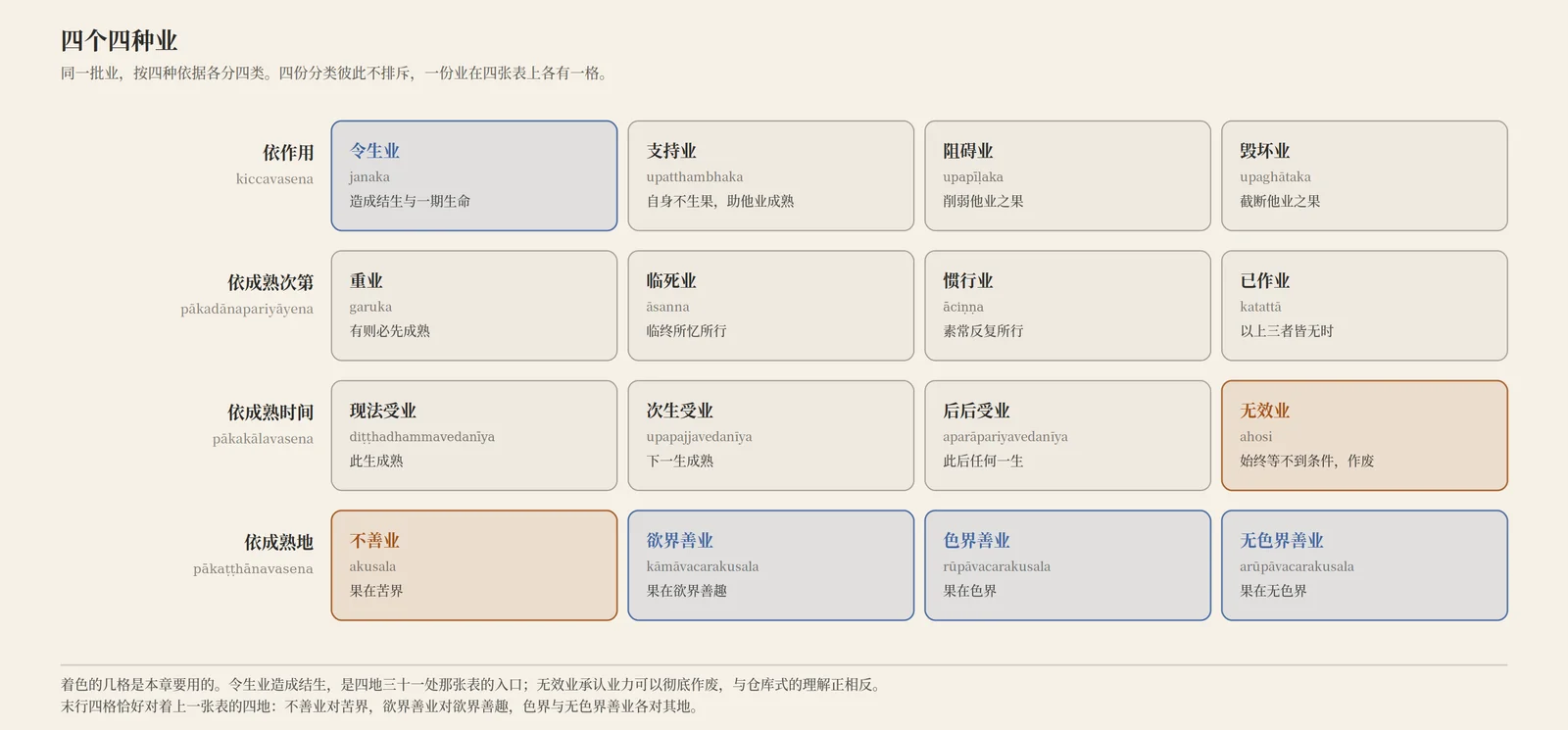
Four sets of four kinds of kamma. Kamma in this system is not an item held in storage; it is a condition that will operate in the future. The root treatise classifies it four ways under each of four criteria.41
| Criterion | Four kinds |
|---|---|
| By function | Productive, supportive, obstructive, destructive kamma |
| By order of maturation | Weighty, proximate, habitual, reserve kamma |
| By time of maturation | Immediately effective, subsequently effective, indefinitely effective, defunct kamma |
| By plane of maturation | Unwholesome, sense-sphere wholesome, fine-material-sphere wholesome, immaterial-sphere wholesome kamma |
The classification by time of maturation most clearly shows the nature of this notation. Immediately effective kamma matures in the present life, subsequently effective kamma in the next, and indefinitely effective kamma in any later life. Defunct kamma never finds the required conditions before no further opportunity remains. The category of defunct kamma matters: it acknowledges that kammic force can become wholly void. If a kamma never finds the conditions for maturation, it is no longer anything. This is the opposite of a storehouse model, for what is held in storage does not disappear merely because no one retrieves it.
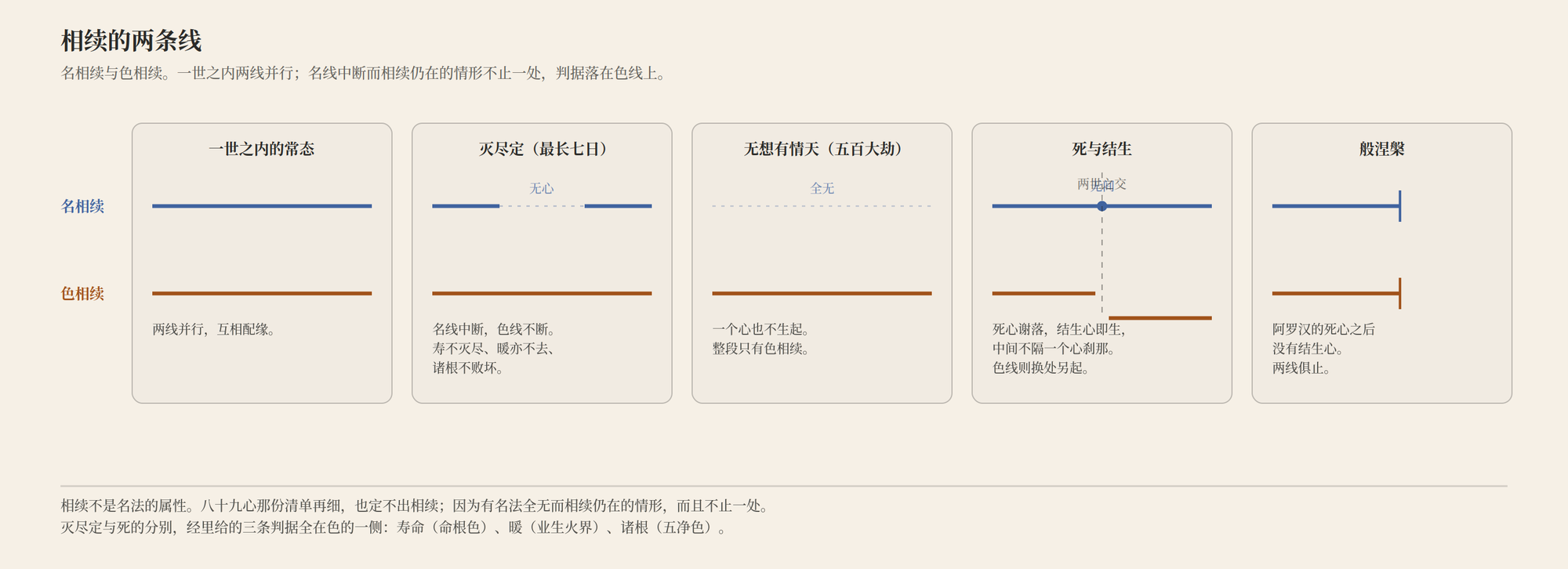
The point of greatest pressure. In the realm of Non-percipient Beings, whose lifespan is five hundred great aeons, there is no mentality and not one consciousness arises.4 Rebirth occurs by materiality alone, and only a material continuum exists during the life. After five hundred great aeons that continuum ends in death, followed by rebirth elsewhere according to kamma.
Set the two systems of timekeeping beside this case. Five hundred great aeons is a duration; the number of mind-moments within it is zero. Here the notations meet head-on, and one of them fails completely. If time is only the order read from the continuum of consciousness, from what is the time of those five hundred aeons among Non-percipient Beings read? It can only be read from the material continuum. Yet the lifespan of materiality is itself defined in mind-moments—seventeen of them. How are seventeen mind-moments of materiality counted in a place with no consciousness at all?
The treatises do not directly address the problem. This book holds that only one answer is available: the material continuum there is still counted on the scale of mind-moments, but the scale has now become independent of any actual consciousness and is purely conventional. This confirms the preceding judgment. Seventeen is seventeen by virtue of the stipulative part of its basis, not the measured part; precisely for that reason, it can still be used where no consciousness exists.
Before the third direction, consider the life-continuum. Within one life, one cognitive process arises after another, but there are intervals between them: when no object appears, during dreamless sleep, and after one process has ended but before another begins. These intervals may not remain empty, because a gap of one mind-moment would break continuity. Life-continuum consciousness (bhavaṅga) fills them. Its name literally means a constituent of existence: the constituent by which one life is a life.
Chapter 4 already gave its three functions: rebirth-linking, life-continuum, and death. The same consciousness performs all three during one life and takes the same object. Life-continuum is therefore not a new kind of consciousness; it is the name given to one of nineteen resultant consciousnesses while it performs a particular function.
It is not store consciousness; the boundary has three parts. Part I of this book already determined that life-continuum and store consciousness are not the same, although both address continuity and latency. This chapter draws the boundary more finely.
First, life-continuum adds no item to the inventory. Store consciousness is the eighth consciousness, a new category of consciousness established beyond the original six. Life-continuum adds no phenomenon at all. It is one of the nineteen resultant consciousnesses already present in the table of eighty-nine; life-continuum is only one function it performs. A function is not a phenomenon. Chapter 4 made this clear when treating the fourteen functions: a function is a position, not a new existent.
Second, life-continuum does not receive. Store consciousness receives the impressions of every active consciousness, with seeds stored in it; this is its central task. Life-continuum receives no impressions. Its object is fixed at the moment of rebirth-linking, taken from the kamma, sign of kamma, or sign of destiny that appeared in the preceding life's final cognitive process, and remains unchanged throughout the life. It records nothing that happens during the present life and has nowhere to record it.
Third, life-continuum is not required to explain kammic result. Kamma and result are explained by conditions, not by life-continuum. This is the most important division of labor. Store consciousness combines two tasks: it bears continuity and stores kammic force. Life-continuum performs only the first, handing the second to asynchronous kamma condition.
The benefit of the boundary, and its cost. The benefit is clear: life-continuum is not thereby made into a substance. It is not one enduring thing, but a series of consciousnesses of the same kind, arising and ceasing one after another while taking the same object. Chapter 7 will place this among the system's acts of restraint.
The cost is equally clear. Without a storehouse, in what manner does kamma exist between the consciousness that makes it and the consciousness that receives its result?
The treatises answer with the condition from Chapter 5: asynchronous kamma condition (nānākkhaṇika-kamma-paccaya). The consciousness that made the kamma has long since completely ceased, yet it remains a condition for a resultant consciousness several lives later.2
This answer replaces a problem about existence with one about relation. We need not ask where kamma exists during the intervening period, but only say that a condition connects it to the later resultant consciousness. The exchange is elegant. Yet Chapter 5 recorded that conditions have no place on the table of ultimate phenomena. The eighty-two phenomena include no conditions; conditioning force inheres in the conditioning phenomenon and cannot exist apart from it. In what manner, then, does this condition extending across several lives itself exist during the interval?
The original problem has returned with one word changed. This book records a second point: without a storehouse, what guarantees the identity of the continuum? Chapter 7 will discuss it.
One qualification should be added. This is not an oversight. Replacing existence with relation is the system's consistent procedure and the reason it can preserve no-self: wherever an enduring subject would otherwise have to be established, it establishes a condition instead. The procedure is consistent, and so is its cost. Chapter 7 will consider these costs together, because in the end they are all one.
Is the interval an interval? One further question deserves to be asked: are the intervals filled by life-continuum really intervals?
The treatises answer that there is no true gap, because life-continuum consciousnesses arise one after another without interruption. But does the life-continuum itself have content? It has an object—the image that appeared at the end of the preceding life. It does not appear in present awareness because it lies outside cognitive process. Thus during dreamless sleep a person still has a mental continuum and still has an object; that object merely comes neither from the present nor into awareness.
This book regards this as the point at which the system comes closest to a psychological hypothesis. It is not read from contemplation, because contemplation cannot enter it. It is inferred backward from the requirement that continuity contain no gap. Chapter 4 said that the exhaustive set of fifteen patterns was calculated rather than observed. Life-continuum is similar: it is inferred. Whether the inference is reasonable is a different question; its origin must be recognized.
The third direction: Nibbāna. Chapter 1 left a question hanging. Among the four ultimate realities, consciousness, mental factors, and materiality are conditioned, while Nibbāna is unconditioned. Placing the unconditioned beside the conditioned on one table declares that the table is not merely an inventory of phenomena but an inventory of everything real. Why should a catalogue intended for contemplation reserve a position for an item that belongs to no aggregate, neither arises nor ceases, and is associated with no consciousness? We now answer directly.
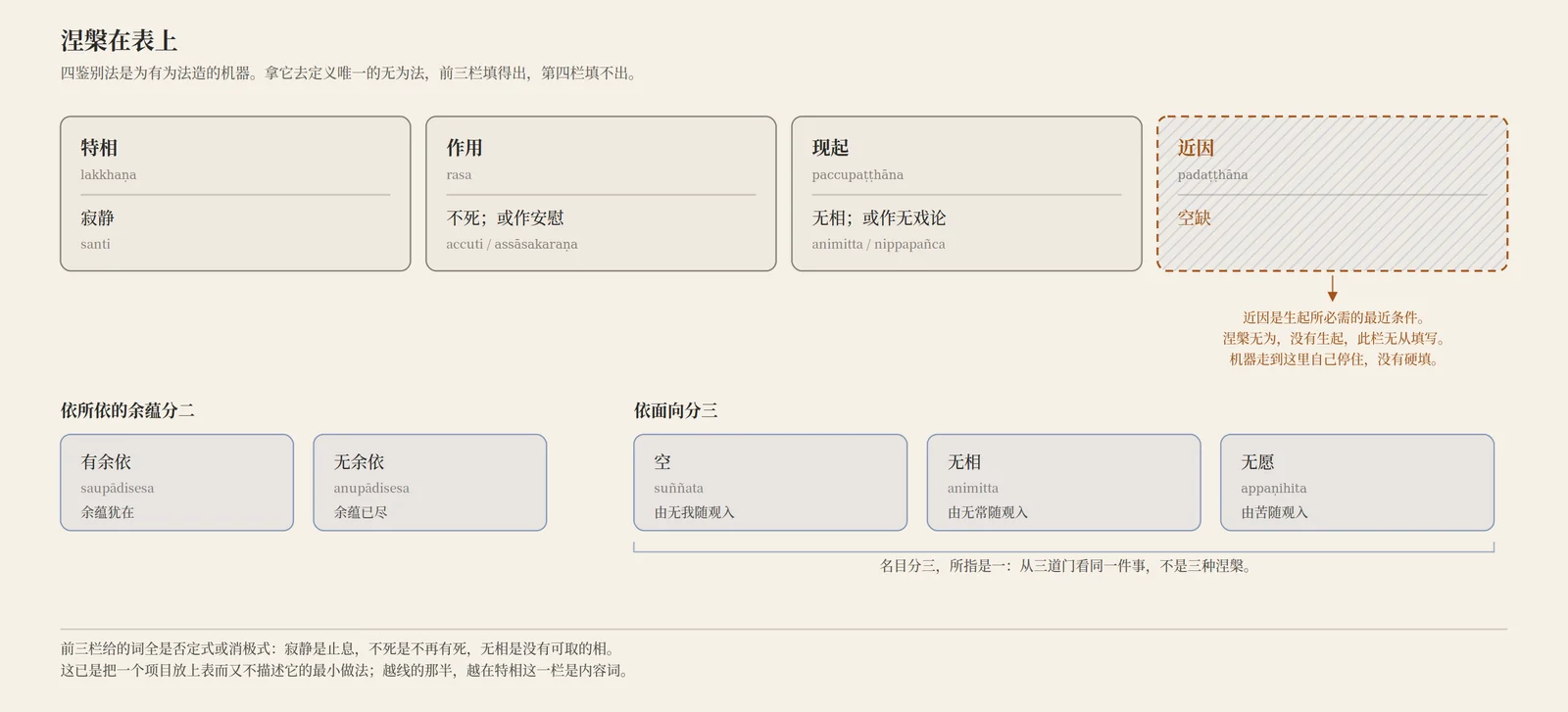
First consider its position in the table. At the end of Chapter 6, the root treatise defines Nibbāna as supramundane, to be realized by the knowledge of the four paths, and the object of path and fruition consciousness; because it has departed from the entanglement called craving, it is called Nibbāna.8 It is divided in two according to the remaining aggregates that serve as its basis: with residue remaining and without residue remaining. It has three aspects: emptiness, signlessness, and desirelessness.8
The three aspects are not three kinds of Nibbāna. They are one thing seen through three gateways. Entered through contemplation of no-self, it is seen as empty; through contemplation of impermanence, as signless; through contemplation of suffering, as desireless. There are three names but one referent.
Only three columns of the four defining devices can be filled. Chapter 1 explained that defining a phenomenon requires four columns: characteristic, function, manifestation, and proximate cause. Applying this machine to Nibbāna produces the following result.9
| Column | Nibbāna |
|---|---|
| Characteristic | Peace |
| Function | Deathlessness; or giving comfort |
| Manifestation | Signlessness; or non-proliferation |
| Proximate cause | Blank |
The fourth column is empty. The reason requires no circumlocution. A proximate cause is the nearest condition necessary for arising; whatever can fill that column arises on conditions. Nibbāna is unconditioned and does not arise, so it has no proximate cause to enter.
This book holds that this blank cell is the most noteworthy in the entire Part. The four defining devices are a machine built for conditioned phenomena, and at least one of their four columns presupposes causation. Feed an unconditioned phenomenon into the machine and it stops by itself at the fourth column. It neither forces an entry nor rebuilds itself to accommodate the exception. It leaves the blank visible in the table.
Does placing Nibbāna on the table cross the line? In treating the four alternatives concerning the Tathāgata after death, Part 13, Chapter 2 reached a judgment: the alternatives are logically exhaustive; what fails is not the arrangement but the conditions of application. Predication can work only where there are worldly phenomena to which it can attach, and the vocabulary of process is exhausted where process ends. The boundary lies at language's working surface, not inside logic. Measured by that judgment, this chapter's answer has two halves.
One half does not cross the line. To say that Nibbāna is the object of path and fruition consciousness, that it is unconditioned, that it is not a concept, or that it is divided in two according to the residual aggregates—all are relational statements made from the side of the conditioned. They describe Nibbāna's relation to path and fruition consciousness and its difference from other phenomena. Part 13, Chapter 2 was meant to block predication about Nibbāna itself, especially vocabulary of process. These statements do not do that. The blank under proximate cause is still stronger evidence of staying within the line: that column would state how Nibbāna arises, and the machine stops there.
The other half does cross the line. A characteristic is a word of content. Chapter 1 defined characteristic as that by which a phenomenon differs from every other. This requires Nibbāna to stand on the same table as other phenomena and be compared with them. To assign it “peace” is to give it a comparable quality. The same applies to function and manifestation. This book holds that this half genuinely exceeds the boundary drawn in Part 13, Chapter 2.
But the manner of excess should be seen clearly. The treatise does not call Nibbāna a state, say whether one who has attained final Nibbāna exists or does not exist, give it any process vocabulary, or say where it is, how long it lasts, or what composes it. Every term supplied in the three columns is negative or privative: peace is cessation, deathlessness is the absence of further death, and signlessness is the absence of any sign to be grasped. This is the minimum procedure for placing an item on a table without describing it. This book's position is that the cell crosses half the line, and does so with restraint. It crosses because the format of the table requires every item to be defined by the four devices, and here uniformity of format outweighs the rule laid down in Part 13, Chapter 2.
This book records the point for Chapter 7: an unconditioned phenomenon has been handed to a machine built for conditioned phenomena.
Consciousness can stop while continuity does not. Two more cases stretch the concept of continuity to its furthest extent.
Fruition attainment (phalasamāpatti): each of the four kinds of noble disciple enters the fruition consciousness corresponding to that disciple's fruit, and fruition consciousnesses arise repeatedly until emergence.10 The stream of consciousness remains unbroken throughout; its content is simply uniform.
Attainment of cessation (nirodhasamāpatti): only non-returners and arahants who have attained all eight fine-material and immaterial absorptions can enter it.10 The practitioner enters the attainments in order through the Base of Neither Perception nor Non-perception, emerges, undertakes four preliminaries, and after two javanas the mental stream stops. The interruption can last no more than seven days. On emergence there first arises one moment of a non-returner's fruition consciousness or an arahant's fruition consciousness; consciousness then falls into the life-continuum, followed by a mind-door process of review.
For seven days, not one consciousness occurs.
How does a person in the attainment of cessation differ from a corpse? The discourses ask the question directly. The Chinese Madhyamāgama 211 and the Pali Mahāvedalla Sutta (MN 43) give the same account: in a corpse, vitality has ended, heat has departed, and the faculties have broken up; in a monastic who has entered the attainment of cessation, vitality has not ended, heat has not departed, and the faculties have not broken up.11
The entire answer lies on the side of materiality. Mentality is absent in both cases: a corpse has no consciousness, and neither does the person in cessation attainment. The difference lies in three things—vitality (material life faculty), heat (the kamma-born fire element), and the faculties (the five sensitive material phenomena)—all material phenomena.
This sentence gathers together the preceding sections. At this point continuity proves not to be one thing but two lines: a mental continuum and a material continuum. Within one life the two run in parallel and condition each other. When the mental continuum stops, whether the person's continuity remains is determined by the material continuum. The five hundred great aeons of Non-percipient Beings exhibit the same structure, only for vastly longer.
This book draws one conclusion: continuity is not a property of mentality. However detailed the inventory of eighty-nine consciousnesses, it cannot define continuity, because there are circumstances (not only one) in which mentality is wholly absent and continuity remains.
What secures identity? Take the preceding conclusion one step further. When seven days of cessation attainment end, why is the life-continuum that resumes this person's life-continuum, and why does it still take the object fixed at the rebirth-linking of this life?
The treatises can answer only: kamma and material life faculty.10 Kamma operates through asynchronous kamma condition, while material life faculty maintains the material continuum without dispersal. But these are exactly the two blanks left earlier: conditions have no place in the inventory of ultimate phenomena, and the function of material life faculty is to maintain, while maintenance itself is a condition.
The point recorded in the section on life-continuum now appears in its clearest form: without a storehouse, what guarantees the identity of the continuum? It need not be registered again; this is the same question.
No further continuity. The final step. After an arahant's death consciousness ceases, no rebirth-linking consciousness arises. Continuity ends there.
The entire system describes continuity: consciousness from one moment to the next, materiality from one generation to the next, conditions one combination after another. The only place it points to without describing is precisely the place where continuity stops. In the end, the position reserved for Nibbāna in the table is a marker for this location.
At the beginning of the chapter, we said that where the system withstands pressure lies its strength, and where it does not must be recorded. After pressure from three directions, the result is this. At the end of time, the system holds by redescribing structure as characteristic, at the cost of leaving the boundary of the moment unclear. At the end of rebirth, it holds by abolishing intermediate existence and any enduring subject, at the cost of presupposing a shared clock and continuing to count in mind-moments where no consciousness exists. At the end of Nibbāna, it holds for the most part by making relational statements alone, at the cost of the column for characteristic. The three costs are ultimately one: wherever an enduring subject seems necessary, the system establishes a condition instead, but gives the condition itself no position.
Handing the question to Chapter 7. The three points above describe where the system cracks under pressure. The next chapter reverses the perspective. At those same three points, it could have gone one step farther but did not. It did not establish an intermediate existence, did not accept the real existence of the three times, did not make life-continuum into a storehouse, and did not describe Nibbāna. These refusals together form an inventory of its restraint, and deserve to be considered on their own.
References
References
-
Tabular Exposition of the Abhidhammattha Saṅgaha (《阿毗达摩义论表解》). All numbers in Part 14 follow this work. This chapter draws from Chapter 5, “Compendium of the Process-Freed,” for the four planes and thirty-one realms, their lifespans and modes of rebirth; the objects of process-freed consciousness and the final cognitive process; the processes of death and rebirth-linking; rebirth after death; the four sets of four kinds of kamma; and the overview table of kamma and result. From Chapter 6, “Compendium of Materiality,” it draws on the distinctions concerning Nibbāna and on three points: a mind-moment has three submoments, the lifespan of materiality is one plus forty-nine plus one submoments, and the four material characteristics do not receive a separate lifespan. The discussion of material characteristics in Chapter 3 cited the same material. ↩↩↩↩
-
Abhidhammattha Saṅgaha, Chapter 8, “Compendium of Conditionality” (Paccayasaṅgahavibhāga). This chapter relies on it for two points: the materiality supported by postnascence condition (pacchājāta-paccaya) must remain in its own phase of presence; and under asynchronous kamma condition (nānākkhaṇika-kamma-paccaya), past and already ceased kamma conditions a subsequently arising resultant consciousness. For the claims that conditioning force inheres in the conditioning phenomenon and cannot exist apart from it, and that conditions have no place among the eighty-two ultimate phenomena, see Chapter 5. ↩↩
-
Kathāvatthu, Book I, Chapter 6, Sabbam-atthī-ti kathā, refutes the equal real existence of past and future. English translation: Shwe Zan Aung and Mrs. Rhys Davids (trans.), Points of Controversy. London: Pali Text Society, 1915, I.6, “Of Everything as Persisting.” Book VIII, Chapter 2, “Of an Intermediate State” (Antarābhavakathā), refutes intermediate existence (antarābhava). Theravāda therefore does not affirm one and holds that no mind-moment intervenes between death consciousness and rebirth-linking consciousness; Chapter 4 already cited this section. For the Sarvāstivāda arguments for the real existence of the three times and for intermediate existence, see Part 15, on Sarvāstivāda philosophy, which remains in planning. ↩↩
-
Abhidhammattha Saṅgaha, Chapter 5, “Compendium of the Process-Freed” (Vīthimuttasaṅgahavibhāga). This chapter relies on it for the four planes and thirty-one realms—the woeful plane (apāyabhūmi), sense-sphere happy-destination plane (kāmasugatibhūmi), fine-material-sphere plane (rūpāvacarabhūmi), and immaterial-sphere plane (arūpāvacarabhūmi)—and the statement that human and woeful-realm lifespans are indefinite; the four causes of death (exhaustion of lifespan, āyukkhaya; exhaustion of kamma, kammakkhaya; exhaustion of both, ubhayakkhaya; and destructive kamma, upacchedakakamma); the three objects at death (kamma, kamma; sign of kamma, kammanimitta; and sign of destiny, gatinimitta); the five weak javanas at death (“Maraṇāsannavīthiyaṃ pan’ ettha mandappavattāni pañc’ eva javanāni”); the absence of an interval between death and rebirth-linking (“tass’ ānantaram eva”); the verse stating that rebirth-linking, life-continuum, and death are the same consciousness taking the same object—“Paṭisandhi bhavaṅgañ ca tathā cavanamānasaṃ / Ekam eva tathā v’eka visayaṃ c’ekajātiyaṃ”; the three classes of rebirth-linking with three, two, or no roots; and the four sets of four kinds of kamma, by function (kiccavasena), order of maturation (pākadānapariyāyena), time of maturation (pākakālavasena), and plane of maturation (pākaṭṭhānavasena). ↩↩↩↩↩↩↩↩↩↩↩
-
Nārada Mahāthera (ed. & trans.), A Manual of Abhidhamma: Being Abhidhammattha Saṅgaha of Anuruddhācariya. Kandy: Buddhist Publication Society, first published 1956 and often reprinted. This chapter draws on Chapter 5 for the Pali names and fourfold division of the thirty-one realms—four plus seven plus sixteen plus four; for the lifespans of the six sense-sphere heavens, doubling at every level from five hundred celestial years among the Gods of the Four Great Kings to sixteen thousand among the Gods Who Wield Power over Others' Creations, and their equivalents in human years; for the fine-material and immaterial lifespans in great aeons, including one third for Brahmā's Retinue (kappassa tatiyo bhāgo), one half for Brahmā's Ministers (upaḍḍhakappo), and five hundred for Great Reward and Non-percipient Beings (pañcakappasatāni); and for the allocation of rebirth-linking consciousnesses. Nārada counts six in the fine-material category because rebirth by materiality alone among Non-percipient Beings is separately included. Following the Tabular Exposition, this chapter counts nineteen rebirth-linking consciousnesses covering thirty realms, with no rebirth-linking consciousness among Non-percipient Beings. ↩↩↩
-
Near-death experience and the life-review component within it have received wide attention since Raymond A. Moody, Jr., Life After Life. Covington, GA: Mockingbird Books, 1975. For an early systematic investigation, see Kenneth Ring, Life at Death: A Scientific Investigation of the Near-Death Experience. New York: Coward, McCann & Geoghegan, 1980; for a scaled rating instrument, Bruce Greyson, “The Near-Death Experience Scale: Construction, Reliability, and Validity,” Journal of Nervous and Mental Disease 171.6 (1983): 369–375; for a prospective study of survivors of cardiac arrest, Pim van Lommel, Ruud van Wees, Vincent Meyers, and Ingrid Elfferich, “Near-Death Experience in Survivors of Cardiac Arrest: A Prospective Study in the Netherlands,” The Lancet 358.9298 (2001): 2039–2045. For a review directly comparing reported proportions, see Judith Katz et al., “The Life Review Experience: Qualitative and Quantitative Characteristics,” Consciousness and Cognition 48 (2017): 76–86, doi:10.1016/j.concog.2016.10.011, p. 77. That page reports that eight of sixty-two near-death experiencers in van Lommel's sample (13 percent) described a life review, while another analysis found 24 percent. The definitions, sampling, and follow-up methods underlying the two figures differ, so they are cited only to establish that the reported proportions vary, not combined into an estimate. This chapter uses the material only as a comparison of form, not as evidence; disputes over physiological, psychological, and nonlocal-consciousness explanations lie outside Part 14. ↩
-
Ashin Janakābhivaṃsa, Abhidhamma in Daily Life, trans. U Ko Lay, rev. Sayadaw U Sīlānanda. Yangon, 1999. On those reborn with two roots or none being unable to attain jhāna or the paths and fruits in the present life: “The two types of ahetuka puggala and dvihetuka puggala have very feeble patisandhi and have no opportunity to attain jhana, Magga or Phala in the present life.” ↩
-
Abhidhammattha Saṅgaha, Chapter 6, “Compendium of Materiality” (Rūpasaṅgahavibhāga), final section, “The Distinctions Concerning Nibbāna”: “Nibbānaṃ pana lokuttarasaṅkhātaṃ catumaggañāṇena sacchikātabbaṃ maggaphalānaṃ ālambanabhūtaṃ vānasaṅkhātāya taṇhāya nikkhantattā nibbānanti pavuccati.” The root text explicitly says that Nibbāna is supramundane, is to be realized by knowledge of the four paths, serves as the object of the paths and fruits, and is unconditioned (asaṅkhata). According to its basis in the remaining aggregates, it is divided into Nibbāna with residue remaining (saupādisesa) and without residue remaining (anupādisesa); according to aspect, into emptiness (suññata), signlessness (animitta), and desirelessness (appaṇihita). The chapter's concluding verse reads: “Padamaccutamaccantaṃ asaṅkhataṃ anuttaraṃ.” “Neither cause nor effect” is not a word-for-word translation of the quoted root passage. It is Nārada Mahāthera's commentarial summary in A Manual of Abhidhamma, Chapter VI, note 64, p. 359: because Nibbāna is not conditioned by any cause, it is neither cause nor effect. The formulation is retained here with its source level made explicit. For a translation of the root text and explanatory material, see Bhikkhu Bodhi (general ed.), A Comprehensive Manual of Abhidhamma: The Abhidhammattha Sangaha of Ācariya Anuruddha. Kandy: Buddhist Publication Society, 1993, Chapter 6. The alignment of the three aspects with the three gateways to liberation also appears in that commentary. ↩↩
-
Visuddhimagga, Chapter 16, Indriyasaccaniddesa, section on the truth of cessation: “santilakkhaṇaṃ nibbānaṃ, accutirasaṃ assāsakaraṇarasaṃ vā, animittapaccupaṭṭhānaṃ nippapañcapaccupaṭṭhānaṃ vā”—Nibbāna has peace as its characteristic, deathlessness or the giving of comfort as its function, and signlessness or non-proliferation as its manifestation. No proximate cause is listed there. Because Nibbāna is unconditioned and does not arise, the column cannot be filled. English translation: Bhikkhu Ñāṇamoli (trans.), The Path of Purification. Kandy: Buddhist Publication Society, 1975, in Chapter 16 under “Discussion of Nibbāna.” ↩
-
Abhidhammattha Saṅgaha, Chapter 9, “Compendium of Meditation Subjects” (Kammaṭṭhānasaṅgahavibhāga), on fruition attainment (phalasamāpatti) and cessation attainment (nirodhasamāpatti). Fruition attainment consists in each of the four kinds of noble disciple entering the fruition consciousness proper to that disciple. Cessation attainment is available only to non-returners and arahants who have attained all eight fine-material and immaterial absorptions. They enter successively through the Base of Neither Perception nor Non-perception; after two javanas the mental stream stops for at most seven days. On emergence, one moment of a non-returner's or arahant's fruition consciousness arises, immediately followed by the life-continuum and then reviewing knowledge. For an English translation and explanation, see A Comprehensive Manual of Abhidhamma, Chapter 9, cited above. For the continuation of material life faculty and kamma-born fire element during cessation attainment, see Visuddhimagga, Chapter 23, “The Benefits in Developing Understanding.” ↩↩↩
-
Madhyamāgama 211, Da Juzhiluojing (《大拘絺羅經》), parallel to the Pali Mahāvedalla Sutta (MN 43). The Chinese states that for the dead, vitality has ended, heat has departed, and the faculties have broken up; for a monastic in cessation attainment, vitality has not ended, heat has not departed, and the faculties have not broken up. The Pali reads “āyu parikkhīṇo, usmā vūpasantā, indriyāni paribhinnāni.” The exchange between Citta the householder and Venerable Kāmabhū in SN 41.6 gives the same account. The Chinese follows Madhyamāgama 211 as published at agama.buddhason.org. English translation: Bhikkhu Ñāṇamoli and Bhikkhu Bodhi (trans.), The Middle Length Discourses of the Buddha. Boston: Wisdom Publications, 1995. ↩