Chapter 5: The Twenty-Four Conditions: A Taxonomy of Relations
What this chapter sets out to do. The preceding three chapters arranged inventories of consciousness, materiality, and cognitive processes. This chapter arranges the connections among them. The twenty-four conditions are not twenty-four causal laws, but twenty-four distinguishable ways in which one phenomenon can support another. Several often hold between the same pair of phenomena at once, which is why the Paṭṭhāna proceeds cell by cell through an exhaustive enumeration. This chapter first explains in modern language the question this taxonomy answers, then lists the conditions, their fifty-two subdivisions, and the 130 combinations. Finally, it directly confronts the taxonomy's own difficulty: if a relation is itself a phenomenon, does a further relation have to connect it to each of its terms? Apart from the overview and the last three sections, the chapter is largely a reference list. It may be consulted when needed and need not be read straight through.
The gist: what this taxonomy is saying. Three sentences.
First, the twenty-four conditions classify modes of support. For one phenomenon to arise, another may give it direction (root condition), give it an object (object condition), give it a seat (support condition), occupy the place immediately before it (proximity condition), or simply remain present without obstructing it (non-disappearance condition). The list answers how many distinguishable modes of support there are, which is not the same as listing causes.
Second, several conditions can hold at once between the same pair of phenomena. The material heart-base supports a consciousness dependent on it simultaneously by support, prenascence, dissociation, presence, and non-disappearance conditions. If that material base also happens to be taken as the consciousness's object, object condition is added. The twenty-four are not twenty-four mutually exclusive drawers; they are twenty-four predicates that can be superimposed.
Third, precisely because conditions have been turned into an enumerable list, the question in the latter half of the chapter arises: is each item on that list itself a phenomenon?
The detailed table of fifty-two conditions can be set aside for the moment. These three sentences already show why the chapter matters. The system has broken phenomena down into their most dispersed state; it depends entirely on this chapter to reconnect them.
First, what it is not. The guide to Part 14 stated that a condition is not a causal law. This chapter makes good on that statement.
A causal law says that because A occurs, B occurs. Only some of the twenty-four conditions fit that form. Presence and non-disappearance conditions require only that the conditioning phenomenon remain present and not yet have ceased when the conditioned phenomenon arises. Absence and disappearance conditions require exactly the opposite: only after the conditioning phenomenon has ceased and departed is there room for the next to arise. Presence and absence are both counted as support on the same list. Mutuality condition goes further, for it has no direction at all. The mental phenomena within one mental group mutually condition one another: A supports B at the same time as B supports A, and neither comes first.1
The treatises themselves divide the action of conditioning force into three: producing, supporting, and maintaining.2 Only a minority of the twenty-four actually produce; most belong to the latter two functions. Kamma condition produces, root condition stabilizes, nutriment and faculty conditions maintain, and presence and non-disappearance conditions simply do not obstruct. If most entries in a list concern maintenance and non-obstruction, the list is not classifying kinds of cause but kinds of support.
The list in this chapter therefore cannot be read as a table of causation. It is closer to a table of predicates: given two phenomena, ask one by one which relations of support A bears to B. This is exactly how the interrogative section of the Paṭṭhāna proceeds.
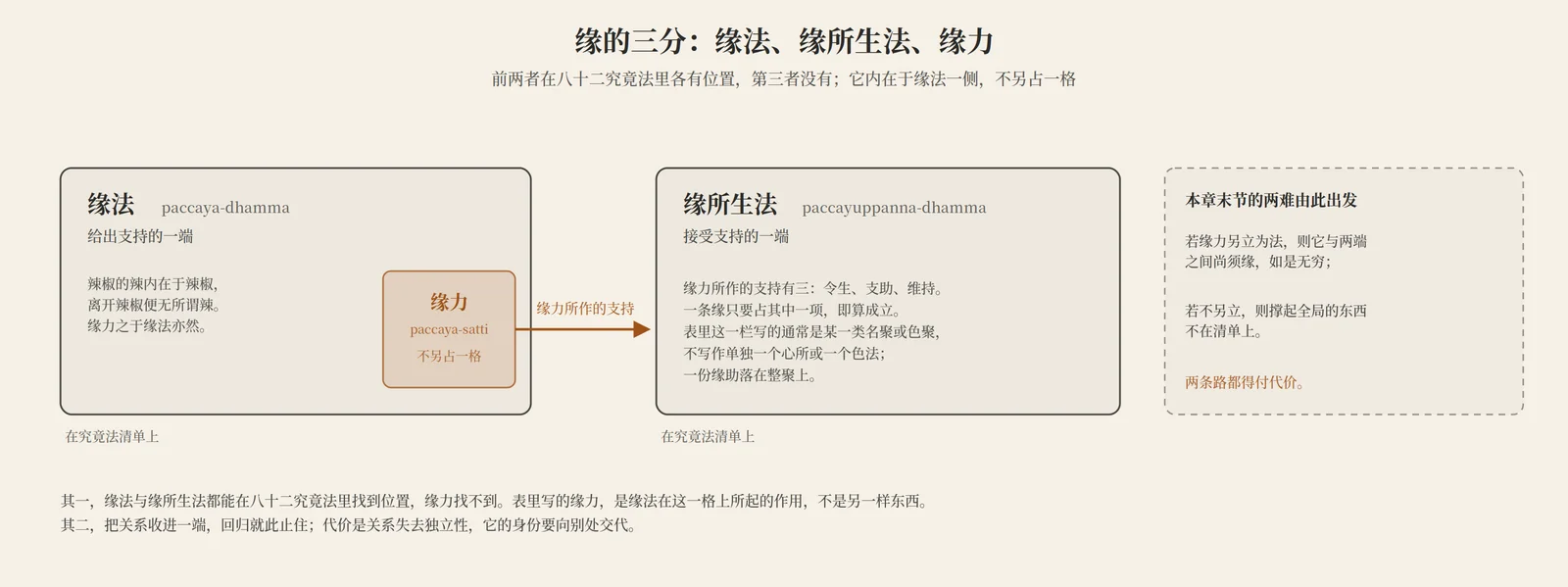
The three parts of a condition. Every condition is supported by three components: the conditioning phenomenon (paccaya-dhamma), the conditioned phenomenon (paccayuppanna-dhamma), and the conditioning force (paccaya-satti).
The conditioning phenomenon is the term that supplies support; the conditioned phenomenon is the term that receives it; conditioning force is the power of that support itself. The first two can both be found on the inventory of ultimate phenomena. The third cannot. The commentaries compare conditioning force to the heat of a chili: heat inheres in the chili and has no existence apart from it; conditioning force likewise inheres in the conditioning phenomenon and has no existence of its own apart from it.2
What matters about the simile is not that it is easy to understand, but that it draws the relation into one of its terms. The entire dilemma in the final section begins here; for now, the point need only be retained.
One further matter concerns how the tables should be read. The column for the conditioned phenomenon usually names not one consciousness or one material phenomenon, but a mental group or a material group. A complete set of mental phenomena that arise and cease together, or a complete cluster of material phenomena that arise and cease together, forms the actual term of a condition. The consciousnesses and mental factors of Chapter 2 and the material clusters of Chapter 3 all appear here in groups.
Chapter 8 of the Abhidhammattha Saṅgaha presents conditionality in two schemes: the dependent-arising method and the Paṭṭhāna method.3 The former is the scheme of twelve links, already treated in Part 13, Chapter 4. The present chapter concerns the latter. They are two arrangements of the same subject, one by stages in the round of becoming and the other by types of support.
Viewed together, the three parts produce the following diagram. The conditioning phenomenon is on the left, the conditioned phenomenon on the right, and the connecting line is conditioning force. That force is drawn on the side of the conditioning phenomenon rather than occupying an independent station, because that is exactly where the treatises place it.
The twenty-four conditions at a glance. For the definitions and combinations of each condition, see Chapter 8 of the Tabular Exposition. This chapter gives only the names, the form of support meant by the conditioning force, and one example.1
| No. | Condition | Pali | Support expressed by its conditioning force | Example |
|---|---|---|---|---|
| 1 | Root | hetu | Stabilizes as a root stabilizes a tree | One of the six roots, in relation to the remaining mental phenomena in the same group |
| 2 | Object | ārammaṇa | Is taken as a target | Mentality, materiality, a concept, or Nibbāna, in relation to the mental group that takes it |
| 3 | Predominance | adhipati | Governs by occupying the dominant position | One of desire, consciousness, energy, or wisdom, in relation to the same javana mental group |
| 4 | Proximity | anantara | Immediately precedes, with no interval | The mental group that has just entirely ceased, in relation to the presently arisen mental group |
| 5 | Contiguity | samanantara | Same as above | Same as above |
| 6 | Conascence | sahajāta | Arises at the same time | The four great elements, in relation to derived materiality in the same cluster |
| 7 | Mutuality | aññamañña | Mutually supports | At rebirth, the heart-base and the rebirth-linking mental group |
| 8 | Support | nissaya | Serves as a support and place of arising | The heart-base, in relation to the mental group dependent on it |
| 9 | Decisive support | upanissaya | Is relied upon with exceptional force | A powerful object; a powerful past phenomenon |
| 10 | Prenascence | purejāta | Has arisen earlier and remains in its phase of presence | The five sensitive material phenomena, in relation to tenfold sense consciousness |
| 11 | Postnascence | pacchājāta | A later-arisen phenomenon supports an earlier one | A later mental group, in relation to an already arisen material cluster in the body |
| 12 | Repetition | āsevana | The preceding gives rise to another of its kind immediately after it | A preceding javana, in relation to the following javana |
| 13 | Kamma | kamma | Volition produces a result | Past volition, in relation to a present resultant mental group |
| 14 | Result | vipāka | Being results together, phenomena mutually support one another | The mental phenomena within the same resultant mental group |
| 15 | Nutriment | āhāra | Maintains | The three immaterial nutriments (contact, volition, and consciousness) and nutritive essence in edible food |
| 16 | Faculty | indriya | Governs within its own domain | The eight mental faculties; material life faculty in relation to kamma-born materiality in the same cluster |
| 17 | Jhāna | jhāna | Makes the object closely observed | The five jhāna factors, in relation to the other mental phenomena in the same group |
| 18 | Path | magga | Leads to a destination, right or wrong | The mental factors that are path factors, in relation to the same mental group |
| 19 | Association | sampayutta | Arises and ceases together, sharing the same base and object | Mental phenomena, in relation to mental phenomena in the same group |
| 20 | Dissociation | vippayutta | Mentality and materiality coexist without being associated | The heart-base, in relation to the mental group dependent on it |
| 21 | Presence | atthi | Supports by not yet having ceased | Mental phenomena within the same group, in relation to one another |
| 22 | Absence | natthi | By ceasing and making room, allows the next to arise | The mental group that has just entirely ceased, in relation to the presently arisen mental group |
| 23 | Disappearance | vigata | Same as above | Same as above |
| 24 | Non-disappearance | avigata | Same as no. 21 | Same as above |
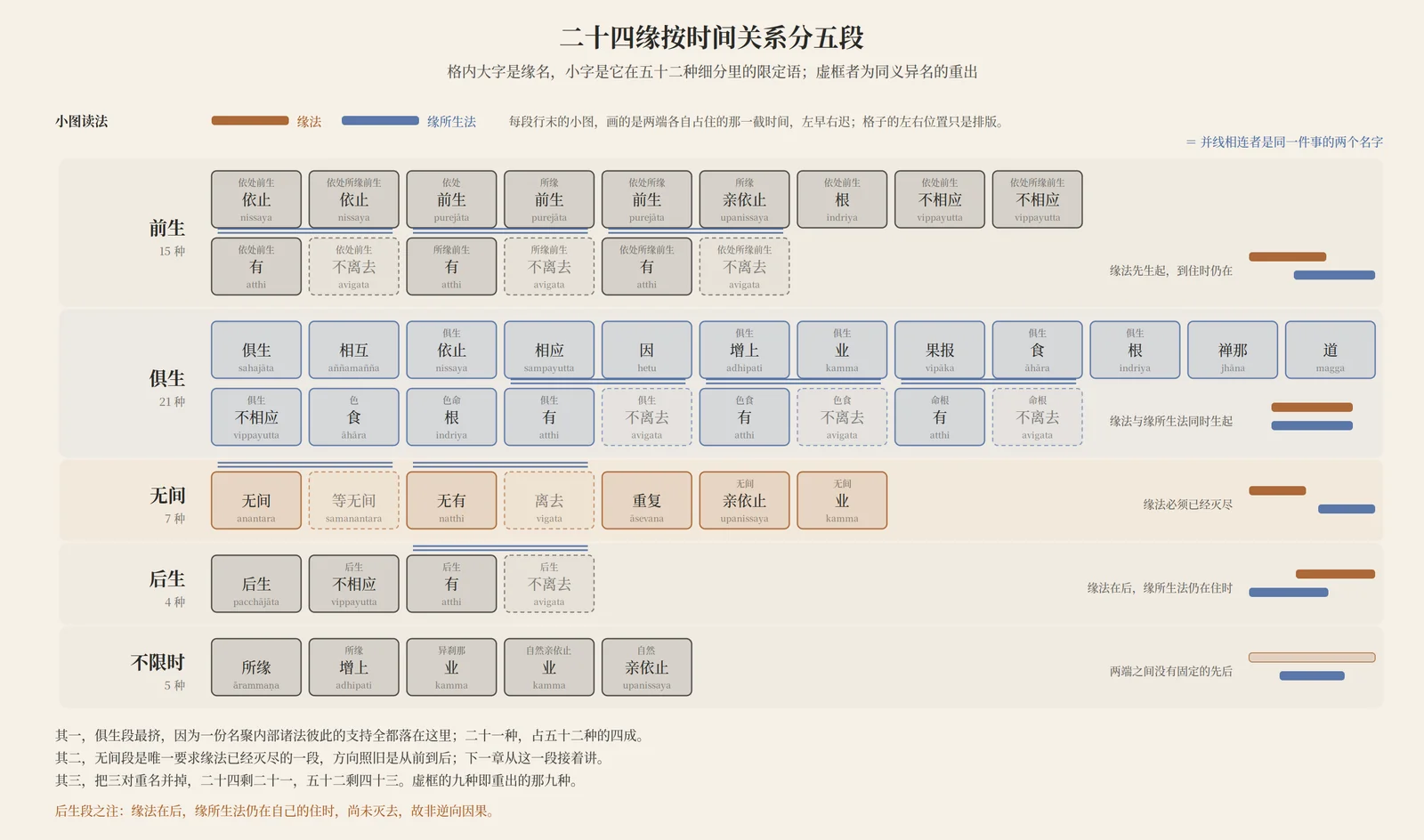
The repetitions in the table are not laziness. Among the twenty-four conditions, three pairs are two names for the same thing: proximity and contiguity, absence and disappearance, presence and non-disappearance.4 This is not an inference made by this book; the treatises and commentaries state it explicitly. A cell-by-cell comparison of the detailed table in the Tabular Exposition yields the same and still firmer conclusion. After subdivision into fifty-two, every combination under contiguity is identical to its counterpart under proximity, every combination under disappearance to its counterpart under absence, and all seven subdivisions of non-disappearance to the seven of presence. Nine of the fifty-two entries are duplicate names, and seventeen of the 130 combinations are repetitions.1
When the duplicate names are merged, fifty-two becomes forty-three and twenty-four becomes twenty-one. This book holds that readers should know this before approaching the tables: a small part of the list's length comes from naming, not wholly from observation. The treatises explain that the duplicate names were retained because each adheres to language found in a different discourse. That is the conservatism of a recitational collection, not an analytical necessity.
Arranging them by time. Some of the twenty-four conditions require the conditioning phenomenon to precede, some require simultaneity, some require it to follow, and others impose no fixed temporal relation. Cutting the list along these lines reveals its structure more clearly than arranging it by name.
Prior: prenascence condition; the object branch of decisive support; and the branch that proceeds through a base. The conditioning phenomenon arises first and remains in its phase of presence; only then does the conditioned phenomenon arise dependent on it. The five sensitive material phenomena in relation to tenfold sense consciousness are the standard example.
Conascent: conascence, mutuality, the conascent branch of support, association, the conascent branch of dissociation, the conascent branches of presence and non-disappearance, and the conascent forms of root, predominance, kamma, result, nutriment, faculty, jhāna, and path conditions. This is the most crowded category, because every form of mutual support among the phenomena within a single mental group falls here.
Immediate: proximity, contiguity, absence, disappearance, repetition, and the proximity branch of decisive support. The conditioning phenomenon must have completely ceased before the conditioned phenomenon arises immediately after it, without room for even one intervening station.
Subsequent: postnascence alone, together with its forms under dissociation, presence, and non-disappearance.
Temporally unrestricted: the asynchronous branch of kamma condition and natural decisive-support condition. The first can operate across several lives; the second across an interval of any length. Object condition and object-predominance condition also belong here. An object may be a past, present, or future phenomenon, or something outside time such as a concept or Nibbāna, so it has no fixed temporal order in relation to the conditioned phenomenon.
Postnascence deserves a further word because it can look like backward causation: a later consciousness supports earlier materiality. It is not backward. The materiality receiving support is still in its own phase of presence and has not yet ceased. The later consciousness does not cause it to arise; it merely nourishes it so that it continues. The condition of the body after a meal can be affected by the state of mind at the time of eating: that is the level at issue. The conditioning phenomenon comes later, the conditioned phenomenon earlier, but they still overlap in time. The conditions with no overlap at all are in the immediate category, where the direction remains from earlier to later.
The following diagram arranges the twenty-four in these five sections.
Fifty-two conditions and 130 combinations. Twenty-four is the primary count. Under one condition name, support need not be supplied in only one way. The conditioning phenomena may occupy different roles (as base, object, nutriment, or life faculty), and their temporal relation to what they support may differ—as conascent, prior, subsequent, or immediate. Subdividing each condition along these two dimensions yields fifty-two. Pairing each of the fifty-two in turn with its conditioning and conditioned phenomena yields 130 combinations. These two numbers form the framework of the inventory in this chapter.1
Only ten conditions are subdivided; the other fourteen remain single.
| Condition | Number of subdivisions | Names of subdivisions |
|---|---|---|
| Predominance | 2 | Conascence predominance, object predominance |
| Support | 3 | Conascence support, base-prenascence support, base-object-prenascence support |
| Decisive support | 3 | Proximity decisive support, object decisive support, natural decisive support |
| Prenascence | 3 | Base prenascence, object prenascence, base-object prenascence |
| Kamma | 4 | Conascent kamma, proximity kamma, asynchronous kamma, natural-decisive-support kamma |
| Nutriment | 2 | Conascent nutriment, material nutriment |
| Faculty | 3 | Conascent faculty, base-prenascence faculty, material life faculty |
| Dissociation | 4 | Conascent dissociation, base-prenascence dissociation, base-object-prenascence dissociation, postnascence dissociation |
| Presence | 7 | Conascence, base prenascence, object prenascence, base-object prenascence, postnascence, material nutriment, life faculty |
| Non-disappearance | 7 | The same seven as presence condition |
The ten conditions divide into thirty-eight; with the fourteen undivided conditions, the total is fifty-two. Presence and non-disappearance account for seven each, and the two sets are identical row by row. Thus fourteen cells of the fifty-two repeat the same combinations twice.
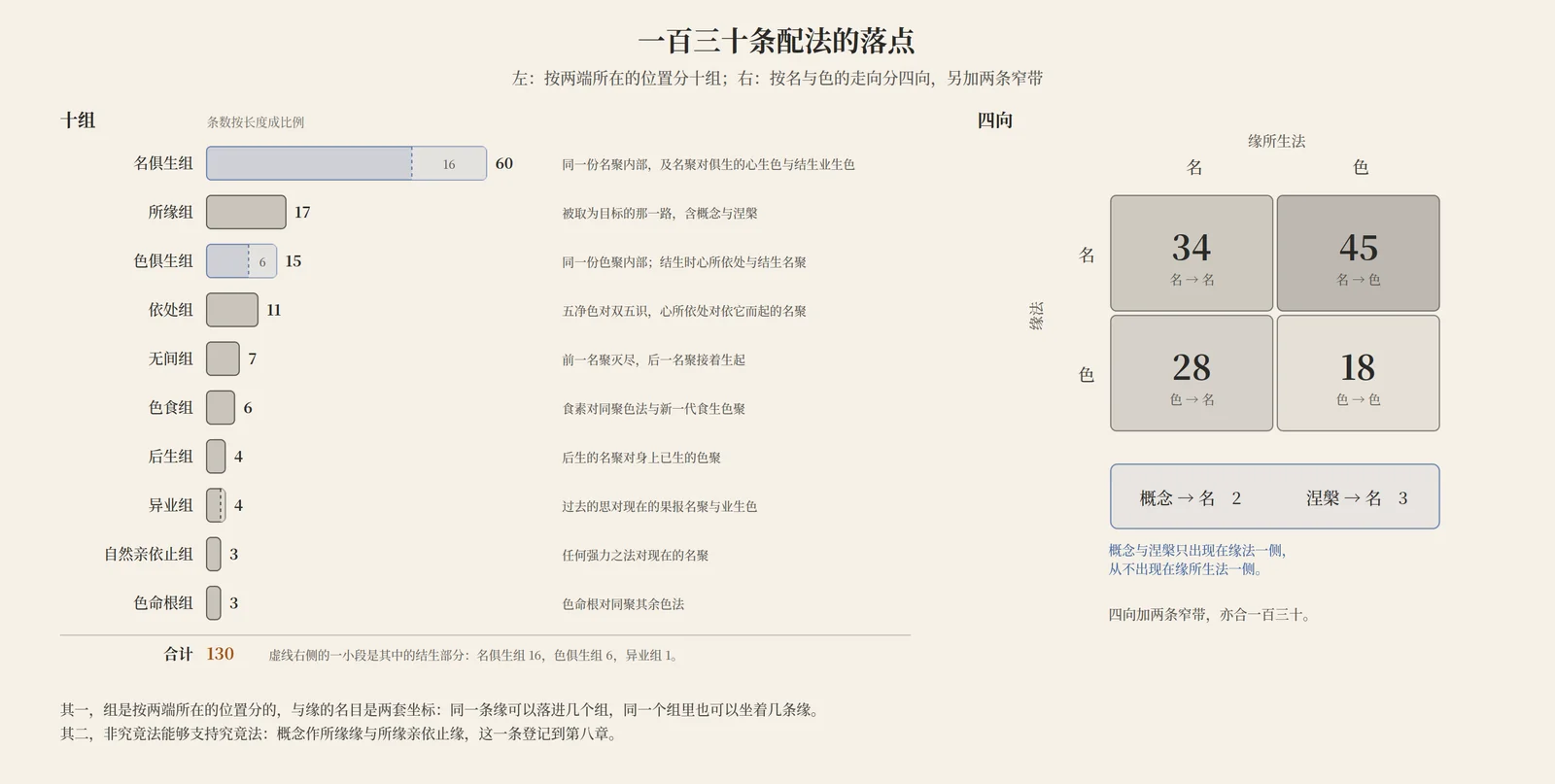
The 130 combinations fall into ten groups. These groups are organized by the location of the conditioning and conditioned phenomena; they form a different set of coordinates from the names of the conditions.
| Group | Number | What the group concerns |
|---|---|---|
| Mental-conascence group | 60 | Relations within one mental group, and a mental group in relation to conascent mind-born materiality and kamma-born materiality at rebirth |
| Object group | 17 | The branch in which something is taken as a target, including concepts and Nibbāna |
| Material-conascence group | 15 | Relations within one material cluster; at rebirth, the heart-base and the rebirth-linking mental group |
| Base group | 11 | The five sensitive material phenomena in relation to tenfold sense consciousness; the heart-base in relation to the mental group dependent on it |
| Proximity group | 7 | A preceding mental group ceases and a subsequent mental group arises immediately after it |
| Material-nutriment group | 6 | Nutritive essence in relation to material phenomena in the same cluster and a new generation of nutriment-born material clusters |
| Postnascence group | 4 | A later mental group in relation to an already arisen material cluster in the body |
| Asynchronous-kamma group | 4 | Past volition in relation to a present resultant mental group and kamma-born materiality |
| Natural-decisive-support group | 3 | Any powerful phenomenon in relation to a present mental group |
| Material-life-faculty group | 3 | Material life faculty in relation to the remaining material phenomena in the same kamma-born cluster |
Viewed from another direction, the same set of combinations yields four directions between mentality and materiality.
| Direction | Number |
|---|---|
| Mentality supports materiality | 45 |
| Mentality supports mentality | 34 |
| Materiality supports mentality | 28 |
| Materiality supports materiality | 18 |
| Nibbāna supports mentality | 3 |
| A concept supports mentality | 2 |
One point in this small table deserves attention: concepts and Nibbāna appear only in the conditioning-phenomenon column and never in the conditioned-phenomenon column. A concept is not an ultimate phenomenon, and Nibbāna is unconditioned; neither is produced by anything, yet each can support the arising of other phenomena. The conditioning phenomenon under object condition has four kinds: mentality, materiality, concepts, and Nibbāna. A consciousness can take a concept as its object, or it can take Nibbāna.1 The system therefore affirms this proposition: a non-ultimate phenomenon can support an ultimate one. Chapter 7 will treat the point further; here it is simply recorded.
The following diagram maps the 130 combinations across the ten groups and six directions.
How many conditions can be superimposed on one pair of phenomena? The second point in the overview stated that several conditions often hold between the same pair. We now inspect the cells, because this is the direct reason why the Paṭṭhāna has to be exhaustive.
Take the pair consisting of the heart-base and the mental group that depends on it. Across the fifty-two conditions, it appears in five cells: base-prenascence support, base prenascence, base-prenascence dissociation, base-prenascence presence, and base-prenascence non-disappearance. Reduced to the twenty-four, these are five conditions: support, prenascence, dissociation, presence, and non-disappearance. The same material base gives the same consciousness five kinds of support at once: it serves as its seat; exists before it; coexists while belonging to a different category; has not yet ceased when the consciousness arises; and has not departed by the time it arises.
If that material base is also taken as the object, six different cells are matched: object condition, together with base-object-prenascence support, base-object prenascence, base-object-prenascence dissociation, base-object-prenascence presence, and base-object-prenascence non-disappearance. Reduced to the twenty-four, these too are six conditions, with object condition added to the preceding set.
Next take the five sensitive material phenomena and tenfold sense consciousness. They appear in five cells: base-prenascence support, base prenascence, base-prenascence faculty, base-prenascence presence, and base-prenascence non-disappearance. Reduced to the twenty-four, there are again five conditions, but one differs from the preceding example: faculty is present here and absent there. The distinction lies in the definition of sensitive materiality. Eye sensitivity governs in the domain of seeing a visible form; the heart-base does not govern but only provides a location. Chapter 3 said that sensitive materiality is not an organ. Here the same point becomes visible again from the side of conditions.
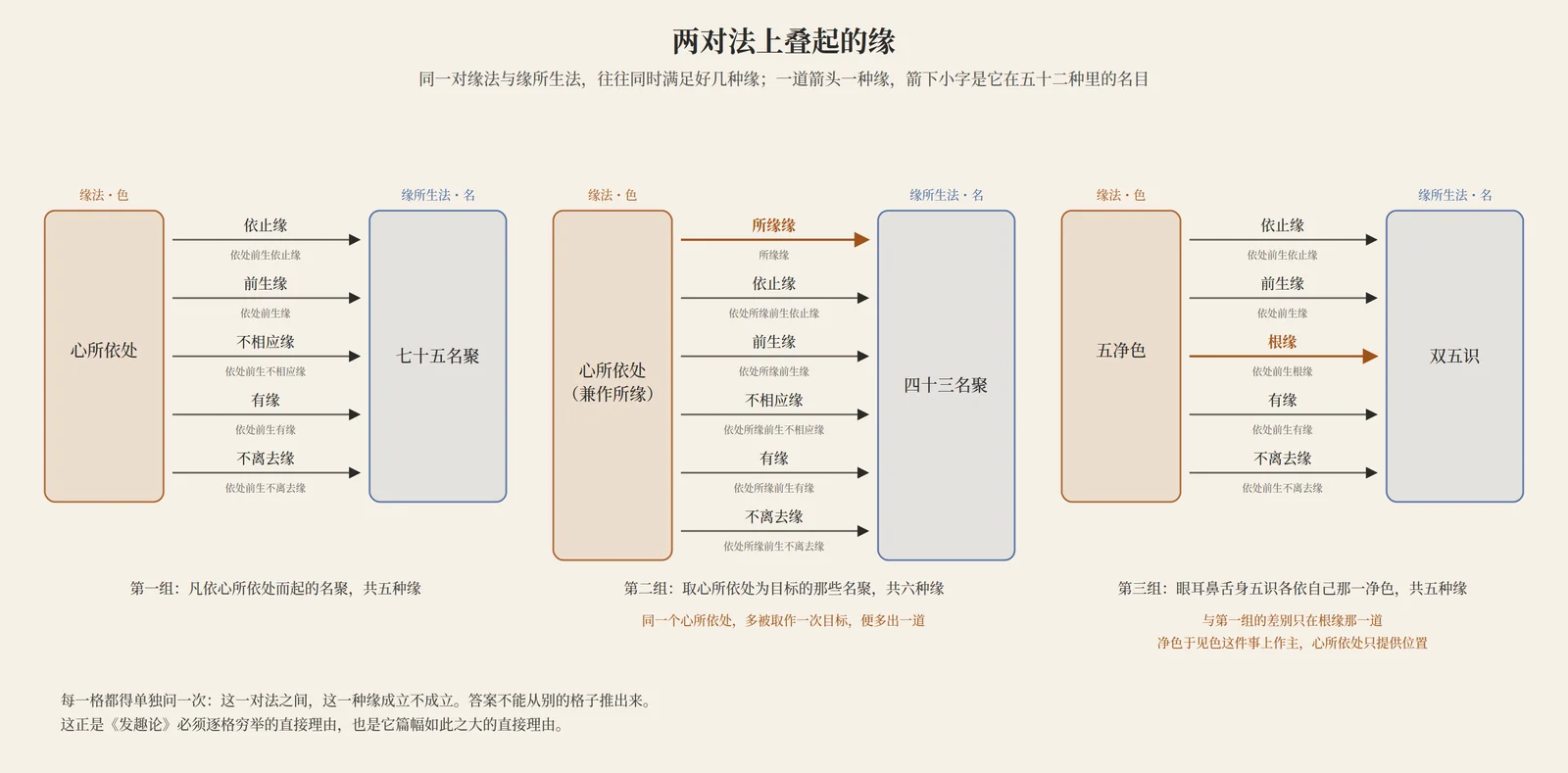
This is why the interrogative section of the Paṭṭhāna cannot be omitted. Every cell must be asked about separately, because its answer cannot be inferred from another.
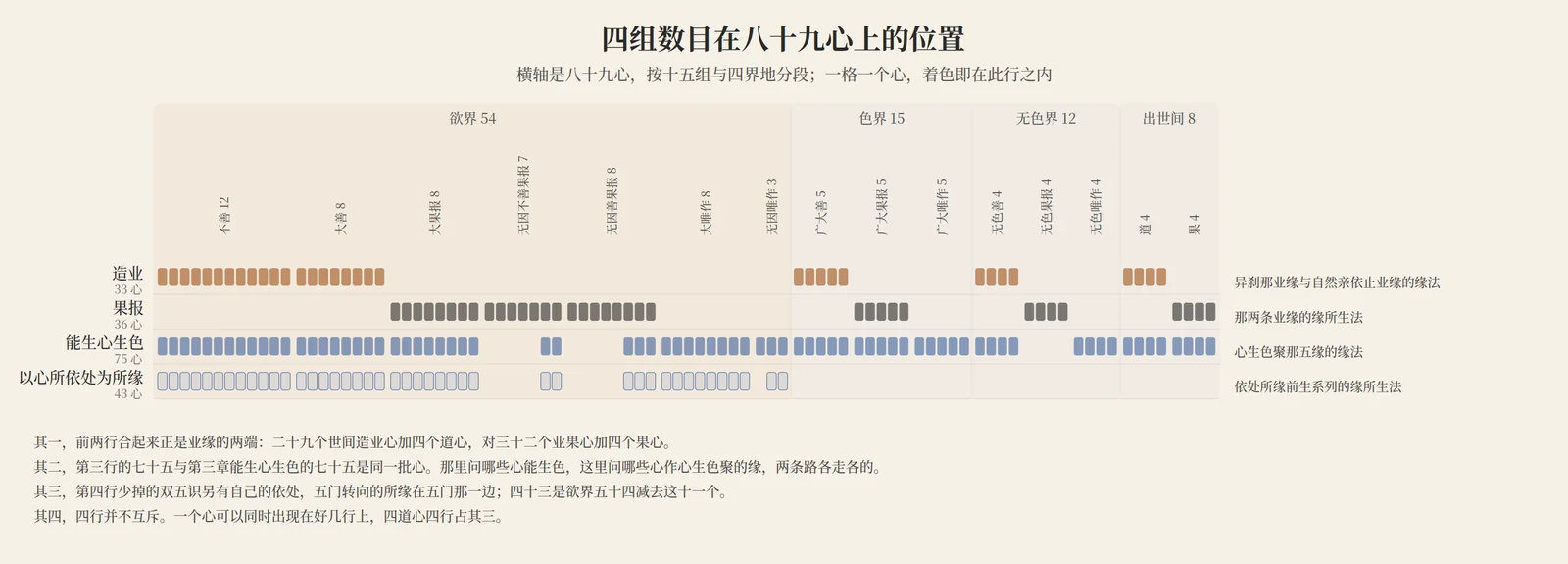
The positions of several counts among the eighty-nine consciousnesses. Four groups of consciousnesses recur throughout the chapter. Marking each once on the complete diagram of eighty-nine is easier than memorizing the numbers.
The first group consists of the volition factors in thirty-three consciousnesses, which are the conditioning phenomena for asynchronous kamma condition and natural-decisive-support kamma condition: twelve unwholesome, eight great wholesome, five fine-material-sphere wholesome, four immaterial-sphere wholesome, and four path consciousnesses. These are the consciousnesses that make kamma: twenty-nine mundane kammically active consciousnesses plus the four path consciousnesses.
The second group consists of the thirty-six resultant consciousnesses, the conditioned phenomena for those two kamma conditions: fifteen rootless resultant, eight great resultant, five fine-material-sphere resultant, four immaterial-sphere resultant, and four fruition consciousnesses.
The third group consists of the seventy-five consciousnesses capable of producing conascent mind-born materiality; tenfold sense consciousness and the four immaterial-sphere resultant consciousnesses are excluded. This count appeared once in Chapter 3. There the question was which consciousnesses can produce materiality; here it is which consciousnesses serve as conascence, support, dissociation, presence, and non-disappearance conditions for a mind-born material cluster. The same seventy-five are obtained in both places, though by two different routes.
The fourth group consists of the forty-three mental groups conditioned through the heart-base when it also serves as object: the fifty-four sense-sphere consciousnesses minus tenfold sense consciousness and five-door adverting. Tenfold sense consciousness has its own bases, while five-door adverting takes an object on the side of the five doors; neither takes the heart-base as object.
Comparison with Sarvāstivāda. The Sarvāstivāda account of conditions uses six causes and four conditions: efficient, coexistent, homogeneous, associated, universal, and maturation causes; cause, immediately preceding, object, and predominance conditions.5 Placed beside the Theravāda list of twenty-four, only the four conditions correspond by name, and even there only the names correspond.
Sarvāstivāda cause condition subsumes five of the six causes, while predominance condition is a residual category into which everything that does not obstruct the arising of a phenomenon is placed; its scope is extremely broad. Theravāda predominance condition is much narrower. It refers only to one of desire, consciousness, energy, or wisdom occupying the governing position within a javana mental group. It means domination, not non-obstruction. Under the same name, one side includes everything that does not obstruct while the other selects the sole dominant factor: they are nearly opposites.
The root of the difference lies in the form of the question. Six causes and four conditions reason backward from the effect: from which kinds of cause does this phenomenon derive its power to arise? The twenty-four conditions reason backward from the relation between two phenomena: given A and B, in how many distinguishable ways does A support B? The former classifies causes; the latter classifies relations. One is concerned with how an effect is produced, the other with how many kinds of connection can hold among phenomena.
Several conditions distinctive to Theravāda show this orientation most clearly.
Repetition condition resembles the Sarvāstivāda homogeneous cause, but the two are not the same. Homogeneous cause states that the wholesome produces the wholesome and the unwholesome the unwholesome, and it can operate across lives; it is a lineage running through a continuum. Repetition condition governs only adjacent javanas within a single cognitive process: from the first through the penultimate javana, each conditions the second through the last by repetition. Fruition consciousnesses, moreover, do not serve as repetition condition.1 Both concern like producing like, but one extends across immeasurable lives while the other is confined within seven mind-moments. It is confined so tightly because Theravāda seeks to keep it within the range identifiable in contemplation.
Postnascence has no place among the six causes and four conditions. Sarvāstivāda causes and conditions all point from earlier to later; no position is reserved for a later phenomenon supporting materiality that has already arisen. Theravāda establishes postnascence because it must account for the moment-by-moment mutual support of body and mind, not merely for production.
Decisive support, absence, disappearance, and asynchronous kamma conditions together carry a further implication. They address one problem: how can a phenomenon that has already ceased still support a present phenomenon? Sarvāstivāda answers through the real existence of the three times. The substance of a past phenomenon continues to exist and has not been canceled, so it can still act. Theravāda does not take this route. It accepts that a past phenomenon has ceased without remainder and therefore must establish special conditions under which cessation itself becomes a mode of support. Absence and disappearance say precisely that cessation makes room; asynchronous kamma and natural decisive support account for support across lives and across time.
Part of the length of the twenty-fourfold list arises in this way: if the substance of a phenomenon is not allowed to persist, relations must be divided more finely. The same pattern of tradeoff appeared in Chapter 3's discussion of unmanifest materiality. Sarvāstivāda is willing to posit an additional entity to bear continuity; Theravāda prefers to make conditions bear it. This is one aspect of the restraint to be treated in Chapter 7. Each side pays a cost: Sarvāstivāda in its ontology; Theravāda in the length of its list and in the difficulty raised by the final section of this chapter.
The Sarvāstivāda reasons for its positions, including the four arguments for the real existence of the three times, are left for direct treatment in Part 15. Here they serve only as a comparison.
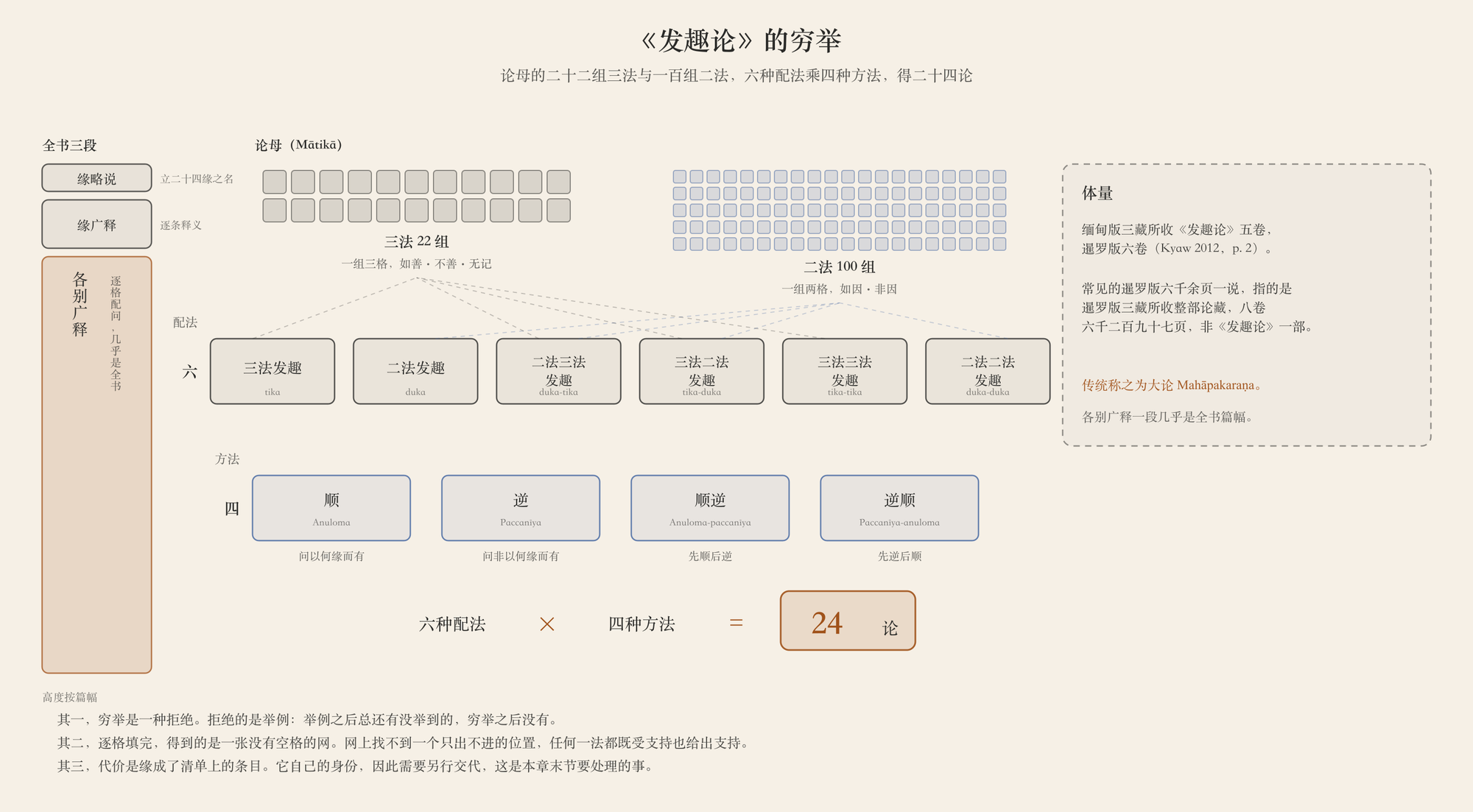
The exhaustive enumeration of the Paṭṭhāna. The source for the twenty-four conditions is the Paṭṭhāna, the last of the seven treatises of the Pali Abhidhamma and traditionally called the “Great Treatise” (Mahāpakaraṇa).6 Its sheer size has no peer in the entire Tipiṭaka, and that size is itself its point.
Its arrangement is as follows. It first establishes the list of twenty-four conditions in the Enumeration of Conditions. It then defines each in turn in the Explanation of Conditions. The main text follows, taking every group of phenomena in the matrix and pairing each group with each of the twenty-four conditions, asking the question cell by cell.
The matrix has two sections: twenty-two triads and one hundred dyads. A triad is, for example, wholesome, unwholesome, and indeterminate; a dyad, root and non-root. The main text combines these sections in six modes: triad progression, dyad progression, dyad-triad progression, triad-dyad progression, triad-triad progression, and dyad-dyad progression. Each mode is then run through four methods: positive, negative, positive-negative, and negative-positive. The positive asks by which condition something exists; the negative asks by which condition it does not exist; the other two cross the two methods. Six multiplied by four gives twenty-four, hence the designation “twenty-four treatises.”6
This is where the size comes from. The Burmese Tipiṭaka contains the Paṭṭhāna in five volumes, and the Siamese edition in six.6 A widespread statement should also be corrected in passing. The often repeated figure of more than six thousand pages in the Siamese edition refers to the entire Abhidhamma Piṭaka in the Siamese Tipiṭaka (eight volumes and 6,297 pages), not to the Paṭṭhāna alone.4 The numbers remain staggering, but their source must be stated accurately.
What does a work of this scale assert? This book sees three levels.
The first is its method. Exhaustive enumeration is not diligence but a refusal: a refusal to settle for examples. The text will not illustrate how conditions work with a few representative cases; it insists on filling every cell. Once that decision is made, the cells that cannot be filled can no longer be hidden, nor can cases in which several conditions overlap within the same cell. The two pairs of phenomena in the preceding section could be counted as matching five cells precisely because of this exhaustive method.
The second is its picture of the world. Once every cell has been filled, the result is a net without empty places. Every phenomenon is drawn by several conditions; none stands by itself, and none is pushed into being by one cause alone. Here no-self is not established by an argument but by the net itself: nowhere in it can one find a position that only sends and never receives.
The third is its cost, which is the problem in the final section of this chapter. To weave such a net, one must first accept that the strands are things that can be listed, counted, and entered cell by cell. Once conditions become items on a list, their own status has to be explained.
The question has moved up one level. Chapters 3 and 4 asked the same question: which items on a list were observed and which were supplied to make the notation coherent? This chapter no longer asks about particular entries. It asks whether the list as a whole is qualified: does a condition itself count as a phenomenon?
Set out the dilemma first.
If a condition is a phenomenon, it should appear on the inventory of ultimate phenomena. There are eighty-two ultimates (one consciousness, fifty-two mental factors, twenty-eight material phenomena, and Nibbāna), but the list contains no place for conditions.3 More seriously, once a condition acquires the status of a phenomenon, its relation to each of the two terms it connects becomes a matter between two phenomena, and in this system every such matter must itself be explained by a condition. What, then, connects the condition to the conditioning phenomenon, and what connects it to the conditioned phenomenon? If the answer is again a condition, the same question returns unchanged and can never terminate.
If a condition is not a phenomenon, the trouble reverses direction. The entire system depends on it: the order of cognitive processes, the interval between kamma and result, and the interdependence of mentality and materiality all rest upon conditions. If something supports the whole system but is absent from the inventory, that inventory cannot claim to have exhausted what exists.
The Abhidhamma's solution already appeared in the section on the three parts of a condition: conditioning force inheres in the conditioning phenomenon. It is a power belonging to the phenomenon itself, like the heat of a chili inhering in the chili.2 This step draws the relation into one term. Once that is done, no third thing remains between the two phenomena, and the regress stops. Nor need anything be added to the inventory, because conditioning force is not another phenomenon but one aspect of a phenomenon's power.
The move is neat, and its cost equally clear: the relation loses its independence. This book holds that a relation without independence cannot bear the metaphysical explanation of dependent arising. There are three reasons.
First, dependent arising is meant to explain “when this exists, that exists.” The weight of this sentence lies in the level between its two terms: how does the existence of A become a condition for the existence of B? If that level is explained as one part of A's own power, the supported term drops out of the description. A possesses a power; how that power reaches B remains unexplained. The point at which the regress is stopped is exactly where the original question stood.
Second, conditioning force actually varies with the other term. The same heart-base gives seventy-five mental groups five conditions (support, prenascence, dissociation, presence, and non-disappearance), but gives forty-three mental groups another set that includes object condition as well. The same piece of materiality does not give faculty condition to tenfold sense consciousness when it is the heart-base, whereas the five sensitive material phenomena do. If conditioning force were purely the conditioning phenomenon's own power, it should not change with the phenomenon supported. The part that changes shows that a relation genuinely has two terms. Drawing it wholly into one cannot account for it.
Third, it fails the criterion. Chapter 3 drew the line at whether something can be taken separately as an object of insight contemplation, and Chapter 4 retained it. Conditioning force cannot cross that line: no conditioning force can be separately taken as an object. Yet the second of the sixteen insight knowledges is Knowledge of Discerning Conditions, which contemplates precisely conditions.1 The object on which contemplation actually works has no recognized position on the inventory of ultimate phenomena. This is the same type of difficulty as in the preceding two chapters, only more acute.
The same type of regress appeared once before, in Chapter 3. If material characteristics are established as real phenomena, arising, presence, and dissolution must themselves arise, persist, and dissolve, and so on without end. The root treatise handles this by excluding material characteristics from the seventeen mind-moments, avoiding rather than solving the regress. Karunadasa states the move clearly in his discussion of dhamma theory: if impermanence were separately established as a phenomenon, that impermanence would require another impermanence to make it impermanent, and so on without end.7 The material-characteristics problem is avoided by denying the characteristics a lifespan; the conditioning-force problem by denying the force a status. Both use the same maneuver: whatever would generate a regress receives no independent place.
Avoidance works. In the context of practice, it can positively be counted a virtue of restraint in metaphysical assertion. But what is avoided does not disappear; it will eventually be written somewhere else. Chapter 7 will discuss this point alongside the material characteristics of Chapter 3 and the fifteen patterns of Chapter 4.
A limited external parallel. In Appearance and Reality, F. H. Bradley offered an argument of the same form: if a relation is real, new relations are required to connect it to the two terms it relates, and so on to infinity; if a relation is not real, nothing connects the terms.8 The structure is nearly identical to that of the preceding section.
The guide to Part II gave a warning on precisely this kind of use: texts come first; external theories serve in this book only as limited corroboration and analogy, and the order must not be reversed. That procedure is followed here. Bradley supplies a comparison, not an argument, and three limits must be drawn.
First, only the form is taken, not the conclusion. Bradley proceeds from it to the view that relations and qualities alike belong to appearance and that reality lies only in absolute experience. This book does not accept that move, and it has no bearing on the Abhidhamma.
Second, the problems on the two sides have different sources. Bradley's question arises from his defense of monism; the Abhidhamma's from no-self and momentary arising and cessation. Different beginnings can reach a similar fork. To call them the same problem would be false.
Third, the solutions differ, and so do their consequences. Bradley absorbs the relation and both its terms into the Absolute. The Abhidhamma absorbs the relation into the conditioning phenomenon. The former abolishes plurality; the latter preserves plurality at the cost of the relation's independence. This book points out only one thing: an inventory that decomposes what exists into its finest elements meets the same fork when it comes to relations, whichever direction it takes.
Handing the question to Chapter 6. Proximity and contiguity conditions look like mere rules of sequence, but in fact they support two places in which no seam is permitted. One lies between one consciousness and the next: the preceding consciousness ceases and the next arises immediately, without room for a single mind-moment. The other lies between one life and the next: death consciousness ceases and rebirth-linking consciousness immediately arises, again without room for a single station. The end of Chapter 4 already marked the latter and recorded one point: immediate succession presupposes a shared clock. The next chapter directly addresses continuity—the four planes and thirty-one realms, objects at the end of life, types and lifespans of rebirth, and the way life-continuum consciousness fills the intervals within a life. The problem of relations remains suspended here; next we examine its consequences for time and rebirth.
References
References
-
Tabular Exposition of the Abhidhammattha Saṅgaha (《阿毗达摩义论表解》), Chapter 8, “Compendium of Conditionality.” All numbers in Part 14 follow this work. Material taken from it in this chapter includes the distinction between the dependent-arising and Paṭṭhāna methods; explanations of the twenty-four conditions; the classifications of Ledi Sayadaw and Ācariya Anuruddha; summary tables of conditioning and conditioned phenomena; brief and synoptic tables of the fifty-two conditions; an introduction to the interrogative section of the Paṭṭhāna; tables giving the numbers of conditions required by mental and material groups; counts by direction (mentality supporting materiality 45, mentality supporting mentality 34, materiality supporting mentality 28, materiality supporting materiality 18, Nibbāna supporting mentality 3, and concepts supporting mentality 2); the five matching cells for each of the two pairs involving the heart-base and the five sensitive material phenomena; readers who need it should consult the work directly. ↩↩↩↩↩↩↩
-
Bhikkhu Bodhi (general ed.), A Comprehensive Manual of Abhidhamma: The Abhidhammattha Sangaha of Ācariya Anuruddha. Kandy: Buddhist Publication Society, 1993. This chapter draws on its explanatory material in Chapter 8 for the following points: conditioning force (paccaya-satti) inheres in the conditioning phenomenon and cannot exist apart from it, illustrated by the commentarial simile that “the hotness of chilies is inherent in the chilies”; the three functions of conditioning force—production, support, and maintenance; the division of predominance condition into conascence and object predominance, in contrast with the Sarvāstivāda interpretation of efficient cause as predominance condition; and the fact that the materiality supported by postnascence condition remains in its own phase of presence, so no backward causation is involved. ↩↩↩
-
Abhidhammattha Saṅgaha, Chapter 8, “Compendium of Conditionality” (Paccayasaṅgahavibhāga): the treatment of conditions is divided between the dependent-arising method (paṭiccasamuppāda-naya) and the Paṭṭhāna method (paṭṭhāna-naya), the first consisting of the twelve links and the second of the twenty-four conditions. The names and Pali terms for the conditions follow this chapter. The Theravāda count of eighty-two ultimate phenomena (one consciousness, fifty-two mental factors, twenty-eight material phenomena, and Nibbāna) is obtained by totaling the categories across the treatise; it contains no place for conditions. ↩↩
-
Nyanatiloka Mahathera, Guide Through the Abhidhamma Piṭaka. Kandy: Buddhist Publication Society, first published 1938 and repeatedly reprinted. Its introduction says that the entire Pali Abhidhamma Piṭaka in the Siamese Tipiṭaka comprises eight volumes and 6,297 pages. This chapter accordingly corrects the widespread claim that the Paṭṭhāna alone occupies more than six thousand pages. Nyanatiloka's Buddhist Dictionary: Manual of Buddhist Terms and Doctrines, entry “paccaya,” also states explicitly that proximity (anantara) and contiguity (samanantara) are identical; non-disappearance (avigata) and presence (atthi) are identical; and disappearance (vigata) and absence (natthi) are identical. ↩↩
-
Abhidharmakośabhāṣya, Chapter 2, Indriyanirdeśa, on the six causes and four conditions. The six causes are efficient, coexistent, homogeneous, associated, universal, and maturation causes; the four conditions are cause, immediately preceding, object, and predominance. Cause condition subsumes the five causes other than efficient cause; predominance condition is efficient cause understood in the sense of non-obstruction and has the broadest scope. This differs from Theravāda predominance condition, which refers specifically to one of desire, consciousness, energy, or wisdom occupying a governing position. For the Sarvāstivāda rationale, arguments for the real existence of the three times, and the trans-lifetime operation of homogeneous and universal causes, see Part 15. ↩
-
The Paṭṭhāna, the last of the seven Theravāda Abhidhamma treatises and traditionally known as the “Great Treatise” (Mahāpakaraṇa). The work has three sections: the Enumeration of Conditions (Paccayuddesa), which states the names of the twenty-four; the Explanation of Conditions (Paccayaniddesa), which defines them one by one; and the Detailed Explanation (Paṭiniddesa), which pairs them cell by cell in questions. Its matrix comprises twenty-two triads and one hundred dyads. The main text crosses six modes (triad progression, dyad progression, dyad-triad progression, triad-dyad progression, triad-triad progression, and dyad-dyad progression) with four methods—positive (Anuloma), negative (Paccanīya), positive-negative (Anuloma-Paccanīya), and negative-positive (Paccanīya-Anuloma). Six times four yields twenty-four treatises. This account of the structure follows the section on the Paṭṭhāna in Guide to Tipitaka. For the statement that the Burmese Tipiṭaka contains the Paṭṭhāna in five volumes and the Siamese edition in six, see Pyi Phyo Kyaw, “The Paṭṭhāna (Conditional Relations) and Buddhist Meditation,” paper presented at the United Nations Day of Vesak academic conference, 2012, main text p. 2: “The Burmese version of the Paṭṭhāna consists of five volumes, while the Siamese version consists of six volumes.” This book cites the location in that paper and does not claim to have compared the Burmese and Siamese primary editions volume by volume. ↩↩↩
-
Y. Karunadasa, The Theravāda Abhidhamma: Its Inquiry into the Nature of Conditioned Reality. Boston: Wisdom Publications, 2019; originally published by the Centre of Buddhist Studies, University of Hong Kong, 2010. Its eighteen chapters conclude with one devoted to conditional relations, and an appendix treats Theravāda and Vibhajyavāda. See also Karunadasa, The Dhamma Theory: Philosophical Cornerstone of the Abhidhamma, Wheel Publication No. 412/413. Kandy: Buddhist Publication Society, 1996. The detailed citation promised in the note to Chapter 1 appears here: if impermanence were separately established as a phenomenon, “this impermanence would require another impermanence to make it impermanent,” and so on without end. Part 14 uses the argument twice, for material characteristics in Chapter 3 and conditioning force here. ↩
-
F. H. Bradley, Appearance and Reality: A Metaphysical Essay. London: Swan Sonnenschein, 1893. The regress argument appears in Chapter 3, “Relation and Quality”: if a relation is real, further relations are needed between it and each of its terms, generating an infinite regress; if it is not real, nothing connects the terms. This chapter uses only the form of the argument as limited external corroboration. It does not adopt Bradley's conclusion that relations and qualities belong to appearance and that reality lies only in absolute experience, nor claim that the two discussions concern the same problem. Bradley's full context lies outside the scope of Part 14. ↩