Chapter 3: Rūpa—A Taxonomy of Material Phenomena¶
What this chapter does. The preceding chapter arranged the catalogue of mind; this one arranges its counterpart. The twenty-eight kinds of rūpa are not twenty-eight material ingredients but twenty-eight textures that can be distinguished while contemplating the body. They do not occur alone; the actual minimal unit is a group. Every texture can be asked what produces it, and there are only four answers. This chapter first explains in modern language what question the classification answers, then presents the list, origins, modes of grouping, and durations item by item. Apart from the overview, the chapter is essentially a reference list to be consulted when needed. It need not be read straight through.
Overview: what this classification says. Three sentences.
First, the twenty-eight kinds of rūpa list textures, not ingredients. The characteristics of earth, water, fire, and air are hardness, flowing or cohesion, warmth or cold, and supporting or pushing. All are predicates directly encountered in the body.1 The analysis is neither a particle theory nor an element theory. It does not ask what a thing is made of, but how many identifiable textures can be distinguished in a body under observation.
Second, material phenomena do not arise singly. Wherever rūpa occurs, at least eight phenomena arise together: earth, water, fire, air, visible form, odor, taste, and nutritive essence. Tradition calls them the eight inseparables. Two more are present at the eye, producing the eye-decad. The catalogue contains twenty-eight names; what one actually encounters is always a group.2
Third, the four modes of origination ask about sources. The same texture may be produced by kamma, citta, temperature, or nutriment. This is an analysis of source, not composition. The question is not what an object is made of, but what brings forth this presently appearing texture.
Even without looking at a table, these three statements should make clear what the classification treats: a body being contemplated, not a chart of material composition.
First, what it is not. Part 13, Chapter 3 has already reached one judgment: all four great elements have experiential qualities as their characteristics—hardness, wetness or cohesion, warmth, and movement. The discourses' manner of defining the four elements supports the point. The Greater Discourse on the Simile of the Elephant's Footprint lists internal earth as hair of the head and body, nails, teeth, skin, flesh, sinews, bones, and the like; internal water as brain, tears, sweat, mucus, saliva, pus, blood, fat, marrow, and the like.3 This is not a list of ingredients but a list for identification in one's own body.
Reading the twenty-eight through particles, fields, or quantum theory is the textbook case of prejudgment against which the guide to Part II warned. Earth is not the solid state, nor water the liquid state. Water's characteristic is flowing and cohesion, yet it is expressly excluded from the tangible object. Tangibility is borne only by earth, fire, and air, because touch directly encounters only hard or soft, cold or warm, and pressure or support. Cohesion is inferred, not touched.4 A theory of material composition would not exclude water from what is tangible. A theory of what is obtained in contemplating the body might.
The twenty-eight kinds of rūpa are working units for contemplating the body and have nothing to do with material composition. This sentence is the general answer to two difficulties later in the chapter.
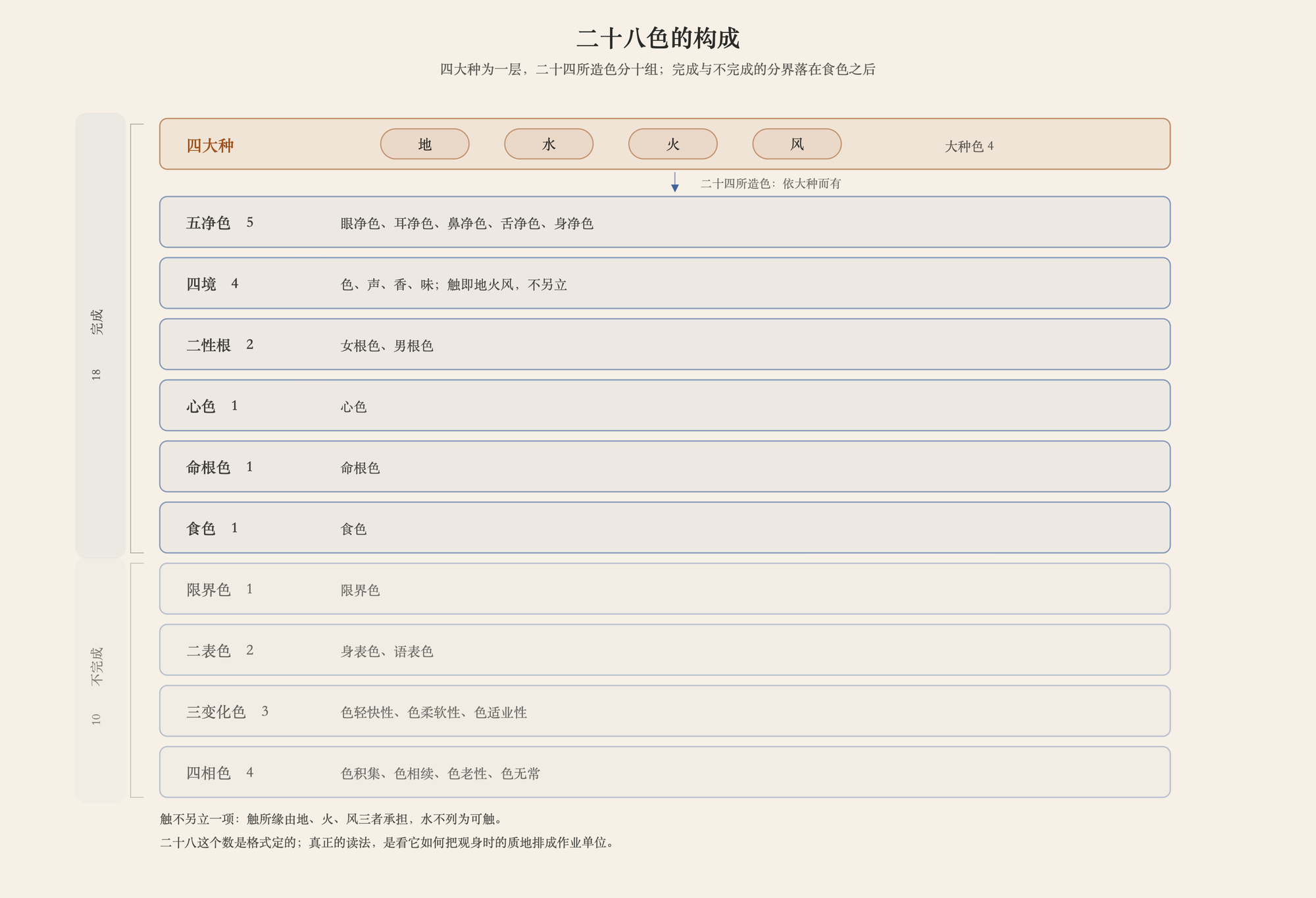
The four great elements and twenty-four derived phenomena. The twenty-eight kinds of rūpa have two levels: four great elements and twenty-four derived phenomena. “Derived” means dependent on the great elements, not assembled out of them.
The four great elements are earth, water, fire, and air. The twenty-four derived phenomena fall into ten groups.
Five sensitivities: eye, ear, nose, tongue, and body. A sensitivity is not the organ but the portion of sensitivity in the organ capable of receiving a particular impact. Eye-sensitivity has as its characteristic the transparent matter capable of receiving visible form; its function is to direct a cognitive process to a visible object; its manifestation is to serve as the base of eye-consciousness. The other four follow the same format.5
Four objective phenomena: visible form, sound, odor, and taste. Tangibility is not separately established because earth, fire, and air already perform that role. Only four objectives are therefore listed; with the three great elements that bear touch, they constitute the familiar five sense objects of the discourses.
Two phenomena of sex: femininity and masculinity. One heart-base, serving as the base of the mind element and mind-consciousness element. One life faculty, maintaining the kamma-born matter in the same group for its allotted duration. One material nutriment, the nutritive essence of food that will recur throughout the sections below.
One space element, demarcating one material group from another. Two kinds of intimation, bodily and verbal: the material aspect of bodily action and speech. Three kinds of mutability: lightness, malleability, and wieldiness. Four characteristics: production, continuity, aging, and impermanence.
| Group | Number | Contents |
|---|---|---|
| Great elements | 4 | Earth, water, fire, air |
| Sensitivities | 5 | Eye, ear, nose, tongue, body |
| Objectives | 4 | Visible form, sound, odor, taste (touch is borne by earth, fire, and air) |
| Sex | 2 | Femininity, masculinity |
| Heart-base | 1 | Heart-base |
| Life faculty | 1 | Material life faculty |
| Nutriment | 1 | Material nutriment |
| Limitation | 1 | Space element |
| Intimation | 2 | Bodily intimation, verbal intimation |
| Mutability | 3 | Lightness, malleability, wieldiness |
| Characteristics | 4 | Production, continuity, aging, impermanence |
| Total | 28 |
This chapter does not reproduce the characteristic, function, manifestation, and proximate cause of every item. Readers requiring a cell-by-cell comparison should consult the Tabular Exposition of the Abhidhammattha Saṅgaha directly.1
Concrete and nonconcrete matter. The root text cuts the twenty-eight again: the first eighteen are concrete matter, the final ten nonconcrete. Concrete matter comprises the four great elements, five sensitivities, four objectives, two phenomena of sex, heart-base, life faculty, and nutriment. Nonconcrete matter comprises one space element, two intimations, three kinds of mutability, and four characteristics.2
The root text is clear about where the cut falls. Concrete matter possesses its own nature and is therefore suitable as an object of insight contemplation. Nonconcrete matter is not directly produced by the four causes of matter but is merely a quality of concrete matter.4 Concrete matter has a series of synonyms: matter with own-nature, matter with its own characteristic, real matter, matter as matter, and matter to be contemplated by insight. The last name best explains the division. In practice, concrete and nonconcrete are divided by whether an item can be separately taken as an object of contemplation.
The division should be remembered, because every difficulty raised at the end of the chapter lies on the side cut away.
The two levels and two halves appear together in the following diagram. The four great elements occupy the top line; the twenty-four derived phenomena are arranged below in ten groups. The division at left separates eighteen concrete and ten nonconcrete phenomena, with the boundary falling after nutriment.
Four modes of origination: what produces this texture. Four causes: kamma, citta, temperature, and nutriment.
Later sections will explain each term in more detail. One example of each is needed now, or the following figures will remain only numbers in four columns.
Kamma means past intention, limited to twenty-five kinds: the cetasika of intention in the twelve unwholesome cittas, eight great wholesome cittas, and five wholesome fine-material cittas.4 Chapter 2 counted twenty-nine worldly kamma-making cittas. The four absent here are the wholesome immaterial cittas: the plane they produce has no matter, so they naturally cannot produce rūpa. Kamma produces what this body possesses from birth: five sensitivities, the two sex phenomena, the heart-base on which the mind element and mind-consciousness element depend, and the life faculty that maintains them. Which kamma produces which matter receives an answer only in the proximate-cause column. The proximate cause of eye-sensitivity is the four great elements born of kamma rooted in the wish to see; that of ear-sensitivity is the great elements born of kamma rooted in the wish to hear; nose, tongue, and body follow the same pattern.5 Kamma therefore does not allocate one piece of matter to each deed. At rebirth-linking it establishes the whole set and thereafter reproduces it at every moment. However strongly one may now wish to see clearly, one cannot produce a new portion of eye-sensitivity.
Citta means the present citta. Seventy-five of the eighty-nine can produce matter; the exclusions are the two sets of fivefold sense consciousness and the four immaterial resultant cittas.4 It produces the material appearance of intention in the body. When one raises a hand, nods, or walks, the part that lets others read intention is bodily intimation. The shaping of mouth and tongue in speech is verbal intimation; the speech sound that accompanies it likewise originates in citta.1 The three mutable qualities also appear under citta: when the mental state shifts, the body's lightness, heaviness, softness, and rigidity shift with it. One function assigned to joy in the cetasika table is to spread excellent mind-born matter throughout the body.1
Temperature means the fire element within a material group. Upon reaching its static phase, it produces a new generation of material groups, inside and outside the body alike.4 All inanimate things outside (stones, rivers, plants, thunder, and wind) have only this source.
Nutriment means the nutritive essence ingested with food. As digestion distributes it, it too produces a new generation of octads upon reaching its static phase.4 On the material side, this is what it means for a meal to sustain the body.
Eight phenomena are common to all four causes: earth, water, fire, air, visible form, odor, taste, and nutriment—the eight inseparables already introduced. Every material group born of any cause contains all eight.
When the four origins are counted by attribution and derivative matter is included, each column lists the following beyond the eight inseparables. Kamma lists ten more: five sensitivities, the two sex phenomena, heart-base, life faculty, and space. Citta lists seven: sound, space, bodily and verbal intimation, and the three mutable qualities. Temperature lists five: sound, space, and the three mutable qualities. Nutriment lists four: space and the three mutable qualities. Eight plus ten gives eighteen; eight plus seven, fifteen; eight plus five, thirteen; eight plus four, twelve.1
| Origin | Shared | Additionally attributed beyond the eight | Total |
|---|---|---|---|
| Kamma-born | 8 | Five sensitivities, femininity, masculinity, heart-base, life faculty, space | 18 |
| Citta-born | 8 | Sound, space, bodily intimation, verbal intimation, three mutable qualities | 15 |
| Temperature-born | 8 | Sound, space, three mutable qualities | 13 |
| Nutriment-born | 8 | Space, three mutable qualities | 12 |
Expanded item by item, this becomes an incidence matrix: the rows are the twenty-eight kinds of rūpa, the columns the four causes, and a solid mark means that the cause can produce the phenomenon.
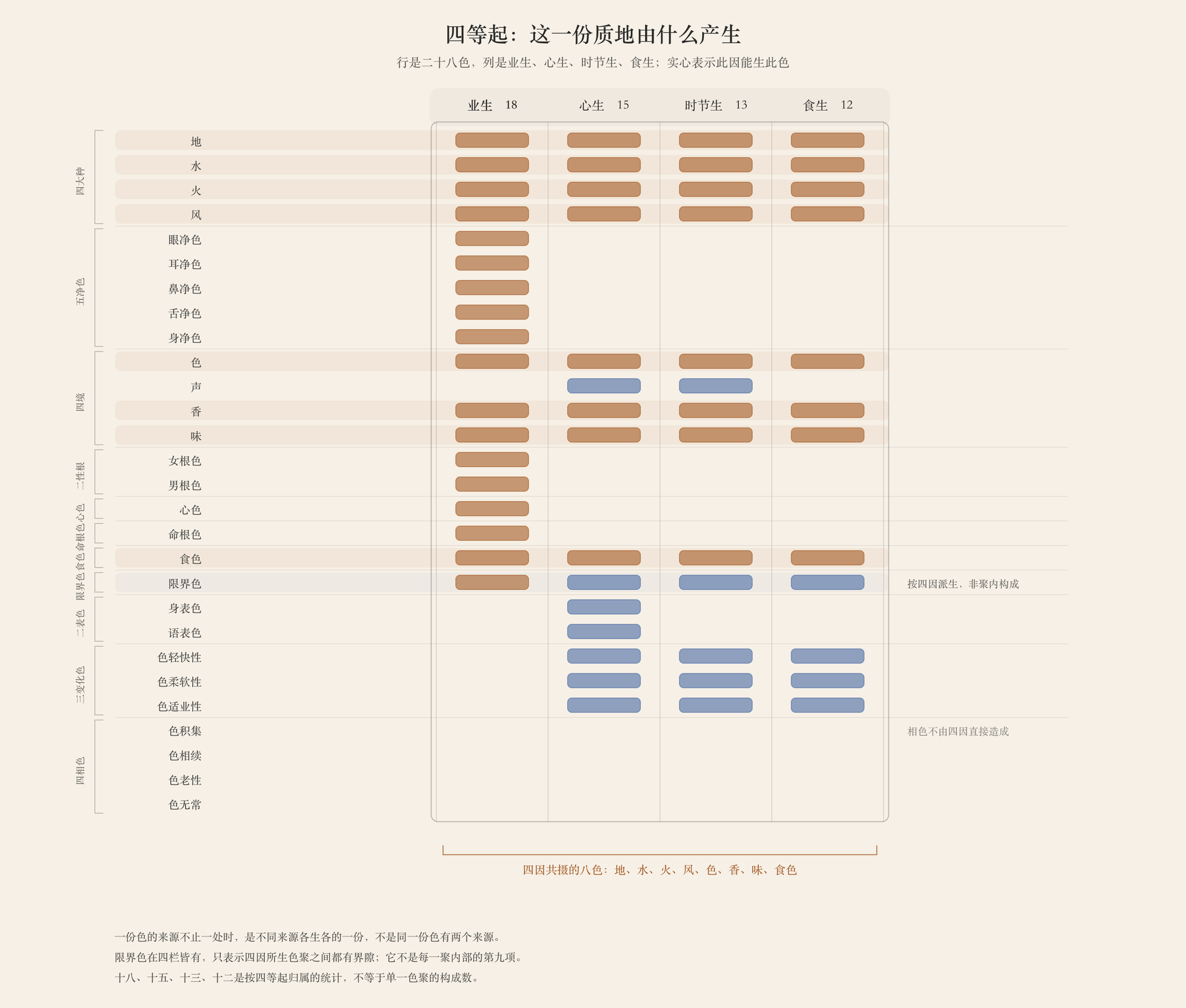
Several points in the table matter.
First, the five sensitivities, two sex phenomena, heart-base, and life faculty are produced only by kamma. The fact that a body is an ensouled body with faculties on which consciousness can depend lies entirely in this column. The other three causes can produce only what sentient and insentient things share.
Second, the two intimations occur only in the citta-born column. Nothing other than present citta can bring forth the material aspect of action and speech.
Third, the four characteristics appear in no column. The reason belongs to the section on duration below: they name the arising, persistence, and ceasing of what has been produced and are not separately produced.
Fourth, space appears in all four columns, but the table records attribution by origin, not internal composition. There are gaps among the material groups produced by all four causes, so space may derivatively be attributed to each. The root text immediately states that it demarcates groups but is not a constituent within any group.2
Fifth, sound appears only under citta and temperature. Speech sound comes from citta; other sounds from temperature. Neither kamma nor nutriment can produce sound.
Their starting points also differ. Kamma-born matter begins at the arising of the rebirth-linking citta and thereafter arises continuously during each of the three phases (arising, presence, and cessation) of every mind-moment. Citta-born matter begins only with the first bhavaṅga after rebirth-linking and arises only at the arising phase of each citta. The rebirth-linking citta does not produce it. The two sets of fivefold sense consciousness were excluded for the same reason: they lack the force required to produce matter.4 There is a boundary at the other end as well. Beginning with the static phase of the seventeenth citta before death consciousness, kamma-born matter ceases to arise.4 The number seventeen appears here for the first time; the next section explains it.
Material groups: rūpa does not arise alone. Two source layers must first be separated. The root Abhidhammattha Saṅgaha lists twenty-one groups: nine kamma-born, six citta-born, four temperature-born, and two nutriment-born. Pa-Auk meditation instruction adds two breath-related citta-born groups (the citta-born breath-sound nonad and the citta-born breath-sound-and-lightness dodecad), thus producing twenty-three: nine, eight, four, and two.26 The itemized list and figure below use the later total of twenty-three in order to connect with the meditation table on which they are based. It is a later pedagogical expansion, not the number given in the root compendium.
Each of the nine kamma-born groups contains the eight inseparables and life faculty, then adds one item. The eye-decad adds eye-sensitivity; the ear, nose, tongue, and body decads follow the same pattern. The femininity-decad adds femininity; the masculinity-decad masculinity; the heart-base-decad heart-base. The ninth is the vital nonad, adding nothing beyond life faculty: eight plus life gives nine.
The eight citta-born groups are the pure octad; bodily-intimation nonad; verbal-intimation decad, adding sound and verbal intimation; lightness undecad, adding the three mutable qualities; bodily-intimation-and-lightness dodecad; verbal-intimation, sound, and lightness group of thirteen; citta-born breath-sound nonad; and citta-born breath-sound-and-lightness dodecad.
The four temperature-born groups are the pure octad, sound nonad, lightness undecad, and sound-and-lightness dodecad.
The two nutriment-born groups are the pure octad and lightness undecad.1
The twenty-three groups of the Pa-Auk pedagogical system appear side by side below. The inner circle of each contains the fixed eight inseparables; the outer circle contains what that group adds.
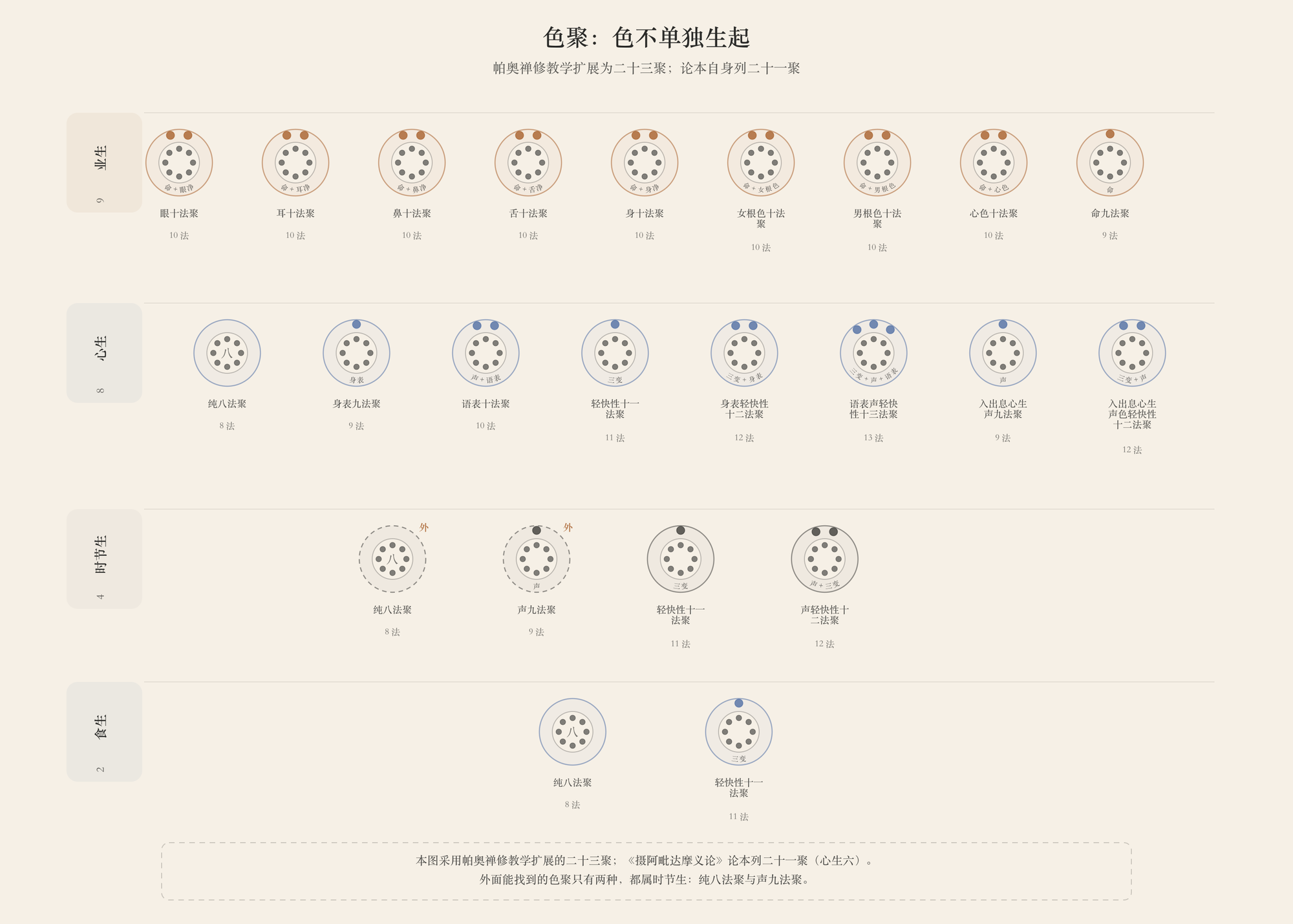
The eye-decad most clearly illustrates the second sentence of the overview. At the eye there are simultaneously hardness, flowing or cohesion, temperature, pressure, color, odor, taste, and a portion of nutriment, together with a force maintaining their life and a sensitivity capable of receiving the impact of visible form. The eight inseparables plus life faculty and eye-sensitivity make exactly ten. Space appears as the gap between this group and adjacent groups and is not counted among the ten. Contemplation of the body can distinguish the members of the group, but none appears alone. The catalogue has twenty-eight entries; contemplation encounters only groups.
Like the preceding chapter's catalogue, this one is for consultation during contemplation, not memorization.
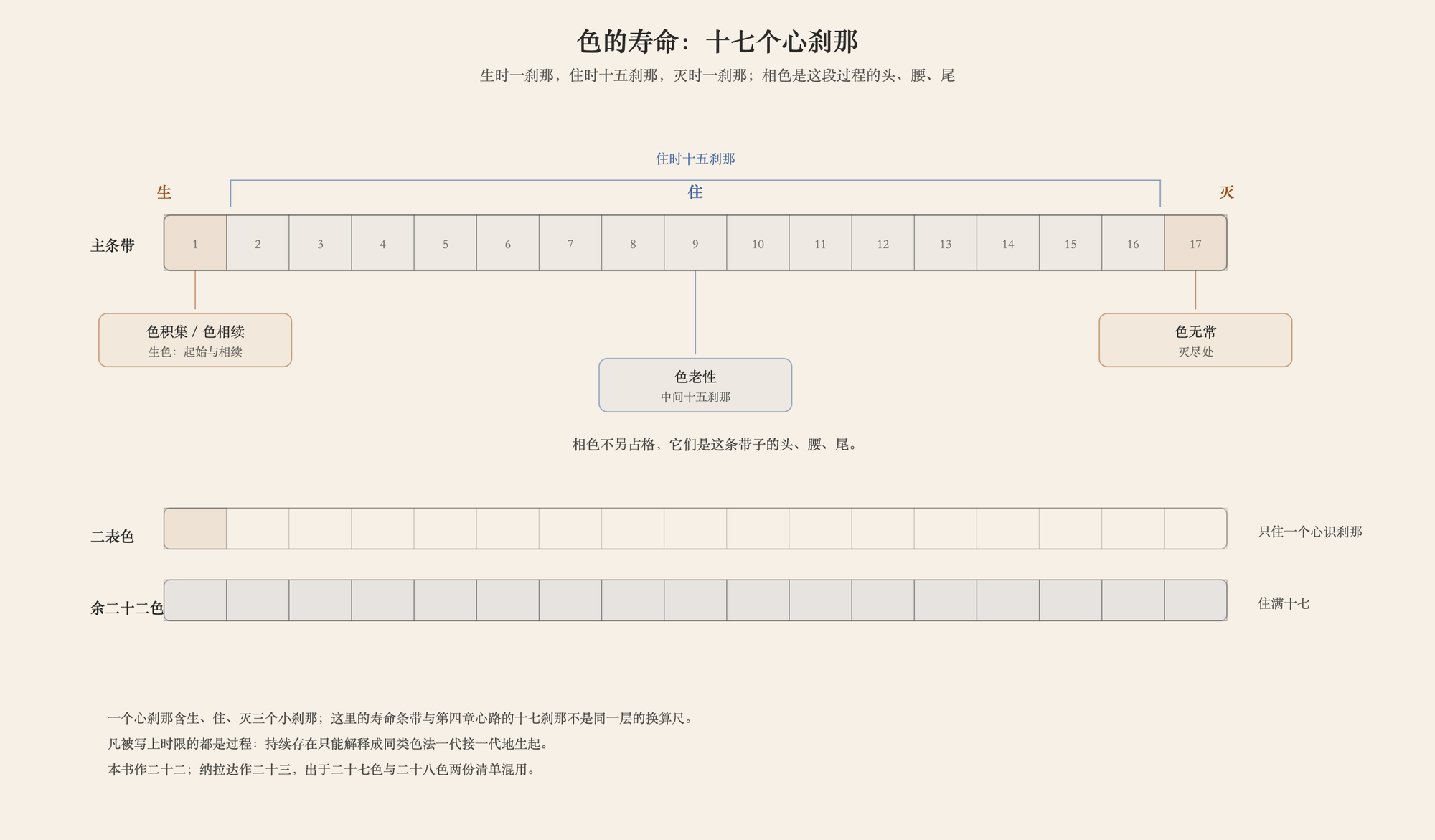
The duration of matter: seventeen mind-moments. A mind-moment is divided into three submoments: arising, presence, and dissolution. The root text then states that the life span of material phenomena is seventeen mind-moments.7 The arising and dissolution phases of mental and material phenomena have the same duration, while the presence phase of matter equals forty-nine mental submoments. In submoments, the calculation is one plus forty-nine plus one, totaling fifty-one.48
What matters about the figure is not its magnitude but that it is a number. To assign a life span to a texture is to acknowledge that it arises and ceases, with beginning and end. Whatever bears a time limit is a process. This book holds that this is the easiest fact to miss in the taxonomy of twenty-eight kinds of rūpa. They appear in the list as twenty-eight names and therefore resemble twenty-eight things, but each is expressly given an expiration. The persistence of an object can only mean that material phenomena of the same kind arise in generation after generation; no unmoving bearer remains between them. Each entry in the catalogue is best read as an event with beginning and end. The next two sections press the point from two sides.
Not all rūpa lasts this long. There are two sets of exceptions, for different reasons.
The two intimations last only one mind-moment.8 Bodily and verbal intimation are the material aspect of action and speech. They originate in citta, and the act of indicating ends when the citta that produced it ends. A gesture appears as one continuous movement because a series of cittas arises in succession, each producing its own intimation.
The four characteristics are more radical: they are the process itself. The root text says that production, continuity, aging, and impermanence are called the characteristics of matter; here birth itself is spoken of under the two names production and continuity.7 Nārada's explanation is direct: the first mind-moment resembles production, the last impermanence, and the intervening fifteen aging.8 The characteristics are not four further things, but the beginning, middle, and end of the seventeen-moment process. Assigning them another duration would amount to assigning a duration to duration.
The count is therefore as follows: remove two intimations and four characteristics from the twenty-eight kinds of rūpa; the remaining twenty-two last the full seventeen moments. Counting positively gives the same figure: eighteen concrete phenomena, plus space, plus three mutable qualities. Nārada's English note gives twenty-three.8 The discrepancy comes from the underlying list. He excludes the two intimations together with birth, aging, and impermanence (five items), because production and continuity have already been combined there as one birth, producing a list of twenty-seven. Twenty-seven minus five gives twenty-two. This chapter uses the twenty-eight-item list, in which production and continuity each occupy an entry; six items must therefore be excluded, and twenty-eight minus six still gives twenty-two. The figure twenty-three results from subtracting the exclusions of the twenty-seven-item list from the total of the twenty-eight-item list. Follow either list consistently and the result is twenty-two. This book therefore uses twenty-two.
Another pair of figures must not be conflated. The fifteen intervening mind-moments and the one-plus-forty-nine-plus-one calculation do not count the same level of unit. The former counts mind-moments; the latter submoments. They cannot be aligned and converted cell for cell.
Duration, the four characteristics, and the two sets of exceptions combine into the following band.
Does a rock exist for only seventeen mind-moments? This is the question most likely to arise upon reading the section on duration. Do external stones, mountains, and houses also live for only seventeen mind-moments?
The first answer returns to the third point in the overview and the general answer already given: the twenty-eight kinds of rūpa are working units for contemplation of the body. The entire list was designed for that purpose. The discourses illustrate the four elements with hair, nails, teeth, tears, sweat, mucus, and saliva. Sensitivities are defined as bases of consciousness. Sex, heart-base, and life faculty make sense only in a sentient body. Applying the list to measure a rock uses an instrument outside its domain. This book holds that asking how many mind-moments a rock lives is the same kind of category error as asking how many kilograms of mineral content a medical report can measure.
The second answer comes from the root text itself and is blunt. Only two kinds of material group are found externally, both temperature-born: the pure octad and sound nonad. All other groups are internal only.9 The root text never spreads all twenty-eight kinds of rūpa across external objects. External groups contain only eight or nine phenomena. Sensitivities, sex, heart-base, life faculty, and intimation do not occur inside the groups constituting a rock. Space merely describes the gaps between external groups and is not a constituent of either pure octad or sound nonad. The four characteristics are likewise not constituents of groups.
How, then, do eight phenomena sustain a rock? Generation after generation. When a material group reaches its static phase, the fire element within it can produce a new generation of temperature-born groups inside or outside. The fire element in that new generation can produce another.4 The Visuddhimagga is more direct: temperature-born matter continues for a long period in what is not clung to and maintains itself.10 Mahinda's lectures state the point most plainly: all inanimate material phenomena are solely temperature-born; the material world, including the body, can exist for a long time because material groups continuously arise and cease generation after generation.11
A rock is therefore continuously new. Each particular group lasts only seventeen mind-moments; a rock that looks unchanged for thousands of years is a relay of thousands of years of groups. What persists is form and causal chain, not any portion of matter. The number seventeen has not been violated. It always governed one material group, not an object.
If nutritive essence supports many generations, does it live longer? The preceding answer immediately raises another question. The texts say that when nutritive essence in a nutriment-born group reaches its static phase, it can produce a new pure octad; the nutritive essence in that generation can produce another, continuing for ten to twelve generations. They also say that food eaten in one day can sustain the body for as long as seven days, while divine nutriment may sustain it for one or two months.410 Seven days is far longer than seventeen mind-moments. Does nutritive essence live longer than other matter?
No. Two things must be separated: how long one material phenomenon lasts and how long a causal chain it can initiate.
Nutritive essence also lasts only seventeen mind-moments. Ten or twelve generations describe what it sets in motion before ceasing. The nutritive essence of the first generation produces a second during its static phase and then ceases normally; the second produces a third during its static phase and then ceases normally. Twelve generations are twelve successive portions of nutritive essence arising and ceasing; no one portion thereby lives twelve times longer. To say that a day's food sustains the body for seven days is to say that the chain can continue for seven days. Every link still ceases after arising.10
This book holds that the confusion has a general form: reading the length of a causal chain as the length of an existent. A match lights a pile of wood and the wood burns for three days; no one says the match burned for three days. This is precisely what Abhidhamma repeatedly guards against in its account of matter. It fixes the limit of each portion of rūpa at seventeen mind-moments, then explains all lasting phenomena as continuity, leaving no position in which an item can secretly extend its life. The rock of the preceding section and the nutritive essence of this one pose different questions, but receive the same answer.
Sources differ on the number of generations and must be kept distinct. The Visuddhimagga and compendium give ten to twelve. Pa-Auk's lectures give three to twelve. Mahinda's lectures give four or five for nutriment-born matter and, separately, ten to twelve generations for temperature-born matter from the fire element in nutriment-born groups, four or five from the fire element in kamma-born groups, and two or three from the fire element in citta-born groups.101211 Treatises and modern lectures do not occupy the same source level; the latter two are experiential explanations in meditation instruction. The body of this chapter uses only the treatise figure and records the lecture figures here for reference.
One terminological point may be settled in passing. Material nutriment among the twenty-eight kinds of rūpa is Pāli ojā, the first of the four nutriments, edible food. The other three (contact, mental intention, and consciousness) are mental phenomena and do not belong to this list of rūpa.4 “Nutritive essence” in this section always means the material item.
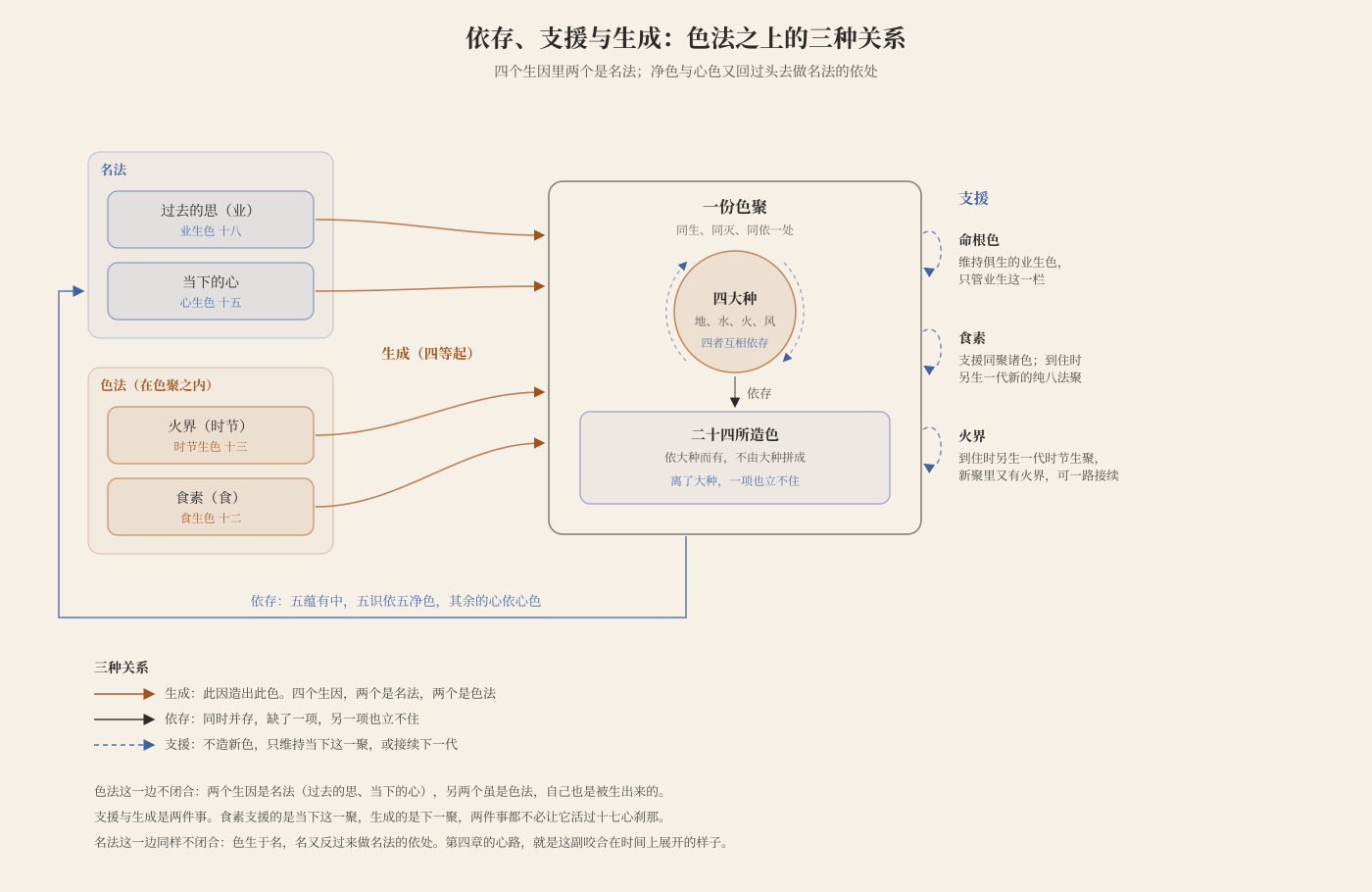
Dependence, support, and production. The preceding sections introduced a layered structure of great and derived phenomena, four origins, material groups as minimal units, and a seventeen-moment limit. Taken together, only three kinds of relation obtain among the twenty-eight kinds of rūpa. Once they are clear, the skeleton of the classification is complete.
The first is dependence. The twenty-four derived phenomena depend on the four great elements; apart from the great elements, not one can stand. Yet derived matter is not assembled out of the great elements. Sensitivity is not some arrangement of them; it has its own characteristic and function.5 The four great elements likewise depend on one another. Earth, water, fire, and air within a material group arise and cease together. Remove one and the other three cannot be established. Dependence is simultaneous: both terms are present in the same group, with no temporal priority.
The second is production, the four modes of origination. Four causes produce matter: kamma, citta, temperature, and nutriment. Two are mental and two material. Kamma is past intention; citta is present citta, both on the side of nāma. Temperature is the fire element in a material group; nutriment is the nutritive essence in a material group. Though the latter two are material, they have themselves been produced by other causes. The material side is therefore not closed. It has two openings onto mind, one in the past and one in the present.
The citta-born route best illustrates the third sentence of the overview. A citta arises and simultaneously brings forth a portion of matter. When the citta ceases, no further succession of that portion comes from it. Bodily and verbal intimation arise from citta alone.1 In this system, speech and action are matter made on the spot by nāma; no preexisting object moves through them.
The third relation is support. Unlike production, support does not create new matter but maintains what already exists. Material life faculty maintains the co-arisen kamma-born matter and only that column; it does not maintain matter produced by the other three causes.1 Nutritive essence crosses columns: within a group, it supports the co-arisen phenomena. Upon reaching its static phase, it produces a new pure octad, generation after generation—ten to twelve in the treatises.10 Support and production are different. Nutritive essence supports the present group and produces the next. Neither requires it to live longer than seventeen mind-moments.
The fire-element route works in the same way and extends farther. When the fire element in a group reaches its static phase, it produces a generation of temperature-born groups. The new group contains fire, which can produce another. The rock of the preceding section remains in the world by this route: matter of the same kind arises generation after generation, while each generation still lasts only seventeen mind-moments.11
Finally, one line turns back. Where nāma and rūpa are both present (the “five-aggregate existence” of the treatises), citta and cetasikas cannot arise on their own. The five sense consciousnesses depend on the five sensitivities; the remaining cittas depend on the heart-base.51 Nāma produces rūpa, and rūpa in turn serves as the base of nāma. Each supports the other; neither is the other's foundation. The cognitive processes of Chapter 4 are this interlocking structure unfolded in time.
The three relations combine in the following figure.
Comparison with Sarvāstivāda. Sarvāstivāda has eleven kinds of matter: five faculties, five objects, and unmanifest matter.13 Theravāda has twenty-eight. The difference is not how finely the two observe but what principles they use in establishing a dharma.
Theravāda distributes across several entries what Sarvāstivāda lets one entry carry, and establishes as dhammas things Sarvāstivāda does not. Sarvāstivāda recognizes none of the three mutable qualities, four characteristics, or space element as dharmas; Theravāda does not recognize Sarvāstivāda's one unmanifest matter as a dhamma.
Unmanifest matter deserves close attention. Sarvāstivāda must explain where the substance of a precept resides while the person who took it sleeps. Its answer is to establish a dharma, a kind of matter not outwardly manifest, which arises when the precept is taken and continues until the precept is abandoned or life ends. Theravāda takes another road. It posits no entity bearing the substance of the precept. Its continuity is carried by the arising of the abstinence cetasikas whenever the relevant occasion occurs and by the conditions left by those events. This book holds that the trade-off is clear. Sarvāstivāda would rather establish an additional entity to bear continuity; Theravāda would rather have continuity borne by conditions. The repeated formula “generation after generation” in this chapter is the general material solution of the Theravāda route.
The two master tables can also be compared. Theravāda has eighty-two ultimate realities: one citta, fifty-two cetasikas, twenty-eight kinds of rūpa, and one Nibbāna. Sarvāstivāda has seventy-five dharmas: eleven kinds of matter, one mind, forty-six mental factors, fourteen formations dissociated from mind, and three unconditioned dharmas.132 More than half the numerical difference lies in matter and formations dissociated from mind, precisely the two columns in which each side is willing to establish formal structures as dharmas. The next part will address Sarvāstivāda's choices directly. This chapter only marks the comparison.
Which items were observed? Part of the list of derived matter is the result of observation; another part was added to complete the classification itself. The earlier cut already defined the scope of the question. The eighteen concrete phenomena are not at issue. What needs examination lies among the ten nonconcrete phenomena, especially three groups.
The two intimations. Bodily and verbal intimation are established as material phenomena, yet their characteristics are expressing one's intention through action and through speech.1 Expressing and indicating are relational predicates; they hold only in the presence of someone able to understand them. This is the only place among the twenty-eight where the characteristic of a material phenomenon includes another observer.
The space element. Its characteristic is demarcating the limits of material groups; its manifestation is the gap between groups. A limit is a relation between groups. To establish that relation as a kind of matter gives this entry the most formal character in the list. It is derivatively attributed to all four causes because the groups produced by every cause require demarcation, not because each group internally contains a space element.
The four characteristics. As already noted, they are the beginning, middle, and end of the seventeen-moment process. Once phases of a process have been made entries in a catalogue, asking how long those entries endure creates a problem. The root text responds by excluding the characteristics from the phenomena that last seventeen mind-moments. This book holds that the maneuver solves a notational difficulty while leaving the underlying problem in place.
The three groups share one feature: everything requiring examination lies on the side of relation and form, not texture. The first eighteen of the twenty-eight can be directly identified in contemplation of the body. More than half of the last ten perform formal duties that make the notation self-contained. This chapter only states the criterion: can the item be separately taken as an object of insight contemplation? Chapter 7 gives the verdict.
One further contrast is registered here without answer. Nāma has two levels, citta and cetasika. Cetasikas count as associated only when they arise and cease with citta, share its object, and share its base. Rūpa, however, is arranged in a flat table of twenty-eight coequal entries with no corresponding second level. Yet the relation of the three mutable qualities, two intimations, and four characteristics to concrete matter resembles that of cetasikas to citta. None is an independent texture; all appear only upon concrete matter; none can be separately taken as an object. The format of association was already available. Why did the material side not use it? This chapter leaves the question to Chapter 7.
To Chapter 4. Matter lasts seventeen mind-moments, and seventeen mind-moments is the length of one complete five-door cognitive process. The preceding chapter arranged the catalogue of mind; this one arranged the catalogue of matter. The two interlock at this number. The next chapter treats cognitive process, and the same number will appear from the other side.
Whether measuring matter with mind-moments is itself circular (using a unit of nāma to measure rūpa, then using the duration of rūpa to explain the persistence of an object) is a legislative question. This chapter does not settle it. Chapter 7 will.
References¶
References
-
Tabular Exposition of the Abhidhammattha Saṅgaha, compiled by Bhikkhu Mingfa, revised by Luo Qinglong, and published by Dhammarain. Its fourfold definitions of the twenty-eight kinds of rūpa, nine additional classifications, and table of the four modes of origination are the principal working tables used here. The twenty-three material groups used in the chapter belong to a later layer of meditation instruction and were separately checked against the fourth revised Chinese edition of Pa-Auk Sayadaw's Light of Wisdom, sections “Nine Kamma-Born Material Groups,” “Eight Citta-Born Material Groups,” “Four Temperature-Born Material Groups,” and “Two Nutriment-Born Material Groups,” pp. 106–109. That work explicitly gives the sound-and-lightness dodecad: the eight inseparables plus sound and the three mutable qualities. This chapter therefore counts twelve. The itemized tables are not reproduced here; readers requiring them should consult the originals. ↩↩↩↩↩↩↩↩↩↩
-
Abhidhammattha Saṅgaha, Chapter 6, Rūpasaṅgahavibhāga: enumeration of matter, the division between concrete and nonconcrete matter, the four origins, and the composition of material groups. The passage on concrete matter reads: “Iti ca aṭṭhārasavidham p'etaṃ sabhāvarūpaṃ, salakkhaṇarūpaṃ, nipphannarūpaṃ, rūparūpaṃ, sammasanarūpan ti ca saṅgahaṃ gacchati.” The summary of the ten nonconcrete phenomena reads: “Paricchedo ca viññatti vikāro lakkhaṇan ti ca / Anipphannā dasa c'āti aṭṭhavīsavidhaṃ bhave.” Sections 16–22 of the root text list only twenty-one material groups: nine kamma-born, six citta-born, four temperature-born, and two nutriment-born. The concluding verse says, “Kalāpānaṃ paricchedalakkhaṇattā vicakkhaṇā / Na kalāpaṅgam iccāhu ākāsaṃ lakkhaṇāni ca”: space demarcates groups and the characteristics merely mark them; the wise therefore do not call either constituents of groups. English translation and guide: Bhikkhu Bodhi, general ed., A Comprehensive Manual of Abhidhamma, Chapter 6, pp. 252–254. The Theravāda total of eighty-two ultimate realities is likewise obtained by summing the categories of this work. ↩↩↩↩↩
-
Madhyama Āgama 30, Discourse on the Simile of the Elephant's Footprint, lists internal earth as hair, body hair, nails, teeth, skin, flesh, sinews, bones, heart, kidneys, liver, lungs, spleen, intestines, stomach, and excrement; internal water as brain, tears, sweat, mucus, saliva, pus, blood, fat, marrow, bile, and urine. The Pāli parallel is the Mahāhatthipadopama Sutta (MN 28). Similar enumerations of the four elements appear in MN 62 and MN 140; the Chinese parallel to the latter is Madhyama Āgama 162, Discourse on the Analysis of the Six Elements. The Taishō text (T26, fascicle 7) carries the same two lists, except that internal earth there reads “腸、𦝩、糞”, 𦝩 being a variant form of 胃 (stomach). ↩
-
Bhikkhu Bodhi, general ed., A Comprehensive Manual of Abhidhamma: The Abhidhammattha Saṅgaha of Ācariya Anuruddha (Kandy: Buddhist Publication Society, 1993). This chapter draws on its Pāli text and guide to Chapter 6: §2, concrete matter possesses its own nature and is suitable for insight contemplation; §3, edible food is material nutriment (“Kabaḷīkāro āhāro āhārarūpaṃ nāma”), while the other three nutriments are mental; §4, nonconcrete matter is not directly produced by the four causes but is a quality of concrete matter; §10, only intention in twenty-five cittas can produce matter—the twelve unwholesome, eight great wholesome, and five wholesome fine-material cittas; §11, seventy-five of the eighty-nine cittas produce citta-born matter, excluding the four immaterial resultant cittas and the two sets of fivefold sense consciousness; citta-born matter begins with the first bhavaṅga after rebirth-linking, is not produced by the rebirth-linking citta, and arises only at the arising phase of each citta; §12, the fire element upon reaching presence can produce temperature-born matter internally and externally; §13, nutritive essence can produce ten to twelve generations of octads and food eaten in one day may sustain the body for seven days; §24, kamma-born matter ceases to arise beginning with the presence phase of the seventeenth citta before death. The statement that the static phase of rūpa equals forty-nine mental submoments appears in the guide to Chapter 4, §6. ↩↩↩↩↩↩↩↩↩↩↩↩
-
Visuddhimagga, Chapter XIV, Khandha-niddesa: itemized definitions of matter, applying characteristic, function, manifestation, and proximate cause to the five sensitivities, four objectives, and derived phenomena. English translation: Bhikkhu Ñāṇamoli, The Path of Purification (Kandy: Buddhist Publication Society, 1975). ↩↩↩↩
-
Pa-Auk Sayadaw, Light of Wisdom, fourth revised Chinese edition, pp. 106–109. In the sequence used for meditation discernment, it lists nine kamma-born, eight citta-born, four temperature-born, and two nutriment-born groups. The seventh and eighth citta-born groups are the citta-born breath-sound nonad and citta-born breath-sound-and-lightness dodecad, producing a total of twenty-three. This is a later pedagogical expansion; the root Abhidhammattha Saṅgaha itself remains at twenty-one. ↩
-
Two passages in the Abhidhammattha Saṅgaha concern the life span of matter and its four characteristics. Chapter 4 says, “Uppādaṭṭhitibhaṅgavasena khaṇattayaṃ ekacittakkhaṇaṃ nāma. Tāni pana sattarasa cittakkhaṇāni rūpadhammānaṃ āyu”: three submoments of arising, presence, and dissolution constitute one mind-moment; seventeen such mind-moments are the life span of material phenomena. Chapter 6 says, “Rūpassa upacayo, rūpassa santati, rūpassa jaratā, rūpassa aniccatā ti lakkhaṇarūpaṃ nāma. Jātirūpam eva pan'ettha upacayasantatināmena pavuccatī ti”: production, continuity, aging, and impermanence are the characteristics of matter; here birth itself is spoken of under the names production and continuity. Chinese translations were checked against those of Ye Jun and Bhikkhu Dhammagavesaka. ↩↩
-
Nārada Mahā Thera, trans. and ed., A Manual of Abhidhamma (Abhidhammattha Saṅgaha) (Kandy: Buddhist Publication Society; many reprints). This chapter cites three notes to Chapter 6: the duration of intimation is only one thought-moment; conditioned rūpa normally lasts seventeen thought-moments or fifty-one submoments; and the first thought-moment is compared to production, the last to impermanence, and the intervening fifteen to aging. Another note says that except for two intimations and birth, aging, and impermanence, the remaining twenty-three kinds of rūpa last seventeen moments. Elsewhere the same book notes that production and continuity are sometimes combined as birth, yielding twenty-seven rather than twenty-eight rūpas. The former exclusion of five items therefore presupposes the twenty-seven-item list: twenty-seven minus five is twenty-two. Under the twenty-eight-item list, production and continuity occupy separate entries, so six are excluded and twenty-eight minus six is likewise twenty-two. Twenty-three results from mixing the two lists. The positive count also gives twenty-two: eighteen concrete phenomena plus space and the three mutable qualities. This book uses twenty-two. ↩↩↩↩
-
On the internal and external distribution of material groups, Chapter 6 of the Abhidhammattha Saṅgaha says: “Tattha suddhaṭṭhakaṃ saddanavakañ ca ti dve utusamuṭṭhānakalāpā bahiddhā pi labbhanti. Avasesā pana sabbe pi ajjhattikam eva.” The two temperature-born groups, the pure octad and sound nonad, are found externally as well; all the rest are only internal. See A Comprehensive Manual of Abhidhamma, Chapter 6, §21. ↩
-
Visuddhimagga, Chapter XX, Maggāmagga-ñāṇadassana-visuddhi-niddesa, §§37 and 41. Section 37 says that nutritive essence in a nutriment-born group, upon reaching presence, can produce an octad, whose nutritive essence produces another, linking the occurrence of octads ten or twelve times. The same section says that food eaten in one day may support the body for seven days, divine nutritive essence for one or two months. Section 41 states: “Temperature-originated materiality both goes on occurring for a long period and also maintains itself as well in what is not clung to.” English translation: Ñāṇamoli, The Path of Purification. ↩↩↩↩↩
-
Venerable Mahinda, The Manual of Abhidhamma, Lecture 5. This chapter cites two points: all inanimate material phenomena are exclusively temperature-born, and the material world can persist for a long time because groups continuously arise and cease generation after generation; and the separate counts of generations of temperature-born matter according to the source of the fire element (ten to twelve from nutriment-born fire, four or five from kamma-born fire, two or three from citta-born fire) together with four or five generations of nutriment-born matter. The work is a meditation teaching manual, not a root treatise; the body of the chapter does not use its figures. ↩↩↩
-
Pa-Auk Tawya Sayadaw, The Chariot to Nibbāna, vol. II, gives three to twelve generations produced by nutriment-born nutritive essence. It is likewise a meditation teaching manual and must be distinguished in source level when placed beside treatise figures. ↩
-
Abhidharmakośabhāṣya, Chapter 1, Dhātunirdeśa: eleven kinds of matter—the five faculties of eye, ear, nose, tongue, and body; five objects of visible form, sound, odor, taste, and touch; and unmanifest matter. The Sarvāstivāda division of seventy-five dharmas into eleven material, one mind, forty-six mental factors, fourteen formations dissociated from mind, and three unconditioned dharmas follows the five-category organization of the Kośa. This chapter uses only the comparison with the Theravāda twenty-eight; the next part explains the Sarvāstivāda rationale. ↩↩