Appendix A: The Formal System and Proofs
This appendix serves the slow-track reader: the numbered propositions of the main text receive here their full symbolic statement and the skeleton of their derivations, each item carrying in parentheses the chapter it answers to. Fast-track readers lose nothing of the conclusions by skipping every page of it. Two sentences on the division of labour: Chapter 8 is an application abroad and its conditional framework is not separately formalized; and the premise audit of movement one of Chapter 9 takes section ten below for its ledger.
One. Notation. E1(x): the quantificational sense; x takes a value in the domain of discourse. E2(x): the conventional sense; x is established as individuated by a network of names and conventions. E3(x): the sense of real existence; by the opponents' criteria, what does not break up under analysis, or what generates a cognition by being an object. D2(x): x has intrinsic nature, a conjunction of three — D2(i) not established in dependence on anything other than itself, D2(ii) not altered as conditions change, D2(iii) not produced by conditions. A D3-type claim: an assertion of the form ∃x[E3(x) ∧ D2(x)], and its instances. ⊢A: A is asserted. ⊣A: A is rejected; ⊣ is a sign of force, not a new truth-functional connective. π(t): the subject term t refers in the manner of E3 and D2. ≠: numerical distinctness within the framework; ≠*: independent distinctness, a separate substance standing without dependence on another. Rel(x): the identity conditions of x involve difference and relation, the difference being either at the level of tokens or at the level of types. P: ∀x Rel(x). For these see Chapters 1, 3 and 4 respectively.
Two. Definitions and premises. D1 posits the three senses as primitive predicates; the substantive content of E3 is supplied by either of the opponents' two criteria, which divide the labour and need not coincide, as Chapter 1 recorded. Of the three conjuncts of D2, D2(i) is the root, and D2(ii) and D2(iii) are its appearances in the direction of change and in the direction of provenance; the derivation draws on D2(i) alone. D3 and the range clause: the quantifier domain of the theorem is every D3-type claim, and assertions of E1 or E2 are excluded without exception. The boundary clause for the definitions: identity and difference are logical constants, not defined but governed by laws laid down; Leibniz's Law is restricted to extensional contexts; change := difference across indices; and dependence, establishment and production serve according to the opponents' usage. The rule for grading: dependence divides into three grades, the causal, the relative, and dependence in statement, and the dependence refused by D2(i) includes at least the relative grade, the warrant being texts both parties use, with the evidence taken in open court in Chapter 4. The standing of P is that of an analytic truth, laid down in three steps: content is exclusion, with the granularity annotation that what is closed off is an option open so far as we know; identity and difference come into use as a pair; and the one-element-domain test, in which the difference may be a difference of type.
Three. The lemma group. Lemma 1, weak rejection: ⊣A does not entail ⊢¬A, where ¬ is the internal negation; a rejection may arise from the failure of a presupposition, in which case ¬A carries that same presupposition and asserting ¬A would only prolong the life of π; read ¬ externally and the mutual derivability returns, but what it yields is only the registration of the rejection and adds no commitment (Chapter 3). Lemma 2, presupposition cancellation: where ⊢¬π(t) holds, every F(t) and ¬F(t) that takes t for its subject and inherits π, and every combination of them, is rejected along with it, the authorization issuing uniformly from ⊢¬π(t) (Chapter 3). Three criteria govern its application, the π criteria. First, resistance to paraphrase: the proponent refuses the E2 paraphrase of the sentence and treats the paraphrase as a change of subject, so that the presence of π is established by the opponent's own usage; this extends the discipline of warrant laid down in Chapter 2. Second, load: the inferential load the sentence bears in the opponent's argument must require E3 strength to carry it, and where an E2 reading is enough to carry it the range clause preserves the sentence and the machine is not applied. Third, sentence-form: classical texts are sorted by their closing formula, the refutative family entering the machine and the pedagogical family staying out (the appended table, section twelve). All three are criteria of type, publicly checkable, and of a different order from case-by-case discretion. Lemma 3, the scope-lock: what separates ≠ from ≠ is exactly D2(i); whoever gives up independence keeps ≠ and the lever does not touch him, and whoever holds to independence has ≠ as ≠ and the identity-difference dilemma closes on him (Chapter 3). Skeleton of the identity-difference dilemma: on the identity horn Leibniz's Law transmits the properties and the two ends collapse together; on the difference horn, if x ≠* y then x should be available apart from y, and apart from y nothing is available. The relation lemma: a relation possessed of intrinsic nature does not depend on its two ends, cannot reach either of them, and so is not a relation; hence relations fall to E2 without exception (Chapters 3 and 7).
Four. The tetralemma and the settlement of S4. Notation for the tetralemma: S1 is F(t), S2 is ¬F(t), S3 is F(t) ∧ ¬F(t), and S4 has two candidates, left standing undecided in Chapter 3 and settled here. Candidate (a), the propositional notation: S4 is ¬F(t) ∧ ¬¬F(t), corresponding literally to the two negations of the verse form neither so nor not so. Candidate (b), the notation of stance: S4 is the rejection of both F(t) and ¬F(t) with π(t) retained, both denied and what is referred to still kept. The settlement adopts (b), and (a) is entered as its propositional projection. Three reasons. First, agreement of levels: Nāgārjuna's step runs from ⊣S1 to ⊣S4, and if S4 is already a stance of rejection then what the fourth rejection rejects is not the rejecting but the π kept in reserve beneath it; the interrogation in the chapter on nirvāṇa takes exactly this form, "this is neither existent nor non-existent: by what, then, is it discriminated?" — the holder of the thesis neither existent nor non-existent being still engaged in discriminating that nirvāṇa, with the E3 presupposition of the subject term untouched.1 Second, the mutual distinctness of the four members: under (a), S3 and S4 both come out as contradictions in classical logic and the tetralemma loses its fourth member; under (b) the four members are four distinct strategies for prolonging the life of π, their distinctness supplied at the level of pragmatics with no call upon a non-classical logic. Third, the text's own witness: the commentary on the chapter on the examination of dharmas puts a question to itself, "elsewhere the Buddha spoke of being free from neither existent nor non-existent; why is it said here that neither existent nor non-existent is what the Buddha taught?" — and the difference between being free from neither existent nor non-existent and saying neither existent nor non-existent is exactly the difference between ⊣S4, which rejects the stance together with its presupposition, and S4, which is a stance that keeps the presupposition.1 One further observation is entered here. The verses themselves write down that the four members are established in mutual dependence: "because it is contrary to having a limit, there is being limitless"; "because they depend upon each other"; and, the third member having been refuted, the fourth does not stand either, "because there is nothing left to be depended upon." The grid of the tetralemma is itself a net of mutual dependence: the parts of the machine have demonstrated P before the machine is used.1
Five. The core derivation, T-strong. Item by item this answers to the five steps of Chapter 4. First, suppose ⊢ E3(a) ∧ D2(a); this is the content of a D3-type assertion, with a as the witness. Second, since a is the subject of an assertion it has been individuated, and its identity conditions are in place. Third, by P, Rel(a). Fourth, by D2(i), ¬Rel(a). Fifth, the third and the fourth concern the same object in the same respect: ⊥. Hence D3, together with the definitions and P, entails a contradiction; T-strong holds, its quality depending on P's being an analytic truth. The lever is its equivalent in natural language: to define is to require identity and difference; intrinsic nature cancels identity and difference; hence a contradiction.
Six. T-middle and T-weak. T-middle has two premises: A1, an assertion must individuate its subject; A2, individuation must proceed by contrast. Derivation: the act of asserting D3 presupposes Rel(a), while the content of the assertion contains D2(i), that is, ¬Rel(a); the contradiction falls between the preconditions of the act and its content, and the self-defeat is pragmatic. The answer on reference: the subject of a D3 claim has no causal encounter to fix it, so that reference is fixed by the schema alone, and the schema contrasts in every clause (Chapter 4). To deny A1 or A2 is harder than to deny P, and this is the sense in which the middle version is the more secure. T-weak is programme plus record of engagements: for each D3 candidate t that has been put forward an exhaustive tetralemma refutation is run, the authorization taken case by case from ⊢¬π(t) or supplied at one stroke by T-strong; the archive is the twenty-seven chapters (Chapters 3 and 4).
Seven. Demotion branches and exits. P loses analytic truth but keeps a priori truth: T-strong is demoted to the a priori, exit two. Only an empirical generalization remains: reductio case by case, exit three. The opponent refuses the definitions: conditional demotion, the product being a schematic conditional under which whoever satisfies the definitions draws the conclusion (Chapter 2). The opponent refuses logic: he does not enter the field of argument, and four entries of cost are placed on record (Chapter 2). Verdict: exit one is reached, two and three are not triggered, and the channels are kept open (Chapters 7 and 9).
Eight. The hierarchy clauses and the check on self-application. Clause (a), domain of application: the quantifier of T ranges over object-level D3-type claims only, and ⊣ likewise applies at the object level only. Clause (b), the inventory of resources: the assertion of T draws on the definitions, on logic and on P, and on no E3 item. Clause (c), the exit for self-application: if emptiness is posited as an E3 item, that proposition is itself of D3 type and is rejected under the same rule; the emptiness of emptiness is the content of clause (c) (Chapter 5). The stopping point for the infinite regress of the means of knowledge: the negation of P has no content, and what has no content occupies no situation and takes no seat in the framework; the stopping point is secured by the contentlessness of that negation and not by a higher means of knowledge (Chapter 5). The check on scope goes through one and the same door: T and such pairs as long and short, this and that, go in and out together, and no exemption is cut to anyone's measure (Chapter 5).
Nine. The Preservation Theorem. (a), no loss: for every E1 or E2 assertion A, T and the rejections it authorizes do not alter the truth conditions of A. Two steps: the step by type is supplied by the range clause; and the substantive step is that individuation has at no point drawn on an E3 footing, its universal warrant being conceptual — to ground is to do work, and what satisfies D2 by definition neither enters into causality nor serves as a condition, so that conceptually it is not eligible to be drawn on (Chapter 6). (b), only thus: D2(a) entails that a does not arise, does not cease, does not alter and does not relate, being wholly inert; the contrapositive is that whatever comes into use is without intrinsic nature (Chapter 6). Taken together: because there is the meaning of emptiness, all things hold up. The formal placing of the two truths: conventional truth is the legitimacy of E1 and E2 assertions and ultimate truth is T itself; the division is a division of levels of assertion, not a division of worlds (Chapter 6).
Ten. The premise audit table. Lemmas 1, 2 and 3 and the relation lemma are derived items and do not enter as premises.
| Number | Content | Type | Source | Used in |
|---|---|---|---|---|
| D1 | The three senses of existence | Definition | Laid down in Chapter 1; the criteria taken from the Kośa's surviving analysis and the Nyāyānusāra's generating a cognition by being an object, redeemed in Chapter 2 | The whole part |
| D2 | The three conditions of intrinsic nature | Definition | Laid down in Chapter 1; MMK 15, redeemed in Chapter 2 | The three versions of T, Preservation (b) |
| D3 | Scope and the range clause | Definition | Chapter 1 | The quantifier domain |
| The boundary clause | Identity and difference as constants, the reduction of change, dependence and establishment and production from the opponents' usage | Meta-convention | Chapter 1 | The analyticity of P, the grading |
| The rule for grading | The dependence in D2(i) includes the relative grade | Semantic ruling, agreed by both parties | Chapter 4 | The fourth step of the core derivation |
| P | Identity conditions necessarily involve difference | Analytic truth | Chapter 4, in three steps | T-strong |
| A1, A2 | Assertion must individuate, individuation must contrast | Analytic truth | Chapter 4 | T-middle |
| Logic | Classical logic, the law of non-contradiction, Leibniz's Law restricted | Logic | Chapter 3 | The whole part |
| The hierarchy clauses | The three clauses (a), (b), (c) | Meta-convention | Chapter 5 | Immunity under self-application |
| Scriptural authority | None | No item of this type | The original texts serve three offices only: provenance, historical actuality, evidence of sentence-form | Not a premise |
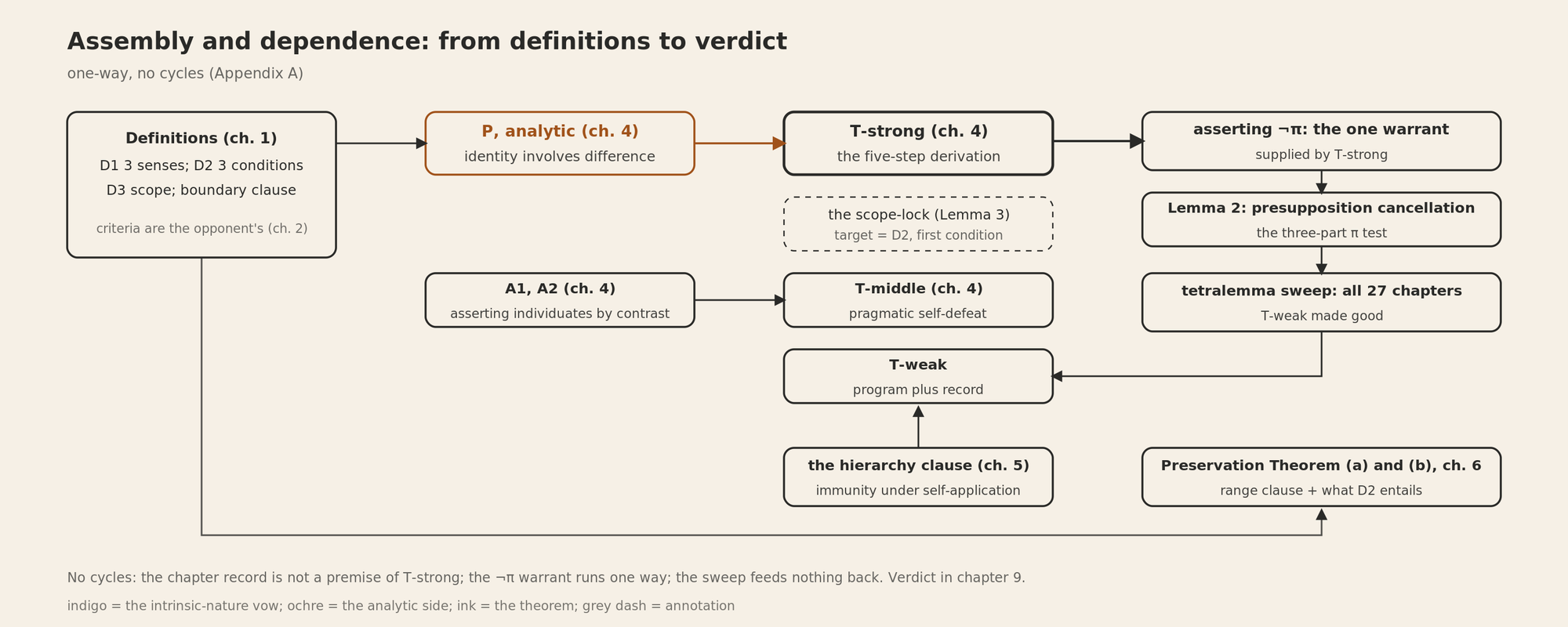
Eleven. The assembly of dependencies. The dependence runs one way. The definitional layer is laid first: D1, D2, D3 and the boundary clause. P is established independently upon the definitional layer. The core derivation takes P and D2(i) and yields T-strong. T-strong supplies the authorization of ⊢¬π over the whole domain; Lemma 2 takes ⊢¬π for its input, the exhaustive tetralemma refutation is the working face, and the record of the chapters is the redemption of T-weak. Lemma 3 locks the target area onto D2(i). The hierarchy clauses and the criteria move T itself out of the scope. Preservation (a) and (b) take in the other half by way of the range clause and the consequences of the definition of D2. Two declarations of no loops: first, the record of the chapters does not enter the premises of T-strong, which is the ruling on failure mode three in Chapter 7; second, ⊢¬π is supplied by T and only then authorizes the tetralemma, so that the direction is one-way and the refutations in the chapters do not feed back into the proof of T.
Twelve. Appended table sorting the pedagogical from the refutative. Range: every place in T1564 where the four members are set out in full, together with one quasi-tetralemma form, on a check through the whole text.2 Criterion: the closing formula, laid down in Chapter 3. The Vibhāṣā's "A fourfold answer should be made" belongs to the grid-filling family and does not enter this table; for the comparison see Chapter 3.
| Place | The four members | Closing formula | Family | Disposal |
|---|---|---|---|---|
| MMK 1, the chapter on conditions, the first verse | arising from self, from another, from both, without a cause | "therefore it is known that there is no arising" | Refutative | All four members rejected, authorizing ⊢¬π(that which arises); the full worked sample is in Chapter 3 |
| MMK 18, the sometimes-taught verse | self, non-self; the closing line a double negation | "neither self nor non-self," governed by "sometimes taught" | Pedagogical, a quasi-tetralemma form | Two teachings suited to their hearers, the closing line a doubled negation in the pure sense; does not enter the machine |
| MMK 18, the verse on the teaching of the buddhas | real, not real, both real and not real, neither real nor not real | "this is called the teaching of the buddhas" | Pedagogical | Designation suited to the hearer, self-attested in three places, Chapter 3 |
| MMK 22, the verse on conventional naming | empty, non-empty, both, neither | "spoken only by a conventional name" | Refutative, the last line opening an interface for preservation | None of the four members can be said; the conventional name is let through at E2 |
| MMK 25, the four gates of existence and non-existence | existent, non-existent, both existent and non-existent, neither existent nor non-existent | "this is not so" | Refutative | Reductio gate by gate; the warrant for the settlement of S4 |
| MMK 25, the Tathāgata after cessation | after cessation: existent, non-existent, both, neither | "one does not say exists or does not exist," the comment "existence, non-existence and the rest are not to be got" | Refutative | The diagnosis of empty-subject sentences; the model case of the cancellation of π |
| MMK 27, the four views concerning the past | I existed, I did not exist, both, neither | "none of these is so" | Refutative | Reductio view by view |
| MMK 27, the four views on limit and limitlessness | having a limit, limitless, both having a limit and limitless, neither having a limit nor limitless | fails "because there is nothing left to be depended upon" | Refutative | The four members are mutually dependent, and so attest P themselves |
References
References
-
Mūlamadhyamakakārikā, MMK XXV, the chapter on nirvāṇa (T1564, fascicle four), the verse: "This is neither existent nor non-existent: by what, then, is it discriminated?" The comments close in each case with "this is not so." The commentary on MMK XVIII, the chapter on the examination of dharmas (fascicle three): "Elsewhere the Buddha spoke of being free from neither existent nor non-existent; why is it said here that neither existent nor non-existent is what the Buddha taught?" MMK XXVII, the chapter on wrong views (fascicle four), the passage on the mutual dependence of the four members: "because it is contrary to having a limit, there is being limitless"; "because they depend upon each other"; "because there is nothing left to be depended upon." ↩↩↩
-
The verses and closing formulae of this table have all been transferred from the original text of T1564 and checked against it word for word: MMK I, the chapter on conditions (fascicle one); MMK XVIII, the chapter on the examination of dharmas (fascicle three); MMK XXII, the chapter on the Tathāgata; MMK XXV, the chapter on nirvāṇa; MMK XXVII, the chapter on wrong views (fascicle four). "Existence, non-existence and the rest are not to be got" comes from Piṅgala's comment on the chapter on nirvāṇa. For the count of three hundred and twelve occurrences of "A fourfold answer should be made" in the Vibhāṣā see Chapter 3. ↩