Chapter 4: The Main Argument
The tools are ready; this chapter opens the proof. The order is as follows. First the relationality premise P is set up, and of the three ways of legislating it the case for analytic truth is argued directly. Then the opponents' strongest opening, the distinction between epistemic dependence and ontic dependence, is put on the table and closed, its price reckoned honestly. Then the core derivation is set out under numbers: the strong version rests upon P, and whatever residue cannot be closed off is taken over by the middle version. At the end come two worked samples, the chapter on motion and the chapter on conditions, showing how this machine runs, word for word, within the text itself.
P and the three ways of legislating it. P: whatever exists has identity conditions that necessarily involve difference and relation. "Whatever exists" is taken here in a broad reading, as whatever can be individuated so as to serve as the subject of an assertion. There are three ways of legislating it. As an analytic truth: P is guaranteed by the grammar of the concept of an identity condition, and to deny it is to forfeit that concept. As an a priori truth: P is a condition of the possibility of identification and reference, issuing from our conceptual framework; by that route the opponent may retreat to an unthinkable thing in itself, and the theorem then closes off the thinkable world only. As an empirical generalization: everything examined to date has been thus, which authorizes case-by-case reductio and nothing more. The three descend in strength. The target already fixed is analytic truth, argued for directly in this chapter; should it prove impossible to hold, the route of demotion was laid down in Chapter 1.
The direct argument for the analytic case. Three steps. Step one: content is exclusion. An identity condition is a contentful determination, saying what x is; and a sentence that excludes nothing has said nothing. Exclusion is counted here at epistemic grain: to say something is to close an option that was, for all we knew, still open. What a mathematical theorem closes has always been of that kind, and not a possible world. A determination is a determination in virtue of drawing a boundary, and to draw a boundary is to bring in what is excluded. Spinoza's old maxim: determination is negation.1 Step two: identity and difference come in a pair. The boundary clause of Chapter 1 laid it down that identity and difference are a pair of logical constants, and that whoever has the one must have the other; a concept of identity with identity alone and no difference in it is no concept at all. To individuate is to contrast: x is individuated if and only if there is a criterion separating x from what is not x. Step three: the classical witness. One sentence of Piṅgala's commentary says the whole of it — since there is no self-being there is no other-being either; where there is self-being there is other-being.2 Self and other are established over against each other, and this is not an empirical discovery about the world but a statement about the grammar of that pair of words. The three steps taken together: every contentful identity condition involves difference, and to involve difference is to involve relation, at the least the relation of difference between the thing and what it excludes. P is an analytic truth.
One further test may be added, the one-element domain. Suppose there were only the one thing x in the world: does P then fail? It does not. To say what x is, is still to draw a boundary against the kinds that x is not; the difference may be a difference of type, and need not be a difference of thing. And in any case not one of the opponents of this part argues within a one-element domain: in the phrase "each abiding in its own intrinsic nature," the very first word, "each," writes plurality into the foundation, and a dharma's holding its own intrinsic nature is precisely its holding it over against the remaining dharmas. The provenance was redeemed in Chapter 2.
The opening: epistemic dependence and ontic dependence. The opponents' strongest reply is to be set out in its strongest form. The reply runs thus. P conflates two things. That we must go by contrast in identifying x is a matter of cognition; whether x's being x turns upon contrast is a matter of being. That identification depends upon relations does not amount to existence depending upon relations; you have shown at most that nothing can be apprehended without contrast, and not that nothing can exist without contrast. Saṅghabhadra stands squarely in this opening: he founds his verdict of real existence upon generating a cognition by being an object, so that on the side of apprehension he relies plainly and openly upon relations, while at the same time maintaining that the substance of a dharma abides of itself and waits upon nothing else (Chapter 2, and Chapter 7 of Part 17). In the modern history of interpretation, the standing side by side of an ontological dimension and a cognitive dimension is a projection of the same opening.3
Closing it. The closing argument does not take the epistemic route but the route of content, and not a step of it may be left blurred. An identity condition is not a procedure of apprehension but a constitutive determination: what it states is what x's being x turns upon. Now ask: a constitutive determination that involves no difference whatever — what is its content? It cannot say that x is thus and so, because thus and so marks off a kind, and marking off a kind is contrast; it is left with the single sentence x is x. But x is x holds of anything at all, does not separate x from what is not x, and cannot do duty as an identity condition for x. Saying nothing is here a dereliction and not a proper office: an identity condition is employed to separate x from what is not x, and a sentence that holds of everything is idling in that post. There is another kind of saying nothing that is a proper office, the silence of a rule, and Chapter 7 will distinguish it. The two horns thus close together. Either the constitutive determination has content, in which case it involves difference and the first condition of D2 is violated; or it has no content, in which case the bearer of intrinsic nature asserted in the D3-type claim has received no determination at all, the assertor merely pointing at it and saying that it is it, which does not amount to a thesis. The first horn is the contradiction of T-strong. The second falls under the jurisdiction of T-middle: to maintain that there is a constitutive yet unstatable essence is itself a statement. A signpost may be planted here in passing, to be revisited in Chapter 8: when a self-existent being has to state itself, the grammar leaves it one sentence form only, x is x; and why that should be so the two horns have already said in full.
The price to be reckoned: does this closing smuggle in verificationism? It does not. Content is exclusion speaks of exclusion in the semantic sense, that a sentence must exclude some possible case if it is to have said anything, and it does not require that what is excluded be testable. A proposition may exclude cases we shall never be able to test and still have content. What the closing genuinely requires is one thing only: that D3 be a contentful thesis. And that one thing is supplied by the opponents' own practice. They classify, they lay down theses, they refute others, they hand down evaluations; two hundred fascicles of controversy are the standing proof that D3 has content. If at this point the opponent retreats into a contentless mystery, what he has withdrawn from is the ranks of theses, and the record entered at the end of Chapter 2 applies to him here.
Grading the collision: the senses of dependence. Steps three and four of the core derivation collide, and at which level they collide can be settled only by first grading the word "depend." This is the passage in the whole part that most needs its scaffolding shown, and not a step of it may be left blurred. Three grades of reading are conceivable. Narrowest, the causal grade: to depend is to arise in dependence upon conditions. Broadest, the statemental grade: every determination employs contrast. In between lies the relative grade: a property's being this property turns upon the correlate over against which it is established — long against short, this against that, one against different. Which of these grades of dependence is refused by the first condition of D2? Evidence is taken in court from the texts of warrant and from the opponents' own usage. On the very spot where "not established in dependence on anything other than itself" stands, Piṅgala supplies a control group of his own: unlike long and short, or this and that, which, having no determinate nature, exist in dependence on another; and the same commentary uses "established by way of dependence" and "relative to one another" to dismiss other-nature. MMK 19, the chapter on time, runs throughout upon mutual dependence, taking "each established separately" for its opposite pole, and it lists identity and difference expressly among the family of things mutually dependent: because of one there is different, because of different there is one. On the opponents' side: the Mahāvibhāṣā defines dependent origination for itself as arising in dependence upon conditions, and the Kośa lays down that what depends upon conditions is for that reason impermanent; while the five kinds of existence in the Mahāvibhāṣā give relative existence a column of its own and assign it to nominal existence, so that whatever is relative is thereby out of the ranks of the really existent — and this is the opponents' own taxonomy, quoted in Chapter 2. The Sanskrit original is plainer still: unmade and not-dependent stand there as two separate items, so that dependence is not merely a matter of arising from conditions, and apekṣā is precisely the word for relativity, for standing over against a correlate. The later commentarial tradition divides dependence into three, dependence upon causes, dependence upon parts, and dependence upon designation relative to something; and modern scholarship likewise draws a line between ontic dependence and relative dependence, taking the independence of intrinsic nature to be what must be free of both.4 The ruling: the dependence refused by the first condition of D2 includes at the least the relative grade. This is the consensus of the texts on both sides and of the commentarial tradition, and is not something added to them by this part. P therefore need not be argued all the way up to the grade of ontic dependence. It need only deliver this much: that any determinate nature is, at the level of type at the least, relatively bound to what it excludes. And that is exactly the grade the three steps of the analytic argument deliver. The collision occurs upon an axis of dependence that both sides acknowledge; no bridge has to be thrown across, the road is the old highway.
One turn further: independence is itself a relative property. Press the question one turn further: what sort of property is independence itself? Established without depending upon anything other than itself — the content of that determination is a blanket denial ranging over all other things and over all relations of dependence; it is established over against what it denies, and is thus the most thoroughly relative property there is. Where there is self-being there is other-being shows its full force at this point: for whatever has independence as its nature, that nature is relatively bound to the other things, and the content of the first condition of D2 carries with it the very contrast it is meant to cancel. At this point the opponent has four routes left and no more — the four ways of closing — each with its own assignment. The first is to take independence itself as the nature: the nature is then relative, cancels itself, and the strong version collects. The second is to name some other determinate F as the nature: the determinacy of F is relativity at the level of type, which walks straight into the collision, and the strong version collects. The third is to fall back upon an identity that is primitive while continuing to state it: primitive does not amount to unstatable, and this route is a position with content, to be answered head-on; the answer follows below. The fourth is to fall back upon a nature that is unstatable: the D3-type claim then loses its determination and passes over to T-middle and to the clause on the domain of theses; the yield of this route is entered under the middle version and is not credited to the strong one. Each route is entered under its own name, and the premise audit table is laid out accordingly. The third and the fourth were formerly a single route, which entered an opponent who speaks as one who does not; the correction and its grounds are in failure mode one of Chapter 7.
Answering the third: how the primitive itself gets individuated. Whoever takes identity as primitive needs the item he posits to tell A apart from B; unable to do that, it is posited to no purpose. So one question: the thisness of A and the thisness of B, in virtue of what do they differ? Only two answers can be given. Answer that they differ in virtue of their several bearers A and B, and the account is circular, thisness having been posited to account for A and B differing in the first place. Answer that the two differ primitively, and difference now stands at the ground floor alongside sameness, while one and different, by the grading set out above, stand squarely within the family of mutually dependent terms that both parties acknowledge, the chapter on time saying in so many words that by reason of the one there is the different and by reason of the different there is the one.4 Either answer sets this primitive back into relativity, and relativity is exactly the level the first condition of D2 refuses. The point of application deserves notice: it does not lie in how the word thisness is introduced, a layer the opponent may legitimately set aside; it lies in what makes the posited item this one rather than that one. The question has the same form as the one in the paragraph above: there it was asked what the property of independence is established over against, here what makes a primitive this particular primitive.
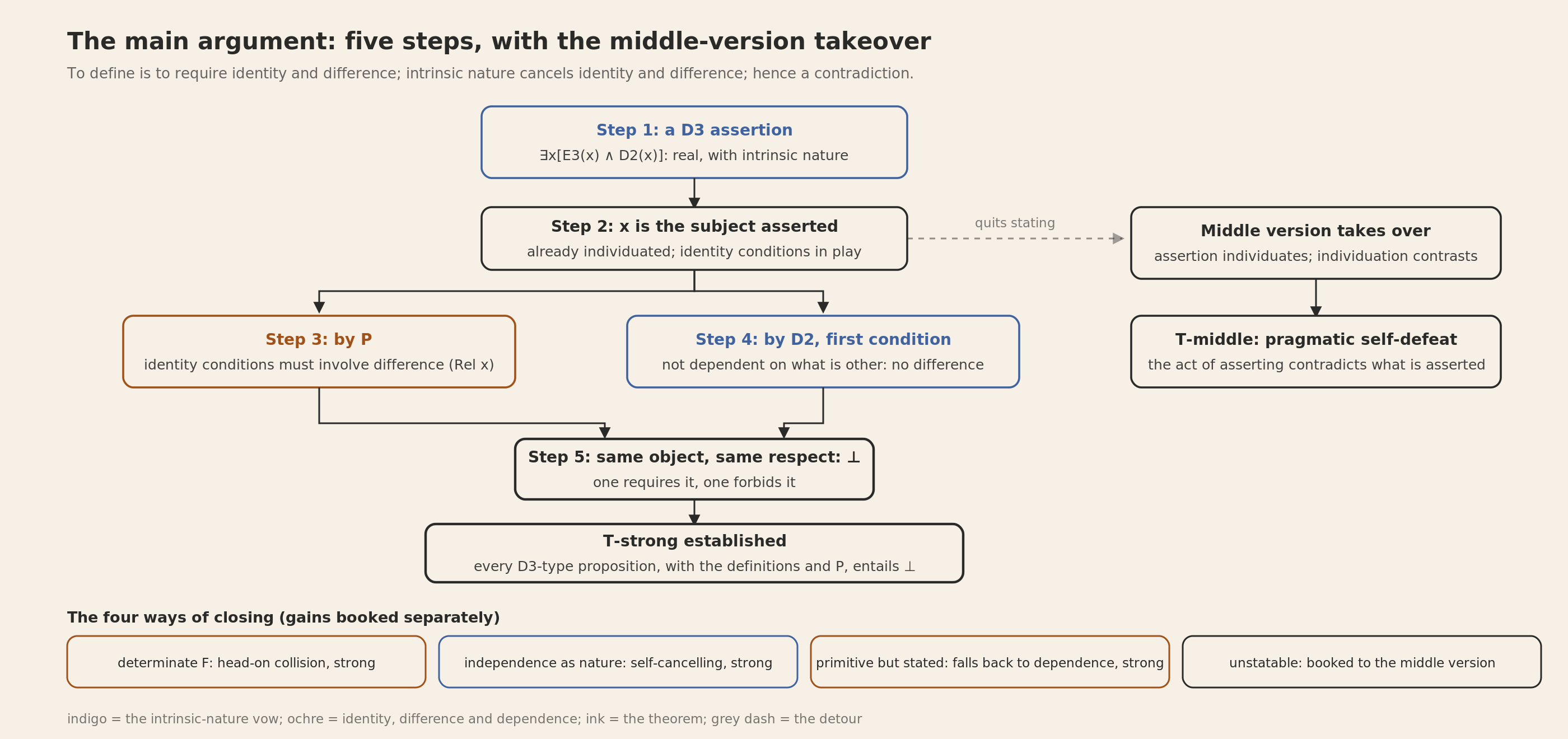
The core derivation. Set out under numbers; the fully symbolic form belongs to Appendix A.
(i) Suppose there is an x such that E3(x) and D2(x); this is the content of a D3-type claim.
(ii) Since x is the subject of an assertion, x has already been individuated.
(iii) By P: the identity conditions of x involve difference and relation.
(iv) By the first condition of D2, not established in dependence on anything other than itself: x's being x turns upon nothing other than x, and its identity conditions may not involve difference.
(v) Steps (iii) and (iv) bear upon the same object in the same respect, the one requiring involvement and the other forbidding it; they issue in a contradiction.
Hence any D3-type proposition, taken together with the definitions and with P, jointly entails a contradiction. T-strong stands from here; its quality turns upon P's standing as an analytic truth, and that standing is what the argument above has established.
The takeover mechanism of the middle version: should the opponent withdraw before step (iii), declaring the constitutive determination of x unstatable, the derivation changes route, and attacks no longer the content of the proposition but the act of assertion. To assert anything of x, the assertor must first individuate x; individuation must go by contrast; the act of assertion therefore presupposes contrastive identity conditions for x, and what the asserted content denies is exactly those. The contradiction moves from inside the proposition to the space between the saying and what is said. This is T-middle, the level of the Vigrahavyāvartanī. It may be asked: reference can be fixed by a causal chain, so what need is there of contrastive conditions? The answer: a causal chain fixes the names of ordinary things. With that special subject term which a D3-type claim sets up, no one has ever had a causal encounter, and its reference is fixed by the schema alone — and every clause of that schema, really existent, not established in dependence on anything other than itself, not altered as conditions change, not produced, is a contrastive determination. The assertor has no other way into his subject.
The place of the weak version: the twenty-seven chapters apply this lever, one by one, to every bearer of intrinsic nature that has actually been proposed, and the conflict between not depending upon anything other and necessarily depending upon something other recurs throughout. T-strong is that lever extracted from the several cases and stated as one proposition. Whether the extraction is capped, which is the doubt about the inductive leap, is handled expressly as failure mode three in Chapter 7.
The three versions can now be combined into the shortest statement available. The lever of the theorem: to define is to require identity and difference; intrinsic nature cancels identity and difference; hence a contradiction. Its twin at the level of assertion: to assert is to require identity and difference; intrinsic nature cancels identity and difference; hence self-defeat. Every reductio in the several chapters is one more appearance of this lever. One further layer must be recorded: cancel difference and identity idles along with it, the two being instruments that come into service only as a pair; whereupon all that a bearer of intrinsic nature can still say of itself is x is x, and the root of the signpost planted for Chapter 8 lies just here.
Sample one: the chapter on motion. The opponent opens by setting up the act in three times, what is gone, what is not yet gone, and what is being gone: an act is seen with the eyes, and therefore a dharma must be granted. Nāgārjuna answers: in what is gone there is no going; in what is not yet gone there is no going either; and apart from what is gone and what is not yet gone, in what is being gone there is no going.5 The verse is often read as a denial of motion, which is a misreading. Read going as a predication over a relational domain and what it is doing becomes plain: going implicates a goer, a place gone to, and a time of going. On the temporal axis: in what is gone the act has already ceased; in what is not yet gone the act has not yet come to be; and what is being gone is half gone and half not yet gone, and does not stand apart from the first two. On the axis of mutual individuation, one sentence of Piṅgala's commentary makes the point: first the act of going establishes the goer, second the goer establishes the act of going, and that the goer should be established first and thereafter employ the act of going is not so.6 If the goer has a going, then there are two goings, the first the goer's going and the second the going's going: if the goer has going for its intrinsic nature, then the phrase "the goer goes" has counted going twice over. Apart from the goer the act of going is not obtained, and since there is no act of going, how should there be a goer: if the goer is to be established apart from going, then once going is taken away there is nothing left to serve as the goer. The goer does not go, the non-goer does not go, and apart from the goer and the non-goer there is no third goer: the grid is swept clean and the base is cancelled. The conclusion of the chapter is not that no one in the world walks, but that the E3 reading of walking cannot be set up; walking at the level of E2, individuated by a network of relations, loses not a single step. This is precisely steps (iii) and (iv) of the core derivation in their native place: the identity conditions of a goer must involve the act of going, and a goer made into a bearer of intrinsic nature may not involve it.
Sample two: the four conditions in the chapter on conditions. The joint handed over by the last chapter of Part 16 is closed here. The system of four conditions is the skeleton of the Sarvāstivāda account of causation, and Nāgārjuna asks one question only: from this dharma the fruit arises, and this dharma is therefore called a condition; but while the fruit has not yet arisen, why is it not called a non-condition?7 Piṅgala's commentary gives the crucial words: a condition is constituted by its fruit. A thing's being a condition is conferred retrospectively, after the fruit has arisen; while the fruit has not yet arisen, water and earth are only water and earth. Retrospective conferral is individuation by way of the fruit: the fruit stands written into the identity conditions of the condition. The condition on an E3 reading therefore defeats itself, since as a bearer of intrinsic nature it must stand of itself without depending upon the fruit, while as a condition its standing turns upon the fruit. The condition on an E2 reading runs as before: the farmer sows his seed, the potter works his clay, and nothing whatever goes wrong. The reading against Part 16 closes here. The doctrinal difficulty of the four conditions as a device of relation was walked through doctrinally in Chapter 5 of Part 15; what is added here is the formal placement — a device of relation cannot at the same time be a set of bearers of intrinsic nature.
Three proofs, one comparison table. Three proofs of differing make now stand in this book: Piṅgala's reductio of the four modes of arising in the chapter on conditions, given as a full worked sample in Chapter 3; the modernized reconstruction of MMK 8, the examination of action and agent, in Part I, Part 5, Chapter 3, with its two-storey dilemma of agent and action — if they are identical, the link has no two endpoints; if they are different, one asks next whether the action has an intrinsic nature or not, for if it has, it cannot be produced, and if it has not, then the agent's causal properties vary with the conditions and are not intrinsic to it; and the main argument of the present chapter. Set side by side, the three can be seen to be three stages in the working of one and the same lever.
| Dimension | Piṅgala's reductio of the four modes of arising | The modernized reconstruction in Part I | The main argument of this chapter |
|---|---|---|---|
| Target | Arising possessed of intrinsic nature | An agent possessed of intrinsic nature | Every claim of E3 together with D2 |
| Form | Exhaustive reductio through four gates | A two-storey dilemma | A direct proof in five steps |
| Key step | Where there is self-being there is other-being; one dharma, two substances | A link requires two endpoints; causal properties that vary with conditions are not intrinsic | P and the first condition of D2 collide head on |
| Character of the premises | Commitments taken from the opponent gate by gate | Conceptual analysis of causal vocabulary | An analytic truth plus definitions the opponents use themselves |
| Coverage | One candidate | One candidate | All D3-type propositions |
| Position in strength | One appearance of T-weak | T-weak, with an embryo of T-strong | T-strong proper |
Two further entries are worth reading off the table. First, the relation of dependence: the reconstruction in Part I expressly cites the fourfold non-arising as a lemma within its difference horn, and the present chapter in turn erects the lever common to the first two into a matter of grammar; the three proofs are one chain — in place, half extracted, extracted as a universal. Second, the relation of rehearsal: the step in the Part I reconstruction by which, if the action has no intrinsic nature, the agent's causal properties vary with the conditions, is already an embryo of P within the causal domain; and the comparison with Bradley on relations being empty as well, written down in passing in that same chapter, is a rehearsal of the answer given to failure mode two in Chapter 7. The outline drawn in Part I is here redeemed as a theorem, and the arch closes at this point.
What this chapter hands in. The strong version: the five steps of the core derivation, resting upon P as an analytic truth, with the argument for P and the price of that argument both on record. The middle version: the takeover mechanism is in place, and its premises, that assertion requires individuation and that individuation requires contrast, are harder to deny than P itself. The weak version: the state of affairs in the several chapters, the working of the lever in its native place having been demonstrated by the two samples. Handed in besides, a comparison table of the three proofs: Piṅgala in place, Part I half extracted, the present chapter extracted as a universal, one chain. This book's position: the case for analytic truth stands, and T-strong holds at the strength of analysis. The final judgment waits upon Chapter 7, once the failure modes have all been examined, and the verdict falls in Chapter 9. Chapter 5 deals first with the blow the theorem aims at itself.
[The Chinese text closes with a restatement of this chapter in plain language — the same content in a different register, the academic half governing wherever the two diverge. That restatement is not yet translated; nothing in the argument is missing from what stands above.]
References
References
-
From Spinoza's correspondence: determinatio negatio est, determination is negation; later enlarged by Hegel and his line into a speculative principle. This part takes only its semantic core, that to determine is to draw a boundary. ↩
-
Mūlamadhyamakakārikā, fascicle one, Piṅgala's commentary on MMK 1, the chapter on conditions (T1564): "Since there is no self-being, there is no other-being either. Why? Because where there is self-being there is other-being." Filed in Chapter 3; formally brought into service here. ↩
-
Jan Westerhoff, Nāgārjuna's Madhyamaka: A Philosophical Introduction, Oxford University Press, 2009, pages 19–52, on the division between the ontological dimension and the cognitive dimension. Saṅghabhadra's position in the gap is given in Chapter 2 of this part and in Chapter 7 of Part 17. ↩
-
The evidence for grading the word "depend." Mūlamadhyamakakārikā, fascicle three, MMK 19, the chapter on time (T1564): "such dharmas as superior, middling and inferior, and one and different, likewise exist through mutual dependence"; "if the three times each had a distinct characteristic, they would not be established through mutual dependence, as pot and cloth and the like are each established separately and not by mutual dependence"; "because of one there is different, because of different there is one." Piṅgala's commentary on MMK 15 in the same fascicle: "unlike long and short, or this and that, which have no determinate nature and therefore exist in dependence on another"; "it too is established by way of dependence." Abhidharma Mahāvibhāṣā Śāstra, fascicle twenty-three (T1545): "it is called dependent origination because it arises in dependence upon conditions." Abhidharmakośabhāṣya, fascicle twenty-six (T1558): "because it depends upon conditions it is not permanent." That relative existence is assigned to nominal existence stands in fascicle nine of the Mahāvibhāṣā, quoted in Chapter 2. The Sanskrit of MMK 15.2, akṛtrimaḥ svabhāvo hi nirapekṣaḥ paratra ca, sets unmade and not-dependent as two separate items. On the distinction between ontic dependence and relative dependence, and on the later commentarial tradition's threefold division of dependence (dependence upon causes, dependence upon parts, and dependence upon designation relative to something), see Jan Westerhoff, Nāgārjuna's Madhyamaka, Oxford University Press, 2009, pages 24–27. ↩↩
-
Mūlamadhyamakakārikā, fascicle one, MMK 2, the chapter on motion (T1564), verse: "In what is gone there is no going; in what is not yet gone there is no going either; and apart from what is gone and what is not yet gone, in what is being gone there is no going." The opponent's objection, "where there is movement there is going," and Piṅgala's comment, "what is being gone is called half gone and half not yet gone," stand in the same chapter. ↩
-
Verse in the same chapter: "If the goer has a going, then there are two goings: the first the goer's going, the second the going's going." Piṅgala's commentary: "First, the act of going establishes the goer; second, the goer establishes the act of going. That the goer should be established first and thereafter employ the act of going is not so." Further verses: "Apart from the goer the act of going is not obtained; and since there is no act of going, how should there be a goer?" "The goer does not go, the non-goer does not go; and apart from the goer and the non-goer there is no third goer." For comparison: Siderits and Katsura, Nāgārjuna's Middle Way, Wisdom Publications, 2013, chapter two (pages 31–42); Jay L. Garfield, The Fundamental Wisdom of the Middle Way, Oxford University Press, 1995, the commentary on chapter two. ↩
-
Mūlamadhyamakakārikā, fascicle one, MMK 1, the chapter on conditions (T1564), verse: "From this dharma the fruit arises, and this dharma is called a condition; while the fruit has not yet arisen, why is it not called a non-condition?" Piṅgala's commentary: "A condition is constituted by its fruit, since the fruit is later and the condition earlier. ... As a pot arises through the combination of water and earth, so it is on seeing the pot that one knows water and earth and the rest to be conditions of the pot." The full view of the four conditions on the Mahāvibhāṣā's side is given in Chapter 5 of Part 15 and in the last chapter of Part 16. ↩