Chapter 5: Self-Application and Immunity
Once the theorem stands, the first blow struck in return is bound to be aimed at the theorem itself: you say that everyone who asserts a really existent entity possessed of intrinsic nature contradicts himself — where does that sentence of yours stand? The Vigrahavyāvartanī opens with precisely this thrust from the opponent, and two thousand years later it is still the first question any reader thinks to ask. This chapter takes it head-on. First a check of scope; then the hierarchy clause, formally stated; then the whole exchange of the Vigrahavyāvartanī walked through from end to end; and at the close, the exact sense of the words no thesis made good. Only if this chapter holds does the strong version not fall in of itself; and the formula the emptiness of emptiness receives here its exact reading.
The check of scope. For the opponent's charge to hold, T must fall within its own scope — that is, T must itself be a D3-type claim. Check it against the definition of Chapter 1: a D3-type claim asserts that there is at least one x such that E3(x) and D2(x). What does T assert? T says: any claim of that kind, together with the definitions and with P, jointly entails a contradiction. T posits no E3 item and issues no certificate of intrinsic nature to anything; it operates at the meta-level, and it licenses the rejections that are carried out at the object level. So T does not fall within the scope of D3, and the charge misses. But the step must not be won too cheaply. If T's escape rested on an exemption cut to its own measure, the hierarchy clause would be a privilege. In fact there is no exemption. The range clause of D3 already places every assertion at the E1 and E2 levels outside the scope; long and short, this and that, are outside the scope; assertions at the level of logic and of conceptual grammar are outside the scope; T goes in and out along with them, through the same door. The principle is uniform: the scope bites only on the combination of real existence with intrinsic nature, and bites on nothing that does not assert that combination.
The hierarchy clause, formally stated. Three clauses. Clause (a), domain of application: the quantifier of T ranges over D3-type claims at the object level and over nothing else, and the rejections T licenses (⊣S1 through ⊣S4 and every rejection of the same form) likewise apply at the object level and nowhere else. Clause (b), the inventory of resources: what the assertion of T itself draws upon is no more than the definitions, logic, and P as an analytic truth; for T to hold, no E3 item is required to stand behind it, just as no logical truth requires that a further entity be posited in the world to serve as its ground. Clause (c), the exit for self-application: neither emptiness nor ultimate truth is the name of an E3 item. If anyone sets emptiness up as a really existent thing possessed of intrinsic nature (saying that there is a thing named emptiness, that it does not break up under analysis, that it is not established in dependence on anything other than itself), then that claim is a standard D3-type claim, falls within the scope, and is rejected under the rule. The exact content of the emptiness of emptiness is clause (c): the theorem rejects the reifying reading of its own name, and what is rejected is the reification, not the theorem. The Mūlamadhyamakakārikā itself puts the point as plainly as it can be put: the Great Sage taught the dharma of emptiness so that all views might be left behind; those who then hold the view that emptiness exists, the Buddhas declare incurable. The simile Piṅgala's commentary supplies is medicine: as one who is ill may be cured by taking medicine, but if the medicine should itself become the illness there is no cure; as fire arises from firewood and can be put out with water, but if fire were to arise from water, what could be used to put it out?1 Emptiness is the medicine, not a new object of veneration; and clause (c) of the hierarchy is the instruction for taking the dose.
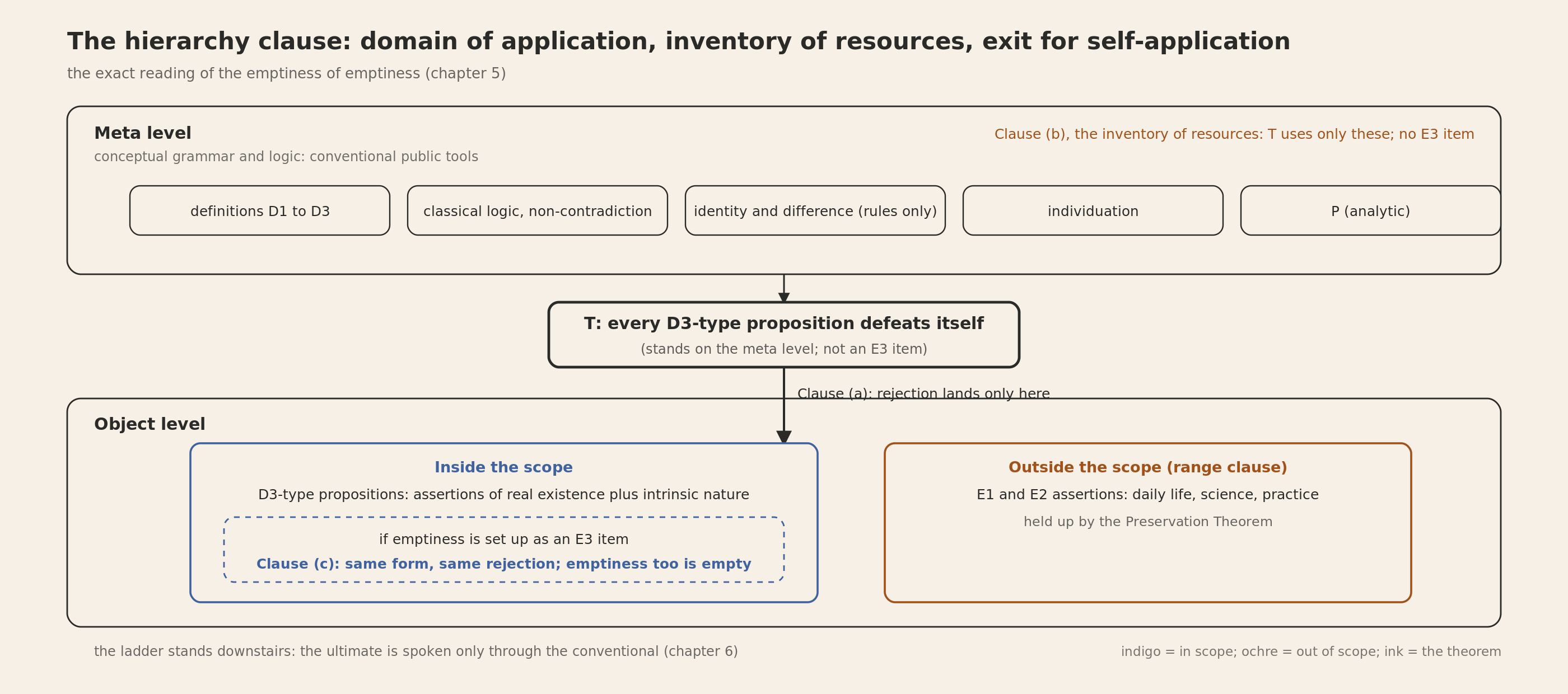
The Vigrahavyāvartanī, the whole exchange. The dilemma with which the opponent opens, given in full:2 if all things are without intrinsic nature, and speech is among all things, then speech is itself without intrinsic nature, and how can it negate the nature of anything? And if speech has an intrinsic nature of its own, the thesis laid down before is destroyed. The first horn: if your words too are without intrinsic nature, they have no force to negate with. The second horn: if your words do have intrinsic nature, your universal claim has already made an exception of itself. Together the two horns charge that the act of refutation is either ineffective or self-destroying. Nāgārjuna's reply comes in four steps, and each step answers to one of the tools this part has already set up.3 Answer one, no thesis: if I had a thesis of my own, I should thereby be at fault; because my thesis holds no thing, no fault falls to me. Rejection is not assertion, and one who performs ⊣ takes on by that act no ⊢ commitment that carries content. Read the negation externally and a ⊢¬A is indeed available; but what it states is no more than the registration of the rejection, and it posits no E3 item. Chapter 3 marks this qualification. This is the weak-rejection lemma appearing in person at the point of contact: only because the opponent reads a negation as a position does his charge have anything to strike; a negation posits nothing. Answer two, the conjured man: as a conjured man toward a conjured man, an illusory man toward an illusory man, so it is with the negation and with what is negated, and the sense is the same. Language without intrinsic nature negates all the same, just as one illusory man may block another. This answer exposes the reef beneath the dilemma: both horns share one undeclared premise, that only what is really existent can perform a function. And that premise is itself among the things the theorem strikes. Functioning has always passed freely at the E1 and E2 levels: an army has no intrinsic nature and wins its battles all the same, a national border has no intrinsic nature and stops travellers all the same. To argue from functioning to real existence was shown in Chapter 2 to be one half of the opponent's own criterion; to make real existence a precondition of functioning is the very claim this part rejects entire. The opponent's dilemma has made the defendant the judge. Answer three, the turn of the blade: what is it that you negate? What you negate is empty; a dharma is empty and yet negation takes place, and so your objection is lost. If the opponent insists that what lacks intrinsic nature cannot negate, then his negation of me is equally without intrinsic nature and equally incapable of negating; the moment he opens his mouth, half his position is already down. Answer four, the close: speech is without intrinsic nature and what is spoken of is without nature likewise; being so, I am at no fault, and no further reason need be stated. Language arises dependently and is empty, and being empty it works; and the declaration of no fault requires no higher entity set up to guarantee it. The four steps taken together: under the hierarchy clause the opponent's dilemma comes apart. The first horn mistakes an E3 backing for a necessary condition of negating; the second mistakes a meta-level assertion for a member of the object level. The theorem comes through untouched, and takes in one exhibit on the backhand: even the fiercest charge of self-application still runs on that rejected presupposition, that only the really existent can function.
The regress of the means of knowledge. The Vigrahavyāvartanī contains one further exchange, answering at a distance to Chapter 1 of this part. The opponent asks: by what means of knowledge is your refutation established? If the means of knowledge establish things, those means are in turn established by means of knowledge; tell us, then, by which means of knowledge this means of knowledge is itself established. If a means of knowledge requires another to vouch for it, the series has no end; and if it establishes itself, that is a privilege: if a means of knowledge can establish itself, without waiting upon the objects it measures, then it is established of itself and not established in dependence on another.4 This and the boundary-of-the-definitions clause of Chapter 1 are two faces of one question: the chain of definitions must have a stopping point, and the chain of grounds must have one no less. The answer of this part is likewise one. The chain stops at analytic truth and at conceptual grammar; and what makes an analytic truth a stopping point is not that some higher means of knowledge vouches for it, but that its negation has no content — no content meaning that there is no situation for it to occupy and no seat for it in any framework that can be run, the details of the grading being distinguished in Chapter 7. The argument was given in the section of Chapter 4 that closes this gap. To demand that behind every link in the chain of grounds there stand a self-establishing means of knowledge with the standing of an entity is precisely to smuggle the E3 schema into epistemology; refuse the schema and the chain closes of itself, and scepticism takes no profit from it.
The precise sense of no thesis. The words no thesis can now be made good. Commitment falls into two layers. At the object level, a metaphysical thesis, asserting that something is really existent and has intrinsic nature. At the meta-level, statements of conceptual grammar and of logic: the definitions, the lemmas, and P. What Nāgārjuna has none of is the first. On this part's list of premises the type of every entry will be marked in the audit table of Chapter 9 (definition, logic, analytic truth), and not one entry is a thesis of the E3 kind. The opponent has a last retort: is not saying that one has no thesis itself a thesis? Answer: that sentence is a report upon the list of commitments, a report that the list is empty; it is not one more entry on the list. To reify the language of the report into a thesis is the same move as reifying emptiness into a thing, and clause (c) is already waiting there. Modern readings may be set alongside. Westerhoff, on verse twenty-nine, likewise places the absence of a thesis at the semantic level and does not read it as a figure of speech;5 and the study Tillemans and Lopez wrote together on how one may reasonably speak of what does not exist without laying down a thesis runs with the speech-act analysis of pure negation.6
What this chapter hands in. The three clauses of the hierarchy: domain of application, inventory of resources, exit for self-application. The four answers of the Vigrahavyāvartanī, and the record of the dilemma coming apart, with one exhibit besides — that the charge of self-application itself presupposes that only the really existent can function. The twin relation between the regress of the means of knowledge and the boundary of the definitions, and the stopping point the two share. The layered definition of no thesis, for the audit table of Chapter 9 to draw on. The theorem has parried the blow aimed at itself, and has borrowed nothing to do it: what it used was still the lemmas of Chapter 3 and the clauses of Chapter 1. The next chapter turns to the other half of the theorem: it not only stands by itself, it holds everything else up.
[The Chinese text closes with a restatement of this chapter in plain language — the same content in a different register, the academic half governing wherever the two diverge. That restatement is not yet translated; nothing in the argument is missing from what stands above.]
References
References
-
Mūlamadhyamakakārikā, fascicle two, chapter thirteen, on the examination of the formations (T1564). The verse: "The Great Sage taught the dharma of emptiness so that all views might be left behind; those who then hold the view that emptiness exists, the Buddhas declare incurable." Piṅgala's commentary: "As one who is ill may be cured by taking medicine, but if the medicine itself becomes the illness there is no cure. As fire arises from firewood and can be put out with water; but if fire were to arise from water, what could be used to put it out?" ↩
-
Nāgārjuna, Vigrahavyāvartanī (T1631, trans. under the Later Wei by Vimokṣaprajñāṛṣi together with Gautama Prajñāruci). The opponent's verses of objection: "If all things are without intrinsic nature, and speech is among all things, then speech is itself without intrinsic nature; how can it negate the nature of anything? If speech has an intrinsic nature of its own, the thesis laid down before is destroyed." ↩
-
The four sets of answering verses in the same treatise: "If I had a thesis of my own, I should thereby be at fault; because my thesis holds no thing, no fault falls to me." "As a conjured man toward a conjured man, an illusory man toward an illusory man, so it is with the negation and with what is negated; the sense is the same." "What is it that you negate? What you negate is empty; a dharma is empty and yet negation takes place, and so your objection is lost." "Speech is without intrinsic nature, and what is spoken of is without nature likewise; being so, I am at no fault, and no further reason need be stated." These four were recorded in Chapter 3; here the whole exchange is set out. ↩
-
The same treatise: "If the means of knowledge establish things, those means are in turn established by means of knowledge; tell us, by which means of knowledge is this means of knowledge established?" "If a means of knowledge can establish itself, without waiting upon the objects it measures, then it is established of itself and not established in dependence on another." The twin relation between the exchange over the means of knowledge and the boundary-of-the-definitions clause of Chapter 1 of this part has been set out in the text above. ↩
-
Jan Westerhoff, Nāgārjuna's Madhyamaka: A Philosophical Introduction, Oxford University Press, 2009, chapter nine (pages 183–197): 9.1 the doctrine of no thesis; 9.2 the context of verse twenty-nine; 9.3 the semantic reading; 9.4 the particular role of that verse. ↩
-
Tom J. F. Tillemans & Donald S. Lopez, Jr., "What Can One Reasonably Say about Nonexistence?", in Tillemans, Scripture, Logic, Language, Wisdom Publications, 1999 (pages 247–283). ↩