Chapter 7: Entities and Regress¶
This chapter settles the account. The first six chapters registered, place by place, what the Sarvāstivāda put in; this chapter puts the entries together and reads them as one set of books. The table at the head of Chapter 7 of Part 14 has been missing a column all along: what each filling itself brought with it. That column has waited until now because it takes all seven chapters before one can see whether the fillings are compatible with one another. Once it is supplied there are three further pieces of work. The debts recorded separately by the first six chapters have to be gathered into a single chain, and it has to be said why the chain does not come to a stop. The several devices by which the school handled a regress have to be set out in one place and examined to see whether they are one device or several. And the whole has to be set against the verdict of Part 14, so that this book can state its judgment on the Abhidharma line of analysis as such. Saṅghabhadra's reply is held back until the chain has been drawn, because only when the shape of the problem is clear can one tell whether what he answered was this problem.
First, the third column is supplied.
| The place Part 14 left open | What the Sarvāstivāda put in | What the filling itself raised |
|---|---|---|
| How one dharma relates to another | Six causes, four conditions, five fruits | Are cause and condition themselves dharmas; by what does a cause already ceased still reach its fruit |
| The boundary of the moment | The four characteristics: arising, abiding, alteration, ceasing | The four characteristics are themselves conditioned dharmas, and each requires four of its own |
| How a dharma exists in time | Real existence in the three times; the substance of a dharma abides always | The whole distinction of the three times is loaded onto function, and function has no identity |
| The identity of a continuum | Possession, non-possession, life faculty, homogeneous character | Possession must itself be possessed, so there must be a possession of possession |
| Persistence: the substance of restraint, the force of action | Unmanifest matter | By what does a thing neither visible nor resistant count as matter at all |
| The passage between two existences | Intermediate existence | If intermediate existence has mind and has matter, where is its line against a lifetime drawn |
| How dharma is demarcated from non-dharma | The division into real existence and nominal existence | The measuring rod on which the demarcation rests is not itself on the list |
| Where nirvāṇa sits on the table | The three unconditioned | The unconditioned falls outside the three times, and half the warrant for real existence is gone |
Not one row of the third column is blank. What deserves more notice is that not one of the questions entered there was thought up for the school by an outsider. The possession of possession stands in the questions and answers of fascicle one hundred fifty-eight; the arising of arising in those of fascicle thirty-nine; whether function and substance are one or different in those of fascicle seventy-six; the boundary of intermediate existence in the Kośa's restatement. The school knew that every place it filled brought out a fresh demand, and it copied the demand into its own textbook word for word, and then supplied, place by place, a form of words for stopping. What this chapter asks is not whether it saw the difficulties (it saw all of them, and wrote them down), but what it stopped with each time, and whether the several stoppings amount to a method.
The last row deserves a sentence to itself, because its shape is not the shape of the others. The three unconditioned do not fall within the three times and therefore have no function; and the warrant for real existence in this school comes mainly to two things, that a thing cannot be broken up under analysis and that it performs a function. The unconditioned cannot be broken up, but the second warrant does not apply to it at all. The school's handling is to rule the unconditioned not comprised in the three times, which amounts to conceding that the real existence entered in this cell was obtained on some other set of reasons. Chapter 2 observed that the Theravāda has one unconditioned only, nirvāṇa, and that positing two fewer unconditioned means granting the status of a real dharma to two fewer formal items. This chapter adds a line to that observation: the two additional ones do not merely occupy two additional cells, they also cost the criterion a further exception.
One row still belongs on the table, and it does not come from Part 14. At the lower limit of matter the Theravāda is not empty-handed: it has the material cluster, it has the pure octad, and it has an account of clusters as generated by the four causes of kamma, mind, temperature, and nutriment. In the same place the Sarvāstivāda puts the atom, the co-arising of eight substances, and aggregation. The reason for adding the row is that Chapter 6 handed in the cleanest specimen of the pattern. The atom is invisible, cannot be touched, cannot exist by itself, and does not touch its neighbours but is merely adjacent to them without interval—four rulings, of which not one is derived from anything outside itself. And each ruling added obliges the school to add another to catch the hole the first one opened. If atoms do not touch, then on collision they ought to scatter, so the element of wind is brought in to hold them. If atoms do not touch, then striking ought to produce no sound, so arising without interval is brought in and the sound is made to come from that. Ruling follows ruling, all the way down to the wind and the noise. The other rows have the same shape; they are only not as clearly legible as this one.
Gathered together, these debts make three chains, and the three chains begin from one and the same act.
The first runs from all-exists. Whatever is a dharma exists in all three times; and if all three exist they must still be distinguished, and the distinction can be drawn only by function; so function becomes the load-bearing wall of the whole building. The identity of the wall itself is then asked after at once: is function a dharma? If it is, it too must have three times, and the function of function is asked for. If it is not, then the distinction among the three times is drawn by something that is not on the list of dharmas. Chapter 1 carried this step as far as the treatise-master's sentence—it cannot be determined as one or as different, and therefore it should not be pressed.
The second runs from non-self. That the person is not really existent is a line this school held very strictly; but the things said about persons still had to remain sayable. This dharma belongs to this man; this man is still alive; this man is of this class; this man took the precepts and has fallen asleep and still counts as keeping them; this man has passed from this life into the next. Five sayings, and five dharmas to carry them: possession, life faculty, homogeneous character, unmanifest matter, intermediate existence. Chapter 4 has already made the point that of the six fillings only the four characteristics is purely about dharmas, the other five all pointing at a person. And once possession has been set up it must itself be possessed, and so there is a possession of possession.
The third runs from momentariness. A dharma arises and ceases in an instant, and the two ends of the instant need something to carry them, so the four characteristics are posited. The four characteristics are conditioned dharmas, and conditioned dharmas each have four characteristics, so the secondary characteristics are posited. And once the second storey stands, it has to be explained why the second storey does not in turn produce a third.
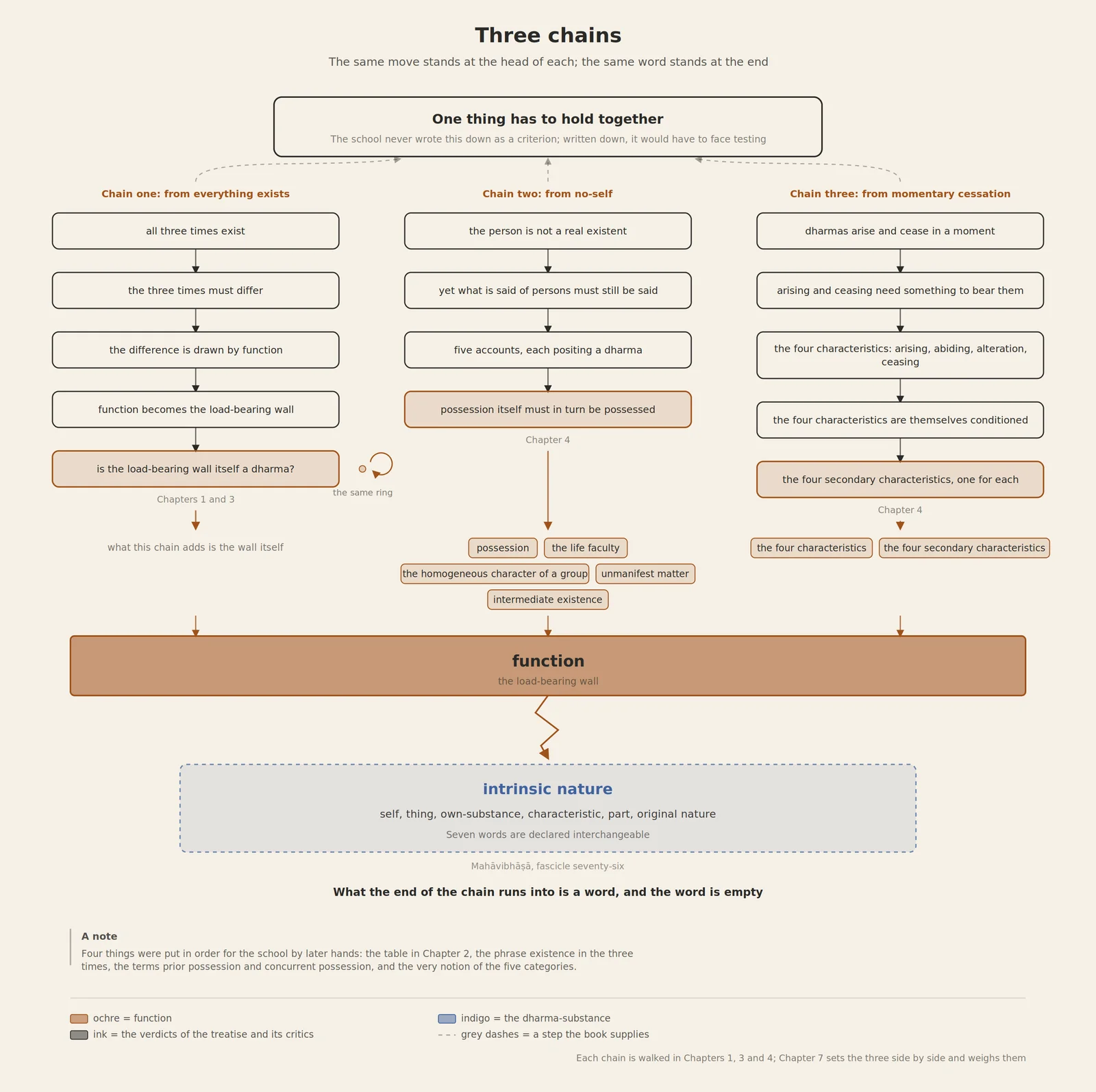
The three chains look as though each went its own way, but their last stretches are shared. The secondary characteristics must have a function; possession must have a function; every newly added dharma, so long as it still counts as conditioned, must have a function—and it is by function precisely that the distinction among the three times is established. So each dharma added is one more object hung on the same load-bearing wall. Chapter 3 said that the gap stands open in the very middle of the system; what Chapter 4 saw was that same gap leaking downward along each newly added dharma in turn. Why the category of dharmas dissociated from mind should be the hardest part of the system to manage has its answer here as well: the whole category of fourteen consists of formal items, formal items are the least able to say clearly what work they do, and this system demands of every dharma that it do work. The reasons given for legislating this category, and the way the judgment of real existence took shape, have been cleared up item by item by an earlier hand.1
Four things on this chain were not made by the Sarvāstivāda itself. Chapter 2 recorded that the table of seventy-five dharmas in five categories is nowhere in the Mahāvibhāṣā. Chapter 3 recorded that the phrase rendered "real existence in the three times" does not occur once in the two hundred fascicles. Chapter 4 recorded that "prior possession" and "simultaneous possession" do not occur in the Mahāvibhāṣā at all, and that "posterior possession" occurs exactly once. The fourth has to be put a step further back: even the phrase "five categories" is not the Kośa's own wording. In fascicle four Vasubandhu writes "five classes"—all dharmas are, in brief, of five classes: matter, mind, mental factors, those dissociated from mind, and the unconditioned. The words rendered "five categories" occur once only in the thirty fascicles, at fascicle fifteen, where they mean the state of intermediate existence and the states within and outside the womb and have nothing to do with this list; the number seventy-five is never written out at all; and on the Mahāvibhāṣā's side "seventy-five dharmas" is likewise zero.23 So this stands: "the seventy-five dharmas in five categories," the name under which very nearly every Chinese primer of Buddhist studies files this school, is said in neither of the two root treatises. Taken together the four make a rather awkward finding: the set of terms by which this school is best known was for the most part put in order for it by its critic, and the most famous item in the set was not said even by the critic. Vasubandhu compiled the table, named the thesis, completed the set of three terms, and then criticised each of them in turn. This bears directly on the present chapter. Every link of the chain drawn here has a clear source, but the chain itself was straightened by a later hand. The Mahāvibhāṣā is a book in which four masters are set out side by side and difficulties are raised at every turn; it did not arrange its own positions into a line running from a starting point to an end, and it shows no sign of having wanted to. This book holds that the line can be drawn, and the ground for holding so is that both ends of every link have their text in the Mahāvibhāṣā's own questions and answers, so that the drawing does the material no violence. But to say that the Mahāvibhāṣā was consciously walking the line is more than the evidence supports, and that had better be said at the front rather than left to be inferred from the neatness of the result.
All three chains begin from the same sentence: there is something that must be made to come out. Chapter 4 read out of the school's practice a second reason for judging a thing really existent—an item that cannot be dispensed with in a sentence that must be allowed to stand is thereby established as a really existent dharma. Possession cannot be dispensed with, since otherwise the word "attainment" in the sūtras has nothing to rest on. Homogeneous character cannot be dispensed with, since otherwise there is nothing by which a class of beings counts as one class. Unmanifest matter cannot be dispensed with, since otherwise a sleeping man is not a keeper of precepts. This reason converts indispensability in language directly into real existence in being, and the rate of exchange is one to one.
The school never once wrote this criterion down as a criterion. Written down it would have had to submit to examination, and there are two examinations it cannot pass. The first is that it carries no stopping condition: as many sentences as there are, so many dharmas there may be, and Abhidharma sentences only ever multiply. The second is that it does not apply to itself. Whether a thing can be broken up is the first measuring rod, and whether it can be dispensed with in a sentence is the second, and the two rods are not measuring the same thing. Chapter 2 has already shown that one and the same criterion kept nineteen candidates out of the category of matter and let fourteen into the category of dharmas dissociated from mind, and that the two sides were not in fact applying one reason. The great convenience of a measuring rod that has never been written down lies exactly here: it is not obliged to answer for the two occasions on which it was used.
What the end of the chain runs into is a word, and the word is empty. Chapter 1 recorded a passage of fascicle seventy-six: asked what the three times have for their intrinsic nature, the text answers that all conditioned dharmas are their intrinsic nature, and then adds that as it is said of intrinsic nature, so it should be understood of self, thing, own-substance, characteristic, part, and original nature. Seven words are declared interchangeable. A word employed as the final term of an explanation, if it can be swapped at will with six others, marks not the terminus of explanation but the place where explanation stopped. Chapter 3 added a further layer to this: on fascicle seventy-six's own aggregate-by-aggregate check, past and future matter does not deform, feeling does not experience, and consciousness does not cognise, so that the ever-abiding substance is what is left of a dharma once everything by which it is defined has been subtracted. Not the specific characteristic, which belongs to it as this kind of dharma; not the function, which is what the three times differ in; not the four characteristics, which are separate dharmas. What catches the chain at its end is neither a more fundamental fact nor a more basic principle, but one word that has changed its name six times.
A regress appears three times in this system; the school stopped it all three times; and the stopping was not one method but three.
The first is the possession of possession. Fascicle one hundred fifty-eight first records one answer: it should be said that possession has a further possession, and that an infinite regress is no fault, since it is by this that birth-and-death is hard to sever and hard to cross. What was adopted is a different answer: in a single moment there are only three dharmas—the dharma itself, its possession, and the possession of that possession; by the possession are accomplished the dharma and the possession of possession, and by the possession of possession is accomplished the possession, the two obtaining each other in turn.3 The chain has been folded into a ring. The second storey does not go on to generate a third; it turns back and takes charge of the first.
The second is the characteristic of a characteristic. Fascicle thirty-nine likewise records first a saying that grants the regress (this infinite regress may be allowed and there is no fault in it, for the three times are vast and how should there be no room to lodge it), and then settles the matter on nine dharmas arising together: arising gives rise to the remaining eight, and the arising of arising gives rise to one only, namely the primary arising.3 The stopping is not the stopping of the first case. Here the chain is not folded; the rule is changed at the second storey. The question follows at once: both are called arising, so by what does the one generate eight and the other one? The answer is that such is the nature of dharmas and it should not be objected to.
The third is the function of function, and this time the Mahāvibhāṣā did not stop the regress; it refused the question. Pressed in fascicle seventy-six on whether function and substance are one or different, it answers that this cannot be determined as one or as different, supports the answer with a comparison, and closes with the words: therefore it should not be pressed.3 That is not the offering of a way to stop but the declaration that the question ought not to be put. Of the three, the first two limit the loss; the third seals the opening.
The three ways of stopping can be weighed side by side. Folding into a ring is the cheapest, and its cost is that the first storey and the second are each the condition of the other's standing, so that neither stands alone—a self-referring arrangement of the kind the school elsewhere takes care to forbid. Changing the rule at the second storey costs more, since a reason has to be found for the asymmetry, and the reason found is that such is the nature of dharmas. Refusing to answer takes the least trouble and costs the most, because the question refused falls exactly on the load-bearing wall of the whole building. Chapter 2 recorded the shape of a closing move: a comparison, followed by a declaration that nothing further need be asked. Chapter 4 recorded its third appearance, under the co-existent cause (conditioned dharmas are feeble in nature, and only by depending on one another in turn do they accomplish their work) together with the three similes of two sheaves of reeds leaning together, many ropes hauling one timber, and many men crossing a river. All three occasions have precisely the same shape: an everyday comparison is given, and then the matter is declared closed. A comparison can bring people to accept a saying; it cannot make the saying stand.
There is a number here that can be checked. In the two hundred fascicles of the Mahāvibhāṣā the term "infinite regress" occurs forty-seven times, and twenty-four of those occurrences are concentrated in two fascicles—seven in fascicle thirty-nine and seventeen in fascicle one hundred fifty-eight, which are precisely the two places of the four characteristics and of possession.3 The remaining twenty-three are scattered through other fascicles, and their use there is almost uniformly the reverse: if such and such a thesis were to hold, then this and that would follow in turn and become an infinite regress, and then there would be no liberation and no escape, and therefore the thesis does not hold. The infinite regress, in the Mahāvibhāṣā's hands, is principally a weapon for demolishing other people. Only in these two places, where it is turned on the school's own body, is it swung round and treated as something acceptable, and on both occasions a reason for the acceptability is appended—birth-and-death is hard to sever and hard to cross; the three times are vast and have room enough. A tool used to refute others fails in two places, and both places are the school's own roof-beams. That is not a coincidence.
There is a second set of ready-made formulae for terminating a question, and their distribution can be checked in the same way. "It should not be pressed" occurs seventy-two times in the Mahāvibhāṣā, not once in the thirty fascicles of the Kośa, and seven times in the eighty fascicles of the Nyāyānusāra. "Because the author of the treatise wished it so" occurs seventy-six times in the Mahāvibhāṣā and not once in either of the other two.324 One layer has to be deducted first. "Because the author of the treatise wished it so" is used for the most part to answer why the entries of the treatise under commentary stand in the order they do, the answer running that the author of the treatise wished it so, that it does not contravene the characteristics of dharmas, and that therefore it should not be pressed. That is a saying that comes with the commentarial genre; the Kośa is not a commentary of that kind and has no occasion for it, and the difference cannot be counted. What is left after the deduction is still considerable. For one and the same act (the ruling that a demand is improper), the Mahāvibhāṣā has a set of phrases it uses by habit, and Vasubandhu never once uses them. That he does not use them does not mean he has no stop line of his own; it means only that he draws it somewhere else, or else leaves the question at that point standing open. Chapter 3 observed that Vasubandhu's own way of closing is a different sentence: the nature of dharmas is profound and is not the province of discursive thought.2 Both seal an opening. One of them says the question should not be asked; the other says it cannot be reached.
There is a third way of stopping, and it does not even need to say that the question should not be asked. The first two are that it should not be asked and that it cannot be reached; the third takes sectarian allegiance directly for a reason. This one is hard to count in the Mahāvibhāṣā, since that book is a work of sectarian doctrine from end to end and speaks for its own school on every page. But it left a clean trace in the Kośa, because each time Vasubandhu restates a Vaibhāṣika ruling he copies the signature down word for word. A search of the thirty fascicles gives seven such places.2
| Fascicle | Topic | The sentence |
|---|---|---|
| Four | Possession and non-possession | Both routes are well said. Why so? Because they do not go against reason, and because they are what my school holds |
| Five | Homogeneous character, and the attainment of non-perception (one sentence, two places) | This is not well said, because it goes against what my school holds |
| Five | The prior resolve in the two attainments | The former statement is the better, because it is what my school holds |
| Five | The four characteristics | Is one to abandon what one's school holds merely because the objectors are many? One does not leave off sowing wheat for fear there may be deer, nor refuse a good ball of rice for fear that flies will settle on it |
| Thirteen | Unmanifest matter | Let these many disputes rest. The Vaibhāṣika masters say there is a real thing named unmanifest matter, and that is what my school holds |
| Twenty-eight | Inner serenity | Though there is this reasoning, it is not what my school holds |
Laid out in a row, the gradation is plain. Fascicle four is a pairing: not going against reason and being what my school holds stand side by side, and Chapter 4 has already pointed out that the two are not of one weight and are used there as though they were. At the two places in fascicle five the first of the pair has dropped away, and all that is left is that the account goes against what my school holds—a statement is rejected, and the whole of the reason given is that it does not agree with the school. The passage on the four characteristics in fascicle five rises into a declaration, and a well-turned one: is one to abandon one's school because the objectors are many? One does not leave off sowing wheat for fear of deer, nor refuse a good ball of rice for fear of flies; therefore against objections one should work diligently at explanation, and toward the doctrine of one's own school one should conform and practise. Fascicle thirteen calls a halt first and shows the colours after: before the sentence letting the many disputes rest, Vasubandhu has just spread out the difficulties of unmanifest matter for a whole paragraph.
The summit is at fascicle twenty-eight: though there is this reasoning, it is not what my school holds. That the other side's account holds together is granted; and having been granted, it is still not adopted, because it is not the school's. The earlier places can be read as an argument left out; this one cannot. It separates holding together from being adopted into two plainly different things, and then says the two need not agree.
The case must not be put from one side only. A work of sectarian doctrine has the establishing of a position for its very substance, and marking one's own school off from another's is part of that business; to read every "because it is what my school holds" as a want of reason would not be fair, the more so as several of the seven do give an argument above, the sentence being only a signature. This book takes one thing from them: the signature falls in a very regular place. It comes down where an argument has just been brought up short—after both routes are well said, after the account by nominal designation has just run very smoothly, after the many disputes, after though there is this reasoning. The signature carries no weight of its own, and yet every time it lands exactly on the square where the weight is greatest.
Chapter 3 stopped on the last page of the Mahāvibhāṣā, and that page asked only half the question. Fascicle two hundred assigns concealment and manifestation to the eternalism of the outsiders, and the measure it uses is that characteristic and substance are one: if the characteristic differs, the substance too should differ; and if a dharma is said to abide permanently with only concealment and manifestation among its states, then it must be granted that the characteristic never differs at all. Applied to the outsiders, the measure takes an accurate reading. The half not asked next is what this measure reads when it is turned on the school itself. What the Sarvāstivāda wants is precisely that the substance should not differ while the characteristic does—the substance of a dharma exists always through the three times, while function has its arising and its ceasing, and the arising and ceasing of function is nothing other than a difference of characteristic. The Mahāvibhāṣā never raised that question itself. Vasubandhu raised it on the book's behalf.
Saṅghabhadra took this demand over. Fascicle fifty-two of the Nyāyānusāra, in the chapter on the latent defilements, carries an exchange in which Vasubandhu raises the pressure layer by layer and Saṅghabhadra answers layer by layer; it is the one stretch of direct engagement on this question anywhere in the three treatises. Vasubandhu asks first: a dharma is established as past, future, or present by its function, so by what is function itself divided into three times? One can hardly say that function has a further function.4 This is exactly the dilemma Chapter 1 derived, put by Vasubandhu with more urgency.
Saṅghabhadra's first answer dismantles the demand. When did the Abhidharma masters ever establish function as past or future, that you should now press it about having three times as though the objection were not groundless? I have not said that past and future have function either; how then can you turn about and press me on whether function has a past and a future?4 The answer does not answer the question; it cancels the question's standing, on the ground that the thing being pressed was never posited as an item requiring to be settled.
Vasubandhu at once tightens the dilemma. If past and future have no function, then it must be admitted that function was not and comes to be and having been is no more; and since function is a differentiation of a dharma, one of the two must be chosen, different or not different. If different, it has a separate substance of its own, and then the conditioned dharmas ought to stand in the same case as this function. If not different, then it must be explained how there can be a differentiation that is not different from the substance of the dharma.4 Here Saṅghabhadra yields half a step: I grant that function is a differentiation of a dharma, and yet it cannot be said to be different from the substance. He has chosen not different, and with that Chapter 1's "it cannot be determined as one or as different" is void. The question the Mahāvibhāṣā refused to determine, Saṅghabhadra determines, and he takes the not-different side of it.
Vasubandhu presses once more: how is there a differentiation where there is no difference? Saṅghabhadra's reply is a counter-question, and it is well aimed. On your own tenet, within a wholesome mind there is the differentiated seed-capacity that draws forth dharmas of another class, the unwholesome and the rest; that capacity is not different from the wholesome mind and yet genuinely differs from it—how will you account for that?4 He then instances several cases in a row: feeling, which has one characteristic of experiencing, carries within it the differentiation of pain and pleasure; the earlier and later moments of one continuum have no distinct characteristic of dharma and yet differ before and after; a thing burnt by fire keeps its coarse aspect unchanged and differs subtly from moment to moment. The counter-question is effective. Any account that must lodge change upon an unchanging bearer owes the same debt, and the Sautrāntika's seeds owe no less of it than the Sarvāstivāda's function. Chapter 4 said that Vasubandhu's side hands persistence over to capacity and to the transformational differentiation of a continuum, and that all of it is nominally posited; Saṅghabhadra's point is that being nominally posited does not excuse a thing from explanation.
Saṅghabhadra's positive answer is a set of three denials. Present differentiated function is not different from the dharma, because it has no separate substance; it is also not identical with the dharma, because there are times when the substance is present and the function is not; and it cannot be said not to exist, because function once arisen is able to draw forth a fruit. A verse is set on this: a continuum has no separate substance, yet a separate operation is granted to it; the principle of function is likewise, and so the meaning of the three times is established.4 The three sentences place function in a position where it neither has a substance of its own nor is nothing at all. The regress is indeed stopped, because its first link never forms: a thing with no separate substance does not have to be assigned three times. The earlier question is answered at the same stroke. That the characteristic should differ while the substance does not is intelligible on this account, because the difference brings no substance along with it; and the measure applied in fascicle two hundred of the Mahāvibhāṣā was a measure for characteristics that do bring substance along with them, so that here it finds nothing to take hold of. It is a clean answer. The price of the cleanness lies in the model he uses.
It is worth attending to what he took for his comparison. The passage before the verse says it plainly: differentiated function and the substance it rests on cannot be said to be different, in the way that a continuum cannot. Conditioned dharmas arising moment after moment without interval are called a continuum; the continuum is not different from the dharmas, since it has no separate substance; nor is it identical with them, lest a single moment should have a continuum; and it cannot be said not to exist, since operation is seen upon a continuum.4 The three clauses match the three on function word for word—first the continuum, then the principle of function is likewise. But the continuum, in this school, is a nominal dharma. To secure the reality of the three times, Saṅghabhadra reached for a model that his own division files on the nominal side.
Chapter 6 arrived at a sentence of the same shape at the material end. The atom never acts alone; the five consciousnesses depend on the accumulated and take the accumulated as object; and since the distinction of the three times is established by function, an atom's present can only be borrowed from the cluster it stands in. The real borrows its time from the nominal. The two derivations are made differently (one from the support and object of the five consciousnesses, the other from the simile Saṅghabhadra chose for himself), and they come down in the same place. This book holds that these are not two accounts but one account showing itself once at either end of the system.
This exchange has been gone over repeatedly in modern scholarship, and Saṅghabhadra's replies to Vasubandhu's three difficulties have been given a full and orderly survey; that layer is not repeated here.5 The one thing this chapter has to add is that the existing discussion mostly comes to rest on whether Saṅghabhadra succeeded in blocking the regress, whereas this book is more interested in the model he blocked it with. That he blocked it is a fact; that he used the continuum as his model is also a fact; and the two have to be held together before it becomes visible how much the reply actually cost.
This should be stated fairly. Saṅghabhadra did what the Mahāvibhāṣā had not dared to do. The Mahāvibhāṣā ruled the one-or-different question improper, and he answered it. The Mahāvibhāṣā left function in a condition without identity, and he gave it a position. He also showed that his opponent owed the same debt, and to that Vasubandhu's side returned nothing. But the stop line was only moved down one notch; it was not abolished. The three denials themselves admit no further pressing, and what "not different, not identical, not to be said not to exist" amounts to when the three are put together has no sequel. Nor did he give up the formula himself: answering the objections to the co-existent cause in fascicle fifteen, he sets the words "should not be pressed" directly on the point of the question, saying that within an assemblage all in mutual relation are cause and are fruit, and that therefore no determinate cause should be demanded of cause and fruit.4 Of the seven occurrences in the Nyāyānusāra counted in the previous section, this is one. Chapter 3 said that the substance of this exchange is a contest over where the stop line falls; this chapter can finish the sentence. The result of the contest is that the line moved one notch, and the manner of contesting did not change on either side.
What the line of non-self held and what it let go was a question Chapter 4 handed on to this chapter. What was held comes first. The Sarvāstivāda does not concede that the person is really existent, and from beginning to end that never loosened; the five dharmas it posited for the person's sake (possession, life faculty, homogeneous character, unmanifest matter, intermediate existence) themselves arise and cease in a moment, and not one of them is a permanent, unitary, sovereign substance. To read these dharmas as an invitation to the self to return is unfair, and this book does not take that reading.
What was let go is another thing. What non-self set out to cancel was a position—a holder standing outside the dharmas and bearing them. The Sarvāstivāda did not install that holder; but it made the holding itself into a real dharma. Possession is not the person who holds; possession is the relation of holding. Once the relation has been made an entity, the position does indeed stand empty, and yet every job that used to be done from it has found someone to take it over, not one of them left undone. Chapter 4's account is plain enough: of the six fillings, five point at a person. What was held is the letter of non-self; what was let go is the expense that non-self was meant to save.
This has to be said of the Theravāda as well if it is to be said fairly. Part 14, Chapter 6 reached a finding of its own: the continuum is not a property of any mental dhamma, and the list of eighty-nine minds, refine it as one may, cannot fix the continuum anywhere upon it. The Theravāda did not posit possession; but the continuum in its system is doing work all the same, and doing it without a name. One school posits it as a dharma and pays for the positing with a regress; the other declines to posit it and pays with an inability to say it. Neither of them actually saved the expense.
The verdict starts from a small difference. Chapter 1 set the two schools' nominal existence side by side and found that they were not the same kind of thing. What the Sarvāstivāda calls nominal is what analysis has taken apart: the pot is nominal because it can be resolved into atoms, and the resolving is an act performed in the study, an act that comes to an end when the parts are reached. What the Theravāda calls nominal is what cannot be entered on the register: the concept is nominal because it cannot be singly taken as the object of contemplation, and the taking is an act performed on the cushion, an act whose end is reached when the meditator either sees the thing or does not.6 It is one and the same word, resting on two different reasons, and the two reasons presuppose activities that are not of one kind. Seven chapters have now shown that small difference at work everywhere. Where reality is settled by taking apart, the question of where to stop is settled by reasoning, and reasoning carries no stopping condition inside itself; so the atom had to be sealed by stipulation and possession had to be closed into a ring by mutual possession. Where reality is settled by registering, the question of where to stop is settled by whether contemplation reaches the thing, and whatever contemplation cannot reach does not get onto the table however much work it may be doing; so the list came out short and several items that do real work in the system were left without names. The faults of the two schools grew out of their respective acts. They did not grow out of a difference in intelligence between them.
One item in the verdict has to be positive, and it has to come first. The Sarvāstivāda took the three problems head-on and wrote out every step of its answer in words that can be quoted and refuted. Part 14 argued that the Theravāda's reification does not occur in any declared doctrine but in the procedure of cataloguing and the pressure of a format; nothing is asserted, and so nothing can be pinned. Here the situation is reversed. The substance of a dharma exists always, the three times are really existent, the atom is indivisible, possession is a real dharma dissociated from mind, the six causes and four conditions exhaust relation — every one of these is a stated thesis, laid down in a sentence, with the reasons attached. That is decisive for the history that followed. Only a thesis written plainly can be systematically refuted, and it is no exaggeration to say that half the argumentative form of both Madhyamaka and Yogācāra was forced into being by this school. Without an opponent who says everything he thinks, Nāgārjuna's item-by-item dismantling would have had nothing to take hold of. This book's first assessment of the Sarvāstivāda is therefore that it deserved to be refuted; and in the history of thought that is not a low assessment.
The other three bricks were delivered by the first six chapters.
The first comes from Chapter 1. The verdict will not read: the Theravāda was clever and the Sarvāstivāda was muddled. Theravāda caution has a price of its own, and the price was paid in silence — on the whole group of questions about time it said nothing at all. The Sarvāstivāda answered badly, but it answered in a way that can be checked; and checkability is itself a contribution.
The second comes from Chapter 3. The line at which the school stopped was pressed out of it, not selected by it. "Therefore it should not be pressed" says that the question ought not to be asked; it does not say that the question has an answer. The tone of the sentence is impatient, not composed. What the present chapter adds to that reading is arithmetic: the distribution of the forty-seven occurrences of "infinite regress" and the seventy-two of "should not be pressed" gives the judgement numerical support, and not merely support drawn from tone.
The third belongs to this chapter. The three vacancies left standing at the end of Part 14 mark the boundary of the analytical line itself; they do not mark an oversight on the part of one school. The reason for saying so is that the two failures are complementary in shape. To use a list of dharmas at all one must already have relation; to set moments in order one must already have time; to draw up a list in the first place one must already have a boundary. All three are conditions that make analysis possible, and not one of them is an object that analysis can take. The Theravāda left them outside the list, and the cost of that was that the list can no longer claim to have set down everything that exists. The Sarvāstivāda took them inside the list, and the cost of that was that the items so taken turn round and demand entries of their own, at which point the chain begins. One school leaves them out and the other takes them in; these are the two sides of a single boundary, and not two separate mistakes.
There is a question that Chapter 3 asked at its close and left standing: whether a bearer of persistence and a bearer of differentiation can both be had at once. This book's answer is that within this method they cannot both be had. Press reality into the present alone, and connection across time can only be a relation, and a relation has no place of its own in which to sit. Spread reality across the three times, and particularity in the present can only be a function, and a function has no identity of its own that it can give. Each of the two roads loses one end, and the end it loses is precisely the end that the other holds fast. Between them no third road is open — unless what is altered is not the list but the doing of analysis itself.
What has to change is analysis itself, and that is the business of the parts that follow. What the Yogācāra line does is to draw the bearer inside consciousness: seeds are stored in the storehouse consciousness, persistence is borne by the continuity of consciousness itself, and the work that the group of possession and unmanifest matter was built to do at last has somewhere to rest. That is aimed at the group of difficulties in Chapter 4 of this part. What the Madhyamaka line does is to cancel the premise of the question: if intrinsic nature does not hold at all, then no chain of explanation that must terminate in intrinsic nature needs to be drawn to its end, because it was drawn in the wrong direction from the very first stroke. That is aimed at the group of difficulties in Chapter 1 of this part, which is to say at the seven words that gloss one another. Each of the two roads faces one place in this part; noting as much before those parts are read will make the reading go more easily.
A list is opened last, to be drawn on by the parts that follow.
The first class is what is to be taken as a target: intrinsic nature; the real existence of the three times; the division of the real from the nominal; atoms and aggregation; and the criterion that lays down as a real dharma whatever cannot be left out of a sentence. Madhyamaka puts its knife to the first and the fifth. Yogācāra puts its knife to the fourth. Both make use of the second as a counter-instance.
The second class is what was kept after alteration. The work that possession and unmanifest matter were made to do is taken over by seeds and perfuming. The frame of six causes and four conditions is preserved almost intact in the later treatises. The distinction between the co-existent cause and the homogeneous cause, and the pairing of the cause of maturation with the fruit of maturation, both continue into the Yogācāra treatises. Opposing a system and using its tools have never been in conflict.
A further class was neither refuted nor altered, and these sank below the level of language: dharma, substance, function, association, object, immediate antecedence, dominance, co-existence, maturation, real existence, nominal existence. These words are still in daily use in Chinese Buddhist scholarship today, and most of those who use them no longer remember which particular difficulty each of them was made to solve. What this part has been doing from beginning to end is in fact one thing only: putting these familiar words back into the dispute out of which they were made, so that they may be allowed to become questionable once more.
It is handed on to the next part. The next part turns to the Mahāvibhāṣā itself. This part has tested the Sarvāstivāda's assertions as philosophical propositions, and the results of that testing have been set out above; what the next part asks is a different thing, namely how these propositions came in the first place to be adjudicated into orthodoxy out of a heap of divergent views set down side by side. Through the two hundred fascicles four masters are presented in a row and only then does the evaluator's verdict follow; and what that verdict rests on is not argument alone. One should first see clearly the process by which an orthodoxy is made, and then see a few pieces of it lifted off by one of its own in the Abhidharmakośa. Only then does what Madhyamaka afterwards dismantles have a definite object.
References¶
References
-
Collett Cox. Disputed Dharmas: Early Buddhist Theories on Existence. Studia Philologica Buddhica Monograph Series XI. Tokyo: International Institute for Buddhist Studies, 1995. The reasons offered for legislating the dharmas dissociated from mind are at §4.3, Rationale for the Category of Dissociated Forces, pp. 73–78. The formation of the judgement of real existence, and the uses of the word function, are at chapter 9, §9.1, Sarvāstivādin Ontology, pp. 134–144, where §9.1.4, Activity and Capability, pp. 141–144, treats function directly and §9.2, Vasubandhu’s Ontology, p. 145, records Vasubandhu’s side. The shape of the chain argued in sections five to seven of this chapter shares its concerns with that work; the item-by-item judgements, and the counts on which they rest, are this book's own. ↩
-
Abhidharmakośabhāṣya, 30 fascicles, composed by Vasubandhu, trans. Xuanzang, Taishō vol. 29 (T1558). Every place cited in this chapter has been given in Chapters 3, 4, and 6 of this part, and the classical Chinese is not reproduced here. In the second part of the chapter on the latent defilements, the discussion of the real existence of the three times closes with the sentence "the nature of dharmas is profound and is not the province of discursive thought"; within that same discussion stand the three questions put to function, of which the second (the three times of function itself) is the starting point of the exchange set out in section eleven of this chapter. Fascicle four, in the second chapter on the faculties, reads "all dharmas are, in brief, of five classes: first matter, second mind, third mental factors, fourth those dissociated from mind, fifth the unconditioned," and the same fascicle reads "mental factors, for the present, are of five classes": the treatise uses "five classes" and not "five categories," as recorded in the notes to Chapter 2. Signatures of the kind that take sectarian allegiance directly for a reason were found in seven places on a search of all thirty fascicles. Fascicle four, on possession and non-possession: "both routes are well said. Why so? Because they do not go against reason, and because they are what my school holds." Fascicle five, on homogeneous character: "this is not well said, because it goes against what my school holds," the same words standing in the passage on the attainment of non-perception in that fascicle. Fascicle five, on the prior resolve in the two attainments: "the former statement is the better, because it is what my school holds." Fascicle five, on the four characteristics: "the Vaibhāṣika masters say that arising and the rest are characteristics having a separate real substance, and their reasoning should hold. Why so? Is one to abandon what one's school holds merely because the objectors are many? One does not leave off sowing wheat for fear there may be deer, nor refuse a good ball of rice for fear that flies will settle on it. Therefore against objections one should work diligently at explanation, and toward the doctrine of one's own school one should conform and practise." Fascicle thirteen, on unmanifest matter: "let these many disputes rest. The Vaibhāṣika masters say there is a real thing named unmanifest matter, and that is what my school holds." Fascicle twenty-eight, on inner serenity: "though there is this reasoning, it is not what my school holds." Four further places are left out of the seven, being either a plain statement of where a position stands or preceded by a reason of their own: fascicle ten, "my school grants the two to be a co-existent cause"; fascicle fourteen, "therefore my school does not grant this sense"; fascicle seventeen, "on what my school holds it should be put thus"; fascicle twenty-six, "let the side discussion rest; the school's own position should now be stated." The counts that follow were obtained by searching the whole thirty fascicles of the CBETA text: "infinite regress," thirteen occurrences, distributed among fascicles four, five, nine, ten, and twenty, not one of which answers by accepting a regress; "should not be pressed," none; "because the author of the treatise wished it so," none; "such is the nature of dharmas," none; "seventy-five," none; "five categories," one, at fascicle fifteen, where it means the state of intermediate existence and the states within and outside the womb and has no bearing on the seventy-five dharmas in five categories. For the modern Chinese version see this site's translation of the Abhidharmakośa, rendered from the CBETA text. For the English see Leo M. Pruden, trans., Abhidharmakośabhāṣyam of Vasubandhu, 4 vols. (Berkeley: Asian Humanities Press, 1988–1990), rendered from Louis de La Vallée Poussin, L'Abhidharmakośa de Vasubandhu (Paris–Louvain, 1923–1931). ↩↩↩↩
-
Abhidharma Mahāvibhāṣā Śāstra, 200 fascicles, trans. Xuanzang, Taishō vol. 27 (T1545). This chapter cites no new material; the places relied on have all been given in the first six chapters of this part, and what follows lists only the few sentences and the few general counts that bear directly on the present argument. Fascicle seventy-six, on the synonyms of intrinsic nature, reads "as with intrinsic nature, so also with self, thing, own-substance, characteristic, portion, and original nature; it should be known that the same holds"; the question of one and different in the same fascicle reads "question: are function and substance one or different? Answer: it cannot definitely be said that they are one, nor that they are different," and the sentence that closes it reads "therefore it should not be pressed." The same fascicle runs a check through the aggregates one by one, of which the question on the aggregate of matter reads "are the dharmas that are matter possessed of deformation and resistance? Answer: whatever has deformation and resistance is definitely matter. There are dharmas that are matter and yet have no deformation and resistance, namely past and future matter, and present atoms and unmanifest matter," the remaining four aggregates being handled on the same pattern. Fascicle thirty-nine, on the four characteristics: the difficulty is put as "question: does this characteristic of arising have a further characteristic of arising? Suppose it does—what fault? If it does, this too has a further one, and that a further one, and so on in succession it should become an infinite regress"; the answer recorded first reads "some say thus: to grant this infinite regress is no fault either. The three times are broad; how should there be no place to stand?"; the adjudication reads "here arising is able to produce eight dharmas, namely the dharma itself, the three characteristics, and the four secondary characteristics; arising-of-arising produces one dharma only, namely arising. By this reasoning there is no fault of infinite regress"; and the answer to the asymmetry reads "such is the nature of dharmas, and it should not be objected to." Fascicle one hundred fifty-eight, on possession: the difficulty is put as "question: if so, it should become an infinite regress. Answer: the infinite regress too is no fault. It is by this that birth and death are hard to cut off and hard to cross"; the adjudication reads "as it is stated thus: in a single moment there are three dharmas only, first that dharma, second its possession, third the possession of the possession." Fascicle sixteen, under the associated cause, reads "conditioned dharmas are feeble in nature, and only by depending on one another in turn do they accomplish their work," the three similes being two bundles of reeds leaning one against the other, many ropes drawing a log, and many people crossing a river. The counts that follow were obtained by searching the whole two hundred fascicles of the CBETA text: "infinite regress," forty-seven occurrences, of which seventeen in fascicle one hundred fifty-eight and seven in fascicle thirty-nine, twenty-four in the two together, the remaining twenty-three scattered through fascicles three, sixteen, nineteen, twenty-four, forty-seven, sixty-three, seventy-nine, eighty-nine, ninety, ninety-six, ninety-seven, ninety-eight, one hundred twenty-nine, one hundred ninety-three, and one hundred ninety-nine, the usage being for the most part to charge another's doctrine with a regress; "should not be pressed," seventy-two; "because the author of the treatise wished it so," seventy-six; "it simply does not conflict with the characteristics of dharmas," nine; "such is the nature of dharmas," two; "feeble," eighty-two; "seventy-five dharmas," none; "five categories and seventy-five," none. For the modern Chinese version see this site's translation of the Mahāvibhāṣā, rendered from the CBETA text. ↩↩↩↩↩↩
-
Abhidharma Nyāyānusāra Śāstra, 80 fascicles, composed by Saṅghabhadra, trans. Xuanzang, Taishō vol. 29 (T1562). This site holds the classical-Chinese text of the treatise complete. The passage used in this chapter stands in fascicle fifty-two, in the eighth part of the chapter on the latent defilements, and has been transcribed directly from that text; the note to Chapter 3 has since been settled against the same original, so that the two rest on one source. Vasubandhu's challenge reads "again he presses function: how can it be said to be past, future, or present?", its sense being that a dharma can be established as past, future, or present by its function, but that by what function itself has a division into three times is unsaid, and that one can hardly say this in turn has a function. Saṅghabhadra takes the question apart with "have the Abhidharma masters ever established function as past or future, that you should now press as though the charge were not unreasonable?" and "it is not I who say that past and future also have function; how then do you press that function should have a past and a future?" The difficulty of one and different is put as "if so, function is a differentiation of a dharma; is it to be said different from the dharma or not different? If different, one must say it has a separate own-substance, not existing before and existing now, and having existed ceasing again, and the formations too would be just like this function. If not different, one must say how there is differentiation where there is no difference from the substance of the dharma." Saṅghabhadra's choice reads "I grant that function is a differentiation of a dharma, and yet it cannot be said to be different from the substance of the dharma." His counter-question to the Sautrāntika reads "how is it that in your own school, within a wholesome mind, the differentiated capacity of the seeds drawn on by dharmas of another class, unwholesome and the rest, is not different from the wholesome mind and yet has differentiation?", after which he brings forward in succession the difference of pain and pleasure within feeling, the difference between an earlier and a later moment of one continuum, and things met by the condition of fire being alike in the coarse and different in the subtle. The simile of the continuum reads "as conditioned dharmas, arising moment after moment without interval, are called a continuum: this is not different from those dharmas, for it has no separate substance; nor is it those dharmas themselves, lest a single moment should be a continuum; nor can it be said not to exist, since a continuum is seen to do work." The three positive sentences read "so the differentiated function in the present is not different from the dharma, for it has no separate substance; nor is it the dharma itself, since there is a time when the substance exists and the function does not; nor can it be said not to exist, since once function has arisen it can draw a fruit." The verse reads "a continuum has no separate substance, yet is granted a work of its own; the principle of function is likewise, and so the meaning of the times is established." The passage closes with "though the substance of a dharma abides, on meeting a separate condition, or by the very force of the nature of things, a differentiated function arises upon the substance of that dharma, not existing before and existing now, and having existed ceasing again, while the substance abides in its own characteristic constantly as before." The same fascicle also contains words in which Saṅghabhadra derides Vasubandhu, in a tone of some severity; they are not recorded here. The counts that follow were obtained by searching the whole eighty fascicles of the CBETA text: "infinite regress," twenty-five occurrences; "should not be pressed," seven; "because the author of the treatise wished it so," none. Saṅghabhadra's positive establishment of the real existence of the three times stands, besides this passage, in fascicle fifty-one, and the defence he makes of the co-existent cause and of simultaneous causation in fascicles fifteen to twenty bears on the same matter; both have been read through in the present round, and what came of them is recorded in the notes to Chapters 3 and 5. On the matter of regress each adds one thing. Fascicle fifty-one closes with a verse, "dharmas are one in substance and characteristic, while their capacities and their kinds of existence are many; whoever does not know this as it is dwells outside the Buddha's teaching," which again refers difference to capacity and asks no further where the differences among capacities come from, the same shape as the step recorded in the eleventh section of this chapter. Fascicle fifteen uses the same device in answering the objections to the co-existent cause: "again, the Abhidharma masters do not grant that co-arisen dharmas that are reciprocally fruit have any determinate measure, this being only cause and that only fruit; they grant rather that within such an assemblage all in mutual relation are cause and are fruit, and therefore no determinate cause should be demanded of cause and fruit." Of the seven occurrences of "should not be pressed" in the Nyāyānusāra, one is therefore Saṅghabhadra's own, and set squarely on the point of the question; the manner of closing recorded in the thirteenth section of this chapter is no single instance in this treatise. This chapter takes only the section bearing on regress, and the whole is left to the part on the Abhidharmakośa. ↩↩↩↩↩↩↩↩
-
K. L. Dhammajoti. Sarvāstivāda Abhidharma. 4th ed. Hong Kong: Centre of Buddhist Studies, University of Hong Kong, 2009. Saṅghabhadra's replies to Vasubandhu's difficulties against the real existence of the three times are treated in the last two sections of chapter 5, Sarvāstitva and Temporality: §5.6, Saṃghabhadra's theory — an innovation?, pp. 131–133, and §5.7, Bhāva, svabhāva and the dharma, pp. 134–142. Note that the book has no chapter assessing the Sarvāstivāda system as a whole; the description given here in an earlier draft was inaccurate. On the judgement of real existence the nearest thing is chapter 3, The Sarvāstivāda School and Its Notion of the Real, pp. 55–82. The concerns of sections eleven to fourteen of this chapter run parallel to the former; the passages quoted have in every case been taken back to the Nyāyānusāra itself for verification. ↩
-
Abhidhammattha Saṅgaha, with Tables, ed. Bhikkhu Dhammadhīra, rev. Luo Qinglong, published by the Dhamma Rain Monastery. The Theravāda comparanda drawn on in this chapter—the material cluster and the pure octad, material clusters as generated by the four causes of kamma, mind, temperature, and nutriment, the twenty-four conditions standing in place of a bearer of persistence, and the exclusion of the continuum from the table of ultimate realities—were given in full in Chapters 3 to 6 of Part 14 and in Chapters 1, 4, and 6 of this part, and are not relisted here. ↩