Chapter 5: Six Causes and Four Conditions—Another Algorithm for Relations
The end of the last chapter left a distinction standing. Fascicle one hundred fifty-seven says that a characteristic and what it characterizes must share one fruit, that the characteristic accompanies what it characterizes and is not separate from it, and that there is no before or after between them; whereas possession and what is possessed do not share one fruit, do not of necessity accompany one another, are not inseparable, and may stand before or after. Two dharmas are tied together in both cases, and the two ties are not equally tight. To state that difference clearly, one attainment or one persistence is not enough; a whole doctrine of causes and conditions is wanted. The Sarvāstivāda has one, the Theravāda has one, and the two are shaped very differently. This chapter compares them.
The lists are not set out again. Part I has already given the definitions of the six causes, the four conditions, and the five fruits, and Chapter 5 of Part 14 gave the twenty-four conditions; this chapter does not do either a second time.1 What is asked here is something else: twenty-four items on one side, six plus four plus five on the other—where does that difference in number come from, and where does the cost of it fall.
Look first at the shape. The Theravāda's twenty-four are a flat list. Each item is a type of relation, none is subordinate to any other, and one may begin reading anywhere. The Sarvāstivāda's apparatus is a subsumption in two tiers: the four conditions comprise everything, the causal condition among them comprises five of the six causes, and the remaining efficient cause is distributed among the other three conditions. The levels are distinct and the items are fewer by more than half. It looks as though the same business had been tidied up.
But the tidiness was fitted afterwards. The four graphs "six causes and four conditions," used together, occur exactly once in the two hundred fascicles of the Mahāvibhāṣā: in fascicle twenty-three, and not in a discussion of causation at all, but in a definition of what makes an Abhidharma master—one must come to know the meaning of the Abhidharma basket through fourteen items, of which the six causes and four conditions are merely the first two; and the same passage records a variant that makes it seven items instead.2 In the thirty fascicles of the Abhidharmakośa and the eighty of the Nyāyānusāra, the four graphs never occur together at all.34 Each of the three lists exists on its own; what does not exist is the account that welds them into a single three-tier machine. That account is a convenience of later hands. Chapter 2 recorded that the table of seventy-five dharmas in five categories is not found in the Mahāvibhāṣā; Chapter 3 recorded that the four graphs "existence in the three times" are not found there; Chapter 4 recorded that prior possession and co-present possession are not found there. This is the fourth instance.
The treatise states its own provenance. Fascicle sixteen opens its discussion of the six causes with a blunt sentence: these six causes are not stated in the sūtras; the sūtras state only that there are four conditions; the six causes are stated here because one wishes to distinguish the conditions by way of cause.2 The six causes were made in order to cut the four conditions of the sūtras finer, and the treatise knows it. What is interesting is the other end: fascicle one hundred twenty-one, discussing the five fruits, says that in the sūtras the fruits are stated to be five in number.2 Of three lists, two claim scriptural warrant and the middle one admits to being new.
The weight of each of the three lists, together with the provenance the treatise claims for it:
| List | Provenance the treatise claims | Where stated | Occurrences in the two hundred fascicles |
|---|---|---|---|
| Six causes | Not stated in the sutras; stated here because one wishes to distinguish the conditions by way of cause | Fascicle 16 | 60 |
| Four conditions | The sutras state only that there are four conditions | Fascicle 16 | 148 |
| Five fruits | Yet in the sutras it is said that the fruits are five in number | Fascicle 121 | 7 |
| The four graphs used together | No provenance offered, and the passage is not on causation but on the definition of an Abhidharma master | Fascicle 23 | 1 |
Having admitted it, the treatise then tries to take it back. In the same fascicle sixteen someone next argues that the six causes were stated in scripture too, only that the scripture has been lost—the Ekottarāgama originally increased from one item up to a hundred and now retains only one to ten; the venerable Kātyāyanīputra and others, by the power of the knowledge born of resolve, beheld the place in the sūtras where the six causes were taught, and composed the treatise on that basis. It is added that on the day the arhat Śāṇavāsa entered final nirvāṇa, seventy-seven thousand birth-story scriptures and ten thousand Abhidharma treatises vanished from sight at once—if one master's passing carried off that much, how much more the hundreds and thousands of masters after him.2 Someone else then says that although no single sūtra sets out the six in order, they lie scattered through the sūtras, and proceeds to match one scriptural sentence to each of the six.2 This book takes the structure of that defence to be evidence in itself: when a doctrine has to be guaranteed by something already lost, the person saying so knows it is new.
There are also two views about how the subsumption runs. On the question which comprises which, cause or condition, fascicle sixteen gives two answers: on one, the two comprise each other according to the case; on the other, condition comprises cause and cause does not comprise condition, since the immediately antecedent condition and the objective condition fall outside the six causes altogether.2 The difference is not small. On the second answer, two of the four conditions have no counterpart whatever among the causes, and the two tiers are not one nested inside the other but two figures that overlap. A more conspicuous passage stands nearby: fascicle sixteen says that the six causes were framed in order to display four fruits—the associated and co-existent causes display the fruit of human effort, the homogeneous and universal causes display the outflowing fruit, the cause of maturation displays the fruit of maturation, and the efficient cause displays the dominant fruit—and that one who has grasped this sees as clearly as one looking at an āmalaka fruit in the palm of the hand.2 What is counted out there is four fruits, not five; the fruit of disjunction has no place on that table. Six, four, and five do not mesh with one another; the seams were smoothed over later.
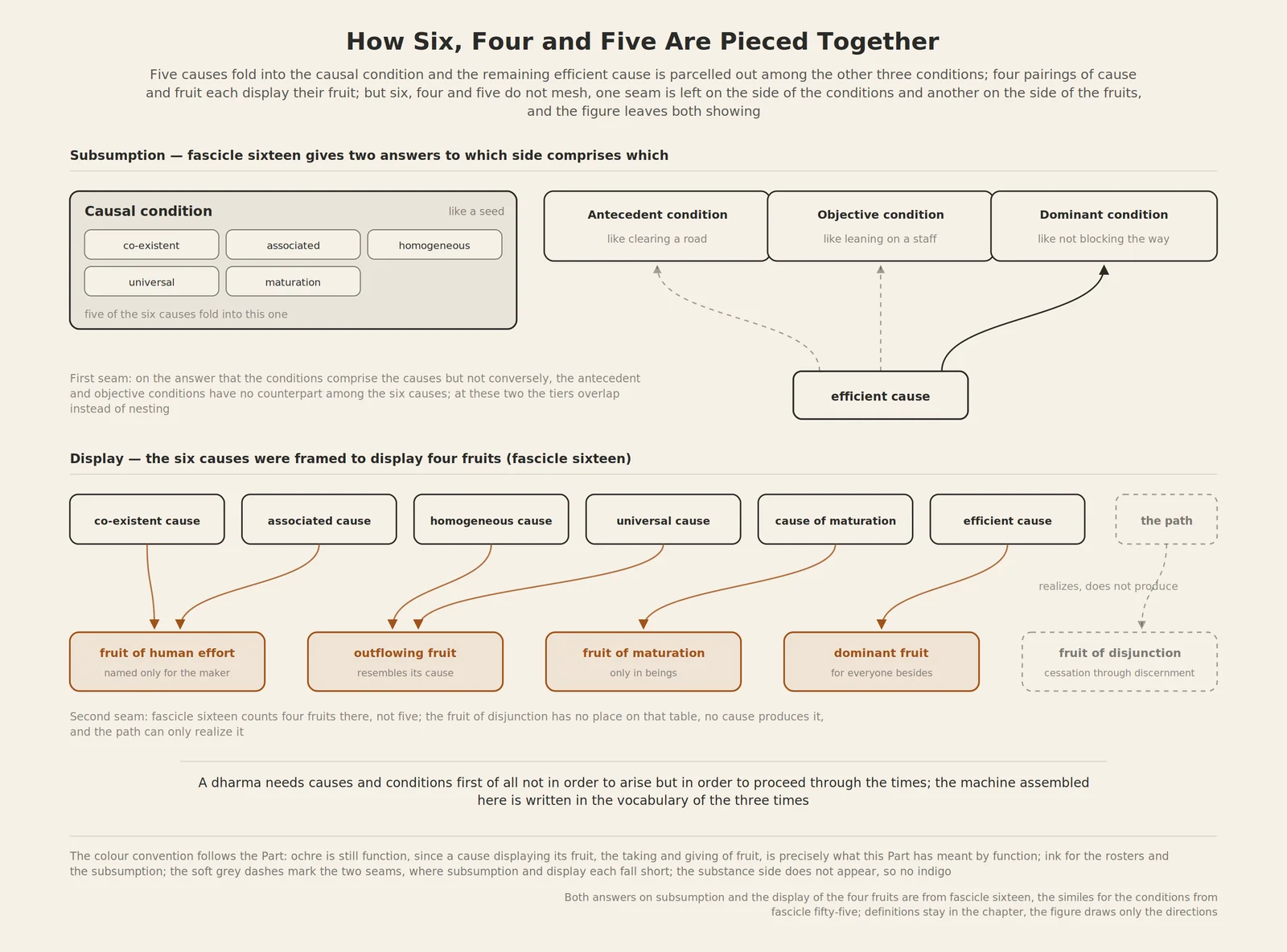
Whether the apparatus was real was asked at the time. Fascicle fifty-five, on the four conditions, begins by recording the opposition: some hold that conditions have no real nature, as the Dārṣṭāntikas do. Their reason comes from a scriptural sentence—scripture says that ignorance is the condition of formations; but ignorance has no distinguishing characteristic of its own while formations do, and how should a dharma without a differentiating characteristic serve as condition to dharmas that have one and be itself really existent. The Bhadanta puts it more plainly: the masters posit the names of the conditions each according to his own notion, and there is no real nature to them.2 The claim is that those condition-names are arranged as the framers of the doctrine saw fit, and that there is no such thing in the world as the immediately antecedent condition. The Mahāvibhāṣā's reply repays attention: if the nature of the conditions is not really existent, then no dharma at all has real nature, since the four conditions comprise all dharmas.2 This is a reply that yields ground in order to gain it, and it yields too much—it concedes that a condition has no substance over and above the dharmas, that a condition is simply the dharmas themselves gone through once more by role. The end of this chapter returns to the point. The treatise then adds that if the nature of conditions were not really existent there would be no distinction of the three grades of enlightenment; and Ghoṣaka adds that if it were not, a teacher could not raise a pupil's understanding from poor to excellent, and a pupil could never become a teacher.2 This book judges neither of the last two to be an argument at all: they say what would follow if there were no causal relation, whereas what the Dārṣṭāntikas deny is not causal relation but that the relation is a further substance.
It should also be set down whom the apparatus was aimed at. Fascicle sixteen says the six causes were framed to stop the doctrines of no cause and wrong cause: some outsiders hold that dharmas arise causelessly, others that there is an unequal cause.2 Fascicle seven of the Abhidharmakośa attacks the same line more fiercely at the end of its section on the four conditions—dharmas do not arise from a single cause such as Īśvara, a self, or primordial nature; if they truly arose from one cause, all things ought to arise at once and not in succession; and it ends with a snort, what use is this Īśvara, and takes apart the name Rudra in passing.3 The conclusion is that there is certainly no dharma produced by a single cause.3 The first office of a doctrine of causation is not to explain how the world runs; it is to block the road marked only one cause. The quarrel about how many items to have belongs in that setting: the Theravāda and the Sarvāstivāda are doing the same thing, spreading the causing of one event out into many items, and only the manner of spreading differs.
So fewer items does not mean simpler relations. The gap between twenty-four and six-plus-four has not disappeared; it has been pushed elsewhere. Four places are collated below, all of them charged explicitly to this part's account by Chapter 5 of Part 14; where the gap has been pushed will be clear once the four are done.
First, the dominant condition, which bears the same name and nearly the opposite sense. The Sarvāstivāda's dominant condition takes non-obstruction for its meaning: every conditioned dharma, its own substance alone excepted, has all dharmas for its efficient cause, because when it arises nothing stands in its way. The Kośa supplies a simile—the people of a country, because their sovereign does them no harm, all say that it is by the sovereign that they enjoy their ease; and it adds that even a sovereign with no power counts.3 Someone presses: if all dharmas are efficient cause to one another, why do not all dharmas arise at once? The answer is that it is only by non-obstruction, and not by any direct productive force upon their arising.3 The Theravāda's adhipati-paccaya means the one among desire, mind, energy, and investigation that takes the lead; it is the item that heads a given undertaking, and Part 14 rendered it the predominance condition.1 One doctrine says it was not in the way; the other says it went in front. The two are all but contraries.
The point is worth a further sentence. In the Sarvāstivāda apparatus the widest compartment of all is defined by a negative word, and it is precisely that compartment which swallows the efficient cause from among the six. That the widest is the emptiest is not a defect in a taxonomy; it is a choice. To make non-obstruction a compartment is to grant that the great majority of relations need no finer division, and need only be kept from interfering with one another. The Theravāda spends its labour on fine division; the Sarvāstivāda spends its labour elsewhere. Where, the next item shows.
Second, the homogeneous and universal causes against the Theravāda's repetition condition. Both sides are speaking of like producing like in succession, and the reach of the two doctrines is enormously different. The Theravāda's āsevana-paccaya is confined within the seven impulsions of a single cognitive series (the earlier impulsion makes the later one stronger), and outside that series it has no business.1 Sarvāstivāda homogeneous production is established across lifetimes: a wholesome root of a former birth is homogeneous cause to a wholesome root of its own sphere in a later birth and to the dharmas associated with it; a past wholesome root is homogeneous cause to future and present ones; a present wholesome root is homogeneous cause to future ones.2 One is laid out across incalculable lifetimes, the other packed into seven moments.
That it works across lifetimes is possible only on the real existence of the three times, and the treatise says so outright. Fascicle seventeen, on the homogeneous cause, opens as usual by asking why this section is made, and the answer is: in order to stop other schools and display the correct principle; for some hold that past and future have no real substance, some hold that the present is unconditioned, some hold that a dharma is homogeneous cause to its own kind alone—to stop these various divergent holdings and to display that past and future really exist.2 The first reason for positing the homogeneous cause is to prove that past and future really exist. This is not a connection this book has drawn from outside; it is the treatise's own statement of its legislative motive. Chapter 3 and this chapter are therefore not treating two matters but the two ends of one: the real existence of the three times makes a cross-temporal cause possible, and the cross-temporal cause becomes in turn the most important use to which the real existence of the three times is put. This book takes it to be the most important structural finding of this part—two doctrines propping each other up, either of which pulled away brings the other down at once.
The props hold each other, and the costs pass between them too. Since the homogeneous cause requires before and after, the future stretch runs into trouble: future dharmas lie jumbled without before or after; if they had before and after they would be cause to one another; if cause to one another, then fruit to one another; and mutual cause-and-fruit is contrary to reason.3 The conclusion is that there is no homogeneous cause in the future.2 The bill for that conclusion is not small. Fascicle seventeen has to go through the older texts one by one on its account (the Vijñānakāya, the Prakaraṇapāda, the Prajñaptipāda), and in the end, to the Prajñaptipāda's sentence that dharmas are fixed in four respects, it can only answer that it should be said that in the future world there is no homogeneous cause, while to several other places it answers that they are speaking with a hidden intention, by reference to the last position.2 To answer with a hidden intention means that those texts, read as they stand, do not agree with this school's position, and must be supposed to mean something else. To save one cause, the treatise re-read three of the six feet.
The same reasoning also keeps the immediately antecedent condition out of the future: future dharmas lie jumbled without before or after, and so there is no immediately antecedent condition in the future.3 The question that follows at once is how the Buddha knows what will arise in the next moment. The Kośa records three answers: by inference from past and present dharmas he knows it presently; by the knowledge born of resolve; or, on a third account, there are within the body of a sentient being prior signs of the future fruit and cause, and these are a species of the conditionings dissociated from mind.3 The third answer is worth a pause—to patch one sentence, one more dharma dissociated from mind is manufactured. Chapter 4 counted possession, unmanifest matter, the homogeneous character of a group, the life faculty, and the intermediate existence; here is the same move used once more inside the doctrine of causation. Vasubandhu takes none of the three, and says flatly that what the Sautrāntika masters say is best: the Blessed One knows all dharmas by directing his intention, and not by inference or divination.3
This condition carries one more restriction worth recording. The immediately antecedent condition governs mind and mental factors only, and not matter, and the reason is that the quantities do not match: the Bhadanta's examples are that burning a great heap of rice-straw leaves a little ash, which is many producing few, and that one fine seed grows into a nyagrodha tree, which is few producing many.3 Mind and mental factors, by contrast, are equal before and after (one mind, one feeling, one perception, neither more nor fewer), and so they alone can be ranged in an unbroken file. Part 14 said that the Theravāda's proximity condition presupposes a single shared clock;1 what is presupposed here is that same clock plus a track that carries mind and not matter. Matter's continuity is provided for otherwise, and that is Chapter 6's business. The objective condition runs the opposite way, so wide as to be almost unrestricted: the Kośa says that if a dharma has ever been object to some dharma, there is no time at which it is not object to it, just as firewood is called the burnt even when it is not burning, the characteristic being no different.3 Being cognized and being able to be cognized are made one thing, and here again it is the real existence of the three times that pays.
Third, the postnascence condition has no place in this apparatus. The Theravāda posits pacchājāta-paccaya to handle the moment-by-moment mutual support of body and mind: mind arising later supports the material body that arose earlier in its continuing to exist.1 Sarvāstivāda causes point uniformly from earlier to later, and there is no such item. On the side of the conditions, however, an opening is left: fascicle fifty-five says that a future view of the existing body, in relation to past and present views of the existing body, is objective condition and dominant condition when taken as object, and dominant condition alone when not.2 A later dharma can be the object of an earlier one, because future dharmas really exist, and what really exists can be taken as object. So the Sarvāstivāda is not without backward relation; it simply puts every backward relation among the conditions and not one of them among the causes. And this backwardness is asymmetrical—an earlier dharma is dominant condition to a later, and a later is dominant condition to an earlier, yet only the later counts as the dominant fruit of the earlier, and not the reverse.2 One and the same condition bears fruit when it runs with time and keeps only a title when it runs against.
Fourth, the four items posited for dharmas that have ceased. Decisive support, absence, disappearance, and asynchronous kamma are posited by the Theravāda to answer one question: on what ground can a dharma that has ceased still support a present dharma.1 The Sarvāstivāda needs one sentence here—the substance of a dharma exists always; what ceases is the function and not the substance. Part 14's judgement was that the Theravāda pays on the length of the list and the Sarvāstivāda pays in ontology. To audit that account from the Sarvāstivāda side, the question to ask is whether it really paid only once.
It did not. The sentence that the substance of a dharma exists always is not a lump sum but an instalment plan. The first instalment is that the future has to be written as a heap without succession, into which neither the homogeneous cause nor the immediately antecedent condition can enter. The second is that, to preserve the Buddha's omniscience, one more dharma dissociated from mind is added. The third is the heaviest: every cause and every condition must be issued a time of function of its own. Fascicle twenty-one sorts the six causes by time—the associated, co-existent, and causes of maturation run through all three times; the homogeneous and universal causes belong to past and present only; the efficient cause runs through all three times and also stands outside time.2 A verse of the Kośa pins down the position of the function as well: two causes at the moment of ceasing, three at the moment of arising, and the remaining two conditions exercise their function contrariwise.3 The taking of a fruit and the giving of a fruit each have their own times besides: five causes take their fruit in the present only; the associated and co-existent causes give theirs in the present too; the homogeneous and universal causes give theirs in past and present; the cause of maturation gives its fruit in the past alone.3 One table of causes and conditions requires a second table of times, and the second is longer than the first.
The four now being done, they may be set out together:
| The point collated | What the Theravada posits | What the Sarvastivada posits | Where the gap goes |
|---|---|---|---|
| Predominance | The predominance condition: whichever of desire, mind, energy, and investigation takes the lead in a given undertaking | The dominant condition taken in the sense of non-obstruction, into which the efficient cause is absorbed | The same name and nearly the opposite sense; the widest compartment of all is defined by a negative word, which is to grant that the great majority of relations need no finer division |
| Like producing like in succession | The repetition condition, confined within the seven impulsions of a single cognitive series | The homogeneous and universal causes, established across lifetimes | One packed into seven moments, the other laid across incalculable lifetimes; the cross-life reach is possible only on real existence in the three times, and the treatise itself gives that as its ground for positing the homogeneous cause |
| Backward relation | The postnascence condition: mind arising later supports the body that arose earlier | Not one such item among the causes; an opening only among the conditions, a future view of the existing body serving as objective and dominant condition to past and present ones | Every backward relation is put among the conditions and none among the causes; and it is asymmetrical, bearing fruit when it runs with time and keeping only a title when it runs against |
| How a ceased dharma still supports | Decisive support, absence, disappearance, asynchronous kamma | One sentence: the substance of a dharma exists always, and what ceases is the function | The Theravada pays on the length of the list and the Sarvastivada in ontology; and the ontological payment is made by instalments, a future without succession, one more dharma dissociated from mind for the Buddha's omniscience, and a time of function issued to every cause and every condition |
The most naked place in this account is in fascicle sixteen. There the treatise gives each of the six causes a thoroughgoing definition: the associated cause is all mind and mental dharmas; the co-existent cause is all conditioned dharmas; the homogeneous cause is all past and present dharmas; the efficient cause is all dharmas.2 Fascicle fifty-five says that the four conditions comprise all dharmas—the causal condition comprises all conditioned dharmas; the immediately antecedent condition comprises all past and present mind and mental dharmas except the last mind and mental dharmas of an arhat; the objective and dominant conditions together comprise all dharmas.2 Both lists rearrange the same heap of dharmas by role, and neither has added one new thing. The holes left are the same two on both sides: a nature is not efficient cause to itself, nor the conditioned to the unconditioned, nor the unconditioned to the unconditioned; the answer given on the four-conditions side is word for word the same.23 Outside those two places there is not a dharma that can stand outside cause and condition. Yet someone immediately points out that even so the account is not exhaustive, because one still does not know at which position which is cause to which.2 At which position—those two words are the hinge of the whole chapter: having finished counting the dharmas one has still not stated the causation, and one must further say at which square of time each of them stands.
Three passages have each answered that question: fascicle twenty-one sorting by time, the Kośa verse by the taking and the giving of fruit, fascicle sixteen by the fruit displayed. Laid one upon another they come out thus:
| Cause | Times it runs through (fasc. 21) | Takes its fruit | Gives its fruit | Fruit it displays (fasc. 16) |
|---|---|---|---|---|
| Associated cause | All three | Present only | Present only | Fruit of human effort |
| Co-existent cause | All three | Present only | Present only | Fruit of human effort |
| Homogeneous cause | Past and present only | Present only | Past and present | Outflowing fruit |
| Universal cause | Past and present only | Present only | Past and present | Outflowing fruit |
| Cause of maturation | All three | Present only | Past alone | Fruit of maturation |
| Efficient cause | All three, and also outside time | Not listed in the verse | Not listed in the verse | Dominant fruit |
The last column yields only four fruits. The fruit of disjunction has no place on it, and that is exactly why fascicle sixteen stopped counting at four.
Now the fruits. The Theravāda files the fruit under the classification of mind: resultant consciousness is one class of mind divided by function, and its identity is fixed by where it falls in the cognitive series.1 The Sarvāstivāda files the fruit under the classification of causal relation: the five fruits are the far side of the causes, not a species of mind. The same matter has been put into different drawers by the two schools, and the choice itself has consequences.
Filed under relation, one must answer how many kinds of fruit there are, and that number was fought over. Fascicle one hundred twenty-one says that the masters of the west posit four further kinds beyond the five (the established fruit, the fruit of preparatory effort, the fruit of conjunction, and the fruit of cultivation), and that the treatise-masters of Kaśmīra say these last four are comprised in the former five, falling under the fruit of human effort and the dominant fruit.2 The Kośa records the same four and the same subsumption.3 Add to this that fascicle sixteen, as noted above, counts only four fruits, and it is plain that five is the outcome of an adjudication and not a fact lying ready to hand. The side that files the fruit under mind need not answer the question at all, because resultant consciousness is a class of mind, and how many classes of mind there are is a separate account.
The fruit of disjunction is the place that will not join up. Cessation through discernment is unconditioned, and the unconditioned has neither cause nor fruit; on what ground, then, is it called a fruit? The Kośa's handling is that the path has a different function with respect to the obtaining and with respect to the cessation: with respect to the obtaining its function is called producing, and with respect to the cessation it is called realizing; the path is not the cause of the cessation, yet cessation through discernment may be said to be the fruit of the path.3 The Sautrāntika objects on the spot: the unconditioned is not a cause, and no sūtra says that a cause is unconditioned.3 The reply is that although no sūtra says it, no passage forbids it either, and that innumerable sūtras have now vanished from sight—how can one determine that none said it.3 The lost scriptures make their second appearance, this time to stop a mouth. This book takes the awkwardness of the fruit of disjunction to lie not in the distinction between realizing and producing but in the fact that this taxonomy has only the one compartment of cause and fruit: the relation between the cultivation of the path and nirvāṇa is not production, and ought properly to have been given a heading of its own; but there are only five headings, and so it was written down as a kind of fruit.
The pair made of the fruit of human effort and the dominant fruit, by contrast, is where this taxonomy does its work well. One and the same finished undertaking is, for the person who did it, fruit of human effort and dominant fruit both; for the person who enjoys it, dominant fruit only. The Mahāvibhāṣā instances husbandry—the crop is fruit of human effort to the farmer and dominant fruit only to the one who eats; the Kośa instances the artisan, one finished article bearing both names for the craftsman who made it and one name only for anybody else.23 The name of the fruit changes with the end from which you stand, and this is exactly the competence a taxonomy of relations ought to have. A taxonomy of mind cannot state that layer: it can say that this mind is a resultant consciousness, and cannot say whose doing it was.
The converse holds equally. Resultant consciousness in the Theravāda has its determinate place in the cognitive series, and to call it resultant is already to say at which step it appears. The Sarvāstivāda's fruit of maturation can say only that it is exclusively unobstructed-and-indeterminate, and must belong to a sentient being—the receptacle world does not count as a fruit of maturation, since it is held in common, and a fruit of maturation cannot be enjoyed in common.3 Each set of terms has its own blind spot. This book's position is that neither is right against the other; there is only the question how the taxonomic choice shapes what can be asked afterwards. Put the fruit inside mind, and the questions run toward the order of the cognitive series; put the fruit inside relation, and the questions run toward how many kinds of fruit there are and whether the unconditioned counts as one.
The last internal strain is in the co-existent cause. The association of mind and mental factors, the mutual co-existence of the four great elements, and mind together with the bodily and vocal action that follows upon it—all three require cause and fruit to be simultaneous; and the criterion is that what are reciprocally fruit of human effort to each other are reciprocally co-existent cause to each other.3 A common statement needs correcting in passing: although possession and what is possessed very often arise together, they are not co-existent cause—the Kośa says expressly that possession and what is possessed do not of necessity proceed together, being now before, now after, now co-arisen, and so, although named co-existent, they are not made cause by the co-existent cause.3 That exclusion is telling. The possession of Chapter 4 was made precisely so as to be able to fall out of step with what is possessed; the three names prior possession, co-present possession, and posterior possession say just that falling out of step; and the very design that let possessing come loose from the present moment is what disqualifies it from simultaneous causation. Atoms of derived matter that offer resistance are excluded as well, on the ground that they are not of one fruit.3
The associated cause and the co-existent cause are in fact two faces of one thing, and the treatise knows it. Fascicle sixteen asks how the two differ and gives several answers in a row: the sense of being companions is the associated cause and the sense of sharing one fruit is the co-existent cause; the sense of grasping a staff is the associated cause and the sense of having accomplished something with the staff already grasped is the co-existent cause; the sense of joining hands is the associated cause and the sense of having crossed a torrent with hands already joined is the co-existent cause; the sense of according with one another is the associated cause and the sense of being inseparable is the co-existent cause.2 One and the same batch of mind and mental factors is the associated cause seen as keeping company and the co-existent cause seen as getting one piece of work done together. This is the second time in this chapter that one thing has gone into two drawers, except that this time both drawers are in the Sarvāstivāda's own house. A word in passing: the two shakiest of the six causes are exactly these. The two scriptural sentences assigned to them—that seeing is associated with the faith, realization, and knowledge that are its root, and that eye and form as condition give rise to eye-consciousness, the meeting of the three being contact, together with which feeling, perception, and volition arise—both state that mind and mental factors appear simultaneously, and whether mind and mental factors appear simultaneously is the very thing the Sarvāstivāda has to prove. Adducing it as evidence is circular. The difference of level between the two lists, the dispute between the masters of Kaśmīra and those of the west, and the controversy over the co-existent cause in particular have been sorted out at length in recent scholarship.5
Simultaneous causation is wanted because dharmas are too weak. The reason given in fascicle sixteen, in the section on the associated cause, is that conditioned dharmas are feeble in nature and therefore accomplish their work by leaning upon one another; and three similes follow together—two bundles of reeds standing by mutual support, many strands of rope joined able to drag a great log, many men joining hands able to cross a great river.2 Fascicle fifty-five, on the four conditions, spreads the same thought wider: conditioned dharmas are feeble in their own nature, are not their own masters, depend upon others, have no function of their own, and do not follow their own wish; therefore some arise from four conditions, some from three, some from two, and there is not so much as one that a single condition can produce by itself, still less none; as with a man weak with sickness, four may support him, or three, or two, before he can rise and stand.2
There is a deep strain here, and it is worth pointing out on its own. Every dharma is really existent and its own nature exists always—that was the conclusion of Chapters 1 and 3; yet the same dharmas, as conditioned, are feeble, without function of their own, not following their own wish. Really existent and powerless, the two statements standing together. This book takes that to be the exact weight of the word own-nature in the Sarvāstivāda: it guarantees only that a dharma has a determinate characteristic of its own, and never guarantees that the dharma can accomplish anything by itself. Part 14 recorded the opposite route in the Theravāda—the force of a condition is intrinsic to the conditioning dharma, as pungency is to a chilli, the relation being drawn back inside one of its own terms.1 The Sarvāstivāda cannot take that route, because its dharmas are constitutionally without strength; strength can come only from an arrangement. But the arrangement is not itself a new thing either, since the six causes and four conditions are only the same heap of dharmas rearranged. Strength lies neither inside the dharma nor outside it, and the one remaining place to put it is the square of time on which the dharma stands.
This is where Vasubandhu cuts in. He says that in the causation of seeds and sprouts and the like in the world, simultaneous cause and fruit have never been seen. Someone instances flame and lamplight, or a sprout and its shadow, as simultaneous and reciprocally cause and fruit; he does not accept it—that must first be sorted out: is the flame cause to the light, or did a prior assemblage of causes and conditions make flame and light arise together.3 He then produces the logicians' criterion: where, if this is, that is, and if this is not, that is not, this is definitely cause and that definitely fruit.3 On that criterion the simultaneous is not necessarily barred from being cause and fruit, but reciprocal cause and fruit will not go through—his own words are that simultaneous cause and fruit may indeed be allowed, but how can one speak of being cause and fruit to each other.3 The Sarvāstivāda offers three staves standing by mutual support; he takes the simile apart: are the three staves supporting one another because they were set up together, or did some other cause and condition set them up together—besides which there are ropes and hooks and the ground there, holding them in place.3 The reply from the Sarvāstivāda side is that there too there are homogeneous causes and the rest, and that therefore the sense of the co-existent cause stands.3
That reply in fact concedes a step. To rescue a simultaneous cause by means of a prior cause is to grant that the simultaneous layer will not hold up by itself. This book takes the real difficulty to lie not in the simultaneity but in the reciprocity: simultaneous one-way causation is nothing out of the ordinary, and it is being cause to each other that is the awkward thing. The Sarvāstivāda insists on reciprocity because it has already set up characteristic and characterized, and mind and mental factors, as separate substances—that was the work done in Chapters 2 and 4. Things separate in that way must have a cord to bind them; and the moment that cord has a before and an after, a gap opens at the point of binding, a gap this system cannot afford. The co-existent cause is a repair made for a problem that pluralist realism made for itself.
Saṅghabhadra later did this reply over again. Fascicle fifteen of the Nyāyānusāra answers the same set of objections, but from another place: instead of pleading that homogeneous causes are also present there, he works at two points. The first is the criterion. He finds reciprocal fruit of human effort too tight and says the mark of the cause is too narrow, since between a dharma and its secondary characteristic the causation runs one way only; so he loosens the criterion to conditioned dharmas of one fruit.4 The second is where the word reciprocal lands. The reciprocity he grants does not hold between one member and one member; it holds of an assemblage all of whose members are cause and fruit to one another, and to press for which is definitely cause and which definitely fruit is, on his view, to press in the wrong place.4 He also sets a test: screen the lamp with something and the light goes out while the lamp remains, so that the two do not issue from one cause.4 The Kośa offers no such test; there Vasubandhu only sets the two possibilities side by side and leaves the deciding undone. The concession stands all the same: he writes that he does not grant the co-arising cause to produce dharmas without the help of other causes, so the simultaneous layer still has to be made up by causes of another kind.4
One sentence to close on: the burden of relating is spread by the Theravāda over the items and by the Sarvāstivāda over time. That is not a figure of speech. Fascicle fifty-five, discussing the four conditions, assigns each of them a simile (the causal condition is like a seed, the immediately antecedent condition like clearing a road, the objective condition like leaning on a staff, the dominant condition like not blocking the way), and then says that a later dharma, being taken up by an earlier dharma under the four conditions, is thereby able to proceed through the times, to take its fruit, to perform its work, and to know its object.2 The first thing purchased by being taken up under the conditions is the ability to proceed through the times, that is, to walk about among the three times. A dharma needs causes and conditions in the first place not in order to arise but in order to be able to move. That sentence settles the whole chapter's account at once: the Sarvāstivāda theory of causation is written in the vocabulary of the real existence of the three times, and cancel that premise and not one term of it remains usable.
To Chapter 6. The standard example of the four great elements as reciprocal co-existent causes has been used repeatedly above, and it was mentioned that atoms of derived matter that offer resistance are barred from reciprocal co-existent causation because they are not of one fruit. Both sentences presuppose a doctrine of matter: what an atom is, how several atoms come to count as one place, and whether the aggregated thing and the atoms gathered in it are the same thing. The Sarvāstivāda works this doctrine out in great detail, and it is here, at the last, that it draws the line between nominal and real existence at a place that would not afterwards hold. The next chapter takes up the material end.
References
References
-
Abhidhammattha Saṅgaha, with Tables, ed. Bhikkhu Dhammadhīra, rev. Luo Qinglong, published by the Dhamma Rain Monastery. The names, definitions, and mutual relations of the twenty-four conditions are given in the eighth chapter of that work, on the analysis of conditions, and were set out in full in Chapter 5 of Part 14. That the predominance condition refers specifically to whichever of desire, mind, energy, and investigation takes the lead; that the repetition condition is confined to the seven impulsions of a single cognitive series; that the postnascence condition is a later-arisen mind supporting earlier-arisen matter; that the four conditions of decisive support, absence, disappearance, and asynchronous kamma are posited for the joining of a dharma that has ceased to a present dharma; that resultant consciousness is one of the four classes into which mind is divided by function; and that the force of a condition is intrinsic to the conditioning dharma—all are found in that part. The end of Chapter 5 of Part 14 charged this part explicitly with the Sarvāstivāda side: its legislative reasons, the several schools' arguments for the real existence of the three times, and the cross-temporal working of the homogeneous and universal causes. The present chapter discharges that charge. ↩↩↩↩↩↩↩↩
-
Abhidharma Mahāvibhāṣā Śāstra, 200 fascicles, trans. Xuanzang, Taishō vol. 27 (T1545). The passages used in this chapter fall in fascicles sixteen, seventeen, twenty-one, twenty-three, fifty-five, and one hundred twenty-one. Fascicle twenty-three, just before the section on the person: "the meaning of the Abhidharma basket should be known through fourteen items, namely the six causes, the four conditions, comprising, association, attainment and non-attainment," and "he is called an Abhidharma master, and not one who merely recites the text"; the variant reads "the meaning of the Abhidharma basket should be known through seven items, namely skill in causes, skill in conditions, skill in individual characteristics, skill in common characteristics, skill in comprising and not comprising, skill in association and non-association, skill in attainment and non-attainment." Fascicle sixteen, in the section on the six causes: the ground of the doctrine reads "in order to stop the doctrines of no cause and of wrong cause; for outsiders hold either that dharmas arise causelessly, or again that there is an unequal cause," and also "some hold that the causal condition is not a real thing, as the Dārṣṭāntikas do; to stop that notion, and to display that the causal condition, in nature and in characteristic, is really existent"; the display of the four fruits reads "wishing by the six causes to display the four fruits and make them clear, as one observes an āmalaka fruit in the palm—namely, by the associated and co-existent causes to display the fruit of human effort; by the homogeneous and universal causes to display the outflowing fruit; by the cause of maturation to display the fruit of maturation; by the efficient cause to display the dominant fruit"; the admission reads "yet these six causes are not stated in the sūtras; the sūtras state only that there are four conditions," and "now, wishing to distinguish the conditions by way of cause, these six causes are stated"; the two views on comprising read "answer: they comprise one another according to the case—the former five causes are the causal condition, and the efficient cause is the other three conditions. Some say: condition comprises cause and cause does not comprise condition… the immediately antecedent condition and the objective condition are not comprised by cause"; the doctrine of the vanished scripture reads "as is said in the sixth increment of the Ekottarāgama; the time being long past, its text has vanished from sight; the venerable Kātyāyanīputra and others, by the power of the knowledge born of resolve, observed the place in the sūtras where the six causes are stated, and compiled and composed the Abhidharma," and "it was heard formerly that the Ekottarāgama increased from one dharma up to a hundred dharmas; now only one to ten remain, and the rest have vanished from sight," and "when that arhat entered final nirvāṇa, on that very day seventy-seven thousand birth-story scriptures and ten thousand Abhidharma treatises vanished from sight"; the scattered-statement view reads "these six causes, though no one sūtra states them in order and in full, are yet stated scattered here and there throughout the sūtras," with the six scriptural sentences assigned to the associated, co-existent, homogeneous, universal, maturation, and efficient causes given in the same fascicle. The exhaustive definitions in the same fascicle read "if one is to state it exhaustively and without remainder, it should be said thus: what is the associated cause? all mind and mental dharmas. What is the co-existent cause? all conditioned dharmas. What is the homogeneous cause? all past and present dharmas… what is the efficient cause? all dharmas," and the rejoinder that follows reads "some say: even supposing it stated thus, it is still not exhaustive, for one does not know at which position which is cause to which." The difference of the two causes reads "the sense of being companions is the associated cause; the sense of sharing one fruit is the co-existent cause"; "the sense of grasping a staff is the associated cause; the sense of having accomplished something with the staff already grasped is the co-existent cause"; "the sense of joining hands is the associated cause; the sense of having crossed a torrent with hands already joined is the co-existent cause"; "the sense of according with one another is the associated cause; the sense of being inseparable is the co-existent cause." The three similes of feebleness stand in the section on the associated cause and not in that on the co-existent cause, and read "as two bundles of reeds stand by mutual support; as many ropes joined together can drag a great log; as many men joining hands can cross a great river; because conditioned dharmas are feeble in nature, they accomplish their work by leaning upon one another." Fascicle seventeen, in the section on the homogeneous cause: the ground of the doctrine reads "in order to stop other schools and display the correct principle; for some hold that past and future have no real substance, some hold that the present is unconditioned, some hold that a dharma is homogeneous cause to its own kind—to stop such various divergent holdings, and to display that past and future really exist"; the cross-life passage reads "a wholesome root of a former birth is homogeneous cause to a wholesome root of its own sphere in a later birth and to the dharmas associated with it; a past wholesome root is homogeneous cause to future and present wholesome roots of its own sphere and to the dharmas associated with them; a present wholesome root is homogeneous cause to future wholesome roots of its own sphere and to the dharmas associated with them"; the denial for the future reads "answer: it should be said that in the future world there is no homogeneous cause; because it is absent there it is not stated here, and there is no fault of two minds being cause to one another"; the sentence of the Prajñaptipāda that had to be accommodated reads "dharmas are fixed in four respects, namely cause, fruit, support, and object; if in the future world they are not homogeneous cause, how are they fixed once arisen"; and the method of accommodating the remaining passages reads "the answer is made with a hidden intention, by reference to the last position." The opening of the same fascicle glosses co-existence as "the sense of being inseparable is the sense of co-existence; the sense of sharing one fruit is the sense of co-existence; the sense of according with one another is the sense of co-existence." Fascicle twenty-one sorts the six causes by time: "three run through the three times, namely the associated, co-existent, and maturation causes; two are past and present only, namely the homogeneous and universal causes; one runs through the three times and also stands outside time, namely the efficient cause," closing with "if one can come to know the six causes thus, one will discern the four fruits as clearly as an emblic myrobalan in the palm of the hand"; the two exceptions to the efficient cause read "is there a dharma that is not efficient cause to a dharma? There is: a nature with respect to its own nature," and "the conditioned with respect to the unconditioned, and the unconditioned with respect to the unconditioned." Fascicle fifty-five, in the section on the four conditions: the refutation of the Dārṣṭāntikas reads "or some hold that conditions have no real nature, as the Dārṣṭāntikas do," with the scriptural ground being the sentence that ignorance is the condition of formations, and the Bhadanta's words reading "the masters posit the names of the conditions each according to his own notion, and there is no real nature to them"; the reply reads "if the nature of the conditions is not really existent, then no dharma has real nature, since the four conditions comprise all dharmas"; the two further difficulties, of the three grades of enlightenment and of the pupil's understanding, stand in the same fascicle, the second being ascribed to the venerable Ghoṣaka. The comprehensive statement reads "the four conditions comprise all dharmas: the causal condition comprises all conditioned dharmas; the immediately antecedent condition, excepting the last mind and mental dharmas of an arhat in the past and present, comprises all remaining past and present mind and mental dharmas; the objective condition and the dominant condition together comprise all dharmas." The passage on feebleness reads "in order to display that conditioned dharmas are feeble in their own nature, are not their own masters, depend upon others, have no function of their own, and do not follow their own wish, this section is made," and "by reason of feebleness, conditioned dharmas arise from four conditions, or from three, or from two; there is not so much as one condition that can produce alone, how much less none," and "as with one weak with sickness: four may support him, or three, or two, before he can rise and stand; there is not so much as one man who can make him rise and stand alone, how much less none." The four similes read "the causal condition is like a seed; the immediately antecedent condition is like the clearing of a road; the objective condition is like leaning upon a staff; the dominant condition is like not blocking the way," and the fruit of being taken up reads "a later view of the existing body, being taken up by an earlier view of the existing body under the four conditions, is thereby able to proceed through the times, to take its fruit, to perform its work, and to know its object"; the passage on the future in relation to past and present reads "a future view of the existing body, with respect to past and present views of the existing body: if taken as object, it is objective condition and dominant condition; if not taken as object, it is dominant condition alone," the reason given being "because there is no sense of causal condition or of immediately antecedent condition from the later to the earlier." Fascicle one hundred twenty-one, in the section on the five fruits: the claim of scriptural warrant reads "yet in the sūtras it is said that the fruits are five in number: first the outflowing fruit, second the fruit of maturation, third the fruit of disjunction, fourth the fruit of human effort, fifth the dominant fruit"; the dispute over nine reads "the masters of the west say the fruits are nine in kind, namely, to the former five are added four more: first the established fruit, second the fruit of preparatory effort, third the fruit of conjunction, fourth the fruit of cultivation," and "the treatise-masters of the country of Kaśmīra say: the latter four here are comprised in the former five, being the fruit of human effort and the dominant fruit"; the distinction of the two fruits reads "in every undertaking performed, with respect to the one who performs it there is the fruit of human effort and the dominant fruit; with respect to the one who enjoys it there is the dominant fruit alone; as with husbandry and the like, the undertakings performed are, with respect to the farmer and the rest, the fruit of human effort and the dominant fruit, and with respect to the one who enjoys them, the dominant fruit alone," and "the force of the dominant is wide, since it does not obstruct; the force of human effort is narrow, since it can draw forth and realize"; that the dominant fruit does not run backward reads "later dharmas are the dominant, and the dominant fruit, of earlier dharmas; earlier dharmas are the dominant of later dharmas but not their dominant fruit." The counts that follow were obtained by searching the whole two hundred fascicles of the CBETA text: "six causes and four conditions," one occurrence (fascicle twenty-three); "six causes," sixty; "four conditions," one hundred forty-eight; "five fruits," seven; "co-existent cause," one hundred thirty-three, of which thirty-four in fascicle sixteen; "homogeneous cause," two hundred eighty-two, of which sixty-one in fascicle seventeen and thirty-one in fascicle eighteen. For the modern Chinese version see this site's translation of the Mahāvibhāṣā, rendered from the CBETA text. ↩↩↩↩↩↩↩↩↩↩↩↩↩↩↩↩↩↩↩↩↩↩↩↩↩↩↩↩
-
Abhidharmakośabhāṣya, 30 fascicles, composed by Vasubandhu, trans. Xuanzang, Taishō vol. 29 (T1558); Paramārtha's version is entitled Abhidharmakośaśāstra (T1559). What is used in this chapter is the passage on the six causes and five fruits and the passage on the four conditions, both in the second chapter, on the faculties (fascicles six and seven). Unlike Chapter 4, every sentence cited here has been checked line by line against the classical-Chinese text of T1558 held on this site. The efficient cause reads "all conditioned dharmas, their own substance alone excepted, have all dharmas for their efficient cause, because when they arise nothing obstructs their abiding"; the simile of the sovereign reads "as the people of a country, because their sovereign does them no harm, all say: it is by the sovereign that we obtain our ease," with the added phrase "as with a king without power"; the question why all do not arise at once is answered "it is only by non-obstruction that all dharmas are allowed to be efficient cause, and not by any direct productive force upon their arising." The criterion of the co-existent cause reads "if dharmas are reciprocally fruit of human effort to one another, those dharmas are reciprocally co-existent cause to one another"; the exclusion of possession reads "all co-arisen possession and what is possessed, taken in mutual relation," and "possession and what is possessed do not of necessity proceed together, being now before, now after, now co-arisen"; atoms of derived matter that offer resistance are excluded because they are not of one fruit. The denial of a homogeneous cause in the future reads "if there were no before and after, they would be cause to one another; being cause to one another, they would be fruit to one another; and reciprocal cause and fruit is contrary to reason." Vasubandhu's objection to simultaneous causation reads "yet in the matter of cause and fruit producing one another, as universally admitted in the world of seeds and sprouts and the like, no such simultaneous cause and fruit has been seen"; the challenge of the flame reads "is it not observed that flame and lamplight, and a sprout and its shadow, are simultaneous and yet cause and fruit? This must be examined: is the flame itself cause to the light, or did a prior assemblage of causes and conditions make flame and light arise together"; the logicians' criterion reads "where, if this is or is not, that accordingly is or is not, this is definitely cause and that definitely fruit"; the crucial sentence reads "simultaneous cause and fruit may indeed be allowed; how then can one speak of being cause and fruit to each other"; the simile of the three staves reads "if it be said that they are as three staves standing by mutual support," and "moreover, there are among them other things (rope, hook, ground, and the like) holding and keeping them in place"; the Sarvāstivāda reply reads "here too there are homogeneous causes and the rest, and therefore the sense of the co-existent cause stands." On the fruit of disjunction: the unconditioned has neither cause nor fruit; the function of the path reads "how has the path a function with respect to the obtaining? because it produces it. How has the path a function with respect to the cessation? because it realizes it," and "though the path is not the cause of the cessation, yet cessation through discernment may be said to be the fruit of the path"; the Sautrāntika objection reads "the unconditioned is not a cause, for no sūtra says that a cause is unconditioned," and the reply reads "though no sūtra says it, no passage forbids it either; moreover, innumerable sūtras have now vanished from sight." The distinction of the two fruits reads "as with what an artisan has made: with respect to the artisan who made it, it acquires the names of both fruit of human effort and dominant fruit; with respect to others, who are not the artisan, it is dominant fruit alone." That the fruit of maturation does not extend to the receptacle world reads "a fruit of maturation must have no sense of being enjoyed in common." The four additional fruits are as in the Mahāvibhāṣā's masters of the west, and are likewise subsumed under the fruit of human effort and the dominant fruit. The verse on taking and giving the fruit reads "five take their fruit in the present alone; two give theirs in the present likewise; past and present give it, for two causes; one gives it in the past alone"; the verse on the position of the function reads "two causes at the moment of ceasing; three causes at the moment of arising; the remaining two conditions contrariwise exercise their function." Fascicle seven, on the four conditions: the five causes are the nature of the causal condition; that there is no immediately antecedent condition in the future reads "because future dharmas lie jumbled and abide without before or after"; the third of the three accounts of the Buddha's knowledge of the future reads "within the body of a sentient being there are prior signs of the future fruit and cause, which are a species of the aggregate of conditionings dissociated from mind"; Vasubandhu's adoption of the Sautrāntika view reads "the Blessed One knows all dharmas by directing his intention, and not by inference or divination; this account is the good one." The passage denying matter an immediately antecedent condition reads "because material dharmas appear before one jumbled, whereas what arises from the immediately antecedent condition arises without jumbling; therefore matter is not established as an immediately antecedent condition," Vasumitra's account resting on the non-conflict of matter that is nourished, and the Bhadanta's two similes of unequal quantity reading "at one time few are produced from many, as when a great heap of rice-straw is burnt to ash; at another time many are produced from few, as when a fine seed grows into a nyagrodha tree." That the objective condition does not change with being cognized or not reads "if a dharma is object to that dharma, there is no time at which this is not object to that; even in the state of not being cognized it is comprised under object, since being cognized and not being cognized are one in characteristic—as firewood and the rest are called the burnt even when not burning, the characteristic being no different." The two places excluded from all four conditions read "is there a dharma that is not at all any of the four conditions to a dharma? There is: a nature with respect to its own nature. And with respect to another nature there is also: the conditioned with respect to the unconditioned, and the unconditioned with respect to the unconditioned," which are the same two exceptions to the efficient cause given in fascicle twenty-one of the Mahāvibhāṣā. The refutation of the single-cause doctrine reads "all the world arises only from the causes and conditions stated above, and not from a single cause such as Īśvara, a self, or primordial nature"; the difficulty from succession reads "then all things ought to arise at one time and not in succession"; the difficulty from dependence reads "or if that Īśvara requires other causes and conditions to help him before he can produce, he is not sovereign"; the difficulty from taking pleasure ends "enough! what use is this Īśvara"; the verse quoted next reads "by his fierceness and sharpness and burning, dreadful and ever oppressive, delighting to feed on blood, flesh, and marrow, he is called Rudra"; and the conclusion reads "therefore there is no dharma produced by a single cause." The verse on the great elements and derived matter reads "the great are two causes to the great; five kinds to what is derived; the derived are three kinds to the derived, and one kind only to the great," the clause on the great elements being reciprocally co-existent and homogeneous cause alone being what Chapter 6 builds on. The last sentence of fascicle six reads "the arising of a dharma from a single cause is certainly not the case." For the modern Chinese version see this site's translation of the Abhidharmakośa, rendered from the CBETA text. For the English see Leo M. Pruden, trans., Abhidharmakośabhāṣyam of Vasubandhu, 4 vols. (Berkeley: Asian Humanities Press, 1988–1990), rendered from Louis de La Vallée Poussin, L'Abhidharmakośa de Vasubandhu (Paris–Louvain, 1923–1931). ↩↩↩↩↩↩↩↩↩↩↩↩↩↩↩↩↩↩↩↩↩↩↩↩↩↩↩↩
-
Abhidharma Nyāyānusāra Śāstra, 80 fascicles, composed by Saṅghabhadra, trans. Xuanzang, Taishō vol. 29 (T1562). This site now holds the classical-Chinese text of the treatise complete. The counts are: "six causes and four conditions," no occurrence; "six causes," forty-three; "four conditions," twenty-nine; "five fruits," twelve; "co-existent cause," eighty; "homogeneous cause," one hundred forty-six. Its discussion of the six causes and four conditions lies chiefly in fascicles fifteen to twenty, which have been read through in the present round. Saṅghabhadra's positive defence of the co-existent cause and of simultaneous causation is concentrated in the long passage closing fascicle fifteen, the seventh part of the chapter on differences. First, the criterion. He gives the mark of the co-existent cause from the same source as the Kośa, "if dharmas are reciprocally fruit of human effort to one another, those dharmas are reciprocally co-existent cause to one another, since they arise by helping one another"; but he at once finds it too tight, saying "the mark of the cause stated here is too narrow," and "again, it should not be said that only what is reciprocally fruit is co-existent cause, for a dharma and its secondary characteristic are not reciprocally fruit and yet are cause," and shifts the criterion to one fruit: "conditioned dharmas of one fruit may be co-existent cause, since the root treatise says so." Between a dharma and its secondary characteristic the causation runs one way only, and a criterion of reciprocity leaves that case out; the criterion therefore falls back from reciprocity to one fruit, so that what is recorded in the eighth section of this chapter is the Kośa's criterion, already loosened in Saṅghabhadra's hands. Second, the objections answered. The four objections from the other side correspond closely to those recorded in the Kośa: "dharmas arising together, in the position of being about to arise, are not yet arisen and must all be absent; how then can one speak of producer and produced"; "if future dharmas could produce, there would be the fault of dharmas arising at all times"; "again, in co-arisen dharmas there is no determinate proof of which is fruit and which is cause, as with the two horns of an ox"; "again, in the causation of seeds and sprouts and the like, universally admitted in the world, no such simultaneous cause and fruit has been seen." Saṅghabhadra answers along five lines. The first is scriptural: he divides the Buddha's two clauses of dependent arising between the two causes, "the Blessed One is cited as saying everywhere that when this exists that exists, and that from the arising of this that arises... here the first displays the sense of the co-arising cause, and the later text displays the sense of the prior cause," so that when this exists that exists establishes the simultaneous cause and from the arising of this that arises establishes the prior cause. The Elder reads both clauses of a continuum, "this says that there is first a continuum of cause, and afterwards a continuum of fruit abiding"; Saṅghabhadra breaks this with "that where there is one moment of cause there is one moment of fruit, this accords with correct principle; a continuum of cause is not followed only afterwards by a continuum of fruit." The second line restricts the range of reciprocity, and answers Vasubandhu's "how then can one speak of being cause and fruit to each other" head on: "again, I do not grant that all co-arisen dharmas have the sense of being reciprocally cause and fruit. What do I grant? Only those sharing one fruit, or fruit of one another, have this sense, or those by whose force the other dharma arises"; and "again, the Abhidharma masters do not grant that co-arisen dharmas that are reciprocally fruit have any determinate measure, this being only cause and that only fruit; they grant rather that within such an assemblage all in mutual relation are cause and are fruit, and therefore no determinate cause should be demanded of cause and fruit." The reciprocity he grants does not hold between one member and one member; it holds of an assemblage, all of whose members are cause and fruit to one another, and to press for which one is definitely cause and which definitely fruit is, on his view, to press in the wrong place. The third line meets the objection from arising at all times: "the capacity of this cause is not there at all times, and so there is no fault of dharmas arising at all times," with the admission "again, I do not grant that the co-arising cause produces dharmas without the help of other causes." The ninth section of this chapter says that the school's reply concedes a step; here is a corroboration, the concession stated by Saṅghabhadra himself. The fourth line is a fight over the similes. The ox's horns will not serve, "for it is plainly seen that when one horn is destroyed the other is not; were the other destroyed along with it, mutual production could be inferred, as with mind and mental factors." The lamp will serve: Vasubandhu holds that flame and light issue from one cause, the oil and wick, and that the lamp is not the cause of the light; Saṅghabhadra answers "it has never been seen that there is a time when there is a lamp and no light," and sets a test, "or when something is used to screen the lamp, the light ought, like the lamp, not to fail of continuing," for screening the lamp puts out the light while the lamp remains, which is not how two things of one cause behave; and he adds that in a single sprout visible form, odour, taste, and the tangible arise together with different causes each, so that things arising together need not arise from one cause. The fifth line is four counter-proofs: one who enters the attainment of cessation by turning from feeling and perception finds volition and the other mental factors failing to arise as well, which shows a bond of co-arising among the mental factors; without a co-existent cause the doctrine of the great elements and derived matter cannot be set up; without it the two discourses "eye and form as condition give rise to eye consciousness" and "the meeting of three is contact" are contradicted, since "if eye consciousness arises when eye and form have already ceased, with what does that consciousness then meet"; and without it the first uncontaminated dharma has nothing to arise from, the doctrine of seeds and of an innate pure element failing at just that point. The passage closes with "by this it is settled that there is a co-arising cause, and the sense of the co-existent cause is fully established." Fascicle eighteen further gives four kinds of fruit of human effort, "this has four kinds: co-arisen, immediate, remote, and unarisen," the co-arisen being the one had from the co-existent cause, "co-arisen means what is produced at one and the same time by the force of causes reciprocal to one another," which agrees with the Kośa account given in this chapter. ↩↩↩↩↩
-
K. L. Dhammajoti. Sarvāstivāda Abhidharma. 4th ed. Hong Kong: Centre of Buddhist Studies, University of Hong Kong, 2009. Two chapters are relevant: chapter 6, Theory of Causality I: The Six Causes, pp. 143–168, and chapter 7, Theory of Causality II: The Four Conditions and the Five Fruits, pp. 169–186. They sort out the divergences between the Mahāvibhāṣā and Kośa accounts, the dispute between the masters of Kaśmīra and those of the west, and the controversy over the co-existent cause and simultaneous causation. The concerns of this chapter run parallel to it; the primary passages cited here have all been taken back to the Mahāvibhāṣā, the Abhidharmakośa, and the Nyāyānusāra themselves for verification, and the judgements are this book's own. ↩