Chapter 1: Sarvāstitva—Substance and Function, Real and Nominal
The introduction to this part said that reading Part 13 means supplying what was never said, while reading this part means checking what has been said. Checking has to begin somewhere. The Sarvāstivāda pressed its position into three words: all exists. The phrase is at once the school's name and the summary of everything it holds, and the six chapters that follow grow out of it. This chapter looks first at what those words say on their face, and then at what holds them up.
Two things hold them up: a distinction and a criterion. The distinction is between substance and function; the criterion separates the real from the nominal. Both are used throughout this part, and every chapter from the second onward takes its measurements with them. The task here is therefore not only to explain a doctrine but to hand over two instruments, saying clearly what each can measure and where each stops working.
"All" is a word borrowed from the discourses, and it changed jobs in transit. In the three hundred nineteenth discourse of the Saṃyukta Āgama, a brahmin asks what "all" is. The Buddha answers with the twelve bases: eye and forms, ear and sounds, nose and odours, tongue and tastes, body and tangibles, mind and mental objects—this is called all. A second sentence follows, and it matters more than the first: should anyone say this is not all and propose to establish some other all, that is mere words; questioned, he will not know, and his perplexity will only increase, because it is not within his range. The Pāli parallel is SN 35.23, whose title is simply the Discourse on the All.1
The "all" of the discourse is a seal on a door. Its work is to fix a boundary, to hold the discussion inside what experience can reach and to forbid the erection of anything beyond. The discourse asks about range, not about existence. The Buddha does not say that whatever lies outside the twelve bases does not exist; he says that such a question yields nothing, and he gives his reason as well—not within his range, meaning not within what you are in a position to verify. This is a remark about method, not a remark about being.
In the hands of the schools the same word took different employment. The "all" of "all exists" no longer means the twelve bases; it means the whole body of dharmas across the three times. "Exists" no longer means being admitted into the twelve bases; it means possessing substance of one's own. The word is the same word; the question has already been exchanged. So the Sarvāstivāda stands at odds with the three hundred nineteenth discourse in more than one place. Part I, Part 3, Chapter 1 identified the conflict over the word "exists"; this chapter supplies the conflict over the word "all." The discourse used the term as a sign to halt; the treatises use it as a sign to set out.
The school did not walk around this discourse. It handled the matter itself. Fascicle seventy-four of the Mahāvibhāṣā quotes a discourse in which Śāriputra says to the Buddha that in setting forth the bases there is nothing higher, for the twelve bases comprehend all dharmas. Those last words rewrite the discourse's sense of range into a sense of coverage: the twelve bases are no longer merely a boundary one may not cross, they have become a net that gathers every dharma in. The treatise then asks how Śāriputra could know that the twelve bases comprehend all dharmas. The answer comes in two layers. One is that he knew by instruction: possessing the four unshakable confidences, he accepted with certainty what the Buddha said, having heard the Buddha say exactly this. The other is that he had knowledge from realization as well, but could realize the general characteristics only; the particular characteristics only a Buddha realizes one by one as they are. The same passage leaves behind an inference: the bodies of consciousness are six and no more, a body of consciousness necessarily has a basis and an object, basis and object together are necessarily twelve, and therefore the twelve bases are neither more nor fewer.2
Three things here deserve notice. First, the discourse's "not within his range" has become "known by instruction": where nothing can be verified in person, transmission is made to stand surety. Second, once coverage is established, "all" turns from a seal into a list, and a list can be added to. Third, the inference that consciousness necessarily has a basis and an object is the ground the next section stands on.
The gap need not be counted against the school; it is the opening posture of Abhidharma as a discipline. Questions the discourses declined, the treatises take up as their proper business; a word the discourses used to close a discussion, the treatises use to open a system. Part 13 argued that the early teaching left blanks in a number of places deliberately, and that those blanks were not silence for want of anything to say, only a judgment that nothing needed saying there. The whole enterprise of Abhidharma can be read as the filling in of those blanks, and the first step in filling them is to peel off the seal and treat it as a starting line. The gap itself has to be seen clearly, or many later disputes will look unintelligible: an opponent quotes the "all" of the discourses against the "all" of the Sarvāstivāda, and the two are speaking of different things.
Which groups of questions the thesis answers. Part I, Part 3, Chapter 1 already listed three difficulties: an action bears fruit long afterward, and something must carry it in the meantime; cognition that takes past and future for its object must have something as that object; a continuum breaks and resumes, and the join has to be somewhere. That list was arranged according to the school's own sense of its problems, and it is an arrangement the school itself would accept.
This part adopts a different arrangement, following instead the three vacancies set out in Chapter 7 of Part 14. The reason is practical: if two parts are to be read against each other, they must share one set of coordinates. Reading the Sarvāstivāda through its own list of problems shows only whether it answered them well; it does not show why the school had to answer in precisely these places. The three vacancies are: how dharmas are related to one another; how a dharma exists in time; how dharmas are demarcated from what is not a dharma.
The real existence of the three times answers the second group head-on. To the question of what a dharma that has already passed is now, it gives a direct answer: the substance of the dharma is there throughout, only it exercises no function. On this point the Theravāda advances no positive thesis of its own. It speaks of moments and of continuity, yet it never states the existential standing of a past dharma at the present moment; Part 14 showed this cell to be empty, and emptied so thoroughly that not even a denial was left behind. The empty cell the Sarvāstivāda filled, and filled without hedging.
The real existence of the three times also takes care of the half of the first group that concerns crossing time. If causation is to hold, cause and effect must both be available; if a past cause is simply gone, the causal relation has nothing to rest on. The Theravāda handles this by making conditionality relational, and several of its twenty-four conditions are designed for cases where the terms are not simultaneous. Yet the existential standing of a condition is never accounted for, which is exactly the content of the first group in Chapter 7 of Part 14. The Sarvāstivāda answer is a good deal blunter: let the cause remain, and no further support need be found. One difficulty, two treatments—one goes around it by way of relation, the other blocks it by way of existence.
The remaining half of the first group is reached by another road. What does cognition of past and future take as its object? Remembering is an act of consciousness, anticipating is an act of consciousness, and consciousness necessarily has a basis and an object. That premise appeared a moment ago; fascicle seventy-four used it to derive that the twelve bases are neither more nor fewer. Put to work here it yields something else: if the object has no substance, consciousness cannot arise at all, and when one remembers a past event that event must have some standing now to be taken as object. From a fact about mind a fact about the world is derived. The step is executed cleanly, and it is the most load-bearing step in the whole position. Chapter 3 examines on its own terms whether the step goes through, and where Vasubandhu later applied the knife.
The Theravāda has a ready answer available at just this point: an object need not be something that has substance now, concepts can serve as objects at the mind door, and a past dharma being remembered is not thereby required to still be present. The Sarvāstivāda declines this road, because it holds a tighter premise—what has no substance cannot serve as an object. The disagreement between the two schools here does not lie at the level of psychological description; it lies in whether one is willing to let something without substance occupy the position of object.3
The division between real and nominal answers the third group. What counts as a dharma and what is only a way of speaking: the Sarvāstivāda supplies an explicit procedure. The Theravāda's fourfold defining method answers the question of how a given dhamma presents itself; it does not answer the question of what entitles it to count as a dhamma at all. Which items appear on the table rests on transmission and on the consensus of contemplative observation, not on a criterion anyone can check.3
The first and third of the difficulties listed in Part I (the attachment between action and fruit, and the join where a continuum breaks and resumes) are not treated in this chapter. They are caught by the conditionings dissociated from mind, by possession, non-possession, the life faculty, and the homogeneous character of a group, and that is the business of Chapter 4. One thing may be pointed out here. Not one of the three difficulties is a matter of pure temporal theory; in each case something first had to be made to work, and only then was a thesis raised. The real existence of the three times did not grow out of speculation about time; it was forced out by these few things that had to be made to work. To criticize it as though it were a metaphysics of time misplaces the first step.
Each of this part's two measures therefore faces a vacancy. There is a reason for this: what a system most needs to fix first is its account of time and the boundary of its own inventory; leave those two unsettled and nothing else can be discussed. And because they are fixed first, they are afterward the hardest to alter, which is why the collapses examined in Chapters 3 and 7 both begin here.
First, what it does not claim. Opponents commonly set up their targets in the places below, and most of these are not of the school's making.
First, the school does not claim that past things remain visible and tangible now. That a dharma-substance exists and that a phenomenon is present are two different matters, and the first does not entail the second. To say a past dharma exists is to say it still occupies a place on the inventory, not that it is standing in front of you.
Second, it does not claim that a future fruit is already ripe. A future dharma has substance but no function; function arises only when the dharma enters the present. Were a future fruit already ripe, practice would have nothing left to do, and the Sarvāstivāda is a school that takes the graded path with great seriousness. It cannot take that road.
Third, it does not claim that time is an illusion. On the contrary: for this school the difference among the three times is a real difference. Only, the difference is marked out by function and not by substance. What the school wants is a way of saying both that all three times exist and that they differ, and both sentences have to hold at once, or the school cannot keep even its own name.
Fourth, it does not claim that conditioned dharmas are permanent. What exists always is substance; conditioned dharmas remain subject to the four marks of arising, abiding, alteration, and ceasing. That the substance of a dharma exists always does not turn a conditioned dharma into an unconditioned one. This is the point most easily misread and the hardest to state cleanly, and Chapter 3 sets it out in detail.
The four set side by side, together with the source of each misreading:
| The common target | What the school actually holds | Where the misreading comes from | Where it is treated at length |
|---|---|---|---|
| Past things remain visible and tangible now | A past dharma still occupies a cell on the roll; that a dharma-substance exists and that a phenomenon is present are two matters | Reading exists as being present | This chapter |
| A future fruit is already ripe now | A future dharma has substance and no function; function waits upon the dharma's entry into the present | Reading has substance as already exercising function | Chapter 3 |
| Time is an illusion | The difference among the three times is a real difference, only it is marked out by function and not by substance | Supposing that all three times existing amounts to there being no difference among them | Chapter 3 |
| Conditioned dharmas are permanent | What exists always is substance; conditioned dharmas remain subject to the four marks of arising, abiding, alteration, and ceasing | Pushing the permanent existence of substance over onto the side of function | Chapter 3 |
Part I, Part 3, Chapter 1 has already laid out in a table the contrast between eternalism and presentism. One sentence may be added here: aiming at the target is not the same as defending the school. When a target is misplaced, the criticism falls wide and the genuine difficulty escapes. What this part means to do is to locate the difficulty, which makes it all the more necessary to clear away the false ones first. Not one of the places where the following chapters take hold lies among the four just listed.
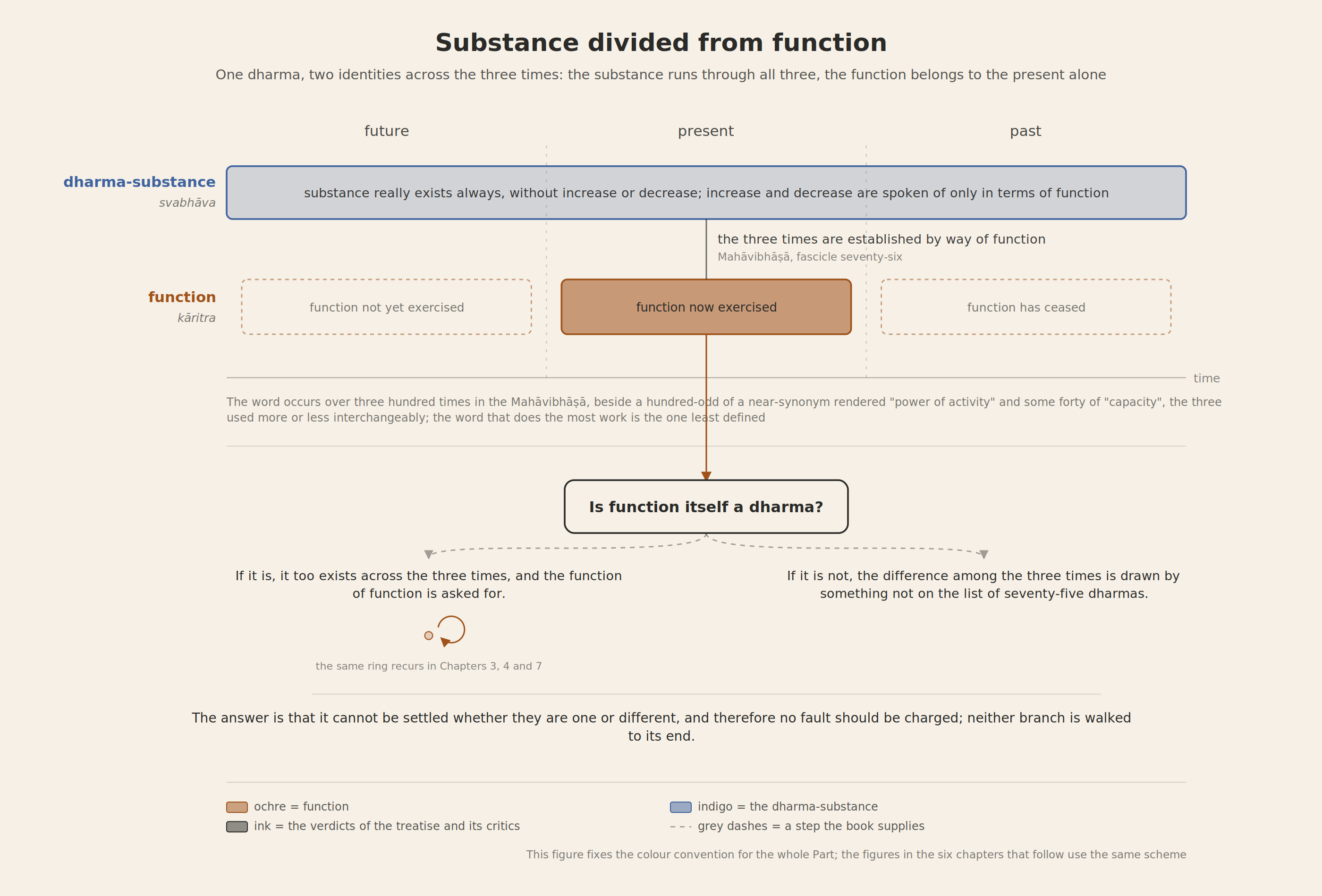
The division of substance and function, which is the pivot of this part. The Sarvāstivāda arrangement is this: the substance of a dharma (svabhāva) exists always across the three times, while function (kāritra) belongs to the present alone. Fascicle seventy-six of the Mahāvibhāṣā states it as plainly as possible: the three times are established by way of function. What has not yet exercised function is future, what is exercising function is present, what has finished exercising function is past.2 Part I, Part 3, Chapter 1 has already made this distinction clear; the present chapter does not restate it and only pursues it one step further.
Begin with the weight the word carries in the treatise. "Function" occurs in more than three hundred places across the Mahāvibhāṣā, with "power of activity" in more than a hundred and "capacity" in nearly forty, the three being used more or less interchangeably and never distinguished. The density itself shows that this is a working word; what is curious is that the word that does the most work is exactly the word that receives the least definition. The treatise uses it again and again to divide the three times, to explain causation, to house the six causes and four conditions, and yet it never gives the word a place of its own.
The next step is this: what standing does function itself have?
If function is a dharma, it must itself have three times. In its future state it has no function, in its present state it has function; but it is itself function, and so the function of function has been raised, which is one step back to where we began, and the questioning can go on without end. If function is not a dharma, then the difference among the three times is marked out by something that is not a dharma. The entire legitimacy of this system hangs on a single sentence: whatever is real is a dharma. To arrange dharmas in time by means of something that is not a dharma is to install an operator outside the inventory, an operator that by the system's own rules ought not to exist.
The school takes the second road: function is a capacity of the dharma-substance and is not established as a separate dharma. There is no cell for function among the seventy-five. Chapter 2 goes through that inventory item by item, and the point can be checked there.
Worth noting is that the dilemma was not thought up on the school's behalf by later readers. The Mahāvibhāṣā raises it itself. Fascicle seventy-six carries an exchange. When a conditioned dharma in the future is about to arise, does it arise because it already exists, or because it does not yet exist? If it arises because it already exists, then its own substance being already there, what use is arising? If it arises because it does not yet exist, then all dharmas are new where there was nothing, and "all exists" cannot be maintained. The treatise answers: one should say it arises although already existing. The questioner presses: its own substance being already there, what use then is arising? The answer: though the substance already exists it has no function, and now, meeting with causes and conditions, function arises. Then comes the question that matters most: are function and substance one or different? The answer: it cannot be settled whether they are one or different. The reason offered is a comparison—just as a single substance among the contaminated dharmas carries many aspects such as impermanence, of which likewise it cannot be settled whether they are one or different. The last words are: therefore no fault should be charged.2
What this book wishes to point out is the place where the questioning halts. Every step up to that point had been giving reasons; at this step the reason is replaced by a comparison, and the comparison is replaced by a sentence saying the matter should not be pressed further. And this is precisely the joint on which the whole distinction hangs. If substance and function are one, the difference among the three times falls back onto substance and substance does not exist always; if they are different, function becomes something outside substance and the inventory has no room for it. The treatise saw the fork and chose not to walk down it. Part 16 will show that this manner of closing is not an isolated case in the Mahāvibhāṣā, which regularly meets a genuine impasse with a comparison followed by a refusal to be charged with fault. Only, the weight here is different: what this one holds up is the school's own name.
A patch can be seen in the same fascicle. Someone asks: if a present eye stands in the state of a similar-but-inactive faculty and does not see form, is it not without function while still being called present? The answer: though it lacks the function of seeing and the rest, it definitely has the function of taking up an effect.2 The move matters more than its content. Once function has taken on the office of dividing the three times, it must be thickened whenever needed, and the direction of thickening is set by the leak, not by any definition of its own. The same fascicle records a question from the Venerable Pārśva: past and future dharmas having no function, on what basis are dharmas said to increase and decrease? The answer: substance really exists always, without increase or decrease, and increase and decrease are spoken of only in terms of function. Function thereby takes on one more office: even the numerical increase and decrease of dharmas is to be explained by it. A word never once defined is loaded in this way, layer upon layer.
Read alongside Part 14, the shape is the same. The first item in the third group of Chapter 7 of Part 14 says: who draws the line between ultimate realities and concepts, and on which side of the line does the act of drawing fall? The Theravāda gives no answer. What the Sarvāstivāda meets here is the same embarrassment displaced by one cell. Something used to make a division work cannot at the same time be one of the items divided. The Theravāda is tripped by the agent of the division, the Sarvāstivāda by its criterion. The two are tripped by different things and tripped in the same way. This book holds that the resemblance is no coincidence: one and the same method has shown the same floor in two places. Any system that cuts the world into a finite set of names must use some instrument that is not among the names, while refusing to admit that anything exists outside the names.
Saṅghabhadra later answered this question directly, holding that function is a differentiating aspect of the dharma-substance and is not a separate substance. That answer, together with Vasubandhu's objection, is left to Chapter 3, since it belongs no longer to the level of construction but to the level of defence.4
Real and nominal. The settled form of the criterion is in fascicle twenty-two of the Abhidharmakośa, in the chapter on the path and the persons: where the idea of a thing ceases when the thing is broken, and where it ceases likewise when other elements are removed by analysis, as with a pot and with water, the thing is conventional; what differs from these is ultimate.5 Unpacked, this is two operations. The first is breaking: take a thing and shatter it, and if the idea of it disappears along with it, the thing exists conventionally. A pot is of this kind; broken into shards, the idea of the pot is gone. The second is analysis: the thing need not be shattered, one removes the other components with the mind, and if the idea of it disappears, it too exists conventionally. Water is of this kind; take away colour, odour, taste, and the tangible, and the idea of water is gone. Whatever survives both operations with its idea intact exists ultimately. Chinese treatises call these two classes nominal existence (prajñapti-sat) and real existence (dravya-sat). The terms have already been listed in Part I, Part 3, Chapter 1, and this chapter does not set them out again; it pursues only the character of the criterion itself.
One misunderstanding should be cleared away first: nominal existence is not falsity. In the Abhidharmakośa the two classes are each assigned a truth, and the side of conventional existence is called conventional truth. It is called a truth and not a falsehood. Speaking conventionally, "there is a pot" is a true statement, and it is the denial that would be wrong. The criterion divides two modes of being established, not true speech from false. That a pot is nominal says that its being established depends on other things; it does not say that the person who sees the pot has been deceived. This measure of proportion is what is most often lost afterward, and readers of Madhyamaka are especially prone to read nominal existence straight off as illusion.5
First point: this is an operational procedure. It does not describe what properties a real thing possesses; it prescribes an action—take a thing, run it through the operations, and see whether the idea disperses along with it. The whole content of the criterion lies in that action, and no further explanation is offered. This is its strength, because it can be checked; the Theravāda table has no such checkable procedure.
Second point: the procedure presupposes that dissection has an end, and who fixes that end the criterion does not say. Atoms and moments are precisely those two lower limits, matter being divided down to the atom and time down to the moment. Yet "down to here and no further" is here a stipulation, not a result of dissection. Carried out strictly, no step in the procedure would ever tell you that this is where to stop. Chapter 6 takes this to its conclusion on the question of atoms, asking whether the lower limit is demonstrated or merely posited.
Third point: from "cannot be broken up" to "really exists" there is a step that has not been taken. Being indissoluble is an epistemological matter: when I operate in this way, the idea does not disappear. Being real is an ontological matter: it stands on its own. The former does not entail the latter. The school's answer to this step is to produce intrinsic nature: it cannot be broken up because it has intrinsic nature. But intrinsic nature is defined precisely as each abiding in its own nature, which is synonymous with what was to be shown, and the answer circles back to its own starting point.6
The circle was not drawn for the school by this book; the Mahāvibhāṣā is even franker about it. Fascicle seventy-six asks what the three times have as their intrinsic nature and answers that they have all conditioned dharmas as their intrinsic nature, then adds a line: as with intrinsic nature, so should self, thing, own-substance, characteristic, portion, and original nature be understood. Seven words are declared interchangeable. A word set up to serve as the final term of explanation, if it can be swapped at will with six others, has no independent content of its own; what it marks is not the terminus of explanation, only the place where explanation stopped. The chain argued in Chapter 7 has this very word at its far end.
The word divides in the reading, though both schools use it. Chapter 1 of Part 14 separated its two readings. On one, the sense is characteristic: intrinsic nature is the mark by which this dhamma is this dhamma, close in meaning to "characteristic." On the other, the sense is existential: intrinsic nature is what entitles this dharma to stand on its own. Theravāda usage mostly stays with the first reading; the first of the four defining columns is characteristic, and there intrinsic nature is nearly a synonym for it, while the backward reference of the fourth column makes it hard for the word to travel to the second reading. The Sarvāstivāda puts the word directly to the second use: each abiding in its own nature means each possessing its own substance. The seven interchangeable words above confirm as much—self, thing, own-substance, original nature: not one of them is a word of characteristic, all are words of existence. One word, and one school takes it as a term of registration while the other takes it as a warrant of existence. Wherever both schools are found saying "intrinsic nature" in the chapters below, which reading is in play must be settled first, or the two sides will not line up.
One further matter concerning textual layers must be explained, because it governs how this part uses its materials. The tidy division just given is not what the Mahāvibhāṣā itself looks like. Fascicle nine sets three mutually different lists side by side. Some say two kinds: existence as a real thing, that is, the aggregates and elements; and existence by designation, that is, male and female and the like. Some say three kinds: relative existence, existence by combination, existence in a temporal division. Some say five kinds: existence in name, such as the hair of a tortoise, the horns of a hare, a garland of sky-flowers; real existence, that is, all dharmas each abiding in its own nature; nominal existence, such as pot, cloth, cart, army, forest, house; existence by combination, that is, a person designated upon the aggregates in combination; and relative existence, such as this shore and the far shore, long and short. Three lists in one place, and the treatise renders no verdict.2
Four things are worth recording. First, the definition of real existence given under the five kinds is "all dharmas each abiding in its own nature," which is the very circle described above, and it is the Mahāvibhāṣā that writes it. Second, the pot already stands in the column of nominal existence here, an example that never changes from the Mahāvibhāṣā to the Abhidharmakośa, which shows that a criterion may be redrawn while its examples hold steady. Third, existence by combination and relative existence, in the twofold division of the Kośa, must both be folded into nominal existence; things established relatively, such as near and far shore or long and short, are given no separate place by the twofold scheme. Going from five classes to two is not merely simplification but selection, and the classes folded away are exactly those least tractable to breaking and analysis. Fourth, the column of existence in name is abolished altogether. The hair of a tortoise and the horns of a hare have a name and no thing, and the Mahāvibhāṣā list still counts them as a kind of existence; under the twofold division they cannot appear at all, since neither operation applies to them, there being nothing to break and nothing to analyse away. Having a name and no thing ceases to be a mode of existence and passes straight over into non-existence. This step looks like mere housekeeping, but it is the criterion fixing its own range of application: it is a procedure for sorting kinds of existence, not a procedure for telling existence from non-existence. When Chapter 4 comes to possession and non-possession, that boundary will surface again.
The three parallel lists of the Mahāvibhāṣā, with the place each entry comes to occupy under the later twofold division:
| From which list | Entry | Example or definition | Where it lands under the twofold division |
|---|---|---|---|
| Two kinds | Existence as a real thing | The aggregates and elements | Real existence |
| Two kinds | Existence by designation | Male and female and the like | Nominal existence |
| Three kinds | Relative existence, existence by combination, existence in a temporal division | Fascicle nine gives the names here and nothing more | Relative and combination fold into nominal existence; existence in a temporal division is already absent from the list of five and has no place under the twofold division either |
| Five kinds | Existence in name | The hair of a tortoise, the horns of a hare, a garland of sky-flowers | Its standing to appear is withdrawn; neither of the two operations applies to it, and it passes straight over to non-existence |
| Five kinds | Real existence | All dharmas each abiding in its own nature | Real existence |
| Five kinds | Nominal existence | Pot, cloth, cart, army, forest, house | Nominal existence |
| Five kinds | Existence by combination | A person designated upon the aggregates in combination | Folded into nominal existence |
| Five kinds | Relative existence | This shore and the far shore, long and short | Folded into nominal existence |
Down the last column, the entries folded away and the entry struck out come to half the table.
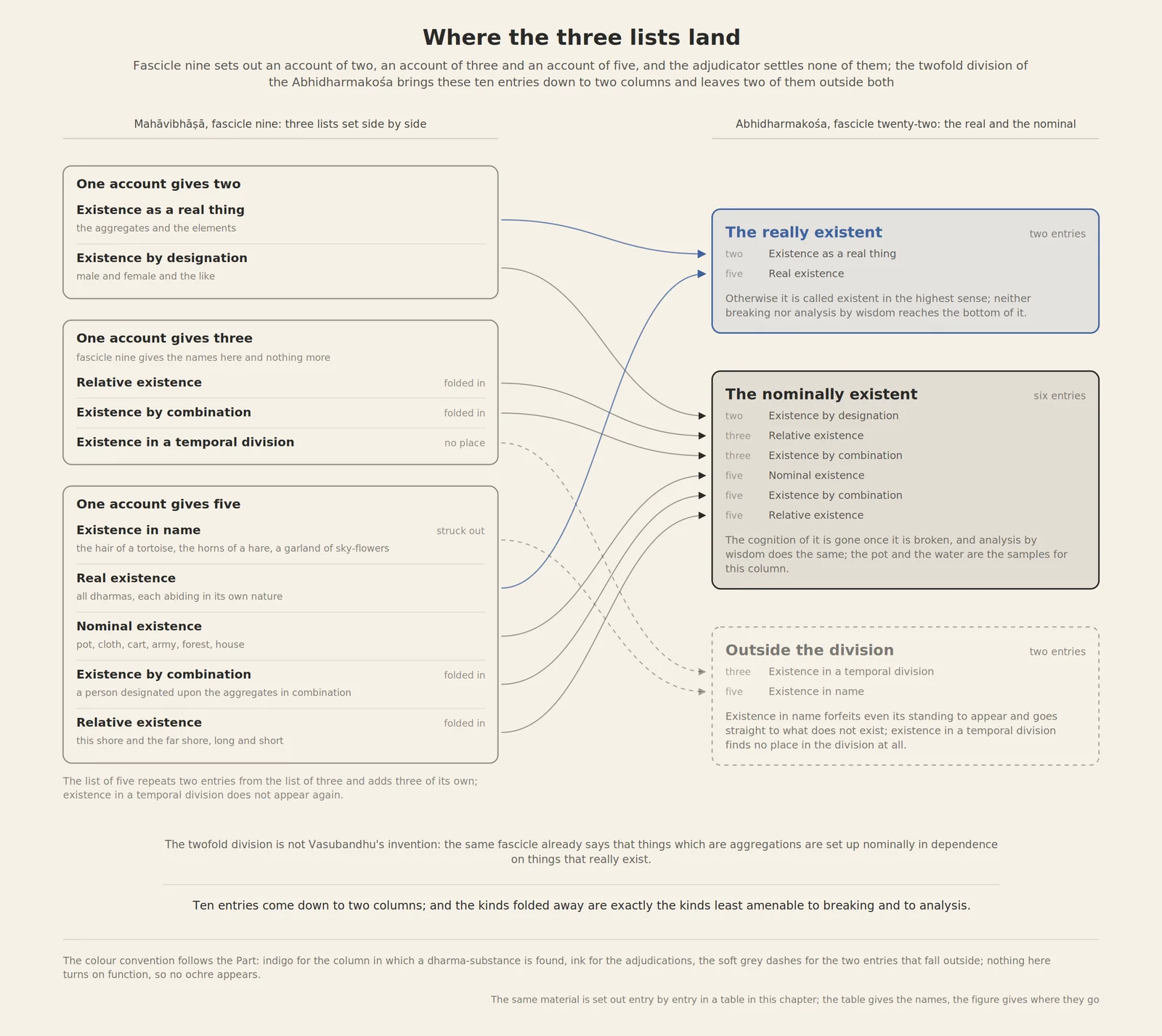
This book's judgment is that the twofold division used as a measure throughout this part is what the Abhidharmakośa selected out of one of the Mahāvibhāṣā's parallel lists and then polished, with several centuries and one adjudication in between. The five-layer table of texts set up in the introduction to this part exists so that differences of this kind remain visible. How the adjudication happened belongs to the next part; here it is enough to remember that wherever this part speaks of the Sarvāstivāda criterion, it means the polished one and not the whole stock the Mahāvibhāṣā had on hand. In passing, the Mahāvibhāṣā leaves a more fundamental sentence in the same place: aggregated things are designated as existing in dependence on real things. The nominal must rest on the real to be established at all, and both schools agree on that. The disagreement has always been at the real end, never at the nominal end.
Comparison with the Theravāda measure, which is why the two parts can be read against each other. The Theravāda fourfold defining method has four columns: characteristic, function, manifestation, and proximate cause. It asks how this dhamma presents itself, and it is a phenomenological register. The Sarvāstivāda criterion of real and nominal asks whether this thing can be broken up, and it is an ontological test. The first asks you to look; the second asks you to take apart and then look.
The real asymmetry is in the fourth column. Proximate cause (padaṭṭhāna) asks after the nearest condition of a dhamma, what allows it to appear here. This column ties every dhamma back to dependent arising: a dhamma stands because it has a proximate cause, not because it stands on its own. Chapter 1 of Part 14 argued that this column is a line of defence for the Theravāda, since it makes the word "intrinsic nature" very hard to read as an independent entity: every time intrinsic nature is written, the fourth column reminds the reader once more that it depends on something else.
The Sarvāstivāda criterion has no corresponding fourth column. Indissoluble is indissoluble; the reason stops there and does not point back toward conditions. This book takes that to be no oversight but a trade. To handle causation across time, the school must let a cause retain its standing in the past; and once the existential standing of a dharma can be stated apart from present conditions, a backward reference of that kind is no longer usable. The line of defence was removed deliberately, and Chapter 3 will reckon up what its removal bought.
An easy reading should be guarded against here. Seeing that the Theravāda has a fourth column and the Sarvāstivāda does not, one readily concludes that the Theravāda is the more careful and the Sarvāstivāda the more reckless. Yet Theravāda caution has its own price: on the group concerning time it says nothing at all and leaves the problem lying. The Sarvāstivāda took the problem up and answered it head-on, and if it answered badly, at least the answer can be tested. The verdict in Chapter 7 will not read "the Theravāda was clever and the Sarvāstivāda was muddled." Each left a gap of a different shape in a different place, and the location of the gap was decided by the work each had to do. This comparison is the fundamental reason the present part and Part 14 can be read against each other, and it is the first brick of the verdict in Chapter 7.
What each of the two measures measures, item against item:
| Point of comparison | The Theravāda fourfold defining method | The Sarvāstivāda criterion of real and nominal |
|---|---|---|
| Columns or operations | Four columns: characteristic, function, manifestation, proximate cause | Two operations: breaking and analysis |
| What is asked | How this dhamma presents itself | Whether this thing can be broken up |
| Character | A phenomenological register | An ontological test |
| What the reader is asked to do | Look | Take apart and then look |
| Backward reference to conditions | The column of proximate cause ties every dhamma back to its nearest condition | No column answers to it; the reason stops at indissoluble |
| Which reading of intrinsic nature is taken | Mostly stays with the sense of characteristic, nearly a synonym for the first column | Takes the existential sense directly: each abiding in its own nature means each possessing its own substance |
| Whether the operation can be checked | The table carries no operation of the kind | The act can be checked: take the thing apart once and it is known |
| The gap left | Says nothing at all on the group concerning time | The step from indissoluble to really existent is never taken |
How the two measures are used. Whenever the school establishes a dharma in the chapters below, this part asks three things. First, by which criterion is it established as real: indissolubility, or something else? Second, what would be lost by not establishing it: which gap was it called in to fill? Third, what does establishing it cost: what new problems does it bring, and what do those new problems in turn call in?
The first question most often produces surprises. A good many entries on the Sarvāstivāda inventory are not established by indissolubility at all. Possession, non-possession, the life faculty, and the homogeneous character of a group are not things that can be broken or analysed away. They are established as real by a different line of argument: without this dharma, some matter cannot be accounted for. That is a criterion of an entirely different kind, and Chapter 4 takes it up separately.
The third question is the main line of this part. Chapter 7 of Part 14 observed that entries in an Abhidharma inventory arrive by three routes: seen in contemplation, added to explain something, added to keep the system of notation itself standing. On the Sarvāstivāda inventory the third route is the most heavily travelled—possession, non-possession, the life faculty, the homogeneous character of a group, and the four marks of arising, abiding, alteration, and ceasing all belong to it. Put the three questions together and a chain results: B is established to shore up A, and B once established requires C. Chapter 7 draws that chain out in full and shows why it does not come to a stop.
A small example: the pot and the material cluster. In both schools the pot is nominal, and for different reasons.
The Sarvāstivāda says: break the pot and the idea of the pot is gone, so the pot is nominal; the colour, odour, taste, and tangible left over cannot be broken up, so they are real. This is an analytical reason, and it looks to the result of dissection. The Theravāda says: the pot does not enter the table of ultimate realities, because it is not an item that can be registered by the fourfold defining method; what actually exists is a number of material clusters, in each of which eight dhammas arise and cease together, and the cluster itself is not a dhamma either but only a designation.3 This is a working reason, and it looks to whether the item shows up on the list contemplation produces.
The difference lies just here: the Sarvāstivāda nominal is what dissection produces, the Theravāda nominal is what fails to be registered. The opposite of the first is a component that cannot be divided further; the opposite of the second is an item that insight can actually catch. One word, and the two usages cannot be added together. More importantly, the two reasons presuppose different activities: dissecting is an act of reasoning and can be completed at a desk; registering is an act of practice and has to happen on the cushion. The difference in the centre of gravity of the two systems is already visible in this one small example, and the verdict of Chapter 7 begins from that difference.
To Chapter 2. The two measures have been handed over. Measures need an inventory to be used on, and the next chapter looks at that inventory: why exactly seventy-five, why five categories, and on what the boundaries between the categories rest. The terms themselves have already been listed in Part I, Part 3, Chapter 2, and Chapter 2 does not list them again; it asks only how the table came to be and whether it holds itself up.
References
References
-
Saṃyukta Āgama 319 (Taishō vol. 2). A brahmin asks about "all" and the Buddha answers with the twelve bases, adding that anyone who establishes some other "all" has "mere words; questioned, he will not know, and his perplexity will increase—why? because it is not within his range." The Pāli parallel is the Sabba Sutta, SN 35.23; for the English see Bhikkhu Bodhi, trans., The Connected Discourses of the Buddha (Boston: Wisdom Publications, 2000). The difference between the sense of range in the discourse and the sense of existence in the schools is the subject of the first section of this chapter; Part I, Part 3, Chapter 1 discussed the same conflict from the side of the Kātyāyana Sūtra. ↩
-
Abhidharma Mahāvibhāṣā Śāstra, 200 fascicles, trans. Xuanzang, Taishō vol. 27 (T1545). The passages used in this chapter fall in fascicles nine, seventy-four, and seventy-six. Fascicle seventy-four quotes a discourse in which Śāriputra says that "in setting forth the bases there is nothing higher, for the twelve bases comprehend all dharmas"; the treatise asks "how could the Venerable Śāriputra know that the twelve bases comprehend all dharmas," answers "he knew it by instruction, for Śāriputra possessed the four unshakable confidences and accepted with certainty what the Buddha said," and states that "he can realize only the general characteristics one by one; the particular characteristics he cannot realize one by one as they are"; the same place also has "the bodies of consciousness are only six; a body of consciousness definitely has a basis and an object; that basis and object are definitely twelve; therefore the twelve bases are neither more nor fewer." Fascicle nine sets three parallel classifications of existence side by side (real thing and designation; relative, combination, temporal division; name, real, nominal, combination, relative), with no adjudication. Fascicle seventy-six: "the three times are established by way of function"; "though the substance already exists it has no function, and now, meeting with causes and conditions, function arises. Question: are function and substance one or different? Answer: it cannot be settled whether they are one or different … therefore no fault should be charged"; "though it lacks the function of seeing and the rest, it definitely has the function of taking up an effect"; the Venerable Pārśva asks "past and future dharmas having no function, how are increase and decrease established," with the answer "substance really exists always without increase or decrease; increase and decrease are spoken of only in terms of function. Aggregated things are designated as existing in dependence on real things"; and "Question: what do the three times have as their intrinsic nature? Answer: all conditioned dharmas as their intrinsic nature. As with intrinsic nature, so should self, thing, own-substance, characteristic, portion, and original nature be understood." The counts of more than three hundred occurrences of "function," more than a hundred of "power of activity," and nearly forty of "capacity" were obtained by a full search of the CBETA text. For a Chinese vernacular rendering see the Mahāvibhāṣā translation on this site. ↩↩↩↩↩
-
The four columns of the fourfold defining method (characteristic, function, manifestation, proximate cause) and the sense of proximate cause as nearest condition follow the Tabular Exposition of the Abhidhammattha Saṅgaha, compiled by Bhikkhu Dhammadhara and revised by Lo Ching-lung, published by the Dhamma Rain Monastery; all Theravāda figures and columns in this part follow that work, as detailed in Chapter 1 of Part 14. The eight dhammas arising together in a material cluster are from Chapter 6 of that work, the Compendium of Matter. That concepts and past dhammas alike may serve as objects at the mind door is from the section on objects in Chapter 3, the Compendium of the Miscellaneous, and stands directly opposed to the Sarvāstivāda principle that what has no substance cannot serve as an object; this is the basis of the second section of the present chapter. That the selection of dhammas on the Theravāda table rests on no checkable criterion is this book's observation on that work and on the format of Chapter 14 of the Visuddhimagga, and is not stated there. ↩↩↩
-
K. L. Dhammajoti, Sarvāstivāda Abhidharma, 4th ed. (Hong Kong: Centre of Buddhist Studies, University of Hong Kong, 2009). A general treatment of the distinction between substance and function, of the relation between function and dharma-substance, and of Saṅghabhadra's reply in the Nyāyānusāra to Vasubandhu's objection; Chapters 2 through 5 of this part follow its collation in several places, the judgments being this book's own. A sixth edition was reissued in expanded form by the Buddha-Dharma Centre of Hong Kong in 2026; citations in this part follow the fourth edition throughout, and the entry in Part I, Part 3, Chapter 1 has been brought into line with it. ↩
-
Abhidharmakośabhāṣya, 30 fascicles, by Vasubandhu, trans. Xuanzang, Taishō vol. 29 (T1558); Paramārtha's version is the Abhidharmakośaśāstra (T1559), and the verses alone are T1560. The criterion of the two truths is in fascicle twenty-two, chapter on the path and the persons: "where the idea of it ceases when broken, and likewise when other elements are removed by analysis, as with pot and water, it is conventional; what differs from this is called ultimate." For the English see Leo M. Pruden, trans., Abhidharmakośabhāṣyam of Vasubandhu, 4 vols. (Berkeley: Asian Humanities Press, 1988–1990), rendered from Louis de La Vallée Poussin, L'Abhidharmakośa de Vasubandhu (Paris–Louvain, 1923–1931). The same fascicle carries, after this verse, the passage on conventional truth on which the fifth section of the present chapter rests: "so long as that thing has not been broken or analysed, it is designated by a worldly notion and name, and because the designation exists it is called conventional. To say by conventional reasoning that there is a pot is real and not false, and this is called conventional truth." The matching sentence on the ultimate reads: "to say by ultimate reasoning that there is visible form and the rest is real and not false, and this is called ultimate truth." Both sentences use the same four words, real and not false, so that the line between the two truths does not fall where the line between the true and the deceptive falls. ↩↩
-
Collett Cox, Disputed Dharmas: Early Buddhist Theories on Existence, Studia Philologica Buddhica Monograph Series XI (Tokyo: International Institute for Buddhist Studies, 1995). On the formation of the criterion of real existence, and on the different line of argument used when dharmas dissociated from mind are established as real. The point made in the fifth section of this chapter, that a step is missing between indissolubility and real existence, shares its problem-setting with Part One of that book; the conclusion is this book's own. ↩