Chapter 3: Existence in the Three Times—The Dharma Substance in Time
The table set out in the last chapter left one piece of business unfinished. Every cell in it has to exist in each of the three times, and that is precisely what the three words "all exists" govern. This chapter is the central thesis of the whole part, and also the place where the school has drawn the heaviest criticism. Both sides of the dispute left texts behind, and the aim here is to let each of them finish speaking.
Begin with a surprise. The title of this chapter is "the real existence of the three times," and yet that phrase does not occur once in the two hundred fascicles of the Mahāvibhāṣā. Searched through the whole treatise, the nearest thing to it stands at the close of fascicle seventy-six: the causal nature and the fruit-nature of the dharmas of the three times are set out in their proper order, the substance is really and always existent, without increase or decrease, and it is only in terms of function that existence and non-existence are spoken of.1 That sentence occurs once in the entire work, and not in any position of prominence: it is the wrap-up of a question-and-answer passage about aggregation, added in passing. This is not to say the school lacked the doctrine (quite the reverse, all two hundred fascicles are built on it), but that within the treatise the doctrine never once had a section of its own in which to prove itself. It makes its appearance in a different manner.
It appears in the form of a phrase that blocks discussion. The Mahāvibhāṣā has a fixed opening formula: why is this matter treated here? Answer: in order to stop other schools and to display the correct principle. The formula is used more than a hundred times across the work. In three of those places the party to be stopped is the same: some hold that past and future have no real substance, and some hold that the present is unconditioned. The three occurrences hang beneath three topics that have nothing to do with one another (the homogeneous cause, the deterioration of a mind once that mind is past, and the bondage already effected by a fetter once that fetter is past), one in fascicle seventeen, one in fascicle thirty-seven, one in fascicle sixty.1 The wording is nearly identical word for word each time, and each time the pattern is the same: announce that the opponent is wrong, then turn straight to the topic at hand, leaving no argument in between.
The distribution is itself a piece of evidence. Within the Mahāvibhāṣā, the real existence of the three times is not a conclusion awaiting proof; it is a premise already in force. It is reasserted constantly and never re-argued; it appears in the doorway of other topics, functioning as an entrance check. The only passages that treat it as a question in its own right are in fascicles seventy-six and seventy-seven, and what those two passages do is, in the one case, clean up the trouble the doctrine creates, and in the other, choose among four available explanations of it. As for the grounds on which the doctrine itself stands, the treatise nowhere devotes a section to the matter.
The three jobs it has to do. The last chapter mentioned the three sets of vacancies laid out in Chapter 1; a single reminder is enough here. The real existence of the three times fills the second set head-on, and takes care of both halves of the first set along the way. One half is the question of what sustains an action in the interval after it has ceased and before its fruit has arisen; the other is the question of what serves as object for cognitions that take past and future things as their objects. Taken together, the three jobs come to this: a causal dharma must retain, after it has passed, a standing such that it can be an object and can be a condition.
The most complete formal statement of these three jobs is not found in the school's own books. It is in Vasubandhu's hands. The chapter on the latent defilements in the Abhidharmakośa arranges the case into two scriptural proofs and two rational proofs. First, the Buddha said that if past matter did not exist, the learned noble disciple would have no reason to cultivate disgust and abandonment toward past matter, and if future matter did not exist, he would have no reason to cultivate the severing of desire toward it. Second, the Buddha said that consciousness arises from two conditions; and if past and future are not really existent, a consciousness arising in dependence on them is missing one of its two conditions, the object. Those are the scriptural proofs. First, when a cognition arises there must be an object; where there is an object cognition arises, where there is none it does not. Second, an action already performed has a future fruit; and if a past action has no substance, then at the moment the fruit arises there is no present cause to produce it. Those are the rational proofs. With the four set out, Vasubandhu delivers a verdict: it is precisely because it holds that all three times are real that this school is called the school that holds that all exists.2
No matching set of four can be found in the Mahāvibhāṣā. The two scriptural passages (cultivating disgust and abandonment, cultivating the severing of desire) are not quoted once in the whole treatise. "Consciousness arises from two conditions" does occur nine times, but all nine are in fascicle twenty-three, and their purpose there is to distinguish which segment of dependent arising is meant by three different formulas: consciousness conditioned by formations, consciousness conditioned by name-and-form, and consciousness arising from two conditions. None of them has anything to do with the existential standing of the three times.1 In other words, the four proofs that textbooks repeat as the standard Sarvāstivāda argument were, so far as the surviving Mahāvibhāṣā is concerned, assembled into that shape afterwards. This book does not infer from this that the school had no such reasons at the time; the reasons are scattered through the treatise, and fascicle seventy-six has a set of its own. What this book wishes to point out is only the attribution of the arrangement: the person who set them out as two scriptural and two rational proofs, in a list that can be refuted item by item, was Vasubandhu. A doctrine is often reduced to its clearest form at the moment it comes under attack.
The four masters: where the change is stored. Part I, Part 3, Chapter 1 has already set out the four masters and their four similes in a table, and this chapter does not repeat it. There is one question to be put here that Part I did not put. All four agree that the dharma-substance does not change; where, then, does each of them store the small amount of change that a difference among three times requires?
Dharmatrāta stores it in the mode. When one piece of gold is beaten into different vessels the shape alters while the visible colour does not; when milk turns to curds the taste and potency are surrendered while the visible colour is not. As a dharma passes from future to present it surrenders its future mode and acquires its present mode, while the dharma-substance acquires nothing and surrenders nothing.1 Ghoṣaka stores it in the characteristic. Every dharma in each of the three times possesses all three temporal characteristics; it is conjoined with one of them at a given moment without thereby being separated from the other two, as a man in the act of being enamoured of one woman's form is not said to be free of desire for the forms of other women. Vasumitra stores it in the position. As one counting-rod placed in the units column is called one, in the tens column ten, in the hundreds column a hundred, so it passes through different positions while the rod itself remains the same; when a dharma does not yet have function it is called future, when it is exercising function, present, when its function has ceased, past. Buddhadeva stores it in relative standing. One and the same woman is called daughter relative to her mother and mother relative to her daughter, and though there is no difference in her substance she acquires the names daughter and mother by difference in relation; a dharma relative to what comes after it is past, relative to what comes before it is future, relative to both at once is present.
The differences among the four amount, in the end, to four ways of putting the change out of sight. The mode gives the dharma a changeable outer garment; the characteristic has all three garments worn at once and displayed by turns; the position gives no garment at all and draws the grid outside the dharma instead; relative standing abolishes the grid and keeps only a relational way of speaking about before and after. Of the four devices, the first two put the change inside the dharma itself, the last two put it outside.
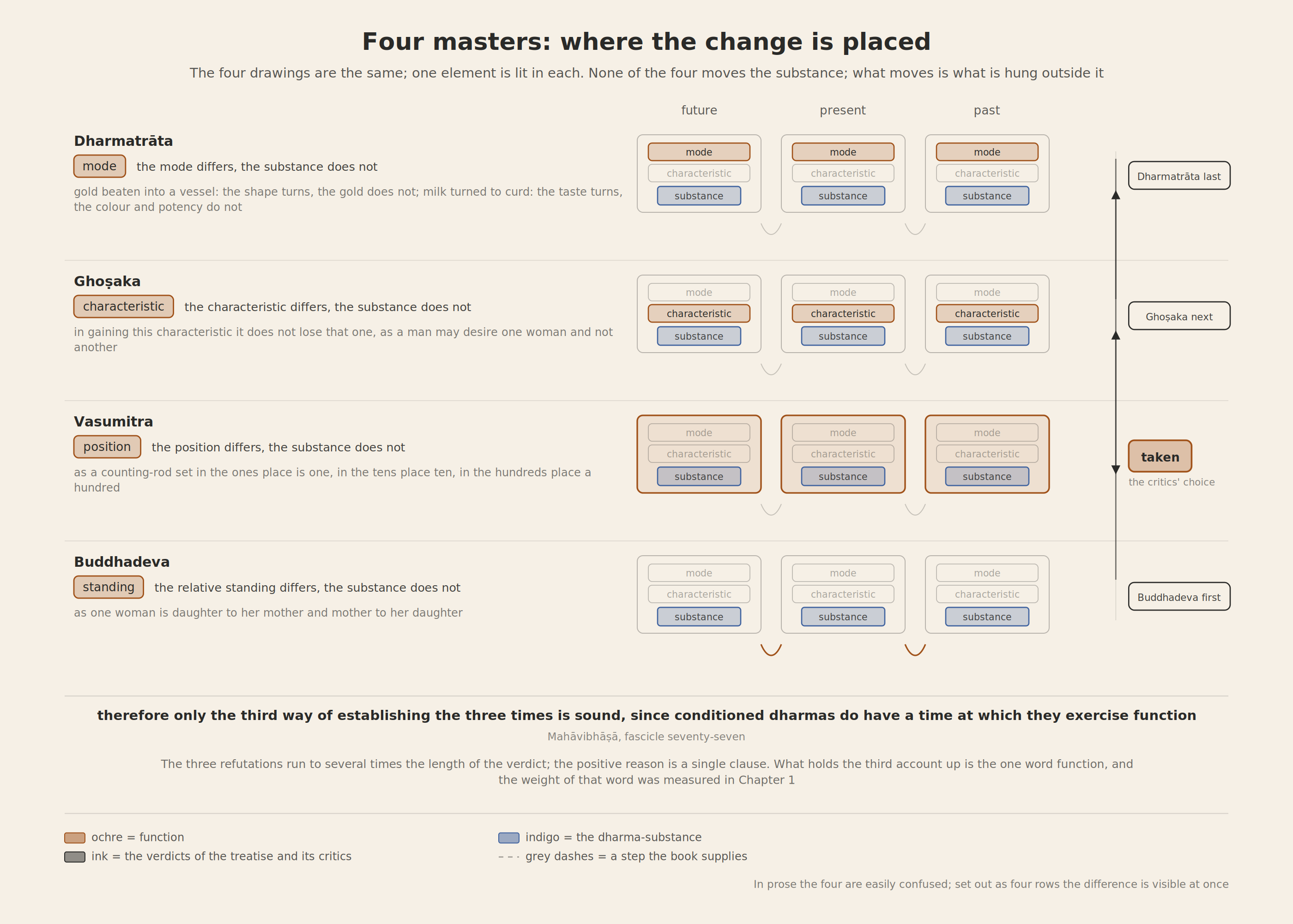
The adjudicator's choice is an elimination. The adjudicating comment proceeds in reverse order, refuting Buddhadeva first, then Ghoṣaka, and last Dharmatrāta; all three refutations perform the same operation, which is to show that the position in question produces a confusion among the three times, or else offends against sound principle.
Against Buddhadeva: if it is a matter of standing relative to before and after, then each of the three times contains all three within itself. The earlier and later moments of the past can be called past and future respectively, with a present between them, and the same holds of future and present. A present dharma occupying a single moment, by standing relative to what follows, to what precedes, and to both at once, ends up furnishing three times; this cannot be right. Against Ghoṣaka: the three times he establishes are likewise confused, since on his own admission every dharma in each of the times possesses all three temporal characteristics. Against Dharmatrāta the refutation is the shortest and the most severe: apart from the intrinsic nature of the dharma, what is this mode of yours? Moreover, as a dharma goes from future to present the earlier mode must perish, and as it goes from present to past the later mode must arise—so that there is arising in the past and perishing in the future, which cannot be right.1
The question put to Dharmatrāta is worth pausing over. It asks after the existential standing of the mode. If the mode is not separate from intrinsic nature, then it is intrinsic nature that is changing, the dharma-substance has moved, and "all exists" collapses on the spot. If the mode is separate from intrinsic nature and is some further thing, then what dharma is it, and by what right does it change? This is a dilemma, and both horns are blocked. When Chapter 1 discussed the real and the nominal it noted that the school's criterion asks whether a thing can or cannot be broken up; the refutation of Dharmatrāta uses exactly that measure, only turned around and applied to one of its own. The school is not gentle with its own people.
Then comes the verdict, and it is a single clause: therefore only the third way of establishing the three times is sound, since conditioned dharmas do have a time at which they exercise function.1 The three refutations occupy something like four times the length of the verdict, and the positive reason amounts to eight words: because conditioned things do have a time of function. Vasumitra's account was selected not principally because it had been shown to be right, but because the other three had been shown to be wrong. This is an elimination, not a demonstration. This book takes the procedural detail to be important: a verdict produced by elimination cannot be more reliable than the completeness of the elimination, and whether there might be a fifth explanation beyond the four is a question the treatise never asks.
Where each of the four stores that bit of change, together with the adjudicator's disposal of it:
| Master | Change stored in | Device | Change falls inside the dharma or outside | The adjudicator's disposal |
|---|---|---|---|---|
| Dharmatrāta | Mode | Gives the dharma a changeable outer garment | Inside | Refuted most briefly and most severely: apart from intrinsic nature, what is the mode; pressed further it yields arising in the past and perishing in the future |
| Ghoṣaka | Characteristic | Has all three garments worn at once and displayed by turns | Inside | Refuted: the three times he establishes are confused, since he admits that every dharma in each time possesses all three temporal characteristics |
| Vasumitra | Position | Gives no garment, and draws the grid outside the dharma instead | Outside | Not among the refuted; the verdict takes this one, and the positive reason amounts to eight words: because conditioned things do have a time of function |
| Buddhadeva | Relative standing | Abolishes the grid, keeping only a relational way of speaking about before and after | Outside | Refuted: on standing relative to before and after, each of the three times contains all three within itself |
Read down the column and the master left standing is the one who moved the change furthest out of the dharma-substance. The adjudicator nowhere says that this was the criterion, and yet the order of the four falls out exactly along it.
A difference on Vasubandhu's side may be recorded in passing. When he reproduces the same doxography, his refutation of Dharmatrāta adds a remark the Mahāvibhāṣā does not make: one who admits that the dharma-substance undergoes transformation should be placed among the Sāṃkhya outsiders.2 The adjudicator's refutation is internal—it asks what your mode is supposed to be. Vasubandhu's is external—it tells you that you have ceased to be a Buddhist. The same hole, and one man goes to repair it while the other goes to classify it.
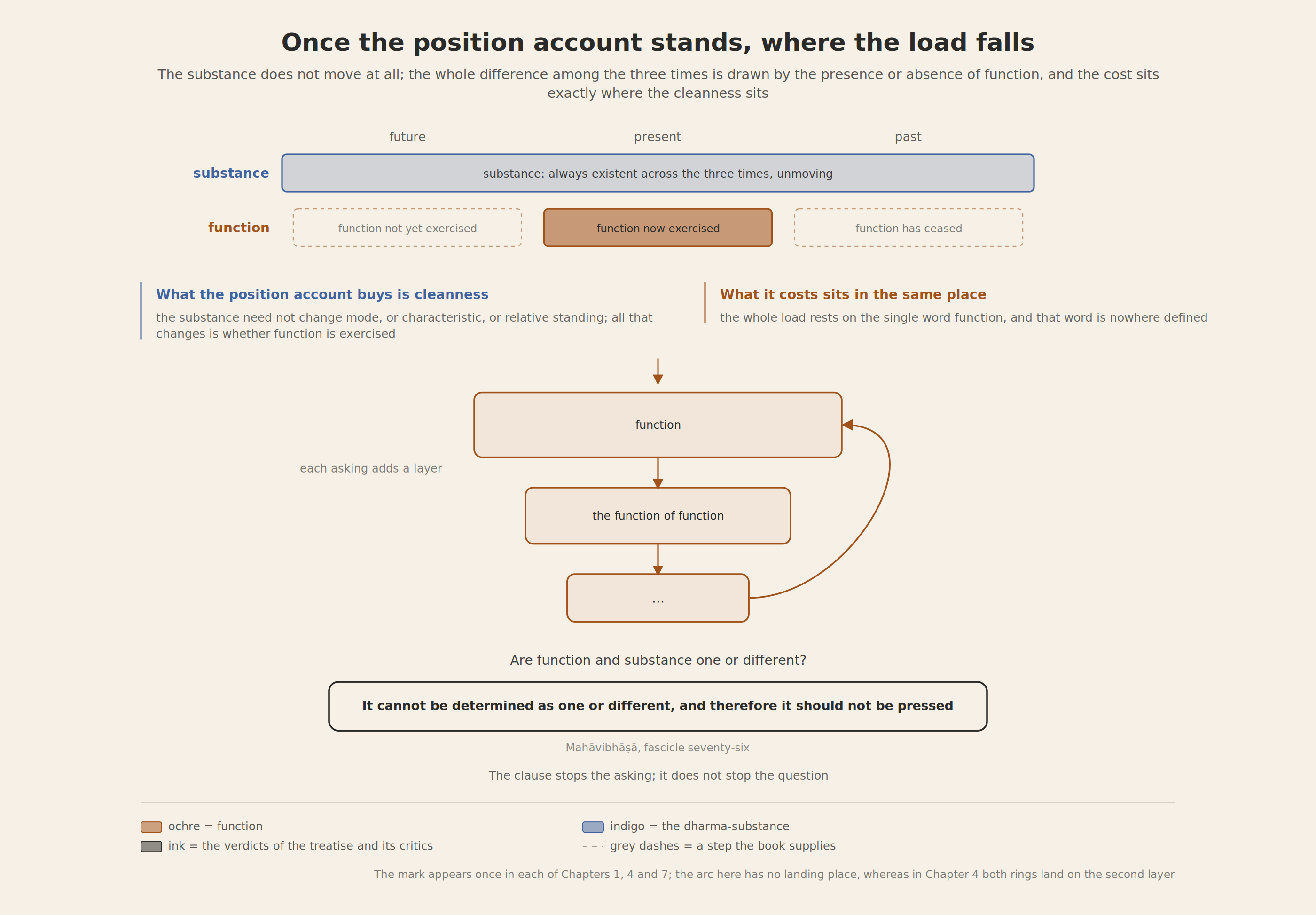
Once the position account is established, the whole weight rests on one point. The merit of the position account is its cleanliness: the dharma-substance does not move at all, and the difference among the three times is drawn entirely by the presence or absence of function. The cost lies in the same place. The entire weight of the doctrine now rests on this one thing, function; and Chapter 1, in treating the division of substance and function, has already pointed out that function has no standing of its own in this school. Pressed to say whether function and substance are one or different, the adjudicator answers that it cannot be determined as either one or different, and that the question therefore should not be raised. At the time that was a closing remark; in this chapter it becomes an opening left in the wall. How the distinction between existence and function hardened, over the course of the schools' disputes, into two things that could be housed separately has been examined in detail elsewhere.3
Chapter 1 quoted the difficulty about arising from fascicle seventy-six: when a conditioned dharma in the future is about to arise, does it arise because it already exists or because it does not yet exist? Both horns carry a fault, and the adjudicator chose arising-though-already-existent, adding at once that the substance already exists but has no function, and that on meeting its conditions it now gives rise to function.1 What was at issue there was the place where the questioning halts; what is at issue here is what that answer cost.
It amounts to moving the word "arising" out of its house entirely. Arising is no longer a dharma's coming to be from not being; it is a dharma that has been there all along beginning to exercise function. Arising, one of the four characteristics of the conditioned, from this point on describes not the acquisition of existence but the commencement of function. The first sum the school paid out to keep its dharma-substance was this word.
The same exchange contains a more urgent sentence, which Chapter 1 did not use. If the temporal substance itself were what arises, then when one dharma arises all dharmas in the future time would have to arise along with it; once this dharma had arisen there would be no future left, and once it had ceased there would be no present left, and the whole doctrine of the real existence of all three times would be wrecked.1 The adjudicator brings it in to block a side road, but the sentence also exposes the strain in the system. A dharma, so long as it remains in the future, must remain immobile together with every other future dharma; if one moves, all must move. In order to allow the dharma-substance no change whatever, the real existence of the three times has to transfer the entire allotment of change to function, and transfer it without remainder. This is not restraint. There is simply nowhere else to put it.
The cost, as the adjudicator himself states it. Also in fascicle seventy-six there is a set of exchanges which this book takes to be the most candid passage in the whole treatise on the real existence of the three times, and also the least quoted.
The set works through the aggregates one by one, checking definition against instance. If something is matter, does it therefore obstruct and deform? Answer: whatever obstructs and deforms is certainly matter, but there are things that are matter and do not obstruct or deform, namely past and future matter, together with present atoms and unmanifest matter. If something is feeling, does it therefore experience? Answer: whatever experiences is certainly feeling, but there are things that are feeling and do not experience, namely past and future feeling. Perception and the apprehension of marks, formations and the act of forming, consciousness and discernment—each is answered on the same pattern.1
Notice what this string of answers says. Obstruction is the definition of matter, experience the definition of feeling, apprehension of marks the definition of perception, forming the definition of formations, discernment the definition of consciousness; the names of the five aggregates are given throughout in terms of function. And by the adjudicator's own check, past and future matter do not obstruct, past and future feeling does not experience, past and future consciousness does not discern. They are still called matter, feeling, and consciousness, because the intrinsic nature is still there; but the reason for calling them matter, feeling, and consciousness is, in every case, no longer there.
What then is that substance which exists throughout the three times? On the answer given in this passage, it is what remains of a dharma after everything by which the dharma was defined has been subtracted. Chapter 1 observed that the term "intrinsic nature" in this school is glossed by seven synonyms which define one another in a circle, so that no content can be extracted from it. A more specific remark can be added here: it is not that no content can be extracted, it is that the content has been deducted. The share belonging to function was assigned to function, and once that assignment was made, what was left on the side of substance was only a place—it is still on the list, it can still be counted, taken as object, and treated as cause, but it does nothing that makes it what it is.
This must be put fairly. The school concealed nothing. It wrote these answers into its own manual just as they stand, in a calm hand, and one can see at a glance that they are a considered trade-off rather than a slip of the tongue. It would rather have past matter not obstruct than have past matter not exist. Which of the two is more worth keeping is a question one may argue; the school chose the second, and it knew what it was choosing.
The passage on aggregation: a tool already in the house. Fascicle seventy-six goes on to ask whether past and future dharmas form aggregations in the way that a present wall does. As usual, both answers carry faults. If they do aggregate, then a donor's labour in having a thing made is wasted, since the thing already existed before it was made; past and future dharmas would occupy locations; walls would all be permanent; and past and future affairs ought to be visible. If they do not aggregate but lie scattered severally, then what becomes of the discourses' statements that in the past there was a king named Mahāsudarśana and that in the future there will be a Buddha named Maitreya, and what is it that the knowledge of former abodes observes in the past, and the knowledge of death and rebirth in the future?
One opinion holds that past and future do aggregate, and answers each objection by force. The adjudicator did not adopt it, and issued a comment: past and future have no aggregation as present things do; they merely lie scattered severally.1 Having taken that side, he must find another way out of the first half of the difficulty, and the way out he gives is this. When one speaks of a past affair, one speaks of it as it once was present, and there is no fault; when one speaks of a future affair, one speaks of it as it will be present, and there is no fault; what the knowledge of former abodes observes is what was once undergone, and what the knowledge of death and rebirth observes is what will be undergone.
The device is called "once present" and "to be present." The expression "once present" occurs exactly once in the whole treatise.1 It is worth remembering, because the tool Vasubandhu would use some generations later to dismantle the real existence of the three times is this very one: a past dharma is said to exist in the sense that it once existed; a future dharma is said to exist in the sense that it will exist; and existence in that sense is not real existence in the way the present is real.2 The same tool. The school used it on walls, and used it deftly; when Vasubandhu turned it on the doctrine itself, the school would not use it any more.
What appears here is a situation seldom noticed. The resources for the refutation were not brought in from outside. They had been in the house all along, filed under a smaller problem. It is not that the school was unable to say that a thing exists because it once existed; it was unwilling to apply that formula to its own signboard. Once applied, past and future would no longer be real in the way the present is, and the "exists" in "all exists" would have to be read differently. This book's view is that what the school was defending at this point was not an argument but a boundary. Hold the boundary, and an argument can always be found later.
Where Vasubandhu strikes. The refutation in the chapter on the latent defilements falls entirely on function. The first question is the most direct. If the dharma-substance exists permanently, it ought to exercise function at all times; what exactly is it that obstructs, such that the function exercised by one and the same dharma-substance is sometimes present and sometimes absent? The question blocks a line of retreat in advance: it will not do to answer that the assemblage of conditions is incomplete, since on your own doctrine the conditions too exist permanently.
The second question concerns regress. To which time does function itself belong? If function must also be divided among three times, then a further function has to be established within function in order to fix the times of the first, and so on without end. If function does not belong to the three times and is nonetheless said to be real, then it becomes unconditioned, and ought to exist permanently without fail—in which case it makes no sense to speak of function having ceased or not yet having arisen. The third question concerns identity and difference. When the school answers that function is not different from the dharma-substance, Vasubandhu takes the answer up: then your grounds for establishing the three times are gone. Function is the dharma-substance, the dharma-substance exists permanently, so function should exist permanently too; and how then would anything ever come to be called past at one time and future at another?2
The three questions tighten in sequence, and come to rest on the most damaging line of all: to admit that the substance exists permanently while saying that its nature is not permanent is a doctrine without precedent, and since nature and substance are not different in the first place, this is creation by arbitrary fiat, in the manner of a creator god. Chapter 1 listed four things the school does not claim, the fourth being that it does not claim conditioned dharmas are permanent, and noted at the time that this item is the easiest to misread and the hardest to state clearly. It can now be stated clearly. The school's defence is that what exists permanently is the substance, while impermanence falls on the momentary arising and ceasing of function, and that conditioned dharmas are still subject to the four characteristics. For that defence to hold, substance and function must be separable and each assigned its own permanence or impermanence—and whether they are separable is exactly what Vasubandhu is asking. The defence takes what is to be proved as its premise. This book's judgment is that the item is not misread: it has been pushed by the school's own position account into a place where it cannot be stated. To say the school holds conditioned dharmas to be permanent is unfair; to say it has settled permanence and impermanence satisfactorily is equally unfair.
The stroke with the inactive faculty. The finest piece of workmanship in Vasubandhu's refutation is this one, and it deserves separate treatment.
Chapter 1 recorded a patch. A present eye faculty standing in the corresponding-but-inactive state, that is, not at this moment seeing anything, is nonetheless present, because although it lacks the function of seeing it certainly has the function of grasping a fruit. The patch exists to keep a dozing eye from falling out of the present. Vasubandhu picked it up. Very well, he says: what function does the inactive eye have? Can it not grasp a fruit and give a fruit? If grasping and giving a fruit count as function, then a past homogeneous cause also gives a fruit, and past dharmas would then have function as well. And with that, some dharmas would have only half a function, and the characteristics of the three times would fall into confusion.2
The accuracy of the stroke is in that last word. Confusion is precisely the blade the Mahāvibhāṣā used to eliminate Buddhadeva and Ghoṣaka: any account that lets the three times run together is rejected without exception. When Vasumitra's account was chosen, one of the reasons the adjudicator gave was that on this master's account the times are not confused. What Vasubandhu does is to take that same standard and measure the survivor with it, and the reading he gets is the same disease as the two that were eliminated. He did not set up a second ruler; he used the school's own. This book takes it to be the strongest single blow struck in the whole exchange, and its strength is that it requires Vasubandhu's readers to accept no Sautrāntika premise whatever.
Vasubandhu's scriptural proof, and its absence from the Mahāvibhāṣā. Having refuted, Vasubandhu must supply the reading on his own side, and for that he uses the Discourse on Emptiness in the Ultimate Sense: when the eye arises there is nowhere it comes from, and when the eye ceases there is nowhere it collects; not having been, it comes to be, and having been, it ceases to be. If past and future eyes really existed, the discourse could not have said "not having been."4
This passage runs head-on into the school's position, and the collision is exact down to the wording. It was said above that the adjudicator of fascicle seventy-six chose the horn of arising-though-already-existent, and that his reason was precisely that the other horn leads to all dharmas not having been and then coming to be, at which point the doctrine that all exists fails. Nor is that the only place. Fascicle twenty-three, treating the twelve links, is more explicit still: the two past links are asserted in order to block the view that birth-and-death has not been and comes to be, and the two future links are asserted in order to block the view that birth-and-death, having been, ceases to be.1 Coming to be after not having been, and ceasing to be after having been, are within the Mahāvibhāṣā two heresies that must be barred. And in the discourse Vasubandhu produces, the Buddha uses those very words of the eye faculty.
How, then, does the Mahāvibhāṣā handle this discourse? The answer is that it does not. Searched through the whole work, the phrase "emptiness in the ultimate sense" occurs twice, and neither occurrence is a quotation of the discourse; both are entries in a list of ten kinds of emptiness, standing beside inner emptiness and outer emptiness.1 Sentences of the type "when the eye arises there is nowhere it comes from" do not occur anywhere in the treatise. A discourse that runs directly counter to the school's central doctrine is not reconciled even once in two hundred fascicles. Chapter 1 said that the school's "all" is a word borrowed from the discourses and given different employment after the borrowing; a further remark can be added here. It borrowed diligently, and when it met a discourse that was hard to borrow, it walked around.
As for where Vasubandhu himself finally stands, it is on the more famous line: what is called "all" is just the twelve bases.4 This is the same discourse quoted at the opening of Chapter 1. From it the school had borrowed the word "all" and read a term of scope as a term of existence; Vasubandhu carries the discourse back and demands that things be said to exist in the manner in which they actually do. One discourse, two entrances: the first is the starting point of the school's thesis, the second the landing point of Vasubandhu's dismantling of it. Chapters 1 and 3 of this part are thereby buckled together.
Saṅghabhadra's defence. Saṅghabhadra met Vasubandhu's objections head on in fascicle fifty-two of the Nyāyānusāra, and he met them with more precision than the received summaries of the exchange allow. He begins by saying that the difficulty arises wholly from a failure to understand the nature of dharmas, and then divides the forces the school ascribes to a dharma into two kinds: one is called function, the other capacity. Only the capacity that draws forth a fruit is raised to the title of function; it is not that function comprehends capacity, for there are capacities that are not function. The illustration is the eye in the dark. Darkness obstructs the capacity of seeing visible form, so the eye in the dark sees nothing; darkness does not obstruct the function of drawing forth a fruit, so the eye in the dark draws forth its fruit as before. The establishing of the times hangs on function alone, the present being established solely in dependence on function; a past cause is able to give its fruit and yet has no function, and the marks of the three times are therefore unconfused.56
This answer is sturdier than the received summaries. Function and capacity are not two coordinate names but a relation of inclusion: capacity is the wider class, only its fruit-drawing member is raised to function, and only function governs the division of the times. The past cause that gives a fruit thereby ceases to be a counter-instance, since it has capacity and no function, and capacity does not divide the times, so it stays quietly in the past. Vasubandhu's first question, why the function exercised by one and the same dharma-substance should be sometimes present and sometimes absent, thus acquires a shape that need not be answered head on: exercising function and not exercising it are not the on and the off of one thing, they are a division of labour between two layers of force. Saṅghabhadra has a symmetrical formulation that fixes the point. The past should receive two names, its own characteristic being really existent and its use having been; the present should receive two names likewise, really existent and presently existent, since function is presently there in a real substance. One name for the substance, one for the use, each kept to its own place.
It is worth looking as well at what the answer does not accomplish. The layering does not abolish the regress, it pushes the regress out by one layer: whether capacity and the dharma-substance are one or different is still unaccounted for. Saṅghabhadra sets up a further simile to cover that gap, saying that a continuum has no separate substance and is yet admitted to have an operation of its own, and that the principle of function is likewise; but a continuum, on the school's own reckoning, is nominally existent, and taking a nominally existent thing as the model for a really existent one is a step that cannot be settled before Chapter 7. By this stage the two men are no longer using the same vocabulary.
The three questions and the three answers, set one against another:
| Vasubandhu asks | What is being asked | Saṅghabhadra's defence |
|---|---|---|
| If the dharma-substance exists permanently, why is the function exercised by that one substance sometimes present and sometimes absent; and it will not do to answer that the conditions are incomplete, since on your own doctrine the conditions exist permanently too | Who holds the switch on function | Force divides into two layers: capacity is the wider class and only its fruit-drawing member is raised to function; exercising and not exercising are not the on and the off of one thing but a division of labour between two layers |
| To which time does function belong; if it is divided among the times, a further function must be established within function to fix them, and so without end; if it belongs to no time and is still called real, it becomes unconditioned | Regress | The times are established in dependence on function alone; a past cause gives its fruit and has no function, and capacity does not divide the times, so it stays quietly in the past |
| Whether function and the dharma-substance are one or different; answer not different, and the grounds for dividing the times collapse on the spot | Identity and difference | This question receives no defence: whether capacity and the dharma-substance are one or different is still unaccounted for, and the simile of the continuum offered in its place takes a nominally existent thing as the model for a really existent one |
Of the three rows the first two are answered and the third is empty, and the empty one is the shortest of the three questions.
What the exchange is actually about. This book's view is that the exchange is, in substance, a contest over where inquiry is entitled to stop.
The whole of Vasubandhu's attack comes down to one demand: you use function to support the division of the three times, so give function itself an existential standing—is it a dharma or not, is it one with substance or different from it, does it belong to the three times or not? The whole of Saṅghabhadra's defence comes down to one refusal: no such account is owed. Function is the differentiating aspect of the dharma-substance, a differentiating aspect is not the kind of thing that requires separate housing, and the questioning ought to stop here.
Neither man proved the other wrong. Vasubandhu did not prove that function must have a standing; Saṅghabhadra did not prove that it need not. Their disagreement lies not in any particular inference but somewhere further upstream: whether a thing that is used to support other things must itself first be given a settled place. Those who answer yes will keep asking downward until they reach something that stands on its own, or until they concede that they cannot. Those who answer no will plant a marker at some point and say that here is the floor. The school planted its marker at function; Vasubandhu asked that it be moved down one notch, and Saṅghabhadra declined to move it.
A stopping point is not an argument, but neither can it be called an error. Every system has to stop somewhere, and the only question is whether the place where it stops has been declared. This book's judgment is that the school's stopping point was extracted from it under questioning rather than chosen: the sentence in fascicle seventy-six saying that the matter cannot be determined as one or different and therefore should not be pressed is impatient in tone, not composed. The words "should not be pressed" say that the question ought not to be asked, not that the question has an answer. That sentence is the second brick in the verdict of Chapter 7.
One sentence making two appearances. Vasubandhu closes the debate on a scene: wherever the school cannot make its case, those who cherish their own school should think in this way—the nature of dharmas is profound and is not the province of discursive thought; is it to be said that a thing does not exist merely because we cannot explain it?2 The sentence has circulated very widely and is commonly taken for the school's closing gesture once its case has run out. There are two things in this scene, however, and Sanghabhadra accepts neither.
Take the first half. The wording "as really as the present" Saṅghabhadra twice refuses in so many words: listen, venerable sirs, it is not my school that says the past and the future exist as really as the present, for the three times are really existent and their natures are severally distinct; and again, nor is it as that man who, following his own fancy, speaks at random of past and future existing as really as the present. His own formulation is this: a conditioned dharma at the position where it can draw forth its fruit is called present, and that position is not there before and not there after; the difference of the three times has already been drawn along that line, so how should it be said that past and future exist as really as the present? Searched across the three corpora, the phrase "as really as the present" stands three times in the Mahāvibhāṣā, all in fascicle thirty-four, in a passage on taking refuge in the three jewels that has nothing to do with the three times; twice in the Abhidharmakośa, both in fascicle twenty, where Vasubandhu is restating the other party's doctrine; and five times in the Nyāyānusāra, four of them where Saṅghabhadra brings the phrase out in order to refuse it.5 The difference is not merely verbal. "As really as the present" sets the three times out as three equal shares, whereas what the school wants is that all three exist and the present is nonetheless distinctive: one substance, distinct in kind of nature, divided by function. Put the other way about, the phrase asks a different question.
Now the second half. This sentence does have a source, only not in this position. Fascicle one of the Mahāvibhāṣā, opening the question of who composed this treatise, begins with just this: since the nature of all that is knowable, in all its kinds, is profound and subtle, who but the Buddha, the World-Honoured One, the omniscient, could fully awaken to it and set it forth? The same fascicle then quotes four passages in succession, in which the Buddha tells Śreṇika and Ānanda that he possesses a profound Abhidharma, hard to see and hard to awaken to, beyond discursive thought and not the province of discursive thought, and that only the subtle and acute in wisdom are able to know it.1 The string "hard to see, hard to awaken to, beyond discursive thought" is the language with which the Mahāvibhāṣā establishes the authority of Abhidharma.
But the search over the two hundred fascicles gives something narrower still. "The nature of dharmas is profound" occurs three times and "not the province of discursive thought" three times, all six of them in fascicle one, and the two halves are never joined. The first three stand in the preface: two in the discussion of who composed the Jñānaprasthāna, one in the explanation of the name Abhidharma. The second three are three citations of one and the same scriptural formula, describing the depth of the discipline itself. As a single continuous sentence, "the nature of dharmas is profound and is not the province of discursive thought" does not exist in the Mahāvibhāṣā at all. The words rendered "conclude that it does not exist" occur nowhere in the book. More to the point is the substance: the positive discussion of the real existence of the three times stands in fascicle seventy-six, and in the whole of that fascicle the word "profound" does not occur once.1
Saṅghabhadra charges Vasubandhu with fabrication, and in heavy words: I now hold that you have secretly composed a treatise of your own and falsely fastened upon it the title of the Vibhāṣā; the true Vibhāṣā has no such saying anywhere in it.5
This book's judgment is that on the letter Saṅghabhadra is entirely right, and that on the substance he stands as well. What the Mahāvibhāṣā gives at fascicle seventy-six is hard argument: reduction of the kind used at the thirteenth base, the dilemma over cause and fruit in maturation, the simile of the fruit in the vessel set up against the Dārṣṭāntikas and the Vibhajyavādins. It is not a sentence excusing the school from answering. The treatise does have a settled formula for closing a question, but the order runs the other way about; see fascicle seventy-five: if there were no space, then this whole graded succession of cause and fruit would fail to be established; let there be no such fault; therefore the substance and characteristic of space really exist and are not to be denied.1 Ground first, verdict after, and not "since we cannot explain it, you may not deny it." One allowance only can be left to Vasubandhu: "the Vaibhāṣika masters say thus" is the school's habitual formula for reporting a doctrine and does not necessarily claim to quote word for word, and what he meant to convey may have been a posture rather than a sentence. This book sets the allowance down here and adjudicates for neither party.
What matters is not which man lost his measure but what the transfer accomplished. A sentence used to say that this discipline runs so deep that only those of keen faculty can get into it, moved to the place where an argument has failed, retains one use only, which is to keep further questioning outside. The man who moved it was Vasubandhu, not the Mahāvibhāṣā. And yet the move carries conviction because the school does have a line at which it stops; only in the original book that line is written "therefore it should not be pressed," and its tone is impatience, not composure. Vasubandhu rewrote impatience as solemnity. Both are stopping points, and after the rewriting the stopping is harder to refute and harder to defend as well. Chapter 1 said that the school's method of construction is to give every vacancy an existent; the other half to be added here is not that when it cannot give an existent it gives a sentence, but this: where it could not give one, someone else gave a sentence on its behalf, and where it could, what it gave was an argument.
The last page of the two hundred fascicles. The Mahāvibhāṣā itself came up to the door of this question, and it did so in the last fascicle of the book.
Gathering the sixty-two views in fascicle two hundred, the treatise draws a line: some eternalist outsiders hold to transformation, some to concealment and manifestation, some to the permanence of a mind element that comes and goes, and all of these fall under the class of eternalism. Transformation, and concealment and manifestation, are consigned to the eternalism of the outsiders. There follows the last exchange in the book: how is it known that transformation is not effected by concealment and manifestation, but rather that the substance in question has arising and ceasing? Vasumitra answers that if transformation were merely concealment and manifestation, the stages of the womb, of infancy, childhood, youth, middle age, and old age would all have to arise at once; but they arise by degrees, so it is known that transformation is the substance arising and ceasing, and not concealment and manifestation. Vasumitra adds a second: if it were merely concealment and manifestation, there would have to be gaps between those stages; but there are no gaps. Then the Elder says that it is plainly seen in the world that when conditions gather, dharmas arise, and when conditions fall apart, dharmas break up, and that concealment and manifestation admit of no such distinction. The last remark is the weightiest: when a dharma undergoes transformation the characteristic before and the characteristic after are distinct, and the substance too ought to be distinct, because characteristic and substance are one; whereas if a dharma abode permanently, then for all the difference of concealed and manifest positions the characteristic would not differ.1
Set these four remarks beside what this chapter has looked at earlier. The standard form of the real existence of the three times is that the substance always exists while function arises and ceases, that is, one substance and distinct characteristics; and the last of the four remarks says that characteristic and substance are one, so that where the characteristic differs the substance differs. The first two are given by name to Vasumitra, the very master the adjudicator chose out of the four. The remark about characteristic and substance follows "the Elder says" and carries no further name, so by the order of the text it belongs to the Elder, and this book will not assign it to anyone else. What matters is where it stands. Below it there remains only one line dismissing the section on verses as plain enough to need no comment, and after that Xuanzang's two verses on the completion of the translation. Those words about characteristic and substance are the last piece of argument in the main text of the two hundred fascicles. On the letter they cancel Ghoṣaka's account by difference of characteristic, and they unsettle Vasumitra's account by difference of position as well, since a difference of position has to show itself as a difference of characteristic. And the one that consigned concealment and manifestation to the eternalism of the outsiders was the Mahāvibhāṣā itself.
This book does not read the matter as self-contradiction. What the treatise consigns is the outsiders' kind of concealment and manifestation: the dharma abides permanently, only its positions are now concealed and now manifest, and the characteristic never alters. That is not what the school wants. The school wants the substance unaltered while function arises and ceases, and the arising and ceasing of function is precisely a difference of characteristic. The measure that separates the two is the relation between characteristic and substance. It was recorded earlier that Saṅghabhadra used exactly this measure to clear Dharmatrāta of Sāṃkhya: that the cause in transforming becomes the very substance of the fruit, and the fruit sinks back concealed into the primordial nature, is the Yellow Sage's tenet; that function occupies the present moment only, and that dharmas once ceased do not arise again, is ours. The measure exists, and it works. The trouble is that it scalds the hand when it is turned on the school itself: where the characteristic differs the substance differs, and what the school requires is that the characteristic differ while the substance does not.
On its own last page the Mahāvibhāṣā took an outsider for its target, asked half of what Vasubandhu would later ask, and then asked not one question more. This chapter stops here; the other half is taken up by Chapter 7.
Comparison with the Theravāda: each side drops one end. Chapter 6 of Part 14 examined the Theravāda handling. The Theravāda cancels the persistence of the dharma-substance; everything arises and ceases within the moment, and a past dhamma has ceased without remainder. The cost is that the identity of the continuum has no bearer, and can only be secured by the continuity of conditions and the sequence of the cognitive process, joined very finely, with nothing that actually crosses over.7 The Sarvāstivāda keeps the identity: the dharma-substance exists throughout the three times, and what crosses over is plain to see. The cost is that the difference among the times has no bearer, since the one thing capable of marking off the three times, function, has no standing of its own.
Each side drops one end. The Theravāda drops the bearer of persistence, the Sarvāstivāda the bearer of difference. The manner of dropping differs, but the shape is symmetrical: the Theravāda compresses reality into the present moment, so that connection across time can only be relational; the Sarvāstivāda spreads reality across the three times, so that the distinctiveness of the present can only be function. Neither obtained both. What Chapter 7 has to ask is whether both can be had at once, or whether any system that undertakes to account for continuity under not-self must give up one of them.
One addition on the modern comparison. Part I, Part 3, Chapter 1 has already set the comparison with eternalism and presentism, and this chapter does not repeat it; only one point not made there needs adding. The school's real existence of the three times does not map neatly onto eternalism. In the classic form of eternalism the three times are entirely on a par in existential standing, and the present is merely a position picked out by an indexical, with no special character of its own. But the school's present is privileged: only present dharmas exercise function, and only present dharmas can be seen by the five sense consciousnesses, can aggregate, and can constitute a wall. What the school wants is a structure in which all three times exist and the present is nonetheless distinctive, and such a structure does not sit comfortably within the modern dichotomy; forcing it in obscures its difficulty. Existing scholarship has drawn this distinction, and this book does not claim it as its own. Kristie Miller has set the Buddhist schools against the taxonomy of eternalism, presentism, and the growing block, and holds that the Sarvāstivāda ontology is indeed eternalist, while the school reserves for the present a privilege of causal efficacy, which places it with the moving spotlight rather than with the block universe.8 The moving spotlight is precisely the position that lies outside the two-way division; what was said above about the structure not sitting comfortably is a remark about the division itself. One difference between the two remains. The moving spotlight ordinarily takes presentness as a primitive property, while the school reduces it to function, so that presentness in the school is a conditioned matter.
Handing over to Chapter 4. The real existence of the three times settles how dharmas exist in time, and leaves one job undone: how a qualification, a state, or a relation carried by a continuum gets across the moments. An action has been performed and the fruit has not yet come; on whom does the intervening stretch hang? A precept has been undertaken and the person has fallen asleep; where is the substance of the precept? The boundary between an ordinary person and a noble one falls on which dharma? None of these is a question about whether a dharma exists. They are questions about how dharmas are hooked to persons. For this the school established a further set of real entities, and the next chapter takes them item by item, together with what each of them requires in order to stand.
References
References
-
Abhidharma Mahāvibhāṣā Śāstra, 200 fascicles, trans. Xuanzang, Taishō vol. 27 (T1545). The passages used in this chapter fall in fascicles one, seventeen, twenty-three, thirty-seven, sixty, seventy-five, seventy-six, seventy-seven, and two hundred. Fascicle seventy-seven on the four great masters: "In the Sarvāstivāda there are four great masters, each establishing his own account… Venerable Dharmatrāta says the difference is in mode; Venerable Ghoṣaka says the difference is in characteristic; Venerable Vasumitra says the difference is in position; Venerable Buddhadeva says the difference is in relative standing." Dharmatrāta: "the difference is by mode and not by substance; as when a gold vessel is broken and made into another object, the shape differs while the visible colour does not; or as when milk becomes curds, taste and potency are surrendered while visible colour is not… though it surrenders the future mode and acquires the present mode, the dharma-substance neither acquires nor surrenders." Ghoṣaka: "every dharma in each time has the three temporal characteristics; being conjoined with one is not separation from the other two, as a man in the act of being enamoured of one woman's form is not called free of desire for the forms of other women." Vasumitra: "as one counting-rod placed in the units column is called one, in the tens ten, in the hundreds a hundred; it passes through different positions while the rod remains the same… on this master's account the times are not confused, since the difference of the three times is established in terms of function: a conditioned dharma that does not yet have function is called future, one exercising function is called present, one whose function has ceased is called past." Buddhadeva: "as one woman is called daughter relative to her mother and mother relative to her daughter; though there is no difference in substance, by difference of relation she acquires the names daughter and mother." The three refutations: "the times this master establishes are confused… a present dharma occupying a single moment, by standing relative to what follows, to what precedes, and to both at once, would come to have three times; how can this be right?"; "as for the one who says the characteristic differs, the three times he establishes are also confused, since he admits that every dharma in each time has all three temporal characteristics"; "as for the one who says the mode differs, apart from the intrinsic nature of the dharma, what is this mode? Hence it is likewise contrary to principle. As conditioned dharmas go from the future time to the present, the earlier mode must perish; as they go from present to past, the later mode must arise. Arising in the past and perishing in the future—how can this be right?" The verdict is a single clause: "therefore only the third way of establishing the times is sound, since conditioned dharmas do have a time at which they exercise function." Note: the refutations run in the order Buddhadeva, Ghoṣaka, Dharmatrāta, the reverse of the order of presentation, and their combined length is roughly four times that of the verdict. Fascicle seventy-six, the difficulty about arising and the passage on aggregation: "If it arises because it already exists, then since the substance already exists, what use is arising? If it arises because it does not yet exist, then all dharmas would come to be after not having been, and the doctrine that all exists could not be established. Answer: it should be said that it arises though already existent"; "though the substance already exists it has no function; now, meeting its conditions, it gives rise to function"; "if the temporal substance itself were what arises, then when one dharma arises all dharmas of the future time would arise; this one having arisen, there would be no future; this one having ceased, there would be no present—which wrecks the doctrine of the real existence of all three times." The aggregate-by-aggregate check reads: "there are dharmas that are matter and yet do not obstruct or deform, namely past and future matter, and present atoms and unmanifest matter" / "there are dharmas that are feeling and yet do not experience, namely past and future feeling" / "there are dharmas that are perception and yet do not apprehend marks, namely past and future perception" / "there are dharmas that are formations and yet do not form, namely past and future formations" / "there are dharmas that are consciousness and yet do not discern, namely past and future consciousness." The passage on aggregation: "Comment: past and future have no aggregation as present things do; they merely lie scattered severally," with the way out given as "spoken of as it once was present, there is no fault" / "spoken of as it will be present, there is no fault" / "as what was once undergone and as what will be undergone, one observes the affairs of past and future times." The closing sentence of the fascicle: "the causal nature and the fruit-nature of the dharmas of the three times are set out each in its proper order; the substance is really and always existent, without increase or decrease, and it is only in terms of function that existence and non-existence are spoken of. Aggregated things are nominally set up in dependence on really existent entities, and they exist at some times and not at others." The blocking preface in fascicles seventeen, thirty-seven, and sixty is nearly identical word for word in all three: "in order to stop other schools and display the correct principle; that is, some hold that past and future have no real substance, and some hold that the present is unconditioned," the topics beneath which they hang being, respectively, the homogeneous cause, the deterioration of a mind once that mind is past, and the bondage already effected by a fetter once that fetter is past. Fascicle twenty-three: "asserting the two past links blocks the view that birth-and-death has not been and comes to be; asserting the two future links blocks the view that birth-and-death, having been, ceases to be"; the nine occurrences of "consciousness arises from two conditions" in the same fascicle all serve to distinguish, within the treatment of dependent arising, the three formulas of consciousness conditioned by formations, consciousness conditioned by name-and-form, and consciousness arising from two conditions. Fascicle one: "since the nature of all that is knowable, in all its kinds, is profound and subtle, who but the Buddha, the World-Honoured One, the omniscient, could fully awaken to it and set it forth," together with the words addressed to Śreṇika and Ānanda: "I have a profound Abhidharma, hard to see, hard to awaken to, beyond discursive thought, not the province of discursive thought; only the subtle and acute in wisdom are able to know it." Fascicle seventy-five, answering the question what use space is, first says that space, being unconditioned, has no function, then runs through a chain of dominant conditions and closes: "if there were no space, then this whole graded succession of cause and fruit would fail to be established; let there be no such fault; therefore the substance and characteristic of space really exist and are not to be denied." That is the normal shape of a verdict in this treatise: ground first, verdict after. Fascicle two hundred, gathering the sixty-two views: "as the scripture says, eternalist outsiders hold, some to transformation, some to concealment and manifestation, some to the permanence of a mind element that comes and goes, and all such fall under eternalism and so belong to the class of eternalism." The closing exchange of the main text: "how is it known that transformation is not by way of concealment and manifestation, and that the substance in question has arising and ceasing? The venerable Vasumitra says: if that transformation were merely by concealment and manifestation, then the stages of the womb, infancy, childhood, youth, middle age, and old age would all arise at once; but they arise by degrees, and so it is known that transformation is the substance arising and ceasing and not concealment and manifestation. Again, if that transformation were merely by concealment and manifestation, then the stages of the womb, infancy, childhood, youth, middle age, and old age would have gaps; but there are no gaps... The Elder says: it is plainly seen in the world that when conditions gather, dharmas arise, and if conditions fall apart, dharmas break up; concealment and manifestation have no such distinction, and so it is known that transformation is not by concealment and manifestation but by the substance having arising and ceasing. Again, when a dharma undergoes transformation the characteristic before and after differs, and the substance too ought to differ, because characteristic and substance are one; if a dharma abode permanently, then though there were the positional difference of concealed and manifest the characteristic would not differ; and so it is known that transformation is the substance arising and ceasing." What follows immediately is the line "the purport of the section on verses is plain enough in the text and needs no further comment," and then Xuanzang's two verses on the completion of the translation; the last remark is therefore the final piece of argument in the main text of the two hundred fascicles. It follows "the Elder says" and carries no further name of its own. The following counts were obtained by searching the CBETA text of all two hundred fascicles: "the real existence of the three times," zero occurrences; "the substance is really and always existent," one (fascicle seventy-six); "the dharma-substance is always existent," zero; "once present," one (fascicle seventy-six); "emptiness in the ultimate sense," two (fascicles eight and one hundred four), both entries in a list of ten kinds of emptiness rather than quotations of the discourse; formulas of the type "cultivating disgust and abandonment," "cultivating the severing of desire," and "when the eye arises there is nowhere it comes from" all have zero occurrences; "the nature of dharmas is profound," three, and "not the province of discursive thought," three, all six in fascicle one, the first three being two in the preface's discussion of who composed the Jñānaprasthāna and one in the explanation of the name Abhidharma, the second three being three citations of one scriptural formula in the words addressed to Śreṇika and to Ānanda, the two halves never standing as one continuous sentence anywhere in the book; "conclude that it does not exist," zero; in the whole of fascicle seventy-six the words "profound" and "discursive thought" each occur zero times; "concealment and manifestation," sixteen, distributed as one in fascicle one hundred eighty-three, one in fascicle one hundred ninety-eight, five in fascicle one hundred ninety-nine, and nine in fascicle two hundred. For the Chinese vernacular version see this site's translation of the Mahāvibhāṣā, rendered from the CBETA text. ↩↩↩↩↩↩↩↩↩↩↩↩↩↩↩↩↩
-
Abhidharmakośabhāṣya, 30 fascicles, by Vasubandhu, trans. Xuanzang, Taishō vol. 29 (T1558); Paramārtha's version is the Abhidharmakośaśāstra (T1559). The material used in this chapter is the long passage on the existence of the three times in the second part of the chapter on the latent defilements, which includes: the arrangement of two scriptural and two rational proofs, with verdicts of the type "by this scripture and reasoning the Vaibhāṣikas firmly establish the real existence of the past and future times" and "it is because it admits that all three times are really existent that it is called the school holding that all exists"; the restatement of the four masters and the refutation of each, the refutation of Dharmatrāta being "the first, holding that the dharma-substance undergoes transformation, should be placed among the Sāṃkhya party," and the refutation of Ghoṣaka turning on the difference between possession and present activity in his simile; Vasubandhu's three questions, on what obstructs the exercise of function, on the time to which function itself belongs, and on the identity or difference of substance and function; the passage on admitting a permanently existent substance while calling its nature impermanent, and on the non-difference of nature and substance; the objection from the corresponding-but-inactive faculty; the solution by "once existent" and "will exist"; the citation of the Discourse on Emptiness in the Ultimate Sense; the passage on "what is called all is just the twelve bases"; the simile of the lamp, "as the world says, there is a lamp that did not exist before and a lamp that does not exist after; or as one says, the lamp has gone out, it is not that I have now put it out"; and the closing passage, "the Vaibhāṣika masters say thus: as really as the present, the past and future cannot on that footing be given a consistent explanation. Those who cherish their own school should know it in this way: the nature of dharmas is profound and is not the province of discursive thought; is it to be that because we cannot explain it we may conclude that it does not exist?" The account here first followed fascicle twenty of this site's translation of the Abhidharmakośa, rendered from the CBETA text, and has since been checked sentence by sentence against the classical Chinese; the words attributed to Vasubandhu in this chapter are all taken from the original text. For the English see Leo M. Pruden, trans., Abhidharmakośabhāṣyam of Vasubandhu, 4 vols. (Berkeley: Asian Humanities Press, 1988–1990), rendered from Louis de La Vallée Poussin, L'Abhidharmakośa de Vasubandhu (Paris–Louvain, 1923–1931). ↩↩↩↩↩↩
-
Collett Cox, Disputed Dharmas: Early Buddhist Theories on Existence, Studia Philologica Buddhica Monograph Series XI (Tokyo: International Institute for Buddhist Studies, 1995). An analysis of the uses of the term "function" across the Sarvāstivāda treatises, and of how the division between existence and function took shape in the disputes among the schools; the point made in the fifth section of this chapter, that the whole weight comes to rest on function alone, shares its problem with this study, while the conclusion is this book's own. ↩
-
The Discourse on Emptiness in the Ultimate Sense; the Chinese version is Saṃyukta Āgama 335 (Taishō vol. 2), which takes the six faculties of eye, ear, nose, tongue, body, and mind as its examples and says that when they arise there is nowhere they come from and when they cease there is nowhere they go, that not having been they come to be, and having been they cease to be. The Pali correspondence remains to be confirmed; on one view there is no direct parallel (a scholarly case). The other two scriptural proofs cited by Vasubandhu have now been settled: the passage that if past matter did not exist one should not cultivate disgust and abandonment toward it corresponds to Saṃyukta Āgama 79, whose correspondence note in the Taishō reads S.22.9–11.Atītānāgatapaccuppanna, that is, the Kālattaya group; the line that consciousness arises from two conditions corresponds to Saṃyukta Āgama 214, whose note reads S.35.93.Dvayaṃ. The line that what is called "all" is just the twelve bases is at Saṃyukta Āgama 319, with the Pali parallel Sabba Sutta, SN 35.23, already set out in Chapter 1 (the Taishō gives no correspondence note for that discourse; this identification follows the concordance of the Saṃyutta Nikāya with the Saṃyukta Āgama). English translations to follow. ↩↩
-
Abhidharma Nyāyānusāra Śāstra, 80 fascicles, by Saṅghabhadra, trans. Xuanzang, Taishō vol. 29 (T1562). What this chapter draws on is concentrated in fascicle fifty-two, the eighth part of the chapter on the latent defilements; the treatise's positive establishment of the real existence of the three times does not stand there but in the fascicle before it, and is recorded at the end of this note. On the division of function from capacity: "this difficulty arises entirely from a failure to understand the nature of dharmas. The forces of dharmas are of two kinds in all: the first is called function, the second capacity. The capacity to draw forth a fruit is termed function; it is not that function alone comprehends capacity, for there are also capacities other than function. Thus in the dark the eye's capacity to see visible form is impeded by the dark, while its function is not; that is, there is an obstruction of darkness that impedes the capacity of seeing, and therefore in the dark the eye cannot see visible form, whereas the function of drawing forth a fruit is not impeded by darkness, and therefore in the dark the eye can still draw forth its fruit... the present is established solely in dependence on function... it is precisely through not having grasped what the Abhidharma school holds that one supposes the past cause, though able to give a fruit, has no function, so that the marks of the times are unconfused." That past and present each receive two names: "hence the past should receive two names, its own characteristic being really existent and its use having been... the present should be named really existent and presently existent, since function is presently there in a real substance." The two refusals of "as really as the present": "listen, venerable sirs, it is not my school that says past and future exist as really as the present, the natures of the three really existent times being severally distinct"; "nor is it as that man, following his own fancy, who speaks at random of past and future existing as really as the present, the natures of the three really existent times being severally distinct." His own formulation: "a conditioned dharma at the position where it can draw forth its fruit is called present; this fruit-drawing position is not there before and not there after, and the difference of the three times has already been established along that line, so how should it be said that past and future exist as really as the present?" The charge of fabrication: "the master of the Kośa here sets up a slander by artifice... I now hold that you have secretly composed a treatise of your own and falsely fastened upon it the title of the Vibhāṣā; the true Vibhāṣā has no such saying anywhere in it." The verse comparing the four masters: "of these there are four kinds, differing by mode, by characteristic, by position, by relative standing; the third, which goes by function, establishes the times most soundly." The defence of Dharmatrāta: "I say it is not so. That venerable one did not say that the substance of conditioned dharmas is permanent and that in passing through the three times the dharma is now concealed and now manifest. He said only that when dharmas proceed through time their substance and characteristic are the same while their kind of nature differs. This is in part the same as the venerable Vasumitra's account; how should it be judged the same as the Sāṃkhya outsiders'?" The disavowal of Sāṃkhya: "there is a class of blind fellows who take themselves for men of discernment, who say that what my school holds is the same as the Yellow Sage's tenet. This is not reasonable, for what they hold is that the cause in transforming becomes the very substance of the fruit, and that the fruit sinks back concealed into the primordial nature, so that past, future, and present are one in substance. What my school sets up has no confusion of the times: function occupies the present moment only... and the fruit does not sink concealed into the primordial nature." The verse establishing function on the analogy of a continuum: "a continuum has no separate substance, yet a separate operation is admitted of it; the principle of function is likewise, and so the sense of the times is established"; that verse is handed to Chapter 7. Counts obtained by searching the three corpora: "as really as the present," three occurrences in the Mahāvibhāṣā (all in fascicle thirty-four), two in the Abhidharmakośa (both in fascicle twenty), five in the Nyāyānusāra (one in fascicle fifty-one, four in fascicle fifty-two); "conclude that it does not exist," zero in the Mahāvibhāṣā, one in the Abhidharmakośa (fascicle twenty), one in the Nyāyānusāra (fascicle fifty-two, quoting the Kośa); "the nature of dharmas is profound," three in the Mahāvibhāṣā (all fascicle one), two in the Abhidharmakośa (both fascicle twenty), two in the Nyāyānusāra (both fascicle fifty-two); "the Yellow Sage" occurs in the Nyāyānusāra only, twice, both in fascicle fifty-two. Fascicle fifty-one, the seventh part of the chapter on the latent defilements, and fascicle fifty-two have both been read through in the present round: the first sets up the thesis, the second answers objections. The positive establishment stands in fascicle fifty-one, which comments on the same verse the Kośa gives, "the three times exist because it is said so, because of the two, because of the object, and because of the fruit; because the three times are said to exist, it is allowed to be the school that says all exists," opening with "the past, the future, and the present really exist, since both authoritative teaching and reasoning fully establish it." Two scriptural proofs are given: the discourse that past and future matter are impermanent, and the discourse on the ascetic with the staff and topknot, the latter reading "though an action is past and has perished and altered, it still exists." Vasubandhu's solution by "once existent" and "will exist" is then taken apart sentence by sentence: "if past and future are merely the once and the will be, the substance of the dharma being really non-existent, they should not be called existent"; "the world plainly says the once and the will be of what really exists, and has never been seen to say the once and the will be of what is not real." Two instances are put beside this, Śāriputra saying that the monk Chanda once went for alms in a certain brahmin village, and the Blessed One saying that Ānanda will be an elder: what is spoken of as once or as still to be is in each case a real thing. The handling of the Discourse on Emptiness in the Ultimate Sense reads: "if the Buddha had said what is not existent before and is existent now in order to deny that past and future exist, then, as the earlier clause says not existent before and existent now, the later clause should have said existent and afterwards not existent. Since it does not say not existent but says departs again, it is plain that he did not hold the past to be non-existent." The reasoning turns on consciousness requiring two conditions, "again, because consciousness arises only when two conditions are complete": if past and future were not really existent, the consciousness that takes them would lack its object. To Vasubandhu's account of the object by way of the once and the will be, the answer is "past and future do not exist as the present does, since among all that is alike really existent many kinds of existential status are admitted." A verse in that fascicle may serve as the whole treatise in brief: "dharmas are one in substance and characteristic, while their capacities and their kinds of existence are many; whoever does not know this as it is dwells outside the Buddha's teaching." Every sentence cited in this chapter belongs to fascicle fifty-two, and the two fascicles cannot stand for one another. The occurrence of "as really as the present" in fascicle fifty-one is not Saṅghabhadra speaking for himself but quoting the Kośa: "the master of the Kośa, wishing to force it by main strength into a text of provisional meaning, explains thus... it is not that past and future exist as really as the present." Like the four in fascicle fifty-two it is quoted in order to be refused, so that of the five occurrences of the phrase in the Nyāyānusāra not one is Saṅghabhadra's own. The defence of the co-existent cause in fascicles fifteen to twenty and the thirty-two passages on conglomeration have likewise been read through, and what came of them is recorded in the notes to Chapters 5 and 6. ↩↩↩
-
K. L. Dhammajoti, Sarvāstivāda Abhidharma, 4th ed. (Hong Kong: Centre of Buddhist Studies, University of Hong Kong, 2009). The dedicated chapter on the existence of the three times, the treatment of the four masters, and Saṅghabhadra's response in the Nyāyānusāra to Vasubandhu's objections; the ninth and tenth sections of this chapter follow this book's arrangement in several places, though the judgments are this book's own. A sixth edition was reissued by the Buddha-Dharma Centre of Hong Kong in 2026 with additional material; citations in this part follow the fourth edition throughout. ↩
-
Abhidhammattha Saṅgaha, with Tables, ed. Bhikkhu Dhammadhīra, rev. Luo Qinglong, published by the Dhamma Rain Monastery. That the Theravāda posits no substance for past dhammas, that momentary arising and ceasing leaves nothing over, and that the joining of a continuum depends on the sequence of the cognitive process and on conditions rather than on any persisting substance, are found in the third chapter, on the miscellaneous, and the fourth, on the cognitive process, of that work, and were treated in Chapters 4 and 6 of Part 14; the comparison in the thirteenth section of this chapter rests on them. ↩
-
Kristie Miller, "A Taxonomy of Views about Time in Buddhist and Western Philosophy," Philosophy East and West 67, no. 3 (2017): 763–782. The essay places the Buddhist accounts of time one by one within the modern taxonomy, judges the Sarvāstivāda ontology eternalist, and then observes that the school reserves a privilege of causal efficacy for the present, assigning it on that ground to the moving spotlight family: "although the Sarvāstivādins are eternalists, it does not follow from this they must reject hard-nosed realism," and "their view looks like a version of the moving spotlight view. For they think the present is special in one way: it is the only moment that is causally efficacious." The observation in the fourteenth section of this chapter agrees with this, reached by another route, and is therefore not listed as this book's own. Scope of the search: one round of English-language material online in August 2026, on combinations of Sarvāstivāda and Vaibhāṣika with eternalism, presentism, growing block, moving spotlight, and temporal ontology, together with checks of the Journal of Indian Philosophy, Philosophy East and West, and Asian Philosophy, and of the IEP and PhilPapers listings. Chinese and Japanese scholarship, printed monographs, and dissertations not online were not searched, so what can be said is that one such treatment was found, not that no other exists. Two further pieces stand close to the question without drawing the distinction: Bart Dessein, "Time, Temporality, and the Characteristic Marks of the Conditioned: Sarvāstivāda and Madhyamaka Buddhist Interpretations," Asian Philosophy 21, no. 4 (2011): 341–360; and Philipp A. Maas, "Sarvāstivāda Buddhist Theories of Temporality and the Pātañjala Yoga Theory of Transformation (pariṇāma)," Journal of Indian Philosophy, 2020. ↩