Chapter 4: Persistence—Possession, Unmanifest Matter, and Formal Entities
What the last chapter settled was the existence of a dharma in time; what this chapter has to settle is the attachment between a dharma and a person. The real existence of the three times guarantees that a dharma does not become nothing merely by having passed, but it cannot guarantee that this dharma is still tied to some one continuum. In the Sarvāstivāda these are two separate pieces of business, and the dharmas that do the second are the subject of this chapter.
Set out first the sentences that have to be held up. This man has already attained the first fruit. This restraint is still on him, even at a moment when he lies fast asleep. This action has been performed and its fruit has not yet come. These beings all belong to the human destiny. What the four have in common is that none of them states something happening at some one moment; each states something that holds continuously over a stretch of time. Dharmas that arise and cease in a moment cannot hold up sentences of that kind—the persisting thing such a sentence demands is not to be found anywhere on the list of the five aggregates.
The fork is here. Chapter 7 of Part 14 described the Theravāda's way of proceeding: wherever a persisting thing would be required, it posits a condition instead, and uses the twenty-four conditions to join action to fruit, restraint to person, one life to the next.1 The Sarvāstivāda's way is exactly the reverse: wherever a persisting thing would be required, it posits a dharma. This chapter takes these dharmas one at a time, to see which vacancy each of them fills, and to see what is met with along that road.
It has a licence ready to hand. Fascicle sixteen, discussing the co-existent cause, gives a general statement: conditioned dharmas are feeble in nature, and therefore accomplish their work by leaning upon one another. Three similes follow at once—two bundles of reeds standing by mutual support, many strands of rope together able to drag a great log, many men joining hands able to cross a great river.2 The use of that sentence is very wide. That one dharma need not accomplish a piece of work by itself, and that several dharmas together get the work done, is normal in the Sarvāstivāda. That being so, adding one more dharma for a piece of work that will not otherwise get done is, procedurally, no exception at all. Chapters 1 and 2 each met this move once; this is the third time, and Chapter 7 sets the three side by side.
Possession: hear the opposing side first. Fascicle one hundred fifty-seven opens the section on possession in the chapter on concentration, and it opens by recording the opposition. The Dārṣṭāntikas say: to speak of someone as possessing some dharma is only to say that this class of beings is not separated from that dharma; there is no real substance here, only a designation posited nominally under a relation—as five fingers closed together are called a fist and are not a fist when opened, which shows that the fist is not really existent.2 The simile matters, because it assigns possessing to the side of relation. The relata are real and the relation holds, but the relation is not one more thing in addition to them.
The treatise then sets out five positive Sarvāstivāda reasons, all five starting from scripture. Scripture says that one in training possesses eight limbs and that an arhat whose outflows are exhausted possesses ten; scripture says that a man may possess wholesome and unwholesome dharmas at once; scripture says that a monk possesses the seven excellent dharmas; scripture says that the Tathāgata possesses the ten powers. The fifth runs the other way: if there were no possession and no non-possession, an ordinary person would have to be called one free of the defilements of the three realms, and an arhat would have to be called an ordinary person.2 Taken together the five establish one thing only—without possession, not one of these sentences can be read.
The five scriptural proofs side by side, with the sentence each of them holds up:
| Which scripture | The sentence in the discourse | What that sentence lacks if possession is not posited |
|---|---|---|
| One in training and one whose outflows are exhausted | One in training possesses eight limbs; an arhat whose outflows are exhausted possesses ten | Those limbs are not in operation at every moment, and the word possesses has nothing to fall upon |
| Wholesome and unwholesome held together | A man may possess wholesome and unwholesome dharmas at once | Minds of the two kinds cannot arise together, so possessing both at one time cannot be said at all |
| The seven excellent dharmas | A monk possesses the seven excellent dharmas | All seven have discernment for their nature, and two discernments cannot be present at once |
| The ten powers | The Tathāgata possesses the ten powers | As in the row above: the ten powers cannot possibly be in operation together |
| The argument run backwards | Were there no possession and no non-possession, an ordinary person would have to be called one free of the defilements of the three realms, and an arhat an ordinary person | The standing of the ordinary and of the noble loses whatever was to carry it |
The five adduce five different scriptures, and what is missing is in every case the same thing: not that some event has failed to occur, but that some sentence has nothing to rest on.
Two of the five carry the real weight. The seven excellent dharmas and the ten powers alike have discernment for their nature, and two discernments cannot be present at once. To say that a man possesses the seven excellent dharmas cannot mean that all seven are in operation in his mind together; the same holds for the Tathāgata and the ten powers. What the word "possesses" refers to therefore cannot be the dharmas currently in operation. The Sarvāstivāda concludes that there is a further dharma whose whole office is to tie a set of dharmas that are not in operation to one continuum. What possession does, in the end, is to convert statements of the form "he is capable of" and "he is qualified as" into statements of the form "there is a thing that now exists in him." That a man is now a stream-enterer is a statement about his standing; the Sarvāstivāda turns it into a statement that a real dharma is now present in him.
Vasubandhu takes the scriptural proof apart first. On what ground, the school is asked, is it known that there is a further substance called possession? Because a discourse has said that the noble one is spoken of with respect to those ten dharmas of one beyond training as having them arise, as obtaining them, as being accomplished in them. Vasubandhu catches that sentence and puts another discourse against it: it is also said, monks, know that there is a wheel-turning king accomplished in the seven treasures—and the seven treasures are insentient things, so is a further possession to be erected upon the king's continuum as well? What is called accomplishment there is sovereignty: the king has power of disposal over those seven, and they turn as he pleases, and that is all.3 If one and the same accomplishment means no more than sovereignty in the one discourse, on what ground must it mean a further thing in the other? Only when the scriptural proof has been taken apart does the shortest of the objections come forward: the possession that is maintained has no substance that can be cognized in the way that colour and sound, or greed and hatred, can be cognized; it has no function that can be cognized in the way that eye and ear can. Having neither substance nor function, it gives no ground on which to be admitted.3
The five questions that follow all ask after function. Someone answers on the school's behalf that possession is the productive cause of the dharmas obtained, and Vasubandhu lays out five objections in one breath. First: unconditioned dharmas never arise, and the school itself allows that beings are accomplished in cessation through discernment; on the productive-cause account the unconditioned would have to be without possession. Second: a dharma once obtained and afterwards relinquished (by a change of realm or stage, or by becoming free of a defilement) has no possession now, and how then is it to arise hereafter? Third: if the possession that co-arises with a dharma is what produces it, what work is left for the characteristic of arising and for the arising of arising? Fourth: insentient things have no possession, and plants would then never grow. Fifth: within one and the same person bound by every fetter, the difference between weak, middling, and strong grades of defilement in their arising could not be stated either, since possession admits of no difference. The retreat is closed at the end: if that difference is owing to some other cause, then dharmas should arise from that cause, and what further use has possession?3 The five come down on one point: name the moment at which this dharma accomplished anything.
The school's answer is not a defence but a change of wording. Who said that possession is the productive cause—so the treatise turns the question back. Then what function has possession? Answer: it is the cause that establishes differences. The ground follows at once, and that ground is the most telling piece of self-disclosure in this chapter: if there were no possession, then at the moment when an ordinary person and a noble one give rise to one and the same mundane thought, the difference between the ordinary person and the noble ones could not be established. The scene is worth pausing over. The two chosen are not any two persons but the ordinary and the noble; the moment chosen is not any moment but the one at which neither has the noble path before him and each has nothing but a commonplace thought. At that moment the dharmas actually occurring in the two may be exactly alike, while the standing of the two must not be alike, and there is nothing that can carry that unlikeness except possession. The office of possession is accordingly not to make dharmas arise but to keep a certain body of statements about persons standing when there is no occurring dharma for them to rest on. It was posited for the sake of sentences, not for the sake of events. How Vasubandhu goes another way is left to a later section; here it is enough to record how far the school has fallen back in this one change of wording—from the cause that produces to the cause that establishes, no longer saying that possession makes anything happen, only that possession makes something tellable apart. (How possession and the dharmas dissociated from mind came to be established as real dharmas, step by step, in the disputes among the schools has been treated at length elsewhere, with translations appended.4)
The three best-known terms are not in the Mahāvibhāṣā. A dharma and its possession need not be simultaneous: possession preceding the dharma is called prior possession, possession simultaneous with it co-present possession, and possession following a dharma already past is called posterior possession. These three terms are almost non-existent in the two hundred fascicles of the Mahāvibhāṣā—prior possession and co-present possession do not occur once, and posterior possession occurs once, in fascicle one hundred fifty-eight.2 The set of three as a coined vocabulary belongs to the Abhidharmakośa. It is not that the Mahāvibhāṣā lacks the thought: the same fascicle says there can certainly be no dharma having only a posterior possession, since at the time it is present it must already have possession. What the treatise does not do is erect the thought into a heading. Chapter 2 recorded that the table of seventy-five dharmas in five categories is not found in the Mahāvibhāṣā; Chapter 3 recorded that the phrase "the real existence of the three times" is not found in the Mahāvibhāṣā; this is the third instance. The vocabulary by which this school is best known was for the most part put in order for it by its critics, and Chapter 7 takes the three instances together.
Non-possession is posited along with it, on the strength of a rule of symmetry. The treatise's words are that it is precisely by reference to not possessing that possessing is spoken of, and therefore both are really existent; as day is posited by reference to night and light by reference to darkness, and day and light both have real substance.2 This book records the rule separately, because the later sections of this chapter depend upon it above all for their additions to the inventory: of a pair of terms posited relative to one another, once one is judged really existent the other becomes really existent with it. What such a rule raises at a stroke is not one dharma but two. Non-possession carries more work than it appears to. That a man is an ordinary person consists, on the Sarvāstivāda definition, in there being in him a non-possession of the noble path; the item called the state of an ordinary person is, in the end, an absence erected into a thing.3 The step is worth seeing clearly. It is not that he is called an ordinary person because he has not yet obtained the noble path; it is that there now exists in him a dharma called the non-possession of the noble path, and therefore he is an ordinary person. A negative sentence has here been translated into a thing that is present. Once non-possession stands, the abandoning of defilement has to be rewritten as well: fascicle one hundred fifty-seven says that abandoning is not like cutting a thing with a knife or grinding a thing with a stone, by which the thing is got rid of, but is only the severing of the possession that binds and the obtaining of the possession of release, so that the defilements no longer arise in the manner of being possessed—this is what is called abandoning.2 The real existence of the three times, in the last chapter, permits no dharma-substance to be destroyed; past greed is still there and future greed is there too. What the cultivation of the path can do is then reduced to one thing, the exchange of an attachment. That step lies outside the scope of this part, and only its provenance is noted here: the shape of the theory of the path was fixed in advance by the ontology.
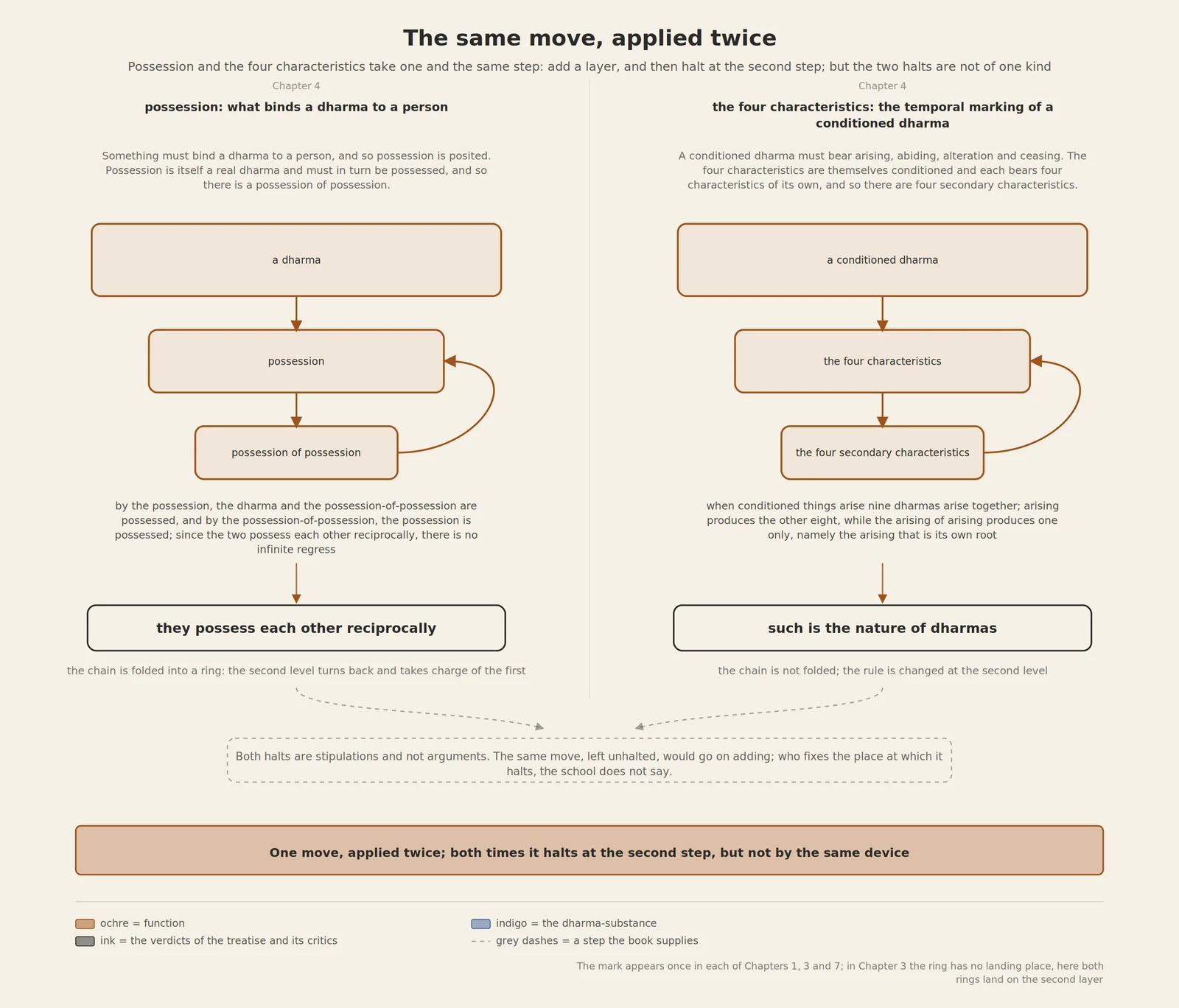
The regress appears for the first time. If possession is a real dharma it must itself be possessed; does possession then have a possession of its own? Fascicle one hundred fifty-eight takes the question head on, and the first answer given is that possession should be said to have a further possession. Someone at once presses: is that not an infinite regress? Answer: an infinite regress is no fault either, and it is by this that birth-and-death are hard to sever and hard to cross.2 The posture of that sentence is not that of an evasion; it looks rather as though the infinite had been put to use as a resource—it is precisely because the levels of possessing have no floor that birth-and-death are so hard to sever and to cross. What is adopted, however, is a different answer: in a single moment there are only three dharmas, first the dharma, second its possession, third the possession of the possession; by the possession, the dharma and the possession-of-possession are possessed, and by the possession-of-possession, the possession is possessed; since the two possess each other reciprocally, there is no infinite regress.2 The chain has been folded into a ring. The second level, instead of generating a third above it, turns back and takes charge of the first. This book records the move as the school's standard handling of a regress, since the next section will meet it again. It is worth noting that adopting the one answer is not the same as ruling the other wrong—the treatise carries both, with only the latter marked as the one that should be said. What the Sarvāstivāda does here is choose, not refute.
The same move applied a second time. The four characteristics of the conditioned are arising, abiding, alteration, and ceasing. If the four characteristics are real dharmas they are themselves conditioned dharmas, and should each have four characteristics of their own; whence the four secondary characteristics—the arising of arising, the abiding of abiding, the alteration of alteration, the ceasing of ceasing. Fascicle thirty-nine asks whether the characteristic of arising has a further characteristic of arising. Answer: arising has a further arising. Pressed: then is the characteristic of arising not an infinite regress? The answer recorded first is that to allow this infinity is no loss either, for the three times are broad and ample, and how should there be no room to lodge in.2 The phrasing is cut from the same cloth as the passage on possession, and the added half-sentence is more direct still: the infinite is not to be feared because the real existence of the three times can afford the storage. One thesis furnishes a warehouse for another thesis's difficulty. This is a common enough thing inside a system; what is worth recording is that it should appear so plainly.
The settled verdict at the end of the same fascicle is that when conditioned things arise, nine dharmas arise together—the dharma, arising, the arising of arising, abiding, the abiding of abiding, alteration, the alteration of alteration, ceasing, and the ceasing of ceasing. The division of labour is that arising can produce the other eight, while the arising of arising produces one only, namely the arising that is its own root. The next question comes of itself: both are called arising, so on what ground does the one produce eight and the other produce one? The treatise's reply is that such is the nature of dharmas and it should not be objected to; just as among fowls and dogs some bear eight at a birth and some bear one—is that to be objected to as well? The reply is not newly made. The earlier round, when three dharmas were said to arise together, used the same sentence, with only the simile changed from a woman bearing children to fowls and dogs. The number has gone from three to nine and the reason has been kept as it stood; what was upgraded is the accounting, not the reason behind the accounting.
Vasubandhu attacks from the side of function. His objection does not ask whether the four characteristics are real dharmas; it asks only which time their function belongs to. If the characteristic of arising has already exercised its function while in the future, on what ground is it still called future; and if the dharma has already arrived at the present while the function of arising is long past, on what ground does it count as present? A step further: at the moment when the characteristic of abiding is making this dharma abide, alteration and ceasing are simultaneously making it deteriorate—so is that moment to be called abiding, or alteration, or ceasing?3 This is the same blade as the three questions in the last chapter. The whole division of the three times is loaded onto function, and any newly added dharma that must also exercise a function has to answer which time its own function belongs to. The last chapter said that this gap stands open in the middle of the system; what this chapter sees is the leak running down along every newly added dharma. The Sautrāntika side puts it less politely: why analyse in this manner things as non-existent as space, when there is no determinate measure by which they can be shown?3
The two sides also used one and the same simile, pointed in opposite directions. Fascicle thirty-nine, describing the relation between the characteristics and what they characterize, says it is as the marks of a great man are to the great man: neither called an individual characteristic nor counted a common one, but simply an emblem.2 Vasubandhu, on the same matter, uses the ox: horn, hump, dewlap, hoof, tail—these marks of an ox are not separate from the ox.3 The Mahāvibhāṣā uses bodily marks to find a place for the characteristics, saying they have a standing of their own and need not be classed as individual or common; Vasubandhu uses bodily marks to abolish that place, saying the characteristic is not outside what it characterizes at all. A simile settles nothing by itself, but it shows what the two sides are really disputing: whether a mark must have an existence of its own.
The other side offers a different road. Vasubandhu posits no possession, and speaks instead of a transformation in the body that serves as basis. An action performed, a restraint undertaken, a defilement aroused, leaves in the psychophysical continuum a capacity, like a seed; and a seed that has been through fire is no longer what it was, having lost the power of growth. From seed to capacity, from capacity to the difference in the transformation of a continuum, the whole way is nominal positing, with no real substance at any point.3 Note the shape of this road: it hands persistence over to process and relation, in the same direction as the Theravāda's handing it over to the twenty-four conditions. The fork described at the opening of this chapter shows a third leg here—the opposition to the Sarvāstivāda is not the Theravāda alone, and the roads its several opponents take are alike in shape.
Why unmanifest matter was put among the material dharmas. The term "substance of the restraint" is used exactly once in the two hundred fascicles of the Mahāvibhāṣā, in fascicle one hundred forty, and that once happens to be in answer to the question of this section. Question: why is the substance of the restraint matter alone? Answer: because it blocks the arising of evil matter; and because it is of the nature of bodily and verbal action, and bodily and verbal action have matter for their substance. Question: why is mental action not restraint? Answer: because it cannot directly block evil restraint; and because the world commonly agrees that what guards and checks body and speech is called restraint. A last remark is added: mental action is the cause that issues in restraint, and the cause of restraint may not be called restraint, lest cause and effect fall into confusion.2 Observe the character of this answer. It is functional, not ontological. The evil that a restraint has to block arises along the two channels of body and speech, so what blocks it must be of the same kind as body and speech; and when the world speaks of restraint, what it speaks of is precisely the guarding of body and speech. As for the grounds on which this thing counts as really existent, not a word is said here.
There is a harder reason why it has to be matter: a restraint must still be there when there is no mind. A man asleep, a man who has entered the attainment of non-perception or the attainment of cessation, has the whole continuity of his mind cut off, and the restraint cannot be cut off along with it; a thing hung upon mind cannot cross that stretch, and a thing hung upon matter can. Vasubandhu, restating the point, puts it as a question: how could a restraint be issued in a state without mind?3 The Mahāvibhāṣā, discussing the great elements from which unmanifest matter is derived, leaves room for this as well, saying that the unmanifest issuing from bodily and verbal manifest action may be made from past great elements.2 Put the two passages together and the real reason for placing unmanifest matter among material dharmas is that it has to cross the interruption of mind. Chapter 2 said that it entered the material dharmas on the strength of "without it nothing can be made to work"; here that can be said more precisely: the sentence that will not work is exactly the sentence that a sleeping man is still a man who keeps the restraint. One further restriction follows the same line of thought. The unmanifest extends to the wholesome and the unwholesome only and not to the indeterminate, because an indeterminate mind is too weak in force to issue anything capable of remaining.3 In the Sarvāstivāda, persistence is a thing that has to be won by effort.
The price falls on the definition of matter. The last chapter quoted the admission in fascicle seventy-six: certain dharmas are matter and yet without obstructive resistance, namely past and future matter, and, in the present, the atoms and unmanifest matter. Vasubandhu, discussing the unmanifest, says it again: the unmanifest is not appropriated, because it has no obstructive resistance.3 The two passages lie generations apart and come from opposed sides, and they say the same thing. Matter takes its name from obstructive resistance, and unmanifest matter neither obstructs nor resists. An item admitted at the door on the strength of "otherwise it cannot be made to work" has, once inside, pushed the doorframe wider, and from this point on the word "matter" has two widths in Sarvāstivāda usage.
Two counter-questions from the Dārṣṭāntikas. Fascicle one hundred twenty-two records a passage from the opposition that is far from polite. The first counter-question: if manifest and unmanifest action really are matter, then are they blue, yellow, red, or white? The second: and how do they come to be of wholesome or unwholesome nature; if the shaking of the body is what makes them good or evil, then flowers and swords move too, so why not they?2 The first question is the shortest and the hardest to answer, since material dharmas have always been named under the two heads of visible colour and shape, and unmanifest matter goes into neither. The same fascicle records a caustic comparison as well. The Dārṣṭāntikas say the Abhidharma masters speak falsely, like a man who coaxes a beautiful woman to take off her human clothes so that he may clothe her in celestial ones, and who, when she asks where the celestial garment is, answers that celestial dress is subtle and can be seen by him alone and not by her—there was no celestial garment to begin with, let alone one to put upon another. The Mahāvibhāṣā copies this passage into its own book as it stands, and then rebuts it point by point. The last chapter said that the school is not polite to its own; a line may be added here—it is not casual about the record either, and it sets down the opposing words in full.
A glance in passing at the side of manifest action, where the same operation was performed once before. The Sarvāstivāda holds that the substance of bodily manifest action is shape and not motion: dharmas arise and cease in a moment, and ceasing does not wait upon a cause, so that a dharma has no time at all in which to move from here to there; what is called raising a hand or setting down a foot is only a succession of adjacent shapes each arising and ceasing, and the only thing that can be seen, and can be called good or evil, is that shape.3 The Sautrāntika side will not grant even the real existence of shape. What is to be noticed here is not which side is right, but that the school's manner of handling a problem has shown itself once again. When a stretch of process cannot be stated, it is restated as a thing. Motion is exchanged for shape, persistence is exchanged for unmanifest matter, and the direction of the two exchanges is exactly the same.
The life faculty and the homogeneous character of a group. Fascicle twenty-seven asks: a being of the formless realm has no body, so upon what does the continuity of his mind proceed? Answer: upon the life faculty (jīvitendriya), upon the homogeneous character of a group (nikāya-sabhāga), and upon the rest of the conditionings dissociated from mind of this kind; and that one ordinarily speaks only of proceeding upon the body is because the body is coarse and evident, while the life faculty and the rest are subtle and hard to point out.2 The life faculty is the vital force, charged with maintaining warmth and consciousness; the homogeneous character is charged with letting a class of beings be spoken of as a class. The two fill the two halves of one vacancy: on what ground a continuum is alive throughout, and on what ground a continuum is human throughout. Vasubandhu's handling of the life faculty is to dissolve it—the vital force is only a certain power residing in the homogeneous character, as a seed has a course to run before it ripens, as an arrow once off the string has a residual momentum, and no separate dharma need be posited. The reply of the Mahāvibhāṣā masters is a single sentence: there is a distinct real thing able to maintain warmth and consciousness, called the substance of the vital force, and this account is the better one.3
The homogeneous character of a group is the furthest step taken along this road. What it has to handle is similarity. Men resemble men and gods resemble gods, and if this resemblance were only a description, every sentence resting on it would be left without support; therefore it has to be a dharma. But once similarity has become a dharma the question follows at once: this instance of the homogeneous character and that instance of it also resemble one another, so is a further homogeneous character needed to take charge of them? The treatise has already distinguished the homogeneous character of beings from that of dharmas, and the undifferentiated homogeneous character from the differentiated; the direction of the dividing is toward finer detail, not toward this question. The Theravāda is empty at the same place: it posits the life faculty and does not posit a homogeneous character, and that a class of beings is a class is accounted for there by action and by the pattern of the cognitive process, with no dharma in charge of resemblance required. The comparative table in Chapter 2 already carried this cell; what is added here is the reason.
An appended section: the intermediate existence. The transition between two lives was pointed to twice, in Chapters 4 and 6 of Part 14. The Sarvāstivāda posits an intermediate existence (antarābhava) and the Theravāda does not, and the reasons on both sides have been preserved. Fascicle sixty-nine records that the Vibhajyavādins object from scripture: one who commits an act of immediate retribution must go straight to hell, and there is no room in between; and they cite a verse about seeking to abide in the middle and finding nowhere to stay. A further objection is added on grounds of reason: as there is no gap between a shadow and the light, so there should be none between two lives. The reply of those who accord with reason has two parts. The first also adduces scripture—the gandharva, the one who attains final nirvāṇa in the interval, the mind-made being: three terms all found in the discourses. The second is the real reason: if there were no intermediate existence, then since this body has ceased and that body has not yet arisen, the interval would be a break; and then that body would be what did not exist and comes to be, and this body what existed and has returned to non-existence, and dharmas too would have to follow suit, coming to be from not existing and, having existed, returning to non-existence. This fault cannot be allowed, and therefore there is an intermediate existence.2
The intermediate existence is therefore not, in the first place, a doctrine about what happens after death. The last chapter said that "what did not exist now exists" and "what existed has returned to non-existence" are the two wrong views the Mahāvibhāṣā has to block, and that fascicle twenty-three, treating the twelve links of dependent arising, uses the two past links and the two future links precisely to block them. If a vacancy is left at the junction of two lives, those two sentences come out true at the most critical point of all. Something must therefore occupy that interval, and once that something has to exist, it has to be a stretch of existence possessed of mind and matter. One distinction should be made here. The intermediate existence is not one more dharma added to the inventory; it is a stretch of existence composed of the five aggregates, and does not stand on the same level as the preceding items. But the act of positing it is exactly the same as in those items—a vacancy is not to be left empty, and an existent is placed there. This chapter sees the act for the third time, only this time the vacancy filled opens between two spans of life. There is one asymmetry in this debate worth recording. The scriptures cited by the Vibhajyavādins are reconciled one by one, being declared of provisional meaning, or nominal positing, or spoken with another intention; while the reasoning of the Vibhajyavādins is dismissed thus: the difficulty they raise need not be reconciled, and why? because it is not from the three baskets.2 Scripture must be reconciled; reasoning need not. What that sentence implies for the ranking of teachings lies outside the scope of this part, and Part 16 will collect sentences of this kind and look at them together; a single source is noted here.
A dharma, once posited, grows its own contents. The two words "intermediate existence" occur more than twelve hundred times in the Mahāvibhāṣā, the great majority concentrated in the three fascicles sixty-eight to seventy, and what is discussed there is no longer whether it exists but what its size is, what faculties it has, what it feeds upon, how long it stays, and whether it can change its destination.2 The item of what it feeds on shows that self-direction best. The treatise does the arithmetic first: intermediate beings are as thick as unhusked rice poured into a granary, and if they fed on coarse and heavy food, all the food in the world would not be enough for the intermediate beings of the canine sort alone; besides which the body of an intermediate being is exceedingly light and fine, and would break up were it to eat coarse matter. It concludes accordingly that the intermediate being feeds on scent and not on coarse substance, those with merit regaling themselves on the light and subtle fragrance of pure flowers and fruits, those without merit on the faint and rank fragrance of dung and putrefaction.2 The old word gandharva is rendered in Chinese precisely as "feeder on scent," in the sense of sustaining the body by scent on the way to the place of birth; the reading "seeker of scent" is a later corruption, and the road by which it went wrong most likely runs through another of the names given in the same passage—the intermediate existence is also called seeker of birth, explained as being always glad to seek out and examine the place where it is to be born.3 This book records the bulk because it shows the other face of addition: a dharma posited to stop up one leak acquires, once it stands, topics of its own, and those topics are no longer under any restraint from the leak that occasioned it. Chapter 2 asked why that inventory has exactly seventy-five entries; a line may be added here—the length of an inventory is not wholly designed, and one stretch of it has been made long by the topics the inventory itself generated.
The rebuttal from the Theravāda side is powerful, and it is at the same time a rebuttal of the Theravāda. Chapter 6 of Part 14 recorded the argument of the second chapter of the eighth book of the Kathāvatthu: if the intermediate existence is a stretch of existence possessed of mind and matter, it is already a span of life in its own right, and then it is not between two lives but makes a third, and the problem has merely been pushed back one place.1 That rebuttal lands. But once the intermediate existence is abolished, the junction of two lives has no cushion at all: the last mind of one span and the first mind of the next have to meet flush, and the only thing that could make them meet is a clock shared by both sides, which this system has not supplied. To compress a problem to zero thickness is not to answer it; squeezing it out of sight is not the same as settling it. That sentence is this book's own judgement.
Beneath the polemic lies an agreement. What neither side will have is one and the same thing: a gap opening in the continuity of phenomena between two spans of life. The Sarvāstivāda sets a stretch of existence into the gap and fills the interval; the Theravāda declares that the rebirth-linking consciousness arises just where the death consciousness ceases, and presses the interval to zero. Filling and flattening are two handlings of one refusal. The metaphysical distance between the doctrine of intermediate existence and the doctrine of death consciousness and rebirth-linking is therefore much smaller than the pitch of the debate suggests: that the continuity of phenomena must not break is a line the two sides hold in common; they differ only over what to hold it with.
In this book's judgement there is a further distinction here that neither side draws: a gap for whom? To say that the junction of two lives is broken is to measure in the third person — standing outside the continuum, holding a clock the world shares, gauging the distance between the last mind and the first. From the stream's own side there is only one question, whether the preceding moment and the following moment join; and so long as two moments cohere as phenomena, however long the clock says passed between them, nothing of it shows up within the stream, and no break is constituted there. The break treated as a disaster is a third-person break. Keep the two continuities apart, the third-person and the first-person, and the threat of the gap shrinks a good deal; nor are the Theravāda's own resources plainly unequal to that step. It simply did not take the step. Its manner here is assertoric: no intermediate existence, death and rebirth without interval — one sentence, and a metaphysical question is halted short of the root. Chapter 7 of Part 14 described this school's restraint; this is the same restraint, except that what is restrained away this time is precisely the question its own rebuttal of the Sarvāstivāda had raised.
There is one place where it goes further still. Fascicle one hundred sixteen asks what the intrinsic nature of a schism in the Saṅgha is. The answer: its intrinsic nature is non-concord, unobstructive and indeterminate, a conditioning dissociated from mind; it is comprised in the aggregate of dissociated conditionings, being what is spoken of elsewhere as the further conditionings dissociated from mind of this same kind.2 The breaking up of a monastic community (an event that happens in time, the relations among a body of people coming apart) is here too made over to a dharma, and made over by way of that residual entry at the end of the roll. The distinction drawn next is exceedingly fine: a schism and the offence of causing a schism are two different things. The schism is the property of non-concord, unobstructive and indeterminate, comprised in the aggregate of dissociated conditionings; the offence of causing a schism is false speech, an unwholesome act of speech, comprised in the aggregate of matter. The schism is therefore accomplished by the community, and the offence of causing it by the man who caused it. The accounts are kept very clearly, and it is their very clearness that makes them the harder to answer for—accomplishment must always have a continuum to carry it, and a monastic community is not a continuum.
These dharmas are almost all posited for the sake of sentient beings. Possession and non-possession (aprāpti) govern whether a dharma is tied to a given person; the life faculty governs whether a continuum is alive; the homogeneous character governs which class a being belongs to; unmanifest matter governs whether a man who has undertaken the restraint still counts as one who keeps it; the intermediate existence governs the stretch in which a being passes from this life to the next. Of the six fillings-in seen in this chapter, only the four characteristics are purely about dharmas; the other five all point at persons, and the schism just examined points at a body of persons. The Sarvāstivāda does not admit that the person is really existent, and it holds that line strictly; yet in order that what is said about persons might go on being said, it has posited five real dharmas along the way, and, one step further on, has posited one for the coming apart of a community as well. This book does not propose to describe that as inviting the self back in, which would not be fair—these dharmas are indeed not permanent, unitary, sovereign selves, and they arise and cease momentarily themselves. But what the doctrine of no-self has held and what it has let go in the Sarvāstivāda is a question Chapter 7 will answer directly; this chapter only hands over the list.
The six fillings-in this chapter has handled, laid out item by item:
| The item posited | The sentence it has to hold up | The positive reason for positing it | What the other side says | The trouble that follows once it stands |
|---|---|---|---|---|
| Possession and non-possession | This man has already attained the first fruit; this man is an ordinary person | Without possession the five scriptural sentences cannot be read; non-possession is raised along with it by the rule of symmetry | The Dārṣṭāntikas say possessing is only not being separated from, as five fingers closed together are called a fist; Vasubandhu says it has no substance that can be cognized and no function that can be pointed to | Possession must itself be possessed, and the regress begins here; the abandoning of defilement has to be rewritten as the exchange of an attachment |
| The four characteristics of arising, abiding, alteration, and ceasing | This dharma is now arising; this dharma is now ceasing | A conditioned dharma must have something able to mark its arising and its ceasing, and a mark must have an existence of its own | Vasubandhu asks which time the function of the four characteristics belongs to; the Sautrāntika side says there is no determinate measure by which they can be shown | The four characteristics are themselves conditioned dharmas, so four secondary characteristics are added, and with one dharma nine arise together |
| Unmanifest matter | A sleeping man still counts as one who keeps the restraint; the man who hires an assassin bears the guilt | Evil issues along the two channels of body and speech, so what blocks it must be of their kind; and a restraint has to cross the stretch in which there is no mind | The Dārṣṭāntikas ask whether it is blue, yellow, red, or white, and ask why, if the shaking of the body is what makes an act good or evil, flowers and swords are not good or evil too | Matter takes its name from obstructive resistance and the unmanifest neither obstructs nor resists, so from here on the word matter has two widths in the school's usage |
| The life faculty | This continuum has been alive throughout | A being of the formless realm has no body, and the continuity of his mind must rest on something; warmth and consciousness need something to maintain them | Vasubandhu says the vital force is only a power residing in the homogeneous character, like the momentum left in an arrow once off the string, and that no separate dharma need be posited | The reply of the Mahāvibhāṣā masters is only that this account is the better one, and what it rests on is the school's own tenet |
| The homogeneous character of a group | These beings all belong to the human destiny | If resemblance were no more than a description, every sentence resting on it would be left without support | Vasubandhu charges that to posit one general homogeneous character is to display outright the Vaiśeṣika category of generality | The resemblance between one instance of the homogeneous character and another still needs something to carry it, and the treatise never comes back to that question |
| The intermediate existence | Dying here and being born there, the stretch between is not empty | Were a vacancy left at the junction of two lives, what did not exist now exists and what existed has returned to non-existence would come out true at the most critical point of all | The Vibhajyavādins object from scripture; the Kathāvatthu says the intermediate existence is already a span of life, so the problem is merely pushed back one place | Once it stands it grows topics of its own, its size and its faculties and what it feeds on and how long it stays, twelve hundred occurrences and more within three fascicles |
The reasons in the middle column differ one from another; the troubles in the last column are for the most part of one shape, in that the dharma newly posited becomes in its turn a thing that has to be provided for. At the schism in the Saṅgha the step goes further still, for what has to be provided for is by then no longer a dharma but the relations among a body of people.
The second measure can now be weighed. All six fillings-in use the same action: wherever a sentence will not come out true, posit a dharma at that spot. Chapter 1 said that the Sarvāstivāda's measure of real existence is whether a thing can be broken up; Chapter 2 pointed out that this measure is not really applied at two places, the conditionings dissociated from mind and unmanifest matter—one and the same criterion keeps nineteen items out of the material dharmas and admits fourteen into the dissociated conditionings, and the reasons on the two sides are in fact not one reason. Having now gone through the items one by one, that second reason can be stated: an item is posited as a really existent dharma as soon as it cannot be dispensed with in some sentence that has to come out true. Possession cannot be dispensed with, because otherwise the word "possesses" in the discourses has nothing to rest on; the homogeneous character cannot be dispensed with, because otherwise there is no ground on which a class of beings is a class; unmanifest matter cannot be dispensed with, because otherwise a sleeping man does not count as keeping the restraint; the intermediate existence cannot be dispensed with, because otherwise there is a break between two lives. The Sarvāstivāda never wrote this criterion down as a criterion; it is read off the practice. Its merit is that every sentence has something to carry it. Its defect is that there can be as many dharmas as there are sentences.
It has no internal condition of stopping, and what stops it is stipulation. Neither regress was picked out by an outsider; the adjudicator raised both himself in the course of the question-and-answer, which shows that the school knew this action would roll onward. And each time it stops, it stops upon a stipulation: possession and the possession-of-possession possess each other reciprocally, therefore there is no infinite regress; the arising of arising produces one dharma only, such being the nature of dharmas, which should not be objected to; the substance of the restraint is matter alone, because what the world commonly agrees to call restraint is the guarding of body and speech. The three have their several reasons, but none of the three is derived from anywhere else; they are boundaries drawn at the place where questioning could be answered no further. A stipulation is not an error—a treatise has the right to fix the bounds of its own terms. A stipulation is not an argument either; it announces that at this place no further question will be asked, and does not state why at this place no further question need be asked.
The three regresses in parallel, two of them answered and one not:
| Where the regress appears | The form the question takes | The answer the treatise records first | The answer that is adopted | The sentence it stops on |
|---|---|---|---|---|
| Possession | If possession is a real dharma it must itself be possessed, so has possession a possession of its own | Possession should be said to have a further possession; an infinite regress is no fault either, and it is by this that birth-and-death are hard to sever and hard to cross | In a single moment there are only three dharmas, the dharma and its possession and the possession of the possession, and the latter two possess each other reciprocally | Since the two possess each other reciprocally, there is no infinite regress |
| The four characteristics | If the four characteristics are real dharmas they are themselves conditioned, and should each have four characteristics of their own | To allow this infinity is no loss either, for the three times are broad and ample, and how should there be no room to lodge in | When conditioned things arise nine dharmas arise together; arising produces the other eight, and the arising of arising produces one only | Such is the nature of dharmas, and it should not be objected to |
| The homogeneous character of a group | This instance of the homogeneous character and that one also resemble each other, so is a further homogeneous character needed to take charge of them | The treatise records no answer | The homogeneous character of beings is divided from that of dharmas, and the undifferentiated from the differentiated, the direction of the dividing being toward finer detail | The treatise never faces this question directly |
The first two rows fold the chain into a ring, the second level turning back to take charge of the first. In the third row the ring does not close.
Three more sentences are worth setting side by side. Vasubandhu, discussing possession, writes at the end that the Vaibhāṣika masters say possession and non-possession each have a real substance of their own and are not nominally posited; both lines of explanation are well stated, because they do not go against reason, and because the latter is the view to which he adheres by lineage. Vasubandhu, discussing the two mindless attainments and the fruit of non-perception, records the Mahāvibhāṣā masters as saying that the account offered is not good, because it goes against their school. Vasubandhu, discussing the life faculty, records that there is a distinct real thing able to maintain warmth and consciousness, and that this account is the better one.3 The three replies have the same shape, and the reason given is the school's own tenet. This book does not propose to read the three as showing that the Sarvāstivāda had nothing to say; that a school should halt upon its own transmission is proper to what a school is. It points out only that the three halting-places fall exactly where this chapter has been asking when the additions come to an end. Whether the three were arranged in this way deliberately by Vasubandhu remains hard to settle even now that the classical Chinese text has been collated, and this book gives no verdict on it.
Handed to Chapter 5. With the entities in place, one piece of business remains: how they are related to one another. Fascicle one hundred fifty-seven has in fact already drawn a distinction. A characteristic and what it characterizes must share one fruit, and the characteristic accompanies what it characterizes, is inseparable from it, and is neither before nor after it; whereas possession and what is possessed do not share one fruit, do not of necessity accompany one another, are not inseparable, and may be before or after.2 Both are attachments, and the two attachments are not equally tight. Drawing that distinction out requires a whole apparatus of causes and conditions, and that is the subject of the next chapter.
References
References
-
Abhidhammattha Saṅgaha, with Tables, ed. Bhikkhu Dhammadhīra, rev. Luo Qinglong, published by the Dhamma Rain Monastery. That the Theravāda posits neither possession nor non-possession, and no homogeneous character of a group, and that it handles the joining of action to fruit, restraint to person, and one life to the next by means of the twenty-four conditions, is found in the eighth chapter of that work, on the analysis of conditions, and was treated in Chapters 4 and 7 of Part 14. That the Theravāda posits the life faculty but no intermediate existence, and that the second chapter of the eighth book of the Kathāvatthu, on the intermediate existence, is devoted to refuting that doctrine, was treated in Chapter 6 of Part 14; the comparison in the appended section of this chapter rests on these. ↩↩
-
Abhidharma Mahāvibhāṣā Śāstra, 200 fascicles, trans. Xuanzang, Taishō vol. 27 (T1545). The passages used in this chapter fall in fascicles sixteen, twenty-three, twenty-seven, thirty-nine, sixty-nine, seventy, one hundred sixteen, one hundred twenty-two, one hundred thirty-two, one hundred forty, one hundred fifty-seven, and one hundred fifty-eight. Fascicle sixteen, on the associated cause, opens "Question: why are mind and its factors reciprocally the associated cause?" and answers "because they are reciprocally cause; because they arise by reciprocal force; because they draw one another on; because they nourish one another; because they increase one another; because they depend upon one another"; then come the similes, "as two bundles of reeds stand by mutual support; as many ropes joined together can drag a great log; as many men joining hands can cross a great river"; and the answer closes "because conditioned dharmas are feeble in nature, they accomplish their work only by leaning upon one another." The similes stand first in the original and the sentence about feebleness is the summing-up. Fascicle one hundred fifty-seven, at the head of the section on possession in the chapter on concentration, gives the Dārṣṭāntika view as "that a class of beings is not separated from that dharma is called possessing it; this has no real substance, but is only a designation nominally posited under a relation, as five fingers closed together are called a fist, and separated are not a fist, and therefore it is not really existent"; the five difficulties from scripture are, in order, that one in training possesses eight limbs while an arhat whose outflows are exhausted possesses ten, that one possesses wholesome and unwholesome dharmas, that a monk possesses the seven excellent dharmas, that the Tathāgata possesses the ten powers, and the gross consequence "an ordinary person would have to be called free of the defilements of the three realms, and an arhat would have to be called an ordinary person"; the rule of relative positing reads "because possessing is spoken of by reference to not possessing; as day is posited by reference to night, and light by reference to darkness, and all have real substance"; the passage on abandoning reads "it is not as one cuts a thing with a knife or grinds a thing with a stone; it is only the severing of the possession that binds and the obtaining of the possession of release, causing the defilements no longer to arise as possessed, that is called abandoning"; the difference between characteristic and possession reads "a characteristic and what it characterizes must share one fruit; the characteristic accompanies it and is not separate from it, and there is no before or after… possession and what is possessed do not share one fruit, do not of necessity accompany one another, are not inseparable, and may be before or after." Fascicle one hundred fifty-eight, on the possession of possession: "Question: does the possession spoken of have a further possession or not?… Answer: it should be said that possession has a further possession. Question: if so, it will be an infinite regress. Answer: an infinite regress is no fault either; it is by this that birth-and-death are hard to sever and hard to cross"; the adopted view reads "thus it should be said: in a single moment there are only three dharmas, first the dharma, second the possession, third the possession of the possession; by the possession, that dharma and the possession-of-possession are possessed; by the possession-of-possession, the possession is possessed; since they possess one another reciprocally, there is no infinite regress"; on posterior possession, "there can certainly be no dharma having only a posterior possession, since when it is present it must already have possession." Fascicle thirty-nine, on the four characteristics: "Question: does the characteristic of arising have a further characteristic of arising or not?… Answer: it should be said thus, that arising has a further arising. Question: if so, the characteristic of arising will be an infinite regress. Some say: to allow this infinity is no loss either; the three times are broad and ample, and how should there be no room to lodge in"; the adjudicating comment reads "it should be said thus: when conditioned things arise, nine dharmas arise together—first the dharma, second arising, third the arising of arising, fourth abiding, fifth the abiding of abiding, sixth alteration, seventh the alteration of alteration, eighth ceasing, ninth the ceasing of ceasing; herein arising can produce eight dharmas…" and "answer: such is the nature of dharmas, and it should not be objected to; as among fowls and dogs some bear eight young and some bear one—should that be objected to?", the earlier round using a woman bearing children, "as among women some bear two children and some bear one—should that be objected to?"; the simile of the marks of a great man reads "as the marks of a great man are to that great man, they are not called individual characteristics, nor are they common ones, but are simply an emblem." Fascicle one hundred twenty-two, at the head of the section on manifest and unmanifest action in the chapter on action, records the Dārṣṭāntikas: "the Dārṣṭāntikas say that manifest and unmanifest action have no real substance… this is merely the false speech of the Abhidharma masters"; the celestial-garment passage reads "as a man on seeing a beautiful woman, wishing out of desire to approach her, says: you may take off your human clothes and I will clothe you in celestial dress… he answers her: celestial dress is subtle, I alone see it and you cannot see it. Thus the foolish man had no celestial garment to begin with, still less one to put upon another"; the two counter-questions read "moreover, if manifest and unmanifest are matter, are they blue, yellow, red, or white? And how do they come to be of wholesome or unwholesome nature? If it is by shaking that they become good or evil in nature, then flowers and swords also move—why is it not so with them?" Fascicle one hundred thirty-two, on the great elements from which unmanifest matter is derived, allows that the unmanifest issuing from manifest action may be made from past great elements. Fascicle one hundred forty, on the substance of the restraint: "Question: why is the substance of the restraint matter alone? Answer: because it blocks the arising of evil matter; and because it is of the nature of bodily and verbal action, and the two actions of body and speech have matter for their substance. Question: why is mental action not restraint? Answer: because it cannot directly block evil restraint… and because the world commonly agrees that what guards and checks body and speech is called restraint, mental action is not restraint. It should be known that mental action is the cause that issues in restraint, and the cause of restraint may not be called restraint, lest cause and effect fall into confusion." Fascicle twenty-seven, on the formless realm: "upon what does the continuity of mind of a formless being proceed? Answer: upon the life faculty and the homogeneous character of a group, and upon the remaining conditionings dissociated from mind of this kind"; "because the body is coarse, one speaks only of proceeding upon the body; the life faculty and the rest are subtle and hard to point out." Fascicle sixty-nine, on the intermediate existence: the Vibhajyavādin objections and the reply of those who accord with reason are both given there in full; the passage on coming to be from not existing reads "if there were no intermediate existence, then this body having ceased and that body not yet arisen, the interval would be a break; and then that body would come to be from not existing, and this body would have existed and returned to non-existence, and dharmas too would have to be so, coming to be from not existing and, having existed, returning to non-existence. Lest this fault obtain, there is an intermediate existence"; and the closing dismissal reads "answer: the difficulty they raise need not be reconciled. Why so? because it is not from the three baskets." Fascicle seventy, on what the intermediate being feeds upon, first disposes of coarse food by the two difficulties of number and of bodily fineness, and then concludes: "it should be said thus: the intermediate being feeds on scent and not on coarse substance, and therefore the foregoing fault does not arise. Those with merit regale themselves on the light and subtle fragrance of pure flowers and fruits and the like, and so sustain themselves; those without merit regale themselves on the faint and rank fragrance of dung and putrefaction and the like, and so sustain themselves." The same fascicle lists the four names of the intermediate existence: "it is called intermediate existence, or gandharva, or seeker of existence, or mind-made." Fascicle one hundred sixteen, on schism in the Saṅgha: "Question: what is the intrinsic nature of a schism in the Saṅgha? Answer: its intrinsic nature is non-concord, unobstructive and indeterminate, a conditioning dissociated from mind. It is comprised in the aggregate of dissociated conditionings, that is, what is spoken of elsewhere as 'and there are yet other conditionings dissociated from mind of this kind.' Therefore a schism is one thing and the offence of causing a schism another… by this a schism is accomplished by the Saṅgha, and the offence of causing a schism by the man who caused it." The sentence from fascicle twenty-three blocking the two views was quoted in Chapter 3 of this part. The counts that follow were obtained by searching the whole two hundred fascicles of the CBETA text: "substance of the restraint," one occurrence (fascicle one hundred forty); "posterior possession," one occurrence (fascicle one hundred fifty-eight), with "prior possession" and "co-present possession" at none—the three as a coined set belong to the Abhidharmakośa and not to this treatise; "possession of possession," seventy-three occurrences, of which thirty-eight in fascicle one hundred fifty-eight and seventeen in fascicle one hundred eighty-six; "non-possession," two hundred thirty-five occurrences, of which one hundred thirty-seven in fascicle one hundred fifty-seven and fifty-six in fascicle one hundred fifty-eight; "unmanifest," three hundred ninety-nine occurrences, of which two hundred thirty in fascicle one hundred twenty-two, and "unmanifest matter," fifteen; "homogeneous character of a group," three hundred seventy-seven; "life faculty," two hundred twenty-seven; "intermediate existence," one thousand two hundred seventeen, of which two hundred fourteen in fascicle seventy and one hundred forty-eight in fascicle sixty-nine; "four characteristics," forty; "secondary characteristic," nineteen; "arising of arising," one hundred three. For the modern Chinese version see this site's translation of the Mahāvibhāṣā, rendered from the CBETA text. ↩↩↩↩↩↩↩↩↩↩↩↩↩↩↩↩↩↩↩↩
-
Abhidharmakośabhāṣya, 30 fascicles, by Vasubandhu, trans. Xuanzang, Taishō vol. 29 (T1558); Paramārtha's version is the Abhidharmakośaśāstra (T1559). The material used in this chapter is the passage explaining the meaning of matter in chapter one, on the elements; the passage on the dharmas dissociated from mind in chapter two, on the faculties (possession and non-possession, the homogeneous character, the life faculty, the four characteristics and the four secondary characteristics, the two mindless attainments and the fruit of non-perception); the passage on the intermediate existence in chapter three, on the world; and the passage on manifest and unmanifest action in chapter four, on action. On possession, the section begins by breaking the scriptural proof: a discourse says "monks, know that there is a wheel-turning king accomplished in the seven treasures," and the treatise glosses it "here sovereignty is called accomplishment; that is, the wheel-turning king has power of disposal over those seven treasures, and they turn as he pleases," from which it appears that the word accomplishment need not stand for a further thing at all. The objection proper follows: "the possession that is maintained has no substance that can be cognized, as colour and sound and the rest have, and no function that can be cognized, as eye and ear have; there is therefore no room for a separate thing called possession." The refutation of the claim that possession is the productive cause runs to five counts, and the original reads: "if this possession too has a function, namely that it is the productive cause of the dharmas obtained, then the unconditioned ought to be without possession. Again, a dharma obtained and afterwards relinquished, by a change of realm or stage or by becoming free of defilement, has no possession now; how then is it to arise? If the co-arising possession were the productive cause, what would arising and the arising of arising still have to do? Again, dharmas of insentient things would definitely not arise. Again, in one bound by every fetter the difference between the weak, middling, and strong grades of defilement in their arising would have to be absent, since possession admits of no difference. And if the difference is owing to some other cause, then dharmas should arise from that cause, and what further use has possession?" The school's change of wording reads: "who said that this possession is the productive cause of dharmas? If so, what function has this possession? It is the cause that establishes differences. How so? If there were no possession, then when an ordinary person and a noble one give rise to a mundane thought, there would be no establishing the difference between the ordinary person and the noble ones." Vasubandhu's own account refers the matter to a transformation of the body that serves as basis—"by the force of the paths of seeing and of cultivation the noble ones make the body that serves as their basis be transformed and become other than it was, so that among the defilements abandoned by those two paths there is no longer any capacity to make them occur, as a seed burnt by fire is transformed and has no power of production as before"—and runs on from there through seed, capacity, and the difference in the transformation of a continuum, all of which he holds to be nominally posited and not real. On the homogeneous character he presses the parallel with the Vaiśeṣikas: their doctrine posits a category of generality by which the notion and the word "the same" arise with respect to all dharmas, and a category of generality-and-particularity by which the notions and words "same" and "different" arise with respect to distinct kinds; the Vaibhāṣika masters answer that their own doctrine is not of the same order as this, since what they speak of is one thing operating over many. On the intermediate existence he gives its five names: mind-made, because it is born of mind; seeker of birth, because it is always glad to seek out and examine the place where it is to be born; feeder on scent, because it sustains the body by scent while going to the place of birth; intermediate existence, because it is the aggregates in the interval between two destinies; and arising. His closing note records that the Vaibhāṣika masters establish possession and non-possession as really existent, and that both explanations are well stated, since they do not go against reason and since the latter is the position he holds by lineage. On the life faculty, Vasubandhu treats the vital force as a power residing in the homogeneous character, with the two similes of a seed running its course to ripeness and an arrow's momentum after it leaves the string, to which the Mahāvibhāṣā masters reply that there is a distinct real thing able to maintain warmth and consciousness, called the substance of the vital force, and that this account is the better one. On the two mindless attainments and the fruit of non-perception, the Mahāvibhāṣā masters are recorded as saying that the account offered is not good, because it goes against their school. On the four characteristics, the material includes the division of labour by which the primary characteristics each act upon eight dharmas and the secondary characteristics each upon one only, the Sautrāntika objections to the real existence of the four characteristics (that this is to analyse what is as non-existent as space, and that no determinate measure can show it), the two questions on the time to which function is assigned, the difficulty of abiding, alteration, and ceasing occurring at once, the jibe at the doctrine that ceasing waits upon a condition—"though another school says that ceasing meets with the causes and conditions of ceasing and that only then can the characteristic of ceasing make the dharma cease, what that school says should be put beside the man who said that when one takes a purgative a god comes and makes it work"—and Vasubandhu's own reinterpretation of the four characteristics as the initial arising, the middle abiding, the difference between earlier and later, and the final exhaustion of a continuum, with the simile of the marks of an ox. The passage explaining the meaning of matter in chapter one records three attempts to justify calling the unmanifest matter, and three refutations of them: "one explanation says that manifest action has resistance to change, and that the unmanifest, following upon it, likewise receives the name of matter, as when a tree moves its shadow moves with it. This explanation will not do, for the unmanifest has no resistance to change; and again, when manifest action ceases the unmanifest would have to cease, as when a tree is destroyed its shadow is necessarily destroyed with it"; and to the rescue that shifts the resistance to the great elements upon which the unmanifest depends, the answer is "if so, then since what it depends on has resistance to change, the five sorts of consciousness beginning with the eye ought also to be called matter." On manifest and unmanifest action, the material includes the statement that the unmanifest is not appropriated and has no obstructive resistance; the school's proof from the case of a deed not done oneself ("again, when a man does not act himself but only sends another to do it, then if there were no unmanifest action the path of action would not be completed") together with Vasubandhu's substitute for it, "when the deed done by the one sent upon instruction is accomplished by force of the original preparation, it is in the nature of things that a subtle difference in the transformation of the instructor's continuum should arise, and by this a manifold fruit can be brought about hereafter… it should be known that just this subtle difference in the transformation of a continuum is what is called the path of action, which is to posit the name of the cause upon the fruit"; the doctrine that bodily manifest action is shape and not motion, with its simile, "as a flame runs along burning grass, arising in another place without interval, so the notion of running arises, and one is over-confident that there is a going"; the question of how a restraint could be issued in a state without mind; and the restriction of the unmanifest to the wholesome and unwholesome and its absence in the formless realm. The citations in this chapter were first taken from fascicles one, four, five, ten, and thirteen of this site's translation of the Abhidharmakośa, rendered from the CBETA text, and have since been verified line by line against the classical Chinese original; every sentence here attributed to Vasubandhu stands in that original. The two words "seeking scent" were searched for through the whole thirty fascicles of the Abhidharmakośa and the whole two hundred of the Mahāvibhāṣā, and occur in neither; both treatises read "feeding on scent," and the old claim that gandharva was anciently rendered "seeking scent" is mistaken. For the English see Leo M. Pruden, trans., Abhidharmakośabhāṣyam of Vasubandhu, 4 vols. (Berkeley: Asian Humanities Press, 1988–1990), rendered from Louis de La Vallée Poussin, L'Abhidharmakośa de Vasubandhu (Paris–Louvain, 1923–1931). ↩↩↩↩↩↩↩↩↩↩↩↩↩↩↩
-
Collett Cox, Disputed Dharmas: Early Buddhist Theories on Existence, Studia Philologica Buddhica Monograph Series XI (Tokyo: International Institute for Buddhist Studies, 1995). The book takes possession, non-possession, and the dharmas dissociated from mind for its subject, and appends annotated translations of the relevant sections of Saṅghabhadra's Nyāyānusāra; the problems addressed in the fifth through ninth sections of this chapter are those that study addresses, though this chapter goes back to the text of the Mahāvibhāṣā for its evidence throughout, and the judgements are its own. Saṅghabhadra's positive defence of the real existence of possession is found in the sections of the Nyāyānusāra translated there; the classical Chinese original of that treatise is now to hand (Taishō vol. 29, T1562, eighty fascicles), but this chapter has not yet gone through it point by point, and what is said here of Saṅghabhadra follows that study's translations for the present. ↩