Chapter 6: Atoms and Aggregation—The Material End¶
Separate the two senses of the word aggregation first, or this chapter will run two accounts together. Fascicle one hundred ninety-seven of the Mahāvibhāṣā was forced to do exactly this while treating contact. That contact from the eye through to the body is called contact by the aggregation of three raises no difficulty: faculty, object, and consciousness arise at once. That mental contact should also be called contact by the aggregation of three is awkward, since the mental faculty lies in the past, the object may lie in the future, and the consciousness is present—the three are not on the same square of time at all. The treatise's answer is to split aggregation into two senses: to arise together and not be separable is aggregation; not to conflict and to accomplish one task together is aggregation. Contact in the five consciousnesses holds by both senses, contact in mental consciousness by the second alone. The Venerable Ghoṣaka states it more flatly: it is because faculty, object, and consciousness accomplish one task together that the name aggregation is given, and not because they arise together and are inseparable.1
That sentence is the key to the school's doctrine of matter. What the Sarvāstivāda wants has never been that a number of atoms should pile up into a new entity; it is that a number of entities should accomplish one thing together. But the trouble sits just there. When it treats matter, the aggregation the school actually uses is precisely the sense Ghoṣaka refused—arising together and not being separable. Atoms do not accomplish one task together, as the end of Chapter 5 recorded: atoms of derived matter that offer resistance are barred from standing as co-existent cause to one another, because they are not of one fruit.2 One word, and the later sense is taken when contact is under discussion while the earlier sense is taken when clusters are. Wherever the word aggregation appears in what follows, the first thing to ask is which sense is in play.
Chapter 5 handed down three questions: what an atom is, how many atoms count as one place, and whether the thing that has been aggregated is the same thing as the atoms lying together. By the sentence of fascicle one hundred ninety-seven the third answer ought to be blunt—not another thing, only a number of things accomplishing one task. The material end is exactly where that blunt answer cannot be given, and why it cannot be given is what this chapter examines.
Why the school counts only eleven kinds of matter. Chapter 2 gave the list: the five faculties, the five objects, and unmanifest matter. The reason is that these eleven analyse down to atoms and no further; they cannot be dissolved, and by the criterion of Chapter 1 they are really existent.1 Look at it from the other side, at what was struck out of the Theravāda's twenty-eight. The three mutable kinds are states and not constituents. The four characteristic kinds are provided for elsewhere. The delimiting kind, that is, the element of space, is comprised in the sphere of visible form. The matter of sex is comprised in the body faculty. The matter of nutriment is comprised in odour, taste, and the tangible. The four great elements are comprised directly in the sphere of the tangible. The rule of striking out is one rule throughout: what disappears under analysis is not posited.
Yet the same criterion yields opposite results in the two directions. Pressing downward it is merciless, and whatever can be dissolved goes out. Reaching upward it erects unmanifest matter, a thing neither visible nor tangible, a thing that stands off the line of analysis altogether. Chapter 4 gave the account of how that thing came to be needed. Here it is enough to hold on to the asymmetry: used against others the criterion is a knife, and used in its own defence it is a door.
Of the eleven, the four great elements are the producers and the other ten the produced, and the relation of the two sides has a ready-made account. The verse of fascicle seven of the Kośa says: the great are two causes to the great, five kinds to what is derived; the derived are three kinds to the derived, and one kind only to the great. Taken in mutual relation the great elements are co-existent and homogeneous cause alone; toward derived matter they can be five causes, namely generating, supporting, upholding, sustaining, and nourishing—and all five are no more than differences within the efficient cause. Because things arise from them they are called the generating cause; as one speaks of relying on a teacher they are called the supporting cause; as a wall holds a painting they are called the upholding cause; because they do not break off they are called the sustaining cause; because they make things increase they are called the nourishing cause.2 Laid out, the five names give arising, transformation, support, duration, and growth, which sounds like a physics; in fact not one of them steps outside the single square of the efficient cause. The conclusion of Chapter 5 can be verified here once more: the six causes and four conditions only rearrange the same heap of dharmas by role, and the rearrangement is no different when it arrives at matter. What actually explains why a thing grows as it does is not the five names but the sentence standing behind them, that the great elements produce derived matter.
The definition of the atom is a string of negations. The words of fascicle one hundred thirty-six run: it cannot be cut, broken, or pierced; it cannot be taken up or put down, mounted or trodden, gathered or dragged; it is neither long nor short, neither square nor round, neither regular nor irregular, neither high nor low; it has no fine parts and cannot be analysed; it cannot be seen, cannot be heard, cannot be smelled or tasted, cannot be touched.1 A dozen cannots and half a dozen neithers, and in the whole passage only the closing half-sentence is positive: therefore the atom is said to be the subtlest matter. This book takes it that the style is not the point. The atom is the terminus of the procedure of analysis, and a terminus cannot be explained by analysing further; what can be said is only what it is not. Any property that could be stated positively would, in the stating, invite one further question—which part of the atom does that property belong to? And the atom is not permitted to have parts.
There follows immediately the sevenfold series. Seven atoms make a mote, seven motes a copper dust, and thence sevenfold again to water dust, hare's-down dust, sheep's-wool dust, ox-hair dust, and sunbeam mote, then nit, louse, and barleycorn, seven barleycorns making one finger-joint, and twenty-four finger-joints one cubit.1 Fascicle twelve of the Kośa compresses the same series into a verse and adds that the atom stands first and the finger-joint last, each successive term increasing sevenfold.2 The mote in that series is the subtlest of the colours grasped by eye and eye-consciousness, and only three kinds of eye can see it: the divine eye, the eye of a wheel-turning king, and the eye of a bodhisattva in his last existence.1 Which is to say that counting up from the atom, the second rung is already past the range of ordinary sight, and it takes a dozen more rungs from the mote to reach a single finger-joint. The impression such a series leaves is that the school possessed a quantitative grasp of matter; what it actually possessed was the number seven, multiplied a number of times.
A widely quoted account should be checked while we are here. Seven atoms make one atomic cluster, and the current version has one atom at the centre with six others posted one to each direction. But the term six directions does not occur even once in the two hundred fascicles of the Mahāvibhāṣā, the thirty of the Abhidharmakośa, or the eighty of the Nyāyānusāra. The sevenfold series of the Mahāvibhāṣā is a conversion of magnitudes and not a diagram of arrangement. The nearest thing to a doctrine of arrangement in the three treatises is a sentence in fascicle thirty-four of the Nyāyānusāra: in conglomerated, highly obstructive aggregates of matter, shaped atoms are laid out round about, and by the shape that such an aggregate sustains there come to be boundaries and interstices.3 Laid out round about is indeed arrangement, but it fixes no number. The diagram of one centre and six directions therefore does not come from these three books, and its actual source remains to be established elsewhere.
That an atom cannot exist singly is stated outright. The verse of fascicle four of the Kośa: in the desire realm a cluster without sound and without a faculty has eight substances; with the body faculty, nine; with a further faculty, ten. The prose explains that the subtlest aggregate of matter is given the name atomic cluster in order to show that there is nothing subtler than this; that where there is neither sound nor faculty in the desire realm eight substances arise together with not one lacking; and that the eight are the four great elements together with visible form, odour, taste, and the tangible.2 So the school in fact holds two minimums: the atom, a theoretically indivisible point, and the eight-substance cluster, the smallest lump that actually occurs.
One further sentence about the cluster deserves to be pulled out on its own. Within such a cluster, the treatise says, whichever substance has the greater force is plainly got at, while the bodies of the rest are not therefore absent—as with feeling the touch of a needle-point together with a stick, or tasting the flavour of salt together with parched flour.2 The needle goes in and one feels only the point, though the touch of the stick is there too; salt is stirred into the flour and one tastes only the salt, though the flavour of the flour is there too. This is the sentence in the whole Sarvāstivāda doctrine of matter that most looks as though it came from experience, and it is very nearly the only one. What it establishes matters: that eight substances arise together does not mean that eight are perceived, and what is perceived is only the one whose force predominates.
The two minimums do not have the same provenance, a point Chapter 1 left owing. The atom is analysed out: one divides and divides until division stops. The co-arising of eight is not analysed out at all; it is a restriction added on, and added precisely so that the atom shall not become a small ball one could set down by itself. The first lower limit is a result of analysis, the second a warden set over analysis. A doctrine that contains both a terminus reached by analysis and a rule forbidding that terminus to be taken out and used alone has a two-storey structure, and the structure will be met again.
Whether the atom is visible the Mahāvibhāṣā has not settled with itself. Fascicle one hundred thirty-two records two views: the Venerable Ghoṣaka says the atom should be called visible, since it is the object of the eye of wisdom; the Abhidharma masters say it should be called invisible, since neither the fleshly eye nor the divine eye can see it. The adjudicator adds a line in passing, that the question here is not put with reference to the eye of wisdom—which is to stand with the second party.1 The Kośa is blunter: the five consciousnesses definitely require many atoms accumulated before there is a support or an object for them, and by this reasoning too the atom is called a body that is not seen.2 Fascicle thirteen takes it as far as it will go: there is no case of a single atom serving as support and a single atom as object for the arising of one of the five consciousnesses, because the five consciousnesses depend on the accumulated and take the accumulated as object, depend on the resistant and take the resistant as object, depend on the aggregated and take the aggregated as object.1
Yet the same place in fascicle thirteen also says that there is a blue atom, and that there are atoms of length and the other shapes, only that eye-consciousness cannot grasp them. The reason given is carefully chosen: if a single atom were not blue, then a mass of atoms gathered together ought not to be blue either, and the same for length and the rest.1 The inference runs from the property of the aggregate back to the property of the unit, and its principle is that addition cannot conjure a new property out of nothing. The Sarvāstivāda here amounts to conceding that blue must already be present in the atom, since no quantity of piling will otherwise produce blue. There is nothing wrong with the principle itself. The trouble is that it holds against the school equally: what is not in the atom ought not to be in the aggregate either—so the interstices of the aggregate, its boundaries, and its visibility come from which atom exactly?
It is worth noticing that the Mahāvibhāṣā is perfectly capable of describing arrangement. On how the atoms of the faculties are set in the body it is minutely detailed: the atoms of the eye faculty are spread over the black of the pupil like a coriander flower, on another account standing one behind another like fine needles visible in an autumn pool; the ear faculty coils within the ear-hole like rolled birch bark; the nose faculty sits in the nostrils like a pair of fingernails; the tongue faculty is shaped like a half-moon; the body faculty is distributed in order throughout the body within and without.1 Fascicle two of the Kośa records much the same, with a further account of the eye faculty as heaped up in layers like a pellet.2 Where a diagram is due there is a diagram, and a creditable one.
Of all places, the one that most needs a diagram has none. How a number of atoms are put together into a single eight-substance cluster is a matter on which none of the three treatises offers an arrangement. This book takes it that the omission is not carelessness. The disposition of the faculties can be inferred backward from experience—the field of vision, the shape of the ear, the shape of the tongue all lie open to view. The disposition of a cluster cannot be so inferred, and once it were drawn a question would have to be answered: do two adjacent atoms touch or not? That is exactly the question the school least wishes to answer.
The passage on the body faculty carries an odd remark with it. Supposing all the atoms of the body faculty were to give rise to body-consciousness, the treatise says, the body would fall apart.1 The same fascicle records the Venerable Vasumitra on the four conditions under which matter is not seen: it is too near, too far, too subtle, or obstructed.1 Read together, the two show a school thinking rather finely about the limits of the senses, to the point of considering that a sense without limits would break the body. That kind of consideration is wholly absent one storey down: not a single limit set on the atom comes from experience.
Now to the dispute over contact. Fascicle one hundred thirty-two sets out the dilemma without padding: do atoms touch one another? If they touch, why do they not become one, or else acquire parts? If they do not touch, then when struck they ought to scatter, or else there ought to be no sound. The treatise's adjudication is that atoms do not touch one another, on the ground that if they touched it would be either wholly or in part; wholly, and there is the fault of becoming one substance; in part, and there is the fault of acquiring parts—and atoms have no finer parts.1
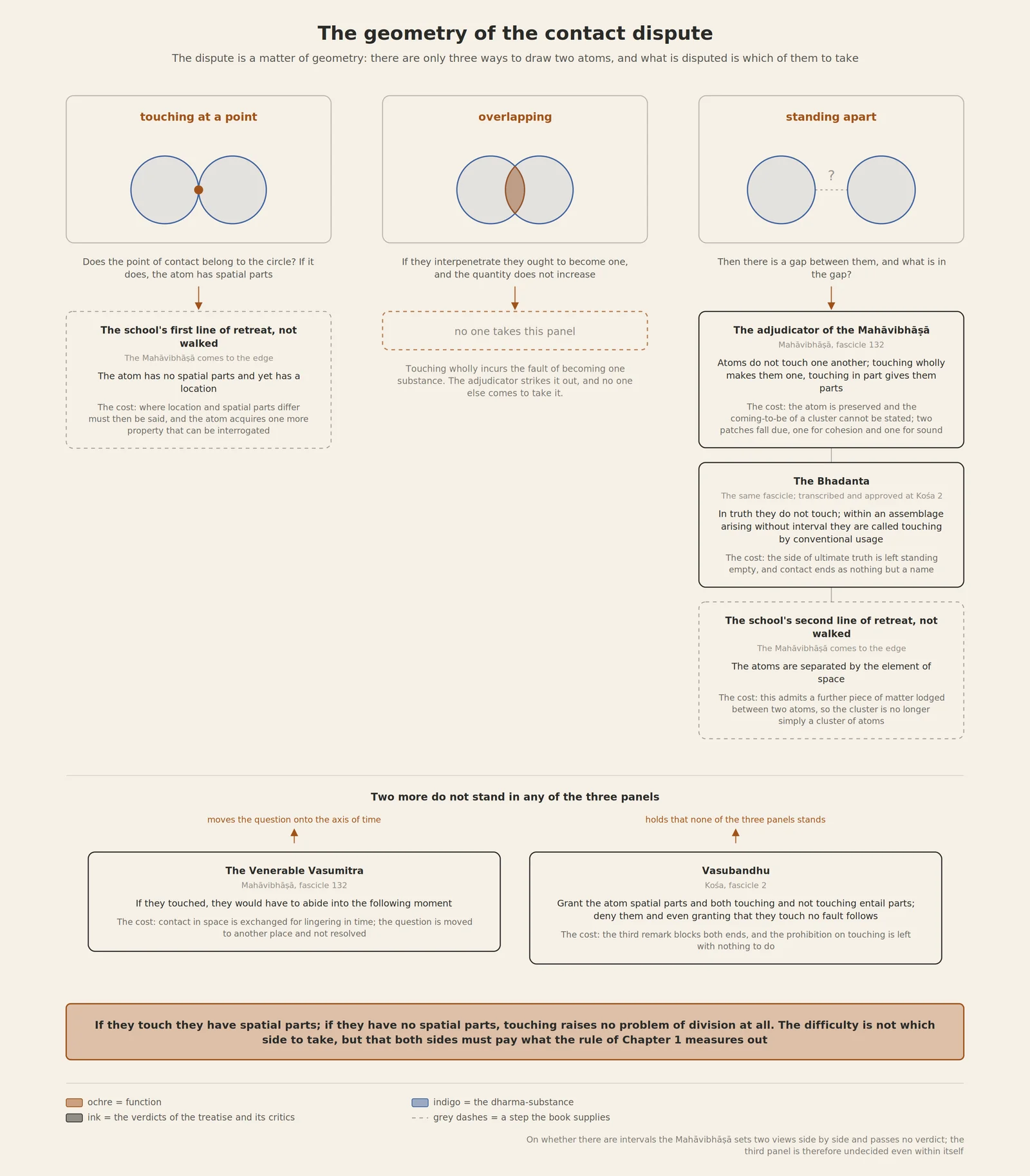
Why that inference is obligatory can be measured with the rule laid down in Chapter 1. If they touch they have spatial parts; if they have spatial parts they can be divided; if they can be divided they dissolve under analysis; if they dissolve under analysis they are not really existent. The criterion is carried over to matter without the alteration of a step. Not touching is therefore not a thesis about physics; it is a corollary of the criterion. It follows cleanly, and just because it follows cleanly it was later broken open at the same joint.
The two consequences of not touching were each fitted with a patch. Why do things not fall apart, given that the atoms do not touch? Because the element of wind holds them and keeps them from scattering. Does the element of wind not blow things apart? There is a kind that disperses, as in the aeon of dissolution, and a kind that holds together, as in the aeon of formation. And how can sound still be produced without contact? By that very absence of contact—for if the atoms really touched, then when the palms are brought together their bodies ought to blend, and with no interval left between them how could sound be produced at all?1 Neither patch is unsightly. But neither comes from observation; both come from the shape of the opponent's question.
The same passage leaves a four-case division which pairs contact with non-contact throughout. Sometimes contact is the cause of non-contact, as when an aggregated thing is in the act of dispersing; sometimes non-contact is the cause of contact, as when a dispersed thing is in the act of aggregating; sometimes contact is the cause of contact, as when an aggregated thing aggregates further; sometimes non-contact is the cause of non-contact, as with the homogeneous succession of a sunbeam mote.1 It reads very much like an account of particles gathering and dispersing, and yet it has not stepped an inch outside the prohibition, since contact and non-contact here are alike the nominal contact allowed above. The treatise has rewritten the entire phenomenon of aggregation as a ledger in which nothing touches anything.
Two elders' alternative views stand side by side in the same place. The Venerable Vasumitra says that if atoms touched one another they would have to abide into the following moment; the Bhadanta says that in truth they do not touch, and that within an assemblage arising without interval they are called touching by a nominal usage of conventional truth.1 Fascicle two of the Kośa transcribes the passage and declares itself openly: the Bhadanta's intention is to be found agreeable.2 Vasubandhu then adds three remarks of his own, each tighter than the last. If it were otherwise there would be intervals between the atoms, and with the space between them empty, what obstructs their passage such that they are granted resistance? Again, apart from atoms there is no aggregated matter, so that for aggregates to touch is for atoms to touch. And again, if the atom be granted spatial parts, then both touching and not touching entail parts; while if it has no spatial parts, then even granting that they touch, no fault follows.2
The third remark is the crux. If the atom has no spatial parts, then touching raises no problem of division at all, and the prohibition on touching was erected for nothing; if it has spatial parts, then not touching leaves it with parts just the same, and the prohibition was erected for nothing again. Vasubandhu's point is that the rule the Sarvāstivāda laid down in order to save real existence comes to nothing at either end.
The school is not without a line of retreat, only that each step back carries a bill. Say that the atom has no spatial parts and yet has a location, and the difference between location and spatial parts must be accounted for separately—and once that difference is explained the atom has acquired one more property that can be interrogated. Say instead that the atoms are separated by the element of space, and the trouble is more direct: the element of space is one of the items comprised in the sphere of visible form, so that this is to admit a further piece of matter lodged between two atoms, and the cluster is then not simply a cluster of atoms. The Mahāvibhāṣā comes to the edge of both retreats and walks neither of them to the end.
The dispute over contact, with the five statements and the bill each of them runs up:
| Who says it | Where it stands | What is said | What saying so costs |
|---|---|---|---|
| The adjudicator of the Mahāvibhāṣā | Fascicle one hundred thirty-two | Atoms do not touch one another; were they to touch it would be either wholly or in part, wholly incurring the fault of becoming one substance and in part the fault of acquiring parts, and atoms have no finer parts | The atom is preserved and the coming-to-be of a cluster cannot be stated; two patches fall due at once, one for why things do not fall apart and one for how sound is still produced |
| The Venerable Vasumitra | The same fascicle | If atoms touched one another they would have to abide into the following moment | Contact in space is exchanged for lingering in time; the question is moved to another place and not resolved |
| The Bhadanta | The same fascicle; transcribed in fascicle two of the Kośa, which declares the intention agreeable | In truth they do not touch, and within an assemblage arising without interval they are called touching by a nominal usage of conventional truth | The side of ultimate truth is left standing empty, and contact ends as nothing but a name |
| Vasubandhu | Fascicle two of the Kośa | Three remarks: with the space between them empty, what obstructs their passage such that they are granted resistance; apart from atoms there is no aggregated matter, so that for aggregates to touch is for atoms to touch; grant the atom spatial parts and both touching and not touching entail parts, deny them and even granting that they touch no fault follows | The third remark blocks both ends, and the prohibition on touching is left with nothing to do |
| The school's two lines of retreat, neither walked | Both touched on in the Mahāvibhāṣā | One, that the atom has no spatial parts and yet has a location; two, that the atoms are separated by the element of space | The first must then say where location and spatial parts differ, and the atom acquires one further property that can be interrogated; the second admits a piece of matter lodged between two atoms, so that the cluster is no longer simply a cluster of atoms |
Of the five, only the first is drawn out of the criterion; the remaining four circle the consequences of the first. And the last column comes to rest in one and the same place throughout: the cluster.
Turn back a page and the question of intervals is not adjudicated in the Mahāvibhāṣā at all. Fascicle one hundred thirty-two first asks whether there are intervals within an aggregate of great elements and the rest, and the answer offers two views. Some say there are intervals, the element of space lying mixed among them, which is why the atoms look inseparable—as a woman in a thicket screens her own body. Some say there are no intervals, the atoms pressing one on another and abiding without interval. And if there are no intervals, why do they not become one? The answer is that though there is no interval they do not become one, just as among the aggregates, bases, elements, and the three times there is no interval and yet no becoming one; and again that the great elements and the rest differ each from each in their own substance and function, and so cannot become one.1 The two views stand side by side with no adjudicating comment. Intervals and no intervals are two contrary descriptions of the same lump of matter; the treatise takes both in, and having taken them in goes on to something else.
A current account may as well be corrected here too. It is often said that the Sarvāstivāda held atoms to conglomerate without aggregating, conglomeration being set up as a technical term. But the word conglomeration occurs exactly once in the two hundred fascicles of the Mahāvibhāṣā, in fascicle seventy-one, where it says that the element of the tangible has many atoms conglomerated in one place;1 it occurs not once in the thirty fascicles of the Kośa; and it is only in the eighty fascicles of the Nyāyānusāra that it reaches thirty-two occurrences.23 Against these, the word aggregation stands at two hundred ninety-two, fifty-three, and two hundred sixty-one in the three books respectively. The technical term is Saṅghabhadra's and not the Mahāvibhāṣā's. This book takes it to have come of answering: pressure from the Sautrāntika side left the school no choice but to set up a name marked off from aggregation, and Saṅghabhadra then erected one. The party directly opposite him is the Elder Śrīlāta, the matter in dispute is the object of the five consciousnesses, and the instrument is the simile of the blind men; the three additional remarks in fascicle two of the Kośa are another branch of the same line of attack.3 The Mahāvibhāṣā, arguing that atoms do not touch, had no such word in hand and felt no need of one.
The weight carried by the atom itself likewise rose as the beating went on. The word atom stands at one hundred twenty-seven occurrences in the two hundred fascicles of the Mahāvibhāṣā, seventy-two in the thirty of the Kośa, and two hundred fourteen in the eighty of the Nyāyānusāra. Converted to a density per fascicle these are roughly six-tenths, two and four-tenths, and two and seven-tenths, the last two some four times the first. The atom is not a hot spot in the Mahāvibhāṣā. It is a technical term at the far end of the procedure of analysis, and across two hundred fascicles it does not even receive one concentrated treatment. Only when there was something to defend did it become a position.
The three words, counted through the three treatises:
| Word | Mahāvibhāṣā, two hundred fascicles | Abhidharmakośa, thirty fascicles | Nyāyānusāra, eighty fascicles |
|---|---|---|---|
| Atom | One hundred twenty-seven | Seventy-two | Two hundred fourteen |
| Atom, converted to density per fascicle | Six-tenths | Two and four-tenths | Two and seven-tenths |
| Aggregation | Two hundred ninety-two | Fifty-three | Two hundred sixty-one |
| Conglomeration | One, in fascicle seventy-one, where the element of the tangible is said to have many atoms conglomerated in one place | None | Thirty-two |
| Six directions | None | None | None |
Five rows of figures point at three sides of one thing. In the Mahāvibhāṣā the atom is no more than a technical term at the far end of the procedure of analysis, and becomes a position only when there is something to defend; conglomeration is Saṅghabhadra's term, and the Mahāvibhāṣā, arguing that atoms do not touch, had neither the word in hand nor any felt need of one; as for the figure of one centre and six directions, in the three treatises there is not a single occurrence of the phrase to rest it on.
Modern scholarship on this line is already fine-grained: the contact of atoms, the difference between conglomeration and aggregation, and the dispute over the object of the five consciousnesses have all had dedicated treatment, and the context in which Saṅghabhadra set up conglomeration has been described.4 The concerns of this chapter run parallel to that work; its evidence has been taken back throughout to the three treatises themselves, and the counts, together with the judgements drawn from them, are this book's own.
The target is set up here, and this chapter does not fire. Vasubandhu later took two cuts at the atom in the Viṃśatikā, the Twenty Verses: if the atom joins with six others one to each direction, then a single atom comes to have six parts; and if the six occupy one point, then the mass of atoms is still only the size of one atom, and a great mountain ought to weigh the same as a mote.5 Both cuts are left to Part 18. What need be noted here is only the shape of the target: neither cut is aimed at the atom, both are aimed at aggregation. The Sarvāstivāda says that atoms do not touch in order to leave no room for spatial parts; Vasubandhu's way of putting the question is, then how does a lump of anything come to be? Not touching preserves the atom, at the price of an aggregate that cannot be explained.
One thing easily confused should also be cleared up: the Sarvāstivāda atom is not the eternal atom of the outsiders. Fascicle twelve of the Kośa, treating the destruction of the aeon, says that in the end not even an atom remains, and immediately records the contrary case—that a class of outsiders holds the atom to be permanent, and says that atoms remain even then.2 The school explicitly does not stand on that side. The atom arises and ceases moment by moment like every other conditioned dharma; its minimality holds only along the dimension of space, and along the dimension of time it is as short-lived as anything else. The refutation of the Vaiśeṣika doctrine of the part-possessor in the same fascicle, and the refutation of the single-cause doctrine in fascicle seven, both run on from this position.2
So two doctrines are stacked on the atom: momentary cessation, and existence in the three times. Chapter 3 dealt with the pair—the substance abides while the function has an arising and a ceasing, and the three times are established by way of the function.1 Carried over to the atom the pair becomes conspicuous, because a single atom never exercises any function: the five consciousnesses depend on the accumulated and take the accumulated as object, and one atom serves neither as support nor as object. On what ground, then, is a given atom judged to be present? This book's position is that it is on the ground of the cluster it is in. Function is something only a cluster has, and the boundary between present and past-and-future must be drawn by function; so the smallest really existent unit has to borrow its presentness from the nominal lump it goes to make up. Here is the sharpest point at the material end: the real must borrow its time from the nominal.
Set beside the Theravāda, the difference is not in the picture but in what the picture is for. Among the twenty-eight kinds of matter treated in Chapter 3 of Part 14 there is no atomic storey. The material cluster is the smallest unit that actually exists, eight dhammas arising and ceasing together within it; the cluster itself does not count as a dhamma but is only a name.6 The Theravāda does not ask whether the cluster divides further, because further down is not a place contemplation can reach. The minimum the two schools want is not the same kind of minimum: the Sarvāstivāda wants a theoretical lower limit, where analysis can push no further; the Theravāda wants an observational lower limit, where looking can see no further.
The difference has a more concrete expression as well. The Theravāda has to answer how material clusters arise, and the answer is that kamma, mind, temperature, and nutriment each generate clusters of their own.6 The Sarvāstivāda has no corresponding account of origination for the eight-substance cluster. It has the great elements producing derived matter, but that is a ledger of what depends on what inside a single cluster, not a ledger of where the cluster came from. This book takes the reason to lie in the nature of the limit itself. An observational limit is something met with in direct contemplation, and what one meets one naturally asks the provenance of; a theoretical limit is something inferred, and what is inferred need have no provenance at all.
As it happens, the two lists of eight almost coincide. The Theravāda's pure octad is the four great elements together with visible form, odour, taste, and nutritive essence; the Sarvāstivāda's eight co-arising substances are the four great elements together with visible form, odour, taste, and derived tangibility.62 The first seven agree word for word, and only the eighth slot is filled differently. This book takes it that the agreement is not accidental. To draw up a list for the smallest lump of matter, the four great elements cannot be avoided, and visible form, odour, and taste give one item each to eye, nose, and tongue; who gets the remaining slot depends on what the school wants the list for. The Theravāda wants the cluster to be generable by four causes, and so counts in nutritive essence; the Sarvāstivāda wants body-consciousness to have an object, and so counts in derived tangibility. One table, two fillings, and each betrays what its school actually cares about.
The small example of Chapter 1 can be closed off here. There it was said that the pot is nominal in both schools for different reasons: the Sarvāstivāda says that when the pot is broken the idea of the pot is gone, so the pot is nominal, while the colour, odour, taste, and tangible left over cannot be dissolved, so they are real; the Theravāda says that the pot cannot be entered in the table of ultimate realities, and that what actually exists is a number of material clusters. One is a nominality arrived at by analysis, the other a nominality of failing to be registered. Arriving at the material end, that difference shows its full extent: on one side the lower limit is legislated, on the other it is encountered.
The two minimums measured item against item:
| The item measured | Sarvāstivāda | Theravāda |
|---|---|---|
| What the minimum is | Two of them: the atom, a theoretically indivisible point, and the eight-substance cluster, the smallest lump that actually occurs | One: the material cluster, eight dhammas arising and ceasing together |
| Where the lower limit comes from | Inferred, in that analysis pushes until it can push no further | Encountered, in that looking goes until it can see no further |
| Whether it is still asked if the thing divides | Indivisibility is stated outright, and standing alone is forbidden besides | Not asked, since further down is not a place contemplation can reach |
| Whether the cluster counts as a dharma | The atom is real and the cluster nominal, and yet function belongs to the cluster alone | The cluster does not count as a dhamma but is only a name |
| Whether arising is accounted for | For the eight-substance cluster there is no corresponding account of arising; great elements and derived matter settle which depends on which inside one cluster | Kamma, mind, temperature, and nutriment each generate clusters of their own |
| The eighth slot in the list of eight | Derived tangibility, so that body-consciousness may have an object | Nutritive essence, so that the cluster may be generated by the four causes |
| Why the pot is nominal | Break the pot and the idea of the pot is gone, while the colour, odour, taste, and tangible left over cannot be dissolved and so are real | The pot cannot be entered in the table of ultimate realities |
Of the seven items both schools answer six, and only at arising is the Sarvāstivāda box empty. A theoretical lower limit is inferred, and what is inferred need have no provenance; laid out on the table, that sentence is the one blank square.
Now to move existence in the three times formally onto the atom. Fascicle one hundred thirty-two states that the great elements and the matter they produce must be of the same time period: past elements produce past matter, present produce present, future produce future.1 The weight of the sentence tends to be read too lightly. It means that atoms exist not in the present only; past atoms and future atoms have substance just as much, each producing the matter of its own time period. A thing that occupies no volume, cannot be seen, and cannot be touched stands solidly in place across all three times.
The single exception is precisely unmanifest matter. The unmanifest matter set up by a manifest act is, in its first moment, produced by elements of the same time period like matter that offers resistance; from the second moment on, if it lies in the past or the present it is uniformly produced by past elements, and if it lies in the future it is produced by present and future elements together, and further on by elements of all three times.1 Chapter 4 said that unmanifest matter was made in order to catch the persistence of karma; here the back of that design is visible. For it to catch what it must catch, even the elements that produce it have to straddle the times. The one of the eleven kinds of matter not produced by elements of its own time period is exactly the one kind that is neither visible nor tangible.
But a passage almost the reverse of this stands close by in the same fascicle. Asked why there is no possession of past or future great elements, the treatise gives three answers in a row. First, that the great elements have only so much force of possession, so that possession occurs when they are present for a moment, and there is none of what has ceased or has not yet appeared. Second, that the perfuming of the great elements is not firm, since their nature is feeble and indeterminate—as with a thing held in the hand that is extremely fragrant, where the scent still clings after washing and wiping, unlike wood or stone, where the moment the hand lets go the scent is gone. Third, that if past and future great elements could be possessed, then in one destiny one would possess the great elements of five destinies, so that one body would be the body of five destinies, and when the destiny were destroyed its support would be destroyed with it.1 This is possession, from Chapter 4, coming back to collect. Possession can hang across the three times on wholesome and unwholesome dharmas, and cannot hang on the four great elements; the reason offered is that the elements are too feeble and too indeterminate. The substance exists in all three times, and there is nobody who can possess it. To have substance and yet not be capable of being possessed—the material end turns that odd sentence into settled doctrine.
There is a finer dislocation still. Fascicle one hundred thirty-eight records the definition of the appropriated given by the Venerable Zuoqu: a dharma that has spatial parts, belongs to the class of sentient beings, is bound up with the body, offers resistance, and can be drawn or repelled is called appropriated—and his own gloss adds that having spatial parts excludes past and future.1 In this elder's usage, having spatial parts is precisely the mark of the present. The atom, however, must be without spatial parts, since otherwise it is divisible, and divisible means not real. Put the two together and this is the result: as the last unit of matter, the atom lacks exactly the mark that separates the present from the past and the future. This book's position is that this is not enough to establish a contradiction, since the term spatial parts need not be used in one sense in the two places. But it photographs the shape of the same trouble: the more the Sarvāstivāda wants to call a thing real, the more it must call the thing property-less, and what has no properties is hardest of all to place in time.
The debt left over from Chapter 1 is settled here. There it was said that the criterion presupposes analysis to have a terminus, and that who sets the terminus the criterion does not say, and the account was charged to this chapter. The answer has been on the page all along: fascicle one hundred thirty-six, having finished with the measures of the atom, closes with a sentence—of conditioned dharmas the very least are one moment and one atom.1 That is the tone of legislation, not the tone of demonstration. The atom is indivisible not because analysis, arriving there, could go no further, but because there has to be some place where it can go no further, since otherwise analysis has no terminus and real existence has nowhere to be lodged. The dispute over contact shows this better than anything else: from beginning to end not one item of experience is used in it, only inferences of the form if such-and-such then such-and-such, whose major premise is that atoms have no finer parts—which is the very thing to be proved. The lower limit is not demonstrated. It is posited. The Sarvāstivāda doctrine of matter shows its floor at this point.
To Chapter 7. With six chapters run through, the first two columns of the table in Chapter 7 of Part 14 are filled in. The left column holds the empty slots in the Theravāda list; the right holds what the Sarvāstivāda put into the same positions—the criterion of sarvāstitva, the seventy-five dharmas, existence in the three times, possession and unmanifest matter, the six causes and four conditions, atoms and aggregation. The next chapter supplies the third column. The material end has already handed over a specimen of what it will contain: each time something is to qualify as really existent, one more rule has to be added, and that rule is not itself submitted to the same examination. What Chapter 7 has to see is whether six such additions, stacked one on another, still stand.
References¶
References
-
Abhidharma Mahāvibhāṣā Śāstra, 200 fascicles, trans. Xuanzang, Taishō vol. 27 (T1545). The passages used in this chapter fall in fascicles thirteen, seventy-one, one hundred thirty-two, one hundred thirty-six, one hundred thirty-eight, and one hundred ninety-seven, together with the account of function in fascicle seventy-six already given in Chapter 3. Fascicle one hundred ninety-seven, on the contact of three in aggregation: the ground of the doctrine reads "contact is called aggregation because the three do not conflict but produce one fruit together, and not merely because they arise together"; the division of the two senses reads "aggregation is of two kinds: first, to arise together and not be separable is called aggregation; second, not to conflict and to accomplish one task together is called aggregation. Contact associated with the five consciousnesses is called aggregation by both aggregations; contact associated with mental consciousness is called aggregation by the aggregation of accomplishing one task"; Ghoṣaka's words read "it is because faculty, object, and consciousness accomplish one task together that the name aggregation is given, and not because they arise together and are inseparable; for these three dharmas, in whatever time they may stand, are all able to accomplish one task in turn, and are therefore all called aggregation." Fascicle one hundred thirty-six, on the measure of the atom, reads "it should be known that the atom is the subtlest matter. It cannot be cut, broken, or pierced; it cannot be taken up or put down, mounted, trodden, gathered, or dragged. It is neither long nor short. It is neither square nor round. It is neither regular nor irregular. It is neither high nor low. It has no fine parts and cannot be analysed. It cannot be seen. It cannot be heard. It cannot be smelled or tasted. It cannot be touched. Therefore it is called the atom, and it is the subtlest matter"; the sevenfold series reads "these seven atoms make one mote, which is the subtlest of the colours grasped by eye and eye-consciousness. This is seen by three kinds of eye only: first the divine eye, second the eye of a wheel-turning king, third the eye of a bodhisattva in his last existence," with copper dust, water dust, hare's-down dust, sheep's-wool dust, ox-hair dust, sunbeam mote, nit, louse, barleycorn, and finger-joint following in sevenfold succession, twenty-four finger-joints making one cubit, the order of copper dust and water dust being differently given in another account; the closing passage of the same fascicle, on a dharma arising from a single condition, reads "is there a dharma that arises from one condition? Answer: there is not. Why? Because conditioned dharmas are feeble in nature… of conditioned dharmas the very least are one moment and one atom." Fascicle one hundred thirty-two, on contact: the dilemma reads "question: do atoms touch one another? Suppose they do—what fault? Both alternatives have a fault. If they touch, why do they not become one, or acquire parts? If they do not touch, then when struck they ought to scatter, or there ought to be no sound"; the adjudication reads "atoms do not touch one another. If they touched it would be either wholly or in part. Touching wholly, there is the fault of becoming one substance; touching in part, there is the fault of acquiring parts; and atoms have no finer parts"; the element of wind reads "the element of wind holds them and so keeps them from scattering," and "there is a kind that disperses, as in the aeon of dissolution, and a kind that holds together, as in the aeon of formation"; on sound, "it is by this very cause that sound is produced," and "if the bodies of atoms touched, then when hand and the rest are brought together their bodies ought to blend, and with no interval between them how would sound be produced?"; the two elders read "the Venerable Vasumitra says thus: if atoms touched one another, they would have to abide into the following moment. The Bhadanta says: in truth they do not touch, but within an assemblage arising without interval they are called touching by a nominal usage of conventional truth"; the four-case division reads "sometimes contact is cause and produces non-contact, that is, when an aggregated thing is in the act of dispersing. Sometimes non-contact is cause and produces contact, that is, when a dispersed thing is in the act of aggregating. Sometimes contact is cause and produces contact, that is, when an aggregated thing aggregates again. Sometimes non-contact is cause and produces non-contact, that is, the homogeneous succession of a sunbeam mote." The preceding passage of the same fascicle, on intervals, reads "question: are there intervals within an aggregate of great elements and the rest? Suppose there are—what fault? Both alternatives have a fault. If there are intervals, why are they not separate? If there is no interval, why do they not become one?" with the two views reading "some say: there are intervals here, since the element of space lies mixed among them… as a woman in a thicket screens her own body" and "some say: there is no interval here, since they press one on another and abide without interval," and the answer on not becoming one reading "though there is no interval they do not become one, as among the aggregates, bases, elements, and the three times, where though there is no interval they do not become one," and "again, the great elements and the rest differ each from each in their own substance and function, and therefore cannot become one"; on visibility, "the Venerable Ghoṣaka says thus: the atom should be called visible, since it is the object of the eye of wisdom. The Abhidharma masters say: the atom should be called invisible, since neither the fleshly eye nor the divine eye can see it. The question here is not put with reference to the eye of wisdom"; on the great elements and their matter being of one time period, "matter that offers resistance and is produced, and unmanifest matter that follows upon mind, are produced by the great elements of whatever time period they stand in: past produces past, present produces present, future produces future"; on the three classes of unmanifest matter, "if unmanifest matter is set up by a manifest act, there are three classes, unequal in the time of their production. In the first moment they are, like matter that offers resistance and the rest, each produced by great elements of the same time period. In the second moment, if they lie in past or present they are alike produced by past great elements; if they lie in the future they are produced by present and future great elements together. In the remaining moments, past and present are as before; if they lie in the future they are produced by great elements of all three times"; the passage on not possessing past and future elements reads "for those great elements have only so much force of possession, so that when they are present for a moment there is possession; of what has ceased and what has not appeared there is no possessor," and "some say: the perfuming of the great elements is not firm, and therefore there is no possession of past or future, their nature being feeble and indeterminate," and "as with holding for a moment a thing of the most fragrant flower, where though one washes and wipes, the perfume still clings—unlike holding wood, stone, and the like, where the moment the hand lets go the scent is gone," and "if past and future great elements were possessed, then in one destiny one would possess the great elements of five destinies, and thus one body would be the body of five destinies; and so when the destiny were destroyed its support would be destroyed also." Fascicle thirteen, on the atom and consciousness, reads "is there a case of one atom as support and one atom as object giving rise to eye-consciousness and the rest? Answer: there is not. Why? Because the five consciousnesses depend on the accumulated and take the accumulated as object, depend on the resistant and take the resistant as object, depend on the aggregated and take the aggregated as object"; on the blue atom, "question: is there a single blue atom? Answer: there is, but it is not grasped by eye-consciousness. If a single atom were not blue, then a mass of atoms gathered together ought likewise not to be blue; and so for yellow and the rest," with atoms of length and the other shapes given in the same form; on the disposition of the faculties, the eye faculty is "spread over the black of the pupil like a coriander flower," with the variant "standing one behind another like fine needles visible in an autumn pool," the ear faculty coiled within the ear-hole, the nose faculty within the nostrils, the tongue faculty "like a half-moon," and the body faculty distributed in order throughout the body within and without; also "supposing all the atoms of the body faculty were to give rise to body-consciousness, the body would fall apart"; and Vasumitra's four conditions for matter not being seen are that it is too near, too far, too subtle, or obstructed. Fascicle one hundred thirty-eight cites the Venerable Zuoqu on the appropriated ("a dharma that has spatial parts, belongs to the class of sentient beings, is bound up with the body, offers resistance, and can be drawn or repelled is called appropriated") with his own gloss "having spatial parts excludes past and future," a separate explanation by Ghoṣaka standing in the same place. The Chinese name of this elder is Zuoqu; the Sanskrit is not settled. Fascicle seventy-one, the one occurrence of conglomeration, reads "thus the element of the tangible has many atoms conglomerated in one place; two bodies pressing upon it each obtain one side, and there is no obtaining in common." The counts that follow were obtained by searching the whole two hundred fascicles of the CBETA text: "atom," one hundred twenty-seven occurrences, of which thirty in fascicle thirteen, ten in fascicle eight, eight in fascicle one hundred thirty-two, eight in fascicle seventy-six, eight in fascicle seventy-four, and six in fascicle one hundred thirty-six; "aggregation," two hundred ninety-two; "conglomeration," one. For the modern Chinese version see this site's translation of the Mahāvibhāṣā, rendered from the CBETA text. ↩↩↩↩↩↩↩↩↩↩↩↩↩↩↩↩↩↩↩↩↩↩↩
-
Abhidharmakośabhāṣya, 30 fascicles, composed by Vasubandhu, trans. Xuanzang, Taishō vol. 29 (T1558); Paramārtha's version is entitled Abhidharmakośaśāstra (T1559). Every sentence cited here has been checked against the classical-Chinese text of T1558 held on this site. Fascicle two, on accumulation, reads "of the eighteen elements, the five faculties and five objects, ten elements having matter, are capable of accumulation, being aggregates of atoms," and "the five consciousnesses definitely require many atoms accumulated before there is a support or an object for them; and by this very reasoning the atom is called a body that is not seen, since it cannot be seen"; the disposition of the faculties gives the eye faculty as "spread out like a coriander flower," with the variant "heaped up in layers like a pellet," the ear faculty "coiled like rolled birch bark," the nose faculty "like a pair of fingernails," the tongue faculty "like a half-moon," and the body faculty "of the shape of the body." The passage on contact in the same fascicle reads "again, do atoms touch one another? The Vaibhāṣika masters of Kaśmīra say they do not touch. Why? If atoms touched over their whole bodies, there would be the fault of real substances having their bodies mixed; if they touched in one part, there would be the fault of acquiring parts, and atoms have no finer parts"; then "if so, why does striking produce sound? Only because atoms arise without interval. If touching were granted, then when stone is struck or the hands clapped their bodies ought to blend"; and "if they do not touch, why does an aggregate of matter not scatter when struck? Because the element of wind holds it and keeps it from scattering." Vasumitra and the Bhadanta are as in fascicle one hundred thirty-two of the Mahāvibhāṣā, and Vasubandhu's verdict reads "the Bhadanta's intention is to be found agreeable," his three additions reading "were it otherwise, these atoms would have intervals between them; and the space between being empty, what obstructs their passage such that they are granted resistance?", "again, apart from atoms there is no aggregated matter, so that for aggregates to touch is to touch atoms; as with being capable of deformation, so here also," and "again, if the atom be granted spatial parts, then touching and not touching alike entail parts; and if it has no spatial parts, then even granting that they touch, no such fault follows." Fascicle four, the verse on the eight co-arising substances, reads "in the desire realm a subtle cluster without sound and without a faculty has eight substances; with the body faculty, nine substances; with a further faculty, ten," the prose reading "the subtlest aggregate of matter is given the name atomic cluster, in order to show that there is nothing subtler than this. In the desire realm, where there is neither sound nor faculty, eight substances arise together with not one lacking. What are the eight? The four great elements together with visible form, odour, taste, and the tangible," and "if sound arises in any of the foregoing clusters, the count increases in order to nine, ten, and eleven"; the passage on predominant force reads "within that cluster, whichever has the greater force is plainly got at, the bodies of the rest not being absent—as with feeling the touch of a needle-point together with a stick, or tasting the flavour of salt together with parched flour." Fascicle seven, the verse on the great elements and derived matter, reads "the great are two causes to the great; five kinds to what is derived; the derived are three kinds to the derived, and one kind only to the great," the five causes reading "toward what is derived the great can be five causes. Which five? Generating, supporting, upholding, sustaining, and nourishing, severally; and these five causes are only differences within the efficient cause," with the five similes reading "because things arise from them they are called the generating cause," "as one speaks of relying on a teacher they are called the supporting cause," "as a wall holds a painting they are called the upholding cause," "because they do not break off they are called the sustaining cause," and "because they make things increase they are called the nourishing cause," and the summary reading "thus is displayed the causal nature of the great toward what is derived, as arising, transformation, support, duration, and growth"; the refutation of the single-cause doctrine closes the same fascicle with "therefore there is no dharma produced by a single cause." Fascicle six excludes co-arisen matter that offers resistance from being co-existent cause, reading "all co-arisen derived matter that offers resistance, taken in mutual relation… not being of one fruit or of one maturation or of one outflow," already given in Chapter 5. Fascicle twelve gives the atom as the least of matter, "analysing matter down to a single atom, therefore one atom is the least of matter," the sevenfold verse reading "atom, mote, metal, water, hare, sheep, ox, sunbeam mote, nit, louse, barleycorn, finger-joint, each successive term increasing sevenfold," the prose reading "the atom stands first and the finger-joint last; it should be known that each successive term increases sevenfold, that is, seven atoms make one mote, and motes accumulated to seven make one metal dust"; the passage on the destruction of the aeon reads "down to not even an atom remaining. A class of outsiders holds the atom to be permanent, and says that atoms remain at that time," and the refutation of the Vaiśeṣika doctrine of the part-possessor stands in the same fascicle. The counts that follow were obtained by searching the whole thirty fascicles of the CBETA text: "atom," seventy-two occurrences, of which twenty-seven in fascicle two, eighteen in fascicle twelve, nine in fascicle one, six in fascicle thirteen, and five in fascicle twenty; "aggregation," fifty-three; "conglomeration," none. For the modern Chinese version see this site's translation of the Abhidharmakośa, rendered from the CBETA text. For the English see Leo M. Pruden, trans., Abhidharmakośabhāṣyam of Vasubandhu, 4 vols. (Berkeley: Asian Humanities Press, 1988–1990), rendered from Louis de La Vallée Poussin, L'Abhidharmakośa de Vasubandhu (Paris–Louvain, 1923–1931). ↩↩↩↩↩↩↩↩↩↩↩↩↩
-
Abhidharma Nyāyānusāra Śāstra, 80 fascicles, composed by Saṅghabhadra, trans. Xuanzang, Taishō vol. 29 (T1562). This site holds the classical-Chinese text of the treatise complete. Fascicle thirty-four, on shape and aggregates of visible matter, reads "again, in conglomerated and highly obstructive aggregates of matter, shaped atoms are laid out round about; and by the shape that such an aggregate sustains, boundaries and interstices come to be found," preceded by "it is plainly seen in the world that when conglomerated, highly obstructive, shaped aggregates of matter are entered by another highly obstructive thing, they are thereby damaged." This is the nearest thing to a doctrine of atomic arrangement in the three treatises. The counts that follow were obtained by searching the whole eighty fascicles of the CBETA text: "atom," two hundred fourteen occurrences; "aggregation," two hundred sixty-one; "conglomeration," thirty-two, distributed among fascicles four, eight, fifteen, twenty-five, thirty-two, thirty-three, thirty-four, and others. The thirty-two passages have been read one by one in the present round, and are distributed as follows: sixteen in fascicle four, one each in fascicles eight, fifteen, twenty-five, and thirty-two, two in fascicle thirty-three, and ten in fascicle thirty-four. The positive setting up of conglomeration stands entire in fascicle four, the fourth part of the chapter on the basic matters, and the party opposite is the Elder Śrīlāta; the treatise calls Vasubandhu the master of the Kośa, and the three occurrences of that title in fascicle four all fall outside this section. The point at issue is whether the object of the five consciousnesses is really existent. The Elder brings the simile of the blind men: "it is handed down that where blind men stand one by one, there is no function of seeing visible form, and where blind men are conglomerated, there is likewise no function of seeing. Just so, where atoms stand one by one there is no function of support or object, and where many are conglomerated this function is likewise absent. Therefore the bases are nominal and the elements alone are real." Saṅghabhadra's own thesis reads: "the five consciousnesses do not take an object that is not really existent, since conglomerated atoms are their object. Again, since the five consciousnesses are without conceptual construction, they do not take an aggregate of many atoms for their object. The name aggregation does not designate any further thing... since that aggregation is no separate dharma, it is only what conceptual reckoning takes. The five consciousnesses have no power of reckoning, and therefore do not take aggregation for their object." The division of labour reads: "therefore mental consciousness may take aggregation for its object, and the five consciousnesses may not, since these take only what is really existent." The counter-stroke against the simile of the blind men is the hinge of the whole section: "again, the simile of the blind men goes against his own school. The doctrine that single atoms are not substances of support and object, and that many atoms aggregated come to be so, set against the simile of the blind men, does not square with it at all. The doctrine that conglomerated atoms are support and object, set against the simile of the blind men, is not contrary to it in principle, since each single atom is granted to be support and object." He adds that whoever holds single atoms to be invisible must hold that many atoms aggregated are not seen either, by that same simile. The simile strikes the doctrine of aggregation and cannot reach the doctrine of conglomeration, because on the latter each atom is itself support and object. On whether atoms are visible: "this position will not do, for they are visible. That they are not made out is owing to the coarseness with which the eye faculty takes its object, and to the eye consciousness having no conceptual construction. Those with the power of surpassing discernment can make out the mark of the fine atom, as one views a brocade pattern from near and from far"; and "there is no atom that is not conglomerated; being always conglomerated, they are not invisible." Fascicle thirty-two further sets up two kinds of atom, real and nominal: "the atom is granted to be broadly of two kinds, the first real and the second nominal... the real is the established own-characteristic of visible form and the rest, got by direct perception in the state of conglomeration; the nominal is known by analysis and inference." The state of conglomeration is thus exactly the position at which the atom enters direct perception. The ten occurrences in fascicle thirty-four all concern shape and bodily manifest action, and are the passage on being laid out round about quoted above. The seventh section of this chapter takes conglomeration to have come of answering, and the reading bears that out; only the opponent needs a further name. What obliged the school to set up the term was the Elder's simile of the blind men and his doctrine that among the twelve bases the elements alone are real, and the three additional remarks in fascicle two of the Kośa are another branch of the same line of attack. ↩↩↩
-
K. L. Dhammajoti. Sarvāstivāda Abhidharma. 4th ed. Hong Kong: Centre of Buddhist Studies, University of Hong Kong, 2009. The relevant chapter is chapter 8, The Category of Matter (rūpa), pp. 187–210, with the atom treated at §8.3, "Atomic" theory. It gives a dedicated treatment of the divergences among the Mahāvibhāṣā, the Kośa, and the Nyāyānusāra on the contact of atoms, the difference between conglomeration and aggregation, and the object of the five consciousnesses, together with the context in which Saṅghabhadra set up conglomeration. The concerns of this chapter run parallel to it; the passages cited here have all been taken back to the three treatises themselves for verification, and the counts and judgements are this book's own. ↩
-
Viṃśatikā Vijñaptimātratāsiddhi, 1 fascicle, composed by Vasubandhu, trans. Xuanzang, Taishō vol. 31 (T1590). Its two difficulties against the atom are, first, that if an atom joins with six others one to each direction it comes to have six parts, and second, that if the six occupy one point the mass is no larger than a single atom. This chapter sets the work up as a target only and does not unfold it; Vasubandhu's complete attack on atoms and aggregation, and its relation to the three additional remarks of fascicle two of the Kośa recorded here, are reserved for Part 20. The base text used is the one-fascicle version translated by Xuanzang in Taishō volume 31, as recorded above. For the English, two renderings may be consulted: Stefan Anacker, trans., Viṃśatikā, in Seven Works of Vasubandhu, the Buddhist Psychological Doctor (Delhi: Motilal Banarsidass, 1984); and Thomas A. Kochumuttom, A Buddhist Doctrine of Experience: A New Translation and Interpretation of the Works of Vasubandhu the Yogācārin (Delhi: Motilal Banarsidass, 1982). Both render from the Sanskrit, whose numbering of the verses differs slightly from Xuanzang's, and Part 20 will cite by the Sanskrit numbering. ↩
-
Abhidhammattha Saṅgaha, with Tables, ed. Bhikkhu Dhammadhīra, rev. Luo Qinglong, published by the Dhamma Rain Monastery. The names of the twenty-eight kinds of matter, the distinction of the four great elements from derived matter, the constitution of the material cluster (kalāpa), and the pure octad (the four great elements together with visible form, odour, taste, and nutritive essence) are given in the sixth chapter of that work, the compendium of matter, and were set out in Chapter 3 of Part 14; the account of material clusters as generated by the four causes of kamma, mind, temperature, and nutriment stands in the same chapter. That the pot is not entered in the table of ultimate realities was given in Chapter 1 of this part. ↩↩↩