Chapter 5: Rebirth, the Destinations, and the Three Realms
Chapter 4 assigned the backbone to three lives and immediately handed the panorama to this chapter: how rebirth unfolds among the realms, how kamma operates, and what status this cosmic map possesses. Chapter 5 of Part 1 in the historical division already did two things. It recovered readings beyond the literal for two cosmic narratives and gave a coherent defense of beginninglessness. This chapter will not retrace those arguments. It asks a different question: under what circumstances did the Buddha say these things? To whom, for what reason, and where was the listener sent afterward? To learn the status of a map, first ask on which walls it was hung.
Hang up the map first. The map itself can be sketched quickly; Part 1 has already given its outline. The canonical phrase is the three modes of existence: sensual, form, and formless existence. In the definitional discourse cited in Chapter 4, these elaborate the link of existence. The names “three realms” and the detailed accounting of thirty-one planes are scholastic compilations: the labels come from the discourses; the shelving comes from the treatises. The canonical list contains five destinations: hell, animal, hungry ghost, human, and deva. The Mahāsīhanāda Sutta enumerates the five destinations and the courses leading to them, with nibbāna following last; the asuras are elevated into a sixth destination only at a later stratum.1 Lists of four, five, and six elements; two versions of a threefold craving; twelve, ten, nine, and four links; five or six destinations: the elasticity of inventories enters the file as a fourth case. The boundary of the map is marked “without discoverable beginning”: no first point can be discerned. Part 1 has already distinguished these words as a negative epistemic report, not a cosmological answer, and presented two challenges and their responses; they need not be repeated.2 One further detail deserves a line of its own. The Chinese Dīrgha Āgama devotes an entire volume, the Discourse on Records of the World, to cosmography: Mount Sumeru, the four continents, heavens, and hells. The Pāli Canon has no corresponding discourse.3 The Nikāyas contain no programmatic lecture on cosmology. Cosmic details are scattered among examples, frameworks, and similes. Anyone seeking a cosmology class will find no classroom in the canon. The absence is not a deficiency but deliberate blank space. Its purpose can be seen only at the scenes of use.
Six scenes. We can now inventory the scenes: where, to whom, and for what purpose did the Buddha bring out the realms?
First, beside the steps. Teaching newcomers among the laity follows a fixed sequence: talk on giving, ethical conduct, and heaven; then the danger of sensuality and the benefit of renunciation; only when the listener's mind is pliant does the Buddha teach the Four Truths.4 Heaven occupies the third step. Its position is already a judgment: the account of heaven is a stair into the hall, not the inner chamber. The stair rises precisely toward leaving the stair behind.
Second, at the sickbed. When people in the village of Nādika die one after another, relatives repeatedly ask about their destinations. After several rounds of answers the Buddha says: whenever someone dies, people come asking him; this is troublesome and is not the kind of question a Tathāgata delights in answering. He then gives the Mirror of the Dhamma: unshakable confidence in Buddha, Dhamma, and Sangha together with noble ethical conduct, by which a disciple can declare attainment for oneself.5 The question of destination is cooled and redirected by the Buddha's own hand: from asking him to knowing for oneself. The other side is reassurance. When Mahānāma fears death, the Buddha compares him to a pot of ghee submerged in water. When the pot breaks, the shards sink but the ghee rises. A mind long cultivated in faith, virtue, learning, generosity, and wisdom rises when the body breaks apart; there is no need to fear for it.6 Talk of realms at the sickbed has only two functions: to awaken the untrained and to settle the trained. Neither is a lesson in geography.
Third, facing opponents. The Aggañña Sutta, addressed to two novices of brahmin birth, recounts the beginning of the world. Radiant beings from the Ābhassara realm greedily taste the savor of earth; their bodies grow coarse and their light disappears. They eat their way from earth-savor to rice, private property, theft, the election of a king, and finally the four castes. Caste is not Brahmā's allocation but the sediment of human affairs. Scholars read the discourse as a parody of Brahmanical creation myth.7 Part 1 accepted that reading and added a layer of psychological phenomenology: installing happiness inside the fall is precisely the mechanism of the fall. This book adds another note here: parody is valid but not exclusive. A text's composition and performance need not sustain one reading only. Over the course of the same discourse's life, audiences change. For brahmins it is parody; for believers, instruction; for practitioners, a mirror of contemplation. The assumption of a single meaning is the modern reader's default, not the text's. The cosmic epic of the Cakkavatti-Sīhanāda Sutta belongs to the same family. Its long cycle of the growth and decline of the human lifespan is fastened at both ends to the instruction to be an island and refuge unto oneself, with the Dhamma as island and refuge. The epic is set inside parentheses belonging to practice.8 For villagers without a secure teaching to rely on, the Buddha is even willing to downgrade another world into a wager: while its existence remains unsettled for them, one who conducts oneself as if there were another world is safe on both sides. In the Apaṇṇaka Sutta, the realms appear as decision theory, not dogma.9
Fourth, on the meditation seat. For meditators, the realms take on another use. The six recollections include recollection of the devas: remember their faith, ethical conduct, learning, generosity, and wisdom, then turn back toward oneself—these qualities exist in me as well.10 The deva realm is a mirror reflecting one's own virtues. In the Tevijja Sutta, two young brahmins dispute the path to union with Brahmā. The Buddha accepts their destination and replaces their itinerary: the four abodes of loving-kindness, compassion, sympathetic joy, and equanimity are the road to Brahmā.11 In accounts of awakening, the divine eye during the middle watch sees beings passing among destinations according to their actions.12 On the meditation seat, the realms are content of direct vision and coordinates for contemplation, not theoretical propositions. A formal correspondence between jhānas and realms receives its own section below.
Fifth, beside an overheated mind. When someone makes the cosmos a playground of speculation, the texts cool it. On Vulture Peak, Moggallāna sees beings moving through the air—skeletons pursued by vultures. The Buddha says that he saw them too but did not report it; if he did, people would not believe him, and their disbelief would bring them suffering for a long time.13 The precise results of kamma belong among the four imponderables whose contemplation brings vexation.14 The worldly questions among the fourteen undeclared remain unanswered. The map is drawn while theoretical questions are refused. The boundary established in Chapter 1 remains on duty unchanged.
Sixth, before a numb heart. For someone who cannot hear impermanence, the scale is enlarged. The suite of discourses on beginninglessness consists entirely of quantities. The tears shed through long wandering exceed the waters of the Ganges and the four great oceans. If one's bones did not decay, their heap would rise higher than Mount Vepulla. If every tree and blade of grass on earth were made into counting sticks, the sticks would be exhausted before one could count one's mothers' mothers. A walled city of mustard seeds, brushed once every hundred years, would be emptied before an eon ended. On this long road one can scarcely meet a being who has not once been one's mother.2 The Sattasūriya Sutta burns down the stage itself. Seven suns arise in sequence. Rivers and oceans dry; Mount Sumeru and the great earth “burn and perish without ash or soot,” like ghee burned away without residue. Before beginning, the discourse posts a statement of purpose: conditioned phenomena are impermanent, unstable, insecure, subject to change; one should become disenchanted with them and seek release.15 The end of the cosmos is a teaching aid for contemplating impermanence, and the aid is labeled on its box.
The inventory yields one observation running across all six. Beside the steps, at the sickbed, facing an opponent, on the meditation seat, beside an overheated mind, before a numb heart—every scene has an audience and a destination, and none is a lecture hall. The canon has no course in cosmology. Its textbook would have to be compiled later. The map is never hung merely for itself.
The six scenes can be surveyed in one table:
| Scene | Audience | Representative text | Role of the realms | Where the listener is sent |
|---|---|---|---|---|
| Beside the steps | New lay followers | Formula of gradual instruction | Third step on the stair | Four Truths |
| At the sickbed | Dying people and mourners | Giñjakāvasatha Sutta / SĀ 854; Mahānāma Sutta | Warning and reassurance | Self-verification through the Mirror of the Dhamma |
| Facing opponents | Brahmins and villagers without a settled allegiance | Aggañña, Cakkavatti-Sīhanāda, and Apaṇṇaka Suttas | Parody, parentheses, and a safe wager | Middle way |
| On the meditation seat | Meditators | Recollection of devas; Tevijja Sutta; discourses on distinctions | Mirror, itinerary, content of direct vision | Contemplation |
| Beside an overheated mind | Speculators | Moggallāna's visions; Acinteyya Sutta | Theory the texts refuse to supply | Stop speculation |
| Before a numb heart | The heedless | Discourses on beginninglessness; Sattasūriya Sutta | Teaching aid of scale | Disenchantment |
Kamma: the physics of the tabletop. What rule governs the movement of beings across the map? This is the question of kamma. Definition comes first, and once again it is a verb: “It is intention that I call kamma; having intended, one acts by body, speech, and mind.”16 Kamma is not an archive inscribed outside but the dynamics of intention itself. Chapter 3 saw the five aggregates defined through verbs; the definition of kamma uses the same hand. The general formula occurs in the Cūḷakammavibhaṅga Sutta: beings are owners and heirs of their kamma; kamma is their womb, kin, and refuge; kamma divides beings into inferior and superior.17 But the formula cannot be read mechanically. In the Mahākammavibhaṅga Sutta, a person does evil and is reborn in heaven; another does good and is reborn in hell. Inferring from a single case either that kamma is disproven or proven is equally erroneous; the complete field of results belongs to a Tathāgata's knowledge.18 The salt simile makes nonmechanical causation into arithmetic. A lump of salt placed in a small cup makes the water undrinkable; placed in the Ganges, it does not change the river's taste. The same deed may be heavy enough to lead to hell for someone undeveloped in body, ethics, mind, and wisdom, yet so light that it is experienced here and now by one who has cultivated them. The discourse's opening judgment matters even more. If people necessarily experience actions in exactly the way they performed them, there would be no use for the holy life and no path to the end of suffering. If instead they experience a result as their actions ripen, practice has a place.19 Kamma is a system of weights, ripening within an entire continuity. The continuity can be cultivated, so the weights can change. The other side remains intact: not in the sky, ocean, or mountain cave is there a place to escape one's past actions;20 at the same time, calculating the precise results of kamma is imponderable.14 Affirm kamma and prohibit calculation—together the two form an exact posture: causation is real; its detailed ledger is not open to inquiry. The judge in hell speaks in the same register: “This evil deed of yours was not done by mother or father, king or god, ascetic or brahmin. You did it yourself; now you must experience its result.”21 The judgment pronounced in hell is self-made result, not divine verdict. The old cases of Chapters 3 and 4 close here: there is the result of action but no agent; the ownerless fire burns in a weighted field.
Jhāna and the realms: two inscriptions of one map. The texts provide a formal table of correspondence between realms and meditation. One who develops the first jhāna is reborn among Brahmā's Retinue; the second, among the Radiant Gods; the third, among the Gods of Refulgent Glory; the fourth, among the Great Fruit Gods. The four abodes of loving-kindness, compassion, sympathetic joy, and equanimity lead to the Brahmā world.22 The table itself is unsurprising. What is surprising is the latter half of the same discourse: after practicing the same jhāna, the ordinary person falls away when that lifespan ends, while a noble disciple attains parinibbāna in that very realm. One address, two itineraries. The map remains the same; what changes is the attainment of the person holding it.
| Practice | Destination | Ordinary person's route | Noble disciple's route |
|---|---|---|---|
| First jhāna | Brahmā's Retinue | Falls away when the lifespan there ends | Attains parinibbāna there |
| Second jhāna | Radiant Gods | Same | Same |
| Third jhāna | Gods of Refulgent Glory | Same | Same |
| Fourth jhāna | Great Fruit Gods | Same | Same |
| Four abodes of loving-kindness, compassion, sympathetic joy, and equanimity | Brahmā world, in the latter discourses of the set | Same | Same |
| Four formless attainments | The four formless planes with the same names (AN 3.116) | Same | Same |
The hardest evidence of double inscription is in the names themselves. The four formless planes and four formless attainments bear exactly the same names: the base of infinite space, infinite consciousness, nothingness, and neither-perception-nor-nonperception. Which is a place-name and which a name of meditation? The texts do not provide two vocabularies. Rupert Gethin offers the governing description: early Buddhist cosmology and psychology are two isomorphic inscriptions; realms are enlarged projections of mind, while jhānas are present rehearsals of realms.23 The old question can therefore be handled: is this correspondence a description of the world or a projection of meditative experience? This book argues that we need not choose one, but the division of labor must be clear. Since the backbone is read across three lives, the realms do not evaporate into pure psychology merely because of the isomorphism. Yet the correspondence has a unidirectionally clear use: it translates cosmography into itinerary and navigates the person on the meditation seat. The map is double-written, with a gazetteer on one side and a map of mental stations on the other. The texts translate back and forth between the two without declaring only one true. The rerouting in the scene of the meditation seat now receives its cartographic explanation. Since the Brahmā world and the four abodes are isomorphic, the road to Brahmā naturally lies not in sacrificial smoke but in the abodes of loving-kindness, compassion, sympathetic joy, and equanimity.
No meaning, and no meaning to be found. Finally inventory what the map does not give. It gives no beginning: no first point can be discerned, and the narrative has no first page. Part 1 already argued that beginninglessness is required by dependent arising itself. It gives no author: the belief in a creator receives a genealogical explanation in the Brahmajāla Sutta when the first being to appear imagines himself the creator, as Chapter 1 noted. It gives no purpose: human lifespans rise and fall cyclically without a theory of progress; the end of the world is combustion, not judgment, and there is no fifth act after the disappearance of ash and soot. It does not even provide a seat for spectators: nowhere on the map is labeled “outside.”
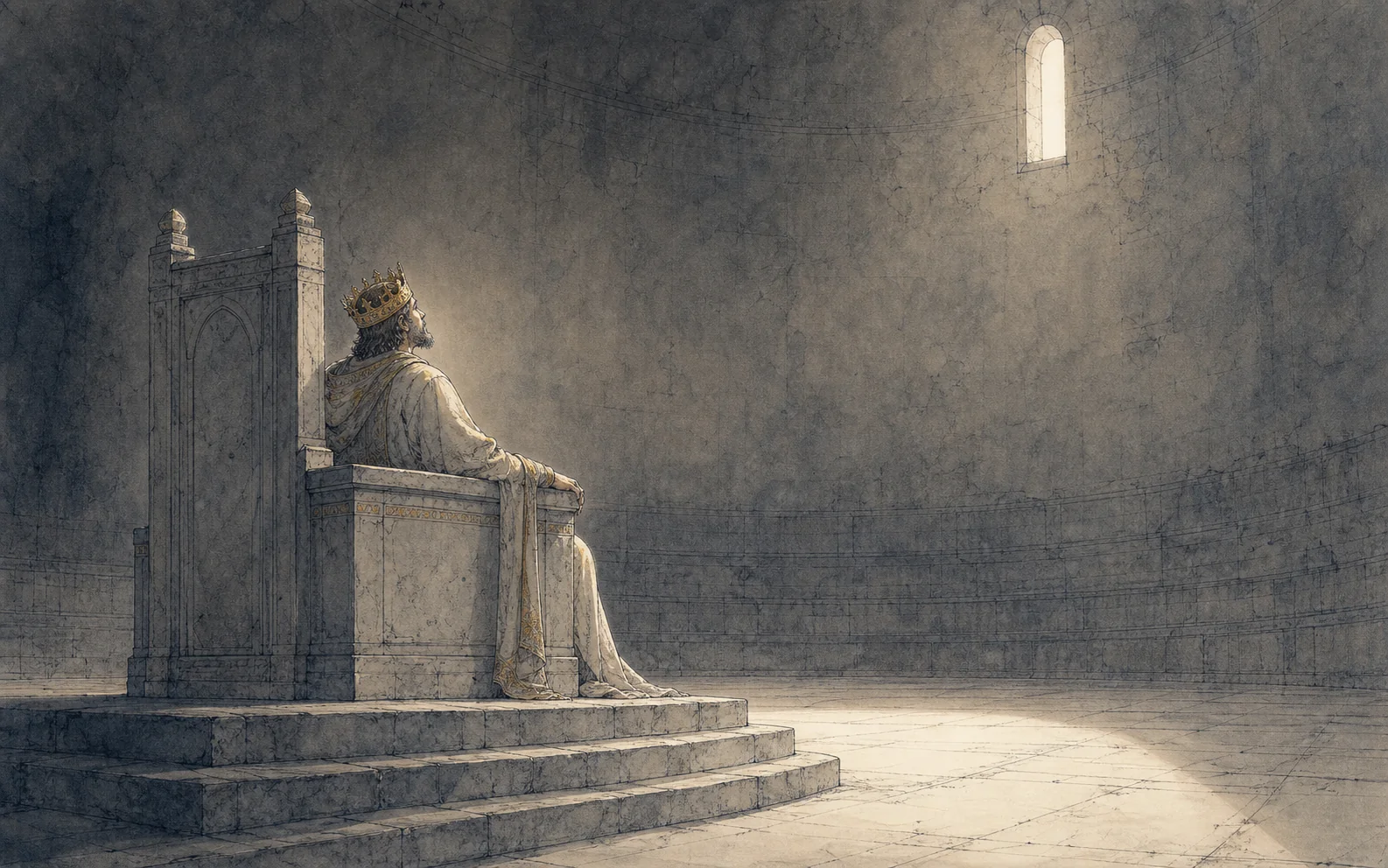
Two boundaries must nevertheless be drawn straight. First, meaninglessness does not mean lawlessness. Dependent arising supplies regularity; kamma supplies weight. The cosmos neither rewards goodness nor punishes evil. It simply produces results according to conditions. Second, meaninglessness does not mean that the question of meaning remains undecided. Asking the cosmos for meaning belongs to the same family as asking where the four elements cease or who ages and dies. It presupposes a reader and a script written for that reader. There is no script; there is suffering. This is the fourth operation on a question: the question of meaning receives no answer because its subject field has no valid entry. As before, the response lies not in finding something but in ending something; Chapter 4's ascending chain takes over here. The map's complete practical output finally gathers into the warning of a narrow window. Those who gain human birth are like the dust on a fingernail; those who lose it like the earth. A blind turtle surfacing once in a hundred years is more likely to place its neck through a floating yoke than a being is to gain human birth again.24 In the map's deepest chamber sits its best reader: King Yama on his throne wishes to gain human birth, hear the true Dhamma, and go forth to practice.21 In the darkest room on the map, a king looks toward the window. Here the map of the three realms can be rolled up. It is stair and stage scenery; among the things it supports, the one thing absent is itself. The next chapter examines the people walking across the map: bodhisattva, Buddha, and the four fruits.
References
References
-
Mahāsīhanāda Sutta (MN 12), enumerating five destinations and the courses leading to them, followed by nibbāna. English translation in Bhikkhu Ñāṇamoli and Bhikkhu Bodhi (trans.), The Middle Length Discourses of the Buddha. Boston: Wisdom Publications, 1995. The Chinese parallel is T757, Discourse That Makes the Body Hair Stand on End. That text is a Song-dynasty translation, and the Taishō records no Pāli parallel anywhere in it; the identification is the received scholarly view and is entered here as a scholarly case. ↩
-
Connected Discourses on the Undiscoverable Beginning (Anamatagga-saṃyutta, SN 15). English translation in Bhikkhu Bodhi (trans.), The Connected Discourses of the Buddha. Boston: Wisdom Publications, 2000. The Chinese parallels are a series around Saṃyukta Āgama nos. 937–956. No. 938 has been checked: beings have wandered through birth and death without discoverable beginning, not knowing the first point of suffering; the tears they have shed exceed the Ganges and the four great oceans. ↩↩
-
Discourse on Records of the World, Dīrgha Āgama no. 30, with alternative translations including the Lokaprajñapti Sūtra and Discourse on the Origin of the World. The Pāli Canon has no parallel. ↩
-
The formula of gradual instruction (giving, ethical conduct, heaven, the danger of sensuality, the benefit of renunciation, then the Four Truths) appears widely, including the story of Yasa in the Mahāvagga and DN 3, 5, and 14. The Chinese sources are in hand. The counterparts of DN 3 and DN 5, Dīrgha Āgama nos. 20 and 23, both carry it: talk on giving, talk on ethical conduct, talk on birth in heaven; sensuality is defilement, the higher taints are an affliction, going forth is supreme; and then, as is the constant practice of the buddhas, the Four Truths. The Madhyama Āgama has a second standard wording, in which the Buddha, as is the practice of the buddhas, first teaches the upright Dharma, teaching giving, ethical conduct, and the Dharma of birth in heaven, censuring sensuality as calamity and birth and death as defilement, and praising desirelessness as excellent; see Madhyama Āgama nos. 62 and 133. ↩
-
Giñjakāvasatha Sutta (SN 55.8–10). English translation in Bodhi. The Chinese parallel is Saṃyukta Āgama no. 854, checked for both the statement that such questioning is troublesome and not delightful to a Tathāgata and the gift of the Mirror of the Dhamma. DN 16 also records the event. ↩
-
Mahānāma Sutta (SN 55.21–22), with the pot-of-ghee simile. English translation in Bodhi. The Chinese parallels are Saṃyukta Āgama no. 930 and Additional Translations of the Saṃyukta Āgama (T100) no. 155. ↩
-
Aggañña Sutta (DN 27). English translation in Maurice Walshe (trans.), The Long Discourses of the Buddha. Boston: Wisdom Publications, 1995. Chinese parallels include Dīrgha Āgama no. 5 and Madhyama Āgama no. 154. For the parodic reading, see Richard F. Gombrich, What the Buddha Thought. London: Equinox, 2009. Part 1, Chapter 5 presented both readings. ↩
-
Cakkavatti-Sīhanāda Sutta (DN 26). English translation in Walshe. The Chinese parallel is Dīrgha Āgama no. 6. See Part 1, Chapter 5 for analysis of its textual layers. ↩
-
Apaṇṇaka Sutta (MN 60). English translation in Ñāṇamoli and Bodhi. The Chinese parallel is uncertain and remains to be checked. ↩
-
Recollection of devas appears in the formula of the six recollections, including AN 6.10: remembering the faith, ethical conduct, learning, generosity, and wisdom of devas and then reflecting on those qualities in oneself. English translation in Bhikkhu Bodhi (trans.), The Numerical Discourses of the Buddha. Boston: Wisdom Publications, 2012. The Chinese parallel is Saṃyukta Āgama no. 931, checked: Mahānāma the Sakyan asks what a monk still in training should cultivate, the Buddha answers with the six recollections, and the section on devas has the practitioner reflect that those devas gained pure conduct, generosity, learning, relinquishment, and wisdom, and that he too will now practice this conduct, generosity, learning, and wisdom. Additional Translations of the Saṃyukta Āgama (T100) no. 156 carries the same discourse. The Taishō records no Aṅguttara parallel for either text, and the concordance between the Saṃyutta Nikāya and the Saṃyukta Āgama does not extend to the Aṅguttara; the identification rests on content. ↩
-
Tevijja Sutta (DN 13). English translation in Walshe. The Chinese parallel is Dīrgha Āgama no. 26. ↩
-
The three knowledges in awakening accounts appear in the Bhayabherava Sutta (MN 4) and Mahāsaccaka Sutta (MN 36). English translation in Ñāṇamoli and Bodhi. ↩
-
Connected Discourses with Lakkhaṇa (SN 19), the series of beings seen by Moggallāna. English translation in Bodhi. The Chinese parallels form a series beginning at Saṃyukta Āgama no. 508. ↩
-
Acinteyya Sutta (AN 4.77): the range of a Buddha, the range of jhāna, the ripening of kamma, and speculation about the world. English translation in Bodhi, Numerical Discourses. ↩↩
-
Sattasūriya Sutta (AN 7.66). English translation in Bodhi, Numerical Discourses. The Chinese parallel is Madhyama Āgama no. 8, checked for the opening statement of purpose and the phrase “without ash or soot.” ↩
-
Nibbedhika Sutta (AN 6.63): “It is intention that I call kamma.” English translation in Bodhi, Numerical Discourses. The Chinese parallel is Madhyama Āgama 111, where the northern text reads "what is it to know karma? There are two karmas: intention, and the karma of having intended," in agreement with the Pali; this correspondence is settled. ↩
-
Cūḷakammavibhaṅga Sutta (MN 135). English translation in Ñāṇamoli and Bodhi. The Chinese parallel is Madhyama Āgama no. 170. ↩
-
Mahākammavibhaṅga Sutta (MN 136). English translation in Ñāṇamoli and Bodhi. The Chinese parallel is Madhyama Āgama no. 171. ↩
-
Loṇakapalla Sutta (AN 3.99, sometimes numbered 3.100). English translation in Bodhi, Numerical Discourses. The Chinese parallel is Madhyama Āgama no. 11, checked for the two programmatic statements and the saltwater similes. ↩
-
Dhammapada 127. ↩
-
Devadūta Sutta (MN 130). English translation in Ñāṇamoli and Bodhi. The Chinese parallel is Madhyama Āgama no. 64, checked for the five divine messengers and the judgment that the evil deed was not done by one's parents. Yama's aspiration also appears in Ekottarika Āgama 32.4. ↩↩
-
The set of discourses on distinctions (AN 4.123–126): correspondences between the four jhānas and the four Brahmā abodes, and the different destinations of ordinary and noble practitioners. English translation in Bodhi, Numerical Discourses. Chinese parallels remain to be identified. ↩
-
Rupert Gethin, “Cosmology and Meditation: From the Aggañña-Sutta to the Mahāyāna.” History of Religions 36, no. 3 (1997). ↩
-
The simile of dust on a fingernail and the great earth is at SN 56.51 (Nakhasikha), with the Chinese parallel at Saṃyukta Āgama no. 442. The simile recurs throughout the repetition series of SN 56, which the editions number differently, and this book cites it uniformly as SN 56.51. The blind turtle and floating yoke are at SN 56.47–48 (Chiggaḷa, the hole), with the Chinese parallel at Saṃyukta Āgama no. 406. ↩