Chapter 4: Dependent Arising and Psychodynamic Analysis
When Chapter 3 closed, two questions remained beside the fire. First, if there is no owner, how does the fire ignite and sustain itself, and what drives it onward? Second, why is the owner who always expects to be found in the ashes (this impulse to be found) so stubborn, and what feeds it? This chapter takes up both questions. The canon's general name for its entire answer is dependent arising.
Before taking them up, receive a warning. At the opening of the Mahānidāna Sutta, Ānanda excitedly reports an insight: dependent arising is wonderful and profound, “yet to me it appears as clear as clear can be.” The Buddha stops him at once: “Do not say that, Ānanda. This dependent arising is profound, and it appears profound.”1 Ānanda's mistake is understandable. The syntax of dependent arising really is simple: when this exists, that comes to be; with the arising of this, that arises. Anyone can memorize the formula. Its depth lies not in the syntax but in what the syntax is made to govern. From gestation to conflict, from a moment's distraction to the direction of a life, tradition connects them on a single diagram. This chapter dismantles that diagram so that its wiring can be seen clearly.
The prior record of the name. “Dynamic psychology” already has a record in Buddhist studies. Rune Johansson's 1979 monograph was titled The Dynamic Psychology of Early Buddhism. Its eleven chapters rearranged the Nikāyas under the headings of psychology: consciousness, perception and sensation, motivation, personality, the taints, and knowledge.2 On page 79 he states the book's thesis: perception creates the world; through understanding and mastering perception, the world can be mastered; one who masters the perceptual process masters one's own state of mind. In one sentence, he stakes dependent arising on epistemology. This book accepts the note contained in his title without reservation. A serious and systematic dynamic psychology does exist in the Nikāyas; this is no polite retrospective honorific. But this book borrows the name without following the method, and records two points of departure. First, the direction is reversed. Johansson sorts the texts' categories into the catalog of modern psychology, requiring taints and latent tendencies to fit the columns of motivation and personality. Chapter 3 established a discipline of standpoints: two maps are not exchanged box for box. This chapter therefore moves the other way. It leaves links, nutriments, hindrances, fetters, and latent tendencies where they are and draws out their dynamics in place. Second is the reading of the backbone. As a psychologist Johansson reads the twelve links as the creative causation of a perceptual process, making dependent arising a psychology enclosed within epistemology. This book's judgment below takes another path.
The backbone and the literal definitions. Establish the backbone first. Ignorance conditions formations; formations condition consciousness; consciousness conditions name-and-form; name-and-form conditions the six sense bases; the six sense bases condition contact; contact conditions feeling; feeling conditions craving; craving conditions clinging; clinging conditions existence; existence conditions birth; birth conditions aging and death, sorrow, lamentation, pain, grief, and despair. Such is the arising of this whole mass of suffering. The cessation side has the same structure: with the cessation of ignorance, formations cease, and so on until this whole mass of suffering ceases. The Vibhaṅga Sutta defines every link, and the literal sense of those definitions deserves close attention.3 The Pāli defines ignorance as not knowing the Four Truths. The Chinese version gives a longer list: not knowing the past and future, kamma and result, Buddha, Dhamma and Sangha, or suffering, origin, cessation and path—“delusion, ignorance, great darkness.” The scope differs, but the mode of definition is the same: ignorance is an absence of cognition, not some positive evil energy. Formations are bodily, verbal, and mental; another discourse divides them by the quality of action into meritorious, demeritorious, and imperturbable formations, two axes of classification operating together.4 This discourse gives six classes of craving; elsewhere craving is sensual craving, craving for existence, and craving for nonexistence, while the Chinese gives craving for sensuality, form, and formlessness. Even the threefold classification comes in two versions. Existence is sensual, form, and formless existence. The definitions of birth and aging-and-death, however, pin the two ends to the literal sense. Birth is the birth, descent into a womb, appearance, manifestation of aggregates, and acquisition of sense bases by beings in their various classes. Aging is falling teeth, graying hair, wrinkling skin, diminishing lifespan, and maturing faculties. Death is deceasing, breaking up, the destruction of aggregates, and laying down the body. These ends leave no room for allegory.
Beside the definitional discourse stands another episode, the third case for Chapter 3's surgical knife. Someone asks, “Who ages and dies? To whom do aging and death belong?” The discourse rejects the question together with its possible answer. If one replies, “I am aging and death; aging and death belong to me,” this is the same position as saying either that life is identical with the body or that life is one thing and the body another.5 The text itself places the “who” question and the life–body question in the same file. Chapter 1's open case and Chapter 3's partial closure meet again on the terrain of dependent arising. The Kevaṭṭa Sutta rewrote “where”; the Moḷiyaphagguna Sutta rewrote “who consumes?”; this discourse rejects “who ages and dies?” Three cases, one knife: escort the subject out of the question and invite conditions in.
Numbers of links and formulas. With the backbone in place, first examine its elasticity. The standard version contains twelve links. The Nagara Sutta has ten, tracing back only to the mutual conditioning of consciousness and name-and-form. The Mahānidāna Sutta has nine and omits the six sense bases as well.6 The Nagara Sutta also gives dependent arising its best self-description. A person in the wilderness finds an ancient road, follows it, and discovers an ancient city. The road is old; the city is old; the discoverer did not build it. The Naḷakalāpī Sutta gives a simile for mutual conditioning: consciousness and name-and-form are like two sheaves of reeds leaning against each other; remove one and the other falls.7 Shorter chains operating here and now appear throughout the discourses: six sense bases condition contact, contact feeling, and feeling craving. Four links make the fire and proceed directly to the arising of suffering.8 The four versions can be compared link by link:
| Link | Twelve (standard) | Ten (Nagara) | Nine (Mahānidāna) | Short chain (Dukkha) |
|---|---|---|---|---|
| Ignorance | ● | absent | absent | absent |
| Formations | ● | absent | absent | absent |
| Consciousness | ● | ●, mutually conditioned with name-and-form | ●, mutually conditioned with name-and-form | Arises from the meeting of faculty and object; not listed separately |
| Name-and-form | ● | ●, mutually conditioned with consciousness | ●, mutually conditioned with consciousness | absent |
| Six sense bases | ● | ● | absent; name-and-form directly conditions contact | ●, starting point |
| Contact | ● | ● | ● | ● |
| Feeling | ● | ● | ● | ● |
| Craving | ● | ● | ● | ●, stopping here is called the arising of suffering |
| Clinging | ● | ● | ● | absent |
| Existence | ● | ● | ● | absent |
| Birth | ● | ● | ● | absent |
| Aging and death | ● | ● | ● | absent |
Two facts are immediately visible. First, every omission occurs at one of the ends. Ignorance and formations can be left off the front; clinging, existence, birth, and aging-and-death need not be unfolded at the back. In the middle, no version lacks contact, feeling, or craving. The ends stretch and contract while the burner remains conserved. The bypass circuits inventoried later in this chapter attach precisely to this middle section. Second, twelve, ten, nine, four: the number of links changes with the needs of the teaching. Chapter 3 counted element-lists of four, five, and six; now a second set arrives. The verdict of the toolbox presents itself for a third time. What can expand and contract is a working inventory, not a sacred number of stages. Even the threefold classifications of craving come in two forms; the axis of classification changes with the work of contemplation.
The philosophical load of the formula is realized in the Kaccānagotta Sutta. The world generally relies on a duality, existence and nonexistence. One who sees the arising of the world as it is does not hold the view of nonexistence; one who sees its cessation as it is does not hold the view of existence. “Avoiding both extremes, the Tathāgata teaches by the middle: when this exists, that comes to be; with the arising of this, that arises.”9 Dependent arising is the road that circles around the door of existence left by Chapter 3's discussion of two registers. It does not answer “exists” or “does not exist”; it asks instead about arising and cessation. Nāgārjuna explicitly cites this discourse in Chapter 15 of the Mūlamadhyamakakārikā. That belongs to Part 14; a signpost is enough here.
Three lives or the present? We now reach the point at which a position must be taken. What span does the backbone of twelve links describe? The commentarial answer is two rounds of causation across three lives. Ignorance and formations are causes in a past life; consciousness through feeling are results in the present; craving, clinging, and existence are causes in the present; birth and aging-and-death are results in a future life. Chapter 17 of the Visuddhimagga engineers this allocation into a complete scheme.10 From the twentieth century onward, present-life readings arose. Buddhadāsa Bhikkhu rejected the three-life account as a brahmanized misunderstanding and held that all twelve links unfold within this life and this mind.11 Ñāṇavīra reread dependent arising through an existential approach as the structure of present experience rather than a mechanism of rebirth.12 On the academic side, Eviatar Shulman examined the original meanings of the links and judged dependent arising to be an account of psychological process.13 Bhikkhu Bodhi defended the traditional reading in two long articles answering Ñāṇavīra sentence by sentence.14 A third reading also exists. Joanna Jurewicz argued that the vocabulary of the twelve links corresponds item by item to Vedic cosmogonic sequences, making dependent arising a line-by-line parody of Brahmanical cosmogenesis; Gombrich adopted and extended the proposal.15 Johansson's book sits next to the present-life readings on this map. An earlier file must also be carried forward: Chapter 5 of Part 1 in the historical division presented three-life and present-life readings side by side without deciding. That was historical exposition doing its job. This chapter performs analysis and must move one step further.
This book argues that the backbone should be read across three lives, for three reasons fixed in the texts. First, the definitional discourse pins both ends of the chain to their literal sense. Birth is descent into a womb and the manifestation of aggregates; aging and death are graying hair, falling teeth, and laying down the body. To make the present-life reading work, these definitions must be rewritten as allegory: birth becomes the birth of a sense of self, death the death of that sense. Such a revision is not indefensible, but the burden of proof rests on the reviser, and the definitional discourse offers no foothold. Second, the backbone has obstetrics at its joints. The Mahānidāna Sutta asks as plainly as possible: “If consciousness were not to descend into the mother's womb, would name-and-form take shape there?” “No.” “If consciousness, having descended into the womb, departed, would name-and-form develop?” “No.”1 At this link, the chain discusses gestation, not metaphor. Third, the texts measure the continuation and termination of the chain in bodies. The ignorant ordinary person, covered by ignorance and fettered by craving, acquires this conscious body. “So long as ignorance is not abandoned and craving not exhausted, when the body breaks up and life ends, another body is taken up.” For the wise person, ignorance is abandoned and craving exhausted; “when the body breaks up and life ends, another body is not taken up.”16 A chain confined to mental events within this life cannot say “takes up another body.”
Having chosen three lives, this book enters three reservations plainly. First, the precise allocation of two rounds across three lives is the work of commentarial engineering. The discourses indicate the direction but do not fill every line of the blueprint assigning links to past and future. This book takes the direction without staking everything on the details. Second, early scholastics had already brought the present into the case. Sarvāstivāda sources counted four kinds of dependent arising: momentary, serial, static, and prolonged. A reading on which all twelve links arise in a single moment had an orthodox registration of its own.17 The error of the present-life reading is therefore not that it sees dynamics here and now, but that it uses the present to abolish the three-life structure. Static dependent arising occupies the primary place while momentary dependent arising supplies a model; the old distinction was adequate. Third, and this is the proper work of this chapter, the material for present-life dynamics is rich and real, but most of it lies not within the links of the backbone. It lies on bypasses attached to them. The chapter's division of labor can therefore be stated in one sentence: read the backbone across three lives and the bypasses here and now. Philological judgment belongs to the backbone; the rest of the analytical force belongs to the bypasses.
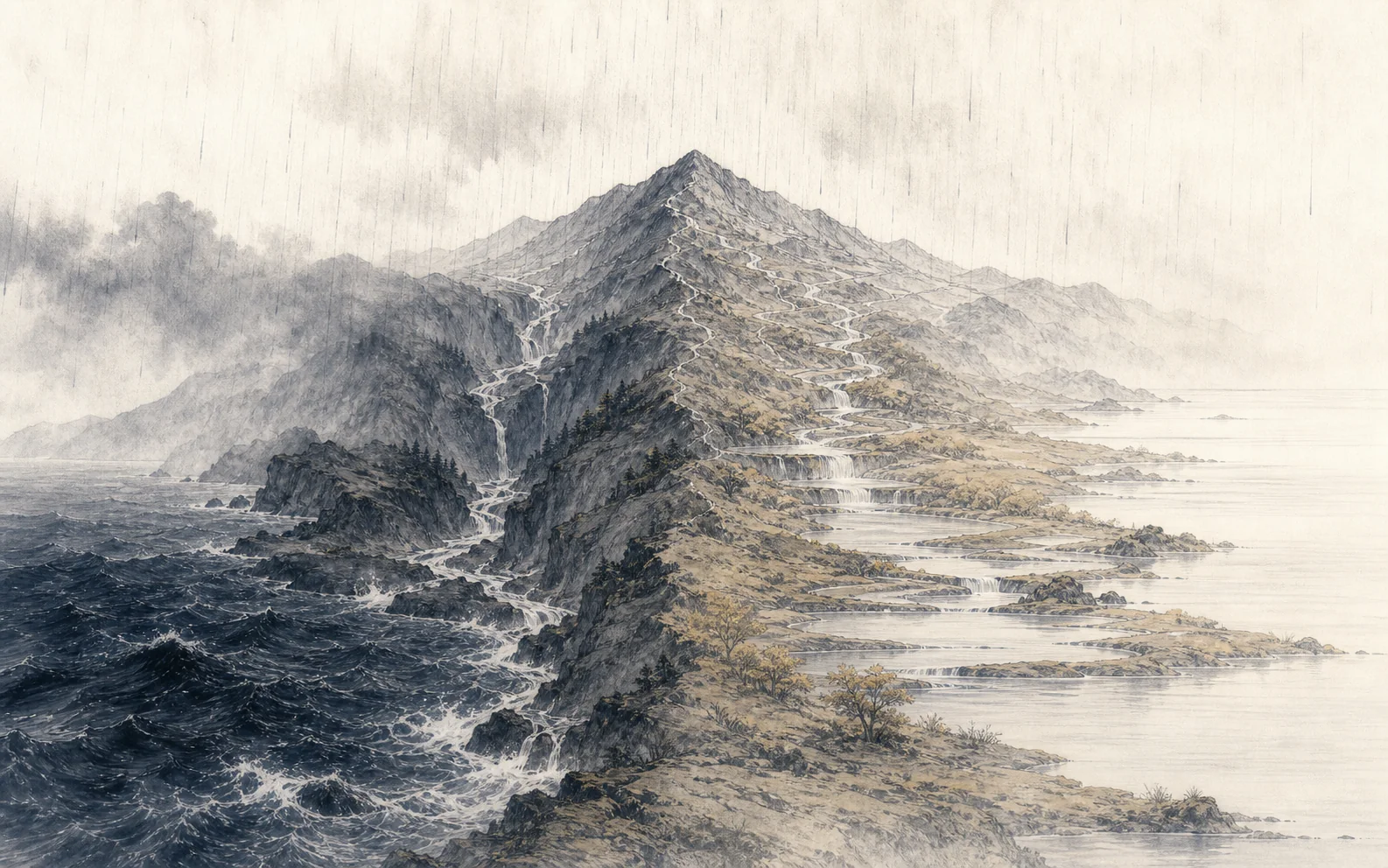
A wiring diagram of ignorance and craving. Chapter 3 asked whether misidentifying self belongs to ignorance or to craving and clinging. We can now draw the wiring diagram, with a discourse number attached to every line. Begin with a subversive claim: ignorance is not a first cause. Its beginning cannot be seen, but ignorance has nutriment. Failure to associate with good people leads to failure to hear the true teaching; this leads to lack of confidence and unwise attention, then to lack of mindfulness and clear comprehension, unguarded sense doors, the three kinds of misconduct, the five hindrances, and finally ignorance. The discourse's simile is mountain rain: rain falls on the heights, fills gullies, then streams, rivers, and the ocean.18 Ignorance is itself inside a food chain, fed by a complete social and habitual watershed. A reverse line stands in the same discourse: what feeds craving for existence? Ignorance. Then recall the birth certificate brought forward from the end of Chapter 3. Taking form to be self is itself a formation. From what is the formation born? Touched by feeling born of contact with ignorance, craving arises, and from craving that formation is born.19 The Parivīmaṁsana Sutta answers decisively concerning the master switch of formations: one who has not abandoned ignorance forms meritorious, demeritorious, and imperturbable formations; when ignorance is abandoned, one no longer forms them.4
The answer to Chapter 3's question is therefore three layers, not a binary choice. The cognitive layer attaches to ignorance: failure to know that something is not-self is an absence, not a driving force. The motivational layer attaches to craving and clinging. The four forms of clinging already include “clinging to doctrines of self,” and craving's own list of utterances reveals even more. The Taṇhā Sutta gives eighteen currents of craving, every one beginning with “I”: “I am,” “I am thus,” “I shall be …” Eighteen internally and eighteen externally make thirty-six; extended across past, present, and future they make 108.20 The mother tongue of craving is the first person. No external interface between craving and self-view need be invented: when craving opens its mouth, it says “I.” The residual affective layer attaches to the latent tendency of conceit. The elder Khemaka can already see each of the five aggregates as not-self and not mine, yet acknowledges that “I am” conceit, desire, and latent tendency remain—not abandoned, not fully understood, not eliminated, not expelled. His simile is the scent of flowers: it cannot be assigned to root or leaf, yet it pervades. The counter-simile is a washed robe retaining an odor, which disappears only after it is stored for a time in a perfumed casket.21 The three layers die at different times. Stream-entry ends identity view; only arahantship ends conceit and ignorance. The stubbornness of the owner at the end of Chapter 3 now has a list of provisions: craving composes daily sentences with “I,” conceit disperses like a residual scent, and ignorance supplies the background light. The view dies on the day of seeing the path; the scent must be perfumed away until the end of the path.
The three-layer anatomy can be kept for reference in one table:
| Layer | Name | Character | Immediate causes and nutriment | Ended where | Evidence |
|---|---|---|---|---|---|
| Cognitive | Ignorance: not knowing not-self as it is | Absence | Fed by the five hindrances (AN 10.61) | Path to arahantship | Vibhaṅga Sutta / SĀ 298 |
| View and appropriation | Identity view; clinging to self-doctrines | View | Born of craving (SN 22.81); currents of craving begin with “I” (SĀ 984) | Seeing at stream-entry | Alagaddūpama Sutta; Taṇhā Sutta |
| Residual affect | Latent tendency of “I am” conceit | Diffuse habit | Latent in feeling born of contact (MN 148) | Cultivated away at arahantship | Khemaka Sutta / SĀ 103 |
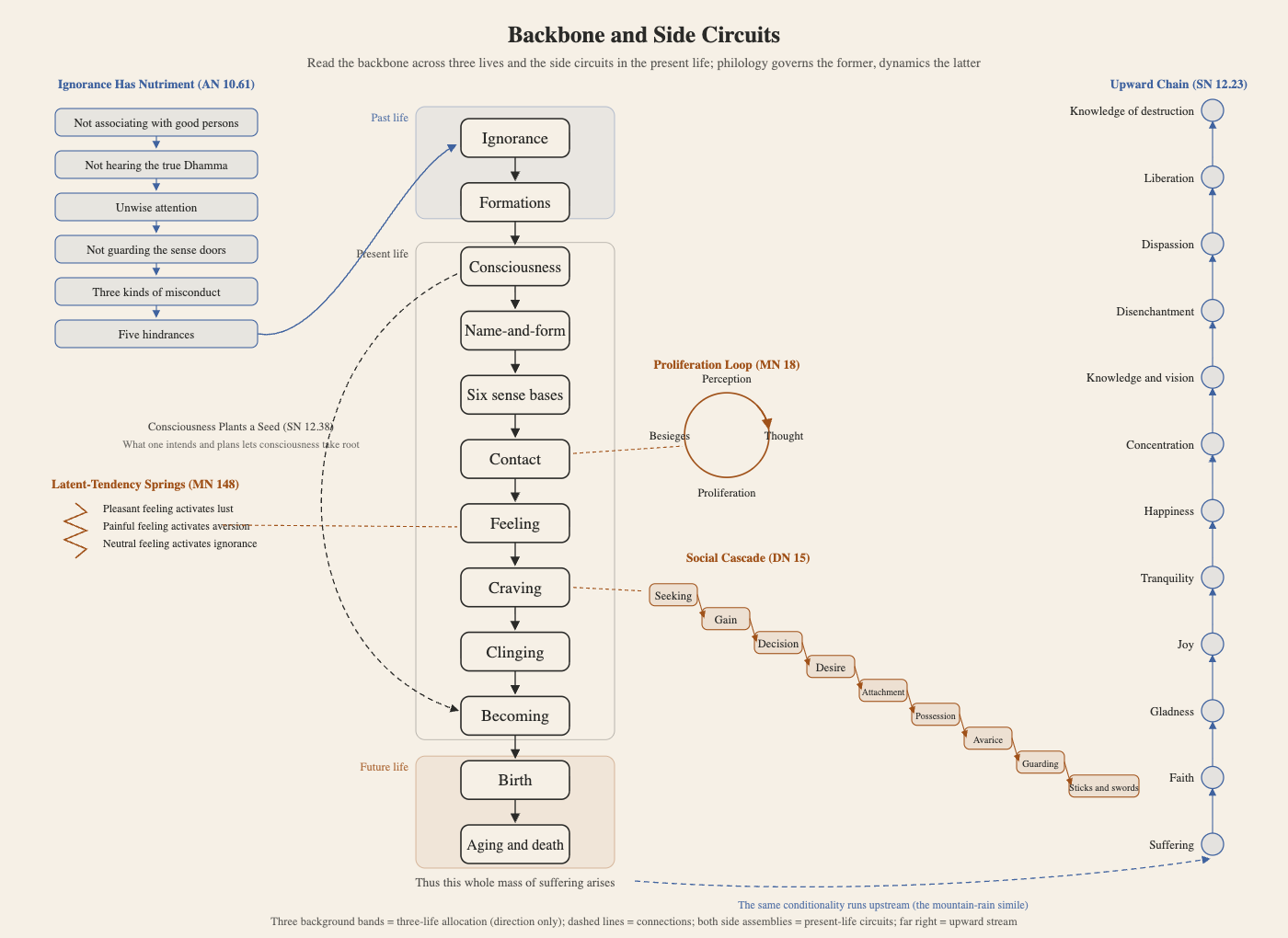
Bypass circuits. Outside the backbone, the texts record several bypasses attached to its links. The analytical force promised above belongs here.
The first is the circuit of proliferation, attached between contact and perception. The Madhupiṇḍika Sutta says: dependent on eye and forms, eye-consciousness arises; the meeting of the three is contact; conditioned by contact, feeling; what one feels, one perceives; what one perceives, one thinks about; what one thinks about, one proliferates.22 The Pāli ends with an additional reversal: the classifications of proliferated perception assail the very person who proliferates. The producer becomes the victim, the output returns to the input: a self-exciting machine.23 When Daṇḍapāṇi asks the Buddha for the root of his teaching, the answer is the dismantling of this machine: a teaching by which one does not quarrel and does not cling to existence or nonexistence. The sixty-two views of Chapter 1 are advanced products of this circuit; the bad question in Chapter 3's Puṇṇama Sutta is a specimen in operation. Views do not fall from the sky. The circuit spins them.
The second is the social cascade attached to craving. The Mahānidāna Sutta follows the current downward: “craving conditions seeking; seeking conditions acquisition; acquisition conditions decision; decision conditions desire and lust; desire and lust condition attachment; attachment conditions possessiveness; possessiveness conditions avarice; avarice conditions guarding; and because of guarding there arise the taking up of sticks and swords, conflicts, quarrels, slander, deceit, false speech, divisive speech, and countless unwholesome things.”1 Nine stations run directly from a moment's desire to armed defense. The moment psychodynamics walks out the door, it becomes political economy. This cascade is the earliest social pathology within the analysis of dependent arising.
The third is the spring beneath feeling. The Chachakka Sutta places latent tendencies immediately below feeling. Pleasant feeling stimulates the latent tendency to greed, painful feeling the latent tendency to aversion, and neutral feeling the latent tendency to ignorance.24 The Salla Sutta supplies the key mechanism: someone struck by one arrow strikes themselves with a second. After physical feeling, mental feeling is added. Unable to see an escape from painful feeling outside sensual pleasure, the ordinary person flees into sensuality.25 Feeling is the switch on the backbone; latent tendency is the spring buried beneath it. The dynamics of addiction were entered into the record here more than two thousand years ago. Beneath the spring the mind cannot remain still. The texts say that identifying the body as self has at least a superficial rationale, for the body may last a hundred years. But the mind is like a monkey in a forest: by day and night it seizes one branch and releases it, then seizes another, arising as one thing and ceasing as another.26
The fourth is the sowing of a station for consciousness. The trilogy of discourses on volition says that what one intends, plans, and has a latent tendency toward becomes a basis for consciousness. With a basis, consciousness becomes established and grows, thereby planting future existence.27 Intention is a seed drill. This circuit reconnects present psychodynamics to the three-life backbone; bypass and backbone close their switch here. The discourses on the four nutriments give the maintenance system four images of suffering: parents eating the flesh of their child in a wilderness, a flayed cow bitten wherever it stands, a pit of fire, and three hundred spears.28 Each of motivation's four meals carries a price.
The four bypass circuits can be kept in one table:
| Circuit | Attachment point | Mechanism in one line | Evidence |
|---|---|---|---|
| Proliferation | Perception and thought | The classifications of proliferation turn back and assail the proliferator: self-excitation | Madhupiṇḍika Sutta / MĀ 115 |
| Social cascade | Craving | Seeking, gain, decision, desire, attachment, possession, avarice, guarding, and finally sticks and swords | Mahānidāna Sutta / MĀ 97 |
| Latent-tendency spring | Feeling | Three feelings activate their respective tendencies; after the bodily arrow one fires a mental arrow | Chachakka Sutta; Salla Sutta |
| Sowing consciousness | Formations and consciousness | What is intended, planned, and latent gives consciousness a station and plants existence | Trilogy of Cetanā Suttas |
Another river from the same rain. If dependent arising could produce only suffering, it would be only a sentence of judgment. The Upanisā Sutta runs the same syntax in reverse. Suffering is the supporting condition for faith; faith for gladness; gladness for joy; joy for tranquility; tranquility for happiness; happiness for concentration; concentration for knowledge and vision as it is; that knowledge for disenchantment; disenchantment for dispassion; dispassion for liberation; and liberation for knowledge of destruction.29 Its conclusion uses the same simile as the food chain of ignorance: mountain rain fills gullies, streams, rivers, and the sea. The same rain becomes two rivers. The latter half of the Avijjā Sutta already supplies a parallel structure. True knowledge and liberation also have nutriment: association with good people, hearing the true teaching, wise attention, mindfulness and clear comprehension, continuing through the seven awakening factors to knowledge and liberation.18 On the ascending chain, knowledge and vision as it is comes after concentration. The Susima Sutta gives this station a name. The outsider Susīma becomes a monk in order to steal the teaching. He hears wisdom-liberated monks declare that they do not possess the deep absorptions and is bewildered. The Buddha's explanation gives only one principle: knowledge of the stability of phenomena comes first; knowledge of nibbāna afterward.30 Knowing dependent arising is an official station on the path, not theoretical decoration. Chapter 2 inventoried the conditional grammar of cultivating a tree: clear the ground around the roots, mound the soil, pour water. The craft is the same in both places. Dependent arising draws links so that a system can be repaired, not so that a person can be sentenced.
Both questions beside the fire now have a place. How does the fire ignite and continue? It needs no owner. The appropriation in “aggregates subject to appropriation” is already the fuel of fire; the hand adding fuel grows on the fire itself. The spring beneath feeling, the loop at perception, and the sowing of consciousness assign the fire its own shifts. And the owner who always wants to be found? The owner is not an exception to the circuit but its product. Craving makes sentences in the first person, conceit diffuses as a lingering scent, and ignorance supplies the background light. The impulse is explained rather than confiscated; the conventional “I” continues to work, as Chapter 3 permits. Once the backbone expands across three lives, the other half of the picture waits outside the door: how rebirth spreads through the realms, how kamma works where no owner claims it, and how to contemplate a cosmos without meaning and without meaning to be found. Those belong to Chapter 5. This chapter closes with the rain. Rain does not choose its river; gullies and channels can be engineered.
References
References
-
Mahānidāna Sutta (DN 15). English translation in Maurice Walshe (trans.), The Long Discourses of the Buddha. Boston: Wisdom Publications, 1995. Chinese parallels are the Discourse on Great Conditions and Expedient Means in the Dīrgha Āgama and the Discourse on the Great Cause, Madhyama Āgama no. 97. This chapter's quotations (the warning about profundity, the questions about consciousness entering the womb, and the nine-stage cascade from craving) follow MĀ 97. ↩↩↩
-
Rune E. A. Johansson, The Dynamic Psychology of Early Buddhism. London: Curzon Press, Scandinavian Institute of Asian Studies Monograph no. 37, 1979; see also The Psychology of Nirvana. London: George Allen & Unwin, 1969. The programmatic sentence quoted here appears on p. 79. For a contemporary review, see Gordon F. S. Ellens, Journal of the Royal Asiatic Society 112, no. 2 (1980): 195–196, which praises Johansson's presentation of Pāli texts as the book's most valuable feature while criticizing the limits of his philosophical equipment. ↩
-
Vibhaṅga Sutta (SN 12.2; see also SN 12.1). English translation in Bhikkhu Bodhi (trans.), The Connected Discourses of the Buddha. Boston: Wisdom Publications, 2000. The Chinese parallel is Saṃyukta Āgama no. 298, which gives a broad definition of ignorance ending “delusion, ignorance, great darkness.” ↩
-
Parivīmaṁsana Sutta (SN 12.51). English translation in Bodhi. The Chinese parallel is Saṃyukta Āgama no. 292. ↩↩
-
Avijjāpaccaya Sutta (SN 12.35–36). English translation in Bodhi. The Chinese parallel is the Discourse on the Great Emptiness of Phenomena, Saṃyukta Āgama no. 297. ↩
-
Nagara Sutta (SN 12.65), with the ten-link version and the ancient road and city. English translation in Bodhi. The Chinese parallel is Saṃyukta Āgama no. 287. ↩
-
Naḷakalāpī Sutta (SN 12.67). English translation in Bodhi. The Chinese parallel is Saṃyukta Āgama no. 288. ↩
-
Dukkha Sutta (SN 12.43–44), with the short chain of six sense bases, contact, feeling, and craving. English translation in Bodhi. ↩
-
Kaccānagotta Sutta (SN 12.15). English translation in Bodhi. The Chinese parallel is Saṃyukta Āgama no. 301. Nāgārjuna explicitly cites it in Chapter 15 of the Mūlamadhyamakakārikā. ↩
-
Buddhaghosa, Visuddhimagga, Chapter 17, with the detailed division of two rounds of causation across three lives. English translation in Bhikkhu Ñāṇamoli (trans.), The Path of Purification. Kandy: Buddhist Publication Society, 1991. ↩
-
Buddhadāsa Bhikkhu, Paṭiccasamuppāda: Practical Dependent Origination. Nonthaburi: Vuddhidhamma Fund, 1992. A representative statement of the present-life reading. ↩
-
Eviatar Shulman, “Early Meanings of Dependent-Origination.” Journal of Indian Philosophy 36 (2008). ↩
-
Bhikkhu Bodhi, “A Critical Examination of Ñāṇavīra Thera's ‘A Note on Paṭiccasamuppāda.’” Buddhist Studies Review 15, nos. 1–2 (1998), published in two parts. ↩
-
Joanna Jurewicz, “Playing with Fire: The Pratītyasamutpāda from the Perspective of Vedic Thought.” Journal of the Pali Text Society 26 (2000); extended in Richard F. Gombrich, What the Buddha Thought. London: Equinox, 2009. ↩
-
Bālapaṇḍita Sutta (SN 12.19). English translation in Bodhi. The Chinese parallel is Saṃyukta Āgama no. 294: “covered by ignorance and fettered by craving, one acquires this conscious body.” ↩
-
Abhidharma Mahāvibhāṣā Śāstra, fascicle 23, on the four kinds of dependent arising: momentary, serial, static, and prolonged. Xuanzang's translation, T 1545, Taishō vol. 27, 117b23–c5. ↩
-
Avijjā Sutta and Taṇhā Sutta (AN 10.61–62). English translation in Bhikkhu Bodhi (trans.), The Numerical Discourses of the Buddha. Boston: Wisdom Publications, 2012. The Chinese parallels are Madhyama Āgama nos. 51, 52, and 53, with two further independent translations at T36 and T37. ↩↩
-
Pārileyya Sutta (SN 22.81). English translation in Bodhi. The Chinese parallel is Saṃyukta Āgama no. 57. ↩
-
Taṇhā Sutta (AN 4.199). English translation in Bodhi, Numerical Discourses. The Chinese parallel is Saṃyukta Āgama no. 984, with eighteen, thirty-six, and 108 currents of craving. ↩
-
Khemaka Sutta (SN 22.89). English translation in Bodhi. The Chinese parallel is Saṃyukta Āgama no. 103, with the similes of floral scent and the perfumed robe. ↩
-
Madhupiṇḍika Sutta (MN 18). English translation in Bhikkhu Ñāṇamoli and Bhikkhu Bodhi (trans.), The Middle Length Discourses of the Buddha. Boston: Wisdom Publications, 1995. The Chinese parallel is Madhyama Āgama no. 115. The final reversal, in which proliferated perceptions assail the person, follows the Pāli. ↩
-
Bhikkhu Ñāṇananda, Concept and Reality in Early Buddhist Thought. Kandy: Buddhist Publication Society, 1971. A specialized study of papañca, conceptual proliferation. ↩
-
Chachakka Sutta (MN 148). English translation in Ñāṇamoli and Bodhi. The Chinese parallel is Saṃyukta Āgama no. 304. Most Majjhima discourses have their Chinese parallel in the Madhyama Āgama; this one is in the Saṃyukta Āgama. ↩
-
Salla Sutta (SN 36.6). English translation in Bodhi. The Chinese parallel is Saṃyukta Āgama no. 470. ↩
-
Assutavā Sutta (SN 12.61–62), with the monkey seizing and releasing branches. English translation in Bodhi. The Chinese parallels are Saṃyukta Āgama nos. 289 and 290, one for each of the two Pāli discourses. ↩
-
The three Cetanā Suttas (SN 12.38–40). English translation in Bodhi. The Chinese parallels are Saṃyukta Āgama nos. 359, 360, and 361, one for each of the three Pāli discourses. ↩
-
Puttamaṁsa Sutta and related discourses (SN 12.63–64), with four similes for the four nutriments. English translation in Bodhi. The Chinese parallels are Saṃyukta Āgama nos. 373 and 374. ↩
-
Upanisā Sutta (SN 12.23), with the ascending chain of supporting conditions. English translation in Bodhi. Madhyama Āgama no. 55 was formerly given as the Chinese parallel and is not retained. That discourse is the Discourse on Nibbāna in the section on conditions, and the parallel recorded for it in the Taishō is AN 10.4, Upanisā, which shares the title of the present discourse without being the same discourse. The Chinese parallel for SN 12.23 and its family of nutriment and ascending links is the run at Madhyama Āgama nos. 51 to 53. ↩
-
Susima Sutta (SN 12.70): knowledge of the stability of phenomena comes first, knowledge of nibbāna afterward. English translation in Bodhi. The Chinese parallel is Saṃyukta Āgama no. 347. ↩