Chapter 7: Leaves in the Hand—Metaphysical Restraint and Inevitable Leakage
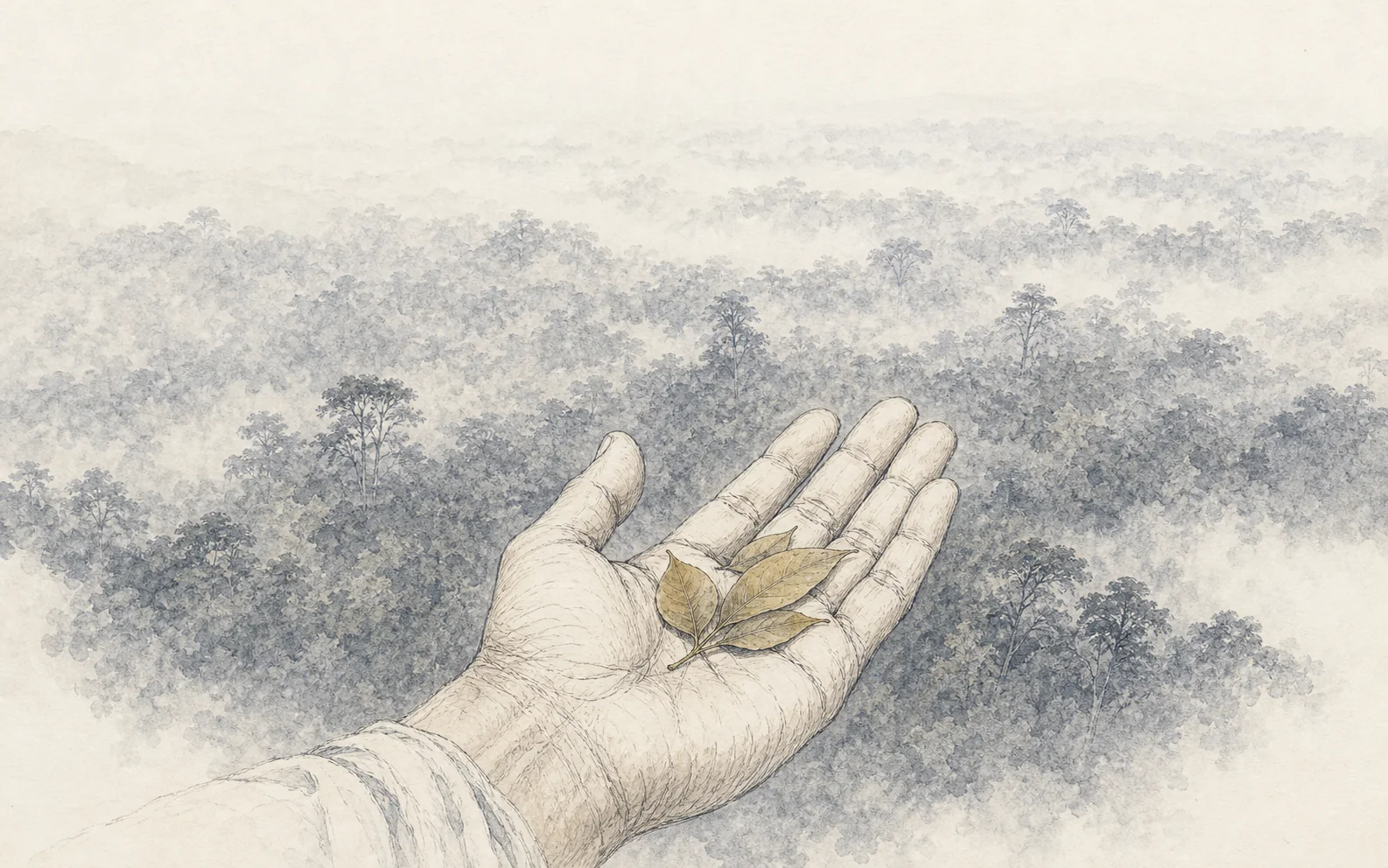
In a siṃsapā grove, the Buddha picked up a few leaves and asked the monks: which are more numerous, the leaves in my hand or those in the forest? The monks replied that the leaves in his hand were few, while those in the forest were far more and beyond comparison. The Buddha said: what I have directly known but not taught you is like the leaves in the forest; what I have taught is like the leaves in my hand. Why has he not taught the rest? Because it is not beneficial, does not belong to the fundamentals of the holy life, and does not lead to disenchantment, dispassion, cessation, or nibbāna. What has he taught? This is suffering; this is the origin of suffering; this is the cessation of suffering; this is the path leading to the cessation of suffering.1
The question posted at the end of Chapter 2 now falls due: how much of this restraint was preserved later, and through which gaps did leakage occur? Each of the preceding six chapters encountered gaps on its own terrain. This chapter combines the files in order to see two things clearly: why contact with metaphysics was inevitable, and why restraint itself became a mold for leakage.
Contact is inevitable. To teach a path out of the world while standing within it, one can only requisition tools on site. Aggregates, elements, and sense bases are instruments of inventory. Fire, lamp, city, and road are instruments of simile. Heavens and hells are the available stage; I and person are pronouns that cannot be retired. Every concept is registered in the world, and every borrowing carries the accent of its place of origin. A teaching can specify how borrowed terms are to be used: aggregates are processes, not parts; elements are qualities, not substances; destinations are places to go, not permanent careers. But prescribing use is easier than canceling a registration. The edges of concepts are rough from the beginning. What is the “remainder” in nibbāna with remainder? What consciousness is “nonmanifest and infinite”? What kind of place is the place of an element? To what does “Buddha” point after the Buddha's death? At the front line of living instruction these rough edges do little harm because a living teacher can trim them at any moment. Once the teacher is absent, rough edges become seams.
Nor does borrowing happen only once. When scriptures crossed into Chinese, the words registered again: aggregate became yin, element became jie, destination became dao, each acquiring a Chinese accent. Crossing into modern languages produces another registration: process, structure, system, consciousness, each carrying the accent of laboratory and lecture hall. A surface of leakage unfolds again with every retelling. This book stands on the same surface. Why did its Reader's Guide post a warning to put texts first? Because this book too is a retelling in borrowed words, working on borrowed concepts. The warning is first addressed to itself. Contact is therefore not a mistake but the cost of teaching. Metaphysics did not break through the door; it entered with language.
The shape of silence is inherited. The teaching's front-line response to rough edges is restraint: the fourteen questions are left undeclared; all four alternatives are blocked; profundity is held back from elaboration; similes stop when a process ends. This part has repeatedly shown that every silence was right for its immediate occasion. Silence saves Vacchagotta from the extremes of eternalism and annihilationism. Māluṅkyaputta must remove the arrow before investigating the archer's identity. Stopping Ānanda's declaration that dependent arising is obvious prevents him from turning a forest into a potted plant. Silence at the point of need is medicine.
But the medicine dies with the person while the shape of silence remains: an empty plot marked “no answer here.” To later readers, the plot is a vacuum. A vacuum transmits no content; it transmits shape. It tells later generations exactly that a position exists here, waiting to be filled. Those who fill it are usually not hostile intruders but committed people compelled by real situations to speak: a debating monk backed into a corner by an opponent; a teacher facing bereaved people who cannot simply hand them silence; a commentator whose very office is to smooth every rough edge raised by disciples. Chapter 5 showed that every teaching has a scene. The scene does not disappear. What disappears is the teacher who knows when to stop speaking. Buildings gradually rise on the empty plots. The space left by the question about the Tathāgata after death becomes theories of Buddha bodies. The rhetoric of the verse on the cessation of consciousness is read as permanent consciousness. A stopping point before profundity becomes the foundation of a system. This book argues that these are manifestations of one mechanism encountered throughout this part: restraint leaves not zero but negative space, and negative space is the finest mold.
Tool inventories harden. This part counted five cases: lists of four, five, and six elements; two threefold classifications of craving; chains of twelve, ten, nine, and four links; five and six destinations; fruits subdivided into at most seven lives, family-to-family, and one-seed. The lists expand and contract because they are tool inventories. But a tool inventory has its own fate. Repeated use creates pressure toward fixation; after boxes have been used long enough, they change from containers into structures. The labels belong to the discourses; the shelves to the treatises. Once the shelves have stood long enough, they call themselves a building. The precise allocation across three lives, the thirty-one-plane compilation, the rates of the cosmic clock, and the genealogies of stages are finished products of fixation encountered throughout these chapters.
Fixation is not wholly bad, much less malicious. It is an engineering of memory: in a world of oral transmission, what can be recited survives. It also possesses a structural inevitability. With a living teacher present, an inventory can be trimmed to fit each instruction. Once the teacher is gone, the inventory must explain itself. Commentary appears, and the office of commentary is precisely to smooth rough edges. Smoothing produces fixation. But neither mnemonic engineering nor commentary remembers on behalf of the user which step was cataloging and which was assertion. Only the reader can continue holding that boundary.
Genres have directions of their own. Leakage enters not only through the rough edges of concepts but through the inertia of genre. Buddha biography is typological. The seven Buddhas share a formula, so episodes can migrate: the excursions through four gates move from Vipassī to Gotama without seeming out of place. Prediction is a genre of guarantee. Moving from guarantee by inference to guarantee by roster requires only one step; reservation replaces extrapolation as law becomes a list of names. Verse is a rhetorical genre. A poetic line on consciousness, nonmanifest and infinite, is read by prose readers as doctrine. A catalog of miracles is a genre of accretion. Ānanda's list was already long. Later biographies did not copy the final item added by the Buddha—knowing as arising and cessation occur. They copied the list. Genre is a vehicle; what is carried is determined partly by the vehicle's own shape. At the moment a teaching entrusts content to these genres, it also entrusts content to their inertia.
The teaching's psychology predicted the teaching's fate. The four points above are merely channels; the force comes from elsewhere. The circuits drawn in Chapter 4 do not stop turning when their object becomes the Dhamma. The circuit of proliferation still takes orders. The meaning of the teaching enters perception; perception produces thought; thought produces proliferation; the classifications of proliferation turn back and assail the person. The production line of the sixty-two views does not stop because its raw material is sacred. Craving conditions clinging, and clinging includes both clinging to views and clinging to doctrines of self. After Chapter 3 expels the owner's impulse from the five aggregates, it does not become unemployed. It finds new hosts in doctrine: permanent consciousness, a magnificent Buddha body, a true and eternal self. This book's judgment is: leakage is not an invasion by an outside enemy but dependent arising operating exactly as described within the history of doctrine; a restrained teaching entrusted itself to an unrestrained process. In this part's own simile, the final step of the honey-cake circuit is that a person is assailed by what they proliferated; the final step in the history of the community is that a teaching is assailed by its own concepts.
The prediction has a positive half as well. Medicine and pathology have always run together in the same canon. The raft and snake similes govern how the teaching is grasped. The four imponderables govern the boundary of calculation. The Mirror of the Dhamma turns a question about destination into self-verification. Bhikkhu Bodhi's instruction to treat Abhidhamma as a map takes over this very shift. The gestures of closure seen throughout this part (the Buddha stopping Ānanda, Moggallāna seeing but declining to report, a final instruction on knowing as it is being added to the catalog of miracles) belong to the same hand removing the crown. Leakage and self-purification run in parallel. The transformations discussed in later parts and Volume III are therefore not a curve of unidirectional decline but a prolonged tug-of-war between two forces.
Combining the files on the gaps. The gaps encountered in the first six chapters can be assembled in one inventory. The affirmative audits in the rightmost column do not belong to this part. Here the gaps are only identified; they are audited in their respective parts and volumes.
| Gap | Restraint in its original form | What later grew there | Where it is audited |
|---|---|---|---|
| Tathāgata after death | All four alternatives blocked; predication suspended (Chapter 1) | Theories of an eternal Buddha body | Part on tathāgatagarbha; Volume III |
| Consciousness, nonmanifest and infinite | Judged rhetoric in verse (Chapter 3) | Readings of permanent consciousness | Parts on Yogācāra and tathāgatagarbha |
| Profundity of dependent arising | Ānanda's declaration of obviousness stopped; no system elaborated (Chapter 4) | Precise three-life calculations, four kinds of dependent arising, Paṭṭhāna | Historical chapters on Abhidharma; Volume III |
| Realms and jhāna | Two inscriptions run together; neither is declared the only truth (Chapter 5) | Reification into thirty-one planes | Volume III |
| Attributes of the Buddha | Self-described through the three knowledges; class predicates refused (Chapter 6) | Catalogs of omniscience, omniscience through attention, thirty-two marks | Chapter 6 above; Volume III |
| Prediction | The future guaranteed by inference (Chapter 6) | Guarantee by roster; systems of the bodhisattva path | Parts on Mahāyāna; Volume III |
Return to the leaves in the hand. When the leaves were offered, the forest did not disappear. It stood within silence, becoming a place into which every generation could walk for itself. Some returned with leaves belonging to the same species as those in the hand. Some returned with leaves from other trees. Both said they found them in the forest, and neither lied. The entire mechanism of restraint and leakage comes down to one sentence: what was not taught cannot guard itself; it can only be entrusted to the few leaves that were taught, and leaves move in the wind. The analysis of this part ends here. The mechanism has been described. One thing remains undisclosed: the author. The next chapter stops analyzing. The author lays out his own path as the final exhibit.
References
This chapter closes the part. Its scriptures and arguments have already appeared in the notes to the first six chapters and are not repeated. Only one new citation is added.
References
-
Sīsapāvana Sutta (SN 56.31). English translation in Bhikkhu Bodhi (trans.), The Connected Discourses of the Buddha. Boston: Wisdom Publications, 2000. The Chinese parallel is Saṃyukta Āgama no. 404. ↩