Chapter 6: Bodhisattva, Buddha, and the Four Fruits
With the map of the three realms rolled up, look at the people walking across it. This chapter inventories the identities given in the canon: bodhisattva, Buddha, paccekabuddha, arahant, and the four fruits. The inventory follows two lines. The first continues Chapter 5's question: in what setting is each account of identity spoken, to whom, and where does it send the listener? The second is this chapter's own central line: in the canon, is awakening repeatable? This line will decide whether the names are castes or signposts.
Begin with the Acchariya-abbhuta Sutta. Before an assembly, Ānanda recites the marvels of the Tathāgata's gestation: he knowingly descends into his mother's womb; light shines while he dwells there; deities guard him on four sides; he emerges unstained by impurity and takes seven steps. When Ānanda finishes, the Buddha says only this: “Then, Ānanda, remember this too as a wonderful and marvelous quality of the Tathāgata: feelings are known as they arise, remain, and cease; perceptions are known; thoughts are known.”1 One final addition changes the center of gravity of an entire catalog of miracles. Everything else on the list occurs in the womb; the added item occurs in awareness. Remember this operation. We will meet it repeatedly: tradition crowns the Buddha while the Buddha removes the crown.
Before I was fully awakened. The canonical word bodhisattva first needs its pronunciation corrected. Its most common use occurs in an autobiographical formula: “Before my awakening, when I was still an unawakened bodhisattva.” The Bhayabherava Sutta uses it to introduce an earlier encounter with fear in the forest; the Dvedhāvitakka Sutta to introduce the exercise of dividing thoughts into two classes; the Ariyapariyesanā Sutta to recount renunciation and the search for teachers; the Mahāsaccaka Sutta to recount the detour of austerity.2 The grammar is the same in all four places. “Bodhisattva” refers to Gotama in this very life before awakening, not to a practitioner on a long race across lives. The scene is also the same: speaking to practitioners, he offers his former difficulty as a handrail. I too was like this; I too took a wrong road. Strictly speaking, this stratum is a prior phase, not a past life. It contains more teaching device than marvel, more humility than coronation. Scholarship has systematically studied how the meaning of bodhisattva grew from this stratum into a trans-life narrative and then into systems of prophecy and perfections.3
That person then was I. Another layer does concern past lives. At the end of the Ghaṭīkāra Sutta, the Buddha tells Ānanda the truth: in the time of Kassapa Buddha, the young man whose potter friend seized him by the hair and dragged him to meet the Buddha—do not think that he was someone else; he was I.4 The Maghadeva Sutta first recounts a rule established by the ancient king Maghadeva: when gray hair appears on the crown, hand over the throne and go forth. The family custom continues for tens of thousands of generations. The ending gives two notices. Maghadeva was I. But the path then led only to the Brahmā world, while the path I teach now reaches nibbāna. The Buddha then entrusts the new continuity to Ānanda: do not be the last man.5 The Mahāgovinda Sutta has the same structure. The brahmin steward Mahāgovinda governs seven kingdoms and teaches beings the path to Brahmā. He was I; that path ended at the Brahmā world, this one at the ending of suffering.6 In the Velāma Sutta, the great donor Velāma who once gave away an immense fortune was I. This is told to Anāthapiṇḍika to calibrate the scale of giving: a great gift is worth less than feeding one stream-enterer; feeding a hundred stream-enterers less than cultivating loving-kindness; and even a moment's perception of impermanence surpasses that.7 Set the scenes side by side and the conclusion of contextual analysis appears by itself. Recognition across lives is never offered to satisfy biographical curiosity. It either hangs up an old road for comparison (the path ending at Brahmā against the path ending suffering), or passes down a transmission (do not be the last), or recalibrates a donor's scale. Past lives are tools here, and each tool has a destination in its scene.
Seven Buddhas, regularity, and a migrated biography. The lineage appears in the Mahāpadāna Sutta. The seven Buddhas from Vipassī onward all share the same formula: descent into the womb, birth, renunciation, awakening, and turning the wheel of Dhamma. Throughout, the discourse labels each feature with one word: this is the regularity (dhammatā) of Buddhas.8 The backbone of the lineage is not blood but repetition. Chapter 5's simile of the ancient road and ancient city is its gloss: the discoverer did not build the city; becoming a Buddha is finding the old city again.
This formula conceals an episode in the study of biography that displays its power and answers a widely circulated misconception. The Buddha biography everyone tells today begins with four excursions. The prince leaves the city, sees an old person, a sick person, a corpse, and an ascetic, awakens to the problem, and renounces the household life. But in the four Nikāyas this story does not belong to Gotama. The Mahāpadāna Sutta tells the entire episode of meeting old age, sickness, death, and a renunciant under the name of Vipassī Buddha.8 Gotama's own account of his motivation survives elsewhere and is much plainer. The Sukhumāla Sutta contains only three seasonal palaces, lotus ponds, luxury, and three reflections: I too am subject to aging and not exempt from it; I too am subject to illness and not exempt; since I share this condition, it is not fitting that I should be repelled by and despise another who is old or sick. Pride in youth, health, and life is thereby extinguished in turn.9 There are no excursions, four gates, or deities manifesting the sights—that appears only in later biographies. Awakening begins in reflection, not at a street corner. The relocation of the four excursions to Gotama is the work of later lives of the Buddha: the Nidānakathā, Chinese scriptures on the beginnings of practice and auspicious responses to the prince, and the Lalitavistara family.10 A piece of biography thus migrated from a past Buddha to the present one.
The migration was possible precisely because the Buddha biography was typological from the beginning. The seven Buddhas share a single formula; episodes are standard parts that fit perfectly under any one of their names. This book argues that the migration amounts to a candid admission by the genre itself. The lives describe the type “Buddha,” not the person Gotama. To read Buddha biography as reportage is to mistake the genre.
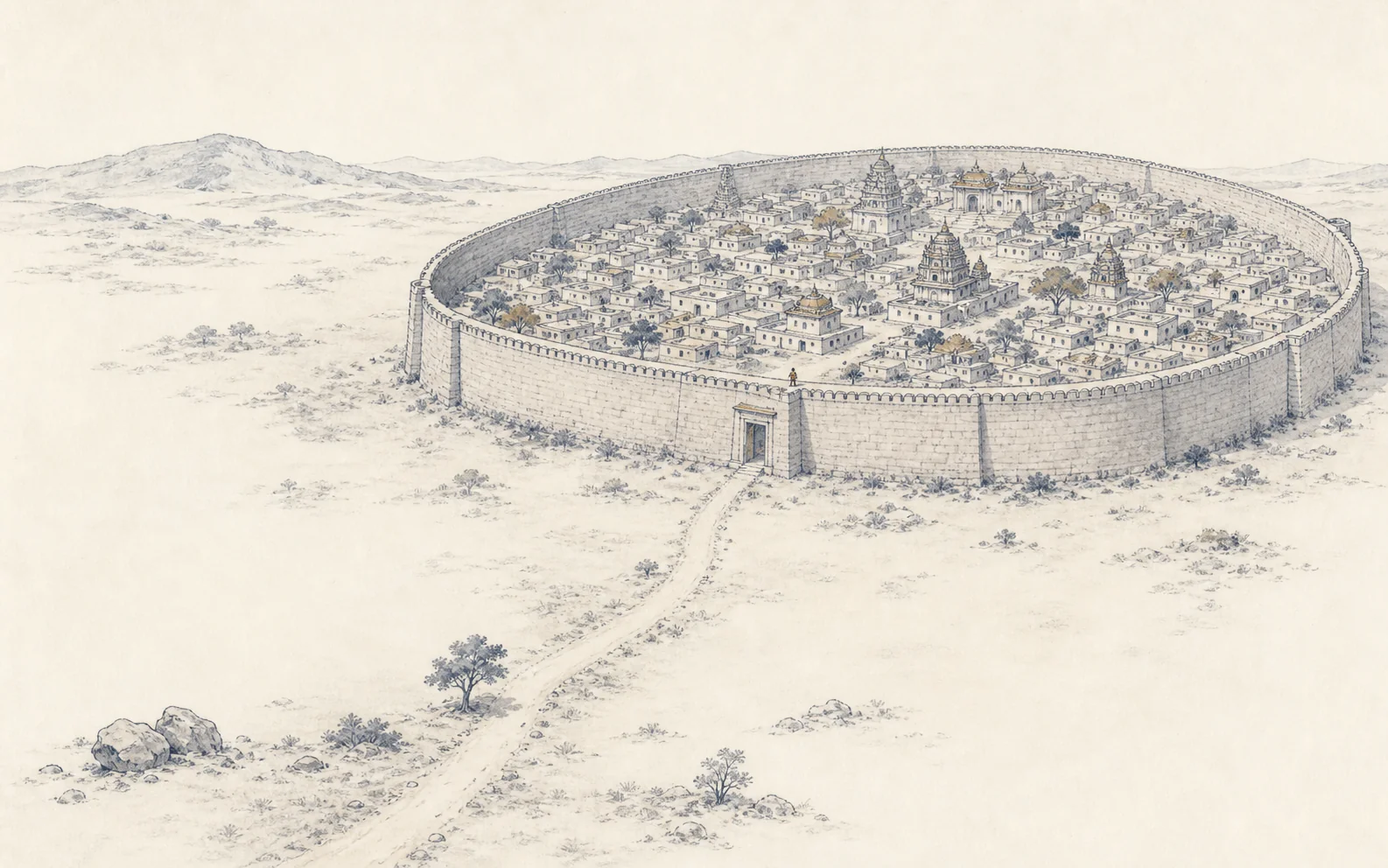
The single gate. Repeatability requires an epistemology, and the canon writes one into the Sampasādanīya Sutta. Sāriputta gives a lion's roar: no ascetic or brahmin in the past, future, or present has surpassed the Blessed One in full awakening. The Buddha asks in reply: have you encompassed with your mind the minds of all past Buddhas? Future Buddhas? My own present mind? Sāriputta answers no to each. Then why make such a grand declaration? Sāriputta replies that he does not know the minds of Buddhas; he knows the regularity of the Dhamma. Imagine a fortified frontier city with a single gate. Its gatekeeper patrols the wall and finds no gap large enough even for a cat. He therefore knows that everyone entering the city must pass through this gate. All Buddhas have abandoned the five hindrances, established their minds well in the four establishments of mindfulness, and cultivated the seven awakening factors as they are before attaining unsurpassed full awakening.11 The point of the dialogue is that the Buddha corrects not Sāriputta's conclusion but the source of his evidence. After correction, equality among Buddhas is guaranteed not by telepathy but by the invariance of the path. Chapter 3's grammar of a standing law, Chapter 4's knowledge of the stability of phenomena, Chapter 5's ancient road, and this single gate are four rivets in one line: awakening can be repeated because the path is a structure, not a miracle.
The extrapolation toward the future belongs to this line, though its literary method changes. In the four Nikāyas, the future Buddha Metteyya appears only once, in one prophecy of the Cakkavatti-Sīhanāda Sutta: when human lifespans reach eighty thousand years, the Blessed One Metteyya will arise in the world.12 The Chinese Discourse on Origins already offers a complete scene of prediction. The venerable Maitreya is present and receives a prediction: a Buddha named Maitreya Tathāgata will arise; Ajita is predicted to become the wheel-turning king Saṅkha.13 The famous prediction made by Dīpaṅkara Buddha to Gotama appears nowhere in the four Nikāyas. It belongs to the later strata of the Buddhavaṃsa, Apadāna, and Mahāvastu.14 Arrange the strata and the change in literary method is clear. The earlier layer guarantees the future by inference: whoever follows this path arrives. The later layer guarantees it by reservation: a named person will become a Buddha in a named eon. From law to roster, the genre of prediction was already moving during the period of the schools; its next station would be Mahāyāna prediction literature.
Attributes and predicates. The attributes of a Buddha appear in the canon as a list of functions: the Tathāgata's ten powers and four kinds of fearlessness, by which he gives the lion's roar and turns the Brahmā wheel.15 Every item is a capacity or fearlessness, not an ontological predicate. At the edge of this inventory stands a famous controversy: is the Buddha omniscient? It should be examined in three layers. First, canonical self-description. Vacchagotta reports an outside claim: the ascetic Gotama calls himself all-knowing and all-seeing, with knowledge and vision continually present whether walking, standing, sleeping, or awake. The Buddha answers that anyone who says this does not repeat what he said but misrepresents him falsely. One should describe the ascetic Gotama as possessing the three knowledges: recollection of past lives, the divine eye, and the exhaustion of the taints, each known when he wishes.16 The Kaṇṇakatthala Sutta adds the limit: no ascetic or brahmin can know and see everything simultaneously; that is impossible.17 Second, the later canon: the Paṭisambhidāmagga includes knowledge of all among its catalog of knowledges.18 Third, commentaries and the Milindapañha reconcile the positions: the Buddha is all-knowing, but his knowledge depends on directing attention; wherever he directs it, knowledge is unobstructed.19 The three layers form a small table:
| Layer | Claim | Source |
|---|---|---|
| Canonical self-description | Continually present omniscience is impossible; the accurate name is possessor of the three knowledges, knowing when he wishes | Tevijjavacchagotta Sutta; Kaṇṇakatthala Sutta |
| Later canon | Knowledge of all enters the catalog | Paṭisambhidāmagga |
| Commentarial reconciliation | Omniscience through attention: knowledge follows wherever attention is directed | Milindapañha |
Omniscience by attention is an ingenious move. It rewrites the tense problem of constant presence as a question of capacity and invocation, preserving both MN 71's denial and the title “all-knowing.” Whether it describes historical fact cannot be decided. But the ingenuity itself is evidence of strata: reconciliation always comes after the things reconciled. The omniscience dispute is ultimately a dispute over predication—what tense and scope of predicates may be applied to a Buddha. Chapter 1 encountered the same line. A living Tathāgata may be predicated through the three knowledges and ten powers; a Tathāgata after death enters the undeclared. These are two segments of the same boundary.
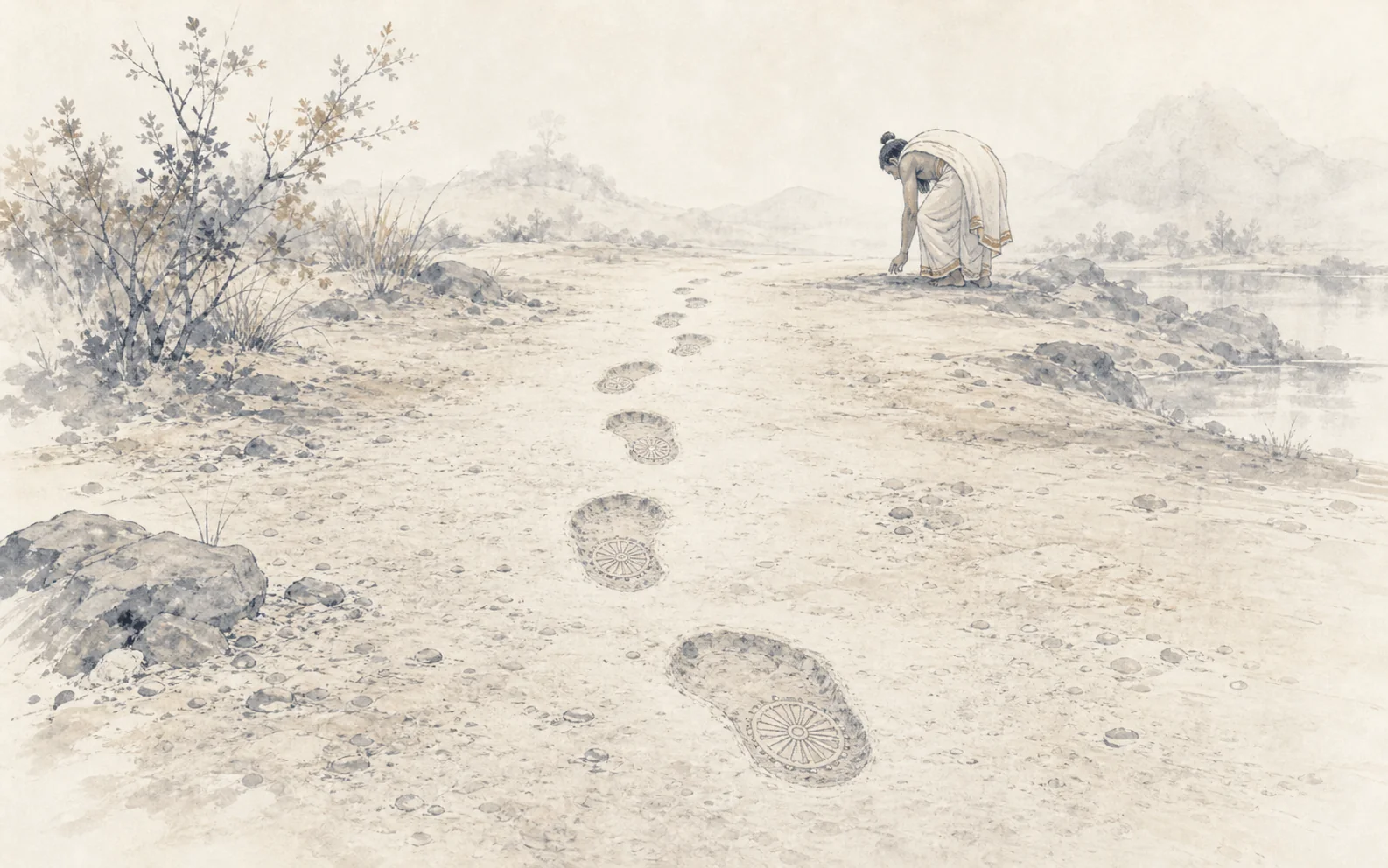
A ready-made scene stands on that boundary. The brahmin Doṇa follows footprints marked with thousand-spoked wheels and catches up with the Buddha. “Are you a deva, sir?” “I am not a deva.” “A gandhabba?” “No.” “A yakkha?” “No.” “A human?” “I am not a human either.” Doṇa is bewildered: then what are you? The answer: the taints are exhausted. Like a lotus born and grown in water yet unstained by water, I was born and grew in the world yet live unsoiled by it. “Remember me, brahmin, as a Buddha.”20 Deva, spirit, demon, human: four class predicates fail in turn. “Buddha” is not a genus. It is a name established by what has been ended and realized. Classification submits a blank paper before the one whose taints are exhausted. That blank paper is the background color of the list of attributes.
Pathfinder and follower. One canonical passage states the difference between a Buddha and an arahant most decisively. A Tathāgata, worthy and fully awakened, awakens by himself to a Dhamma previously unheard, reaches unsurpassed awakening, gains what had not been gained, brings benefit where there had been none, knows the path, distinguishes it, teaches it, and masters it. Disciples follow the Dhamma and path afterward.21 Pathfinder and follower are equal in the ending of suffering and unequal in function. The ten powers and four fearlessnesses belong to the pathfinder; the follower need not possess them. Yet exhaustion of the taints is the same, and liberation has one taste. The canon states the behavioral character of an arahant through impossibilities. A monk whose taints are exhausted is incapable of nine acts, including intentionally killing, taking what is not given, sexual intercourse, and knowingly speaking falsely.22 The lineage contains a third kind of awakened one: a paccekabuddha, who awakens independently but does not establish a teaching. The Nikāyas preserve names but little narrative.23 One who awakens and teaches, one who awakens and does not teach, one who hears and awakens: the three cells are full, making repeatability even clearer. The path does not change according to who walks it; only the walker differs in whether a signpost is left behind.
The four fruits are milestones on this same path. The formula of abandoning fetters says: a stream-enterer ends three fetters—identity view, grasping at precepts and observances, and doubt; a once-returner has additionally attenuated greed, hatred, and delusion; a nonreturner ends the five lower fetters; an arahant ends the five higher fetters.24 The three Sikkhā Suttas further divide the fruits internally. Stream-enterers include those with at most seven lives, family-to-family, and one-seed; nonreturners include five types beginning with one who attains nibbāna in the interval.25 The list stretches again. After elements, cravings, links, and destinations, this is the fifth case. The genealogy of fine gradations had already begun in the discourses; it would lead to the scholastic science of stages. Milestones and abandoned fetters can be surveyed in one table:
| Fruit | What is ended | Canonical subdivisions | Reference back within this part |
|---|---|---|---|
| Stream-entry | Three fetters: identity view, grasping at observances, doubt | At most seven lives; family-to-family; one-seed | Identity view is Chapter 3's twenty-cell table; the four factors of stream-entry appear in Chapter 5's Mirror of the Dhamma |
| Once-return | Three fetters ended; greed, hatred, and delusion attenuated | ||
| Nonreturn | Five lower fetters ended | Five types including one who attains nibbāna in the interval | |
| Arahantship | Five higher fetters ended | The residual scent of conceit ends only here (Khemaka in Chapter 3) |
The point in the table requiring the greatest care is the division of labor between identity view and conceit. Identity view dies at the first station; the residual scent of conceit lingers until the last. The two times of death identified in Chapter 3's Khemaka Sutta receive coordinates on the table of fruits. The owner's impulse is indeed not deprived of support until the path's end.
The two lines now close together. The contextual line is complete. The autobiographical formula offers a handrail; trans-life recognition hangs up a contrast, passes down a family practice, or calibrates a scale; a final instruction to know things as they arise and cease recenters the catalog of miracles; prediction writes law into a roster. Not one account of past lives or identity is biography told for biography's sake. The line of repeatability is secure. The seven Buddhas retrace the same path; the single gate is its epistemology; the four fruits are its milestones; pathfinder and follower mark its order. Return finally to the brahmin following the footprints. He follows marks of thousand-spoked wheels expecting to find a god at the end of the road. The owner of the footprints declines each category offered to him and leaves only a name established by ending and realization. The footprints are impressed on a road, and a road can be walked. All the names inventoried in this chapter are, in the end, depths of footprints.
References
References
-
Acchariya-abbhuta Sutta (MN 123). English translation in Bhikkhu Ñāṇamoli and Bhikkhu Bodhi (trans.), The Middle Length Discourses of the Buddha. Boston: Wisdom Publications, 1995. The Chinese parallel is Madhyama Āgama no. 32. ↩
-
The formula “before my awakening, when I was still an unawakened bodhisattva” appears in the Bhayabherava Sutta (MN 4), Dvedhāvitakka Sutta (MN 19), Ariyapariyesanā Sutta (MN 26), Mahāsaccaka Sutta (MN 36), and elsewhere. English translation in Ñāṇamoli and Bodhi. ↩
-
Bhikkhu Anālayo, The Genesis of the Bodhisattva Ideal. Hamburg: Hamburg University Press, 2010. ↩
-
Ghaṭīkāra Sutta (MN 81). English translation in Ñāṇamoli and Bodhi. The Chinese parallel is Madhyama Āgama no. 63. ↩
-
Makhādeva Sutta (MN 83): “Do not be the last man.” English translation in Ñāṇamoli and Bodhi, where the name is spelled Maghadeva. The Chinese parallel is Madhyama Āgama no. 67. ↩
-
Mahāgovinda Sutta (DN 19). English translation in Maurice Walshe (trans.), The Long Discourses of the Buddha. Boston: Wisdom Publications, 1995. The Chinese parallel is Dīrgha Āgama no. 3, with a further independent translation at T8. ↩
-
Velāma Sutta (AN 9.20). English translation in Bhikkhu Bodhi (trans.), The Numerical Discourses of the Buddha. Boston: Wisdom Publications, 2012. The Chinese parallel is Madhyama Āgama no. 155, with a further parallel at Ekottarika Āgama 27.3 and independent translations at T72, T73, and T74. ↩
-
Mahāpadāna Sutta (DN 14): the formula shared by seven Buddhas, “this is the regularity of Buddhas” (dhammatā), and the life of Vipassī including the excursions on which he encounters old age, sickness, death, and a renunciant. English translation in Walshe. The Chinese parallel is Dīrgha Āgama no. 1; the Taishō spells the Pāli title Mahāpadhāna. ↩↩
-
Sukhumāla Sutta (AN 3.38–39; numbering varies between editions). English translation in Bodhi, Numerical Discourses. The Chinese parallel is Madhyama Āgama no. 117, checked for the three seasonal palaces, lotus ponds, and reflection on one's own subjection to illness. It contains no excursion through four gates. ↩
-
Later Buddha biographies attaching the four excursions to Gotama include the Pāli Nidānakathā, introductory commentary to the Jātaka; the Chinese Xiuxing benqi jing, Taizi ruiying benqi jing, and Fo benxing jijing; and the Lalitavistara family. ↩
-
Sampasādanīya Sutta (DN 28). English translation in Walshe. The Chinese parallel is Dīrgha Āgama no. 18. A compressed version appears at SN 47.12 (Nālandā), whose Chinese parallel is Saṃyukta Āgama no. 498; that is, the Pāli position of Saṃyukta Āgama no. 498 is SN 47.12 rather than DN 28 itself. ↩
-
Cakkavatti-Sīhanāda Sutta (DN 26), the future Buddha Metteyya's only appearance in the four Nikāyas. English translation in Walshe. The Chinese parallel is Dīrgha Āgama no. 6. The concluding chapter of the Buddhavaṃsa in the Pāli Khuddaka Nikāya also mentions Metteyya, so the claim here is limited to the four Nikāyas. ↩
-
Discourse on Origins, Madhyama Āgama no. 66, checked for Maitreya's prediction as a future Buddha and Ajita's as the wheel-turning king Saṅkha. The southern transmission has no corresponding discourse devoted to the prediction: a search of Norman's complete translation of the Theragāthā returns no occurrence of Metteyya or Maitreya. The partial correspondence Zhuang Chunjiang notes (Theragāthā 16.9) concerns the opening of the discourse rather than the prediction itself. There Anuruddha recalls giving a single bowl of food to the paccekabuddha Wuhuan in a former life and being reborn “seven times among the gods as a king of gods, and seven times among men as a king of men”; the parallel is Anuruddha's poem, verses 892–919 (Norman, pp. 84–86), recalling Annabhāra's gift to the paccekabuddha Upariṭṭha. ↩
-
Dīpaṅkara Buddha's prediction appears in the later strata of the Buddhavaṃsa and Apadāna and in traditions of the Mahāvastu. It does not occur in the four Nikāyas. ↩
-
Mahāsīhanāda Sutta (MN 12): the Tathāgata's ten powers and four fearlessnesses. English translation in Ñāṇamoli and Bodhi. The Chinese parallel is T757. That text is a Song-dynasty translation, and the Taishō records no Pāli parallel anywhere in it; the identification is the received scholarly view and is entered here as a scholarly case. ↩
-
Tevijjavacchagotta Sutta (MN 71), checked against Zhuang Chunjiang's Chinese translation: the claim to knowledge and vision continuously present is rejected as misrepresentation; the proper description is possessor of the three knowledges, knowing when he wishes. English translation in Ñāṇamoli and Bodhi. ↩
-
Kaṇṇakatthala Sutta (MN 90): simultaneous knowledge of all is impossible. English translation in Ñāṇamoli and Bodhi. The Chinese parallel is Madhyama Āgama no. 212. ↩
-
The Paṭisambhidāmagga includes knowledge of all in its discussion of knowledge; it belongs to a later stratum of the Pāli Canon. ↩
-
The Milindapañha on the Buddha's omniscience: knowledge depends on directing attention (āvajjana) and follows unobstructed wherever attention is directed. See Book IV (Mendaka-pañho), Chapter 1, dilemma 19, “The Omniscience of the Buddha,” Rhys Davids trans., p. 154 ff.; divisions vary among translations. See also I. B. Horner (trans.), Milinda's Questions. London: Pali Text Society, 1963–64. ↩
-
Doṇa Sutta (AN 4.36). English translation in Bodhi, Numerical Discourses. The Chinese parallel is Saṃyukta Āgama no. 101, checked for the successive denials of deva, nāga, gandhabba, yakkha, and human and for the lotus simile concluding “therefore I am called Buddha.” ↩
-
Sambuddha Sutta (SN 22.58). English translation in Bhikkhu Bodhi (trans.), The Connected Discourses of the Buddha. Boston: Wisdom Publications, 2000. The Chinese parallel is Saṃyukta Āgama no. 75, checked for the formula: awakening by oneself to a previously unheard teaching, gaining what was not gained, knowing, distinguishing, teaching, and mastering the path; disciples follow the Dhamma and path. ↩
-
The nine things that a monk whose taints are exhausted is incapable of doing appear in the Pāsādika Sutta (DN 29) and AN 9.7. The Chinese parallel to DN 29 is Dīrgha Āgama no. 17, and the list itself stands there: he does not kill, does not steal, does not engage in sexual intercourse, does not speak falsely, does not abandon the path, and does not act out of desire, hatred, fear, or delusion. These nine match those of AN 9.7, and this is the Chinese wording of the list. A parallel to AN 9.7 in its own right cannot be found: the parallels recorded for the four Āgamas and for the Additional Translations of the Saṃyukta Āgama contain no entry for A. IX. 7, and searches on the nine things and on the exhaustion of the taints turn up no second passage. ↩
-
Isigili Sutta (MN 116), a list of paccekabuddhas. English translation in Ñāṇamoli and Bodhi. The Chinese parallel is in fascicle thirty-two of the Ekottarika Āgama; this book does not settle the section and discourse number further. ↩
-
The formula for abandoning fetters (three at stream-entry, attenuation of greed, hatred, and delusion at once-return, ending the five lower fetters at nonreturn, and ending the five higher fetters at arahantship) appears widely, including MN 6 and 22. English translation in Ñāṇamoli and Bodhi. ↩
-
The three Sikkhā Suttas (AN 3.86–88): fulfillment of the trainings and the fruits, including the subdivisions at most seven lives, family-to-family, one-seed, and five kinds of nonreturner. English translation in Bodhi, Numerical Discourses. Their respective Chinese parallels are Saṃyukta Āgama nos. 821, 820, and 819. ↩