Chapter 2: Nibbāna, the Similes of Fire and Tree, and a Phenomenological Approach
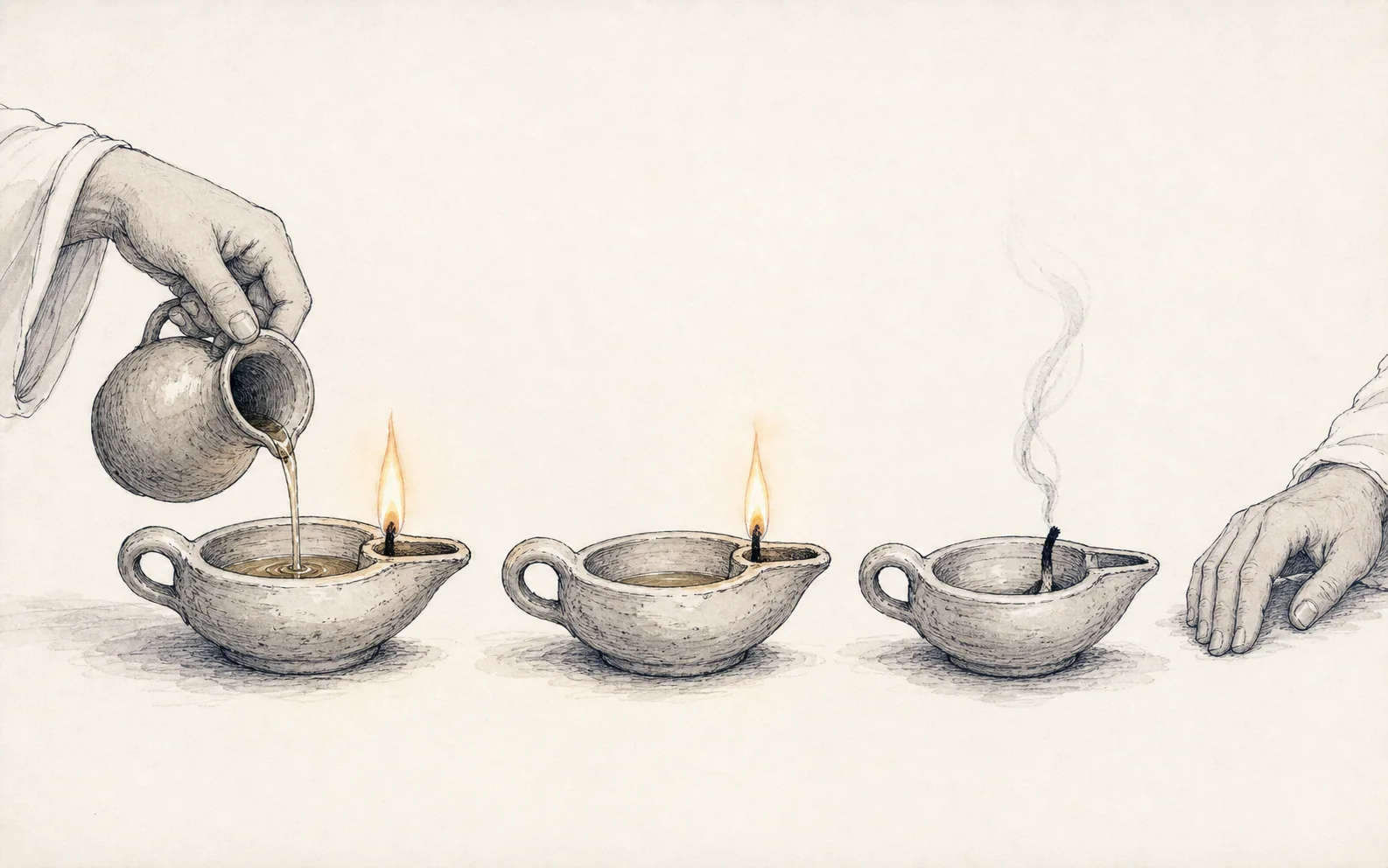
The image left at the scene of the teacher's death is a lamp. At the Buddha's parinibbāna, Anuruddha spoke a verse: the liberation of mind was like the extinguishing of a lamp.1 Paṭācārā had used the same image earlier at the moment of her own awakening. She pushed down the lamp wick with a needle and said, “Just like the quenching of the lamp was the liberation of my mind.”2 One scene is a death; the other is realization in this life. The same lamp stands at both moments. This detail is the entrance to the chapter. If the simile of an extinguished lamp referred to death, it should not appear in the awakening verse of someone still alive. It works in both places because what is extinguished was never the person but the fire. Chapter 1 has already identified the fire: greed, hatred, and delusion. The Fire Sermon, addressed to fire-worshipers, makes this explicit. Everything is burning: the eye, forms, eye-consciousness, eye-contact, and feeling are all burning—with the fires of greed, hatred, and delusion.3 The word nibbāna itself belongs to the vocabulary of fire: it means extinguishing. The name presupposes a fire, and from the beginning the texts register that fire under the defilements.
Both sides of the similes. To read fire, lamp, and tree only as figures for extinguishing is to miss half their work, and the more important half. Fire is first a model of continuity. A fire is named according to its fuel: a wood fire when it burns wood, a grass fire when it burns grass. Consciousness is likewise named according to its condition: consciousness arisen dependent on eye and forms is called eye-consciousness; consciousness arisen dependent on ear and sounds is called ear-consciousness. This is how the Buddha corrects the monk Sāti. Sāti claims that the same consciousness runs and wanders through the round of rebirth; the Buddha replies that consciousness arises dependently and cannot exist apart from its conditions. Here the fire simile concerns not extinction but the absence of a core in consciousness.4 The Kutūhalasālā Sutta goes further and uses fire to address the suspended point in continuity. When wind carries a flame away from one piece of fuel before it has reached another, what sustains it? Wind sustains it. When a being has laid down this body but has not yet taken up another, what sustains it? Craving sustains it.5 The flame does not fall to the ground between two fuels; appropriation forms the bridge. The lamp simile likewise has a side concerned with continued burning: someone repeatedly adds oil and trims the wick, so the lamp burns for a long time. The tree simile has a complete grammar of cultivation: the soil around the roots is cleared, earth is piled up, and water is poured; with this care the sapling grows, increases, and expands.6 Kindling a fire also has its conditional grammar. Wet wood submerged in water will not ignite; wet wood laid on dry land still will not ignite; only dry wood out of water catches fire.7 One family of images covers ignition, maintenance, transmission, and extinction. This is not a rhetorical accident. It shows that the tradition possessed a complete vocabulary of process (arising, remaining, continuing, and ceasing) with a simile for each.
Five theses. The philosophical position carried by this vocabulary can be gathered into five statements.
First, a phenomenon has no foundation of its own. Roots appear everywhere in these similes, but they are conditions, not substrates. Cutting the root means cutting off supply, not excavating an underlying substance. The fullness of a tree's crown is not an attribute belonging to the tree in itself; it results from a continuous supply through root, soil, and water. While the supply remains, the crown remains. When the supply is cut, the crown is no more.
Second, the continuity of a phenomenon requires no inner core. A flame changes with its fuel and crosses on the wind. Appropriation maintains continuity; no thing need be passed along. Sāti's view that the same consciousness transmigrates is rejected at exactly this point. Continuity is real; a continuer is a fiction.
Third, a phenomenon exists when its conditions are complete: oil and wick for a lamp flame; roots, soil, and water for a tree crown; fuel and wind for a fire. “Exists” is a borrowed word here. What the similes give us is only manifestation: the fire ignites; the tree grows. When conditions gather, an event appears. When they disperse, it ceases.
Fourth, when conditions are temporarily incomplete, the phenomenon temporarily fails to appear. The texts already have a simile for this grade. A viable seed without soil or water does not sprout, but it is not dead. When soil and water arrive, it sprouts.8 The attainment of cessation is the tradition's own experiment in suspension. How does someone in this attainment differ from a corpse when feeling and perception have both ceased? The person's life is not exhausted, warmth has not dissipated, and the faculties remain clear. The conditions have not been removed; cessation can therefore be reversed.9 Wet wood will not burn today, but may burn after drying. Temporary interruption must also be distinguished from its close neighbor, obstruction. Rāhu eclipsing the sun or moon and cloud or mist covering their light are forms of concealment, not severance. A covered lamp and an extinguished lamp are not the same.10
Fifth, when the conditions are completely removed, the phenomenon does not arise again. The Connected Discourses on Great Trees render this grade as an engineering procedure: cut the root, dig it up, pull out every filament, cut the tree into sections, split and shave it, dry it in wind and sun, burn it to ash, and scatter the ashes to the wind or sink them in flowing water; the tree becomes incapable of future arising.6 A palm tree with its crown cut off never revives. A scorched seed never germinates. When both oil and wick are exhausted, a lamp goes out of itself. The painstaking series of operations is deliberate. It distinguishes complete removal of the conditions from a single cut. A felled tree whose root remains will grow again; suffering will return while the latent tendency to craving has not been uprooted.11
The correspondence between these five theses and the three families of similes can be surveyed in one table:
| Thesis | Fire | Lamp | Tree and seed |
|---|---|---|---|
| 1. A phenomenon has no foundation | A fire is named according to its fuel | Oil and wick are conditions, not a substrate | Roots are supply lines, not a substance |
| 2. Continuity requires no core | Between two fuels, wind sustains the flame (Kutūhalasālā Sutta) | Adding oil and trimming the wick keeps the lamp burning (Saṃyojana Sutta) | Soil and water make the sapling grow (Connected Discourses on Great Trees) |
| 3. Complete conditions bring manifestation | Dry wood out of water catches fire (Mahāsaccaka Sutta) | Oil and wick give rise to flame | Root, soil, and water make the crown flourish |
| 4. Temporary lack brings temporary interruption | Wet wood does not burn today but may burn after drying | Rāhu eclipses the sun or moon: concealment, not severance (AN 4.50) | A seed without soil or water does not sprout yet remains viable (Bīja Sutta); in the attainment of cessation, life and warmth do not disperse (Mahāvedalla Sutta) |
| 5. Complete removal prevents renewed arising | When fuel is spent and wind ceases, the flame has no bridge | Oil and wick are exhausted; with nothing to feed on, the flame goes out | Root removed and ashes scattered, the tree cannot arise again; a palm cut at the crown is destroyed |
With remainder and without remainder. We can now refine the distinction left by Chapter 1. The Itivuttaka positively distinguishes two nibbāna-elements. In nibbāna with remainder, the fires of greed, hatred, and delusion are extinguished here and now, while life remains, the five faculties persist, and pleasant and painful feelings continue to be experienced. In nibbāna without remainder, after this life ends, all that is felt and no longer delighted in grows cool right here.12 Returned to the simile, the period with remainder is a lamp to which no more oil is being added. A flame still burns, but it consumes only the remaining oil. The hand that pours oil has withdrawn, while the oil has not yet run out and the flame has not yet gone out. The two-way lamp simile in the Saṃyojana Sutta fits this position exactly. Add oil and trim the wick repeatedly, and the lamp burns for a long time. Stop adding and trimming, and when the previous oil and wick are consumed, the flame goes out for lack of nutriment.13 The sick-ward discourses and the Dhātuvibhaṅga Sutta describe the moment of death with the same process word: at the breakup of the body, when life ends, all that is felt and no longer delighted in grows cool right here.14 In the Vappa Sutta, tree and cooling converge in a single place. A shadow depends on the stump of a tree; dig out the root, burn it completely to ash, and the shadow no longer appears. In the same discourse and the same formulation, at the breakup of the body all that is felt grows cool right here.15 Attend to the grammar: cooling, cessation, and no longer appearing are all process terms. The texts never award an arahant in the period with remainder a new state-entity, nor do they designate a destination in the period without remainder. Chapter 1 asked whether nibbāna with remainder is an event of cessation or an existential state that can be established. The similes lean toward the former and give a reason. Only processes and their conditions can be established: fire and fuel, flame and oil, crown and root. Once the process has ceased, this vocabulary contains no column for an entity corresponding to the process that has ended.
At the boundary of nibbāna without remainder, the similes perform the same operation as Chapter 1's exclusion of all four alternatives. Once the fire is out, asking whether it went east, west, north, or south makes no sense.16 A spark struck from an iron anvil gradually cools and its destination cannot be known.17 Once a shadow has ceased, no one asks where it has gone. The similes do not declare that there is nowhere to go; that would use the grammar of annihilationism. They merely deprive the question of destination of its foothold. Chapter 1 said that nibbāna without remainder can enter no positive relation with worldly phenomena, leaving predicates with nothing to attach to. The similes make this tactile: the hooks had been attached to fuel, oil, and root. When fuel, oil, and root are exhausted, the hooks hang in empty air.
The phenomenological approach and its restraint. We can now redeem the title of this chapter. Everything described by the three families of similes is a process: ignition, maintenance, transmission, depletion, cessation. None describes the destination of an entity. Positive vocabulary remains: cool, secure, smokeless, quenched. But these are the experiential aspect of cessation, not a table of properties belonging to another shore. To say that a person has cooled is to say that the three fires no longer ignite in that person, not to report the temperature of another domain. This vocabulary is complete within phenomena. Each of the five theses can be stated, and each has a simile. Its restraint lies in stopping after the fifth, without adding a sixth. Chapter 1 left open whether blocking all four alternatives marks a limit of logic or a limit of predication and conceptualization. The phenomenology of these similes gives this book a reason to decide. This book argues for the latter. The four alternatives are logically exhaustive; what fails is not their arrangement but the conditions of their application. For predication to work, a relation within worldly phenomena must first be available as an attachment point. Process vocabulary is exhausted when the process ends. To write the next sentence would require the vocabulary of entities, and authorization for that vocabulary was already withdrawn when the plantain trunk was peeled to nothing. The boundary lies on language's working surface, not inside logic.
For this very reason, later interpreters could take what they needed from the same collection of similes. In Vedic fire physics, an extinguished fire is not destroyed but released into a latent and diffuse condition, so the simile can be read as release.18 Read through the history of polemic, preaching extinction to fire-worshipers is itself a subversion of the sacrificial fire tradition.19 Read through conceptual history, nibbāna is a period at the end of a narrative. A period describes nothing; it simply lets the narrative stop in good form.20 The three readings contest the same empty place. The simile stops when the process ends and refuses to continue writing. Whoever continues must bring a metaphysics of their own. This proves the restraint of the similes from the other direction.
The question of the fuel. One unavoidable question must be closed off before the chapter ends. If fire is not a substance, is the fuel a substance? Moving the entity backward from phenomenon to substrate is the inevitable second question for a phenomenology of this kind. The texts handle it in four layers. First, the fuel too is burning. In the Fire Sermon, what burns is not only fire: eye, form, consciousness, contact, and feeling all burn. Fuel itself is process, not a platform beneath process. Second comes the plantain simile: form is like a lump of foam, feeling like a bubble, perception like a mirage, formations like a plantain trunk, and consciousness like an illusion. Peel the plantain layer by layer and no solid core is found.21 What had been treated as substrate is equally hollow under inspection. Third comes the statement concerning dependently arisen phenomena. Dependent arising is a standing law, but its links are themselves dependently arisen—impermanent, conditioned, arisen from conditions. Conditions themselves have conditions. Pursuing the fuel yields a cascade, not a foundation.22 Fourth comes the chariot simile: where parts are assembled, convention speaks of a chariot; where the aggregates assemble, convention speaks of a being. Components have no stronger claim to substantiality than the whole.23 Together the four layers say one thing: the similes leave no level of substrate to which an entity can retreat. The Bhāra Sutta seems to invite the bearer back in when it names the burden, taking up the burden, laying it down, and the bearer; later Pudgalavādins cited it as scriptural support. That belongs to the battlefield of Chapters 5 and 6 in Part 3 of the historical division; here a signpost is enough.24 Pursued downward, the question of fuel becomes the four great elements (earth, water, fire, and wind), which the Dhātuvibhaṅga Sutta treats one by one as not to be grasped as I or mine. Chapter 3 takes up that question. Pursued forward, fire and fuel are dismantled together in Chapter 10 of Nāgārjuna's Mūlamadhyamakakārikā. That belongs to Part 14.25
Return to the lamp. Anuruddha's verse did not say where his teacher had gone. It said that the liberation of mind was like the extinguishing of a lamp. At the tradition's most painful moment it chose the most ordinary things: hearth fire, oil lamp, tree, and seed. Process is seen every day, and cessation is seen every day. The vocabulary of nibbāna was not fashioned into an exclusively sacred image; that fact is itself part of the restraint. How much of that restraint was preserved, and through which gaps leakage occurred, are questions for Chapter 7.
References
References
-
Mahāparinibbāna Sutta (DN 16), Anuruddha's verse at the Buddha's parinibbāna. English translation in Maurice Walshe (trans.), The Long Discourses of the Buddha. Boston: Wisdom Publications, 1995. The Chinese parallel is the Discourse on the Great Passing in the Dīrgha Āgama. ↩
-
Paṭācārā's verses in the Therīgāthā (Thig 5.10). English translation in Charles Hallisey (trans.), Therigatha: Poems of the First Buddhist Women. Cambridge, MA: Harvard University Press, Murty Classical Library of India, 2015. ↩
-
Ādittapariyāya Sutta (SN 35.28). English translation in Bhikkhu Bodhi (trans.), The Connected Discourses of the Buddha. Boston: Wisdom Publications, 2000. The Chinese parallel is Saṃyukta Āgama no. 197. ↩
-
Mahātaṇhāsaṅkhaya Sutta (MN 38). English translation in Bhikkhu Ñāṇamoli and Bhikkhu Bodhi (trans.), The Middle Length Discourses of the Buddha. Boston: Wisdom Publications, 1995. The Chinese parallel is the discourse on Sāti, Madhyama Āgama no. 201. ↩
-
Kutūhalasālā Sutta (SN 44.9). English translation in Bodhi, Connected Discourses. The Chinese parallel is Saṃyukta Āgama no. 957. ↩
-
SN 12.55–57, two discourses on great trees and one on a sapling. English translation in Bodhi, Connected Discourses. Chinese parallels occur around Saṃyukta Āgama nos. 283–286, with differences in scope and arrangement. ↩↩
-
Mahāsaccaka Sutta (MN 36), the three similes of wet and dry wood; see also MN 85 and MN 100. English translation in Middle Length Discourses. ↩
-
Bīja Sutta (SN 22.54): the five-seed simile, with consciousness as seed, the four stations of consciousness as earth, and delight and lust as water. The scorched seed that cannot germinate appears in AN 3.34. English translations in Bodhi's editions of the two collections. ↩
-
Mahāvedalla Sutta (MN 43): the difference between a corpse and someone in the attainment of cessation (the presence or absence of life, warmth, and consciousness), and the simile of the mutual dependence of flame and light. The Chinese parallel is Madhyama Āgama no. 211. ↩
-
AN 4.50: sun and moon obscured by cloud, mist, smoke and dust, and Rāhu. English translation in Bhikkhu Bodhi (trans.), The Numerical Discourses of the Buddha. Boston: Wisdom Publications, 2012. ↩
-
Dhammapada 338. ↩
-
Itivuttaka 44, positively distinguishing the nibbāna-elements with and without remainder. English translation in John D. Ireland (trans.), The Udāna and the Itivuttaka. Kandy: Buddhist Publication Society, 1997. ↩
-
SN 12.53–54, with the two-way lamp simile of prolonging a flame by adding oil and allowing it to go out by adding no more. English translation in Bodhi, Connected Discourses. ↩
-
Sick Ward discourses, SN 36.7–8, and Dhātuvibhaṅga Sutta (MN 140): the oil-lamp simile and the formula that at the breakup of the body all that is felt will grow cool right here. The Chinese parallel of MN 140 is Madhyama Āgama no. 162. ↩
-
Vappa Sutta (AN 4.195), where the simile of the stump's shadow meets the formula of cooling. English translation in Bodhi, Numerical Discourses. ↩
-
Aggivacchagotta Sutta (MN 72). The Chinese parallel is Saṃyukta Āgama no. 962. ↩
-
Udāna 8.10, on the parinibbāna of Dabba Mallaputta. English translation in Ireland. ↩
-
Ṭhānissaro Bhikkhu, The Mind Like Fire Unbound: An Image in the Early Buddhist Discourses. Barre, MA: Dhamma Dana Publications, 1993. On Vedic fire physics and the release reading of extinction. ↩
-
Richard F. Gombrich, What the Buddha Thought. London: Equinox, 2009. On the polemical background of Vedic fire sacrifice. ↩
-
Steven Collins, Nirvana and Other Buddhist Felicities. Cambridge: Cambridge University Press, 1998. On nibbāna as the period ending a narrative. ↩
-
Pheṇapiṇḍūpama Sutta (SN 22.95). The Chinese parallel is Saṃyukta Āgama no. 265; its formula compares formations to a plantain trunk. ↩
-
Paccaya Sutta (SN 12.20), distinguishing dependent arising from dependently arisen phenomena. The Chinese parallel is Saṃyukta Āgama no. 296. ↩
-
Vajirā Sutta (SN 5.10). The Chinese parallel is Saṃyukta Āgama no. 1202. Nāgasena's chariot simile in the later Milindapañha takes this as its model. ↩
-
Bhāra Sutta (SN 22.22). The Chinese parallel is Saṃyukta Āgama no. 73. ↩
-
Nāgārjuna, Mūlamadhyamakakārikā, Chapter 10, “Examination of Fire and Fuel.” The Chinese edition with Pingala's commentary appears in Taishō vol. 30. ↩