Chapter 3: The Five Aggregates, the Four Great Elements, and Not-Self
Chapter 2 ended with a question still in place. If fire is not a substance, is the fuel? That chapter blocked the retreat through four layers of scripture and then posted a sign: dismantle the fuel further and one reaches earth, water, fire, and wind; nor can the person tending the fire escape the same scrutiny. This chapter performs both dismantlings. First dismantle the person and obtain the five aggregates; then dismantle the fuel and obtain the four great elements. When both piles have been taken apart, return to the scene and deal with the owner who keeps expecting to be recovered from the ashes. The order matters. The five aggregates come first because they are the tradition's own classificatory instrument. Their perspective is needed to reframe the question of the four great elements, and the dispute over not-self must be tried against their inventory.
An inventory of verbs. The Khajjanīya Sutta defines each of the five aggregates. Look first at the parts of speech, then at the content. Why is it called form? Because it is afflicted: by cold and heat, hunger and thirst, contact with flies and mosquitoes, wind and sun, and creeping things. Why is it called feeling? Because it feels: pleasure, pain, and neither-pain-nor-pleasure. Why is it called perception? Because it perceives: blue, yellow, red, and white. Why are they called formations? Because they form the conditioned: they fashion form as form, feeling as feeling, perception as perception, formations as formations, and consciousness as consciousness. Why is it called consciousness? Because it cognizes: sour, bitter, pungent, sweet, sharp, mild, salty, and bland.1 Not one of the five definitions gives a component, location, or material. All five are verbs. The Chinese parallel uses the same question-and-answer format. Form is obstructed by a hand, stone, stick, knife, cold, heat, thirst, hunger, mosquitoes, poisonous insects, wind, and rain. “Feeling has the characteristic of sensing. What does it sense? Pain, pleasure, and neither-pain-nor-pleasure.” Perception measures little, much, immeasurable, and nothingness. Formations fabricate: what do they fabricate? They fabricate form. Consciousness discriminates: what does it know? Form, sound, smell, taste, touch, and mental objects. The two transmissions substitute different examples for one another. In Pāli, perception identifies colors; in Chinese, it measures breadth and scale. In Pāli, consciousness cognizes tastes; in Chinese, it faces the six kinds of object. Pāli explains form through being afflicted; Chinese through obstruction upon contact. Examples and glosses change, but the interrogative structure does not: what is felt, what is perceived, what is fabricated, what is cognized? Neither transmission treats the examples as the point, because the definitions rest on verbs. This is not an ingenious reading of an isolated discourse. Two lines of transmission independently preserve the same decision: the aggregates are named for what they are doing.
One detail deserves a line of its own: even the first item in the inventory belongs among the verbs. Form is not defined by extension, particles, or matter. It is defined by an encounter: afflicted by heat and cold, obstructed by hand, stone, knife, and stick. On this list, materiality is the resistance and abrasion in experience that cannot be pushed aside, not some filler hidden behind resistance. Chapter 2 burned the fuel down into process; the act of naming here is itself processual.
This decision excludes an entire class of readings. A part can lie idle; an activity cannot. A knife lying unused remains a knife. A feeling that does not occur is nothing at all. The five aggregates are therefore not a parts list enumerating the things from which a being is assembled. They are an inventory of processes distinguishing kinds of activity now taking place in the field of experience.2 Chapter 2 observed that a fire is named according to its fuel: burning wood, it is called a wood fire; burning grass, a grass fire. The aggregates are named in the same family of grammar, according to their conduct. Where feeling occurs, the name “feeling” is established; where cognizing occurs, the name “consciousness” is established. The name is pinned to an action, not to something behind the action. The discourse title presses the point one step further: devoured. Wherever one grasps, one is devoured there. One who grasps form is devoured by form; one who grasps feeling is devoured by feeling. A process offers no dwelling place. Whoever tries to make a home in one first becomes its food.
Aggregates of clinging and fuel. Classification itself is neutral; the burden comes from elsewhere. The texts clearly distinguish the five aggregates from the five aggregates subject to clinging. The aggregates comprise all form, feeling, perception, formations, and consciousness. The aggregates subject to clinging are those among them that are tainted and capable of being appropriated.3 The dialogue in the Puṇṇama Sutta fixes the relation exactly; the Chinese parallel does it in one line: “The five aggregates are not themselves clinging, nor is clinging something different from the five aggregates; desire and greed for them makes them the five aggregates subject to clinging.”4 An etymological detail locks this chapter to the last: upādāna, clinging or appropriation, is also the word for fuel in the vocabulary of fire. The two questions cited in Chapter 2 remain. What sustains a flame between two pieces of fuel? Wind. What sustains a being after laying down one body but before taking another? Craving. Consciousness with upādāna is like a fire with fuel. The “five aggregates subject to clinging” should therefore be heard literally: five classes of process being burned as fuel. The fire called a person seizes its own experience and burns it as wood. Classification is no longer neutral here. It is an investigator's report from the fire scene.
Misreading an anatomical chart. The most common table used to introduce the five aggregates to modern readers looks something like this: form is the physical body; feeling is sensation in the peripheral nervous system; perception is the brain's center for language and logic; formations are volition and planning in the prefrontal cortex; consciousness is a kind of global broadcast.5 This table reads the aggregates as an anatomical chart: one torso accompanied by several partitioned regions of the brain. It circulates widely because it makes an ancient classification look prophetic. Its errors are so orderly that they deserve to be audited one by one.
The parts of speech are wrong first. An anatomical chart supplies organs, and organs can remain on standby. The texts supply activities, and activities have no standby state. A neuron that does not fire remains a neuron; a feeling that does not feel is nothing. Reading an inventory of verbs as an inventory of organs loses the definition at the first step.
The scope is also wrong. Form is not the physical body. The formula in the Anattalakkhaṇa Sutta sweeps across all form: past, future, and present; internal and external; coarse and subtle; inferior and superior; far and near.6 The Mahāhatthipadopama Sutta divides the earth element into internal and external. Hair, body hair, nails, teeth, skin, flesh, sinews, and bones belong to the internal earth element; the great earth belongs to the external.7 To shrink form inside the skin is to discard mountains, the earth, and even the paper on which the table is printed.
The standpoint is the deepest error. The classification by aggregates is first-person: it divides the field of experience into the affliction, feeling, perceiving, forming, and cognizing now taking place. Neuroscientific classification is third-person: it divides tissues and circuits inside the skull. Each map is legitimate and answers its own question. Laying one over the other and declaring a box-for-box correspondence is a modern instance of the category mistake diagnosed in Chapter 1. Only the final item in the comparison has the scent of process: global broadcasting is indeed an activity, not an organ. But it remains a third-person hypothesis answering how information is integrated in the skull, not how experience appears here and now and is appropriated here and now. Sue Hamilton's conclusion after examining the Nikāyas arrives at the same place: the aggregates analyze the constitution of experience, not the parts of the machine called a human being.8 This book argues that the anatomy reading dies here. It does not give the wrong answer; it has picked up the wrong examination paper. Saying so does not belittle either map. The mistake lies only in forcing them to overlap.
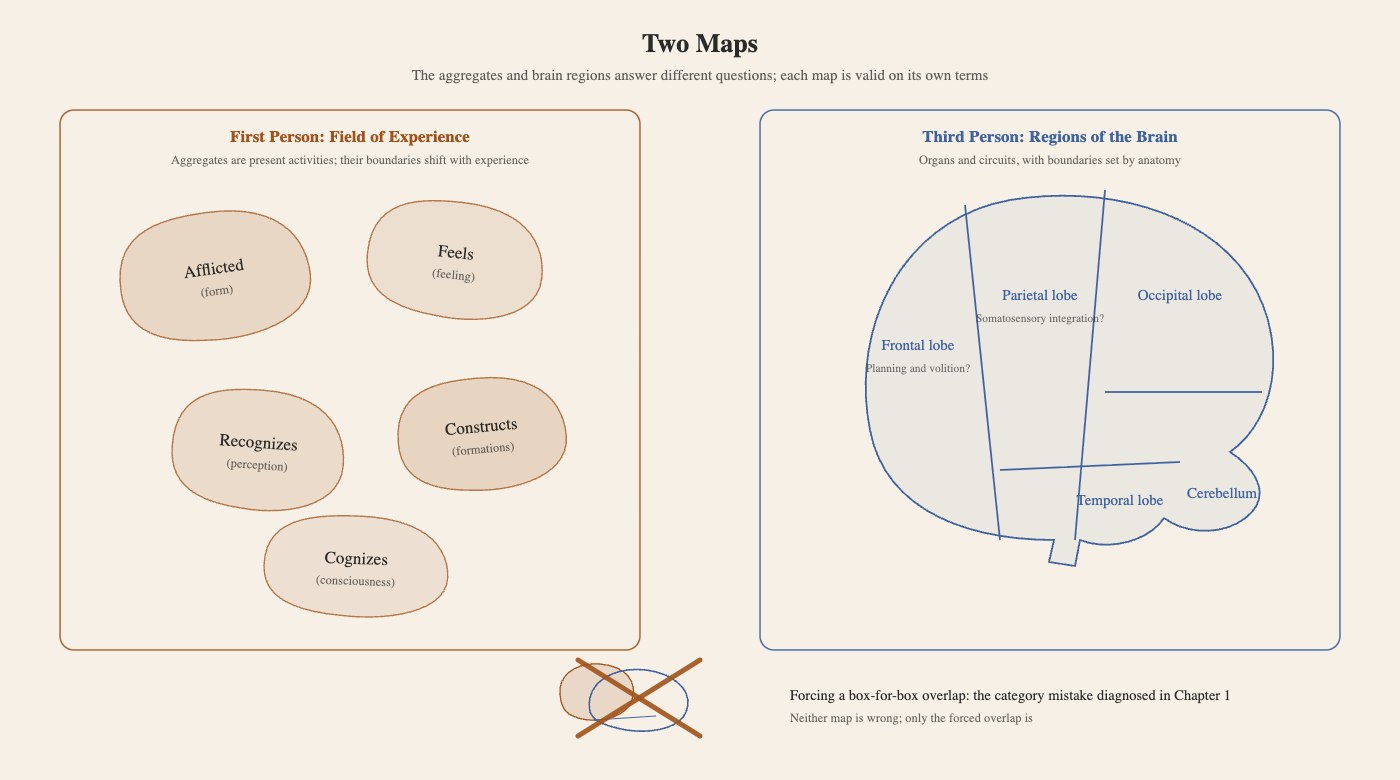
The purpose is wrong as well. This inventory was drawn to end clinging, not to popularize science. As we will see, the argument of the Anattalakkhaṇa Sutta must be run item by item through the list: if form were self, one should be able to command it to be thus or not thus. If the aggregates were regions of the brain, this argument would become a feasibility study in neurosurgery and the reasoning would have nowhere to begin. A tool is tested in use. The criterion by which this inventory is accepted is whether clinging loosens when feeling is seen simply as feeling without adding a feeler.
The contrast between definition and misreading can be decided in a table. The left interpretive column supplies parts; the two textual columns contain only actions.
| Aggregate | Anatomical reading | Pāli definition (Khajjanīya Sutta) | Chinese wording (parallel discourse) |
|---|---|---|---|
| Form | Physical body | Afflicted by cold, heat, hunger, thirst, mosquitoes, wind, and sun | Obstructed and divided: hand, stone, stick, and knife all obstruct on contact |
| Feeling | Peripheral sensation | Feels pleasure, pain, and neither-pain-nor-pleasure | The characteristic of sensing: what is sensed? |
| Perception | Center of language and logic | Perceives blue, yellow, red, and white | Perceives little, much, immeasurable, and nothingness |
| Formations | Volition and planning in the prefrontal cortex | Forms the conditioned: fashions form as form | The characteristic of fabrication: fabricates form |
| Consciousness | A kind of global broadcast | Cognizes sour, bitter, pungent, sweet, salty, and bland | The characteristic of discrimination: cognizes form, sound, smell, taste, touch, and mental objects |
A catalog of qualities. Now dismantle the fuel. A formal interface connects the five aggregates and the four great elements: the standard definition of the aggregate of form is the four great elements and form derived from them. To dismantle form is to reach the elements.9 Earth, water, fire, and wind sound like a recipe of elements, as though they belonged with Thales's water and Empedocles's four roots in the childhood of physics. Examine the definitions before judging their age. Earth is hardness; water is wetness and cohesion; fire is warmth and maturation; wind is motion and support. Hard, wet, warm, and moving are all qualities in experience: the resistance met by the palm, moisture felt by the tongue, heat felt by the skin, pressure moving through the chest. No particles or smallest units appear in the definitions. The four great elements are given at the point of contact, not under a microscope. They are not a list of material ingredients but four ways in which materiality arrives in experience. Chapter 2 said that fuel itself is process. The four elements turn that claim into a catalog: the thing called fuel is simply the gathering of four qualities—hardness, moisture, warmth, and motion.
The Mahāhatthipadopama Sutta provides the backbone of this section. Sāriputta distinguishes each element internally and externally. Hair, body hair, nails, teeth, skin, flesh, sinews, and bones are the internal earth element; the great earth is the external. Then comes a heavy blow: even the external earth element, vast as it is, will be destroyed when the cosmic flood comes and the great earth disappears; how much more this briefly abiding body appropriated by craving. At the end of each element the sentence arrives at the same place: “This is not mine, this I am not, this is not my self”; it should be seen in this way.7 The inventory of elements can expand and contract. The Mahārāhulovāda Sutta gives five, adding space, and turns the list into an exercise. Practice like earth: clean and filthy things are thrown upon it, yet it neither hates nor delights. Practice like water, fire, wind, and space.10 The Dhātuvibhaṅga Sutta gives six, adding consciousness, and repeats for each that it should not be appropriated as I or mine.11 Four, five, six: the list changes according to the needs of contemplation. A periodic table cannot tolerate such elasticity; a toolbox can. Elements cannot number four today and six tomorrow, but wrenches may be added or removed for a job. The flexibility of the list is testimony in itself. The elements are not a catalog of substances but instruments of contemplation.
A wrongly asked question. Once the identity of the four great elements is clear, a famous episode becomes easier to read. In the Kevaṭṭa Sutta, a monk travels through meditation from one class of deities to the next carrying a question: where do the four great elements (earth, water, fire, and wind) cease without remainder? The Four Great Kings do not know and send him upward. Eventually he reaches the gods of Brahmā's retinue, who say that they do not know and that he must wait for Great Brahmā to appear. Brahmā manifests in light and praises himself before the assembly: I am Brahmā, Great Brahmā, the All-seeing, the Sovereign. The monk is unmoved and asks his question three times. Brahmā takes him by the arm, leads him aside, and whispers that he does not know either; the monk should return and ask the Buddha.12 The comedy belongs to the discourse itself. The Buddha gives no location. He rewrites the question on the spot: one should not ask where the four great elements cease without remainder, but where water, earth, fire, and wind find no footing; where long and short, coarse and fine, beautiful and ugly, and name-and-form cease without remainder. The verse answers: with the cessation of consciousness, all this ceases. The diagnosis behind the revision has the same shape as Chapter 1's. Qualities have no destination. Hardness and moisture are not objects that can depart or arrive. Asking where they cease is afflicted by the same disease as asking whether an extinguished fire has traveled east or west. Once the question is healed, the answer has a place to stand. Hardness, moisture, warmth, and motion are qualities within manifestation. Where the field of manifestation ceases, they cease.
One line in the answering verse has long been a battlefield of interpretation: “Consciousness, nonmanifest, infinite, luminous all around.” One line of interpretation treats this as positive doctrine: nibbāna is an objectless consciousness without a footing, and a similar phrase in the Brahmanimantanika Sutta is adduced as corroboration.1314 Another reads it, in light of the verse's context and the commentarial tradition, as rhetoric and transition rather than an affirmation of permanent consciousness. This book regards it as rhetoric for two reasons grounded in the texts themselves. First, the same verse ends by saying that when consciousness ceases all this ceases. If its earlier line established a permanent consciousness, its ending would have nowhere to stand. Second, the Upaya Sutta is categorical: it is impossible to describe the coming, going, passing away, arising, growth, increase, or proliferation of consciousness apart from form, feeling, perception, and formations.15 Consciousness has no privileged compartment in the list of aggregates. Before a consciousness independent of conditions and self-luminous in itself can be registered, these two passages must first be overturned. The point need not be pressed further here: a detailed examination of the line belongs to textual scholarship. For this chapter it is enough that the line cannot cut an ontological opening in this restrained phenomenology.
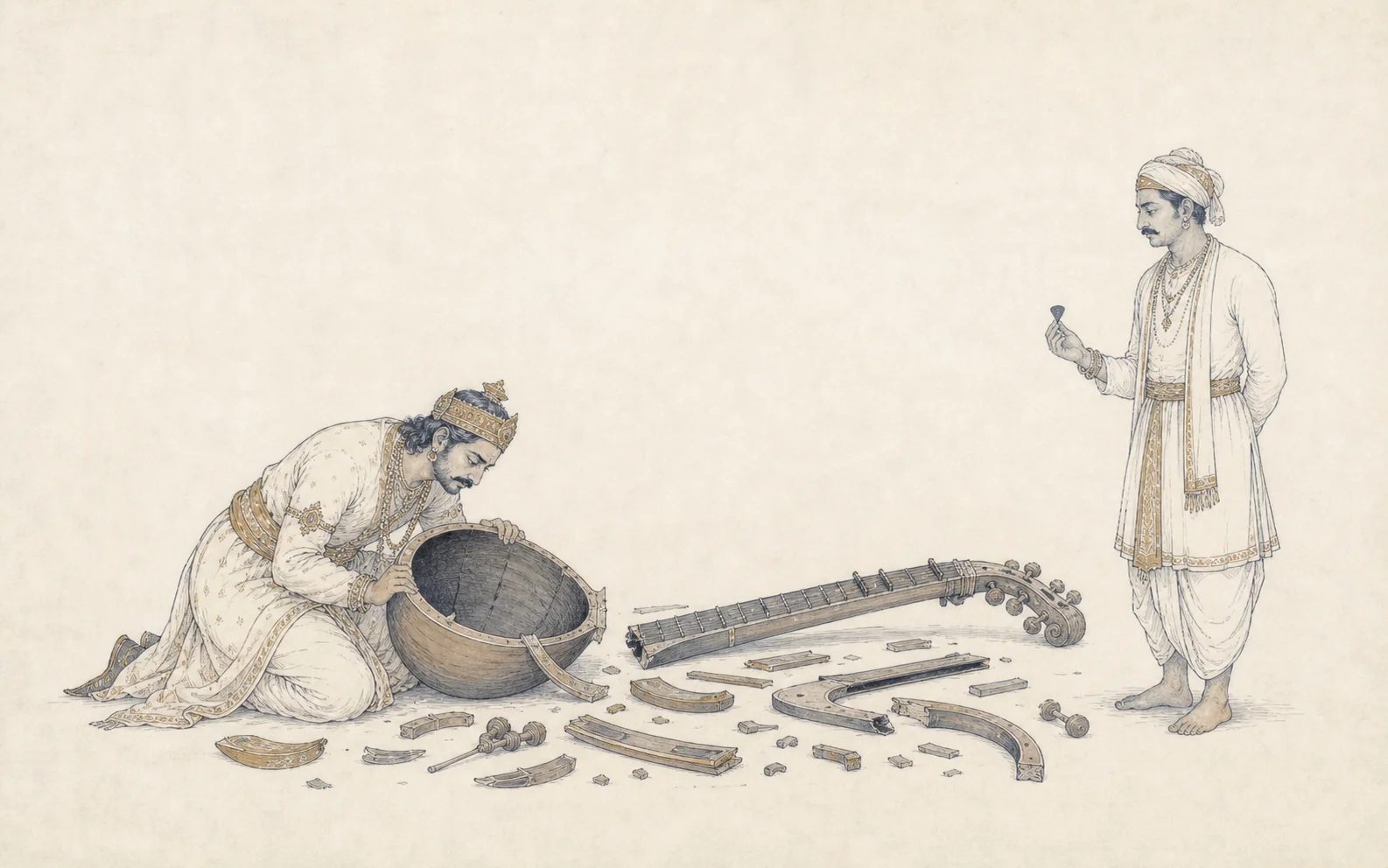
Dismantling the vīṇā in search of its sound. Return, then, to the person. Dismantling fuel yields qualities; dismantling the person yields activities. The two operations meet in one simile. A king hears the sound of a vīṇā and is delighted, so he orders his servants to bring him the sound. They bring the instrument. The king says that he has no use for the vīṇā; he wants the delightful sound he heard before. His servants reply that the vīṇā is made from many conditions: a neck, a body, strings, a hide, and a skilled hand that plays it. Sound arises from those conditions; it is not something stored in the instrument's hollow body waiting to be retrieved. The king does not believe them. He breaks the instrument to look for the sound, splits it into a hundred pieces, and scatters them everywhere, but never finds it.16 The discourse hands the simile to the monk: search form, feeling, perception, formations, and consciousness in the same way, and neither I nor mine can be found. This simile belongs to the same family as Chapter 2's plantain. Peel the plantain layer by layer and no solid core appears; dismantle the vīṇā piece by piece and no sound appears in its belly. The crucial point is the affirmative side of the servants' answer. Sound is not nonexistent. Sound is an event of conditions. Dismantling the instrument in search of sound goes wrong not about sound but about the method of search, which treats an event as a stored object. The relation of self to the aggregates is the relation of sound to the vīṇā.
The second discourse. The Anattalakkhaṇa Sutta is the second teaching after awakening. It advances two arguments, each run item by item through the list of five aggregates. The first is lack of mastery: “Form is not-self. For if form were self, it would not lead to affliction, and it would be possible to command form: let my form be thus; let my form not be thus.”6 Whatever tradition registers the title “self,” the title carries at least one power: command over oneself. Audited one by one, none of the aggregates can produce this authority. The second argument proceeds from impermanence. Form is impermanent; what is impermanent is suffering; what is impermanent, suffering, and subject to change cannot properly be regarded as self, as belonging to self, as in self, or as containing self. The conclusion shared by the two arguments contains a formal detail worth pausing over. The Pāli formula has three clauses: this is not mine; this I am not; this is not my self. The Saṃyukta Āgama formula also has three: not self; not different from self; not mutually contained. “Mutually contained” compresses two forms—self is in form, and form is in self. Expanded, it becomes a table of twenty cells. When the elderly householder Nakulapitā is afflicted in body, the Buddha teaches him to be afflicted in body but not in mind. Sāriputta then lays out this exact table: any identification of the five aggregates with self takes one of four forms (form is self; self possesses form; form is in self; self is in form), and so on through consciousness, making twenty identity views in all.17 Chapter 1 observed that the fourteen undeclared questions, with four alternatives for three questions and two for one, display the tabular culture of an age of debate. The twenty identity views are a sibling work. One exhausts the questions that can be asked; the other exhausts the misidentifications that can be made. The purpose of enumeration is the same: register and guard each entrance, leaving no side door.
The twenty cells appear below, and their family resemblance to this tabular culture is unmistakable:
| Aggregate / form | 1. X is self | 2. Self possesses X | 3. X is in self | 4. Self is in X |
|---|---|---|---|---|
| Form | Form is self | Self possesses form | Form is in self | Self is in form |
| Feeling | Feeling is self | Self possesses feeling | Feeling is in self | Self is in feeling |
| Perception | Perception is self | Self possesses perception | Perception is in self | Self is in perception |
| Formations | Formations are self | Self possesses formations | Formations are in self | Self is in formations |
| Consciousness | Consciousness is self | Self possesses consciousness | Consciousness is in self | Self is in consciousness |
Two registers of discourse. To see not-self in its original form, first ask in which register it ordinarily works. A lesson in Jeta's Grove is the model of the register of ownership: whatever is not yours should be abandoned. What is not yours? Form, feeling, perception, formations, and consciousness. If someone gathered grass, sticks, branches, and leaves from Jeta's Grove, carried them away, or burned them, would you think, “That person is carrying us away; that person is burning us”?18 The teaching's everyday syntax is this: it is not yours, so let it go. This is a practical instruction, not an ontological proclamation. Saying that the trees and leaves are not yours requires no preliminary inventory of whether they exist in the grove. In the great majority of canonical appearances, not-self takes this form.
Direct questions in the existential register—“Is there a self?” “Is there no self?”—meet silence. The wanderer Vacchagotta asks both, and the Buddha is silent twice. After Vacchagotta leaves, Ānanda asks why. The Buddha explains step by step. To answer that there is a self would side with eternalism and conflict with the fact that all phenomena are not-self. To answer that there is no self would side with annihilationism and leave Vacchagotta even more confused: did a self exist for me before and has it now been annihilated?19 On Chapter 1's map, not-self and the life–body gate face each other across a line, as if the teaching affirmed with one hand and covered the mouth with the other. This discourse spells out the division of labor between the two hands. Silence closes the personal question; affirmation states a general characteristic of phenomena. The silence is a pedagogical decision. In explaining that decision, the not-self of all phenomena remains fully present as a fixed point that cannot be contradicted.
Method or doctrine? Contemporary scholarship has turned this line into a formal question: is not-self a doctrine or a method? Ṭhānissaro Bhikkhu stands at the methodological end. Not-self is not a claim about the world but a cognitive strategy for letting go. The Buddha leaves metaphysical questions about self and no self undeclared because answering would exceed the strategy's boundaries. The evidentiary chain consists of the discourses above and two others. The Sabbāsava Sutta classifies the whole series of questions (did I exist in the past, did I not exist, do I exist now, do I not exist) as unwise attention giving rise to a thicket, wilderness, and fetter of views.20 The raft simile closes the case: even teachings should be abandoned, how much more what is not teaching.21 Bhikkhu Bodhi stands at the doctrinal end. The title of his essay gives the structure of his answer: not-self is both strategy and ontological assertion. It works as a strategy precisely because it is true; liberation depends on seeing impermanence, suffering, and not-self as they are, not on a useful fiction.22 Collins and Harvey each construct an intermediate position between the two ends.2314
This book takes not-self to be a doctrine and stands with Bodhi, for three reasons. First, doctrine resides inside the text on which the strategic reading relies most heavily. In the Vacchagotta episode, the Buddha explains his silence by invoking the not-self of all phenomena as a fixed point. A mnemonic cannot be contradicted; only an assertion can be contradicted by an answer. Second is the grammar of the standing principle: whether Tathāgatas appear or do not appear, this element stands, fixed in the Dhamma—conditioned phenomena are impermanent, conditioned phenomena are suffering, all phenomena are not-self. The Chinese formulation in the discourse to Channa is: all conditioned phenomena are impermanent, all phenomena are not-self, nibbāna is peaceful.24 Something that holds regardless of the teacher's presence speaks in the voice of natural law. A practical maxim has no need to proclaim its independence of the teacher. The accompanying phrase is “as it is.” The Anattalakkhaṇa Sutta instructs the monks to see the aggregates as they are; “as it is” presupposes that something is the case to be seen. Without an assertion underfoot, the phrase loses its footing. Third is the handling of scope. The third characteristic changes its subject: conditioned phenomena are impermanent, while all phenomena are not-self. “Phenomena” includes the unconditioned; nibbāna too is not self.25 A tool of attention designed only to end clinging would not need to place the unconditioned inside its jurisdiction. Drawing the boundary there is the handwriting of ontology.
Judging it doctrine does not erase what the strategic reading sees. It describes the use of the teaching correctly, and the discipline governing that use is real. A monk's bad question in the Puṇṇama Sutta provides a ready negative example: “If there is no self, who will be affected by the deeds done by the not-self?” The question is structurally defective. Its first half accepts the premise of not-self, while the word “who” in its second half invites the subject back in. The question's presupposition has already been canceled by its own premise, so “who” is bound to miss. That is precisely the miss the questioner wants. He reads the absence of an answer as no one receiving the result, then quietly substitutes “not me” for “no one.” Self is thus used twice: in the question it demands a recipient of the result; in the calculation it exempts the agent of the deed. The self that acts and enjoys remains present now and goes missing only when the result comes due. In his hands, not-self becomes a clause applying only to consequences. Even read charitably as a reductio, it fails. The premise required by the reductio, that receiving a result requires a recipient, is exactly the disputed point denied by not-self. Using the disputed point as a premise makes the reductio circular. The Buddha rebukes the monk for overstepping, and the expanded Mahāpuṇṇama Sutta identifies the question as driven by craving. He then presses the monk back to the inventory and its dialogue: is form permanent or impermanent?4
What is rebuked is a smuggled form of question. A clean question remains valid, and the tradition answers it directly. The clean form does not ask “who”: in the absence of a subject, how do kamma and result still count, and why should they still matter? Half the answer about mechanism has the same structure as Chapter 2: continuity requires no continuer; the details of its operation are the subject of the next chapter. The half about concern is more direct: suffering does not wait for someone to claim it before it arises. The result is fearsome not because it can find you, but because suffering will actually be felt within this continuity. A scriptural model already exists for the operation on the question. A monk asks: who consumes nutriment? Who contacts? Who feels? The Buddha stops him at each link. “I do not say that there is one who consumes, contacts, or feels. If I said there were, you should ask that question. You should instead ask: conditioned by what does nutriment occur? Conditioned by what does contact arise?”26 The Kevaṭṭa Sutta rewrote “where”; here the same surgical knife rewrites “who.” The Chinese tradition has a summary almost identical to this section's conclusion: there is the result of action, but no agent.27
The strategic reading sees such distortions with particular clarity. The Alagaddūpama Sutta makes three uses of one discourse to draw boundaries around use. A teaching badly grasped is like a snake seized by the tail: it turns and bites. When people accuse the Buddha of teaching annihilationism, he replies that both formerly and now he teaches only suffering and the cessation of suffering. The raft simile closes the discourse: even teachings are to be abandoned.28 But the raft is left behind only after crossing. What is abandoned is clinging, not the fact that the raft carried someone across. To read instructions for use as absence of content is to mistake a manual for an empty box. This book's complete formulation is therefore: not-self is a doctrine with its own instructions for use. Those instructions also appear in the texts: do not answer through personal questions; do not let the teaching spin free from its inventory; do not derive annihilationism from it. The strategic reading's contribution is to arrange these instructions clearly. Its error is to declare that the box contains nothing else.
One final matter is the status of language. A deity wonders whether an arahant whose taints are exhausted still says “I speak” and “they speak to me” because conceit remains. The reply says that the arahant has abandoned conceit and no longer has a mind of “I am,” but “skillfully understanding the world's conventions, uses such terms as mere designations.”29 The doctrine never confiscates first-person pronouns. It removes the view and clinging beneath them. An arahant still says “I” and still replies to questions. The whole apparatus of language continues to work. What has been removed is the engine that drives language to claim, defend, and prolong a self.
In the 2020s this point received corroboration from an unexpected direction. Large language models use “you” and “I” fluently. Their reference is clear, their answers appropriate, and their standpoint shifts with dialogue much like a person's. Whether such systems have an inner life is open to dispute. What is not disputable is that their pronominal competence was produced without first building a self. It arises from statistical shaping over massive bodies of text; no self-component appears in the design or parts.30 A convenient inference is thereby broken on the spot: the ability to say “I” does not entail the existence of an I. All the linguistic functions of the first person can operate through a wholly processual mechanism. This does not compare a language model to an arahant. An arahant once clung and has removed the clinging; the model never had it installed. The two examples meet at only one point: “I” is a functional component of conventional language, not proof of an entity. The same conclusion is supported from both ends. One who has removed clinging continues to say “I”; one who has never clung also says it fluently. At neither end does pronominal fluency require a self. To read not-self as a linguistic prohibition against the word “I” is to pick up the wrong examination paper again.
Closing half the life–body case. Chapter 1 left open whether life and body are the same or different. With the two knives of this chapter in hand, half the file can be closed. After life and body have been dismantled through aggregates and elements, the two grammatical subjects occupy the same position as sound inside the vīṇā. Asking whether two things are identical or different first requires two things. Both are conventional designations; the identity–difference question therefore suffers from the same defect as the question about the destination of the four elements. This explains why it belongs among the undeclared. The answer is not difficult to produce; the foundation of the question has collapsed. The other half of the file belongs elsewhere. How continuity works without self and how kamma and result remain valid are addressed directly by the next chapter on dependent arising. The Pudgalavādin use of the “bearer of the burden” as scriptural evidence remains, following Chapter 2's signpost, in Part 3 of the historical division.31
The simile of Jeta's Grove can escort us out of the chapter. Someone carries away grass and branches, yet no one in the grove feels carried away. Aggregates arise and cease like the flourishing and decay of leaves in the woods. The doctrine says: the leaves are not yours. The method says: therefore let go. The two have never been separate. Only when the boundary is drawn clearly does letting go have somewhere to act; only when an assertion lies beneath it does the strategy avoid hanging in the air. Chapter 2 dismantled the fire. This chapter dismantled the fuel and the person tending the fire. The ashes have been searched. No owner has arrived to claim them, and no discourse says that no one ever warmed themselves at the fire.
Two questions remain beside the embers. First, without an owner, how does this fire ignite and sustain itself? What drives it onward? Second, this chapter began by mentioning an owner who keeps expecting to be found in the ashes. That urge to be found is itself evidence at the scene. The bad question in the Puṇṇama Sutta, Vacchagotta's confusion, and the entire table of twenty identity views are three appearances of the same impulse. Why is it so stubborn, and what feeds it? Does the misidentification of self belong to the side of ignorance, or to craving and clinging? Psychodynamics cannot avoid the question. Both questions lead into the next chapter on dependent arising.
References
References
-
Khajjanīya Sutta (SN 22.79). English translation in Bhikkhu Bodhi (trans.), The Connected Discourses of the Buddha. Boston: Wisdom Publications, 2000. The Chinese parallel is Saṃyukta Āgama no. 46. Its examples differ from the Pāli, but the question-and-answer structure is identical; that structure supports this chapter's argument. ↩
-
Rupert Gethin, “The Five Khandhas: Their Treatment in the Nikāyas and Early Abhidhamma.” Journal of Indian Philosophy 14 (1986). On the treatment of the aggregates in the Nikāyas and early Abhidhamma. ↩
-
Khandha Sutta (SN 22.48), distinguishing the five aggregates from the five aggregates subject to clinging. English translation in Bodhi, Connected Discourses. ↩
-
Puṇṇama Sutta (SN 22.82; expanded as Mahāpuṇṇama Sutta, MN 109). English translation in Bodhi. The Chinese parallel is Saṃyukta Āgama no. 58, containing both the line that the five aggregates are neither identical with nor different from clinging and the bad question about who receives the result. ↩↩
-
The idea of a global broadcast derives from global workspace theory: Bernard J. Baars, A Cognitive Theory of Consciousness. Cambridge: Cambridge University Press, 1988; Stanislas Dehaene, Consciousness and the Brain. New York: Viking, 2014. ↩
-
Anattalakkhaṇa Sutta (SN 22.59). English translation in Bodhi. The Chinese parallel is Saṃyukta Āgama no. 34. ↩↩
-
Mahāhatthipadopama Sutta (MN 28). English translation in Bhikkhu Ñāṇamoli and Bhikkhu Bodhi (trans.), The Middle Length Discourses of the Buddha. Boston: Wisdom Publications, 1995. The Chinese parallel is Madhyama Āgama no. 30. ↩↩
-
Sue Hamilton, Identity and Experience: The Constitution of the Human Being According to Early Buddhism. London: Luzac Oriental, 1996. ↩
-
Upādānaparipavatta Sutta (SN 22.56), defining the aggregate of form as the four great elements and form derived from them. English translation in Bodhi. The Chinese parallel is Saṃyukta Āgama no. 41. ↩
-
Mahārāhulovāda Sutta (MN 62). English translation in Ñāṇamoli and Bodhi. ↩
-
Dhātuvibhaṅga Sutta (MN 140). English translation in Ñāṇamoli and Bodhi. The Chinese parallel is Madhyama Āgama no. 162. ↩
-
Kevaṭṭa Sutta (DN 11). English translation in Maurice Walshe (trans.), The Long Discourses of the Buddha. Boston: Wisdom Publications, 1995. The Chinese parallel is the Kevaṭṭa Sūtra in the Dīrgha Āgama. ↩
-
Brahmanimantanika Sutta (MN 49), which contains a similar form of the phrase “consciousness, nonmanifest, infinite.” English translation and discussion in Ñāṇamoli and Bodhi. The Chinese parallel is Madhyama Āgama no. 78. ↩
-
Peter Harvey, The Selfless Mind: Personality, Consciousness and Nirvāṇa in Early Buddhism. Richmond: Curzon Press, 1995. A systematic construction of the reading of objectless consciousness. ↩↩
-
Upaya Sutta (SN 22.53). English translation in Bodhi. The Chinese parallel is Saṃyukta Āgama no. 40. ↩
-
Vīṇopama Sutta (SN 35.246). English translation in Bodhi. The Chinese parallel is Saṃyukta Āgama no. 1169, in which the instrument is split into a hundred pieces and scattered. ↩
-
Nakulapitā Sutta (SN 22.1). English translation in Bodhi. The Chinese parallel is Saṃyukta Āgama no. 107. The Pāli version enumerates all twenty forms; the Chinese compresses them as identity, difference, and mutual inclusion. ↩
-
Natumhāka Sutta (SN 22.33; the simile also appears in SN 35.101). English translation in Bodhi. The Chinese parallel is Saṃyukta Āgama no. 269, with the grass, wood, branches, and leaves of Jeta's Grove. ↩
-
Ānanda Sutta (SN 44.10). English translation in Bodhi. The Chinese parallel is Saṃyukta Āgama no. 961. ↩
-
Sabbāsava Sutta (MN 2). English translation in Ñāṇamoli and Bodhi. The Chinese parallel is Madhyama Āgama no. 10. ↩
-
Ṭhānissaro Bhikkhu, “No-self or Not-self?” (1996), in Noble Strategy. Valley Center, CA: Metta Forest Monastery, 1999; and Selves & Not-self: The Buddhist Teaching on Anattā. Valley Center, CA: Metta Forest Monastery, 2011. Representative statements of not-self as strategy. ↩
-
Bhikkhu Bodhi, “Anattā as Strategy and Ontology,” in Investigating the Dhamma: A Collection of Papers. Kandy: Buddhist Publication Society. First published in 1993. ↩
-
Steven Collins, Selfless Persons: Imagery and Thought in Theravāda Buddhism. Cambridge: Cambridge University Press, 1982. ↩
-
Uppādā Sutta (AN 3.136). English translation in Bhikkhu Bodhi (trans.), The Numerical Discourses of the Buddha. Boston: Wisdom Publications, 2012. The Chinese formulation occurs in Saṃyukta Āgama no. 262, the discourse to Channa; its direct Pāli parallel is SN 22.90. ↩
-
Dhammapada 279: all phenomena are not-self. ↩
-
Moḷiyaphagguna Sutta (SN 12.12). English translation in Bodhi. The Chinese parallel is Saṃyukta Āgama no. 372, which repeats the same reformulation for consciousness as nutriment, contact, feeling, craving, and clinging. ↩
-
Discourse on Emptiness in the Ultimate Sense, Saṃyukta Āgama no. 335: “When the eye arises it comes from nowhere; when it ceases it goes nowhere … There is the result of action but no agent. When these aggregates cease, other aggregates continue, except as a matter of conventional designation.” The discourse has no Pāli parallel. A verse with the same purport appears in Buddhaghosa's Visuddhimagga, Chapter 16: there is suffering but no sufferer; there is action but no agent. The concluding exception for conventional designation agrees with this chapter's discussion of language. ↩
-
Alagaddūpama Sutta (MN 22). English translation in Ñāṇamoli and Bodhi. The Chinese parallel is Madhyama Āgama no. 200. ↩
-
Arahanta Sutta (SN 1.25). English translation in Bodhi. The Chinese parallel is Saṃyukta Āgama no. 581. ↩
-
This paragraph uses only one engineering fact: large language models in the 2020s conduct fluent first-person dialogue through inspectable processual computation and contain no self-component by design. Whether such systems are conscious or have an inner life is genuinely disputed and unsettled; see David J. Chalmers, “Could a Large Language Model Be Conscious?” (2023). The chapter relies only on the weaker link: pronominal competence can be decoupled from the existence of a self, regardless of how the larger debate is resolved. ↩
-
Bhāra Sutta (SN 22.22). The Chinese parallel is Saṃyukta Āgama no. 73. ↩