Chapter 1: Doctrinal Classification—The Operation That Incorporated the Entire Inheritance
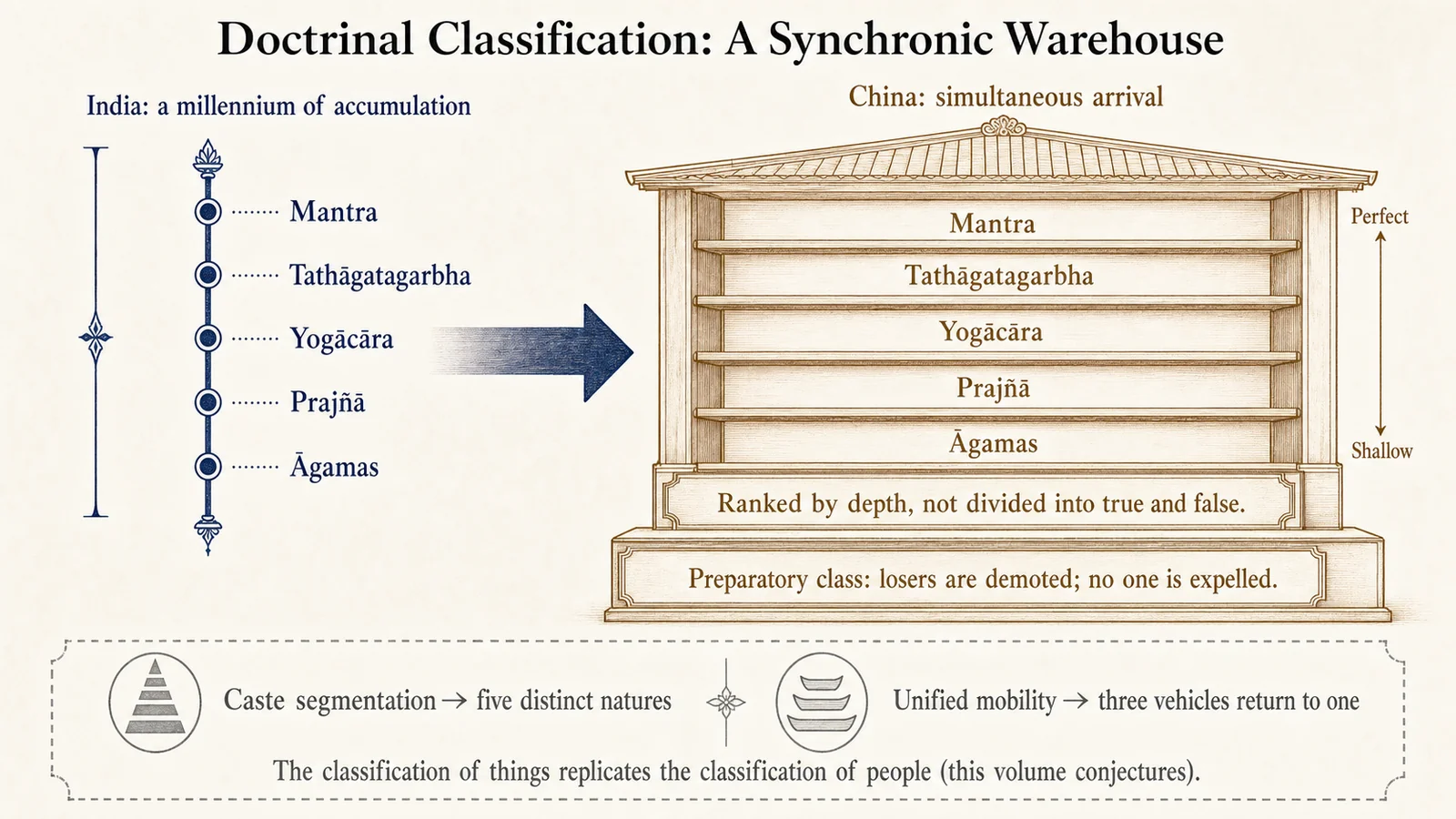
The preceding part ended with a question. A reunified empire looked back and saw a religious community of two million people, and demanded that it specify a place within the order. The community answered with an intellectual engineering project. Its blueprint was called doctrinal classification. Begin with the condition it had to solve, one India had never faced: synchronicity. A thousand years of Indian strata (the Āgamas, Prajñāpāramitā, Yogācāra, tathāgatagarbha, and esoteric spells) reached Chinese shelves almost simultaneously within two or three centuries. The translation bureau's customs gate checked provenance but not doctrine, as Part IX, Chapter 2 showed. Legitimately admitted scriptures therefore contradicted one another. They taught no-self and buddha-nature; emptiness and permanence, bliss, self, and purity; three vehicles and one vehicle. Indians lived along the timeline, each generation practicing its own inheritance. Chinese readers faced a synchronic warehouse with every geological layer spread on one table.
The surgery was brilliant: reclassify a historical problem as a curricular problem. Contradictions were not contradictions but stages. Scriptures were not fighting; the Buddha had taught students of different capacities at different times with different methods. Tiantai's five periods turned the idea into a résumé of the Buddha's teaching career. The first illumination was the Avataṃsaka; the Āgamas enticed beginners; the Vaipulya teachings rebuked; Prajñāpāramitā purged; and the Lotus and Nirvāṇa opened all teachings and returned them to one. The classifications of the Northern and Southern Dynasties were called the “three in the south and seven in the north.” Zhiyi's five periods and eight teachings and Fazang's five teachings and ten schools produced the syntheses whose structures Volume I described in detail.1 This volume has awaited the nature of the operation. Part IV, Chapter 1 recorded the ratchet's third movement: capture the standard. A new teaching no longer deceives verification but takes command of it, reweights the corpus, and seats its own text at the center. In India this capture appeared only in scattered devices such as definitive and provisional meaning or the three turnings. China turned it into architecture. Every school's pyramid placed its own scripture at the apex. Tiantai classified the Lotus as perfectly complete; Huayan classified the Avataṃsaka as the distinct one vehicle. Every judge awarded the gold medal to the home team.
Chinese doctrinal classification nevertheless had one feature absent from India, the foundation for everything else in this part: it ranked high and low without dividing true and false. Indian schools and Mahāyāna condemned one another's texts as heresy, as in the Guptaka file of Part IV, Chapter 4; the loser exited. Chinese classification judged an opponent shallow, provisional, or a beginner's class, yet still the Buddha's speech, still within the canon, and still available for study and practice. Turning an enemy into one's preparatory school is a more thorough incorporation than expulsion. The loser did not leave but merely moved down a level, so no one needed to establish a separate household and no one could tear down another's platform. Chinese Buddhism thereafter contained diversity under one roof, unlike India's diversity of separate houses. Part XI will count how many lives that difference was worth during a century of suppression.
The surgery's market background was the lecture culture of the Southern Dynasties. A doctrinal lecture was a theater shared by aristocrats and emperors. Emperor Wu of Liang personally ascended the Dharma seat to teach and four times surrendered himself to Tongtai Monastery, after which his ministers ransomed him with enormous sums. The title “Emperor-Bodhisattva” carried the bodhisattva-precept monarch introduced in Part IV, Chapter 2 to its extreme.2 In such a market, doctrinal classification was a school's business license. To found a lineage, one first established a classification. Possessing one's own classification diagram marked a school's maturity. Part III, Chapter 1 observed that a school's own Abhidharma marked its coming of age in India. The continent and genre changed; the structure of the initiation remained.
The plain half must be stated fully, because here it is more interesting than criticism. Doctrinal classification was real hermeneutic labor. The contradictions were real and grading them was an honest attempt at explanation. The classifiers also possessed astonishing insight. The five-period order (Āgamas early, Prajñāpāramitā in the middle, and Lotus and Nirvāṇa late) broadly parallels the sequence in which modern textual scholarship reconstructs the scriptures' formation. They saw the strata but read geology as curriculum: doctrine did not grow in sequence; the Buddha taught in sequence. In an age without textual criticism, doctrinal classification was textual criticism with causation read backward. This book has no standing to mock that reversed reading, because it too practices doctrinal classification, as Volume II's Preface already acknowledged: it ranks five soteriologies by using the cessation of suffering as its criterion. Classification is unavoidable; only the criterion can be chosen. Zhiyi's criterion was perfect completeness; this book's is cessation.3
Under the rules, what follows is explicitly this volume's conjecture. The motive of doctrinal classification was the honesty of apologetics. The tradition could not admit that scriptures contradicted one another, for this meant admitting a crack in the foundation called “the Buddha's speech.” It also would not abandon any scripture, because customs had already cleared it and believers already upheld it. The only path between the two refusals was grading. Doctrinal classification was not the art of sophistry. In a system forbidden to say “wrong,” it was the only possible spelling of “wrong”: write “shallow.”
The conjecture has a deeper layer, explicitly marked and sized: it is one of this volume's largest hypotheses. The organization of knowledge replicates the organization of society. The proposition has an address in the sociology of knowledge. Durkheim and Mauss wrote in their study of primitive classification that “the classification of things reproduces the classification of people.”4 This volume applies the claim to doctrinal classification. India was a fragmented world with exceptionally low class mobility. Caste hierarchy was rank without passage; positions could not be exchanged. Its Buddhism grew into the same shape. School boundaries behaved like caste boundaries: separate observances resembled refusal to share food, reciprocal condemnation of scriptures resembled refusal of intermarriage, as Parts II and IV showed. The doctrine of five distinct natures, including a group without a liberating nature and forever unable to become buddhas, was a caste system of souls. China was a unified empire with channels of mobility; a commoner could become a minister, and the ladder was theoretically open to all. Its Buddhism grew into the same shape. Doctrinal classification issued examination results rather than household registers. Converging the three vehicles into one was the doctrinal version of saying “anyone may pass the civil examination.” Rank was permitted; hereditary degradation was not.5
The hypothesis has corroboration almost too neatly tailored to it: the battle over the five natures. Indian Yogācāra expressly held that one kind of being could never become a buddha. The most authoritative translator imported this caste system of souls with the most complete texts, and China rejected it institutionally. Before the corpus had fully arrived, Daosheng had already secured the right of icchantikas to buddhahood, as Part VI, Chapter 2 showed. In the early Tang, Lingrun launched the challenge; Fabao and Huizhao fought for decades. The conclusion was that universal possession of buddha-nature became an axiom of Chinese Buddhism. Zhanran extended the ladder to grass, trees, tiles, and stones: even the insentient possessed nature. A Tang commentary also reports that before translating, Xuanzang wished to hide the doctrine that one group lacked the nature for the eastern lands and was stopped by Śīlabhadra. Read the story at half weight as hearsay, but the anticipation it records was real: the chief translator himself foresaw that the market would reject the product.6 One doctrine, two societies: axiom on one side, rejected proposal on the other. Both sides signed the proposition that classification replicates society. Mark the limits honestly. The civilizational sample contains only two or three cases, the mechanism of replication is loose, and Durkheim's claim itself remains disputed. Japan supplies another data point in Part XIII; judgment is suspended here.
The echo reaches the present. Emperor Xiaozong of Song wrote, “use Buddhism to cultivate the mind, Daoism to nourish life, and Confucianism to govern the world”—functional classification on a civilizational scale. The unity of the three teachings became a Ming fashion. Modern scholars describe Chinese religiosity as diffused rather than institutional: no membership, weak boundaries, and use by function.7 A practitioner today might perform Theravāda insight practice in the morning, dedicate merit to the Pure Land in the evening, and receive a Tibetan empowerment on the weekend, finding reason in each and practicing a little of everything. This is often treated as a contemporary disorder. Under this chapter's reading, it is the continuation of the classificatory habit: rank high and low without dividing true and false. The apex has dissolved; the habit remains.
Record two costs. First, inflation in the definitive. Once classification became a competitive genre, later entrants had to be more complete. Beyond the perfect teaching came the sudden teaching; beyond the sudden teaching, transmission outside doctrine. Bidding for the apex had no ceiling, and Chan in the next two chapters was one product of the auction. Second, the boundary of “the Buddha's speech” fully dissolved. Everything could enter the canon and everything could find a place. The question of true and false was permanently replaced by the question of deep and shallow; the ratchet's final tooth engaged. The resulting atrophy became visible only a thousand years later. When “Mahāyāna is not the Buddha's speech” returned to China in the form of textual scholarship, the response was not argument but thunderous anger, the subject of Part XIV. The frame now stands; the building remains. The next chapter shows Tiantai and Huayan turning doctrinal classification into systems.
References
References
-
For Tiantai's five periods and eight teachings and the Southern and Northern Dynasties classifiers known as the “three in the south and seven in the north,” see Volume I, Part X, Chapter 5. For Huayan's five teachings and ten schools, see Chapter 6 of the same part. This chapter directly adopts their factual layer. ↩
-
For Emperor Wu of Liang's lectures, his four acts of surrendering himself to Tongtai Monastery, and his ransom, see the Liang annals in the History of the Southern Dynasties and his biography in the Book of Wei. On the title “Emperor-Bodhisattva” and the line of bodhisattva-precept kings, see Part IV, Chapter 2. ↩
-
For this book's conscious method of doctrinal classification (taking early soteriology as baseline and the cessation of suffering as criterion), see Volume II's Preface and Introduction. Its balanced framework of “two ledgers” appears in the same volume. ↩
-
Émile Durkheim and Marcel Mauss, “De quelques formes primitives de classification” (1903); English trans., Primitive Classification, trans. Rodney Needham (Chicago: University of Chicago Press, 1963). For modern continuations, see Mary Douglas's grid-group theory and David Bloor, Knowledge and Social Imagery (London: Routledge, 1976). ↩
-
On caste hierarchy as rank without mobility, see Louis Dumont, Homo Hierarchicus: The Caste System and Its Implications (1966; English trans., Chicago: University of Chicago Press, 1980). For empirical work on mobility through the examinations in Ming-Qing China, see Ping-ti Ho, The Ladder of Success in Imperial China (New York: Columbia University Press, 1962). ↩
-
For the dispute between five distinct natures and universal attainment, including Lingrun's challenge and the controversy between Fabao's Treatise on the Ultimate One Vehicle and Buddha-Nature and Huizhao's Discourse That Reveals the Middle and the Edge Like the Sun of Wisdom, see Volume I, Part X, Chapter 7, and the studies cited there. For Zhanran's doctrine that the insentient possess nature, see the Adamantine Scalpel. The report that Xuanzang wished to conceal “one group without the nature” and Śīlabhadra stopped him belongs to a Tang commentary tradition on the Yogācārabhūmi. This volume reads it at half weight as hearsay. ↩
-
Emperor Xiaozong's Discrimination of the Original Way, also titled Discourse on the Original Way: “Use Buddhism to cultivate the mind, Daoism to nourish life, and Confucianism to govern the world.” For the distinction between diffused and institutional religion, see C. K. Yang, Religion in Chinese Society (Berkeley: University of California Press, 1961). ↩