Chapter 1: Does Transformation Have a Direction?—The Engine of the Whole Volume
After fourteen parts, one question remains. Does 2,500 years of change possess a shape? Three answers are available. First, directionless drift: variation is random and survival random, and history need only record. Second, adaptation to environment: every land produces its own form; Sri Lanka takes the island's shape and China the empire's, so history ultimately annotates geography and politics. Third, one overall direction exists. This volume gives the third answer, but the answer must be earned. Establish the mechanism, test the direction, register counterexamples, and then provide the conditions that could overturn it. This chapter handles the first two and gives counterexamples their own section. Without conditions of refutation, a judgment is only rhetoric.
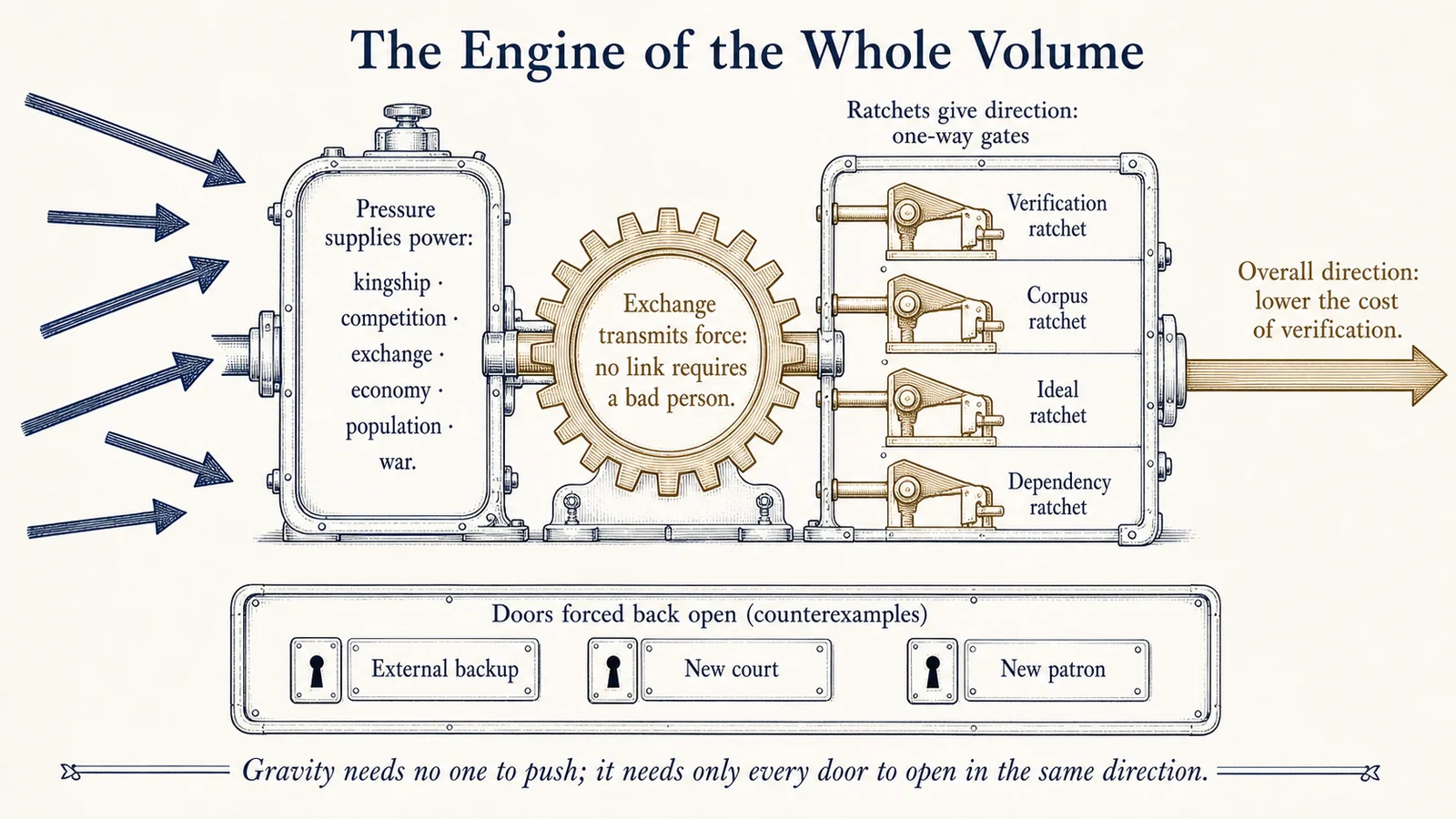
The mechanism is an engine with three components. The first is pressure as power. The six external lines of Chapter 2 of the Introduction supply disorderly pressures: dynasties rise and fall, markets prosper and fail, competitors come and go, while war and calamity strike religious communities without direction. Pressure alone reveals no vector. The second is exchange as transmission. Every joint crossed in this volume can be separated into a transaction rational in its time and place. The Buddha exchanged a final court of appeal for the True Dharma's longevity, in Part II, Chapter 1. The council paid for preservation by giving the community authentication authority, in Chapter 2. In the Interlude, discourse about attainment revised itself three times to resolve a crisis of inventory. Mahāyāna exchanged verification for an inspection-exempt ideal, in Part IV, Chapter 2. The community exchanged legitimating language for imperial routes, in Part III, Chapter 2. Doctrinal learning exchanged drift in criteria for advancement and patronage, in Part V. Doctrine exchanged a lower intuition tax for the market of the true-and-eternal, in Part VI. Institutions exchanged incorporation for customers seeking efficacy and protected themselves through firewalls, in Part VII. Buddhism exchanged clauses of filiality and loyalty for admission to China, in Part IX. Doctrinal classification wrote “wrong” as “shallow” in exchange for keeping the foundation of the Buddha's speech uncracked, in Part X. The community exchanged economic self-restraint for permanent residence, in Part XI. Schools exchanged regency windows for perpetual corporations, in Part XII. The Saṅgha exchanged household-registration services for a legally assigned market, in Part XIII. Traditions ceded their criteria for tickets into modernity, in Part XIV. The list has one uniform quality, tested repeatedly across the volume: no link in the chain requires a bad person. Plain explanations suffice at every link, leaving attacks on hidden motive only as remainder. Every transaction was rational. Rationality is the engine's most frightening property. The third component is the ratchet that gives direction. Transactions are reversible or irreversible. Every transaction selling verification and accountability is a one-way gate. Once enough one-way gates accumulate, disorderly pressure is rectified into one-way drift: alternating current enters and direct current leaves. Borrow the electrical image and then put it away. The mechanism is plain: undirected force striking directional valves produces directed movement.
Four one-way gates were established in this volume and can now be filed together. The verification ratchet: once verification is surrendered, no one has authority to buy it back, because the founder appointed no successor and the system has no final court, the cost recorded in Part II, Chapter 1 and the first cause of the whole volume. The corpus ratchet: scriptures enter but do not leave, while the staircase effect raises each successive step, as Part IV, Chapter 1 showed. The ideal ratchet: an inspection-exempt ideal dismantles the mechanism of reinspection itself, while a construction schedule of three incalculable eons never reaches redemption, as Part IV, Chapter 2 showed. The dependency ratchet: dependence on kingship and estates makes withdrawal more costly in every generation until the state sneezes and the Saṅgha starves, filed in Part III and redeemed in Parts VIII and XI. All four ratchets engage in one direction, allowing the judgment of the volume to be stated.
Under the rules, what follows is this volume's final and largest conjecture: the overall direction of Buddhist transformation is a lowering of the cost of verification. Every successful variation makes belief easier to hold. Inspectable attainment becomes silence about attainment; self-verification in this life becomes verification by others at death; teacher becomes savior; inspection moves into a dark room, is postponed until after death, cast into an office, removed from the agenda, and finally replaced by another examination question, as Part XIV, Chapter 3 showed. The concentration curve in the Interlude is the engine's earliest reading. Volume II's three trajectories (declining self-power, rising guarantee, and retreating verification) are its doctrinal readings. This chapter supplies the genealogy. The three lines are not anyone's history of corruption but the common direction of all irreversible exchanges. Lowering verification costs is the universal gravity of religious organization. Gravity needs no one to push; it needs only every door to open in the same direction.1
Chapter 1 of the Introduction said rewriting is the answer and pressure the question. After the entire volume, the sentence can be completed: an answer becomes the next question. Costs never disappear; they travel down the parts. The cost column in Chapter N becomes the pressure column in Chapter N+k. The principal transmission lines appear below.
| Earlier transaction and cost | Becomes later pressure |
|---|---|
| No final court, Part II, Chapter 1 | Politics of councils and conflict over authentication, Part II, Chapter 2 |
| Community acquires authentication authority, Part II, Chapter 2 | Royal projects enter; authentication changes hands with patronage, Part III, Chapter 2 |
| Provisions freeze while outward dignity remains fixed, Part II, Chapter 3 | Competition moves to chains; after a millennium, the bhikkhunī lineage breaks and reconnects, Parts III and XIV, Chapter 3 |
| Revised language about attainment and inventory crisis, Interlude | Market for inspection-exempt ideals, Part IV, Chapter 2 |
| Corpus admits without expelling, Part IV, Chapter 1 | Scriptures contradict one another; capture through doctrinal classification becomes the only route, Part X, Chapter 1 |
| Construction schedule of three incalculable eons, Part IV, Chapter 2 | Demand for guarantees and shortcuts, Parts VI and VII |
| Drift in criteria in the debate arena, Part V | Protest in songs of realization and esoteric Buddhism's separate scoreboard, Part VII |
| Signs assigned to the master and inspection moved to a dark room, Part VII | Redemption becomes an office until the Golden Urn transfers it to imperial authority, Part XII |
| Heavy assets concentrated at single points, Part VIII | Buildings burn and chains break; only exported copies remain, Parts VIII and IX |
| Economic self-restraint exchanged for permanent residence, Part XI | The seat depends on the landlord and has no appeal when temple property is used for schools, Part XIV |
| Danka contracting and atrophy of the conversion muscle, Part XIII | Meiji opens the gates after 250 years in which no one learned to swim, Part XIII, Chapter 3 |
| Criterion ceded to science, Part XIV | The next question lies outside this volume and has not yet come due |
One reading of the table is enough. These are not fourteen separate histories but fourteen transfers within one history.2
Record two further horizontal findings at the level of rules. First, classification replicates society. Three data points are now assembled. Caste-fragmented India grew diversity through separate households and five distinct natures. Mobile and unified China grew doctrinal classification into one vehicle and universal buddha-nature. Hereditary and feudal Japan grew exclusive school practices bound to membership. Unity produces interfusion; fragmentation produces exclusive practice. The organization of knowledge replicates the organization of society. Durkheim and Mauss's old proposition has acquired three transcontinental specimens from Buddhist history, plus two subsidiary materials: the bureaucratization of the underworld and the map of plateau schools. The boundary remains: three specimens and a loose mechanism make a conjecture, not a law.3 Second, an apologetic argument's hit rate is determined by ownership of the court. The attainment equation fails when it travels north, the market report fails when it travels south, and two duds point in opposite directions with the same structure, as Part IV, Chapter 3 and Part XIV, Chapter 1 showed. Where there is no mutually accepted court, an argument's hit rate is unrelated to its logical quality. This rule explains why most of the volume's polemical history is a history of people talking past one another.
The final section is the register on which this chapter's honesty depends: refused transactions and doors forced back open. The engine must not become a universal solvent. The rule for disorder explanations (why A declines while B rises in the same disorder) applies equally to the engine, so counterexamples must remain present. First, Theravāda welded shut the corpus ratchet. The island's freezing in Part III, Chapter 3 proves that one-way gates can be refused as a complete set, at the cost of the rigidity repeatedly counted in this volume. The ratchet is therefore not fate but accumulated choice. Second, modern Myanmar and Thailand tore up the ten-thousand-year timetable, as the Interlude recorded. The ideal ratchet was partially pried back under two conditions: colonial shock destroyed the old credentialing structure and a lay market supplied new customers. Third, the bhikkhunī ordination of 1998 partially opened the chain's one-way gate because a living overseas backup existed (the Chinese nuns' lineage), and a new court of criteria emerged in the global Saṅgha and academy. Fourth, Tsongkhapa's Vinaya revival moved half of credentialing into the examination hall, as Part XII, Chapter 3 showed, because patrons demanded visible compliance. Combined, the four cases yield the conditions of reversal. Opening a door requires one of three arrivals: an external backup, a new court, or a new patron. Where none exists, no gate in this history turns back by itself. Whenever a gate is said to have reopened, the condition doing the levering must be named. An engine theory that cannot name it is unfalsifiable and violates this volume's own rule. Does Humanistic Buddhism count as reopening? This volume says no. Removing verification from the agenda avoids the gate rather than buying it back. The judgment is disputable, and later writers are invited to reverse it with a new case.4
The engine is assembled, its direction marked, its counterexamples registered, and its conditions supplied. But an engine is cold, and the three volumes of this book ultimately concern more than machinery. The final chapter changes tone and places on the table a tool kept hidden throughout the volume.
References
References
-
For the three trajectories of declining self-power, rising guarantee, and retreating verification, see Volume II, Part VII. For the concentration curve of the Interlude, see Part II, Chapter 4 of this volume. ↩
-
For the original statements and sources of each transaction in the table, see the cited parts and chapters. The table is an index of claims already made in the volume and introduces no new factual assertion. ↩
-
For Durkheim and Mauss's theory of classification and its limits, see the sources cited in Part X, Chapter 1. The three data points appear in Parts X, Chapter 1; XI, Chapter 1; XII, Chapter 2; and XIII, Chapter 1. ↩
-
For the island's freezing, see Part III, Chapter 3. For the Myanmar and Thai revival, see the Interlude, Part II, Chapter 4. For bhikkhunī ordination, see Part XIV, Chapter 3. For Tsongkhapa, see Part XII, Chapter 3. ↩