Chapter 1: Kamakura New Buddhism—The Revolution of the Single Practice
Editorial note. Part XIII is intentionally concise. It establishes only the frame and joints; details and textual layers await expansion in a later version.
The preceding part issued a fourth examination paper: dismantle Buddhism to a minimum and hand it to the market. As usual, begin by describing the room. Buddhism entered Japan from Baekje in the middle of the sixth century by another top-down route. Prince Shōtoku's Seventeen-Article Constitution commanded earnest reverence for the Three Treasures. The Nara court poured national resources into the great Buddha at Tōdaiji, while a network of provincial monasteries spread across the country. The six schools were official learning, ordination platforms state-run, and the three national platforms established only after Jianzhen crossed the sea six times and lost his sight. After the capital moved to Heian, Saichō and Kūkai each opened a mountain. Tendai and Shingon remained Buddhism of the state and aristocracy. For its first six hundred years, Japanese Buddhism was another royal procurement project, the Tibetan script of Part XII, Chapter 1 on an island stage. Yet it concealed one revision Tibet did not have. Beginning in 818, Saichō fought for an independent ordination platform for Tendai, openly discarding formal ordination under the Dharmaguptaka Vinaya and replacing it for the entire community with the ten major and forty-eight minor precepts of the Brahmā's Net Sūtra. Imperial authorization arrived seven days after his death.1 Part IX, Chapter 2 inspected that scripture's origin: a fifth-century Chinese manufacture. Four copies now complete their different treatments of the Vinaya chain. Sri Lanka froze the provisions; Tibet rescued the chain; China kept provisions and chain together; Japan cut the chain itself and retained only the provisions of an apocryphon. No one noticed the significance of the cut at the time. It was the first domino of this part: simplification of discipline preceded every later simplification.
A Buddhism that had cut its chain waited another three centuries to encounter its age. The age began with a precise year. In 1052, Japanese monasteries announced the first year of the decline of the Dharma according to their calculations. In China decline was a mood; in Japan it was a calendar with a starting day.2 History thereafter diligently confirmed the arithmetic. The Genpei wars turned Kyoto into a battlefield during the Jishō-Juei years. The Yōwa famine followed. Kamo no Chōmei's Hōjōki records corpses lying against one another on the Kamo riverbank; a monk of Ninnaji wrote the Sanskrit letter A on the foreheads of the dead to establish karmic connection and counted 42,300 bodies in the capital in two months.3 Chapter 2 of the Introduction established how to use the line of disorder. Collective suffering lowers the feasibility of prolonged cultivation and self-verification in this life and raises the weight of other-power and the next life. Once awareness of Dharma decline is established, the contracting logic “in this age, only this method” has a foundation. Kamakura was the mechanism's fullest specimen. What grew from it was called the single practice.
The revolutionaries all graduated from one school. Mount Hiei was Heian Buddhism's highest academy. Hōnen, Shinran, Eisai, Dōgen, and Nichiren (every founder of Kamakura's new movements) had studied on the mountain. Its curriculum taught Tendai's interfusion and combined practice, included the eight schools, and integrated exoteric and esoteric, principle and practice. Those who descended each took one item and discarded everything else. Hōnen took one name. The Senchakushū used “selection” as its principle: the gate of the holy path was impossible for people of this age and should be abandoned; miscellaneous practices did not belong to the fundamental vow and should be discarded; only recitation of the name remained as exclusive Buddha-recitation.4 Shinran reduced the method until only the recipient remained. Buddha-recitation itself was not my practice but faith transferred by Amitābha. Discipline, practice, learning, and understanding were useless. “Even a good person attains rebirth; how much more an evil person.” The evil person was the true object of salvation, and other-power became absolute. Shinran called himself neither monk nor layman, openly married and raised children, and Shin temples thereafter passed from father to son.5 The bloodline of Part XII, Chapter 1 was installed within Pure Land. Dōgen took one seated posture: just sitting. Practice and realization were one; sitting was not a means to awakening but the conduct of a buddha itself, while the mind seeking realization was already a distracting thought.6 Nichiren took one title: Namu Myōhō Renge Kyō. Chanting it contained every practice. He also carried exclusion to its doctrinal limit. Four later-summarized dictums declared Buddha-recitation the hell of incessant suffering, Chan a heavenly demon, Shingon the ruin of the nation, and Vinaya a traitor to the nation. Fellow practices were not shallow classes but guides to hell.7 Four reductions and four pieces of carry-on luggage: one name, one faith, one posture, and one title. Literate or illiterate, propertied or poor, in flight or on campaign—each could be carried. Part X, Chapter 4 said Pure Land treated illiteracy and lack of time as design assumptions. Kamakura made the assumption into an entire Buddhism.
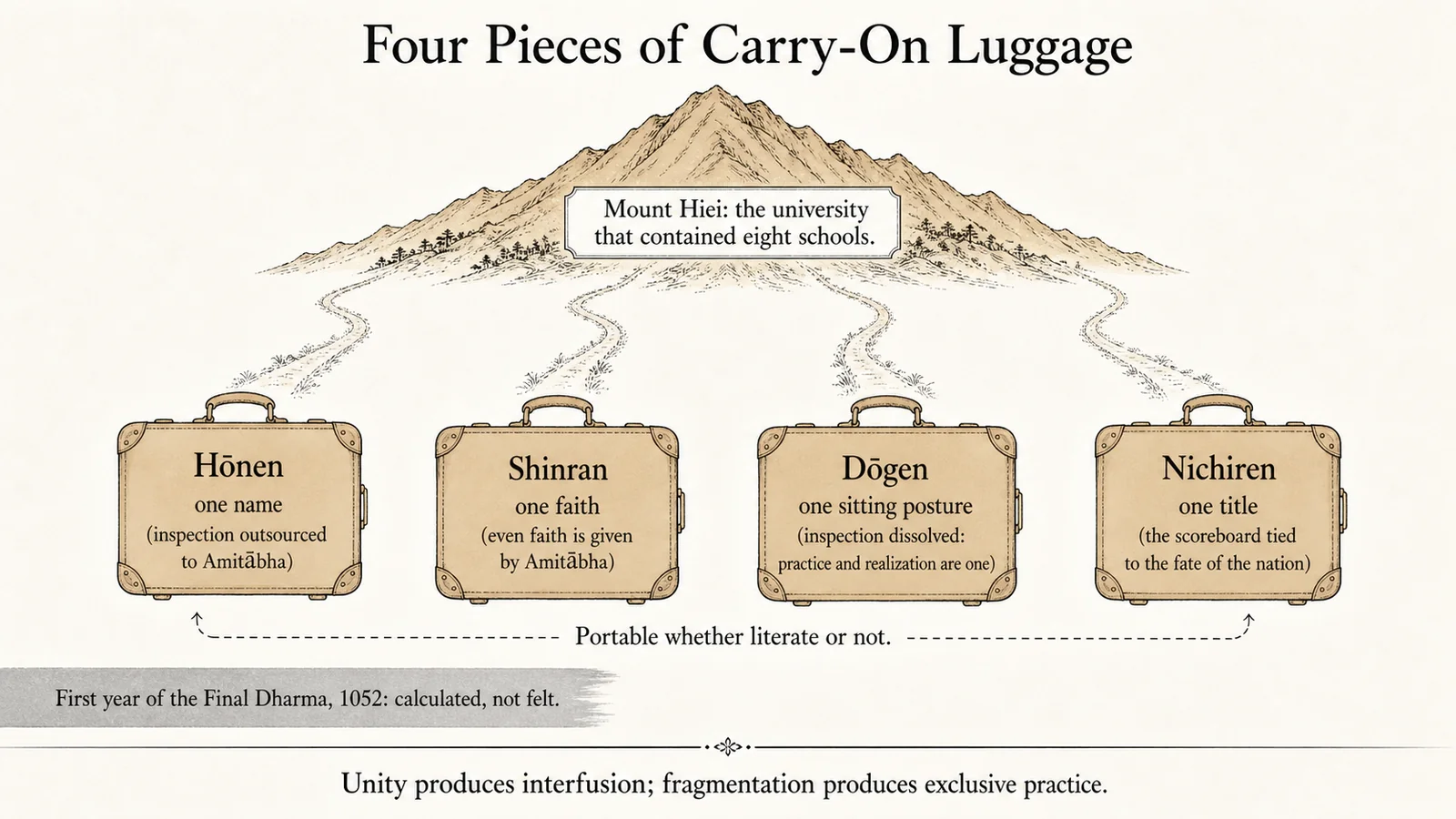
Return the four pieces to this volume's sequence of criteria, and each gives inspection a clean extreme. Hōnen and Shinran outsourced inspection entirely to Amitābha, more thoroughly than Chinese Pure Land. Even auspicious signs at death were unnecessary; faith immediately fixed rebirth. Dōgen dissolved inspection: practice was realization, so no point of redemption remained. Nichiren hung the scoreboard on national fortune. The Risshō Ankoku Ron treated calamity and war as state-level evidence of slandering the Dharma; inspection moved from the person to the realm.8 The three operations share only one feature: none needs a master sitting in a dark room to inspect another. The four dictums announced something else: doctrinal classification had died. Chinese doctrinal classification ranked high and low without dividing true and false, incorporating opponents as preparatory classes. Nichiren judged true and false without ranking levels and condemned peers as guides to hell. The Japanese data point reserved in Part X, Chapter 1 has now arrived. Add it to the large hypothesis, not as a separate conjecture. An imperial market has one buyer who wants order and therefore produces perfect inclusion. A feudal society is a society of lord-vassal bonds and choosing sides (one estate pledges its life, one gate has one lord, favor is answered by service), and therefore produces exclusive practice and exclusion. Unity produces interfusion; fragmentation produces exclusive practice.
This volume gives the textbook narrative of a Kamakura revolution its usual half weight. Since Kuroda Toshio, scholarship has restored the kenmitsu establishment to the medieval mainstream. The estates, assemblies, and rites of the old institutions in Nara and Mount Hiei formed the organized Buddhism of Kamakura and Muromachi; the new movements were marginal tributaries at the time and grew dominant only under the Warring States.9 Chapter 2 of the Introduction established a rule for disorder explanations: when A declines and B rises in the same war, the control must remain in view. It does. Old Buddhism did not passively wait for death. Jōkei and Myōe wrote against Hōnen; Eison and Ninshō revived Vinaya, distributed medicine, and aided people with leprosy—repairing discipline and social charity. Under the same Dharma decline, some subtracted and others made up missed lessons. Disorder does not specify the answer; it gives the examination to everyone. Victory for the new schools came two centuries later. Its mechanism (organization, membership, and armed force) belongs to the next chapter.
Under the rules, what follows is explicitly this volume's conjecture and gives the chapter its name. Simplification redesigned Buddhism for common people at war; complexity is a luxury of peaceful ages. First record the plain half. None of the four revolutionaries was a mediocre worker cutting corners. Shinran's theory of other-power and Dōgen's Shōbōgenzō are two peaks of Japanese intellectual history. The subtraction removed thresholds of practice, not depth of thought; all four founders were learned products of the old academy. The conjecture concerns selection rather than invention. A complete curriculum integrating eight schools presupposed estate rents, years of peace, and aristocratic leisure. All three collapsed together at the end of the twelfth century. A practice surviving war had to be light enough to carry. Part X, Chapter 3 called Chan optimized for catastrophe, while Chapter 2 of the Introduction said lightweight methods disproportionately survive disaster. Kamakura turned the selection law into doctrinal history more cleanly than China. Chinese simplifications later gathered beneath a roof of combined practice; Japanese simplifications founded separate households and condemned one another's life and death. The preceding paragraph supplied the social explanation for roof and household.
After subtraction, each piece of luggage grew an organization. Shin possessed local associations and plain-language letters; Nichiren followers had title-chanting congregations; Chan entered the shogunate as official learning. Organization taken to its extreme becomes armed force. Armed force at its extreme meets the person unifying the realm. The next chapter shows Tokugawa turning exclusive religious communities into obedient household-registration offices.
References
References
-
For Saichō's struggle for a Mahāyāna ordination platform, see the Regulations for Students of the Mountain School and Treatise Revealing the Precepts. Imperial authorization seven days after his death is standard in histories of Japanese Buddhism. For the origin of the Brahmā's Net Sūtra, see Part IX, Chapter 2. For an overview, see Sueki Fumihiko, A History of Japanese Buddhism. ↩
-
The year 1052 as the beginning of Dharma decline was standard medieval Japanese calculation and appears in sources such as the Fusō ryakki; summarized here. ↩
-
Kamo no Chōmei, Hōjōki, section on the Yōwa famine. The Ninnaji monk Ryūgyō wrote the letter A on the foreheads of the dead and counted more than 42,300 bodies in the capital in two months. ↩
-
Hōnen, Senchakushū. For a soteriological analysis of exclusive Buddha-recitation, see Volume II's part on Pure Land. ↩
-
“Even a good person attains rebirth; how much more an evil person” appears in section 3 of the Tannishō. Shinran's description of himself as neither monk nor layman appears in the final fascicle of the Kyōgyōshinshō. For the judgment of his thorough other-power, see Volume II's part on Pure Land. ↩
-
Dōgen's “one suchness of practice and realization” appears in the “Bendōwa” fascicle of the Shōbōgenzō. See also the Fukanzazengi for just sitting. ↩
-
For chanting the title and shakubuku, see Nichiren's writings including the Kaimokushō and Kanjin no honzonshō. The four dictums are later summaries of statements across his works. ↩
-
Nichiren, Risshō Ankoku Ron, submitted to Hōjō Tokiyori in 1260. ↩
-
For Kuroda Toshio's thesis that the kenmitsu establishment formed the medieval mainstream and the new schools remained marginal until after Kamakura, see The State and Religion in Medieval Japan (Tokyo: Iwanami, 1975). On Eison's and Ninshō's Vinaya revival and relief work, see Sueki cited above. ↩