Chapter 3: Gelug's Victory—Union of Religion and Politics
In the late fourteenth century, the Amdo native Lobsang Drakpa traveled to Ü-Tsang for study and became known to later generations as Tsongkhapa. The market he faced was a plateau after three centuries of synthesis. Schools had allied with estates; ritualists married and raised children; boundaries between clergy and laity had blurred. The old disease of Part VII, Chapter 2 (the collapse of recognizability) had acquired a Tibetan form. Tsongkhapa prescribed three old medicines, each a mechanism already seen in this volume. First, revival of the Vinaya: reaffirm pure conduct for bhikṣus—no marriage and no alcohol, with visible monastic form. This restored recognizability as a sign. Investors in merit, whether local aristocrats or later Mongol khans, wanted visible compliance. Second, stages of the path. The Great Treatise on the Stages of the Path to Awakening enlarged Atiśa's blueprint into a construction manual for the complete curriculum and raised the firewall of exoteric teaching before esoteric practice to the roof. Third, degrees. The five great treatises established a curriculum, thesis defense established examination, and the geshe established ranked degrees with titles portable between monasteries. In 1409, Tsongkhapa founded the Great Prayer Festival at Lhasa and Ganden Monastery in the same year; Drepung and Sera followed. The three great monasteries each housed several thousand and were claimed to reach ten thousand; read the figures at half weight while retaining their order of magnitude.1 The Nālandā of Part V, Chapter 2 died in India around 1200. Two centuries later, its curriculum, debate arena, and degrees revived wholesale in Lhasa at even greater scale. Part V, Chapter 3 registered a counterexample: traditions with the most vigorous debate also maintained lines of practice. Gelug's building supplies the floor plan. Downstairs was the public examination hall; debate had an audience, degrees had ranks, and half of credentialing returned to sunlight. Upstairs were the upper and lower tantric colleges and retreat rooms, where esoteric attainment still belonged to the dark room of master and disciple. Two scoreboards occupied one building, kept independent scores, and could not be exchanged.
Where did the people of the three great monasteries come from? A clean inversion of China lies here. China's entry threshold was guarded by the state. Part XI, Chapter 2 priced ordination certificates: expensive entry, followed by a fixed quota. Tibet had no such gate and virtually no admission price. Families commonly sent one of two sons to a monastery; on monastic estates this was not always voluntary. Monastic corvée appeared in the obligations of households, with estates assessing quotas of monks just like quotas of barley and horse fodder.2 The same identity therefore appeared in opposite accounting categories. In China clerical registration was an asset purchased with money; in Tibet it could be a corvée demanded by a lord. With entrance fully open, the threshold moved inside. Only a minority in the great monasteries completed the curriculum of five treatises; most worked, recited, and performed duties throughout life. The higher the stair, the more expensive it became. Beyond the examination for a geshe degree, custom demanded offerings and a feast for thousands of monks. The expense could exhaust a family, and poor scholars required financing by a patron or labrang. China placed the threshold on the day of renunciation; Tibet placed it on the day of fame. Each design had its use. The state charged admission because it managed clergy as a tax base. Monastic corporations waived admission because they cultivated numbers as their base. People were power. A monastery of ten thousand was university and political foundation; the three great monasteries traditionally had a vote in Lhasa's affairs.3
Why did the reform win? Examine the customers. Local nobles wanted reliable fields of merit, and a disciplined Saṅgha looked more like one than married ritualists. Students wanted a fair route upward, and a degree system opened more widely than bloodline or secret transmission; Tsongkhapa himself was an outsider from Amdo. The largest customer stood beyond the mountains. Mongol groups were converting again and wanted a school that could legitimate khanly power without belonging to any old rival. Gelug was youngest, carried no inherited feuds, and its sign of discipline shone especially brightly on the steppe. In 1578, Altan Khan and Sönam Gyatso met by Qinghai Lake and exchanged titles. The khan bestowed “Dalai Lama”; the lama returned “Wheel-Turning Dharma King”—a textbook exchange of reciprocal legitimacy. Sönam Gyatso then retrospectively recognized his two predecessors as first and second and presented himself as the third. The hall-of-fame craft from Part X, Chapter 4—recognize predecessors and backfill genealogy—was replayed on the plateau. The office of Dalai Lama began with its third holder.4 The fourth was recognized in Altan Khan's family, placing a Mongol prince on the Lhasa throne. The political flexibility of reincarnation documented itself. A child could be found in the family of the patron whose alliance most needed binding. Add the half-weight qualification: this need not mean conspiracy. Oracles and signs were observed, and each procedure followed its ritual form. Yet over several centuries, signs rarely pointed toward politically irrelevant households.
The next step in Mongol-Tibetan binding was military force. The Tsangpa regime and Karma Kagyu increased pressure on Gelug, whose administrators invited Güshi Khan of the Khoshut. In 1642, Güshi's armies conquered Ü-Tsang and killed the Tsangpa ruler. He offered the government and revenues of Ü-Tsang to the Fifth Dalai Lama, establishing the Ganden Phodrang government. In 1653, the Shunzhi emperor issued a golden patent and seal, entering the title Dalai Lama into Qing institutions.5 Buddhist history here reached an unprecedented position. The monastery was government, the Dharma seat was throne, and monastic officials stood above the two clerical and lay establishments. An incarnate buddha administered the state directly. Chapter 1 called Buddhism a budget category under the Tibetan empire. Now the relationship reversed: the state became a budget category of the monastery. Chinese Buddhism held a seat in the establishment, as Part XI showed; Tibetan Buddhism became the establishment itself.
Record the nature of victory faithfully. In the same decades that Ganden Phodrang founded the state, monasteries affiliated with Karma Kagyu were converted to Gelug in batches. Jonang's doctrine of other-emptiness was condemned as heretical, its monasteries converted and its printing blocks sealed. Its doctrine became prohibited in Ü-Tsang and survived only in the Amdo borderlands. The conclusion was most revealing. After the death of Taranatha, Jonang's greatest scholar, his reincarnation was recognized in the Khalkha Mongol royal family as the First Jebtsundamba—and converted to Gelug. Tibet's version of doctrinal warfare did not burn the loser; it recognized the loser's reincarnation into the winner's system.6 Part X, Chapter 1 said Chinese doctrinal classification ranked high and low without dividing true and false, and the loser was demoted but did not exit. Tibet's synthesis showed another set of teeth. When a government and army stood behind doctrinal judgment, judgment of rank became judgment of property. A loser was not only demoted but surrendered monastery, lineage, and next life. Volume II's esoteric judgment that authority over verification precedes the master's authority receives its final link here. When the master's authority acquired troops and taxation, verification graduated from epistemology into politics.7 Volume II asked who verifies the verifier. Tibetan history supplied an unambiguous answer: whoever has the army verifies. Government is soteriology's extreme experiment. The statement needs no conjectural label; the result has just been recorded.
Above the union of religion and politics stood another floor occupied by the patron. In 1792, the Qianlong emperor's Discourse on Lamas exposed two centuries of patron-priest relations in one sentence: “Promoting the Yellow Teaching is precisely the means of pacifying the multitude of Mongols.”8 Wuzong's edict condemned monks for neither farming nor weaving; Qianlong's inscription praised the Yellow Teaching for pacifying Mongols. The signs differed but the register was the same: the state's language about Buddhism was always the language of rule. Once exposed, authority was reclaimed. The Golden Urn followed as a fixed procedure through the 1793 regulations. The names of candidates for major incarnations entered an urn for drawing under supervision of the amban and were reported to the Lifan Yuan.9 The preceding chapter said reincarnation moved authentication into the labrang. The urn moved it one level higher into imperial authority. The final step in making redemption into an office occurred here: authority to appoint the office belonged to an emperor who did not believe in rebirth. The historical reading promised at the end of the previous chapter followed. The Ninth through Twelfth Dalai Lamas all died before taking power or shortly afterward, and regents governed for nearly a century.10 The combination of infant heir and permanent regency changed from a design conjecture into a nineteenth-century medical record. Record the plain half. Plateau medicine and hygiene underlay early deaths; they need not all be assigned to intrigue. Yet if a system makes an heir's death harmless or even advantageous to the office, murder is unnecessary as an explanation; incentives suffice.
The Qing interface leaves one question worth answering. The window opened—why did exchange not follow? Tibetan Buddhism's presence at the Qing capital was undeniably prominent. Yonghegong became a lama monastery; the Changkya national preceptors frequently attended the throne; a Tibetan canon was carved in the capital; and Chengde acquired the Eight Outer Temples. The window for propagation was wider than under Yuan or Ming. Yet Chinese Buddhism's list of schools gained no Tibetan branch, and the reading lists of Chan, Pure Land, Tiantai, and Huayan contained almost no Tibetan works. Count the reasons in four layers. The first was design. Qing management of the Yellow Teaching was a project to govern Mongolia and Tibet, as the Discourse on Lamas stated plainly. Lama clergy belonged to the Lifan Yuan; positions, stipends, and titles were arranged for Mongols, Tibetans, and Manchus. Chinese clerical administration belonged separately to the Ministry of Rites. Two offices and two registers made no transfers. The window opened at Beijing but faced the steppe and snow lands. It was a display for others, not an entrance for Chinese. The second layer was customs. Throughout Qing, no translation bureau existed between Tibetan and Chinese. Qianlong commissioned Tibetan-to-Mongolian and Chinese-to-Manchu translations but not Tibetan-to-Chinese. The rule established in Part IX held in reverse: scripture does not travel by post, and interpretation crosses borders even less. Tibetan doctrinal learning remained locked in a language Chinese monks could not read. Only in the Republic, when Fazun translated the Great Treatise on the Stages of the Path and the Sino-Tibetan Buddhist Institute taught courses, did the gate open a crack, the era of Part XIV. The third layer was the market. Almost every Tibetan product already had an incumbent in China. Esoteric ritual service had been domesticated through the Śūraṅgama Mantra in morning liturgy and Yogācāra flaming-mouth rites. Pure Land and repentance services monopolized death, as Part XI showed. Chan and Neo-Confucianism operated the old shops of mind and nature. Apply the judgment of Part IX, Chapter 3 in reverse: Buddhism died in India where positions were full and lived in China where one was empty. When Tibetan Buddhism reached China, the positions were full. The fourth layer was image. Chinese Buddhism's sign was vegetarian discipline in the Brahmā's Net tradition; meat-eating clergy immediately triggered its alarm of recognizability. The old Yuan court scandal of Yan-te-er rites entered Ming official history, while labels of secret great bliss fixed the literati image of Tibetan esotericism. Ming historians had their uses, so read the file at half weight; the reputational tax was nevertheless collected.11 Together the four layers make the answer ordinary. Two copies lived as neighbors for seven hundred years. What separated them was not a mountain but two customs systems, two clerical registers, a market without vacancies, and an old sign that could not be scrubbed away.
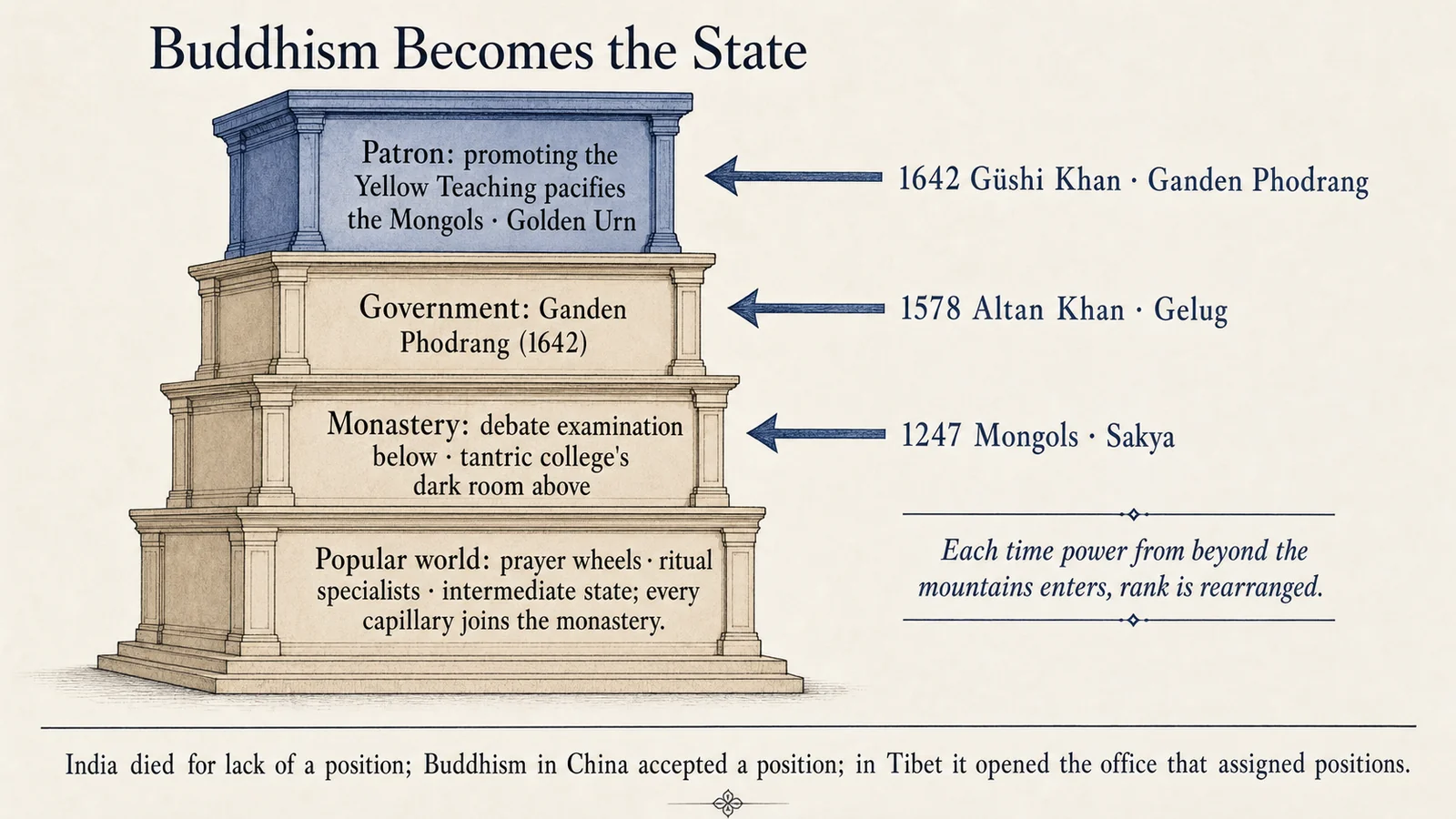
Place the three copies side by side to close the part. Sri Lanka's frozen version fixed its rules and survived through a narrow gate of orthodoxy, as Part III showed. China's translated version combined low dependency, a low threshold, monopoly over death, and private verification to become a permanent institution within the state, as Part XI showed. Tibet's synthesized version took a third road. It did not distribute risk but brought all risk in-house; Dharma, authentication, property, and government became one, and Buddhism itself became the state. The popular layer examined at the end of Chapter 1 connected all its capillaries to the same body. Gain and risk shared one source. This was the only copy to remake an entire civilization and the only one to reinstall a single point of failure within itself. Government was the vital point; Part XIV examines the twentieth century. One sentence gives the judgment. Indian Buddhism died for lack of a position; Chinese Buddhism received a position within the establishment; Tibetan Buddhism opened the office that assigned positions. Three survivals and three examination papers. A fourth answer was simplest of all: dismantle Buddhism to a minimum and hand it to the market. The next part turns to Japan's simplifying revolution.
A theoretical cross-section closes the part. The main text recorded who won; this note adds what they disputed. The stages of the path set the skeleton of theory in the age of synthesis, and Tsongkhapa's line supplied Prāsaṅgika Madhyamaka as its criterion: emptiness is a negation of intrinsic nature, buddha-nature another name for emptiness, and tathāgatagarbha read back into Madhyamaka. Jonang's other-emptiness stood opposite: the ultimate truly exists, tathāgatagarbha is real and empty only of adventitious defilements—the direct Tibetan descendant of the true-and-eternal product from Part VI. The debate between self-emptiness and other-emptiness continued the plateau collision between the return of the true-and-eternal and Prajñāpāramitā grammar. Its philosophical quality was no lower than any Indian debate, but the method of closure appears in the main text: monasteries converted and printing blocks sealed. Theoretical history offers a clean control. In India, a doctrinal dispute ended in parallel schools; in Tibet, the patron's army decided. The rules of debate did not change. The person sitting behind the judge did.6
References
References
-
For Tsongkhapa's reform, the three great monasteries, and the geshe curriculum, see Volume I, Part XI, Chapter 6. For reports and appropriate discounting of their scale, see Melvyn C. Goldstein, A History of Modern Tibet, 1913–1951 (Berkeley: University of California Press, 1989). Volume II's appendix examines modern echoes of the Gelug reading of Madhyamaka. ↩
-
On monastic corvée, household quotas for entrants, and labor obligations on monastic estates, see Melvyn C. Goldstein's studies of estates and taxation in old Tibet and Berthe Jansen, The Monastery Rules: Buddhist Monastic Organization in Pre-modern Tibet (Oakland: University of California Press, 2018); summarized here. ↩
-
On the proportions of scholastic and laboring monks, the cost of offerings for a geshe degree, and the structure of a “mass monastic community,” see Goldstein, A History of Modern Tibet, 1913–1951; summarized here. ↩
-
For the Qinghai Lake meeting, exchange of titles, retrospective recognition of the first two Dalai Lamas, and the Fourth's origin in Altan Khan's family, see Volume I, Part XI, Chapter 6, the Erdeni-yin Tobči, and related accounts; summarized here. ↩
-
For Güshi Khan's conquest of Tibet, establishment of the Ganden Phodrang, and Shunzhi investiture, see Volume I, Part XI, Chapter 6, and general histories. For institutional structure, see Dungkar Lobsang Trinlé, On the Tibetan System of Combined Religious and Political Rule, trans. Chen Qingying (Beijing: Nationalities Press, 1985). ↩
-
On suppression of Jonang, conversion of its monasteries, sealing of printing blocks, and recognition of Taranatha's reincarnation in Khalkha as the First Jebtsundamba, see Cyrus Stearns, The Buddha from Dolpo (Albany: State University of New York Press, 1999), and the relevant chapters of Volume I, Part XI; summarized here. ↩↩
-
For the judgment that authority over verification precedes the guru's authority, see Volume II's part on esoteric Buddhism. ↩
-
Qianlong's Discourse on Lamas, imperial composition of 1792, inscribed in four languages at Yonghegong: “Promoting the Yellow Teaching is precisely the means of pacifying the multitude of Mongols; no small matter depends upon it, and therefore it must be protected.” ↩
-
For the Golden Urn and the Twenty-Nine Articles of the Imperially Approved Ordinance for the More Effective Governing of Tibet of 1793, see Qing official sources; summarized here. ↩
-
For the early deaths of the Ninth through Twelfth Dalai Lamas and government by regents, see Volume I, Part XI, Chapter 8, and general histories. Explanations of the deaths remain disputed; this volume uses only their institutional effect. ↩
-
For Yonghegong's conversion into a monastery in 1744 and the roles of the Changkya Khutukhtus, see Volume I, Part XI, and general histories. Qing lama affairs belonged to the Lifan Yuan under its regulations and were administered separately from Chinese clergy. For Yan-te-er and secret great-bliss rites, see Hama's biography in fascicle 205 of the History of Yuan, a Ming composition whose standpoint must be considered. Fazun's translation of the Great Treatise on the Stages of the Path and the Sino-Tibetan Buddhist Institute founded in 1932 belong to Part XIV; summarized here. ↩