Chapter 2: The Politics of the Tulku—Reincarnation as Institution
Part II established this volume's oldest problem. The Buddha appointed no successor, and rolls and chains only roughly filled the resulting vacuum of authority. Every later tradition patched that empty seat. India used master-disciple succession and schools; China used genealogies and halls of fame. Tibet's solution came last and was most thorough: let authority itself return. This chapter asks from what difficulty the solution grew, whose problems it resolved, and where its cost was recorded.
The plateau after the later dissemination had no central kingship. Local nobles replaced the king as Buddhism's patrons, and schools therefore grew into combinations of scholastic lineage, family, and estate. Before reincarnation was invented, the succession problem had three solutions, each with its price. The bloodline solution is represented by Sakya: the Khön family transmitted from uncle to nephew and the Dharma throne became family property; Sakya Paṇḍita and Phagpa were uncle and nephew from one house. The chain could not be burned through, but the religious community was locked into one surname and talented outsiders remained retainers forever. The master-disciple solution is represented by Kagyu: authorization passed from teacher to student, the Tibetan version of the title deed. Yet one master had many disciples, so every generation faced division of the estate. Dakpo Kagyu divided in one transmission into four major schools and later into eight minor ones; its genealogy was a history of household partition. China used a third solution, the hall of fame described in Part X, Chapter 4, but Tibet did not. The reason is clear. A hall of fame carries neither legal Dharma authority nor property, while plateau schools were precisely property-holding entities. Behind all three solutions stood one fact: schools possessed estates, subject populations, and armed force. Succession was never an elegant question of Dharma lineage but the central issue of property and rule. Following Part X, Chapter 1, add one piece of evidence to the large hypothesis without creating a separate conjecture. Caste-fragmented India grew schools that condemned one another's scriptures; unified and mobile China produced classifications that ranked high and low without dividing true and false; the estate-fragmented plateau produced a map with one school in each valley, each occupying its mountain. Classification again replicated society.1
In the thirteenth century, Karma Kagyu supplied a fourth solution. Karma Pakshi was recognized as the return of Düsum Khyenpa, and Rangjung Dorje continued as the third. Reincarnation changed from case into institution. When a master died, a search found a child, tested objects from the previous life, enthroned and raised the child, then repeated the cycle after death.2 The doctrinal guarantee was already available. Rebirth was common to Buddhism, a bodhisattva's return by vow common to Mahāyāna, and esoteric narratives of attainment guaranteed that an accomplished master could govern death and birth. Combined, the old word “emanation” acquired a new legal meaning. To understand what the invention solved, see which two old costs it bypassed. It did not depend on bloodline and therefore was not locked into one surname; any outsider's child might be a buddha. It did not divide transmission among disciples because there could be only one successor; the Dharma seat, estates, subjects, and patronage network transferred intact to one person. The labrang arose accordingly: the tulku's residence became a permanent office with steward, treasury, subordinate monasteries, and estates. The juridical person did not die but changed bodies.3 For the first time in Buddhist history, a religious community possessed a perpetual corporation. Chan's genealogy required renewed authorization in every generation; Sakya's bloodline depended on fertility and descendants; the tulku system could never become extinct in law. Tibet welded shut Part II's vacuum of authority with the doctrine of rebirth.
Return the device to this volume's sequence of criteria. It was the fifth and final privatization. The Interlude's silence about attainment, esoteric signs interpreted by the master, Chan authorization, and Pure Land rebirth verified at death all moved inspection outside public sight. Reincarnation appears to do the opposite. Recognition is public: the child must identify a previous life's rosary and ritual instruments before witnesses, and procedures are formalized. Yet the ceremony is public, not the criterion. The labrang writes the questions, sets the examination, and grades it through the previous holder's stewards and disciples. The timing and direction of the search likewise follow the office's schedule. Pure Land's point of redemption stands on the other shore where no one can challenge it. Reincarnation brings redemption back to this shore and places it on a child unable to speak, while those speaking on the child's behalf are exactly the people who most require the child to exist. Read miracles of object recognition at half weight as victory narratives. Every institutional fact remains examinable: in seven hundred years the procedure has never once stopped because no child could be found. Searchers do not want to fail to find.
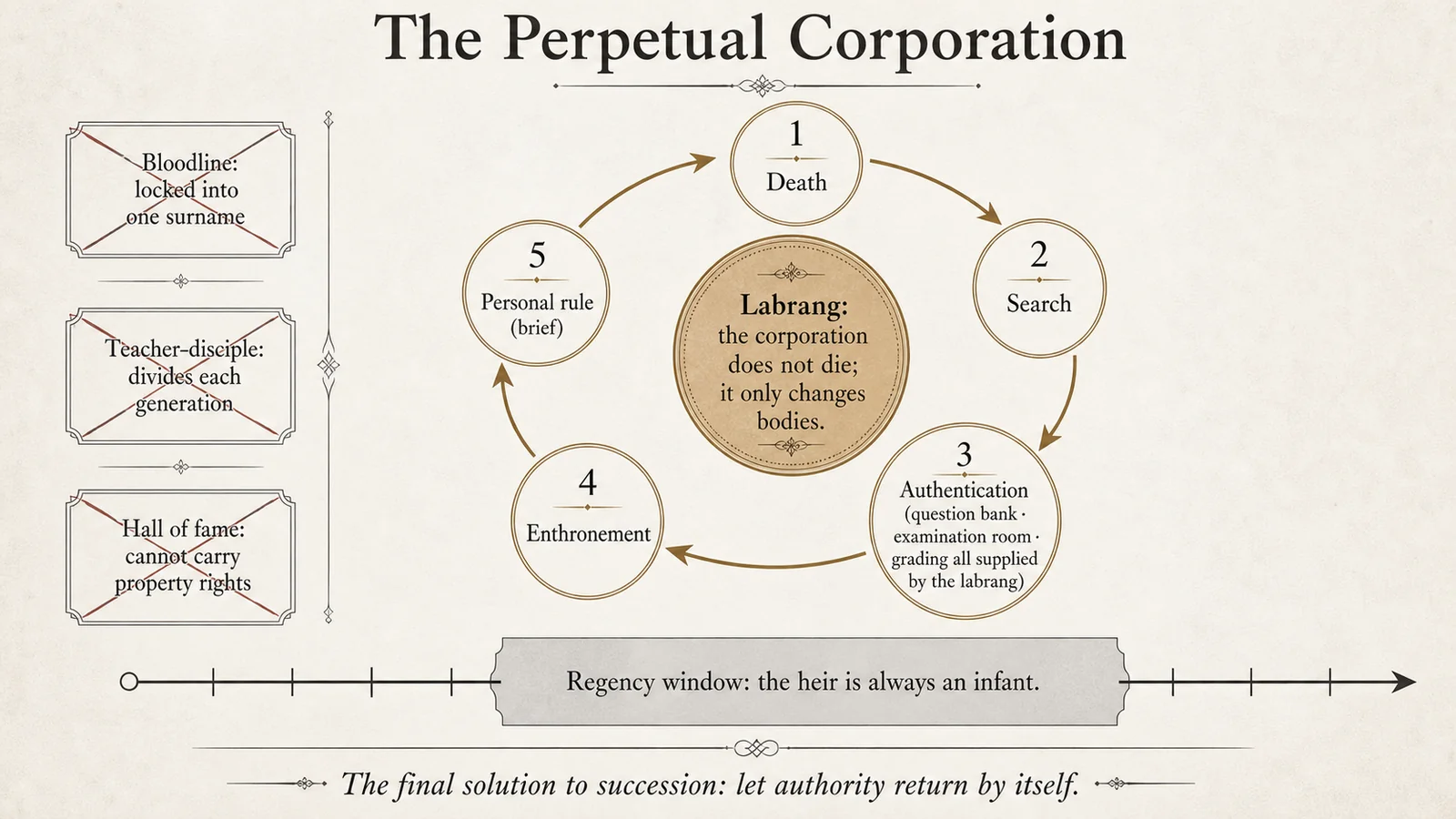
Under the rules, what follows is explicitly this volume's conjecture and explains the chapter title. The tulku system is the most ingenious apparatus of power in Buddhist history. Its ingenuity lies not merely in solving succession but in the successor's form being precisely the one most favorable to a permanent office. The heir is always an infant, producing a regency window of ten or twenty years between every generation. The regent always holds power without bearing the sacred responsibility of the throne. Doctrine guarantees the whole arrangement, and to question the recognition procedure becomes equivalent to questioning rebirth. State the plain half fully. The design need not have originated in anyone's private conspiracy; it looks more like convergence through institutional evolution. The stronger a school's labrang, the longer its lineage survived, and after several generations selection left only forms with powerful offices. But origin does not change nature. In a polity whose heir is perpetually a minor, the default holder of real power is the office, not the throne. The nineteenth century in the next chapter supplies the historical reading of this conjecture.
The final piece of the apparatus came from outside the mountains. In 1247, Sakya Paṇḍita answered an invitation to Liangzhou and met Köden, establishing a procedure for Mongol rule over Tibet. Khubilai appointed Phagpa national preceptor, then imperial preceptor and head of the Bureau of Buddhist and Tibetan Affairs; Sakya thereby governed Ü-Tsang on the Mongols' behalf. The History of Yuan records that “the imperial preceptor's commands circulated in the western lands with the force of imperial decrees.”4 This relation has a name: patron and priest. The master supplied Dharma and legitimacy; the patron supplied troops and money. Placed within this volume's sequence of political-religious relations, its character appears. Indian kings were patrons but did not outsource military force for the Saṅgha to use against rivals. In China the emperor was the client and the imperial preceptor an employee—the Buddha was a barbarian god, as Part IX, Chapter 3 showed. Patron-priest relations formed a third interface with far deeper mutual dependence. A foreign conqueror relied on Tibetan religion to legitimate a Mongol-Tibetan order, while a Tibetan school relied on military force beyond the mountains to defeat its rivals in the next valley. One rule ran through the next four centuries. The plateau did not produce an emperor of its own; every school invited one from beyond the mountains. Each entry of external force reordered the schools. Sakya rose through the Mongols; when Yuan declined, Phagmodru replaced it. The protagonist of the next realignment had not yet been born.5
Reincarnation solved succession and patron-priest relations supplied force. Each was only a component. Tsongkhapa's descendants assembled them into one machine and pushed it to the limit. The next chapter examines Gelug's victory.
References
References
-
For the transmission forms and family structures of Nyingma, Kagyu, and Sakya, including uncle-nephew succession in the Khön family and proliferation of Kagyu branches, see Volume I, Part XI, Chapters 3–5. This chapter uses only their succession structures. ↩
-
For establishment of the Karma Kagyu reincarnation line through retrospective recognition and succession among Düsum Khyenpa, Karma Pakshi, and Rangjung Dorje, see the Karma Kagyu chapters of the Blue Annals and Volume I, Part XI, Chapter 4; summarized here. ↩
-
On the labrang as a tulku's household and property-holding corporation, see Dungkar Lobsang Trinlé, On the Tibetan System of Combined Religious and Political Rule, trans. Chen Qingying (Beijing: Nationalities Press, 1985); summarized here. ↩
-
For the Liangzhou meeting, see the History of the Sakya Lineage and general histories. For Phagpa as national and imperial preceptor and head of the bureau, see fascicle 202, “Biographies of Buddhists and Daoists,” in the History of Yuan. ↩
-
On the concept and reality of patron-priest relations, see Dungkar cited above and Rolf A. Stein, Tibetan Civilization. For Phagmodru's replacement of Sakya, see Volume I, Part XI, Chapter 5; summarized here. ↩