Chapter 1: The Mechanism of New Sūtras—A Media Revolution
Around the beginning of the Common Era, an unprecedented phenomenon appeared in Buddhist literary history. New sūtras emerged in batches—vast, beautifully written, all beginning "Thus have I heard," all claiming to be the Buddha's word, and all absent from the early layer of transmission corroborated across the schools. Who wrote them, where, and why they dared sign them this way were examined through sources and hypotheses in Volume I, Part IV: the material lower bound supplied by Gandhāran manuscripts, the chronological anchor of Lokakṣema's Chinese translations around 179 CE, the evidentiary status of stories about the dragon palace and the three turnings, and judgments among origin hypotheses.1 This chapter does not repeat that work. It asks a question from the history of transformation: what mechanism allowed a tradition to attach thousands of new volumes of "Buddha-word" without schism, a change in Vinaya, or authentication by any council?
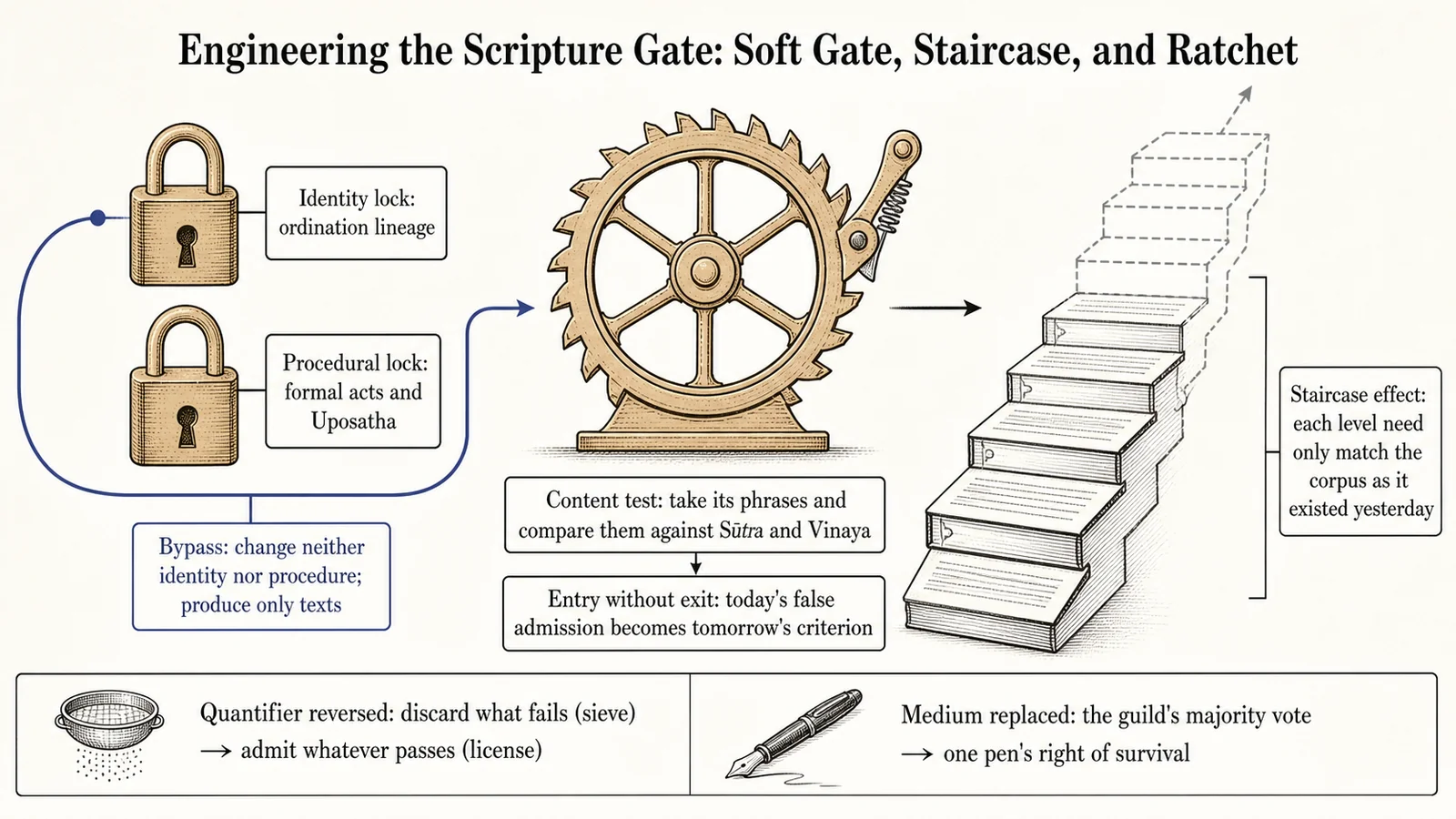
Begin with the gate's original design. The sūtra gate was designed for content verification. The four great standards of the Mahāparinibbāna Sutta instruct that whenever someone claims "I heard this directly from the Buddha," the claim should neither be accepted nor rejected. Its words should be compared against discourse and discipline; if they fit, accept them, and if they do not, discard them. The test concerned consistency of content, not a chain of provenance, because the discourse side had no living chain to check. The Vinaya's human lineage governed status; its definition of schism governed procedure. As Volume I showed, Mahāyāna established neither a separate ordination lineage nor a separate observance and therefore never constituted schism in the Vinaya sense. Tradition knew the textual gate was soft. The simile of the drum peg already predicted that later monks would lose interest in the Tathāgata's profound discourses and delight in new sūtras composed by poets, beautiful in language. As a drum's body cracked, pegs were inserted until no original wood remained.2 Patches were repeatedly added to the gate: the provenance formula "Thus have I heard," redundant backups in reciter lineages, and councils held again and again. Every patch was a soft lock on the content side. New Mahāyāna sūtras followed a route that precisely bypassed the two hard locks and pushed open the soft gate: change neither identity nor procedure; produce only text.
Why did the soft gate fail at this moment? The first variable was medium. In an oral age, the cost of "publishing" one sūtra was extremely high. A guild of reciters had to be persuaded to add it to the curriculum and dozens of people to guarantee it with lifelong memory. Guilds were conservative and capacity finite; adding the new displaced the old. In a manuscript age, one pen and a stack of birch bark sufficed. The earliest Mahāyāna manuscripts, from Gandhāra in the first or second century, and the earliest Chinese translations around 179 fall precisely within the window in which writing became widespread. During nearly the same century, Sri Lanka used the pen at Aluvihāra to seal a storehouse, as Part III, Chapter 3 described. Guardians and innovators received the same technology. One used it to lock the gate; the other to open it.
The first groups of passengers through that window can be named. The physical object is a Gandhāran birch-bark scroll of the Aṣṭasāhasrikā Prajñāpāramitā, radiocarbon-dated to roughly the first century, in Gandhārī, corresponding to the Daoxing Prajñāpāramitā. It is the oldest surviving Mahāyāna manuscript, and it is already a Prajñā text. The Chinese anchor is Lokakṣema's group: Daoxing, Pratyutpanna, Akṣobhya, the old Yiri Moni Bao translation of the Kāśyapa chapter, and the earliest fragment of Avataṃsaka, the Dousha Sūtra. Internal stratification adds works like the Inquiry of Ugra: almost no emptiness, no use of the name Mahāyāna, only a severe bodhisattva path; Volume I cited Nattier on its early date. Together, the compositional window of the oldest core reaches to around the first century BCE. But this batch was not the beginning; it was the waterline. Lists of merits place "preserving and reciting" before "writing." Verse cores such as the Ratnaguṇasaṃcayagāthā retain fossil features of vernacular language and oral recitation. Deeper still, they connect to the mainstream Saṅgha's oral literature of birth stories, avadānas, and Buddha biography—"bodhisattva" was already a word in Jātaka literature. That oral layer is in principle unrecoverable, for the reason in the next paragraph.3
Orality operates by majority rule. A guild's memory is a public budget. For a sūtra to live orally, a community must agree to guarantee it with dozens of lifetimes. A minority's new work could only die. Writing changed not merely the cost of production but the threshold of survival. For the first time, a small circle lacking majority support could make its texts outlive its members. Gombrich's famous argument states exactly this: writing was the technical precondition that allowed Mahāyāna to begin.4 The "earliest batch" we see is therefore, by definition, the first batch not to drown. The visible history of Mahāyāna begins when minorities obtained the right to survive.
The second variable lies inside the new sūtras: they were designed for the manuscript age. Many repeatedly proclaim the same kind of merit. To preserve, read, recite, copy, and worship this sūtra produces greater merit than donating the seven treasures across worlds numerous as Ganges sands; wherever this sūtra is found, there is a stūpa.5 Returned to media history, these are copying instructions. Older scriptures did not need to urge people to copy them because reciter guilds were their reproduction institutions. New sūtras lacked such guilds and wrote the motive for copying into their own contents, paying scribes in merit. Competition between a text carrying its own reproduction reward and one carrying none is unequal. Cult of the book was not only a new form of devotion; it was the distribution architecture of a new medium—what Schopen called a "religion of the book," as Volume I recorded.
A third variable was likewise built in: new sūtras supplied their own authentication machinery. At the level of provenance, they were preserved in dragon palaces, heard personally in Tuṣita, or received by seeing a Buddha in meditation. Each explained why "you have never heard this." The Pratyutpanna samādhi's report of seeing a Buddha in concentration was identified in Volume I as one key to how new Buddha-word was generated. At the level of witness, the Lotus Sūtra makes Prabhūtaratna rise from the earth in his stūpa and testify, "So it is, so it is." The narrative arranges its own notary. At the level of defense, many texts prophesy that "in the last five hundred years" future hearers will be shocked, doubtful, and slanderous, converting later objections in advance into fulfilled prophecy.6 Together, the three layers supply all the credit a text without guild or lineage lacked. Their very presence proves that their authors understood the threshold.
Combine these variables in one family of texts. Why do all the Prajñā sūtras talk about prajñā? Four currents answer. First, literal inheritance. They are not many independent revelations that happened to share a subject but one text budding and multiplying. The genealogy is clear: the eight-thousand-line version is the mother; the twenty-five-thousand- and hundred-thousand-line versions mechanically expand the same skeleton through a "list machine," multiplying every concept by eighteen kinds of emptiness and 108 formulas; the Diamond and Heart sūtras are later condensations. A clone colony naturally speaks the same language. Second, guild character. The people writing these sūtras had been trained to recite them; new works extended the family's repertoire. Third, an induction loop. In a Pratyutpanna-type production mechanism, a practitioner sees a Buddha in concentration, the Buddha teaches, and what he teaches is what the practitioner already carries in the curriculum. The text half admits this: "this mind makes the Buddha" analyzes the Buddha seen in concentration as mind-made, then uses the analysis as proof of emptiness. The vision is preloaded by the doctrine it confirms; the doctrine is then confirmed by the vision. The loop closes. The new text enters circulation and preloads the next meditator. Fourth, selection. Texts with copying rewards were copied most. The "earliest record" surviving today is itself crowded by the family best at self-promotion. The four currents make the family's homogeneity not a mystery but the mechanism's signature.7 Why prajñā was selected in the first place belongs to motive; Chapter 3 returns to it.
The deepest mechanism lies in verification itself, what this volume calls the ratchet of entry into the sūtras. The four great standards test a new text against a corpus. The gate has a geometric property: it moves in one direction. Every text accepted in error becomes tomorrow's standard; every text wrongly rejected does not tighten the standard. A staircase effect follows. A jump from an Āgama directly to the Lotus cannot pass, but each new layer need agree only with "the corpus as of yesterday." No one step violates the rule, yet after ten steps the drum body consists entirely of pegs. Apologists modified the gate once more: "whatever accords with the nature of Dharma is Buddha-word." The four great standards had been a sieve of necessary conditions—discard what does not fit. The new sentence inverted it into a license of sufficient conditions—accept whatever fits. With the quantifier reversed, the same test changed from sieve to issuing office. Volume I, Part IV, Chapter 1 recorded this doctrinal redefinition of "Buddha-word"; here its logical form is added. The ratchet requires no bad actors. Every local act of inclusion can be sincere. Drift is a geometric property of the method of validation, visible only on the scale of centuries, while no participant lives on that scale.
The plain half must be stated fully. The schools' own canons also thickened through Jātakas, avadānas, and Abhidharma collections. Expansion of scripture was not unique to Mahāyāna; Mahāyāna differed in scale and self-consciousness. Its authors probably did not understand themselves as forgers. Visions in concentration and inferences from Dharma counted as Buddha-word in their epistemology, as Volume I explained in its section on redefinition. To accuse individual honesty is to aim at the wrong target; this chapter has always examined the engineering of the gate. A rough comparison (details belong to each history) shows that traditions with chain-locked scripture did exist. Islam attached chains of transmission and a science of transmitter criticism to ḥadīth; Christianity sealed a canon through councils. Buddhism locked persons, not text. Three types of lock produced three histories of transformation.
This chapter records only brief answers to the last two of the four questions; the following chapters expand them. Who benefited? Those who could write. Where was the cost recorded? In the term "Buddha-word." It changed from a historical claim into a function: whatever met the criteria could enter. Once the gate had been altered this way, what entered depended only on who stood outside. The next chapter turns to the first honored guest—an entirely new ideal person.
References
References
-
For sources, legends, and hypotheses concerning Mahāyāna origins—Gandhāran manuscripts, the chronological lower bound of Lokakṣema's translations, Drewes's epigraphic statistics, the rise and fall of Hirakawa's lay-origin hypothesis, forest-meditator and book-cult theories, "Mahāyāna was not a school," the procedural definition of schism, and redefinition of the criterion of Buddha-word—see Volume I, Part IV, Chapter 1 and the works of Schopen, Nattier, Harrison, and Drewes cited there. This chapter adopts those conclusions. ↩
-
The four great standards appear in Dīgha Nikāya 16, the Mahāparinibbāna Sutta, with the Chinese parallel in the Youxing Jing of the Dīrgha Āgama. The drum-peg simile appears in Saṃyutta Nikāya 20.7, with a Chinese parallel in Saṃyukta Āgama 1258. ↩
-
Falk and Karashima published the Gandhāran birch-bark Aṣṭasāhasrikā: "A First-Century Prajñāpāramitā Manuscript from Gandhāra," parivarta 1, ARIRIAB XV (2012), and parivarta 5, ARIRIAB XVI (2013), radiocarbon dated approximately to the first century, with a 47–147 CE range. For Lokakṣema's translations and the early Ugra, see Volume I, Part IV, Chapter 1 and Nattier's work cited there. The relationship of the verse stratum of the Ratnaguṇasaṃcayagāthā to the prose Aṣṭasāhasrikā remains debated; see Edward Conze, The Prajñāpāramitā Literature, 2nd ed. (Tokyo: Reiyukai, 1978). For a periodization of "primitive Mahāyāna," see Shizutani Masao, Shoki Daijō Bukkyō no seiritsu katei (Kyoto: Hyakkaen, 1974). ↩
-
Richard Gombrich, "How the Mahāyāna Began," Journal of Pali and Buddhist Studies 1 (1988), argues that minority texts could not survive under oral transmission and that writing was the technical precondition for Mahāyāna's rise. On oral dimensions of early Mahāyāna centered on dharmabhāṇakas who memorized and preached, see David Drewes, "Oral Texts in Indian Mahāyāna," Indo-Iranian Journal 58 (2015). The arguments can be read together. ↩
-
Statements concerning the merit of copying and worshiping a sūtra and "where the sūtra is, there is a stūpa" appear throughout Prajñā and Lotus literature. Compare the Diamond Sūtra, "wherever this scripture is found, the Buddha is present," and the Lotus Sūtra, "Dharma Preacher" chapter: "wherever a scroll of this sūtra is kept, a seven-jeweled stūpa should be erected… for the complete body of the Tathāgata is already within." Volume I cited Schopen on cult of the book. ↩
-
Prabhūtaratna's testimony appears in the "Emergence of the Jeweled Stūpa" chapter of the Lotus Sūtra. "Last five hundred years" prophecies include the Diamond Sūtra's "five hundred years after the Tathāgata's passing" and the verses on preaching in an evil age in the "Encouragement to Uphold" chapter of the Lotus Sūtra. ↩
-
For genealogical expansion from the earliest Prajñā literature, see Conze's The Prajñāpāramitā Literature and studies cited in Volume I. On the possibility that the Heart Sūtra was back-translated from Chinese, see Jan Nattier, "The Heart Sūtra: A Chinese Apocryphal Text?" JIABS 15.2 (1992). The "this mind makes the Buddha" passage appears in the Pratyutpanna Samādhi Sūtra. ↩