Chapter 4: Who Pushed? Three Populations, Three Mahāyāna Movements
The preceding chapters dismantled mechanism, ideal, and divine person. Under the introduction's rules, the final question cannot be omitted: who pushed? Volume I already adjudicated the sources once—why the lay-origin hypothesis collapsed, why the forest-meditator and cult-of-the-book theories stand, and how inscriptional statistics show that early Mahāyāna involved very few people.1 This chapter adopts that judgment and inventories the populations anew through the external lines used in this volume.
They reduce to three populations and three positions. On the production side stood forest meditators: a small group of the strictest monks within sectarian institutions, leaving monasteries for the forest and devoting themselves to contemplation. The first textual forms of new sūtras may well have been their contemplative reports. In Pratyutpanna samādhi they saw buddhas and heard teaching in concentration; after seeing a buddha, naturally they carried new Buddha-word back into the human world. On the distribution side stood Dharma preachers, dharmabhāṇakas, a profession created by new sūtras. The texts divinized the role (the preacher is the Tathāgata's emissary and supporting one equals supporting the Buddha), while equipping it: wherever this sūtra is taught, there is a stūpa. Texts without guild endorsement circulated through these licensed proclaimers.2 On the patronage side stood money from cult sites and trade routes: the merit economy of making images, copying scriptures, and supporting preachers. Monastics outnumbered householders among named donors, as inscriptions show and Volume I recorded, but the money ultimately flowed along trade routes from Kuṣāṇa-era international commerce and urban wealth. The three positions form one industrial chain: production in the forest, distribution by preachers, financing from cult sites and trade.
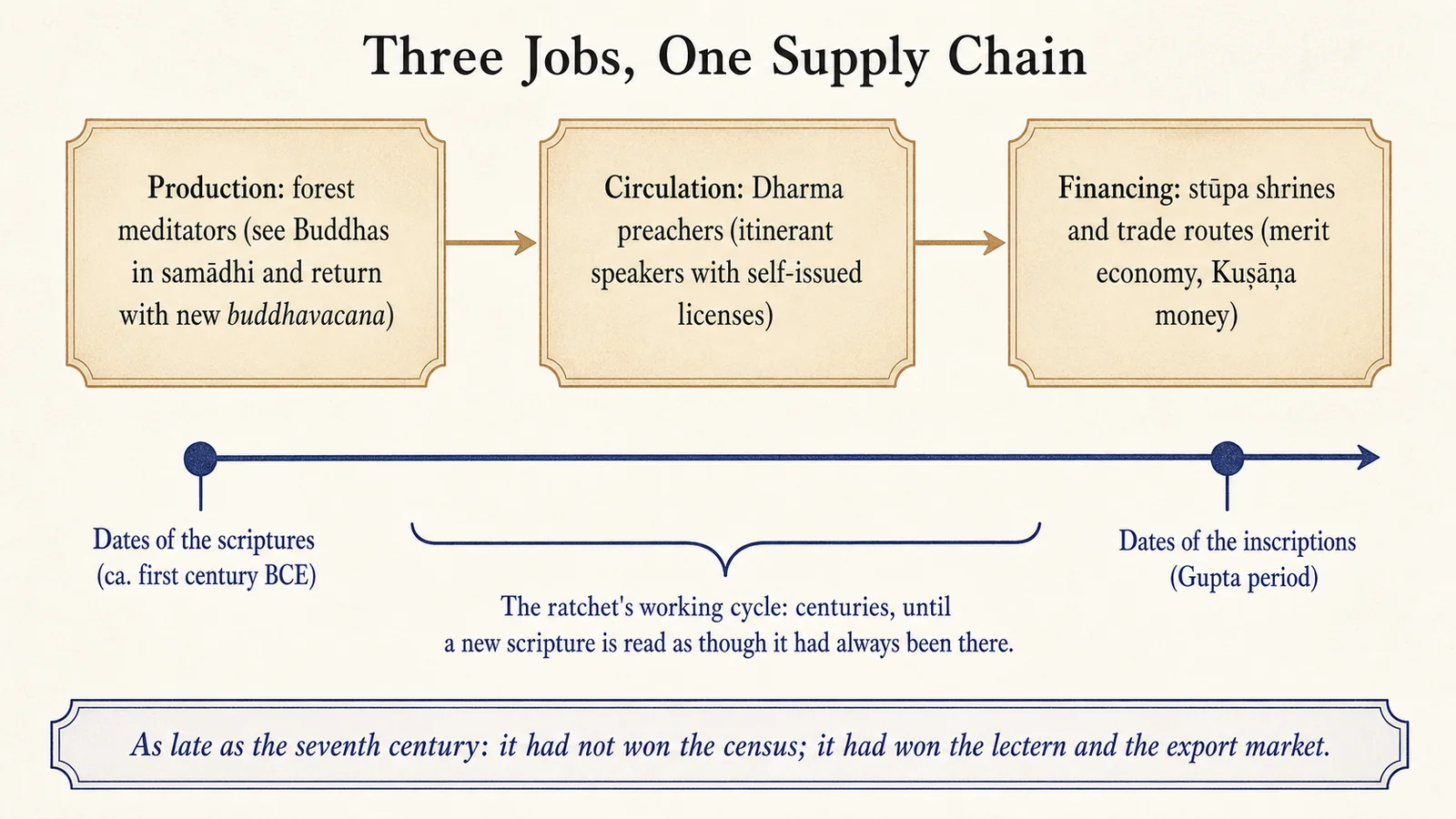
Three populations produced three Mahāyānas. The meditator's Mahāyāna was samādhi and seeing buddhas; the preacher's was scripture and merit; the patron's was stūpa, image, and field of merit. All used the banners of bodhisattva, prajñā, and Buddha-word, but their concerns differed. Volume I concluded that early Mahāyāna consisted of multiple tiny traditions gathered under a common name. The consequence in a history of transformation is clear: a movement driven separately by several engines had no center or charter and therefore nowhere to apply a brake. Later divisions within Mahāyāna (Prajñā's line of wisdom, Pure Land's line of faith and vows, Yogācāra's line of learning, whose soteriological consequences Volume II treated separately) were extensions of the three positions from the beginning.
Another hard fact from Volume I requires direct treatment here. Drewes's statistics show that traces of Mahāyāna in inscriptions and donor records remained scarce until before the Gupta period. Several centuries separate the dates of scriptures from the date of widespread belief.3 Read through this volume's mechanism, the time lag is precisely the ratchet's work cycle. A new text enters quickly—one pen in a manuscript age. A new identity becomes the majority slowly—only after the staircase shifts the corpus layer by layer, and one or two generations learn to read new sūtras as what had always been. Opening by medium, engagement by ratchet, population follow-through: three beats form one complete journey. The rise of Mahāyāna was not a revolutionary explosion but the operating history of a machine.
The phrase "read as what had always been" should not pass lightly. Nor is the effect an ancient monopoly. Sociology has a name for this temporal trick: invented tradition. Hobsbawm and collaborators inventoried modern examples. Scottish clan tartans said to be "handed down for generations" were commercial inventions of the nineteenth century. The standard form of Japan's "ancient" Shinto wedding spread after an imperial ceremony around 1900. Buddhism supplies its own example: the unified international form of Vesak was adopted only in 1950 by the World Fellowship of Buddhists. Two or three generations suffice to read any novelty as "from ancient times." Halbwachs's work on collective memory supplies the mechanism: memory reconstructs the past within present frameworks; "always" is produced in the present tense.4 For a ratchet, one or two centuries is ample. We need not assume the ancients easier to deceive than us, only that they were equally forgetful.
The actual degree of acceptance and resistance can be arranged through evidence from soft to hard. The softest layer lies within new sūtras. Before the Lotus teaching begins, five thousand overconfident people leave; the Buddha says "it is well that they withdrew." The text writes its own resistance into the plot. The Mahāprajñāpāramitā-śāstra repeatedly stages the accusation "your Mahāyāna is not Buddha-word" and answers point by point; an opponent's slogan survives through the apologist's quotation. A firmer layer is the longevity of apologetic literature. From that treatise to Asaṅga's Mahāyānasūtrālaṃkāra, whose dedicated chapter proves that Mahāyāna is Buddha-word, the defense was republished for centuries. Without continued resistance, defense need not be republished. A living specimen remains from the seventh century. Its source is Xuanzang's biography—the same work whose account of his flawless victory at the unrestricted assembly at Kanyākubja must be discounted as a victor's narrative. But this passage is a street scene difficult to invent. On his journey west, the eminent scholar Guptaka declared himself unmatched and honored by king and people. He urged Xuanzang not to travel farther: "The Saṃyuktābhidharmahṛdaya, Abhidharmakośa, Vibhāṣā, and everything else are here; studying them is enough." Xuanzang asked whether he possessed the Yogācārabhūmi. Guptaka replied: "Why ask after that book of false views? True disciples of the Buddha do not study it." Xuanzang wrote that he had initially revered the man deeply but, after hearing this, regarded him like dirt. He denounced Guptaka for slandering a book taught by a future buddha and asked whether he did not fear the bottomless pit.5 One conversation, two expulsions from the religion. Seven centuries after the beginning, mainstream elders still called a flagship Mahāyāna treatise a book of false views; Mahāyāna travelers answered with hell. Two populations mutually judging each other's books as heresy lived under the same Vinaya and roof. That is the actual texture of "acceptance."
The hardest layer is numerical. Inscriptions: Schopen's systematic inventory shows donors identifying by school, while "Mahāyāna" became a self-designation in stone only in the Gupta period. Manuscripts: among the Gandhāran scrolls of the first and second centuries, Mahāyāna texts are a minority in an ocean of mainstream sectarian literature. Censuses: Faxian records by country communities that studied Mahāyāna, those that studied the "Lesser Vehicle," and those that practiced both. Xuanzang records numbers of monasteries and monks and their affiliations; later tables show mainstream schools, especially Sāṃmitīya, still in the majority. Yijing states explicitly that within the four main schools, both vehicles were practiced. "Those who worship bodhisattvas and read Mahāyāna sūtras are called Mahāyāna." Acceptance described an individual's practice, not the raising of a new flag over a monastery.6 In one sentence: even in the seventh century, Mahāyāna had not won India's population census. It won the lecture platform and the export market.
Following the rules, the next claim is explicitly this volume's conjecture. Mahāyāna was not one movement but several movements sharing one name. The name's unity was a rhetorical achievement, not an organizational fact. Corroboration: it had no center, common charter, or unified ordination line, as Volume I established; the systems' concerns diverged—meditators wanted visions of buddhas, preachers circulation, patrons fields of merit. The vast scale of later doctrinal classification in China, treated in Part X, inversely measures the original tension. Things that do not require reconciliation do not generate so many frameworks of reconciliation.
The plain half: every successful great tradition has multiple origins. Multiplicity is not Mahāyāna's scandal but a normal condition. To distinguish three engines is not to expose a fraud but to analyze a successful piece of engineering. The four questions can now be closed. What changed? Production authority over scripture was decentralized. What force pushed it? Medium, market, and three populations. Who benefited? Those able to write, preach, and donate. Where was the cost recorded? In "Buddha-word," and in the burden placed on every later new sūtra to prove itself true. A gate that could never again be closed became the revolution's standing condition for every later century.
New scripture, new ideal, new savior, new populations: all four were present, and a parallel Buddhism had formed beneath the roof of the schools. Its direct encounter with the old scholastic line occurred in the arena of debate. The next part turns to the arms race.
A theoretical cross-section belongs in a closing note. On the doctrinal side, Mahāyāna took new cloth to patch the three holes in the previous part. Buddha-body theory answered what a buddha is: Dharma-, reward-, and transformation-bodies elevated the teacher into an ever-present savior. The bodhisattva path supplied a narrative of practice: three incalculable eons supplied a schedule. Emptiness removed the floor beneath dharmas; the hole did not need patching because the pot itself was removed. But the new cloth contained new openings. Prajñā declared emptiness without arguing for it; negative language had not received a skeleton of reasoning, and this opening produced Madhyamaka. How consciousness projected appearance and karmic seeds continued had not yet opened a storehouse; this opening produced Yogācāra. The reversal of the quantifier in "all this is Buddha-word," identified in Chapter 1, incurred a debt that philology would collect more than a millennium later. Doctrine in this part has this shape: the holes were patched, and the cost was built into the foundation.
References
References
-
For Volume I's adjudication of origin hypotheses, inscriptional and donor statistics, and conclusion that early Mahāyāna consisted of multiple tiny traditions, see Volume I, Part IV, Chapter 1 and the studies of Schopen, Nattier, Harrison, and Drewes cited there. This chapter adopts those conclusions. ↩
-
For the self-elevation of Dharma preachers as emissaries of the Tathāgata, see the "Dharma Preacher" chapter of the Lotus Sūtra. For statements that wherever the text is taught a stūpa is present, see Schopen's work on cult of the book cited in Volume I, Part IV, Chapter 1. ↩
-
For the scarcity of Mahāyāna traces in inscriptions and donor records before the Gupta period, see David Drewes, "Early Indian Mahāyāna Buddhism I: Recent Scholarship," Religion Compass 4.2 (2010), and Schopen's epigraphic studies cited in Volume I, Part IV, Chapter 1. ↩
-
Eric Hobsbawm and Terence Ranger, eds., The Invention of Tradition (Cambridge, 1983); the chapter on Scottish tartan is by Hugh Trevor-Roper. The standardized Shinto wedding spread after the 1900 palace marriage of the crown prince, later Emperor Taishō, and was promoted through the Hibiya Daijingū. The unified international observance of Vesak was adopted by resolution at the World Fellowship of Buddhists' first conference in Colombo in 1950. See also Maurice Halbwachs, Les cadres sociaux de la mémoire (1925) on the social frameworks of collective memory. ↩
-
Biography of the Tripiṭaka Master of the Great Ci'en Monastery, fascicle 2; the scene does not appear in Xuanzang's Great Tang Records on the Western Regions. The same biography later gives an overly perfect victor's account of the Kanyākubja assembly (the Refutation of Mahāyāna against Xuanzang's Refutation of False Views, followed by eighteen days without a challenger), which this volume does not accept as factual history. The ordinary conversation here lacks an obvious motive for invention and is correspondingly more credible. ↩
-
On the late appearance of Mahāyāna self-designation in Indian inscriptions, see Schopen's essays in Figments and Fragments of Mahāyāna Buddhism in India. For the proportion of Mahāyāna texts among Gandhāran manuscripts, see Mark Allon and Richard Salomon, "New Evidence for Mahāyāna in Early Gandhāra," The Eastern Buddhist 41.1 (2010). For pilgrim censuses, see Faxian's Record of Buddhist Kingdoms; Xuanzang's Great Tang Records on the Western Regions, with later tabulations in André Bareau, Les sectes bouddhiques du Petit Véhicule (Saigon: EFEO, 1955); and Yijing's Record of Buddhist Practices Sent Home from the Southern Sea, fascicle 1. ↩