Chapter 1: The Vacuum of Authority—The Buddha Appoints No Successor
The first hinge in the history of Buddhist transformation was not a disagreement in thought but an appointment that never occurred. Around 400 BCE (the precise year of the Buddha's death remains disputed; this volume uses the conventional range and will not dwell on chronology), the eighty-year-old Buddha made a final journey along the northern bank of the Ganges and entered final nirvāṇa between the twin sāla trees at Kuśinagara. A community of renunciants dispersed across the Gangetic basin, gathered during the rains and sustained by wandering for alms, lost its only center. For more than two millennia, every Buddhist schism, every council, and every appeal to royal power for judgment leads back to the same fact: from the beginning, that center refused to arrange a substitute for itself.
Two records fix the Buddha's attitude in the file, one in the Vinaya and one in the discourses. The Vinaya record concerns Devadatta's request for the community. Late in the Buddha's life, his cousin Devadatta proposed publicly: the Blessed One is advanced in years and should entrust the Saṅgha to me; I will lead it. The refusal left no room: I would not entrust the Saṅgha even to Sāriputta and Moggallāna—how much less to you, a consumer of spittle.1 The insult is severe, but the point lies not in the insult but in the first half. Sāriputta and Moggallāna were the acknowledged two chief disciples, foremost in wisdom and supernatural power, yet were not eligible for such entrustment. The rejection therefore concerned not Devadatta as candidate but the act of "entrusting the Saṅgha to one person" itself.
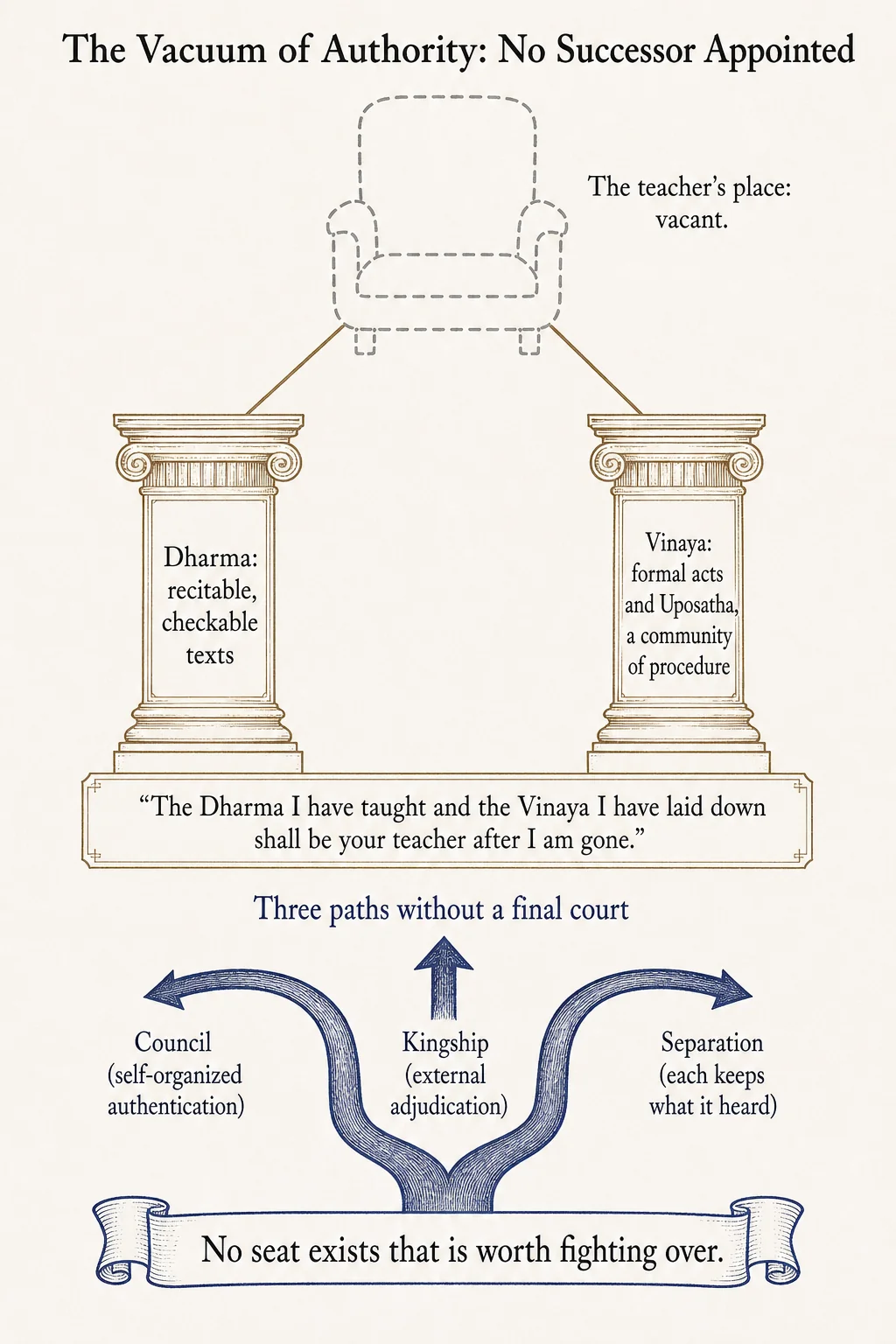
The discourse record appears in the Mahāparinibbāna Sutta. A few months before the final nirvāṇa, the Buddha had just recovered from grave illness when Ānanda voiced the community's expectation: the Saṅgha still awaited the Blessed One's final instruction concerning it. The answer dismantled that expectation in three layers. First: I have taught the Dharma without an inner and outer version. The Tathāgata does not hold the closed fist of a teacher, keeping a secret treasury for a successor. Second: only someone who thinks "I govern the Saṅgha" or "the Saṅgha depends upon me" would need to leave it a final command; the Tathāgata has no such thought. Third came the positive instruction: be islands unto yourselves, refuges unto yourselves, with no other refuge; take the Dharma as island and refuge, with no other refuge. On the night between the twin trees, the final instruction completed the point: after I am gone, the Dharma I have taught and the discipline I have established will be your teacher.2 Volume II's Vajrayāna part cited the "closed fist of a teacher" to test the legitimacy of secret transmission. This volume uses the other side of the same statement: the words that do not establish esotericism also do not establish a pontiff.
Following this volume's rules, plain explanations come first. The plainest is oversight: the Buddha did not have time to make an arrangement. The record contradicts it. One exchange occurred years earlier, the other on his deathbed; the questions were direct, and so were the answers. The refusal was reiterated and systematic. A second explanation is that there was no one to appoint. By the night between the twin trees, Sāriputta and Moggallāna had indeed died before the Buddha, and the two people most like successors were gone. But both were alive when Devadatta's request was rejected, and the Buddha said while they lived that he would not entrust the community to them. Their absence explains the final scene, not the principle. A third explanation is that renunciant traditions simply operated this way. Not entirely. Contemporary Jainism had an orderly succession: after Mahāvīra, disciples led the community in sequence, and their lineage stands at the beginning of Jain religious history. Once these plain explanations withdraw one by one, the remaining reading is this: not appointing a successor was not the absence of a decision. It was the decision.
Placed back within the institutions the Buddha left, the design becomes visible. Doctrinal authority was entrusted to the Dharma: recitable and checkable texts. Procedural authority was entrusted to the Vinaya: formal acts and the observance. Saṅgha business required the community present to decide by prescribed procedure; every fortnight, members recited the code together and disclosed offenses before the assembly. Neither kind of authority depended on one person's judgment. Any community of monks reaching the legal quorum and acting in accordance with the Vinaya constituted a complete Saṅgha; it needed no instructions from a center. This is the same structure as the principle of self-power repeatedly documented in Volume II: liberation depends on no external power; authority is tied to no person. More plainly, the Buddha removed authority from persons and placed it in publicly checkable text and procedure. "Be your own island and refuge" is not only an instruction for practice; it is also an organizational charter.
The rarity of this charter in religious history appears only through comparison. Jainism appointed successors and nevertheless split into Digambara and Śvetāmbara branches: succession did not prevent fracture. Brahmanical traditions placed authority in birth and teacherly lineage, inherited through blood and status. Looking forward, Christianity concentrated judgment in a single seat; doctrinal judgment and competition for the seat became inseparable, and the seat casts a shadow across schisms and religious wars. Islam's first civil war began over succession; the Sunni-Shia division opened in blood and remains unresolved. Buddhism presents the reverse pattern. It fragmented more finely than any of them (the conventional eighteen schools were only the beginning), yet almost never shed blood on a large scale over the cracks. One reason is coldly simple: there was no seat worth fighting for.
Jainism deserves a closer look as the living comparison of a tradition that appointed a successor and survives to this day. Consider its present forms of transmission. After several generations, the succession instituted by Mahāvīra no longer produced one head recognized across the religion. Beneath the Digambara and Śvetāmbara branches stand multiple parallel monastic lineages, each honoring its own ācārya and subordinate to none of the others. The Digambara ascetic lineage almost disappeared in the medieval period; a partly monastic, partly lay institution of seat-holders, the bhaṭṭārakas, guarded temple assets and communities, while naked asceticism was revived only in the early twentieth century. Within the Śvetāmbara branch, the only movement truly to establish "one ācārya governing all monks and nuns" is the reformist Terāpanth founded as late as 1760. Its eleven ācāryas have succeeded in orderly sequence through appointment by the predecessor—but precisely because this is a late artificial design, not the inheritance of Mahāvīra's appointment. More important still, Digambaras hold that the original canon was lost, while the two branches accept mutually unrecognized textual lineages.3 The conclusion is cleaner after reading this specimen. A succession system gave Jainism neither a continuing central authority nor a shared canon. Its real continuity lay elsewhere: in a prosperous endogamous lay community and its temples and trusts. Over twenty-five centuries, the tradition that appointed a pontiff came to inhabit the very form Buddhism wrote into its charter at the outset—multiple branches coexisting, each self-governing and sustaining itself through doctrine and community. The difference is that one was design, the other drift.
The cost of the vacuum is equally clear. Without a final court of appeal, doctrinal disputes had no place of termination. Only three routes remained. First, a council: organize an authentication conference and use communal recitation and deliberation to establish "correct memory." Second, kingship: invite external authority to judge; once Aśoka opened this door, it never closed. Third, separation: when no one can judge anyone else, each group preserves what it heard and establishes its own center. The institutional premise of the whole history of transformation is established here. Almost every later turn in Buddhist history can be recognized as one of these three shapes. This volume might be read less as the history of a religion than as the operation, over two thousand years, of a legal system without a supreme court. The other side should also be recorded: distributed authority means no single point of failure. Indian Buddhism died while lineages in Sri Lanka and Myanmar survived. China suppressed Buddhism four times, yet the community dispersed and gathered again. Fragmentation is one reason for its long life.
Now, as required by the introduction, the following is this volume's conjecture. The refusal to appoint a successor was not an improvised reaction to Devadatta but a plan whose direction had been set earlier: if the true Dharma was to endure, it could not be fastened to any one "leader of the religion." Later events repeatedly confirmed that judgment. The first evidence lies in the construction schedule of the institutions themselves. Placing authority in text and procedure was not a plan drafted in one night before death. Formal acts, the observance, and the whole charter of self-government through the Vinaya were built gradually over decades, without ever reserving a place for succession. The Buddha saw at least three confirming specimens. In the first he was himself the beneficiary. Sāriputta and Moggallāna had belonged to Sañjaya's following; they led 250 wanderers to join the Buddha. Sañjaya pleaded repeatedly and finally proposed that the three of them lead the group together. He could not keep them. Blood burst from his mouth, and his community thereafter declined.4 A group fastened to one leader almost disintegrated when its core left. The Buddha saw this lesson at the beginning of his teaching career, from the winner's position. The middle specimen was Devadatta: a cousin, ordained for decades, possessing discipline, reputation, and talent—the strongest candidate for "successor" available within the contemporary Saṅgha. That strongest candidate supplied a complete specimen of demanding the community, founding a separate Saṅgha, and allying with Ajātasattu. The only schism during the Buddha's lifetime came from him. The lesson was not "this person is unfit" but "this office is unfit." The wording of the refusal already reveals the rule: "I would not entrust" was never aimed only at the cousin. The last specimen came from the nearest outside neighbor. Mahāvīra died at Pāvā before the Buddha; his disciples immediately divided into two factions and attacked one another, while lay followers grew disgusted and dispersed. When the news reached the Saṅgha, Ānanda showed his concern and specifically asked the Buddha about conflict after his own death.5 Three specimens across several decades point in one direction: when authority is placed in a person, the religion moves whenever the person moves. One further corroborating fact: Mahākassapa presided over the First Council through his reputation for ascetic practice and seniority; no Vinaya states that he possessed a testamentary appointment. If the Buddha had favored anyone, the council's presiding elder had the strongest motive to produce the appointment, and he did not. The conjecture's vulnerable point lies in the Vinayas: if any one records that the Buddha planned a succession and abandoned it, or favored someone on his deathbed, the conjecture falls.
Beyond conjecture is another conclusion requiring none: by the night between the twin trees, even had the Buddha wished to appoint someone, he probably could no longer have done so. The Kosambī dispute provides a ready measurement of how mature the community's procedural autonomy had become. Over the classification of a minor offense, the monks at Kosambī split into two groups, expelled one another, and refused to live together. The Buddha came to mediate and urged peace three times. Their answer was: let the Blessed One remain at ease; "we ourselves will deal with this dispute." Unable to persuade them, he left alone for the Pārileyyaka forest, where an elephant came to attend him.6 How was the dispute resolved? Not by the Buddha. Kosambī's laypeople agreed to offer neither respect nor alms. Deprived of support, the two groups went to Sāvatthī for judgment. The monk concerned acknowledged the offense, and the Saṅgha performed a formal act of reconciliation. The living Buddha could not command the Saṅgha in one city. Whom could a written appointment in a testament command? The appointment itself would have become the first crack: if A were chosen, why should B's group accept? Local communities present and complete under the Vinaya already owed no bow to a common head. Thus not appointing a successor was both a design built over decades and, by the end, the only workable option. Design and circumstance converged. Record also the hand that actually worked in the Kosambī dispute: the patrons' alms.
This chapter has described the institutional premise that allowed every external cause to enter. External forces themselves appeared only briefly in the outcome at Kosambī. The vacuum now stands. It was not oversight but design, and finally the only passable road. Yet the designer could prevent himself from sitting in that place; he could not control what would fill it once empty. The first thing to enter was authority over the authentication of memory. The next chapter turns to the First Council: whose memory counted, and who decided?
References
References
-
Devadatta's request for the community and his denunciation as a "consumer of spittle" (kheḷāsaka) appear in the schism sections of the various Vinayas: Pāli Vinaya, Cullavagga VII; the Dharmaguptaka Vinaya's chapter on schism; and the Mahīśāsaka Vinaya's chapter on schism. The Vinayas differ in how they arrange the details of Devadatta's acts (his alliance with Ajātasattu, the separate five rules, drawing the Buddha's blood, and so forth), but all include the rejected request. ↩
-
Dīgha Nikāya 16, the Mahāparinibbāna Sutta, contains the simile of the teacher's fist (ācariya-muṭṭhi), the denial that the Tathāgata thinks "I govern the community," and the instructions to be one's own island and refuge and to take the Dharma as island and refuge. The Chinese parallel is the Youxing Jing in the Dīrgha Āgama. The Pāli discourse concludes with "the Dharma I taught and Vinaya I established will be your teacher after my passing"; the Chinese Sūtra of the Bequeathed Teaching gathers its sense into "take the precepts as teacher." Volume II cited the "teacher's fist" in its Vajrayāna discussion of secret transmission; this chapter takes its institutional side. ↩
-
On Jain transmission: each major branch contains parallel monastic lineages without a head accepted by all; the medieval Digambara ascetic lineage nearly disappeared and the bhaṭṭāraka institution maintained temple properties and communities; naked mendicancy was revived in the early twentieth century by Śāntisāgara; the Śvetāmbara Terāpanth was founded by Ācārya Bhikṣu in 1760 and follows a centralized "one ācārya at a time" system in which each predecessor designates the successor, with eleven ācāryas to date—the most recent three being Tulsī, Mahāprajña, and Mahāśramaṇa. Digambaras hold the original canon to be lost and reject the Śvetāmbara canon. See Paul Dundas, The Jains, 2nd ed. (Routledge, 2002); P. S. Jaini, The Jaina Path of Purification (University of California Press, 1979). ↩
-
For Sāriputta and Moggallāna leading 250 wanderers away from Sañjaya to join the Buddha (Sañjaya's three attempts to retain them, proposal that the three jointly lead the group, and the blood bursting from his mouth afterward), see the ordination section of the Pāli Vinaya, Mahāvagga I.23–24. Chinese Vinayas and the chapter on Sāriputra and Maudgalyāyana in the Abhiniṣkramaṇa Sūtra vary in detail. ↩
-
For Nigaṇṭha Nātaputta, Mahāvīra, dying at Pāvā and his disciples immediately dividing in bitter dispute, see Majjhima Nikāya 104, the Sāmagāma Sutta: the novice Cunda brought the report from Pāvā, and Ānanda asked the Buddha out of concern for disputes after his own passing. The Chinese parallel is the Zhou-na Jing in the Madhyama Āgama. Dīgha Nikāya 29, the Pāsādika Sutta, has the same setting. The texts describe the factions stabbing one another with words and lay followers becoming disgusted and dispersing. ↩
-
The Kosambī dispute appears in the Pāli Vinaya, Mahāvagga X. The issue concerned classifying a minor offense; commentarial tradition identifies the cause as water left in a washroom. The two groups expelled one another. Three times the Buddha urged reconciliation, and the monks replied that he should remain at ease and they would handle the dispute themselves. The Buddha departed alone and eventually entered the Pārileyyaka forest, where the Vinaya also records the elephant attending him; Udāna 4.5 agrees. When Kosambī's householders agreed to offer neither respect nor gifts, both groups went to Sāvatthī for judgment. The monk concerned recognized his offense, and the Saṅgha performed a reconciliatory observance. Majjhima Nikāya 128, the Upakkilesa Sutta, shares this setting; Chinese Dharmaguptaka and Mahīśāsaka Vinayas also record it. ↩