Interlude: Innumerable Saints—An Impossible Census
The fragmentation has been told; the scholastic academy has not yet opened. Between the two, this volume pauses to ask a question both sides avoid: after the Buddha's death, how many arahants remained in the world? Practitioners will not touch it because it damages confidence. Scholars cannot touch it because no evidence can answer. Attainment leaves no material proof, the Saṅgha had no census, and the "number of living arahants" at any moment cannot be verified. But the impossibility of an answer can itself be studied. Tradition left five classes of roughly datable proxy files: reported numbers; published timetables; legends of a "last" saint and doctrines of saints who remain in the world; corroboration from inscriptions and travelogues; and indirect readings from doctrine and literary form. Placed on a timeline, they reveal not the population of arahants but how Buddhism repeatedly revised its understanding of its own stock of saints.
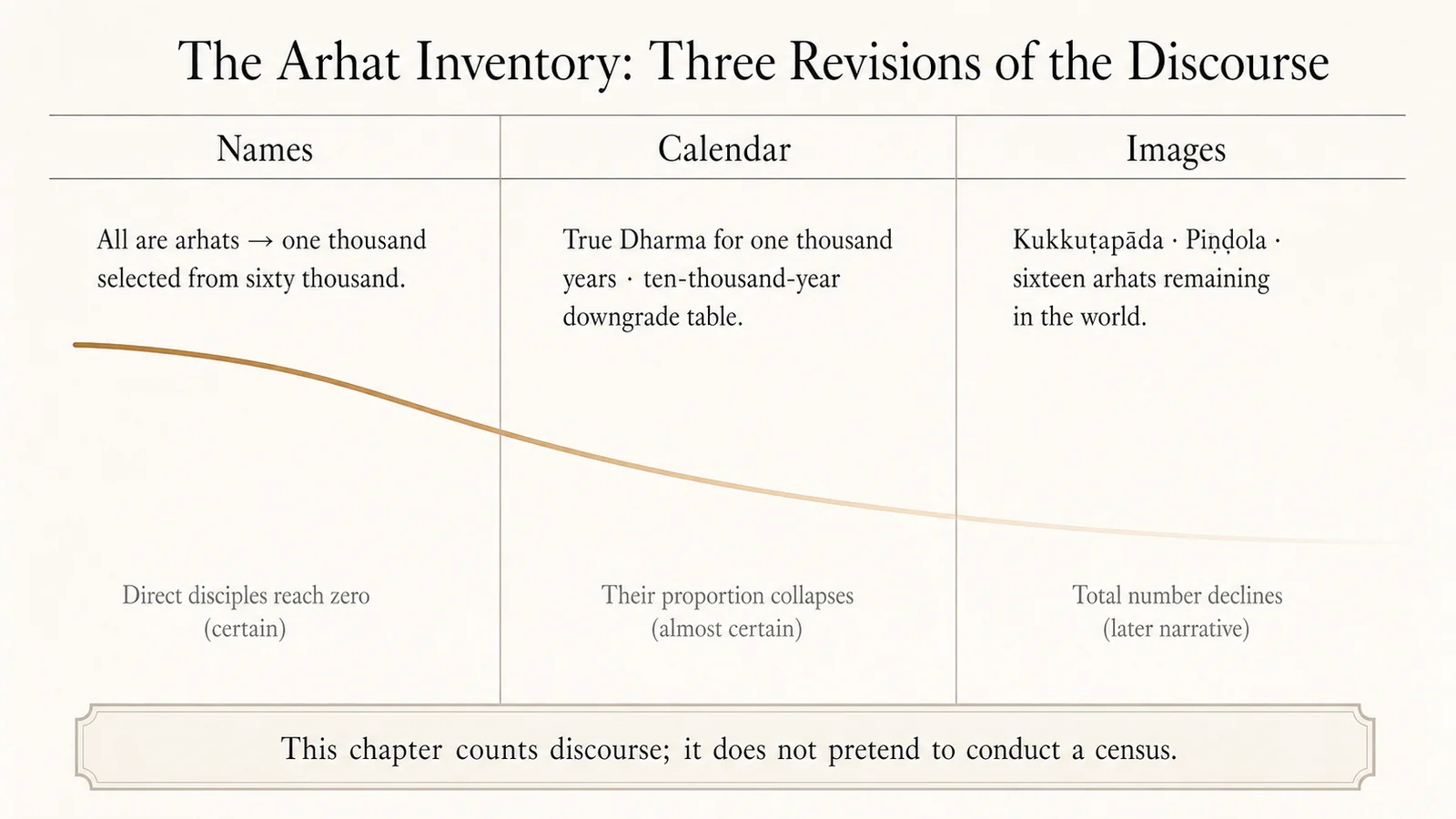
Begin with reported numbers. The formula at the head of many discourses says the Buddha was "together with 1,250 monks, all arahants": monk and arahant nearly coincide. Five hundred attended the First Council, where arahantship was the qualification for entry; the size of the council and the order of magnitude of arahants were the same. Seven hundred attended the Second, still treated as a noble assembly, though attention had shifted from attainment to Vinaya. By the southern narrative of the Third Council, the formulation had changed: from 60,000 monks at Pāṭaliputta, 1,000 were selected to collect the canon. These are formulaic numbers (five hundred, seven hundred, one thousand), and cannot be read as population data. Yet the series has a shape. Even if tradition's own reporting is accepted, "monk equals saint" retreats from an equation to one in sixty. No collapse in production need be assumed. Aśoka's patronage could inflate the denominator (the southern histories themselves speak of "infiltrators" entering for food and clothing), and the concentration would collapse. Northern tradition places a coda in Kaniṣka's time: the compilation of the Mahāvibhāṣā is still said to gather five hundred arahants, the last major narrative of a contemporary assembly of arahants. Thereafter the protagonists of transmission became scholar-monks; arahants disappeared from the register of contemporary persons.
The second file deserves even closer attention: tradition published a schedule for declining production. The earliest is the prediction that women's ordination would halve the duration of the true Dharma from one thousand years. Commentarial tradition completed the timetable. The Samantapāsādikā gives the teaching ten thousand years and lowers attainment by one grade in each millennium: in the first, arahants possess the analytical knowledges; in the second, only arahants who have destroyed craving remain; subsequent millennia descend through nonreturners, once-returners, and stream-enterers; for the final five thousand years there is learning without attainment; after ten thousand, only the outward form of shaven head and dyed robe remains.1 The schedule's function must be seen clearly. It makes the absence of nearby arahants require no explanation; the calendar bears all blame. Explanatory authority drifts from "we have not practiced well" to "the age has reached its appointed point." This is no small hinge. The absence of attainment becomes normal and responsibility-free. The contraction "only this practice suits this age" (Final Dharma in Pure Land and Kamakura Buddhism) rests on this foundation.
The third file is a vote plus a reserve inventory. In the first century BCE, famine nearly broke Sri Lanka's oral transmission. After the disaster, commentaries record a debate: is practice or textual learning the root of the teaching? The verdict went to textual learning: "Even if hundreds of thousands of monks practice insight, without the teaching not one can realize the noble path."2 The decision shares the circumstances and timing of writing the Tipiṭaka at Aluvihāra. The Saṅgha formally redescribed its mission from producing saints to preserving texts, and the island tradition staked orthodoxy on text and Vinaya. Part III follows it. At the other end, as living arahants became harder to find, doctrine invented undying ones. Mahākassapa entered absorption at Cock's Foot Mountain holding the robe and waits for Metteyya; Piṇḍola was ordered not to enter final nirvāṇa and continuously receives offerings in the human world; the Record of the Duration of the Dharma established sixteen great arahants who remain to protect the teaching until the next Buddha.3 The beauty of a reserve inventory is that it never requires an audit. Sixteen saints permanently on the rolls form a perpetual register. After the Tang, images of arahants proliferated. Arahants changed from a population category into an image category. Images are the only medium through which a category with no living specimens can receive offerings.
The fourth class is external corroboration, but its evidentiary weight must be reduced. The short inscriptions on the reliquaries from Sanchi Stupa 3 say only “of Sāriputta” and “of Mahāmoggallāna”; they do not include the title “arahant.” They attest the relic cult of two deceased disciples but cannot establish that sacred titles belonged only to the dead. Contemporary donor inscriptions often identify monks by functions such as reciter, Vinaya holder, or learned monk, but the absence of an attainment title cannot prove that no living person held an attainment. Chinese pilgrims offer at most a change of literary emphasis. Chinese materials around the fifth century still portray Kashmir as a place of meditation lineages and saints; Xuanzang’s arahants are mostly attached to ancient sites and legends while contemporary eminent monks are often distinguished for learning; and Yijing seldom uses attainment as a category of travel observation.4 These are proxies for narrative practice, not statistics for the stock of arahants.
The fifth reading comes from doctrine and literary form. Mahādeva's Five Points were a contemporary complaint about the gap between real and ideal arahants, as the preceding chapter explained. The existence of a complaint proves there were enough registered arahants to question. Later generations no longer needed to question because there was no target. Mahāyāna sūtras cast Śāriputra as a supporting figure who must be taught; the literary space to mock an elite depends on weakening that elite's actual authority—this sentence remains conjectural. Abhidharma and stage-of-the-path systems draw ever finer ranks: the map expands as the territory contracts. Yet this fifth archive supplies a necessary counterweight. The cost of claiming attainment was rising. Falsely claiming a superior human state was a defeat offense, and after the Five Points, claims faced greater scrutiny. Less reporting does not necessarily mean less production. As elsewhere, claims and functions must be distinguished. This chapter counts discourse and does not pretend to conduct a census.
Following the rules, the next paragraph is explicitly this volume's conjecture: a three-stage curve of concentration. Stage one, from the Buddha's death to a century later: the first generation of direct disciples died, the first cliff. Sāvaka literally means one who heard the Buddha's voice. Once the generation that personally heard him was gone, the word's original reference hung empty. Of the three stages, only this one has biological certainty. Stage two, from a century after the Buddha to Aśoka, must be divided into three claims of unequal strength. A collapse in proportion is nearly certain: even with unchanged production, an explosion of the denominator under royal patronage establishes it. A fall in absolute number lacks evidence. Traditional narrative still produces many arahants under Aśoka, and leaders of the missions are often identified as arahants; absolute collapse became a dominant story only later. What can be fixed is a reckoning at the discursive level. The Five Points publicly filed the gap between ideal and actual arahants; council narratives changed from "all arahants" to "one thousand chosen from sixty thousand." Stage three, from Aśoka to around the Common Era: without a pontiff, lineages could govern identity but not attainment, and authentication failed as verification drifted. Tradition saved itself by changing the unit of account: publish timetables, establish a permanent reserve, redefine the mission. Arahant population then ceased to be a discussable category and became calendar, image, and legend. If inscriptions or reliable early texts reveal the routine certification of living arahants for several centuries after the Common Era, beyond formulaic narratives, stages two and three must be rewritten.
The question has a modern echo that serves as the curve's far endpoint. During the seventeenth and eighteenth centuries, when ordination transmission had broken in Sri Lanka, monks concluded that "path and fruit can no longer be attained in the present age"; Volume I recorded this crisis of attainment. Nineteenth- and twentieth-century meditation revivals in Myanmar and Thailand asserted the opposite: attainment remained possible now. They publicly tore up the ten-thousand-year timetable, and living arahants began to be named again. Followers wrote retrospective hagiographies for Ajahn Mun and Mahā Bua; the Sunlun tradition assigned dates to its founder's attainments; Western practitioners even printed "arahant" on the covers of their own books.5 Note the boundary of this revival. It occurred almost exclusively within the Theravāda world that possessed the timetable. Modern Chinese and Tibetan discourses of attainment instead use awakening, emanation, and accomplished practitioner; "living arahant" is not their title category. One subtler present condition must be recorded. Today's Theravāda world commonly believes that stream-enterers, and even once-returners, remain among us, yet sustains a collective silence and does not name who has or has not attained. That silence has two faces. In its solid face, it protects the Saṅgha's supramundane practice: attainment does not enter the public market and gains fewer routes toward fame and offerings. The Vinaya already forbids monks from declaring their own attainment to laypeople, and the ancient law's purpose still operates. In its doubtful face, silence also feeds suspicion; believers cannot avoid the question, is any of this true? A stock that reports belief but no specimen is not so much protected as suspended. Where the discourse of living arahants died and returned maps the territory in which "arahant" remains a living category.
The interlude ends here. The census counted no heads, but counted three revisions: from names, to calendar, to images. Two successors then divided the work of the population problem. Scholasticism drew an ever finer map; the next part follows it. The bodhisattva replaced the ideal itself; Part IV follows that.
The theoretical cross-section belongs in a closing note. The main body of this part counted authority and rolls; the note adds the shape of doctrine at this moment: it had no shape yet. The Buddha left words spoken for occasions, not a book arranged as a system—a thousand conversations, no single outline. Three vacuums remained, each destined to become a major issue. What was a Buddha, human or superhuman? No one needed an answer while those who remembered him remained alive. How could no-self and karma coexist; who received the result? Similes were enough, and no one asked for a mechanism. Who authenticated realization? While the Buddha lived, the Buddha did; after his death, as this part has shown, the first vacuum opened. The beginning of theoretical history was not a system but three questions that no one yet considered questions.
References
References
-
The prediction of a halved duration appears in Aṅguttara Nikāya 8.51 and the bhikkhunī sections of the Vinayas. The ten-thousand-year descending timetable occurs in the Samantapāsādikā's discussion of the duration of the teaching and is summarized here. Pāli commentarial tradition also describes five disappearances in sequence: attainment, practice, learning, outward form, and relics. ↩
-
Manorathapūraṇī I.92–93 records the debate between practice, paṭipatti, and learning, pariyatti, and the judgment that while learning remains, the teaching does not disappear. For the famine and writing of the Tipiṭaka, see the Dīpavaṃsa and Mahāvaṃsa accounts cited in Part III, Chapter 3. ↩
-
For Mahākassapa entering absorption at Cock's Foot Mountain with the robe and awaiting Metteyya, see northern traditions in the Aśoka narrative cycle. For Piṇḍola being ordered to remain and receive offerings, see the Vinayas and the Sūtra on Inviting Piṇḍola. For sixteen great arahants remaining to protect the Dharma, see Xuanzang's translation of the Record of the Duration of the Dharma Spoken by the Great Arahant Nandimitra. ↩
-
The Sanchi Stupa 3 reliquary inscriptions contain genitive forms of the names Sāriputta (Sariputasa) and Mahāmoggallāna (Mahamogalanasa), but no arahant/arhat title. See H. Lüders, A List of Brahmi Inscriptions from the Earliest Times to about A.D. 400 with the Exception of Those of Aśoka, Appendix to Epigraphia Indica X (1912), which also collects donor titles such as reciter, Vinaya holder, and learned monk. For the pilgrim materials, see Faxian’s Record of Buddhist Kingdoms, Xuanzang’s Great Tang Records on the Western Regions, and Yijing’s Record of Buddhist Practices Sent Home from the Southern Sea. The body explicitly uses them only as evidence of literary emphasis. ↩
-
A selective modern register includes Ajahn Mun, 1870–1949, retrospectively recognized in Thai forest biographies; Ajahn Mahā Bua, 1913–2011, whose late public claims remain disputed; Myanmar's Ledi Sayadaw, 1846–1923; Sunlun Sayadaw, 1878–1952, whose tradition dates his successive attainments to 1920; Webu Sayadaw, 1896–1977, widely recognized in Myanmar; Mahasi Sayadaw, 1904–1982, personally cautious but assumed by followers; and Western claimants such as Daniel Ingram, whose book cover identifies him as "The Arahat." On Sri Lanka's eighteenth-century crisis of attainment, see Volume I, Part IX, Chapter 4 and its references to Malalgoda and Gombrich. The widespread contemporary Theravāda belief that stream-enterers and once-returners remain while their identities go unspoken has a Vinaya root in the rule making it an offense for a monk to declare genuine superior human attainment to an unordained person. ↩