Chapter 3: The Root Schism—The Ten Points, Mahādeva, and Two Buddhist Imaginaries
At some point roughly a century after the Buddha's death, the Saṅgha split into Sthavira and Mahāsāṃghika branches, the root schism from which the conventional eighteen schools and still more divisions emerged. This hinge must first be laid out according to the textual criticism of Volume I, because the sources supply three incompatible files. The southern Vinaya records the dispute at Vesālī over Ten Points, but the Vinaya account ends with all ten judged unlawful and seven hundred monks reciting together; it says not one word about a schism. The later Dīpavaṃsa historical tradition welded the schism to the Ten Points.1 The northern Sarvāstivāda tradition linked the split to Mahādeva's Five Points, but this file more probably projects a later internal Sarvāstivāda controversy back onto the beginning of the schism. The Mahāsāṃghikas' own Questions of Śāriputra gives a third account: elders wished to expand the Vinaya, the majority refused, and the two parted. Volume I examined every incompatibility. The conclusions secure there were only one external anchor and an order of magnitude. Aśoka's schism edicts show that by the middle of the third century BCE, division was an established fact requiring royal suppression. The split itself more probably arose from disputes over the breadth of discipline and organization of the Saṅgha than from a clear doctrinal opposition, and can be dated only within one or two centuries after the Buddha.2 This volume will not repeat that investigation. It takes the conclusions and uses the disordered files as two independent windows: one onto the Ten Points, a stress test that did not itself produce a schism; the other onto later stories of the schism, whose cause is obscure but whose accident reports reveal their authors.
Begin with the first window, the stress test. The Vajjian monks at Vesālī practiced the Ten Points. The visiting elder Yasa encountered the most conspicuous: on the observance day, a bronze bowl was placed before the community and laypeople were invited to put money into it for the Saṅgha's needs. Yasa publicly declared this unlawful. The local community responded by ordering him to apologize to the laypeople, then expelled him. He went west for help, enlisting Revata and other elders. Seven hundred gathered at Vesālī; east and west each appointed four adjudicators, who deliberated point by point and judged all ten unlawful. The list deserves to be read in full: storing salt in a horn for later use; eating when the sun's shadow had passed noon by two fingerbreadths; eating again after going to another village; holding separate observances within one boundary; performing a formal act before the full community assembled and obtaining assent afterward; following one's preceptor's customary practice; drinking buttermilk not fully churned; drinking palm liquor not fully fermented; relaxing the specification for sitting cloths; and, tenth, accepting and keeping gold and silver. What stands out is not strictness or leniency in any one item but the list's nature. Not one concerns doctrine; every one concerns livelihood. How to store salt, whether the meal deadline can shift by two fingers, whether money can be accepted: this is a ledger of the Saṅgha's living costs.
Return the list to its geography and the reading appears. Vesālī was a commercial center north of the Ganges. The Ten Points circulated precisely where monetization was most active and lay gifts could most easily be converted from goods into money. They were not ten acts of indiscipline but an urban Saṅgha's adaptations to a new economy. Beneath the dispute over strict and lenient Vinaya lay a change in how monks obtained food. The fourth external line, the monastic economy, enters here for the first time. The gap between ruling and enforcement confirms it. The seven hundred elders won completely in court: all ten points were unlawful. No one later revised the articles. Volume I's comparison of the schools' codes showed that their major substantive rules were almost identical; even the prohibition on money remained verbatim in the Mahāsāṃghika Vinaya, despite that school later being labeled "indulgent." Change took place on another level. Expedients in which a steward received money or a formal relinquishment transferred it through another's hands spread across the schools. Every article remained unchanged; every practice accommodated. The court won. The economy did not lose.
The second point concerns sequence, and Volume I's textual criticism is decisive. The story that the defeated party angrily held a "great council" and formed the Mahāsāṃghika school was welded on later by the Dīpavaṃsa tradition; the Vinayas contain no such step. The defensible sequence is: first came a split whose date and cause cannot be fixed; afterward came each side's accident report; only later did scholastic works complete lists of doctrinal differences. The traditions do not even agree on which rules were contested. The southern account speaks of ten relaxations. Comparison of codes shows the schools' substantive rules almost identical, with differences concentrated in rules of deportment governing eating and dress. The Mahāsāṃghika account says instead that the elders wished to add rules and the majority refused. Houses divided first; doctrine was supplied afterward. The cause of the accident was likewise written afterward by each house. Doctrinal disagreement is often the manual explaining a schism, not its cause. The manual is written after the division, and every house writes its own.
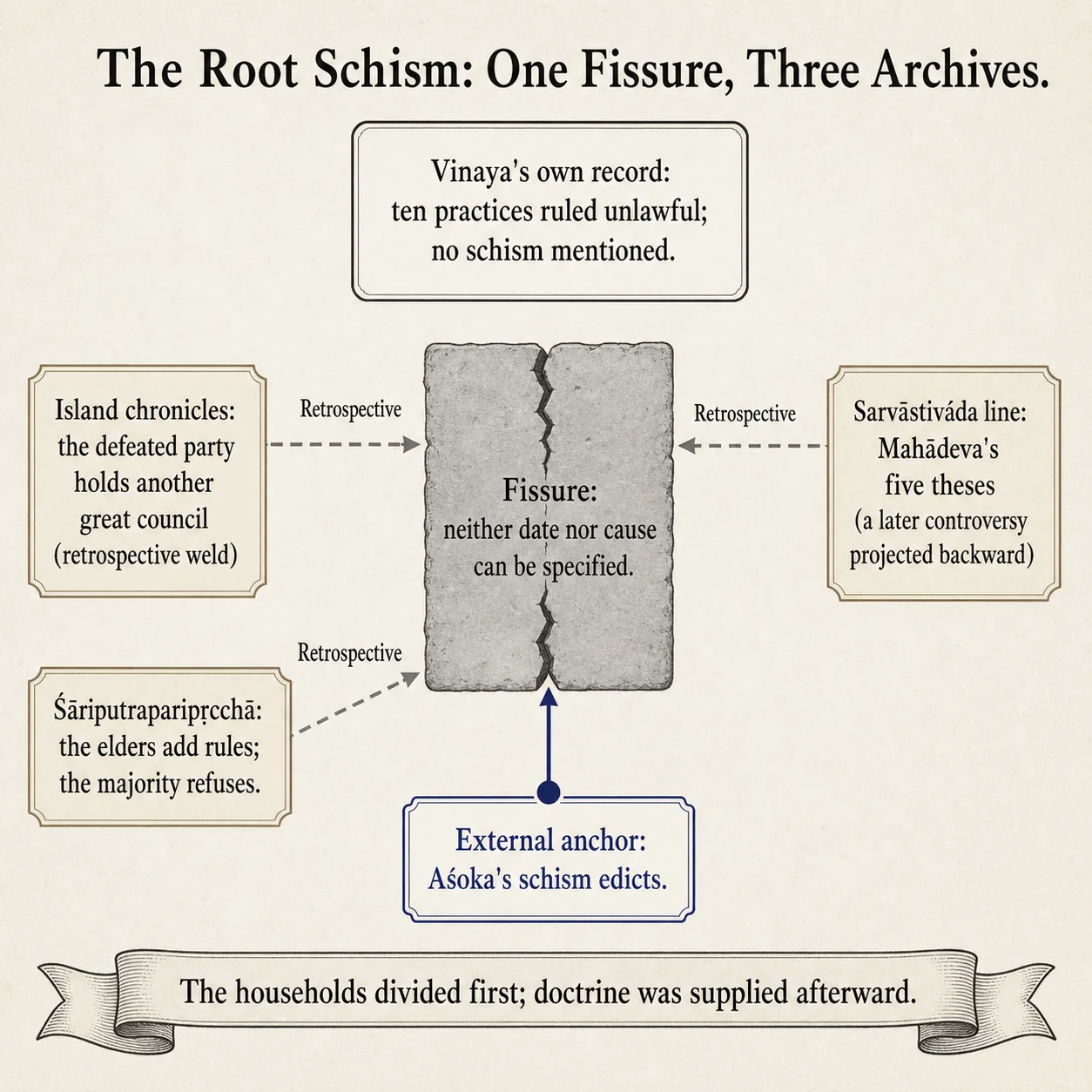
Now the second window: later narratives of the schism. The largest file concerns attainment. The northern Sarvāstivāda tradition says that more than a century after the Buddha, the schism began with Mahādeva. Following Volume I, this volume regards it more probably as a later Sarvāstivāda controversy projected back onto the root split. Suspended chronology does not reduce its analytical value. Whatever year the controversy occurred, it is the first surviving public review of the quality of arahantship. Mahādeva proposed five theses: an arahant may still be disturbed by Māra and discharge impurity; may retain undefiled ignorance; may doubt his own realization; must be confirmed by another before knowing that he has attained; and the path can arise through sound, so that sincerely crying "Suffering!" brings the noble path into manifestation. Combined into the traditional verse: "Another may seduce; ignorance remains; doubt; another brings entry; the path arises through sound—this is the true teaching of the Buddha."3 A vote followed. The majority supported Mahādeva; a minority of elders objected, and the two branches separated.
Under the rules, begin with the plain explanation, which is powerful enough. The Five Points can be read honestly as an observation report. People acknowledged within the Saṅgha as arahants still had nocturnal emissions, did not know everything, hesitated, required a teacher's confirmation, and depended on vocal exertion in practice. Someone had accurately registered the gap between ideal and actual arahants. On this reading, Mahādeva did not debase attainment. He was the first to state publicly that its title had been inflated, and the Five Points were its first quality-control report. The question of "verification" established in Volume II's synthetic criticism had already been asked within a premodern Saṅgha. The community split over the answer, which is itself half the answer.
The plain reading cannot explain how the targets are distributed. This volume's conjecture begins here and is marked as such. The reading does not depend on the Five Points' date; whether they record the root schism or a later Sarvāstivāda dispute, their targets come with the archive. The first four all reduce an arahant's authority: freedom from defilement, complete knowledge, freedom from doubt, and self-certification. These were precisely the enforcement assets of the elder class. As the last chapter showed, reviewing qualifications, enumerating offenses, and declaring practices unlawful all rested on the assurance that "our attainment is genuine." The fifth point moves in the opposite direction by granting ordinary practitioners a route from daily practice into the noble path. Together, the Five Points form a redistributive program: reduce the premium attached to attainment and lower the threshold of entry. The Mahāvibhāṣā's own origin story reveals a third layer. Mahādeva first certified attainments for his disciples. They then questioned him point by point: if we are arahants, why do discharge, ignorance, and doubt remain? He produced the Five Points in response. The hostile narrative meant to portray evasion, but incidentally recorded the actual form of certification: a teacher declared attainment; it did not declare itself. Read this way, the Five Points defend teacherly certification. They fix authentication in the teacher's hands (the fourth point, "another brings entry," makes external certification normal), while lowering the product specification to something deliverable. Lower the standard, lock the channel: a complete supply-side program. Who benefited? The majority, together with every teacher possessing disciples to certify. This is why the majority voted with Mahādeva. The name "Mahāsāṃghika," the Great Community, records that vote, just as "Sthavira," Elder, records its other side. Corroboration: the traditions consistently say the dispute ended by counting persons, not resolving doctrine. If an early source showed that the Five Points arose as introspection within the elder wing rather than an oppositional platform, this reading would fail. One further point must be stated candidly under the rule to halve the value of enemy archives. The most popular biography says Mahādeva committed three heinous acts before ordaining. It comes from the party that declared him demonic, the Mahāvibhāṣā. This volume reports but does not accept it. A file that turns an opponent into a murderer of parents already reveals its own character.
What settled after the split was not two lists of Vinaya rules but two institutional self-imaginaries. Their status must be marked. They emerged over time and need not reproduce the alignments at the original division. According to the Mahāsāṃghika account and the comparison of codes, it may have been the Sthavira party that wished to add rules while the majority preserved the old text. "Mahāsāṃghika equals indulgence" is a victor's label that fails against the texts. Yet over centuries the roles each lineage accepted became clear. For the Sthavira line, the community guarded memory; orthodoxy was its core asset; invariance its strategy—better small than wrong. For the Mahāsāṃghika line, the community adapted to the present; accessibility and a path open to all were its core assets; responsiveness its strategy—better broad than cut off. The roles may not have begun at the moment of separation, but they did settle into two Buddhisms. The guardian line later moved south, sealing the three baskets into palm leaves on an island; Part III follows it. The adaptive line remained on the continent, where over the following centuries its imagination would help produce the largest rewriting in Buddhist history.
One synchronized shift after the schism matters most. Mahāsāṃghika-affiliated schools lowered the arahant while elevating the Buddha: the Buddha's body was undefiled, his lifespan immeasurable, his power immeasurable, and one utterance taught all Dharma.4 The two moves were halves of one act. Once the credibility of attainment failed, the ideal had to be placed elsewhere. When saints in the present could not be trusted, sanctity moved beyond the reach of the present. Arahants descended from the altar while the Buddha ascended. Between the two altars opened a road: human beings remained on this shore, the ideal moved far away, and a traversable role was needed between. More than a century later, a new ideal would claim that road—the bodhisattva. Mahāyāna in Part IV already has its seat reserved here.
References
References
-
For the Ten Points and council of seven hundred, see the relevant sections of the schools' Vinayas: Pāli Vinaya, Cullavagga XII; the Dharmaguptaka section on the seven-hundred-person recitation; and the Mahīśāsaka section on the same. The appointment of four adjudicators each from east and west also appears there. The Vinaya narratives end with the judgment that the practices were unlawful and a communal recitation. The account in which the defeated party conducts a separate "great council" (mahāsaṅgīti) and becomes the Mahāsāṃghika school belongs to later southern histories in the Dīpavaṃsa line. The Vinayas group and name the Ten Points differently; the main text gives their substance. ↩
-
For the detailed analysis of the root-schism traditions, see Volume I, Part II, Chapter 3: the welding performed by the Dīpavaṃsa tradition; Jan Nattier and Charles Prebish's comparison of Vinaya codes, "Mahāsāṃghika Origins: The Beginnings of Buddhist Sectarianism," History of Religions 16.3 (1977); W. Pachow's comparison of the number of training rules; the Mahāsāṃghika account in the Questions of Śāriputra; and the external lower bound supplied by Aśoka's schism edicts at Sarnath, Sanchi, and Kosambi. This chapter directly adopts those conclusions. ↩
-
For Mahādeva's Five Points and their verse, see the Samayabhedoparacanacakra, translated by Xuanzang, and Mahāvibhāṣā fascicle 99. The biography involving three heinous crimes comes from the latter and is a hostile Sarvāstivāda narrative; the story in which Mahādeva certifies disciples and formulates the Five Points after their questions also appears there. Southern Vinaya histories do not make Mahādeva the cause of the root schism. Some scholarship treats the Five Points as a later sectarian controversy projected back onto the beginning, including L. S. Cousins, "The 'Five Points' and the Origins of the Buddhist Schools" (1991). Volume I adopted that judgment; the present reading follows it. Yinshun's Buddhism in India includes a defense of Mahādeva. ↩
-
For Mahāsāṃghika and related views of the Buddha (buddhas are supramundane, their bodies and lifespans immeasurable, and one utterance teaches every Dharma), see the Mahāsāṃghika positions in the Samayabhedoparacanacakra. ↩