Chapter 1: From Practice Ground to Academy—The Abhidharma Movement
Part II concerned a hinge of power: whose memory counted and whose rolls were authoritative. This part turns to a quieter and more durable change. During the two or three centuries after the Buddha's death, the Saṅgha's central activity slowly migrated from practice toward scholarship. No edict announced the migration and no meeting voted on it. It occurred in the daily schedule: time spent reciting exceeded time in meditation; precision of definition took precedence over intimacy of observation; and a new type of monk, the scholar, became the monastery's public face. Abhidharma was the flagship project of the migration. Volume I already described its doctrine—how mātikā outlines expanded into Abhidharma collections and how ontological dharmas, seeds, and persons each founded their own positions.1 This chapter asks only the present volume's four questions: What changed? What force pushed it? Who benefited? Where was the cost recorded?
What changed was genre, and beneath genre a mode of activity. Discourses address particular persons: they have audiences, occasions, and stories. Treatises are systems without occasions: they have definitions, classifications, and cross-checks. From discourse to treatise, the Dharma acquired the shape of an academic discipline for the first time. Mātikā was its syllabus, treatises its textbooks, and debate its examination. A meditation ground could not supply what a discipline required. It needed permanent schools, organized bodies of reciters and collections, full-time teachers, and courses measured in years. Sedentarization was completed at the same time. Temporary settlements for the rains became permanent monasteries; monastic property expanded from bowls and three robes into estates and storehouses. Volume I recorded the doctrine. Here we record its factory.
At least three plain forces drove the change, and each was legitimate. First, adjudicating controversy. Once schools stood side by side and disputes began, each needed more precise tools. How many senses of "existence" were there? How could no-self coexist with continuity? Without system, these questions could not even be argued clearly. Second, preservation. An orally transmitted teaching survived through organized memory, and classified lists were already mnemonic devices. Volume I established that the compressed mātikā form preceded any philosophical motive. Third, teaching. Once the Saṅgha expanded, the old method of direct instruction from teacher to disciple could no longer carry the numbers. A standardized curriculum was the precondition of scale. Together these three explain why Abhidharma appeared.
They do not explain its intensity. Why did systematization become the Saṅgha's central enterprise, precise enough to divide one moment of mind into dozens of components and vast enough that tradition required five hundred scholars to compile the Mahāvibhāṣā? External causes must enter here. Along the line of monastic economy, permanent residence and estates made full-time study possible for the first time, while making it necessary for patrons to approve. In the market for patronage, scholarship possessed what meditation lacked: visibility. Patrons could see eloquence on a lecture platform, manuscripts, and halls. They could not see where a mind had traveled inside a meditation cell. Displayable achievement enjoyed a natural advantage in raising support. Over time, those monasteries wished to maintain and communities celebrated shifted from sitters toward lecturers. Along the line of social composition, this discipline admitted literate young men with leisure, mostly from higher-status backgrounds. The rise of scholar-monks simultaneously rewrote the composition and character of the Saṅgha. The collapse in concentration described in the preceding interlude acquired an institutional version: saints had become difficult to produce, while scholars could be produced. A community no longer confident that it could produce arahants made the producible thing its new central product.
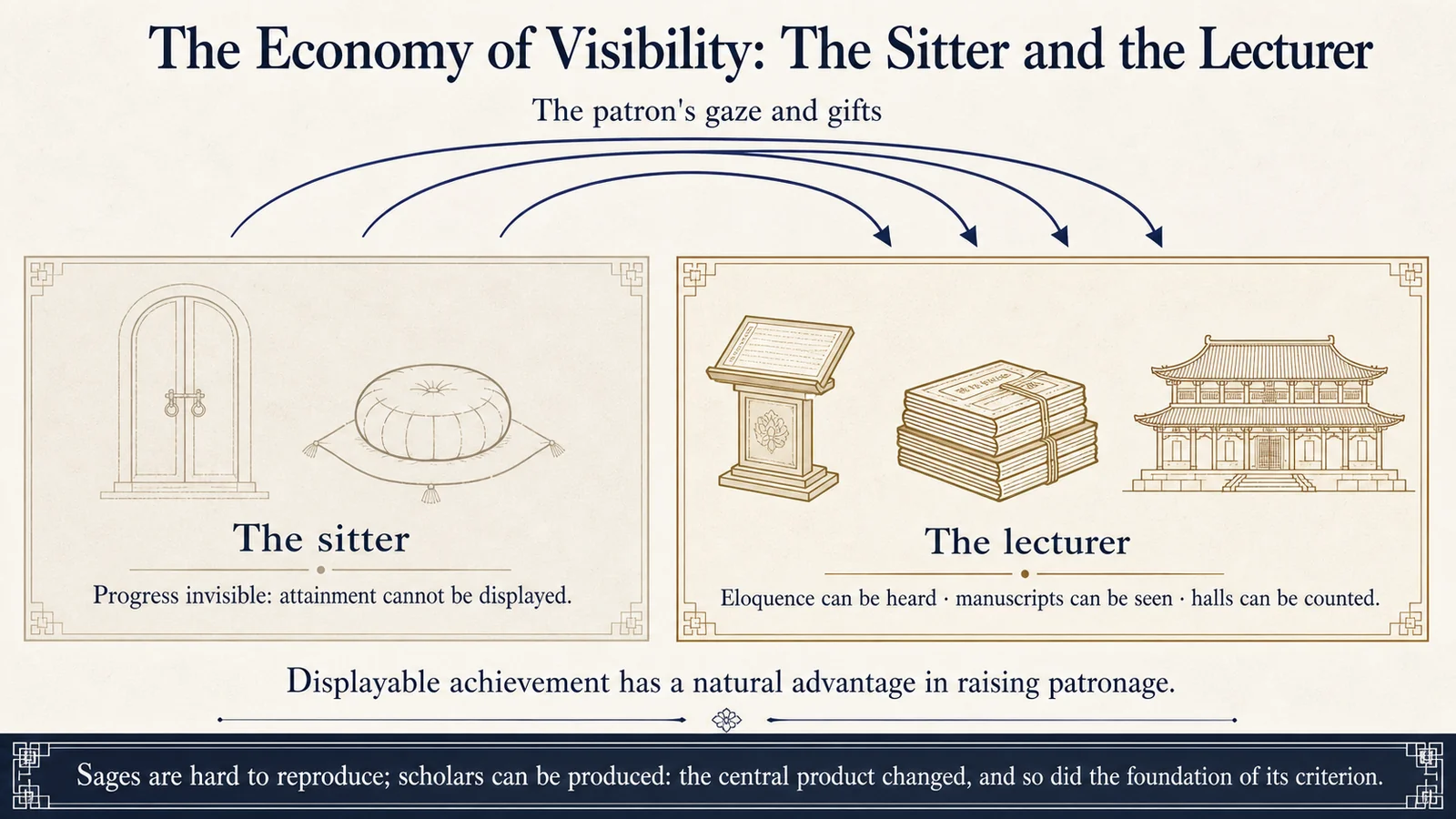
The beneficiaries are easy to list. Monasteries benefited: scholarship is an institutional asset that can accumulate, be inherited, and be displayed; meditation is none of the three. Scholar-monks benefited: a route of advancement independent of attainment opened. Examinations tested recitation and analysis, which could be tested; the interlude showed that attainment could not. Schools benefited: a body of treatises was an identity card, and possessing one's own Abhidharma marked a school as mature.
Now, following the rules, the next claim is explicitly this volume's conjecture. One force behind scholasticization came from outside: competition for status. Buddhism began on an anti-Brahmanical popular route, and Volume I noted its rejection of elite language in favor of ordinary speech. But in a society where Brahmanical learning defined what counted as learning, a community without grammar, logic, or a systematic canon could not hold its head up in the elite market. Abhidharma's form reveals traces of its benchmark: its taxonomic ambition, terminological purism, and rules of debate mirror the Brahmanical disciplines. Buddhism's later wholesale movement toward Sanskrit, recorded in Volume I as a later development, points in the same direction.2 The opponent was not an old relic waiting to be caught. Pāṇini's grammar came first; Patañjali and mature Abhidharma were contemporaneous; jurisprudence and epic literature took form during the same centuries. Academic disciplinization was an arms race in both directions, and neither side dared stop first. The conjecture is this: half the force behind the Abhidharma movement was the desire to prove to a learned world that looked down on renunciants that "we too possess learning—and ours is more rigorous." Corroboration: the achievements Buddhist philosophy later celebrated most proudly were victories in external debate. If the earliest treatises proved concerned entirely with internal adjudication and teaching, without any external posture, the conjecture would fail.
The cost appears in two places. The first is criterion. A discipline carries its own standards: precision of definition, rigor of system, victory in debate. These standards have no conversion rate into "has suffering ceased?" But they are examinable, comparable, and cumulative, and therefore naturally prevail inside institutions. Volume II diagnosed the drift of Mahāyāna criteria from cessation toward debate. The historical beginning of that line does not lie in Mahāyāna but here. When the Saṅgha moved its central activity into scholarship, the foundation of evaluation had already changed. The second cost appears in the map. As the interlude said, maps expanded as territory contracted. Abhidharma drew path and fruit in unprecedented detail; the accuracy of cartography replaced reports from the road. This was not one person's corruption. It was an institution perfecting what it could do well—and what it could do well happened no longer to be the thing for which it had first been founded.
The academy was standing, and academies are expensive. Who paid? Kingship enters in the next chapter.
References
References
-
For the formation of the Abhidharma genre (mātikā, definition, classification, and independent treatises), the two separate Abhidharma collections and their common core, and the evidentiary status of traditions attributing them to the Buddha, see Volume I, Part II, Chapter 5. For the doctrines of the schools, see Volume I, Part III. On the institutional approach adopted here, see also Erich Frauwallner, Studies in Abhidharma Literature and the Origins of Buddhist Philosophical Systems, trans. S. F. Kidd (Albany: SUNY Press, 1995). ↩
-
On the rejection of elite language and later Sanskritization, see Volume I, Part II, Chapter 2, "In One's Own Language." The connection between Sanskritization and the elite market is this volume's analysis. ↩