Chapter 1: The Economics of Huichang—Suppression and Selection
The preceding part ended with a four-beamed structure awaiting a state-level stress test. The test arrived in the fifth Huichang year, 845. Part VIII's death report established a control: China supplied the overseas replication of “attack with roots,” in which buildings fell but the network survived. This chapter is the experimental record. It first asks why the attack came, then what it dismantled, and finally what it did not. Once the three questions are answered, China has signed the judgment that roots explain death.
Huichang was not the first suppression. Emperor Taiwu of Northern Wei destroyed Buddhism in 446, using weapons and hidden stores discovered inside a Chang'an monastery as the pretext. Emperor Wu of Northern Zhou abolished Buddhism and Daoism in 574. His advisers' arithmetic was open: seek soldiers among the clergy and take land from beneath pagodas and monasteries. The laicized population numbered in the hundreds of thousands; Buddhist apologetic sources inflate it to three million and must, as usual, be read at half weight.1 The cases shared one feature. Doctrine occupied only the façade of the judgment; the body of the file concerned resources—people, land, iron, and copper. Buddhism was never suppressed in China because it taught the wrong thing, but because it accumulated too many things. This makes a first contrast with death in India. No document authorized Indian Buddhism's death. In China every suppression came with edicts, inventories, and responsible offices; the death sentence was rendered with perfect clarity and then never executed to completion.
The Huichang file is the fullest. By the middle of the ninth century, monasteries possessed everything on the state's sensitive list: tax-exempt estates; persons exempt from labor; commercial mills, inns, shops, and pawnshops; and, most conspicuous during a currency shortage, copper. A substantial share of the country's copper stood outside circulation in halls as images, bells, and chimes. After the An Lushan rebellion, taxation changed to the two-tax system. In the eyes of the Finance Commission, every person and field outside the two taxes moved from the world beyond the household into the category of leakage. Du Mu's inscription commemorating the destruction calculated throughout how much private property the empire had lost. Emperor Wuzong's edict spoke more plainly: “If one man does not farm, another suffers hunger; if one woman does not weave, another suffers cold. Today the monks and nuns of the realm cannot be counted. All wait on farmers for food and on weavers for clothing.”2 The edict attacked not the Buddha's doctrine but the monk's exemption. The second of the four questions is therefore clear: the principal force was the treasury deficit. The slanders of Zhao Guizhen and the Daoist establishment and the emperor's preferences merely gave a fiscal decision a religious vocabulary. Part IX, Chapter 3 established that orderly times were the season of quotas. Huichang was the quota system's extreme form, reducing the quota to zero at once.
In the eighth month of 845, the responsible office reported victory: more than 4,600 monasteries and more than 40,000 smaller temples and hermitages dismantled; 260,500 monks and nuns returned to lay life and registered as two-tax households; 150,000 slaves confiscated; and tens of millions of qing of good fields seized.2 Part IX, Chapter 3 already entered the line in its long table. Add one verification here. All cultivated land in Tang amounted to only a little over fourteen million qing, so “tens of millions” in monastic fields exceeded the empire's entire arable land.3 Either qing was a scribal error for mu, or officials diluted the victory report with exaggeration. This volume reads hagiographies at half weight and gives official victory reports the same treatment. Both sides watered their ink in opposite directions—one magnified miracles and the other success. After discounting the water, the scale remains astonishing. The 260,500 laicized were grounded in clerical and household registers and represented almost all registered clergy. This was not harassment but an institutional reset to zero.
The process had a foreign eyewitness. The Japanese monk Ennin, trapped in Chang'an, recorded events month by month. Destruction was not one night's violence but a three-year administrative process. Officials first checked ordination certificates and laicized those without them, then reduced the clergy in stages by ordination seniority and age, and finally repatriated foreign monks. Ennin himself was ordered home in this way.4 Focus on the instrument. Tang dismantled Buddhism not with soldiers but with lists. Who possessed a certificate, who lacked one, who was over fifty and who under thirty—all appeared in registers of the Court of State Ceremonial. One document changed 260,000 people back into lay clothes. Indian kings never possessed such a register and could attack Buddhism only one monastery at a time. The Chinese state could execute from a blueprint because Buddhism had entered the plan two centuries earlier. Registration had been the price Buddhism paid for a position within China, as Part IX, Chapter 3 showed. The same archive now became the demolition plan. The hand that issues a credential can withdraw it.
Who benefited? The treasury first. Copper images, bells, and chimes went to the salt and iron commissioner to be cast into coins; iron images became farm tools; good fields entered the two-tax base; slaves became taxable households. The Daoist establishment benefited second and briefly. Zhao Guizhen enjoyed influence for only a few years; in the month Emperor Xuanzong took the throne, he had Zhao beaten to death. A victory won by one emperor's preference was buried with him. A class of beneficiaries is often missed: regional military regimes that ignored the order. Ennin records that the circuits of Chengde, Youzhou, Weibo, and Zhaoyi north of the Yellow River did not carry out the destruction. Their military governors made their own calculation: monasteries were part of the established local order, so why dismantle their own stage for Chang'an?4 An irony lies here. Part X, Chapter 1 argued that unified empire gave Chinese Buddhism its form of perfect inclusion. In the Huichang year, imperial disunity saved its life. Only centralized power could dismantle every monastery in the realm overnight; regional division kept the edict from leaving the north. Unity supplied form and division left gaps. Chinese Buddhism benefited from both ends. This was not strategy but luck, and most institutional survival is coauthored by structure and luck.
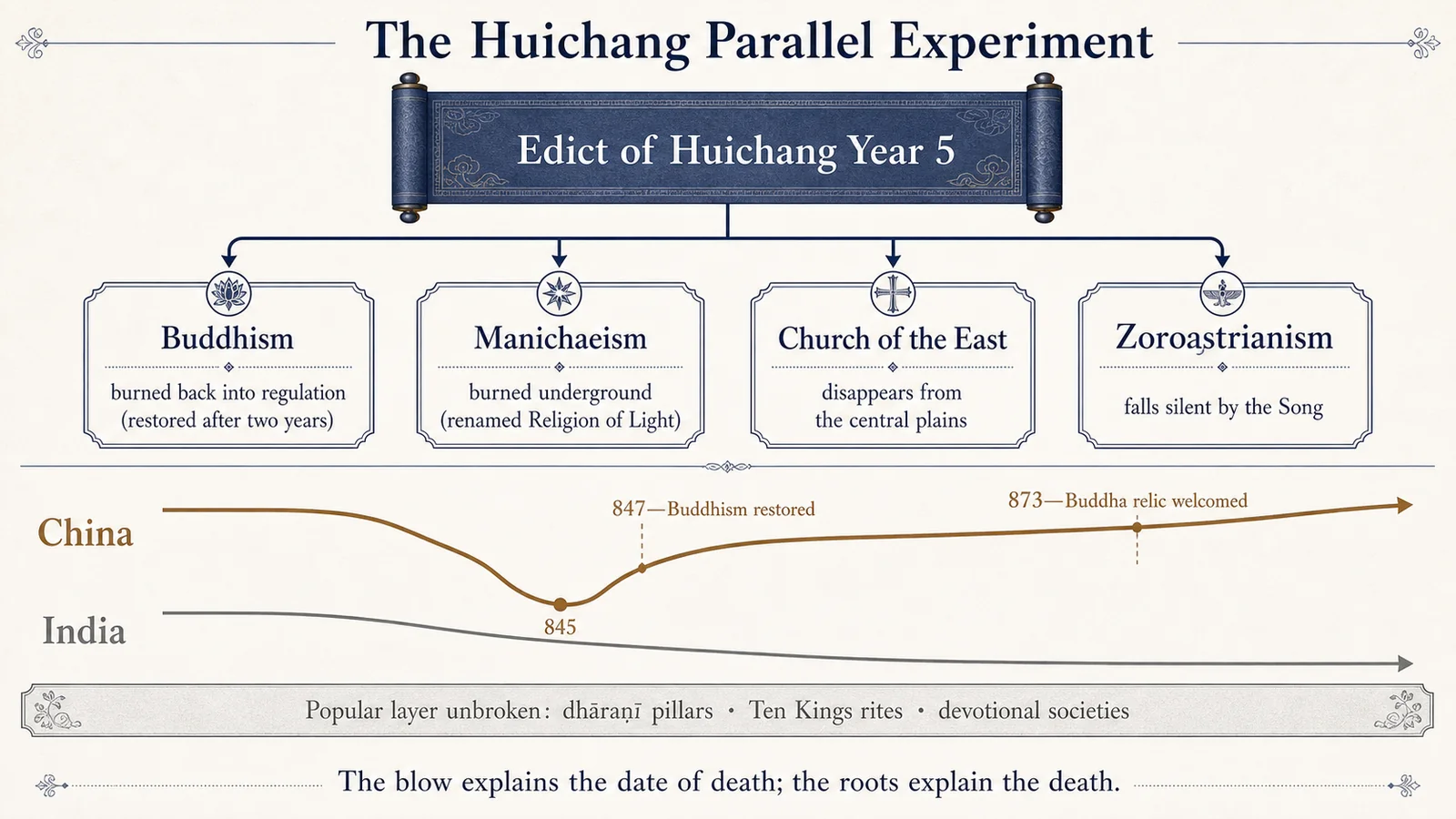
Now the test's most important reading: speed of recovery. Wuzong died in the third month of 846. In the first Dazhong year, Emperor Xuanzong decreed that monks capable of restoring temples abolished under Huichang could take charge of them. Less than two years had passed.5 A little more than twenty years later, in 873, Emperor Yizong welcomed the Buddha's relic with ceremony surpassing the Yuanhe precedent. The scene against which Han Yu had once risked his life to remonstrate returned at twice the scale, and the emperor said only, “If I see it while alive, I may die without regret.”6 Fewer than thirty years separated an institutional reset to zero from the emperor's obeisance. India's file in Part VIII contains no such curve; there it runs only downward. Huichang thus adds a negative annotation to the proposition that death is a process and an event merely signs the receipt. The receipt was issued, and business reopened at the same address two years later. No one tore up the receipt in India.
But “recovery” must be separated by inventory. What returned were monasteries, images, clerical quotas, ordination platforms, and ritual assemblies—everything with a line in the register. What did not return were the lecture seats of doctrinal schools, and they never returned institutionally. Clergy could return while scholastic lineages could not, for four reasons. First, media were asymmetric. When the court restored Buddhism, it rebuilt monasteries, ordained monks, and copied the canon, but the lifeline of doctrinal learning lay outside the canon. Commentaries were not included, existed in few copies, and gathered in the libraries of state monasteries in the two capitals. One fire destroyed the sole copies. A clerical register is a household list and can be restarted by edict; an uncatalogued unique commentary cannot be rewritten by decree. Yiji of Tiantai was later introduced by the national preceptor Deshao to Qian Chu and petitioned that Zhiyi's teaching had been destroyed in the An Lushan wars and Huichang fires, leaving only scraps in China and complete texts abroad. Wuyue therefore sent a mission to Goryeo, the case established in Part X, Chapter 2.7 Second, the human chain lost a generation. Training a lecturer took twenty or thirty years, while the two capitals suffered two strikes within thirty-five years. Huichang scattered teachers into ordinary society before their strength returned; Huang Chao entered Chang'an in 880, and the lecture seats of state monasteries burned with the capitals. Tang then fell and the north experienced sixty years of warfare. Scholastic geography was a single point concentrated in the two capitals, and both blows struck it. Third, the buyer vanished. After restoration, the court wanted blessings, ordination platforms, and assemblies, not doctrinal argument. The translation bureau had already stopped after Emperor Xianzong. Emperor Taizong of Song reopened an Institute for the Translation of Scriptures, but its products were mostly esoteric texts, entered into the canon without lectures. The ritual of translation was restored, not the profession of teaching.8 Fourth, remnants survived under regional shelter. Traces of Chan and Tiantai wintered in Wuyue, whose three Qian rulers supported masters as national preceptors and received scriptures back from east of the sea. The lifeline of doctrinal learning would break and reconnect once again. Yogācāra commentaries remained lost in China until Yang Wenhui recovered them from Japan a thousand years later in a second return.9 Combine the four lines: the state could restore what it had registered but not what it had never recorded. The fire resistance of two transmissions thus separated. A Chan lineage needed two people and a sentence. A scholastic lineage needed, in addition, a library, a lecture seat, and thirty years of peace. After Huichang, two people were easy to find; the last three never coincided again.
At the other end, who suffered least? Chan lived in mountains, tilled its own food, held property outside state monasteries, and received no imperial grants. The state's hand could neither reach nor reclaim it. Pure Land lived in household halls; one name occupied no state post, required no certificate, and appeared on no demolition list. The two structures established in Part X, Chapters 2 and 3 (a three-level dependency and disaster-ready design) announced their results in one Huichang night. High-dependency systems were badly injured; low-dependency systems escaped. The chapter therefore accepts only half of “selection.” Huichang did not choose the winners. Their dependency structures had placed them before Huichang, and the fire merely published the ranking. Tang Yongtong summarized the post-Huichang decline of doctrinal schools and flourishing of Chan and Pure Land. This volume accepts the conclusion and moves causation one step earlier. Fire did not select Chan and Pure Land; their designs had already accounted for fire.10
The restoration inventory omitted another layer, reasonably so. The popular layer did not need restoration because it never stopped. Three excavated kinds of evidence testify. First, dhāraṇī pillars. The Uṣṇīṣavijayā Dhāraṇī Sūtra promises that if dust from the pillar touches a body or its shadow falls across someone, grave karma leading to evil destinations will not be experienced. Erecting a pillar for a dead parent therefore became a common merit. Nearly 150 Tang stone inscriptions of the text survive. Construction did not decline from Wenzong through Yizong but increased, crossing Huichang uninterrupted. The Five Dynasties continued; Qian Liu, king of Wuyue, erected three in a single year.11 One stone column was an apparatus for saving the dead that required no resident Saṅgha. Huichang could dismantle monasteries but not roadside stone. Second, the Ten Kings. In the late Tang, the monk Zangchuan of Dashengci Monastery in Chengdu composed the Sūtra Spoken by the Buddha on the Ten Kings. It joined Buddhism's seven seven-day periods in the intermediate state to Confucian mourning at one hundred days, one year, and three years, forming ten vegetarian observances. The underworld became ten halls; each had a king, and each king had judges, documents, and case files. Kṣitigarbha ruled above them, the dead passed from court to court, and families presented offerings at each observance. From the Five Dynasties and Song onward, the text spread north and south and became a basis of Chinese funerary ritual.12 The conjecture of Part X, Chapter 1 receives another piece of indigenous Chinese evidence without becoming a new conjecture. The Indian afterlife operated automatically through karma; the Chinese afterlife grew government offices, files, and court procedures. Souls from a bureaucratic empire crossed a bureaucratic underworld. Third, lay associations. Dunhuang manuscripts preserve hundreds of bylaws and notices from popular associations. Their core work was assisting funerals and making mutual condolence gifts, alongside lamp-lighting, cave construction, vegetarian feasts, and scripture copying. Defaults incurred penalties, and membership crossed the line between clerical and lay.13 This layer needed no ordination certificate, appeared in no clerical register, and lay outside the demolition inventory. No matter how precise a register, it cannot reach what stands outside it. Part X, Chapter 4 said Pure Land treated illiteracy and lack of time as design assumptions. The popular layer went further and made absence of a Saṅgha an operable condition. Chan and Pure Land later drove roots into precisely this soil: household liturgy, Ten Kings funerals, and the death niche examined in Chapter 3 all began their foundations here.
Huichang also supplied a parallel experiment cleaner than India's controls. The same prohibition did not target Buddhism alone. The Church of the East, Zoroastrianism, and Manichaeism were all prohibited, and their priests ordered to return to lay life. The outcomes differed. The Church of the East never recovered in central China; Zoroastrianism disappeared after Song; Manichaeism went underground, changed names, and became the Religion of Light, thereafter an enemy of the court.14 Same year, same empire, four defendants, three outcomes. Buddhism burned back into the establishment; Manichaeism burned into the underground; the Church of the East and Zoroastrianism burned away. The difference lay not in doctrinal rank but in where each had put roots before Huichang. The life of the three foreign religions depended on official permission and foreign-merchant communities. Zoroastrian shrines admitted no outsiders, while patrons of Christian monasteries rose and fell with the trade routes. Neither held a place beside Chinese graves, in household liturgy, or in lay associations. The Church of the East control from Part IX, Chapter 1 now closes. Both borrowed shells to enter; Buddhism acquired Chinese household registration while Christianity remained in a merchants' lodge. The household inspection of 845 emptied the lodge in one night. Attack explains the date of death; roots explain the death. The cleanest verification of that judgment lies not in India but in Huichang's own edict.
After Huichang, only half of a comparable event occurred. In 955, Emperor Shizong of Later Zhou abolished more than thirty thousand monasteries lacking official authorization and collected copper images for coinage. He neither burned scriptures nor killed monks and even gave destruction of images a respectable explanation: “The Buddha transforms people through the good. If one directs oneself toward the good, one honors the Buddha. Can those copper images be what is called Buddha?”15 The Buddha lay in goodness rather than copper, and therefore the copper could return to the throne. This was no longer a suppression of Buddhism but an asset liquidation of a standing institution. Even this half-event could not escape regional division. Wuyue did not obey. Under Qian Hongchu, not one Hangzhou temple or pagoda moved. The Huichang edict could not cross the Yellow River; the Xiande edict could not cross the Qiantang. Regional gaps saved Buddhism for a second time.7 For the next thousand years, China experienced no nationwide suppression of the Dharma. Why did the sequence stop with “three Wus and one Zong”? Under the rules, what follows is explicitly this volume's conjecture: both sides had finished their lessons. The state learned that dismantling monasteries yielded once while regulating them yielded every year. With ordination certificates and clerical quotas in hand, why light the fire again? Buddhism learned not to grow so fat that it became a fiscal problem; the scale of monastic estates and the clergy thereafter stayed consciously within lines drawn by the state. Huichang and Xiande together set a price. Buddhism's permanent residence in China became a long-term contract, whose cost was economic self-restraint and complete administrative submission. Two pieces of evidence in the next chapter support the conjecture: prices for ordination certificates and tax rules for monastic land.
Finally archive the experiment. The reading for the Chinese group in Part VIII, Chapter 3 is this: the intensity of attack was no lower than any Indian assault and its administrative precision was greater. Death did not occur because something lay beneath the point of impact. Indian Buddhism was one basket of eggs; when the estates broke, all broke. Before Huichang, the Chinese eggs had already been divided: one share in the mountains through agricultural Chan, one in household halls through liturgy, and one beside graves through funerary rites. Song would add another on paper through woodblock printing, the next chapter's subject. Huichang seized Buddhism's real estate but not its habits. The state understood this as well. Restoration was not remorse but recognition: better to rebuild temples and return the habits of 260,000 people to registrable places than leave them scattered among ordinary households. Attack explains the date of death; roots explain the death. The judgment now bears signatures from two continents. The next chapter asks how those roots were replanted in an age of peace: new paper and new patrons.
References
References
-
For the pretext of weapons and hidden stores at a Chang'an monastery under Northern Wei Emperor Taiwu, see the “Treatise on Buddhism and Daoism” in the Book of Wei. For memorials by Wei Yuansong, Zhang Bin, and their line before Northern Zhou Emperor Wu abolished both teachings (seeking troops among the clergy and land beneath monasteries, summarizing their intent), see texts collected in the Guang hongming ji and the annals of Emperor Wu in the Book of Zhou. The figure of “three million” laicized comes from retrospective Buddhist apologetic literature and is read here at half weight. See also the relevant chapters of Volume I. ↩
-
The language of the edict and figures reported in the eighth month of 845 for monasteries dismantled, clergy laicized, land recovered, and slaves confiscated appear in the Huichang fifth-year entry in the annals of Emperor Wuzong, fascicle 18a of the Old Book of Tang. ↩↩
-
The empire had about 14.3 million qing of assessed land in the Tianbao era; see fascicle 2, “Food and Goods II,” of the Comprehensive Institutions. Since the “tens of millions of qing” in monastic fields exceeds the country's arable land, scholars suspect that qing is a scribal error for mu or that the report was exaggerated. See Tang Yongtong, Draft History of Buddhism under Sui and Tang (Beijing: Zhonghua, 1982), section on Huichang. ↩
-
See fascicle 4 of Ennin's Record of a Pilgrimage to China in Search of the Law, entries from the third through fifth Huichang years, for inspection of certificates, laicization in age groups, repatriation of foreign monks, and the refusal of circuits north of the Yellow River (Chengde, Youzhou, Weibo, and Zhaoyi) to carry out demolition. ↩↩
-
The intercalary third-month edict in the first Dazhong year allowed monks able to restore monasteries abolished under Huichang to take charge of them. See fascicle 48 of the Institutional History of Tang; summarized here. ↩
-
For Han Yu's remonstrance, see his Memorial on the Buddha's Relic. For the reception of the relic in 873 and Emperor Yizong's statement that “if I see it while alive, I may die without regret,” see fascicle 252 of the Comprehensive Mirror for Aid in Government. ↩
-
On the support of Buddhism by the three Qian rulers of Wuyue, Deshao's and Yanshou's treatment as national preceptors, Yiji's petition and the mission to Goryeo for teaching texts, and Wuyue's refusal to obey the Xiande suppression, see biographies in the Chronicle of the Buddhas and Patriarchs and Huang Yixun, “The Kings of Wuyue (893–978) and Buddhism,” Chung-Hwa Buddhist Journal 17 (2004). ↩↩
-
Emperor Taizong established the Institute for the Translation of Scriptures in 982, later renamed the Institute for the Transmission of the Dharma. Most of its translations were esoteric and had little effect on the study of doctrine, a standard conclusion in scholarship. See the relevant lectures in Lü Cheng, A Brief Account of the Sources and Development of Chinese Buddhism. ↩
-
During the Guangxu era, Yang Wenhui asked Nanjō Bun'yū in Japan to locate long-lost Yogācāra, Huayan, and other commentaries, then printed them successively at the Jinling Scriptural Press. See correspondence in Yang Renshan's collected works; summarized here. ↩
-
Tang Yongtong's Draft History of Buddhism under Sui and Tang describes the broad post-Huichang decline of doctrinal learning and unique flourishing of Chan and Pure Land. Stanley Weinstein, Buddhism under the T'ang (Cambridge: Cambridge University Press, 1987), offers a broadly similar judgment. This chapter accepts the conclusion while rearranging its causation. ↩
-
The promise that dust touching and shadow covering a person erase grave offenses appears in the Uṣṇīṣavijayā Dhāraṇī Sūtra. For a collection and periodization of nearly 150 Tang stone inscriptions, see Lin Yunrou, “The Translation, Transmission, and Worship of the Uṣṇīṣavijayā Dhāraṇī Sūtra under Tang,” Dharma Drum Journal of Buddhist Studies 3 (2008). On pillars as devices for erasing guilt and saving the dead, see Liu Shufen, Erasing Guilt and Saving the Dead: A Study of Uṣṇīṣavijayā Dhāraṇī Pillars (Shanghai: Shanghai Ancient Books, 2008). For Qian Liu's pillars, see Huang Yixun cited above. ↩
-
Dunhuang illustrated manuscripts of the Sūtra Spoken by the Buddha on the Ten Kings identify it as “composed by the monk Zangchuan of Dashengci Monastery, Chengdu.” On its late-Tang composition, circulation from the Five Dynasties and Song onward, combination of Confucian and Buddhist mourning periods into ten observances, and Kṣitigarbha's rule over the ten halls, see Zhang Zong's studies of the Sūtra of Yama's Prophecy and Stephen F. Teiser, The Scripture on the Ten Kings and the Making of Purgatory in Medieval Chinese Buddhism (Honolulu: University of Hawai'i Press, 1994). ↩
-
On Dunhuang documents recording funeral assistance, condolence gifts, lamp-lighting, cave construction, and vegetarian assemblies by lay associations, see Ning Ke and Hao Chunwen, eds., Critical Collection of Dunhuang Documents on Lay Associations (Nanjing: Jiangsu Ancient Books, 1997), and Hao Chunwen, A Study of Lay Associations in the Medieval Period. ↩
-
For the Huichang prohibition of the Church of the East, Zoroastrianism, and Manichaeism and the laicization of their priests, see the annals of Emperor Wuzong in fascicle 18a of the Old Book of Tang and fascicle 47 of the Institutional History of Tang. For their subsequent fates (the disappearance of Christianity in central China, Zoroastrianism after Song, and Manichaeism's popular survival as the Religion of Light), see Lin Wushu, New Studies of the Church of the East under Tang, Manichaeism and Its Eastward Transmission, and “The Disappearance of the Three Foreign Religions in Medieval China and Paths of Sinicization,” Journal of East China Normal University (Philosophy and Social Sciences) 1 (2019). ↩
-
Shizong's statement appears in the fifth-month entry for 955 in fascicle 292 of the Comprehensive Mirror for Aid in Government. The figures of more than thirty thousand temples abolished and over 2,600 preserved appear in his annals, fascicle 115 of the Old History of the Five Dynasties. ↩