Chapter 3: The Convergence of Chan and Pure Land—The Survivors' Form
Part X described Chan and Pure Land as twins: two solutions to the same privatization of criteria, one hiding inspection in a dark room and the other moving it to the moment of death. The preceding chapters established the setting. Huichang eliminated high-dependency forms, and Neo-Confucianism displaced Buddhism from the upstairs floor. The twins were the last ones standing. The largest internal development in Chinese Buddhism over the following millennium was their gradual approach and eventual merger. This chapter asks how the merger occurred, what sustained it, and what it housed.
Textual history usually points to Yongming Yanshou as the beginning. A Fayan master in Five Dynasties Wuyue, he wrote the Collection on the Common End of Myriad Good Deeds, maintained that no good practice should be abandoned, and said Chan practitioners need not oppose Buddha-recitation.1 Yet the most widely circulated document is the “four selections”: “With Chan and Pure Land, one is like a tiger with horns.” Four lines ranked the four possible combinations, with Buddha-recitation never losing. The file must undergo the archival test used in Part X, Chapter 3. The four selections do not appear in Yanshou's extant works. Their earliest citations occur in Yuan Pure Land literature, more than three centuries after his death.2 The rule that later archives grow more detailed holds again after Bodhidharma. Read this together with Part X, Chapter 4 and it grows more revealing. Yanshou himself was added by Zhipan to the Pure Land patriarchal succession, a retrospective member of the hall of fame. The hall of fame not only admits people but can supply documents for its new members. The four selections need not have been written by Yanshou; the Pure Land tradition needed an eminent Chan master to sign a declaration of merger, and three centuries later such a declaration appeared in the file. Record the case as follows: late verse, no attestation. This volume conjectures that the motive for attribution was the need for a founding document after convergence had already occurred. Merger preceded manifesto; the manifesto backfilled the date.
Texts can be falsely attributed; daily schedules cannot. The real merger lay not in recorded sayings but in liturgy. Morning and evening recitation became fixed in Ming-Qing monasteries. Morning liturgy opened with the Śūraṅgama Mantra; evening liturgy centered on the Amitābha Sūtra and Buddha-recitation. Whether a monastery belonged to Chan or doctrinal schools, clergy across the country recited the same service. The ancestral form of the received liturgy came from revisions made by the late-Ming Yunqi line.3 The opening mantra of the morning contains another irony. Part IX, Chapter 2 recorded the customs file of the Śūraṅgama. A contraband item that cleared customs became the first sound of every monastery's day. Chan halls held seven-day retreats; beside the Chan retreat stood the Buddha-recitation retreat. In halls where monks investigated a critical phrase, “Who is reciting the Buddha?” became a standard phrase. The last item deserves another look. Turning the Buddha's name into a critical phrase is the interface between two systems of criteria. Chan recorded it as incorporation: Buddha-recitation became a tool for arousing doubt. Pure Land recorded incorporation too: investigation deepened Buddha-recitation. Each scoreboard counted its own victory, the device Part V observed in India, now repeated as a cooperative. This time both were right because the customers were the same people and the service the same liturgy. The people converged as well. Yunqi Zhuhong, an eminent Chan master, commented on the Amitābha Sūtra and explained “holding the name” as investigative Buddha-recitation; one mind at the level of principle was the Chan school's illumination of mind. Zhixu wrote the Essential Explanation, and Yinguang's later list invited him into the patriarchal succession. None of the four great late-Ming masters was purely Chan and none rejected Pure Land.4 School boundaries remained only as genealogy names on transmission documents. The title deeds stayed locked in separate trunks; the storefronts had long merged.
Why merge? The direct answer lies in the preceding two chapters. After Huichang, Buddhism's base was a household Buddhism and a literati Buddhism. The two customer groups wanted largely overlapping products: a daily liturgy, a destination at death, and some theory of mind and nature suitable for literati conversation. Chan alone set too high a threshold and promised nothing about the next life. Pure Land alone supplied too little intellectual conversation for literati. The combined line finally completed the product range: Chan governed meaning in this life, Pure Land the destination after death, and liturgy the rhythm of every day. The foundation supporting the line was an ecological niche no one could take: death. China had no Brahmins, while Confucianism expressly refused to operate the afterlife. Mourning and sacrifice expressed grief and reverence; destination remained undiscussed. Families of every stratum therefore ordered postmortem dedication, Ullambana, Water-and-Land rites, seven seven-day memorials, and salvation rites from Buddhist clergy. The early Ming even wrote the division of labor into its clerical system. The Hongwu court divided all monks into three categories—Chan, doctrinal lecturers, and Yogācāra ritual specialists. The ritual specialists used state-issued liturgical manuals and served popular ceremonies; death services became a state-certified exclusive business.5 Part VIII counted zero positions for Indian Buddhism in the lay life cycle; another religion's priest stood at every station of birth, aging, illness, and death. Chinese Buddhism drove its deepest root precisely into the station of death. Repentance rituals and incense supported lecture halls and Chan halls: what sold supported what won. Huichang could burn a monastery but not the habit of inviting monks to a funeral; Neo-Confucianism could take metaphysical conversation but not a dead person's destination. That ecological niche was Buddhism's real property in China.
The merger housed the elephant in the room from Part VII, Chapter 3. After returning from India, Huiri had challenged Chan on behalf of Pure Land: everyone says mind itself is Buddha, but who has actually attained liberation? Transfer the question to China and the structure is unchanged. Chan authorization occurred in a dark room and Pure Land rebirth at death; nowhere in public view did liberation admit immediate inspection. Early Qing Drum Mountain in Fuzhou left a document that exposed the structure without concealment. The Record of the Responsive Passing into Reality of an Ācārya of Our Lineage at Drum Mountain, traditionally attributed to Weilin Daopei and dated 1682, describes the death of Master Mai at the monastery. After illness confined him to bed, elders visited daily to teach. Prajñāpāramitā explained empty quiescence and Pure Land the destination. One sentence disclosed the position: “So long as beings throughout the earth have not realized the unconditioned, they remain within the conditioned and all require a place of rebirth; only the Western Pure Land is the destination.”6 That no one present had realized the unconditioned was common sense beside the sickbed, not polemic. Master Mai's answer disclosed the same: “What have I studied throughout my life? How could I fail to believe it?” Lifelong learning was redeemed at death as faith, not realization. Every remaining station followed. He requested the community's evening liturgy to assist his rebirth, placed an image of the three sages before the bed, gazed upon it and fixed his recollection, died peacefully, and on the day of cremation three people together saw the three sages within the kiln. Read the responsive portion at half weight as a victory narrative. Every step of the procedure is credible, because it was written as a template for others to copy. Part X, Chapter 4 called biographies of rebirth the genre corresponding to verification moved to death. This record supplies the operating scene behind the genre, a complete line from instruction through assisted recitation to eyewitness testimony. It pairs with Huiri's file. In eighth-century India, when he asked what practice swiftly reveals the Buddha, the answer was Pure Land. A thousand years later in an early-Qing Chan hall, every operation surrounding death still belonged to Pure Land. The elephant stands in the same posture across a millennium and ten thousand miles. After seven hundred years, Chan formally answered Huiri: it had not found a method that redeemed liberation on the spot; it outsourced redemption to the Pure Land. The elephant was not expelled but housed.
Under the rules, what follows is explicitly this volume's conjecture. Convergence was not synthesis but division of labor. At the doctrinal level Chan and Pure Land never truly reconciled. Disputes between self-power and other-power, mind-only Pure Land and a western Pure Land continued throughout Ming and Qing; Volume II judged the soteriological tension.7 In practice the fit was exact, because they contracted for two needs in the same monastery. Chan settled elite self-respect and Pure Land popular fear. Those of superior capacity investigated “Who is reciting the Buddha?”; those of middle and lower capacity held the name and sought rebirth. One monastery contained two systems, each serving its need. At the institutional level the division twisted Volume II's two principal lines (self-power's self-verification and other-power's guarantee) into one strand. A monk worked at self-power in the Chan hall by day and dedicated the evening liturgy's merit westward. He crossed the distance between two volumes in one day without sensing contradiction because doctrinal classification had taught everyone to rank high and low without dividing true and false, as Part X, Chapter 1 showed.
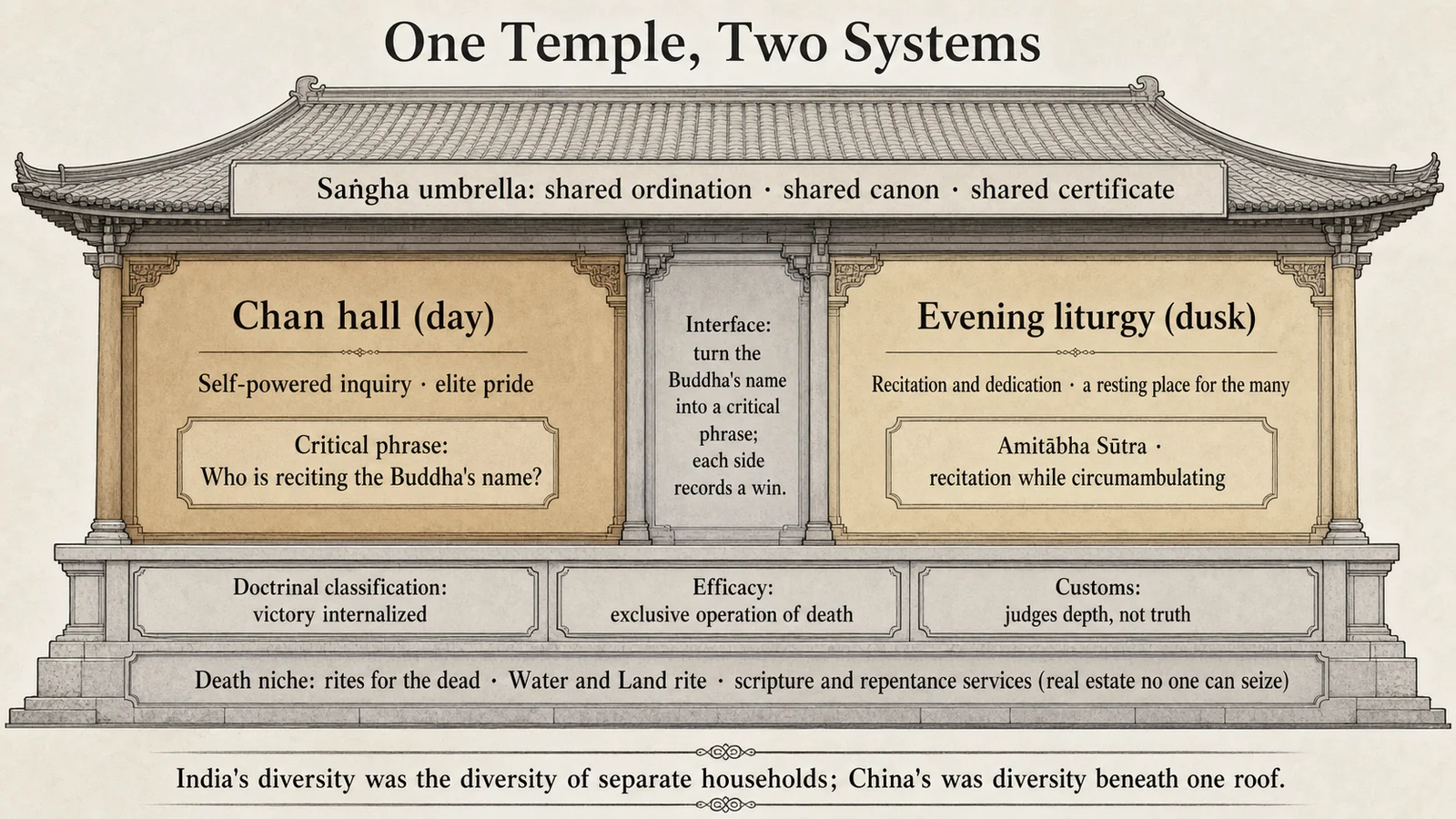
Finally close Part XI. Part V established three scoreboards in India: victory in debate, survival of the medium, and success in the market. The scores never went to the same party. The winner, the survivor, and the bestseller were different; Buddhism as a whole lost and left the arena. China issued all three scoreboards to one license holder for the first time. Doctrinal classification internalized victory; losers were demoted but did not exit, as Part X, Chapter 1 showed. One Saṅgha umbrella gathered all schools under the same ordination lineage, canon, and certificate. When Huichang burned, self-supporting and marketable Chan and Pure Land carried the whole tradition across the fire and returned to replant it, as Chapter 1 showed. No one competed for the death niche; the reputation for efficacy became an exclusive operation. The scriptural customs gate placed judgments of true and false in the translation bureau and catalogues, leaving indigenous disputes to argue only depth, never authenticity, as Part IX, Chapter 2 showed. Together the four elements formed the surviving form of Chinese Buddhism: low dependency, low threshold, monopoly over death, doctrinal classification at the apex, customs locking the gate, and private verification. It withstood Huichang, the Five Dynasties, and every change of dynasty because it required only that someone farm, someone die, and someone recite the Buddha's name. India's diversity belonged to separate houses, each taking a shard when the pot broke. China's diversity lived under one roof; however fiercely people argued, evening liturgy remained the same. Record the cost openly. This form moved Buddhism's original promise of presently verifiable liberation as a whole to death and beyond. Volume II's judgment remains unchanged. This volume adds only that the move saved Buddhism's life in China. Moving verification away is one way to live. Making verification into a public office is another. Plateau Buddhism cast the point of redemption into a position; when the holder died, the position remained. The next part examines Tibet's synthesis.
References
References
-
Yanshou, Collection on the Common End of Myriad Good Deeds (T48 no. 2017). For reassessment of Yanshou's thought and later image, see Albert Welter, The Meaning of Myriad Good Deeds: A Study of Yung-ming Yen-shou and the Wan-shan t'ung-kuei chi (New York: Peter Lang, 1993). ↩
-
The four selections do not appear in Yanshou's extant Record of the Source-Mirror, Collection on the Common End of Myriad Good Deeds, or other works. Their earliest citations occur in Yuan Pure Land literature, in the line of the Precious Mirror of the Lotus School on Mount Lu and Tianru Weize's Questions about Pure Land. Doubt about attribution is widespread in scholarship; see Welter cited above. ↩
-
Common Ming-Qing morning and evening liturgy centered the evening service on the Amitābha Sūtra, repentance text, and Buddha-recitation and was later collected in editions of the Daily Recitations of the Chan Gate. Its ancestral form descends from Yunqi Zhuhong's revised Collected Essentials for Daily Recitation from the Scriptures; summarized here. ↩
-
Zhuhong's commentary and subcommentary on the Amitābha Sūtra joined the Chan school through “investigative Buddha-recitation.” See also Zhixu's Essential Explanation of the Amitābha Sūtra. For the mixed practice of the four great late-Ming masters, see Volume I, Part X, Chapter 9. ↩
-
The Hongwu court's categories of Chan, doctrinal, and Yogācāra ritual clergy, with ritual monks holding state-prescribed manuals and specializing in popular services, appear in early-Ming proclamations clarifying Buddhist administration and the clerical provisions of the Collected Statutes of the Great Ming; summarized here. ↩
-
Record of the Responsive Passing into Reality of an Ācārya of Our Lineage at Drum Mountain, fascicle 2 of Weilin Daopei's Drafts from the Traveling Hermitage (X72 no. 1442, pp. 692b–693a). The recorder is Weilin Daopei and “my former master” refers to Yongjue Yuanxian. The passage has been checked against the text; quotations are translated from the original. ↩
-
For the doctrinal tension between self-power and other-power and their practical convergence, see Volume II, Part VI on Pure Land and Part VII's synthesis. ↩