Chapter 1: A Slow Death—The Loss of the Lay Base
The death of Indian Buddhism has a widely repeated date: around 1193, in the flames at Nālandā. A date creates the illusion that death was an event. This part begins with a forensic rule: death is a process; the event merely signs the receipt. Volume I, Part VIII, Chapter 6 already supplied the timeline of decline, a list of internal and external causes, and an integrated judgment. This part does not rearrange those facts. It uses the mechanisms accumulated in this volume to retell them: what died first, what died afterward, and what had in fact been dead for some time.1
Begin with the timeline, because it immediately rules out a single killer. Buddhism in southern India went out first, between the seventh and ninth centuries, with no relation to Islam. Xuanzang in the early seventh century already found monasteries abandoned in the south. By the eighth and ninth centuries the southern religious landscape belonged to Śiva and Viṣṇu, and Buddhism had no foothold. The actual weapon was competition: the devotional wave and the temple network, those two rivals that Part V, Chapter 3 recorded as refusing to enter the debate arena. The northwest began shrinking in the seventh century under the combined effects of Hephthalite destruction and the diversion of trade routes, cited in Part V, Chapter 2. Eastern India survived on transfusions from the Pāla dynasty until the end and therefore received the most direct final blow. Death arrived by region several centuries apart. A single murder is not carried out over three centuries in three stages with three weapons.
What was lost during those centuries? The lay foundation. Its disappearance can be checked point by point across the human life cycle. After the Gupta period, caste order closed its teeth again. Dharmaśāstra assigned birth, naming, coming of age, marriage, and funerals to Brahman officiants, the mirrored procedure described in Part V, Chapter 2. Land grants planted those officiants institutionally in every village. The devotional movement attacked from the other side. People who could not read could sing; people who did not renounce could love; the god stood in a temple at the village entrance. The threshold lay flat on the ground, while emotion burned hot. What corresponding product could Buddhism offer under this two-sided pressure? The monastery was far away, scholarship was in Sanskrit, empowerment required a queue, and no one could ask about attainment. Part V, Chapter 2 counted Buddhism's lack of an indispensable daily function in the village. This chapter takes that sentence to its conclusion: across every transition in an Indian life from birth to cremation, Buddhism staffed no position. It was not expelled from Indian life; it had never occupied it institutionally.2
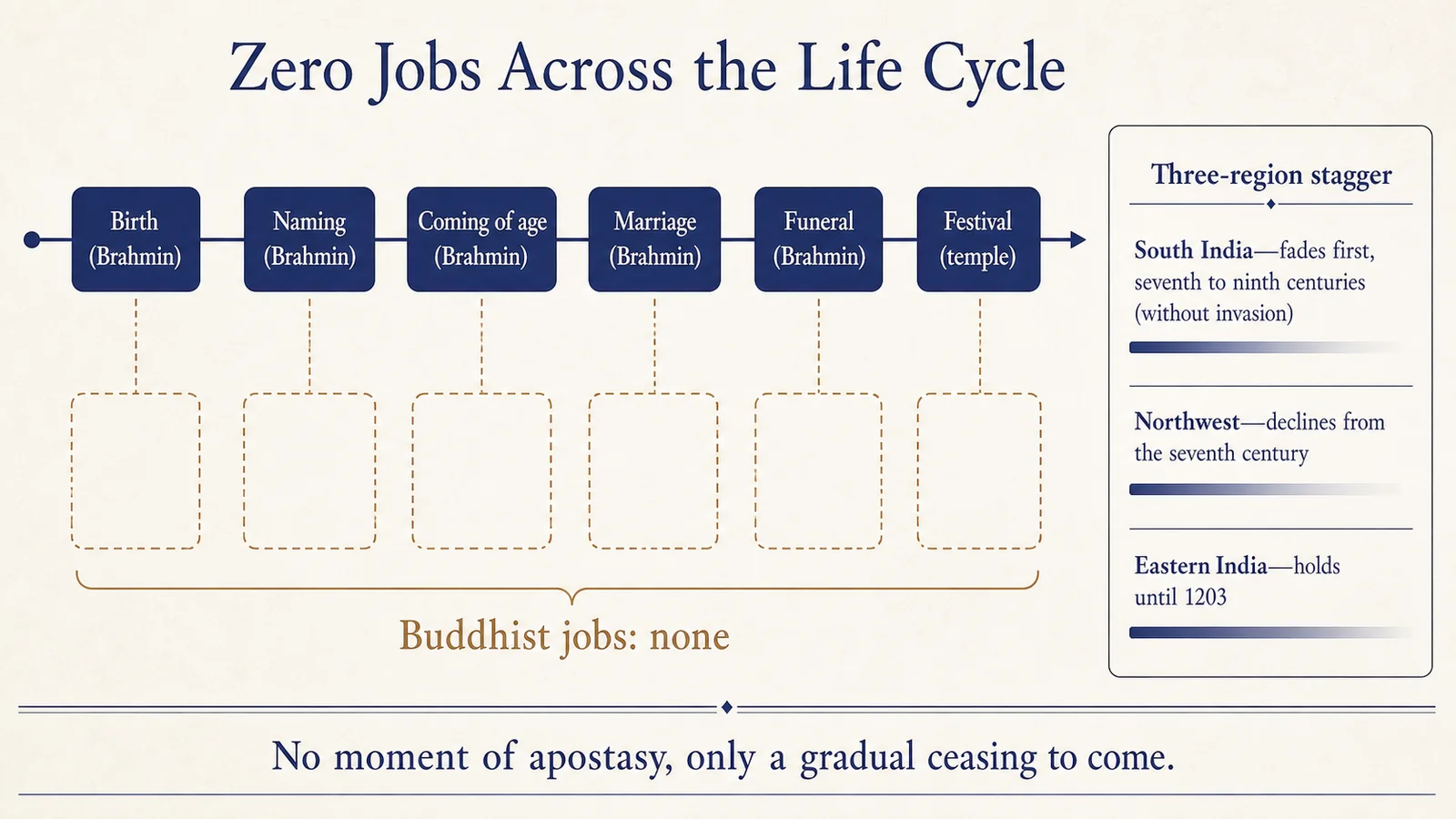
The manner of loss was more fatal than the loss itself: there was no farewell. Part V, Chapter 2 established that “laypeople had no membrane.” A Buddhist lay follower did not possess a hereditary identity or a separate body of identity law. In the centuries of blurred boundaries described in Part VII, Chapter 2, this structural weakness became a mechanism of dissolution. Volume I, Part VIII, observed that Mahākāla could be worshiped in both traditions. An ordinary worshiper could “turn from” Buddhism to Hinduism without sensing a fundamental change. The register of incarnations completed the last operation: the Buddha himself was Viṣṇu's ninth avatāra, so worshiping the Buddha was worshiping Viṣṇu. Conversion crossed no threshold.3 The great loss is therefore almost silent in the sources. There was no moment of apostasy, no rite of conversion, no countable defection—only fewer people coming. A religion without membership leaves no statistical trace when its members drift away.
The community's response looks less like resistance than cooperation. This volume has recorded each contraction along the way: the lecture platform turned toward the court in Part V, Chapter 2; support shifted from ten thousand households to one king in the same chapter; doctrine moved behind the gate of empowerment in Part VII, Chapter 1; and signs of attainment retreated into the space between master and disciple in Part VII, Chapter 3. Each step made sense at the time, and each cut away another piece of contact with ordinary people. In the end, what self-introduction could the community offer a villager? Its learning was unintelligible, the rival next door offered efficacy too, and no one could redeem its promise of liberation—the elephant in Part VII, Chapter 3. Retreat into the great monasteries was not a strategy but the final form of siphoning: the buildings drained the network of nourishment and then narrowed their doors.
Only one of the four questions deserves pause: who benefited? For the first time in this volume, no Buddhist name can be entered in the benefits column. Broken apart, every contraction had local beneficiaries: holders of teaching posts, estates, and ācārya licenses, all named in preceding parts. Taken together, the aggregate benefited no one. This is the darkest way the engine of the entire volume operates. Every exchange was rational at its own moment; all costs were booked to the long term, and the long term finally arrived.
Under the rules, what follows is explicitly this volume's conjecture. A religion dies when it loses the everyday. Once marriage, funerals, and domestic rites had all been returned to Brahmins, Buddhism had withdrawn from the Indian life cycle. All that remained was to wait for a gust of wind. The controls supply mirror-image corroboration. Every Buddhism that survived retained command of the everyday: the village monastery and merit economy in Sri Lanka, described in Part III, Chapter 3; feeding monks and rites for the dead in Myanmar and Thailand; funerary ritual and sutra repentance services in China, described in Part XI. Survival correlates far more strongly with a share of life-cycle rites than with doctrinal sophistication. If inscriptions or texts reveal that late Indian Buddhism still held a substantial share of life-cycle ritual (records of village marriages and funerals, or a resident network), this conjecture should be discounted.
The network was dead while the lights in the buildings still burned. The Pāla flagships were brightly lit, their libraries full and their debaters unobstructed. The next chapter examines those lights and the basket that held them.
References
References
-
For the regional timeline of decline (southern India declining first between the seventh and ninth centuries, the northwest suffering shocks from the seventh century, and Pāla eastern India serving as the last fortress), the structure and social disembedding of monasteries, blurred boundaries, comparisons with surviving regions, and the integrated judgment, see Volume I, Part VIII, Chapter 6. This chapter takes its factual layer and conclusion directly from there, restating them through this volume's mechanisms. ↩
-
On Dharmaśāstra's capture of life-cycle rites and the Brahmanization of villages through land grants, see Bronkhorst 2011 and Sharma 1987, cited in Part V, Chapter 2. On the low-threshold competition of devotional movements, see Hardy 1983, cited in Part V, Chapter 3. ↩
-
On blurred boundaries and imperceptible “turning,” see Volume I, Part VIII, Chapter 6, and Padmanabh S. Jaini, “The Disappearance of Buddhism and the Survival of Jainism: A Study in Contrast,” in Studies in History of Buddhism, ed. A. K. Narain (Delhi: B. R. Publishing, 1980). On the Buddha's entry into Viṣṇu's register of incarnations, fixed approximately between the eighth and twelfth centuries, see Part III, Chapter 2, and Volume I, Part VIII, Chapter 6. ↩