Chapter 2: All Eggs in One Basket—The Fragility of the Monastic Economy
Part V, Chapter 2 registered the conjecture of a single point of failure and promised the death report in this part. This chapter redeems half of that structure: money and buildings. The Pāla dynasty supplied the final transfusion. For four centuries, royal gifts and estates flowed continuously toward a great-monastery system headed by Nālandā, Vikramaśīla, and Odantapurī. Buddhism's form of existence in eastern India was five or six super-institutions plus their landed property.1 The preceding chapter finished the story of the network's death. This chapter examines the buildings, their balance sheet, and why a single push brought them down.
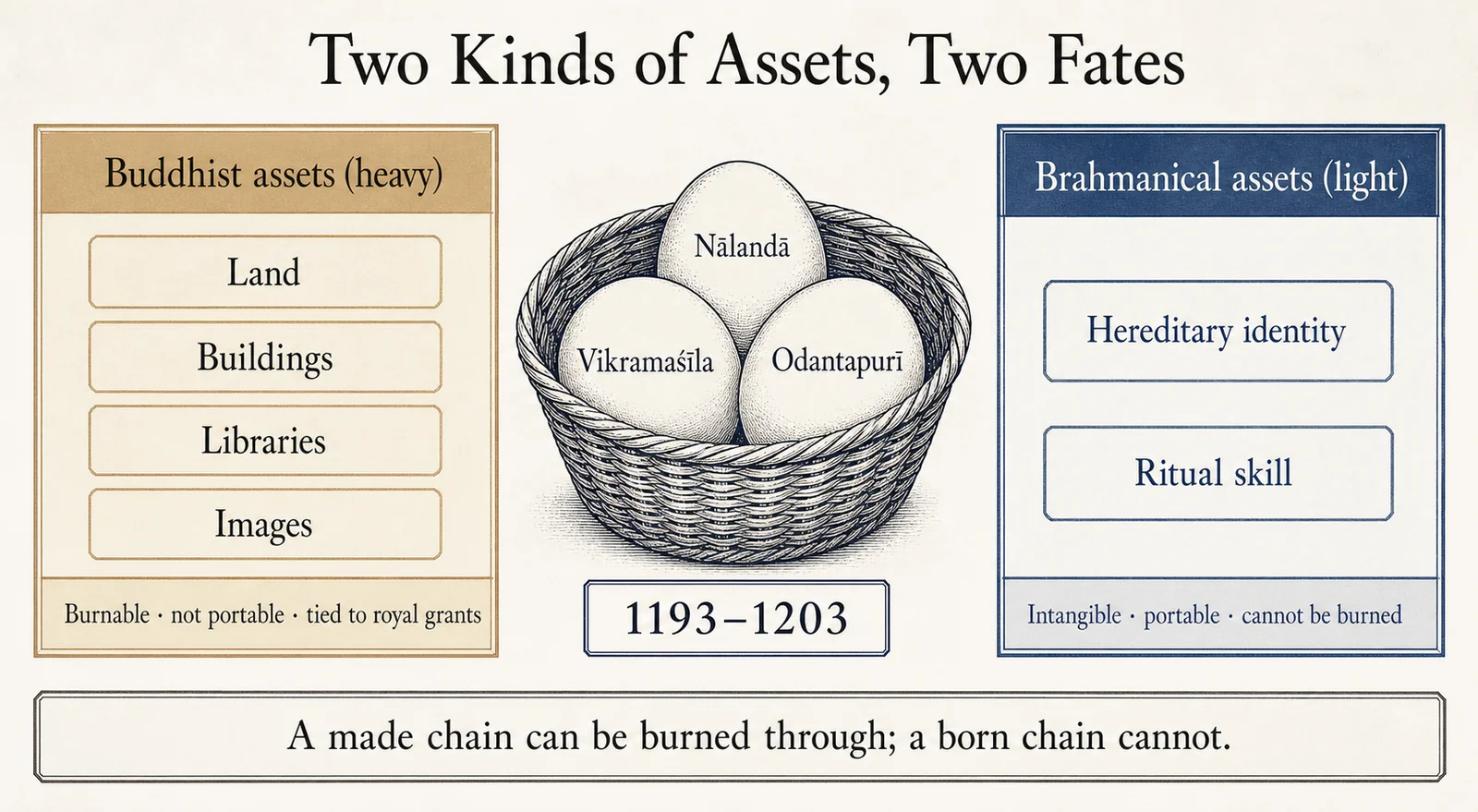
Begin with an economic examination. All three categories looked poor. Revenue was undiversified. Urban and guild patrons had declined several centuries earlier, as Sharma's work cited in Part V, Chapter 2 shows. What remained depended almost entirely on royal allocations and estate rents; the preference of one Pāla dynasty was the business cycle of an entire industry. The assets took the worst form. Farmland, buildings, books, and images were all heavy assets: immovable, confiscable, and burnable. Compare the Brahmins' core assets (hereditary identity and ritual skill), intangible, portable, and impossible to burn. On the liability side stood the institution's appetite. Ten thousand people had to eat, teaching posts had to be maintained, and ceremonies had to display splendor. Once patronage stopped, dispersal meant death. In one sentence: centuries of adaptation turned a religion founded on mendicancy into a heavy-asset industry.
When a heavy-asset industry met an exceptionally mobile opponent, the outcome had its mathematics. The death of a network requires its nodes to die one by one; one village monastery falls and the network remains. The death of a single point requires one strike. Around 1193, the cavalry of Bakhtiyar Khalji swept through Bihar and Bengal. Nālandā, Vikramaśīla, and Odantapurī were destroyed in succession within a few years, their monks killed or scattered and their libraries burned. For a tradition reduced to headquarters, this was everything. The fire did not burn away Buddhism's India; it burned away Buddhism's few remaining addresses in India.
The controls must sit on the same table because the same armies crossed the same land. Many Hindu temples were destroyed, many Brahmins died, and Jain holy places were not spared. Yet Hinduism regenerated in place, and Jainism survives today. The difference lay not in exposure but in asset structure, fulfilling the paired chains registered in Part V, Chapter 2. The Saṅgha's formal-act chain required a monastery, a quorum of monks, and unbroken transmission. The ordination lineage of Bihar and Bengal was physically broken in the early thirteenth century. With no monastery, no monks, and no ordination, the broken chain had no power to renew itself. A bloodline is born within households. A temple can fall and the priest's son remains a priest; the village remains, caste remains, and the rites resume the next day. Fire can break a manufactured chain but not a chain that is born.2
One more file must be registered faithfully: they saw the direction from which the fire would come. In late Kālacakra literature the enemy had a name and the end-time war had a script, as Part VII, Chapter 3 cited. Yet the response was narrative, not organizational. Writing defeat in advance as a cosmic calamity was the last use of the defensive layer from Part IV, Chapter 1, rewriting future disaster as fulfillment before it arrived. Everything was prophesied and nothing was prepared. There was no decentralization, no turn toward ordinary society, no step that moved eggs out of the basket. Seeing the storm and moving assets are different acts. Until the final moment, this system had the ability to write but not the ability to reorganize.3
Exile forms the epilogue and closes the first half of this volume. Survivors took two routes: over the mountains into Tibet or into the Kathmandu Valley. Tibet was the line that Volume I called a vault. In this volume's language, it was the final form of the export trade. Before the buildings burned, the export list of Part V, Chapter 2 made its last shipment and an entire scholastic tradition was packed and transported. The data had been backed up off-site before headquarters was destroyed. The backup saved texts and scholastic lineages, not Buddhism in India.4
Under the rules, what follows is explicitly this volume's conjecture. The flames at Vikramaśīla and Nālandā merely marked the moment of inventory. The foundation was already empty, and the invaders pushed over a shell. Draw the boundary clearly: this conjecture does not excuse violence. The destruction was a real atrocity and the direct cause of death; those killed were real people. It decides only the weight of causes. Under equal attack, a system with roots regenerated while one without roots vanished. The variable explaining selective death lies not in the attack but in the roots.
The direct cause is established and so is the fundamental cause. What remains is a formal document assigning weights and auditing several popular single-cause stories. The next chapter issues the death report.
References
References
-
For the Pāla patronage system, the great monasteries, and their destruction around 1193–1203, see Volume I, Part VIII, Chapters 5 and 6, and Dutt 1962 cited there. This chapter takes its factual layer directly from that account. ↩
-
The survival of Hinduism and Jainism through the same wave of conquest supplies the original judgment (“that itself is proof”) in Volume I, Part VIII, Chapter 6. The difference in asset structure between the Saṅgha's formal-act chain and the Brahmin's bloodline was registered in Part V, Chapter 2 of this volume and is redeemed here. ↩
-
On the Kālacakra Tantra's “mleccha” and end-time war narrative, see John Newman 1998, cited in Part VII, Chapter 3. On the mechanism of a “defensive layer,” see Part IV, Chapter 1. ↩
-
On Tibet as the “vault” for late Indian Buddhist learning, see Volume I, Part VIII, Chapters 5 and 6. Part XII of this volume examines the history of its synthesis. ↩