Chapter 3: The Death Report—Weighing Three Causes
The report follows forensic form: direct cause, intermediate cause, fundamental cause, and contributing causes. It then adds a category absent from ordinary forensics but unavoidable here: why there was no revival. The factual draft is the integrated judgment in Volume I, Part VIII, Chapter 6. It already ruled that the decline resulted from several causes accumulating over centuries and explicitly stated that “equating the final blow with the fundamental cause is an error of historical understanding and an error that has been exploited by political agendas.”1 This chapter performs two operations on that draft. It uses the mechanisms of the entire volume to turn “multiple causes accumulating” into a machine with a transmission system, then ranks the three causes by weight.
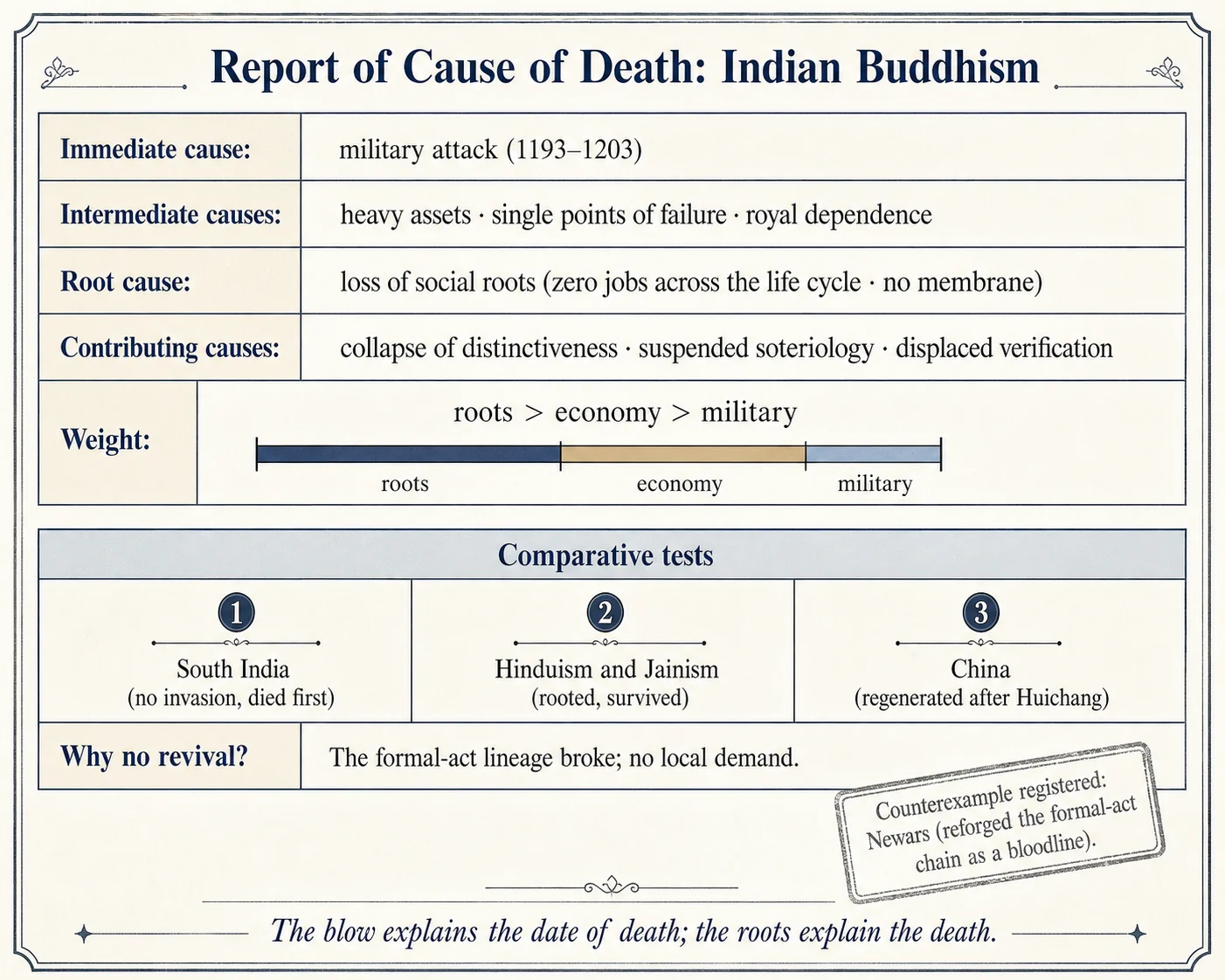
Direct cause: military attack. Around 1193–1203, the cavalry of the Delhi Sultanate destroyed the great monasteries of eastern India. This is beyond dispute, but it fails the first forensic test: same cause, different outcomes. The same conquest passed over the same land. Hinduism regenerated in place, Jainism survives today, and Buddhism vanished. One fire, three patients, one death. A death report cannot list only the fire.
Intermediate cause: the economic and architectural structure examined in the preceding chapter—heavy assets, concentration in single points, and royal dependence. Fundamental cause: the loss of social roots examined in Chapter 1—zero positions in the life cycle, no identity membrane, and imperceptible migration away. The ranking was stated when this part's place was reserved and can now be argued: loss of roots outweighs economic structure, and economic structure outweighs military attack. The argument rests on three historical controls. First, southern India: no Islam and no military destruction, yet Buddhism died there first between the seventh and ninth centuries from competition and the loss of roots. This is the outcome of the “no military attack” group and the heaviest weight in the table. Second, Hinduism and Jainism: military attack plus roots (the bloodline, caste membrane, and village-temple network) produced survival. This is the “attack with roots” group. Third, China: Huichang suppression and repeated wars plus roots (funerary and repentance rites, self-supporting monasteries, and Buddhist lay identity) meant that buildings fell while the network survived and regenerated, as Part XI will show. This is an overseas replication of the “attack with roots” group. The three controls pin down one conclusion: the attack explains the date of death; the roots explain the death.
With the weights established, several popular single-cause stories can be audited. Each has a use and each a flaw. The first says, “Islam destroyed Buddhism.” The timeline does not fit, because the south died first and the northwest declined earlier; selectivity does not fit, because others exposed to conquest survived. Volume I named the story's modern political use, which need not be repeated. A second popular story reverses the moral accusation: “Buddhism died from the corruption of tantricization.” Test it under this volume's rules. Tantricization was precisely the form of Buddhism's last genuine prosperity in eastern India; the Pāla period's vitality was esoteric vitality. Transplanted to Tibet, the same form survives today and recreated the religious life of an entire civilization, as Part XII will show. One variable, two lands, two outcomes: the single-cause claim fails. This volume's revised judgment is that tantricization was more symptom than cause. It was a rational adaptation, after roots had already been lost, to the remaining markets of courts and efficacy. The adaptation deepened the collapse of recognizability described in Part VII, Chapter 2, and therefore counts as a contributing cause. But reading the last page of the medical file as the cause of the illness reverses time. A third story says that Śaṅkara defeated Buddhism in debate. Volume I and Part V, Chapter 3 have already judged this a victory narrative; it is listed here only by name.2
Register the contributing causes exactly as they appeared in the cost columns of this volume's parts: the collapse of recognizability in Part VII, where both traditions answered the same demand sheet from the same shelf; the suspension of soteriology, the elephant in Part VII, Chapter 3—a community unable to answer “what irreplaceable thing do you offer?”; three replacements of criteria and the disappearance of verification in Parts V and VII; and the placement of the entire burden of credentialing and transmission on the physically most fragile chain, registered in Part II and tested in the preceding chapter. None alone was fatal. Put into transmission, they form the full operation of the volume's engine: pressure supplies power, exchange transmits it, and the ratchet determines direction. Every exchange produces a local benefit while booking its cost to the future. The cost-transfer table established in the Introduction states that the cost column of Chapter N becomes the pressure column of Chapter N+k. Its final line in India came due around 1203.
Now the report's last category: why was there no revival? A Brahmin's priestly qualification grew in blood; Buddhist monastic status depended on a formal act. Once every link broke, restarting required external input. External input required local demand, and local demand required a population that still understood itself as Buddhist. That population had dissolved before the chain broke. Indian Buddhism was not emptied out but cremated after absorption; what was cremated was the portion already vacated. A counterexample must be registered, and it is as elegantly tailored to the theory as if the theory had commissioned it. The only ancient form of Buddhism to survive in place on the South Asian subcontinent is Newar Buddhism of the Kathmandu Valley. It survived by turning itself into caste. Renunciation disappeared; Vajrācāryas and Śākyas became hereditary priestly castes; monastic offices passed from father to son; and services were embedded in communal marriages, funerals, and festivals. It lived by reforging the formal-act chain into a bloodline.3 The exception does not overturn the rule; it demonstrates the rule's mechanism. Nor was B. R. Ambedkar's mass conversion of hundreds of thousands of Dalits in 1956, which raised India's Buddhist population from nearly zero to several million, a revival. It was rebirth. Its entrance was the mirror image of the old cause of death. Buddhism died in India because it lacked a caste carrier; seven hundred years later it returned because it opposed caste. Part XIV returns to this rebirth.4
Under the rules, what follows is explicitly this volume's conjecture and the judgment of this part. Single-cause narratives serve different political uses. This volume ranks the causes as follows: loss of social roots outweighs economic structure, and economic structure outweighs military attack; tantricization was more symptom than cause. The report accepts reversal along three routes. If evidence shows that the popular foundation of eastern Indian Buddhism remained healthy on the eve of the attacks, the first and last positions in the table reverse. If evidence reveals a mechanism by which tantricization directly destroyed the lay foundation, rather than adapting to its loss, tantricization is promoted to a cause of death. If the early death of Buddhism in southern India can be explained by another uncounted primary cause, the first control weight is void.
Before signing the report, add a final sentence that determines the direction of the volume's second half. Death is not the end of this history of transformation, because export preceded death. During the centuries before the buildings burned, this tradition had already copied itself institutionally across Asia: the frozen version in Sri Lanka described in Part III, the synthesized version in Tibet described in Part XII, and the translated version in China. India was no longer Buddhism's address. From this point, Buddhist history is the history of its copies. The next part turns to entry into China and translation.
A theoretical cross-section closes the part. At the moment of death, theory stood at the height of its precision. The twin towers of the academies of epistemology and the resultant vehicle of Highest Yoga Tantra stood side by side, able to debate every proposition and cultivate every deity. The note adds one observation: there was no door in the blueprint. The entire theory was written for full-time practitioners. The life of a householder (birth, aging, sickness, death, marriage, agriculture, and trade) had no corresponding chapter in doctrine. Brahmins prepared rituals and theology for every transition in an ordinary person's life; Buddhist theory ceded them to competitors. The main text's judgment says roots explain the death. The theoretical version of the same sentence is this: on the day the building was completed, its architects had drawn no door facing the street.
References
References
-
For the integrated judgment—the table of accumulated causes; “Hindu revival may have been the most far-reaching, disembedding the most enduring, and Islam the most direct”; the criticism of treating “the final blow as the fundamental cause” and of its political misuse; and the counterfactual that “military attack could not have made Buddhism disappear had a popular foundation remained”—see Volume I, Part VIII, Chapter 6. This chapter directly adopts and expands its weighting argument. ↩
-
For the prior decline of southern Indian Buddhism, see Volume I, Part VIII, Chapter 6, including the records of Chinese pilgrims cited from Hazra 1983. Testing the “tantric corruption destroyed Buddhism” thesis is this volume's analysis. For the Śaṅkara story, see Lorenzen cited in Volume I, Part VIII, Chapter 6, and Part V, Chapter 3 of this volume. ↩
-
On the hereditary monastic offices and caste form of Newar Buddhism, including Vajrācāryas and Śākyas, see David N. Gellner, Monk, Householder, and Tantric Priest: Newar Buddhism and its Hierarchy of Ritual (Cambridge: Cambridge University Press, 1992). Its survival was noted in the “Aftermath” section of Volume I, Part VIII, Chapter 6. ↩
-
On Ambedkar and the mass conversion of 1956, see the “Aftermath” section of Volume I, Part VIII, Chapter 6. The movement's modern form and Navayāna lie within the scope of Part XIV of this volume. ↩