Chapter 1: Why Buddhism Kept Changing
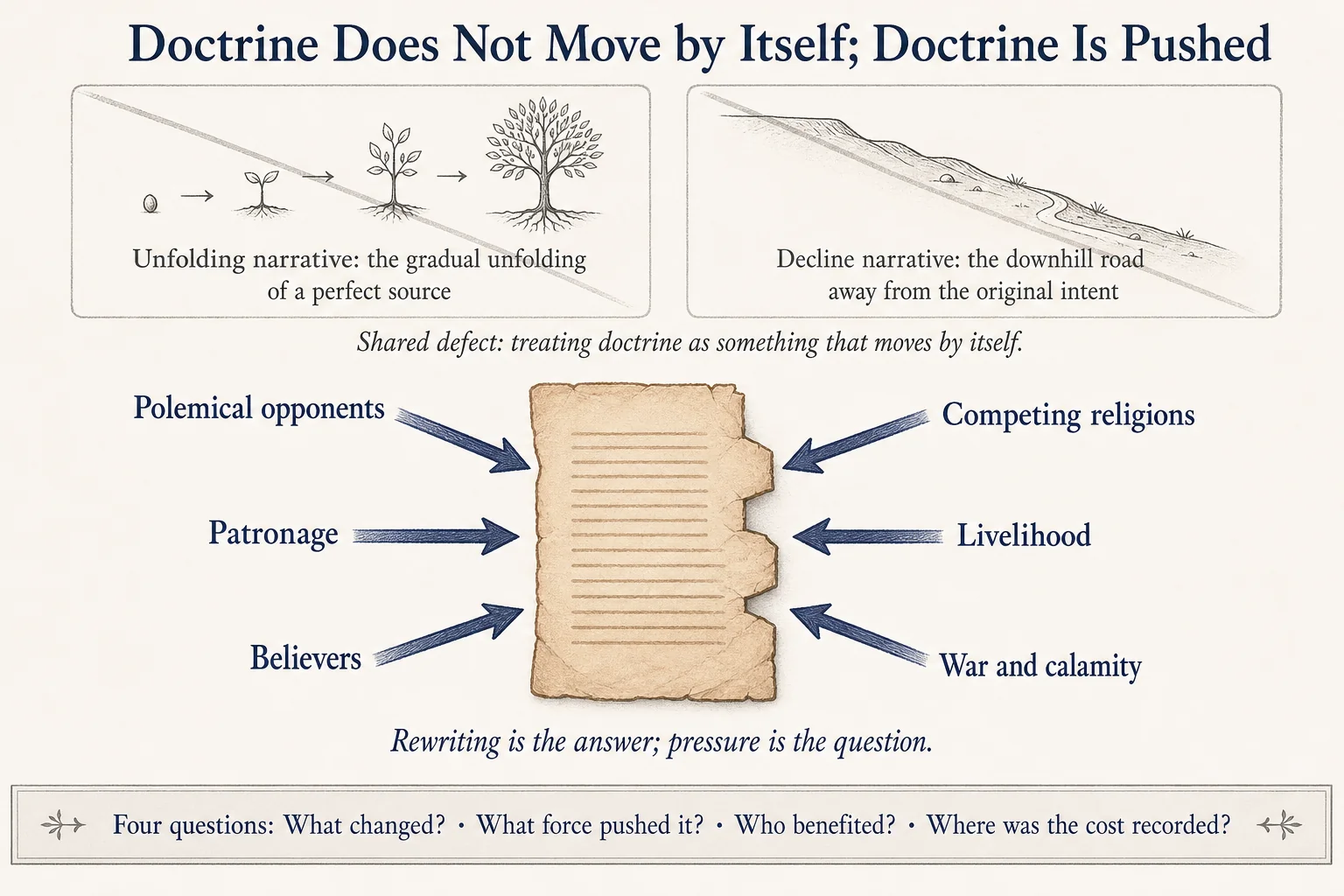
A tradition founded on the teaching that "all conditioned things are impermanent" often changes its tone when speaking of its own history. The standard internal narrative is one of unfolding: the Buddha's teaching over a lifetime, the five periods and eight teachings, the three turnings, and teachings adapted to different capacities. Every later change becomes the gradual unfolding of one perfect source, like a seed growing into a tree on which no leaf is accidental. Opposed to it is a narrative of decline, shared by fundamentalists and some scholars: from pure to mixed, substance to ornament, forest to temple estate. Buddhist history becomes a downward road leading away from the original concern. These two narratives stand opposed, yet share the same defect: both treat doctrine as something that moves by itself. In the unfolding narrative, ideas grow automatically according to an internal logic; in the decline narrative, they decay automatically according to a kind of entropy. Neither side needs external force (grain or money, courts, opponents, patrons) as though intellectual history took place in a vacuum.
This volume adopts a working hypothesis different from both: doctrine does not move by itself; doctrine is pushed. A tradition rewrites itself at a particular hinge because some pressure has accumulated there to a threshold: an opponent's agenda, a shift in patronage, the composition of the faithful, a rival religion's offerings, the Saṅgha's own livelihood, warfare, or famine. Rewriting is the answer; pressure is the problem. This yields a testable working hypothesis: for every major doctrinal concession, one should be able to identify a concrete pressure that it relieved; concessions for which no such pressure can be found should be rare. The hypothesis can be overturned case by case. Wherever this volume cannot infer a pressure behind a hinge, it will say so plainly.
One clarification is needed immediately. To be pushed does not mean to be pushed only from outside the religious community. Pressures internal to the Saṅgha are pressures too: disputes over strict and lenient discipline; competition between scholastic lineages; the different positions of elders and the wider community, forest dwellers and urban residents, scholar-monks and ritual specialists. In this volume, "external cause" means a cause outside doctrinal texts, not a cause outside the Saṅgha. The Saṅgha was never monolithic. Most external pressures affect doctrine only by passing through divisions within it.
The first two volumes prepared the ground for this question. Volume I provided chronology and doctrine: what became what, and when. Volume II provided judgments and trajectories: the changes did not move at random. Across two thousand years, one consistent line emerges—self-power decreases, guarantees increase, and verification retreats until no one can check it. A drift with a consistent direction requires a force with a consistent direction. That line is the largest phenomenon this volume must explain. If transformation were merely a random walk, the separate hinges should lean in every direction. Instead, they form a row. What kind of force could preserve one direction across two millennia and three great cultural spheres? Volume II supplied part of the answer by identifying the forms taken by attachment within each system. Yet even its structural half was incomplete: it touched only briefly on what caused the attachment and fear, and why each system took precisely the shape it did. The historical half, who pushed and by what means, was left untouched. This volume must repay both debts.
Its method is therefore fixed as four questions, applied at every hinge: What changed? What force pushed it? Who benefited? Where was the cost recorded? The first two belong to history. The third crosses a boundary. The fourth returns to doctrinal judgment. Beyond these four, one limit must be stated at the outset: this is not a textbook of the sociology of religion and does not aim at a complete explanatory model. The density of evidence is also highly uneven (thin in India, thick in East Asia), so the density of conjecture must vary inversely with the density of the record. Wherever conjecture is thickest, the rules set out two chapters from now are needed most.
(This chapter establishes the volume's general program. Sources for the historical facts appear in the corresponding chapters of Volume I; the argument for the trajectory appears in Part VII of Volume II and is not separately documented here.)