Chapter 3: The Discipline of Arguments About Hidden Motives
Begin by acknowledging the phrase's bad reputation. In Chinese, zhuxin zhi lun (an argument that "puts the heart on trial") is almost synonymous with ignoring evidence and claiming direct access to another's mind. Historical discipline likewise warns that motives cannot be verified and inquiry must stop at conduct. This volume nevertheless crosses that line, and the reason must be stated fully. Volume I already wrote a history of transformation that recorded only conduct. This volume asks why change took precisely this form at each hinge, and that question cannot avoid people: who pushed, who benefited, who feared. Doctrinal texts never state motives; they state reasons addressed to opponents and believers. Motives leave no archive. Two options remain: pretend the question of motive does not exist, or conjecture under rules. This volume chooses the latter.
The preface established three rules; this chapter supplies their details.
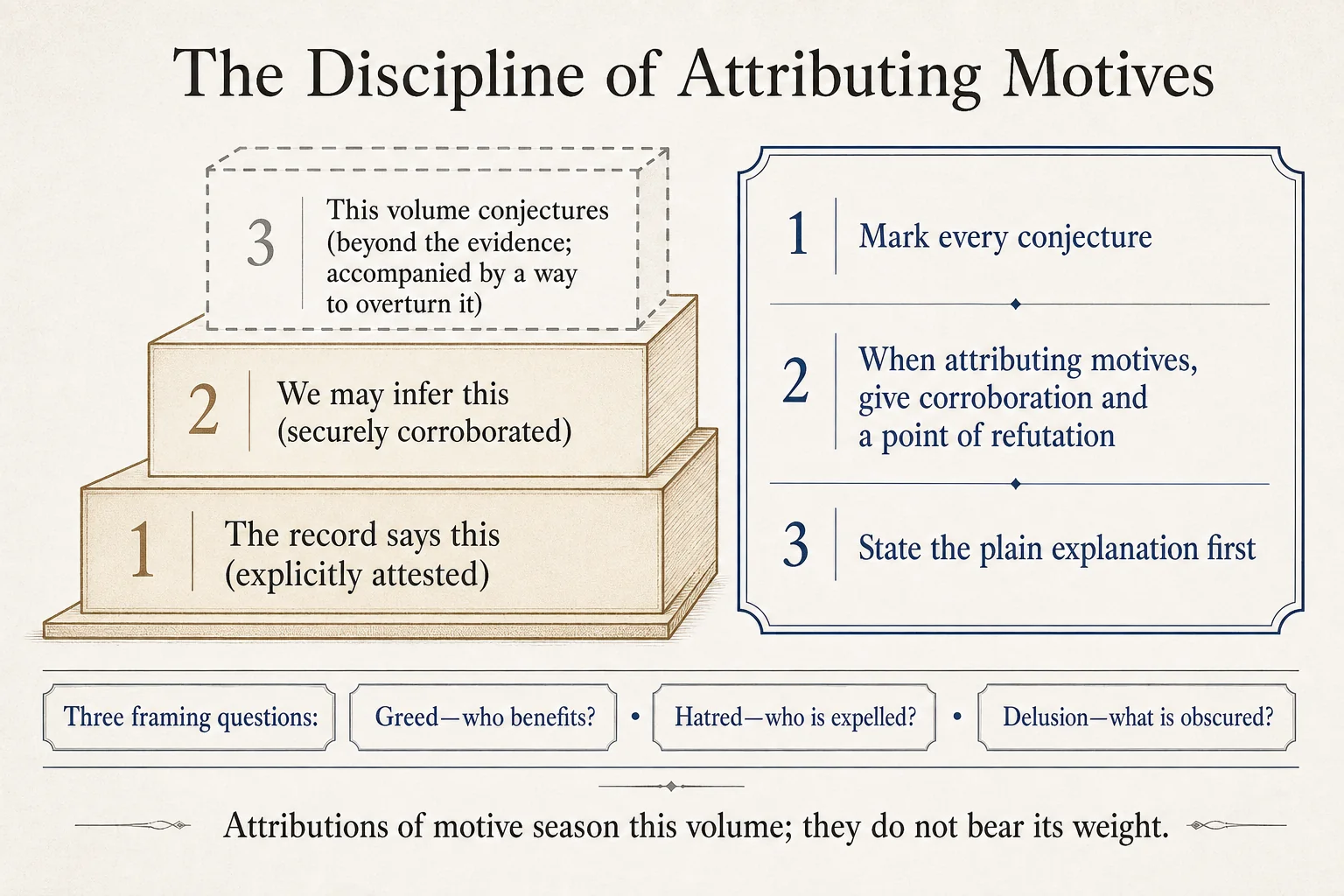
First, mark every conjecture explicitly. This volume uses three levels of diction. Where the historical record is explicit, it says "the record states." Where corroborating evidence supports a secure inference, it says "we may infer." Where the argument crosses beyond evidence to guess at motive, it always begins "this volume conjectures." The three levels are not interchangeable. Whenever readers encounter the third marker, they may strike out the entire sentence. This volume promises that the argument will still stand after its removal. The promise is made once here for the whole volume and will not be restated at every occurrence. When a third-level conjecture appears, informative conditions for refutation will be given in context; obvious ones will not be laboriously repeated. Arguments about hidden motives season this volume; they never bear its load.
Second, every inference about motives must supply corroboration. The possible means of refutation must be present in the writer's mind, though it need not be spelled out every time. Guessing at motive is not exemption from inspection. A qualified conjecture must state what conduct supports it and what kind of counterexample would overturn it. Take one example. This volume will conjecture that the function of Mahādeva's Five Points was to redistribute authority, as Part II argues. The corroboration is that every point strikes directly at a core asset of an elder's qualification. The means of refutation is equally ready: if any source from either side recorded the elder class accepting the Five Points calmly, the conjecture would fail. An argument about motives with no possible refutation will not be written.
Third, whenever a plain explanation and an explanation from hidden motives coexist, present the plain one first. Institutional inertia, economic pressure, and cognitive limits always appear before private desire. Inferences about motives may explain only the remainder left by plain explanations. At most hinges, little remains once the plain account is complete. This volume will therefore contain fewer allegations of hidden motives than readers may expect. This is not timidity. Imagining people to be bad is easy; proving that one must imagine them to be bad is difficult.
With the rules established, the analysis of motive itself still needs a brief defense; otherwise the rules sound like a request for exemption on behalf of something that should never be done. The historian's statement that "motives cannot be verified" is good as discipline but excessive as a proposition. Motives leave no archive, yet they leave traces: choices of rhetoric, distributions of prohibitions, who receives punishment, who is named, and who is silenced. These are acts and can be checked. Nor must every motive be guessed from ancient paper. Volume II's Pure Land part compared Pure Land with Abrahamic religion on one revealing detail: a teaching said to be credible to everyone insists on calling itself a "narrow gate" and a "Dharma difficult to believe." That analysis of motive was not suspended in air. Internal texts describe how the rhetoric is used; modern village surveys and conversion studies record how believers actually use the claimed difficulty; psychology of religion supplies a mechanism through the feelings of selection and superiority. Text, fieldwork, and psychology converge. Even if they cannot reconstruct the founder's inner life, they can establish the rhetoric's actual function in a modern setting. Sometimes that is enough, because this volume explains the direction of transformation, not the interior biographies of the ancients. The credibility of conjecture about motive is a matter of degree, not a binary. The nearer the evidence, the more living the tradition, and the more numerous the routes of corroboration, the closer conjecture comes to verification. This completes the rule at the end of Chapter 1: where sources are thin, conjecture must be more frequent but is less reliable and requires stricter discipline; where sources are thick, conjecture can be rarer and firmer. The weight placed on hidden motives must follow this gradient.
Then comes the old matter that must be accounted for: where did greed, hatred, and delusion go? The original conception of this book explicitly analyzed the forces at every hinge through the three poisons. The preface explained why that plan was abandoned—it was too mechanical and risked firing first and drawing the target afterward. What remains is their use as a discipline of framing. Greed reminds this volume to ask at every hinge: who benefited, what was promised, and which desire the rewriting fed. Hatred reminds it to ask: who was expelled, what was condemned, and for whom the rewriting created an enemy. Delusion reminds it to ask: what was concealed, and which question could no longer be asked. The three poisons do not pass judgment; they open a checklist. They determine where this volume looks, not what it sees.
Two final boundaries. First, structures and persons must remain separate. Volume II judged Tathāgatagarbha as "advance credit" and Vajrayāna as "performance"; those were judgments about the functional structures of doctrines, not the character of individual thinkers. This volume asks about motives and therefore asks about historical actors. The two kinds of judgment must not be transferred into each other. To say that a structure functionally takes the form of attachment does not mean its creators were greedy. To say that a patriarch had practical motives does not make his doctrine false. Rejecting speech because of the speaker, or defining the speaker by the speech, are both prohibited. Second, whoever puts hearts on trial must first speak candidly about their own motives. This volume's own motive belongs among those open to suspicion: the impulse to classify and judge teachings was already acknowledged as attachment in the preface to Volume II. Only rules that bind the writer deserve to be used against the ancients. This chapter guarantees every argument about hidden motives in the volume; wherever the writing breaks discipline, readers may hold this chapter against it.