Chapter 2: Six Lines of External Causation
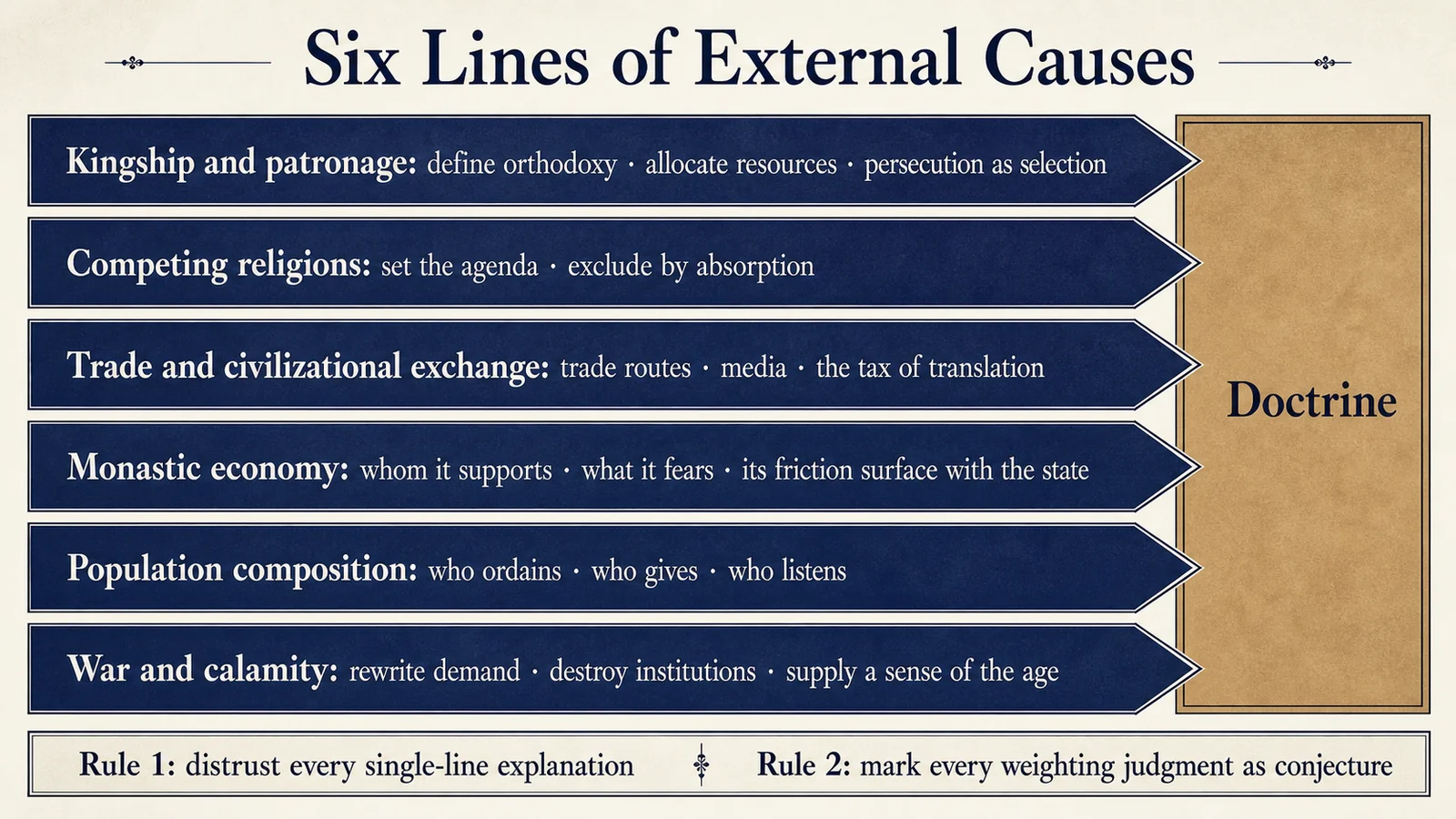
This chapter opens a file on each external variable deliberately suspended by the first two volumes. For each of six lines, it explains three things: what it is, how it acts upon doctrine, and how it is most easily misused.
1. Kingship and patronage. Aśoka established the standard relationship between Buddhism and political power: a Dharma-protecting king supported the Saṅgha with land, tax exemption, and certification of orthodoxy; the Saṅgha repaid kingship with merit, legitimacy, and moral instruction. This exchange structure later traveled with Buddhism throughout Asia; only the currency changed—Kuṣāṇa images, Gupta scholastic estates, Sui and Tang ordination certificates, Tibetan imperial decrees, Tokugawa household registration. Kingship acts upon doctrine in three main ways: by deciding orthodoxy, as royal command concluded the Samye debate; by allocating resources, because scholar-monks are expensive creatures, and whoever pays decides what kind of people Buddhism can sustain; and by suppressing Buddhism. Every purge of the sort associated with the "Three Wus and One Zong" was an episode of doctrinal selection: heavily equipped schools died, lightly equipped ones survived. A warning against misuse must also be entered here. Royal preference is the line most often overestimated. Most imperial conversions merely placed a seal on social facts that had already taken shape. To record every rise and decline on the throne is to mistake approval for motive force. Volume I already noted scattered points along this line: Aśoka and the authorization of the councils in Part II, the Huichang persecution and the fortunes of the schools in Part X, and shifts in dynastic patronage and the end of Indian Buddhism in Part VIII. There they appeared incidentally; here they become a standing line of inquiry.
2. Competing religions. Buddhism never taught in a vacuum. Almost every major claim has an opponent on the other side: the Brahmanical self, Jain asceticism, Nyāya logic, Hindu devotion and tantra, Chinese Lao-Zhuang thought and the Confucian moral order, Neo-Confucianism after the Song, Japanese Shinto, modern Christianity and scientism, contemporary psychology and the market. A competitor's importance lies not merely in victory or defeat but in setting the agenda. Opponents determine which questions count as important, as Part V will show. A rival's products determine the shape of one's own shelves, as in Parts VI and VII. The most sophisticated competition is displacement through absorption: incorporate the other's core asset into one's own framework and then declare the other unnecessary—Viṣṇu's avatāra incorporates the Buddha; Neo-Confucianism incorporates Buddhist philosophy of mind and nature.
3. Trade and exchange between civilizations. The history of Buddhist transmission almost coincides with the trade routes: monks traveled the Silk Roads and sea routes first built by merchants. Merchants were Buddhism's most loyal patrons, and not by accident. A religion indifferent to birth, committed to trust, and promising that karmic results would not fail was almost tailored to a mobile merchant class. This line also includes media: palm leaves, paper, woodblock printing, movable type, and the internet. Every change of medium alters who can produce and reproduce doctrine—Mahāyāna in Part IV, printing in Part XI. Translation is the heaviest link. At every linguistic border, doctrine pays a tax of transposition; matching concepts to Chinese categories is the most conspicuous item on that invoice, as Part IX will show.
4. The monastic economy. How the Saṅgha eats determines what Buddhism becomes. A community living by alms is light, dispersed, and quick; one living on estates is heavy, concentrated, and slow. The monastic economy decides three things: whom it can support (only large estates could sustain Nālandā-style scholar-monks); what it fears (the greater its assets, the more it fears dynastic change, as in the one-basket principle of Part VIII); and where friction with the state occurs—land, tax exemption, and labor. The Huichang liquidation was, in effect, conducted by the ministry of revenue, as Part XI will show.
5. Social composition. Who ordains, who gives, and who listens? The Saṅgha was never homogeneous: aristocratic and common monks, scholars and meditators and ritual specialists, forest and city dwellers. Its patrons included courts, merchants, great clans, and village communities. Social composition is the demand side of doctrine. Literacy sets the ceiling for textual religion; Pure Land's victory was first a victory in population structure, as Part X argues. The composition of motives for ordination shapes the character of the Saṅgha; sources rarely state directly the proportion between avoiding corvée and seeking the path, yet traces appear everywhere. The two-tier structure of elite and popular religion determines whether a tradition can supply both philosophy and miraculous efficacy. Where it cannot, the market will divide the two on its behalf.
6. War and disaster. War, dynastic collapse, epidemic, and famine. General histories treat them as backdrop; this volume makes them a separate line because their mechanism differs from all five above. Suppression along the line of kingship is policy: it destroys the supply side—temple assets disappear while believers remain where they were. Disorder rewrites the demand side as well, because the society that supports Buddhism is itself collapsing. Social composition asks who believes; this line asks what circumstances believers inhabit. It acts upon doctrine chiefly in three ways. First, it rewrites demand. Collective suffering reduces the plausibility of "long cultivation and personal verification in this life" and increases the weight of other-power salvation and guarantees of a future life. Every great expansion of Pure Land has a calendar of disaster behind it. Volume II noted the masters of troubled times; Parts IX and X return to them here. Second, it destroys institutions. Scholastic Buddhism is a capital-intensive tradition. Once academies, libraries, and lineages are broken in war, they cannot easily be rebuilt. Nālandā needed to burn only once. The practices that survive disaster are lightly equipped; the resilience of Chan and Buddha-recitation was selected repeatedly, as Parts X and XIII will show. Third, disorder supplies a feeling of the age. The Final Dharma is not a calendar but a mood. Disorder offers evidence everywhere that "the true Dharma is in decline"; once that consciousness is established, the contraction "only this Dharma works now" acquires a foundation. Kamakura Buddhism is the fullest specimen, treated in Part XIII. A warning against misuse again belongs on record: troubled times are a universal solvent into which anything can be dissolved. Anyone using this line must answer two questions: why did one tradition decline while another rose during the same crisis? Why did nearby regions under the same disorder take different paths? An explanation from disorder without a comparison group commits the same offense as a motive inference with no conditions for its refutation.
The six lines are a checklist, not a theory. This volume does not assume in advance which line is decisive at which hinge. It establishes only two rules of use. First, distrust every single-line explanation: whenever one line makes a hinge look perfectly round, begin by distrusting the circle. Second, label every weighting as conjectural. Even the ranking faintly visible at the beginning of this chapter (economy and social composition matter most, kingship is most often overestimated) is conjecture, not conclusion. The detailed rules follow in the next chapter.
(This chapter opens methodological files. Sources for the historical details of each line appear as the relevant parts unfold; for an overview, see the corresponding chapters of Volume I.)