Chapter 1: Buddhist Modernism—Rewritten for the Examiner
At the end of the preceding part, Meiji Buddhism carried its luggage into the free market. This part watches the entire Buddhist world forced to do the same thing within one century. In the nineteenth century, almost every Buddhist copy struck the same wall at nearly the same time: Western gunboats, missionaries, and Orientalism. Sri Lanka stood under Britain, China beneath the shadow of treaty ports, Japan after the Black Ships, and Tibet at the edge of imperial rivalry. Behind the wall sat a new examiner, whose criteria were no longer whether something had been spoken by the Buddha but whether it was scientific, rational, and progressive. The rewriting of this part's title means the edits each copy made to pass inspection. Textbooks call the period a Buddhist revival. This volume follows the four questions: called revival, it was in fact rewriting. What changed, who held the pen, what the examiner received, and where the cost was recorded must all be counted.
Part XIII recorded the Meiji shock; now bind two other cases into the same volume. Sri Lanka's began on a debate platform. In the Panadura debate of 1873, Guṇānanda publicly defeated Methodist ministers. The battle report crossed the ocean to New York and brought Henry Steel Olcott of the Theosophical Society. The ensuing script was unexpected. An American colonel designed for Sri Lankan Buddhism a catechism, Buddhist flag, and network of Buddhist schools; the catechism directly borrowed the genre of Christian instructional manuals. Anagarika Dharmapala followed, founded the Maha Bodhi Society, launched a campaign to recover Bodh Gaya, and shared the stage in Chicago in 1893 with Shaku Sōen. Scholarship gave the revival an apt name: Protestant Buddhism—resisting Protestantism by remaking itself in the Protestant image, centered on laypeople and text, stripping ritual, and emphasizing preaching.1 China's case opened over temple property. Zhang Zhidong's Exhortation to Learning advocated using temple assets to establish schools. Successive Republican campaigns treated monastery property as readily available education funding. Huichang logic wore the uniform of new education; the state now wanted school buildings rather than copper. In public discourse, Buddhism received the two labels superstition and parasitism, pressured in turn by the New Culture and anti-religion movements. Self-rescue began in a scriptural press. For forty years Yang Wenhui's Jinling Scriptural Press printed books, recovered long-lost Yogācāra commentaries from Japan, as Part XI, Chapter 1 noted, and established the Jetavana Hermitage late in his life with monks and laypeople studying together. Chinese modernization's two routes (the scholarly and the institutional, Ouyang Jingwu and Taixu) emerged from this one gate.2 Their divergence and conflict form the next chapter. This chapter first examines the pen they shared with Sri Lanka and Japan.
The rewriting used three strokes. First, it replaced the criterion. Orthodoxy's lock changed from provenance to agreement with science. D. T. Suzuki wrote Chan as pure experience beyond every religion, Dharmapala called Buddhism an atheistic psychological science, and Taixu described Dharma and science as mutually complementary. The old customs gate checked translators; the new one checked whether a teaching could pass the lecture hall and laboratory. Second came textualism. The Pali Text Society was founded in 1881. “Original Buddhism” as a category was itself a nineteenth-century scholarly invention. The slogan of returning to original texts paralleled the Protestant model of scripture alone. Each tradition raised its oldest textual layer as the essence and demoted a millennium of commentary and ritual as accretion.3 The qualification must be stated immediately so the claim is not mistaken for a fragmentary reading. The nineteenth century invented the category and tools, not the problem. Dispute over what was spoken by the Buddha and what counted as true Dharma had never stopped for two thousand years. The First Council fought over the roll, India possessed eight centuries of apologetic genres, China had customs and catalogues, and this entire volume is an archive of the dispute. Two things were new: philology made the oldest into an operational stratum, and the equation “oldest equals authentic essence” was the imported Protestant product. Old problem, new criterion; every modern rewriting in this part occurred at that level. Third came de-ritualization. Reformers within Buddhism judged salvation rites for the dead, assemblies, amulets, and efficacy to be superstitious shells; meditation and philosophy became essence. Notice what the three strokes together form: a new doctrinal classification, ranking high and low and judging depth, while discarding most of the home tradition's practices. The difference was that the criterion was supplied outside the teaching for the first time.4
Under the rules, what follows is explicitly this volume's conjecture and gives the chapter its title. Modernist Buddhism was an apologetic rewritten for the examiner. It first accepted the standards of science and reason, then demonstrated that it qualified. Ceding the criterion went deeper than ceding doctrine. A doctrine can be changed back; once the criterion is surrendered, every doctrine remains forever on trial. Record the plain half fully. Rewriting saved lives. Schools, publishing, and organization preserved Buddhist population and property through a century of colonialism and revolution. Connection to the new criterion was not mere submission. Buddhism's own discourse of personal knowledge provided a real interface with modernity. The Kālāma Sutta was raised as a charter of free inquiry, although the original setting was more qualified than the slogan.5
The examiner's first great case drove the philological probe into the Buddha's word itself: Mahāyāna was not spoken by the Buddha. Arrange the file geographically. Japan came first. Tominaga Nakamoto's shot in 1745, recorded in Part XIII, Chapter 2, read the canon as layers of successive addition. He was besieged, Mujaku Bunyū wrote a refutation, and Tominaga remained listed after death as a slanderer of the Dharma. A century and a half later, Murakami Senshō restated the claim as history and left the Shin clerical register that year. Within one generation his two-line solution (“not the Buddha's speech, yet Buddhism”) became common sense. China came eighty years later and opened with full fire. Mochizuki Shinkō proposed that the Awakening of Faith was written in China; Liang Qichao's 1924 Textual Study of the Awakening of Faith in the Mahāyāna ignited the domestic case. Ouyang Jingwu and Wang Enyang of the Chinese Inner Studies Institute judged the text apocryphal through doctrine; Wang called the defenders' classification “a reckless display of selfish intent” and “speech identical to outsiders.” Taixu answered with doctrinal classification, installing the Awakening at a high place in his system. Lü Cheng followed with One Hundred Proofs That the Śūraṅgama Is Apocryphal; Buddhist writers replied, while Shoupei and Wang Enyang fought for years—the customs file of Part IX, Chapter 2 now came to trial. Theravāda felt no anger, for the position was its own. India had no living site because Buddhism was dead there, but while it lived authenticity had been a permanent issue. Eight centuries of apologetic genres produced treatises, not trauma.6
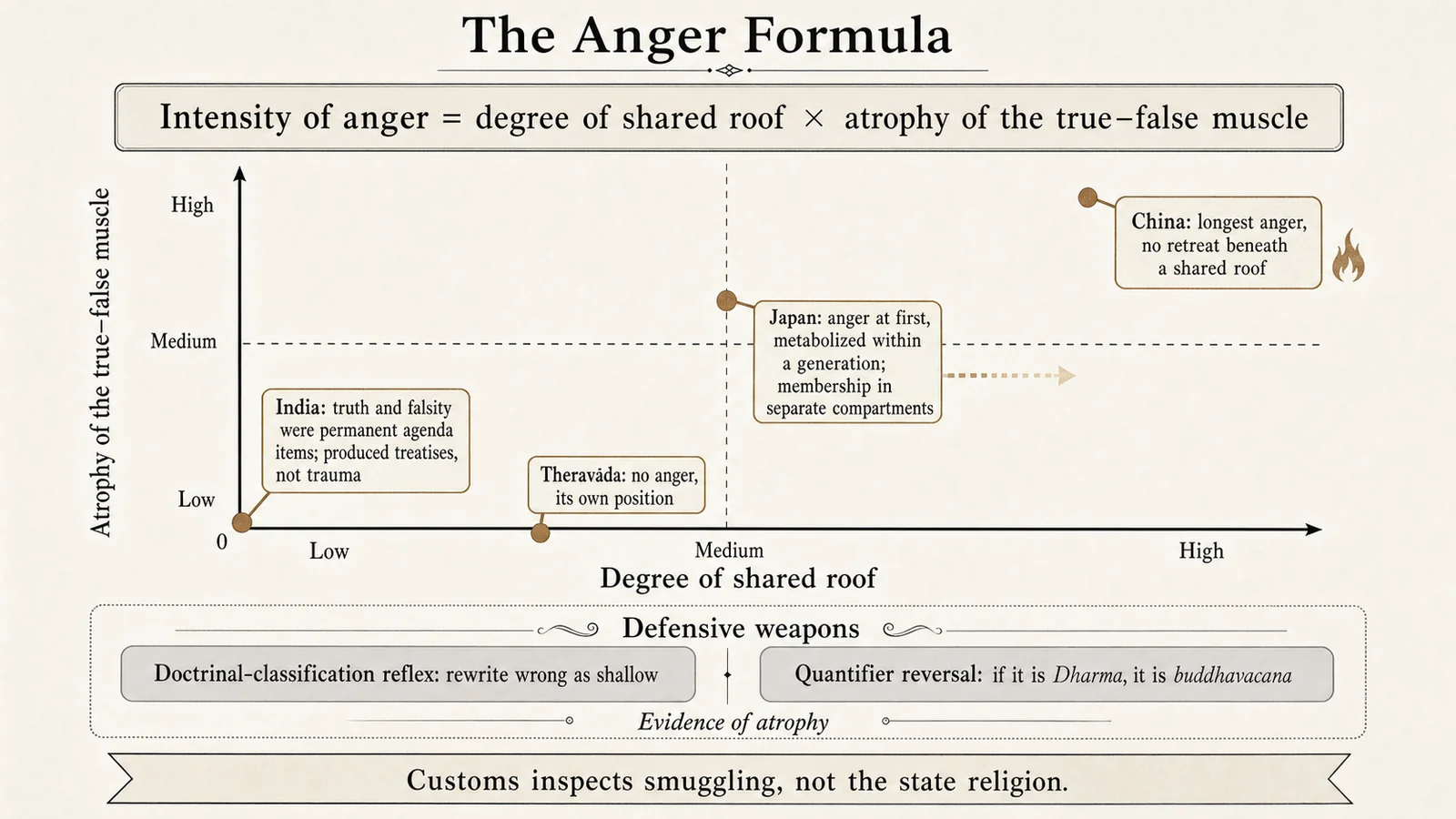
Why did the same probe produce such different pain across four lands? This volume writes the answer as a formula: intensity of anger equals degree of shared roof multiplied by atrophy of the true-false muscle. Test the factors separately. Roof: in China “all are the Buddha's speech” was the common roof of the entire community, the ratchet's endpoint in Part X, Chapter 1. There was no denominational membership behind which to retreat; moving the roof moved everyone. Japan's Kamakura membership allowed watertight compartments. Historical learning belonged to history and sectarian learning to the school. Murakami's two-line solution had a place to stand; anger appeared but metabolized within a generation. Muscle: China did have a true-false muscle, but for a millennium it pointed only beyond the canon. Customs inspected smugglers, not the state religion, as Part IX, Chapter 2 showed. Doctrinal classification could rank only high and low, while catalogues verified translators; no legitimate genre could question the authenticity of canonical Mahāyāna. When modern philology pointed within the canon, the system possessed no genre to receive it, and anger was the default output when there is no genre. The defenders' weapon proves the atrophy. Classifying the Awakening as high was the reflex of doctrinal classification, writing “wrong” as “shallow.” Saying that “whatever is Dharma is the Buddha's speech” restarted the modern reversal of the quantifier from Part IV, Chapter 1. It answered dating with rank because rank was the only muscle that had been trained, and thus demonstrated its own atrophy. The sentence planted in Part X, Chapter 1 is now redeemed. A thousand years later, atrophy of the true-false muscle became visible, and its form was thunderous anger. Record concurrent factors honestly. Historical criticism of founders causes anger in every religion; the historical Jesus debates were equally bitter. Republican nationalism added fuel by binding the probe to the nerve of national salvation. The formula's unique contribution lies not in explaining anger's existence but in explaining the form of the response: why China answered through doctrinal classification and doctrinal ledgers and for so long lacked equivalent historical criticism.7
Two duds lie scattered on the debate ground and close it neatly. Theravāda's ace, “the Buddha too was an arahant,” tested in Part IV, Chapter 3, has a hit rate near zero against Chinese Buddhism. China's symmetrical ace says that without the Mahāyāna movement Buddhism would have disappeared in the second century and that large and small vehicles depend on each other like lips and teeth. Dismantle it in three layers. At the historical layer, the census of Part IV, Chapter 4 established that mainstream Buddhism remained non-Mahāyāna in the seventh century; there is no evidence of second-century extinction. Theravāda's survival without Mahāyāna stands opposite as the audience's own rebuttal. Part VIII offers a harder layer: the places where Mahāyāna ecology flourished most were precisely those where Buddhism disappeared, while a distributed tradition without the Mahāyāna movement survived. To say Mahāyāna saved Buddhism reads survivor bias backward. Record the authentic half. Without Mahāyāna there would be no Chinese Buddhism; that statement is true. Its subject is Chinese Buddhism, not Buddhism. Replacing our branch with the whole is a shift of frame. At the structural layer, this argument uses survival, population, and market as criteria while the other side uses the Buddha's speech and Dharma meaning. Presenting market performance to an audience for whom popularity never proves truth is like presenting the old equation of attainments to Mahāyāna; each answers a question the other side has withdrawn. Theravāda's own canon predicts that semblance Dharma will flourish while the peg of the drum decays. Market success is bad news under that prophecy.8 At the functional layer, like “the Buddha was an arahant,” these statements are really internal ballast stabilizing a community's legitimacy and mistakenly treated by their users as external artillery. Each side holds a dud and calls it an ace. Record the authentic core of “lips and teeth” too. In India it was true through a shared Vinaya and common residence: the walls fell and all died together, not because doctrines supported one another. Different lands allowed separate survival; one land brought shared death. Survival followed media and geography, not vehicle.
Add a final and most thorough rewriting, which also closes a case from Part VIII. The death report's category “why there was no revival” listed conditions: restart required external input, which required local demand, which required a population identifying as Buddhist. In 1956, B. R. Ambedkar delivered all three at Nagpur. Hundreds of thousands of Dalits denied personhood by caste required a non-Hindu identity—demand. Monks from Sri Lanka and Myanmar attended as witnesses—input. The conversion ceremony itself mass-produced the population. His method of delivery was rewriting. Navayāna expressly removed karma and rebirth; Buddhism became a rational charter of social emancipation, and the criterion of entry was equality rather than awakening.9 Buddhism finally returned to India as a rewritten copy. The event closes the chapter exactly. Under modernity's inspection, a tradition unwilling to rewrite could not qualify for revival. The three strokes and one great dispute are now counted. China's version was the most organizationally complete and changed the deepest object; the next chapter treats it separately.
References
References
-
On the Panadura debate of 1873, Olcott and the Buddhist Catechism of 1881, and Dharmapala and the Maha Bodhi Society of 1891, see Richard Gombrich and Gananath Obeyesekere, Buddhism Transformed: Religious Change in Sri Lanka (Princeton: Princeton University Press, 1988). Obeyesekere coined “Protestant Buddhism.” ↩
-
Zhang Zhidong's “Establish Schools” in Exhortation to Learning advocated using monastic assets for schools. For Republican campaigns and Buddhist institutional responses, see Holmes Welch, The Buddhist Revival in China (Cambridge, MA: Harvard University Press, 1968). On Yang Wenhui, the Jinling Scriptural Press, and Jetavana Hermitage, see the same work and Parts XI, Chapters 1 and 2. ↩
-
The Pali Text Society was founded in 1881 by T. W. Rhys Davids. On the nineteenth-century construction of the category “original Buddhism,” see Philip C. Almond, The British Discovery of Buddhism (Cambridge: Cambridge University Press, 1988). ↩
-
For the general framework of replacing criteria, stripping ritual, and emphasizing experience, see David L. McMahan, The Making of Buddhist Modernism (Oxford: Oxford University Press, 2008). This chapter adapts his analysis into three strokes. ↩
-
Kālāma Sutta, Aṅguttara Nikāya 3.65. Scholarship has often corrected its modernist extraction as a “charter of free inquiry”; summarized here. ↩
-
For Tominaga Nakamoto and Mujaku Bunyū, see Part XIII, Chapter 2. See Murakami Senshō, A Treatise on the Unity of Buddhism (1901), and Liang Qichao, Textual Study of the Awakening of Faith in the Mahāyāna (1924). For doctrinal arguments by Ouyang Jingwu and Wang Enyang and Wang's rebukes, see their writings against the Awakening of Faith and modern research on the Wang Enyang–Shoupei controversy. For Taixu's classification, see his essays on the Awakening. For Lü Cheng and Buddhist rebuttals, see the file in Part IX, Chapter 2. ↩
-
The anger formula and four-region comparison are analytical devices of this volume. Concurrent factors (universal sensitivity to historical study of founders and Republican nationalism) limit the formula's explanatory scope as stated in the main text. ↩
-
For the zero-effect analysis of the attainment equation and “the Buddha too was an arahant,” see Part IV, Chapter 3. For the seventh-century census, see Part IV, Chapter 4. For the similes of semblance Dharma and the pegs of the drum, see Saṃyutta Nikāya 16.13 and 20.7. ↩
-
For Ambedkar and the 1956 conversion at Nagpur, see Volume I, Part VIII, Chapter 6, and Part VIII, Chapter 3 of this volume. Scholarship commonly notes The Buddha and His Dhamma (1957) revising karma and rebirth; summarized here. ↩