Chapter 2: Humanistic Buddhism—Chinese Buddhism's Self-Rescue
The preceding chapter counted the common strokes. This one examines the Chinese manuscript. Chinese Buddhism under the Republic faced three walls. The first was temple property. The blade of “using temple property to establish schools” hung overhead; monastic assets were the most convenient source of education funding, and when provincial campaigns began a monastery became a school building. The second wall was public opinion: the two labels superstition and parasitism. The pens of the New Culture movement and slogans of the anti-religion movement attacked in turn. Every charge landed precisely on the form fixed in Part XI. Repentance liturgies were superstition, salvation of the dead a business, exemption and retreat from society parasitism, and mountain dwelling negativity. Under the new criterion, every design that had ensured survival for a millennium became an indictment. The third wall was a model. Christianity stood opposite with schools, hospitals, youth associations, and periodicals, demonstrating what a modern religion looked like.1
Part XI, Chapter 2 and the preceding chapter already named the two routes of self-rescue, both emerging from Yang Wenhui's students. Examine what each altered. The scholarly route belonged to Ouyang Jingwu and the Chinese Inner Studies Institute: return to Xuanzang, rebuild doctrinal learning through Dharma Characteristics and Yogācāra, and re-equip the true-false muscle through epistemology and philology. Laypeople presided over the lecture seat. The three-layer curve of literati involvement from Part XI, Chapter 2 reached its endpoint when the core production of doctrine transferred entirely to lay hands. Their judgment that the Awakening of Faith and Śūraṅgama were apocryphal, filed in the previous chapter, followed naturally. To rebuild the muscle, first clear the inventory. The institutional route belonged to Taixu: three revolutions in doctrine, institution, and property. The Wuchang Buddhist Academy opened in 1922, the same year as the Inner Studies Institute, with two programs of self-rescue opening in south and north. Taixu wrote the program in one verse: “I look up only to the Buddha; completion lies in human character. When the human person is complete, buddhahood is complete; this is called true reality.” From salvation of the dead to human life, mountains to the human world, and next life to this life; reform monastic dress and institutions, establish schools and periodicals. The template was visible across the street: schools, hospitals, and youth associations.2 Record the battle between the routes. The Inner Studies Institute judged the Awakening false; Taixu classified it at a high level. The two wings of one rescue fought as enemies over authenticity. The preceding chapter's formula said that the form of response reveals where the muscle resides. This civil war is its best living specimen.
After Taixu, Yinshun gave Humanistic Buddhism its fixed form. He pushed Taixu's “Buddhism for human life” one step further and made “all buddhas arise in the human world; none ultimately becomes a buddha in heaven” its doctrinal backbone. He judged deification a decline of Buddhism and established the human bodhisattva practice as the right path. Volume II's appendix examined his learning in detail. The history of transformation records one side: Yinshun's doctrinal classification made humanness the criterion, supplying Taixu's reform with a doctrinal constitution.3 The postwar fruit appeared in Taiwan. Tzu Chi, Fo Guang Shan, and Dharma Drum Mountain built hospitals, universities, television networks, and transnational volunteer systems. Taixu's blueprints became buildings across the strait and changed Chinese communities throughout Southeast Asia and the world. Humanistic Buddhism was Chinese Buddhism's most successful self-rewriting in the twentieth century. This half is an accomplishment and needs no discount.4
Under the rules, what follows is explicitly this volume's conjecture and explains the subtitle. The deep motive of Humanistic Buddhism was shame—the urge to prove innocence after the labels superstition and parasitism cut deep. Record the plain half fully. Humanness has indigenous Mahāyāna sources; the this-worldly side of bodhisattva practice was not invented. Reform genuinely saved monastic property, talent, and Buddhism's social reputation. The conjecture identifies selectivity. Its ledger of achievement and ledger of silence are equally striking. Supernormal powers were no longer discussed, efficacy was demoted, the next life mentioned less, and renunciation almost ceased to appear as a goal. These were precisely the subjects at which the examiner frowned. A reform named for the human world quietly moved everything not of the human world into storage. Return the silence to this volume's long line. Part XI, Chapter 3 said Chinese Buddhism outsourced redemption of liberation to the Pure Land, housing the elephant at death. Humanistic Buddhism took another step and removed redemption from the agenda. Volume II's two ledgers each record a line. The ledger of present-world efficacy is full; almost no one opens the ledger of cessation.5
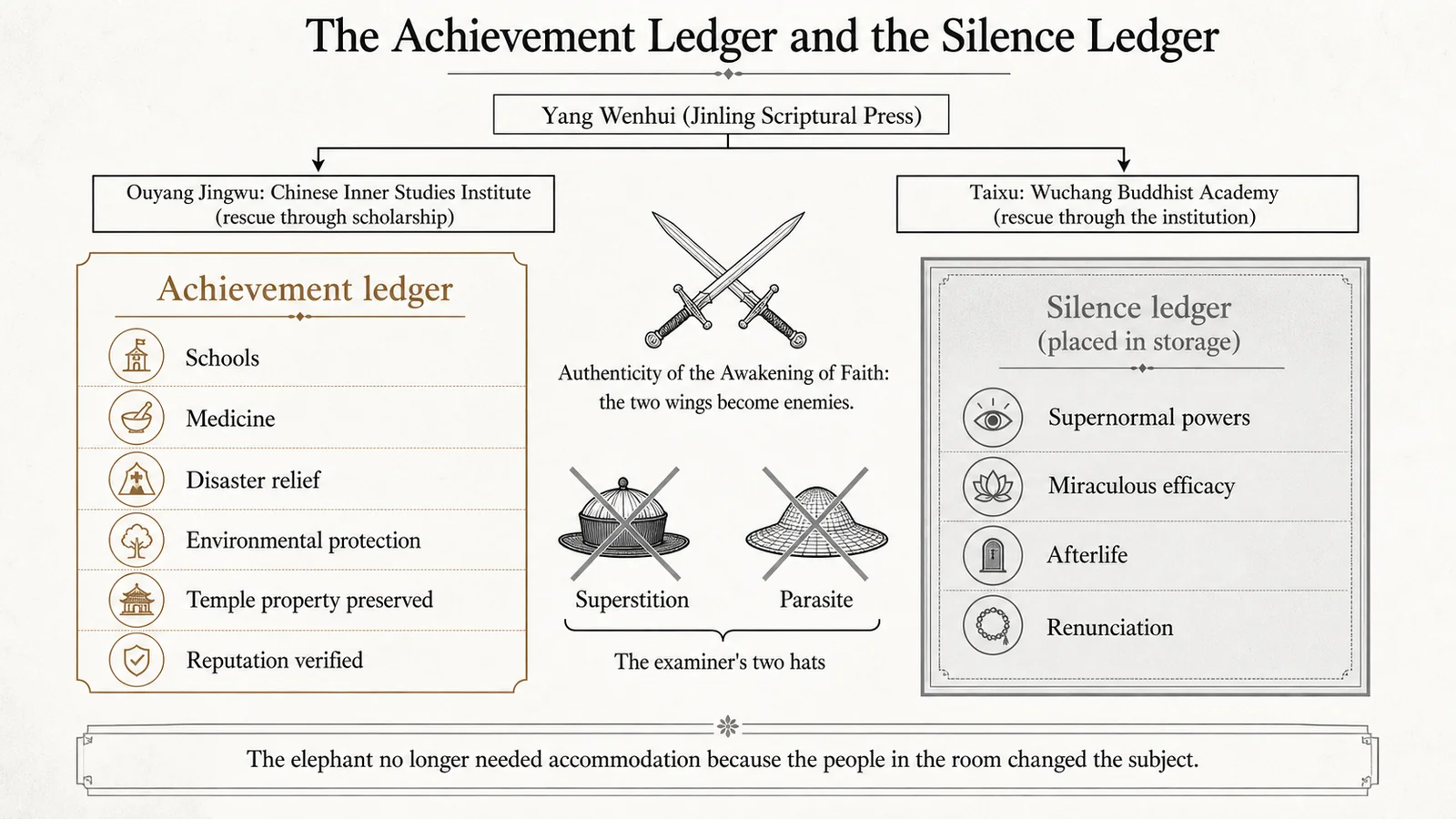
Close the chapter. Humanistic Buddhism rewrote Chinese Buddhism into a religion capable of entering modern public life: education, medicine, disaster relief, and environmental work, present everywhere. The cost was another deepening suspension of soteriology, but the suspension no longer counted as an elephant in the room because the occupants had changed the subject. Across the Pacific, another rewriting went further. It removed the shell of religion as well and placed a single technique on the shelf. The next chapter examines the mindfulness industry.
References
References
-
For the campaign to use monastic property for schools, the discourse of “superstition,” and the situation of Buddhist institutions under the Republic, see Holmes Welch, The Buddhist Revival in China (Cambridge, MA: Harvard University Press, 1968), and sources cited there; summarized here. ↩
-
The Chinese Inner Studies Institute under Ouyang Jingwu and its Dharma Characteristics–Yogācāra line and Taixu's three revolutions and Wuchang Buddhist Academy both date to 1922. Taixu's verse appears in his collected works in connection with the “true reality of becoming a buddha in this very human person.” Both routes descended from Yang Wenhui; see Parts XI, Chapters 1 and 2, and the preceding chapter. ↩
-
“All buddhas arise in the human world; none ultimately becomes a buddha in heaven” appears in the Ekottarika Āgama and Yinshun made it his doctrinal backbone in The Buddha in the Human World. For his classification and the formation of Humanistic Buddhism, see Volume II's appendix; summarized here. ↩
-
For an overview of postwar Taiwanese Humanistic Buddhist organizations, see Volume I, Part XII; summarized here. ↩
-
For the two ledgers of present-world efficacy and cessation, see Volume II's Pure Land and synthetic parts. For “housing the elephant,” see Parts VII, Chapter 3, and XI, Chapter 3 of this volume. ↩