Chapter 1: The Arms Race—Why Buddhism Needed Philosophy
Part IV ended with two populations living under one roof and Vinaya while mutually condemning each other's books as heresy. In other religions, such disagreement often leads to excommunication and war. In Buddhism it had nowhere to go. The Vinaya did not hear cases of doctrine—schism was defined procedurally, a key used in Part II, Chapter 3 and Part IV, Chapter 1. The pontiff's seat was empty and no final court existed. Part II, Chapter 1 counted three roads available in such a system: council, kingship, and separation. Post-Buddha Indian civilization happened to prepare a standing institution for a fourth: the debate arena. It mixed the first three. Rules were self-organized, kingship supplied judges, and a loser need not separate; what was lost was reputation, patronage, and people. Disagreement acquired a destination and doctrinal history a new environment of selection. This chapter follows how that environment armed Buddhism and reshaped it.
Before entry, inventory the stake, because one premise is easily missed. To risk reputation and patronage, one must first possess both and care about losing them. The debate arena created neither; earlier parts accumulated them. On the patronage side, temporary rains settlements became permanent monasteries and bowls and robes became estates and storehouses, as Part III, Chapter 1 described. As early as a century after the Buddha, accepting gold and silver pulled the entire Saṅgha into the dispute over the Ten Points. Kosambī's withdrawal of alms and Pāṭaliputta's purge then demonstrated the taste of interrupted support and exclusion. Once family property exists, something can be lost. The change on the reputation side was deeper. Attainment could not be examined and claims were costly, as the interlude showed. Examinable reputation therefore became the only asset a monk could accumulate, inherit, and exchange. The economy of visibility made it a market in Part III, Chapter 1. Buddhism did not learn winning and losing only on entering debate. It entered with a household estate accumulated over two or three centuries, and the thicker the estate, the heavier the wager.
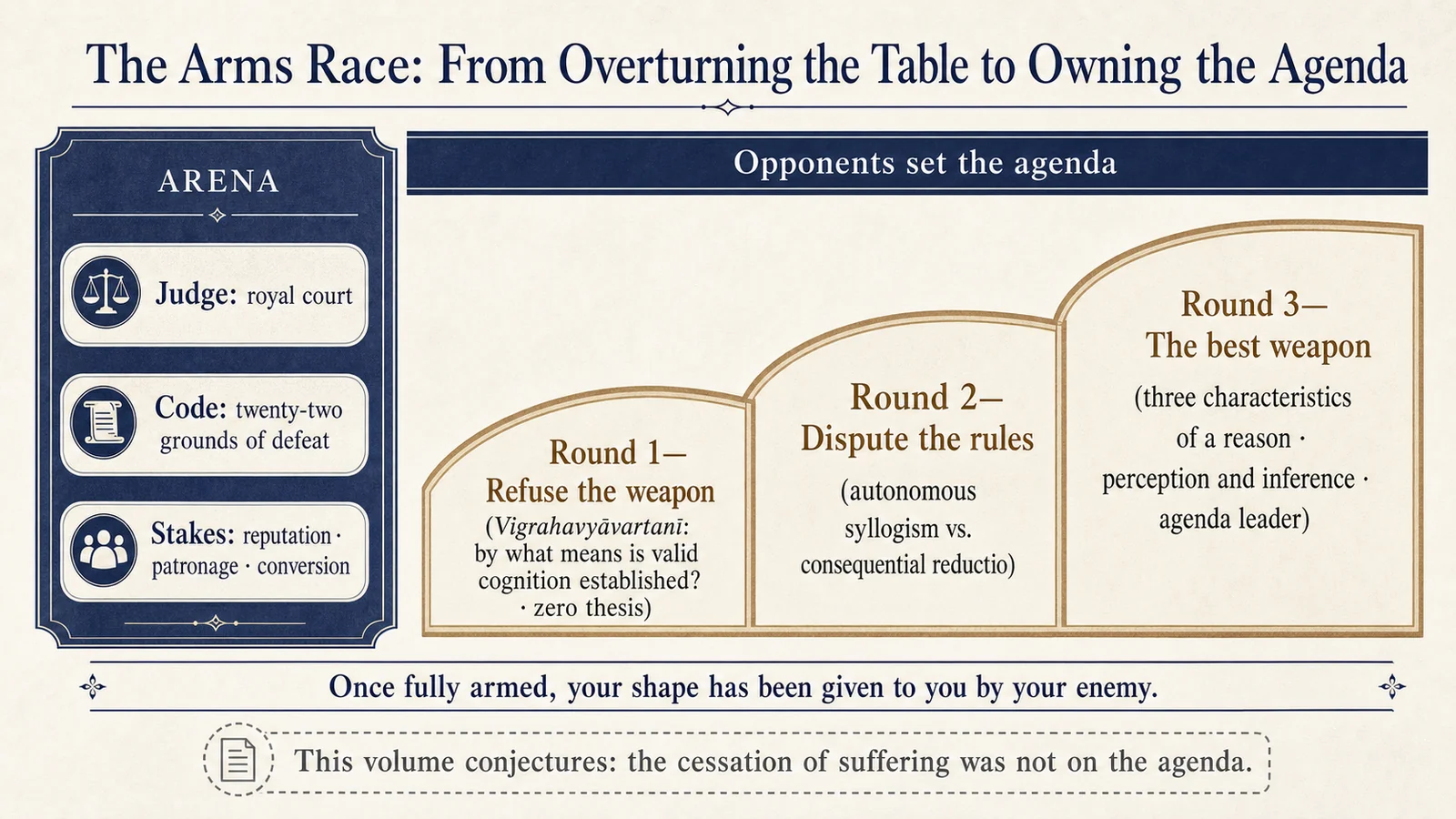
Nor did Buddhism create the arena. By the first centuries CE, cross-school debate was a mature public institution in India. Nyāya made debate a discipline. The Nyāya Sūtra divided dialogue into truth-seeking discussion, victory-seeking disputation, and destructive criticism that dismantled without establishing, then codified twenty-two grounds of defeat, with separate articles for silence and changing the subject. Once victory and defeat had a code, they also had judges and stakes.1 Buddhist files reveal the position still more clearly. The Yogācārabhūmi divided logic and debate into seven topics. "Places of debate" listed suitable venues, with the royal court first. "Grounds of defeat" rehearsed how one lost. "Withdrawal from debate" taught a person before engagement to assess three matters: each side's skill, the audience's disposition, and the consequences of victory and defeat, and permitted declining after the assessment. A science of practice seriously taught disciples how to avoid battle gracefully. This testifies more honestly than any victory narrative that the stakes were real.2
Two biographies preserve numbers and punishments. The Biography of the Master Vasubandhu says a Sāṃkhya teacher defeated eminent Buddhists at court and received gold from the king, greatly damaging Buddhist reputation. Vasubandhu later avenged them with his Seventy Principles of Truth, received three lakhs of gold, and used it to build three monasteries.3 Xuanzang's biography says a Lokāyata opponent hung forty theses on Nālandā's gate, wagering his head. After defeating him, Xuanzang spared the head, took him as an attendant, then released him.4 Under this volume's rules, such stories are discounted by half. Who won and how beautifully belongs to victor narrative. But across sources, the king as judge, gold as prize, the head as rhetoric, and conversion as settlement form a consistent institutional language that cannot be discounted away. The debate arena was a real market: propositions were priced, schools financed, reputations cleared.
Buddhism's first act upon entering was to overturn the table. Nāgārjuna's Vigrahavyāvartanī dismantles not one opponent's thesis but the tribunal itself. You say every cognition must be established by a means of knowledge. By what is the means established? If by another means, infinite regress; if it needs none, the rule that everything needs one refutes itself. Āryadeva's works consist in refutation without establishing his own position. In the Prāsaṅgika line, "zero position" becomes a complete method: borrow only premises the opponent accepts, lead them to contradiction, and possess no thesis of one's own to attack. Volume I, Part V treated the philosophical fortunes; here only the tactical form matters.5 This line is the same intellectual engine analyzed in Part IV, Chapter 3. Prajñā is a universal solvent in debate, a meta-level winning move. Its military advantage is having nothing to defend: no position means no position to lose.
But solvent does not win regular war. A royal court needs a decidable result, and decision requires a shared procedure. To a judge, a debater who declares the procedure invalid is difficult to distinguish from a loser. Buddhists soon made the point internally. Bhāviveka argued that opponents must be refuted through autonomous syllogisms, constructing arguments under mutually accepted rules of knowledge. Candrakīrti answered that believers in intrinsic nature and Mādhyamikas do not see the same world, so no mutually accepted ground exists. Volume I, Part V adjudicated the philosophical dispute between Svātantrika and Prāsaṅgika. A history of transformation adds another reading: it was a dispute over an armament policy. One side demanded weapons built according to battlefield rules; the other denied the battlefield's sovereignty. History sided with weapons.
In the third round, Buddhism made the finest weapon in the arena. Dignāga established the three characteristics of a valid reason, turning valid and invalid inference into a checklist, and reduced knowledge to perception and inference. Dharmakīrti tightened every joint further. For centuries, the agenda of Indian epistemology was effectively set by the two; every new generation of opponents had to answer Buddhist challenges before establishing its own position. Volume I, Part VIII, Chapters 1 and 2 recorded their systems and influence.6 Buddhism took four hundred years to move from overturning the table to occupying the heaviest chair beside the judge. The iron law of an arms race appears in the arc. Rejecting weapons does not remove weapons but removes oneself from the arena. To remain, arm according to the arena's rules. At the end, the enemy has given you your shape.
Once armament was tied to a whole monastery's livelihood, the price of soldiers changed immediately. Nālandā's rolls supply direct evidence. Xuanzang's biography counts resident and visiting monks at ten thousand, not by attainment but by number of works mastered: over one thousand understood twenty collections, over five hundred understood thirty, ten understood fifty (Xuanzang among them), while Śīlabhadra alone was said to have read everything. Compare Part II. The First Council counted "all arahants." A thousand years later, the roll counted books. The unit changed, and the curve from the interlude received an institutional signature. Treatment followed the unit: high-ranked scholars received special daily provisions, rode elephants, were excused from communal duties, and obtained lectureships and rooms according to gradations of learning.7 What of meditators? The roll had no column for concentration. The unit by which a monastery counts people is the unit by which it pays them; the unit in which it pays is the unit toward which the young grow.
Following the names on the roll answers a necessary objection. Part IV, Chapter 4 showed that even in the seventh century, Mahāyāna remained a demographic minority. Yet almost every scholar we name from Nāgārjuna and Āryadeva through Asaṅga, Vasubandhu, Dignāga, Dharmakīrti, Bhāviveka, and Candrakīrti belongs to a Mahāyāna lineage. How can a minority monopolize the hall of fame? The answer has three layers. First, who made the list? It survives mainly through Chinese and Tibetan export channels, and exporters bought lecture-platform products. The mainstream schools had scholars. In the same millennium as Xuanzang, Sri Lanka had Buddhaghosa and Sāṃmitīya had eminent teachers, but no one compiled textbooks and biographies for them. Guptaka in Part IV ("unmatched in reputation, honored by king and people") was one famous non-Mahāyāna scholar known only because Xuanzang passed him. Second, respect divided by ecological niche. Mainstream schools had elders on village and demographic scoreboards; Mahāyāna scholars increasingly dominated the elite niche of court and great monastery because the arms race's two main product lines, solvent and logic, were family crafts. Third, these people carried two identities. According to biography, Asaṅga and Vasubandhu ordained in Sarvāstivāda. Yijing studied ten years at Nālandā, which followed the Mūlasarvāstivāda Vinaya, while he said "those who venerate bodhisattvas and read Mahāyāna sūtras are called great." Vehicle described a person's studies, not a monastery's registration.8 The identity card of a "Mahāyāna scholar" belonged to a school; the lecture platform belonged to Mahāyāna. Ask whether they were respected, and first ask on which roll. On the Vinaya roll, they were lawfully ordained monks of a school, no different from the person beside them. On the debate roll, they were stars. One person, two rolls: the living form of the two positions, articles and lineage, established in Part II.
The four questions can now be inventoried. What changed? The environment selecting doctrinal production. A proposition's survival increasingly depended on defensibility in debate: definitions had to withstand lists of defeat, syllogisms pass the three characteristics, positions survive reductio without bleeding. What force pushed it? Competing religions set the agenda, kingship supplied judges and prizes, social composition supplied promotion within monasteries, and the ladder of scholar-monks in Part III, Chapter 1 opened onto the external field. Who benefited? Clearly, the scholar class and institutional reputation. Another beneficiary must be recorded fairly: philosophy itself. The competition forged the most precise epistemology and logic in Indian intellectual history. Many tools this book's first two volumes use to dissect Buddhism were forged in those centuries of combat. Critics of the arms race are beneficiaries too. The competition also protected communities. Victory could mean estates, grants, and converted patrons. In a world where kings allocated resources according to results, remaining unarmed meant awaiting slaughter.
The cost was recorded in the agenda. Following the rules, the next claim is explicitly this volume's conjecture. Half the precision of Buddhist philosophy was shaped by enemies. Opponents decided which questions counted, the agenda defined importance, and cessation of suffering was not on it. The tables of contents in epistemological works provide corroboration: particulars and universals, how exclusions refer, how momentariness is established, how another mind is inferred. Each is a critical point on an external front; none takes cessation as its outline. Buddhist practice later entered epistemology, but how it entered reveals who governed the agenda. Dharmakīrti treats yogic perception by asking whether it counts as knowledge and under what conditions—its legitimacy as evidence, not its operating procedure. In Buddhism's own epistemology, practice stands in the defendant's dock rather than on the judge's bench. If the earliest epistemological literature organized itself around the operations of practice, or its problem list could be shown to arise independently of opponents' agendas, the conjecture would fail.
Armament needs an arsenal; a standing army needs pay. The debate arena's next station is not a thesis but a building. The next chapter goes to Nālandā.
References
References
-
The Nyāya Sūtra, fixed in approximately the second century, distinguishes vāda, truth-seeking discussion; jalpa, victory-seeking disputation; and vitaṇḍā, destructive criticism, and lists twenty-two nigrahasthānas, grounds of defeat, at NS 5.2. Buddhist manuals include the Upāyahṛdaya, T32 no. 1632, and Vasubandhu's Tarkaśāstra, translated by Paramārtha as the Treatise on Reality, T32 no. 1633. ↩
-
Yogācārabhūmi, fascicle 15, opens its section on logic with seven topics: nature, place, basis, ornament, defeat, withdrawal, and many functions, T30 no. 1579. "Place" lists royal courts, adjudicators, assemblies, sages, and renunciants and brahmins versed in Dharma. "Withdrawal" teaches one first to assess gain and loss, audience, and each side's skill before deciding whether to debate. ↩
-
Biography of the Master Vasubandhu, translated by Paramārtha, T50 no. 2049. Details of victory are discounted as victor narrative; the institutional outline of royal judgment, prizes, and a reputation market is consistent across sources. ↩
-
Biography of the Tripiṭaka Master of the Great Ci'en Monastery, fascicle 4. The victory narrative is similarly discounted; only the language of wagering one's head is used as the debate institution's self-description. ↩
-
For the Vigrahavyāvartanī's criticism of means of knowledge, Āryadeva's refutation without establishment, and the dispute between autonomous inference and consequence, see Volume I, Part V, Chapters 2–5. This chapter adopts the conclusions while reframing them as armament policy. ↩
-
For Dignāga's three characteristics of a valid reason, perception and inference, Dharmakīrti's refinements, and their setting of later Indian epistemological agendas, see Volume I, Part VIII, Chapters 1 and 2 and studies by Hayes, Dreyfus, and Dunne cited there. ↩
-
Biography of the Tripiṭaka Master of the Great Ci'en Monastery, fascicle 3, T50 no. 2053: Nālandā regularly housed ten thousand resident and visiting monks; more than one thousand could explain twenty bodies of scripture and treatise, more than five hundred could explain thirty, ten including Xuanzang could explain fifty, while Śīlabhadra alone had read everything. The same fascicle records Xuanzang's special daily provisions, elephant transport, and exemption from communal duties; these are summarized here. ↩
-
For Asaṅga and Vasubandhu ordaining in Sarvāstivāda, see the Biography of the Master Vasubandhu, T50 no. 2049. Yijing records Nālandā's use of the Mūlasarvāstivāda Vinaya. His statement that "those who venerate bodhisattvas and read Mahāyāna sūtras are called great" appears in Record of Buddhist Practices Sent Home from the Southern Sea, fascicle 1, cited in Part IV, Chapter 4. For Buddhaghosa, see Volume I, Part IX, Chapter 2. ↩