Chapter 3: The Cost of Debate—The Drift in Criteria
Volume II's Madhyamaka part, in Part II, Chapter 6, passed a judgment that should first be reproduced. As the tradition unfolded, the criterion of liberation drifted recognizably. The experiential criterion "cessation of suffering" was gradually replaced by epistemic standards: whether one could speak correctly about emptiness, defeat opponents in debate, answer with Chan-like immediacy, or write philosophically precise commentary. No one decided on the drift. It was a gradual structural process inseparable from institutional academization.1 That judgment was a philosophical dissection of the logical joint. It still owed a history: beneath which roofs did replacement occur, at what rhythm, and through whose hands? The first two chapters have already supplied the parts. This one assembles them.
Four components each have a source. First, the vacuum of authentication. Attainment had no court or certifying institution and therefore no falsifying institution, as the interlude showed. A vacuum does not remain empty; anything public and decidable is drawn into it. Second, the economy of visibility. Institutions and donors naturally prefer displayable achievement; the sitter loses to the lecturer, as Part III, Chapter 1 showed. Third, the debate arena. It supplies exactly the product the vacuum demands: public, decidable, judged, and recorded in victory and defeat. Fourth, the academy. It institutionalizes the product as entrance examination, rank, degree, and promotion. Once the four engage, replacement requires no resolution. No council announces, "from now on eloquence equals realization." There are only a thousand small reviews, each asking who receives this lecture platform and whether this novice remains, and in every one the available evidence is examinable performance. The ratchet in Part IV consumed texts; this one consumes people. Its one-way direction is identical. Skilled debaters rise and do not descend for lacking practice. Those unable to debate do not rise because they practice well.
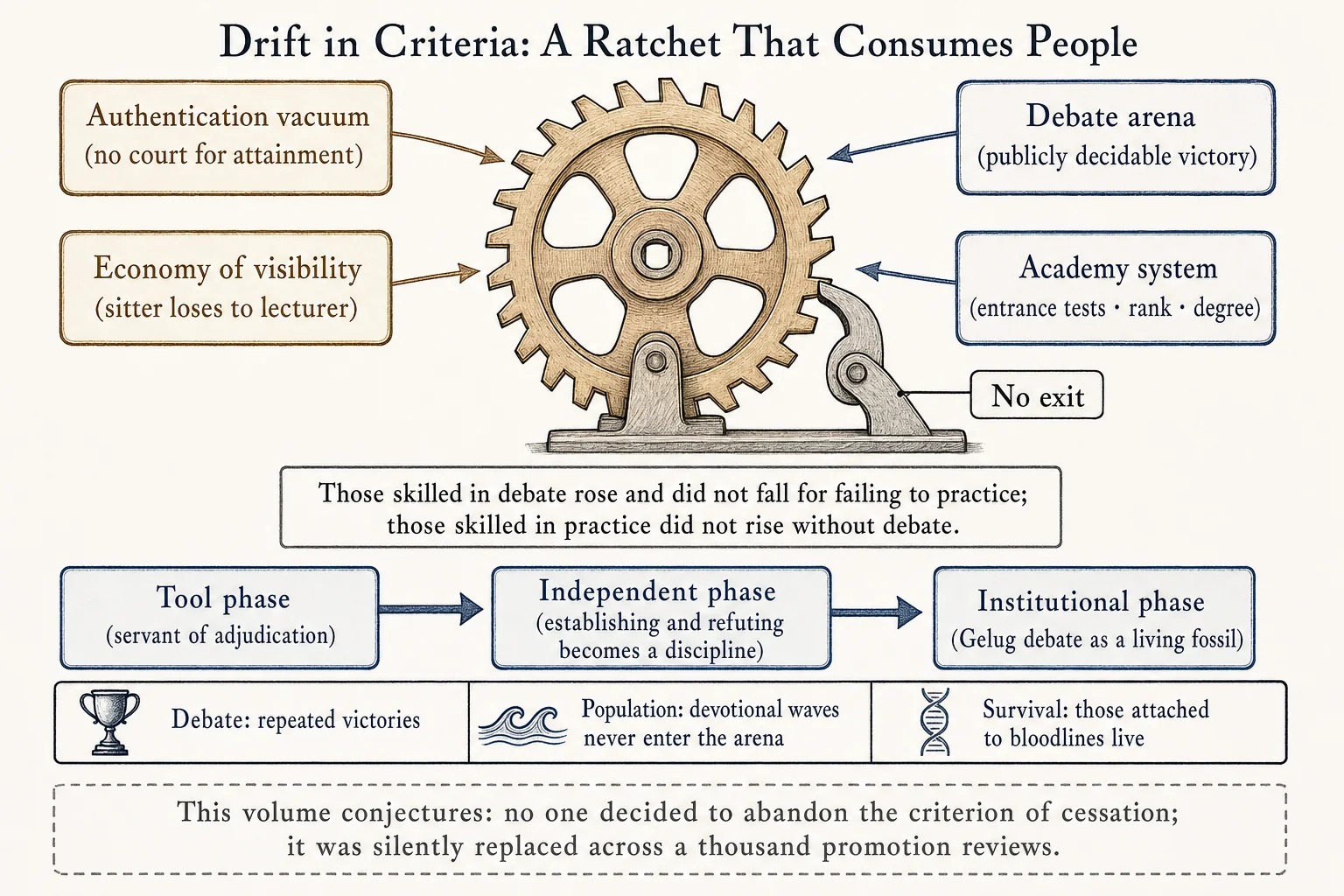
The rhythm has three stations. First, the tool stage. In the Abhidharma movement, debate still served adjudication and preservation. The criterion nominally remained cessation, but examinability had secured an institutional position. Second, the autonomous stage. In the age of epistemology, establishment and refutation became an independent discipline and eloquence a public identity. At the same time, under the Vinaya exemption for overestimation, claims to attainment retreated into private matters that could never be convicted. As one rose and the other fell, the social criterion changed hands. Third, the institutional stage. A degree system built the new criterion into stairs. From gatekeeper’s questions to victory at court, every transition in a scholar-monk’s life was decided by epistemic performance. An institutional descendant of the third stage remains alive. Geluk monasteries in Tibet reorganized Indian treatise curricula into long programs of lectures, memorization, debate, and examination, with geshe training structured around five great textual subjects. This is not an unchanged copy of Nālandā, but it preserves and transforms the mechanism by which scholastic performance confers status.2 The institution disappeared in India while the criterion continued in another organization. A contemporary debating courtyard therefore supplies comparative material, not live footage of ancient India.
Now turn outside the arena, because the greatest cost of debate is recorded precisely there. The arena had a scoreboard on which Buddhism led for a long time: master of epistemology, setter of agendas, frequent victor at court. A second scoreboard counted population. Part IV, Chapter 4 examined the seventh-century census. Here count the opponents outside. It was not a philosopher who took South Indian populations but the devotional tide from the sixth and seventh centuries. Āḿvārs and Nāyaṉmārs sang in Tamil, made pilgrimages, wept, and carried gods into villages and markets. They did not enter the debate arena or recognize lists of defeat and therefore could not be defeated.3 Volume I, Part VIII, Chapter 6 adjudicated the case of Śaṅkara. Stories of his universal debate victories come from disciples' literature centuries later and no contemporary Buddhist source records them; his school's dominance was secured only in the eleventh and twelfth centuries when Buddhism had nearly disappeared; Brahmanical orthodoxy itself derided him as a "Buddhist in disguise," showing blurred boundaries.4 The present volume adopts that judgment and adds one mechanism: displacement through absorption, introduced in Chapter 2, does not need to win debate. It bypasses debate. Absorb Buddhist philosophy, place an Upaniṣadic cover on it, then enter the Buddha on the roll of avatāras. Every step occurs beyond the arena's jurisdiction. An army perfected for one war met two others: one did not debate but sang; the other did not debate but burned, as Part VIII will show. Seven centuries of armament had zero exchange value on those fronts.
A third scoreboard produced numbers only centuries later: the fates of the schools themselves. Check the household registration of old opponents in the arena and survival shows almost no relation to debate performance. Sāṃkhya, the school in the court story of Chapter 1, ceased as an independent lineage after about the tenth century. Yet its skeleton, puruṣa and prakṛti, the three guṇas and twenty-five principles, was dismantled into common furniture across India; Purāṇic cosmology, Yoga, Tantra, and Vedānta all used it. The Sāṃkhya Sūtra, appearing in the fourteenth or fifteenth century, was a textual revival through archaizing attribution, not revival of the school. The institution died; its vocabulary lived forever.5 Vaiśeṣika merged into Nyāya. Nyāya lived longest and, after Buddhist epistemology disappeared, Navya-Nyāya continued its problem list—the arms race's inheritance passed to the survivor. Mīmāṃsā gradually receded into an auxiliary science of Vedānta. Vedānta joined bhakti to become an orthodox axis; Rāmānuja's and Madhva's lineages grew schools onto temples and temples onto caste communities. They learned Buddhist-style communal organization while possessing the bloodline Buddhism lacked. Jainism survives because it staked itself on exactly the missing layer: endogamous merchant-caste communities, with laypeople enclosed by identity and their own law. The comparison group from Part IV, Chapter 3 delivers its result in the survival column. Lokāyata had no institution and survives only in opponents' citations. The scoreboard can be read in one sentence: those attached to household, caste, and bloodline lived; those attached only to institutions and gaming tables died or were dismantled into someone else's toolkit. The best debater died, while losers and nonparticipants prospered. No column in the debate table predicts the survival table.
The costs can now be counted. First, replacement of criterion itself: truth moved from the meditation cell to the lecture platform. Volume II passed the judgment; this chapter completes the mechanism. Second, allocation of talent. For centuries, the tradition's most intelligent minds devoted lives to polishing arguments. The opportunity cost cannot be measured, but its direction can be identified: had the same talent been allocated to transmitting and testing practices, the concentration curve in the interlude need not have taken the same course. This counterfactual is stated under conjectural rules and indicates direction, not necessity. Third, outsourcing the agenda, recorded in Chapter 1. Fourth, strategic blindness. A system defining victory as success in debate has no sensor for opponents who refuse the arena. When the devotional tide rose, the institution best placed to notice was celebrating another victory at court.
Under the rules, counterexamples must be recorded lest the judgment become an unfalsifiable polemic. First, Buddhist epistemology contained a genuine religious core. Dharmakīrti's "Establishment of Authority" chapter in the Pramāṇavārttika establishes the Blessed One as a person who became authoritative through compassion cultivated over many lives. In his hands, the epistemological project ultimately argued that "the Buddha is trustworthy." To read epistemology wholly as armament erases this layer.6 Second, the replacement never became total. Traditions with the strongest debate institutions maintained parallel practice lineages; Part XII returns to Tibet. Drift is movement of the center of gravity, not extinction of practice. Third, the tradition contained protest. Songs of realization made mockery of paṇḍitas reciting books into a genre. Saraha sang most directly: "The paṇḍitas explain all the treatises, yet do not know that the Buddha dwells within the body."7 The fate of this archive confirms the mainstream criterion. Protest was not adopted as a corrective but classified as a separate track. That track is Part VII's subject.
Finally, following the rules, the next statement is this volume's conjecture and this part's verdict. No one decided to abandon the criterion of cessation. It was silently replaced across one thousand promotion reviews. Every review was locally reasonable and every reviewer could be sincere. Replacement existed at no single point and appeared only on the scale of centuries, while no participant lived at that scale. If the tradition explicitly diagnosed the drift at the time and institutionally moved the criterion back, the conjecture would lose weight. Volume II's philosophical judgment and this chapter's historical mechanism now connect. The whole volume's engine gains another page. The costs of this part (criterion replacement, single-point structure, agenda outsourcing) become pressures in later parts. The nearest pressure can already be named. The arena forged lack of intrinsic nature into its strongest solvent, capable of dismantling every position. Yet a large body of customers wanted precisely something indestructible and reliable. The stronger the solvent, the more powerful this demand. The next part turns to the return of the true and eternal.
A theoretical cross-section belongs in a closing note. The debate arena fixed doctrine in the shape of epistemology: perception and inference, the three characteristics of a valid reason, and a public language in which Buddhism could prove itself with its neighbors' grammar. The vacuum moved. Dharmakīrti established the Buddha as an authoritative person—that the Buddha was trustworthy, not immediately attainable. Theory contains no bridge between winning a debate and possessing liberation. The fissure of the two truths widened at the same time. Ultimate truth was inexpressible while every livelihood in the arena depended on expression. Those who spoke of the unspeakable won the contest, but the contest itself remained on the expressible side. The main text recorded the drift in criteria; this note adds only that theory aided it. Once ultimate truth was placed outside language, every contest within language was automatically demoted to conventional truth. However great the victory, it could not touch the inexpressible judge.
References
References
-
For the structural diagnosis of the criterion drifting from "cessation of suffering" toward debate, quality of commentary, and scholarly performance, and the Geluk debate-and-geshe system as its institutional endpoint, with Georges Dreyfus, The Sound of Two Hands Clapping (Berkeley: University of California Press, 2003), see Volume II, Madhyamaka, Part II, Chapter 6. This chapter supplies the historical mechanism. ↩
-
On Geluk monastic curricula, memorization, debate, examinations, and geshe training, see Georges B. J. Dreyfus, The Sound of Two Hands Clapping: The Education of a Tibetan Buddhist Monk. Berkeley: University of California Press, 2003. This institutional and ethnographic study supports the body more securely than a web video lacking stable metadata; the body also avoids equating the modern Geluk institution directly with ancient Nālandā. ↩
-
The South Indian devotional movements of the Vaiṣṇava Āḿvārs and Śaiva Nāyaṉmārs began around the sixth and seventh centuries and sought populations through Tamil hymns and pilgrimage rather than debate. See Friedhelm Hardy, Viraha-Bhakti: The Early History of Kṛṣṇa Devotion in South India (Delhi: Oxford University Press, 1983). ↩
-
For Śaṅkara's dates and works, his criticism of Buddhist schools, historical corrections to victory narratives, and the epithet pracchanna-bauddha, see Volume I, Part VIII, Chapter 6 and Lorenzen cited there. That chapter's judgment, "victory or defeat in the debate arena was not the key cause of Buddhism's death," is adopted and supplemented here. ↩
-
For classical Sāṃkhya, Īśvarakṛṣṇa's Sāṃkhyakārikā, Paramārtha's Chinese Golden Seventy Treatise, T54 no. 2137, the end of independent transmission after about the tenth century, and the late archaizing Sāṃkhya Sūtra, see Gerald Larson, Classical Sāṃkhya, 2nd ed. (Delhi: Motilal Banarsidass, 1979), and Larson and Bhattacharya, eds., Encyclopedia of Indian Philosophies, vol. 4: Sāṃkhya (Princeton: Princeton University Press, 1987). Navya-Nyāya begins with Gaṅgeśa around the fourteenth century. For Jain social form, see Dundas cited in Part IV, Chapter 3. ↩
-
For the Pramāṇavārttika's "Establishment of Authority" chapter and the Blessed One as pramāṇabhūta, see Volume I, Part VIII, Chapter 2 and studies by Dunne and Dreyfus cited there. ↩
-
The cited verse comes from Saraha's Dohākośa; numbering differs by recension and it is verse 68 in Snellgrove's older translation. The English here conveys the sense. For translations and notes on Saraha-line songs, see Roger Jackson, Tantric Treasures: Three Collections of Mystical Verse from Buddhist India (New York: Oxford University Press, 2004). ↩