☰
Studies in Buddhist Thought
Volume 3 · A History of Buddhist Transformation
▶
Volume 1 · A History of Buddhist Philosophy
Front Cover
Preface
▶
Part 1: Background and Origins
Chapter 1: India Before the Buddha—The Vedas, Brahmanism, and Social Structure
Chapter 2: The Upaniṣads and the Core Problems—Karma, Rebirth, and Liberation
Chapter 3: The Renunciant Movement—Jainism, Fatalism, Materialism, and Skepticism
Chapter 4: The Historical Buddha—Reconstructing a Life without the Myths
Chapter 5: The Earliest Teachings—The Four Truths, Dependent Origination, Non-Self, and the Five Aggregates
▶
Part 2: Early Sangha and School Divisions
Chapter 1: Formation of the Sangha and the Vinaya
Chapter 2: Councils and the Oral Transmission of Scripture
Chapter 3 The Root Schism: The Sthaviras and the Mahāsāṃghikas
Chapter 4 The Proliferation of the Schools: Eighteen or Twenty?
Chapter 5 The Rise of Abhidharma
▶
Part 3: Philosophy of the Early Schools
Chapter 1 Sarvāstivāda: The Three Times Really Exist, and the Intrinsic Nature of Dharmas Always Exists
Chapter 2 The *Mahāvibhāṣā* and the Sarvāstivāda System
Chapter 3 Sautrāntika: Seeds, Momentary Cessation, and Continuity
Chapter 4 Theravāda Abhidhamma
Chapter 5 The Vātsīputrīyas and the Problem of the Person
Chapter 6 Core Controversies: Time, Causality, Mind, and Mental Factors
▶
Part 4: Rise of Mahayana
Chapter 1 The Problem of Mahāyāna Origins: Evidence and Hypotheses
Chapter 2 Early Mahāyāna Scriptures: Prajñāpāramitā, Lotus, Avataṃsaka, Pure Land, and Vimalakīrti
Chapter 3 The Bodhisattva Path and a New Ideal of Practice
Chapter 4 Mahāyāna and the Early Schools
▶
Part 5: Madhyamaka
Chapter 1 Nāgārjuna: The *Mūlamadhyamakakārikā*, Emptiness, Dependent Arising, and the Two Truths
Chapter 2 Āryadeva and Early Madhyamaka
Chapter 3 Madhyamaka Methods of Argument
Chapter 4 Buddhapālita and Bhāviveka: The Division between Svātantrika and Prāsaṅgika
Chapter 5 Candrakīrti and Prāsaṅgika Madhyamaka
Chapter 6 Argumentative Slippages in Prajñāpāramitā and Madhyamaka Texts
▶
Part 6: Yogacara
Chapter 1 The Maitreya Treatises and the Formation of Yogācāra
Chapter Two: Asaṅga—The *Mahāyānasaṃgraha* and Storehouse Consciousness
Chapter Three: Vasubandhu—The *Twenty Verses* and *Thirty Verses on Consciousness-Only*
Chapter Four: The Three Natures, Three Absences of Nature, and Transformation of the Basis
Chapter Five: The Debate between Consciousness-Only and Madhyamaka
▶
Part 7: Tathagatagarbha and Buddha Nature
Chapter One: The Tathāgatagarbha Sūtras
Chapter Two: The *Ratnagotravibhāga*
Chapter Three: Tathāgatagarbha, Consciousness-Only, and Madhyamaka
Chapter Four: The Later Influence of Tathāgatagarbha in China and Tibet
▶
Part 8: Late Indian Buddhism
Chapter One: Dignāga—Foundations of Buddhist Logic and Epistemology
Chapter Two: Dharmakīrti’s Logic and Epistemology
Chapter Three: Śāntarakṣita and Kamalaśīla—Synthesizing Madhyamaka and Yogācāra
Chapter Four: The Rise of Esoteric Buddhism and Vajrayāna
Chapter Five: Nālandā, Vikramaśīla, and the Late Great Monasteries
Chapter Six: The Decline of Buddhism in India—An Inference from Historical Sources
▶
Part 9: Southern Buddhism
Chapter One: Transmission to Sri Lanka and the Conflict between Mahāvihāra and Abhayagiri
Chapter Two: Buddhaghosa, the *Visuddhimagga*, and the Commentarial Tradition
Chapter Three: Southeast Asia—Myanmar, Thailand, Cambodia, and Laos
Chapter 4: Doctrine and Meditation Traditions
Chapter 5: Modern Reform and Development
▶
Part 10: Chinese Buddhism
Chapter 1: Transmission and Early Sūtra Translation—An Shigao, Lokakṣema, and Dao’an
Chapter 2: Matching Concepts and Early Interpretation
Chapter 3: Kumārajīva, the Three Treatises, and Sengzhao
Chapter 4: The History of Sūtra Translation and Xuanzang
Chapter 5: The Tiantai School
Chapter 6: The Huayan School
Chapter 7: The Consciousness-Only or Faxiang School
Chapter 8: The Chan School
Chapter 9: The Pure Land School
Chapter 10: The Vinaya, Esoteric, and Other Schools
Chapter 11: Modern Chinese Buddhism and Humanistic Buddhism
▶
Part 11: Tibetan Buddhism
Chapter 1: The Early Diffusion—Imperial Tibet and the Samye Debate
Chapter 2: The Beginning of the Later Diffusion
Chapter 3: Nyingma and Dzogchen
Chapter 4: Kagyu and Mahāmudrā
Chapter 5: The Sakya School
Chapter 6: Gelug and Tsongkhapa
Chapter 7: The Madhyamaka Debate—Self-Emptiness and Other-Emptiness
Chapter 8: Tibetan Buddhism in the Modern and Contemporary Periods
▶
Part 12: Modern and Contemporary Trends
Chapter 1: Buddhist Modernism
Chapter 2: The Transmission of Buddhism to the West
Chapter 3: Methods and Advances in Academic Buddhist Studies
Chapter 4: New Developments from 1990 to 2020
Chapter 5: Buddhism During and After the Pandemic
Chapter 6: Buddhism and Feminism
▶
Part II: Philosophical Analysis
Reader's Guide: Expansion, Necessary Repetition, and Deeper Analysis
▶
Part 13: Analysis of Early Teachings
Chapter 1, Part II: Map of the Metaphysical Frontier
Chapter 1, Part I: The Fourteen Undeclared Questions and the Outline of Early Buddhist Metaphysics
Chapter 2: Nibbāna, the Similes of Fire and Tree, and a Phenomenological Approach
Chapter 3: The Five Aggregates, the Four Great Elements, and Not-Self
Chapter 4: Dependent Arising and Psychodynamic Analysis
Chapter 5: Rebirth, the Destinations, and the Three Realms
Chapter 6: Bodhisattva, Buddha, and the Four Fruits
Chapter 7: Leaves in the Hand—Metaphysical Restraint and Inevitable Leakage
Chapter 8: The Author's Reflections—The Allure of Metaphysics
▶
Part 14: Analysis of Theravada Abhidhamma
Chapter 0: Guide to This Part
Chapter 1: Mind, Matter, and Continuity—The Questions Abhidhamma Taxonomy Seeks to Answer
Chapter 2: Nāma—A Taxonomy of Mental Phenomena
Chapter 3: Rūpa—A Taxonomy of Material Phenomena
Chapter 4: Citta-vīthi: A Taxonomy of Mental Processes
Chapter 5: The Twenty-Four Conditions: A Taxonomy of Relations
Chapter 6: Continuity: Time, Rebirth, and the End of Continuity
Chapter 7: Restraint and the Vacancies
▶
Part 15: Analysis of Sarvastivada Philosophy
Chapter 0: Guide to This Part
Chapter 1: Sarvāstitva—Substance and Function, Real and Nominal
Chapter 2: The Seventy-Five Dharmas—Another List
Chapter 3: Existence in the Three Times—The Dharma Substance in Time
Chapter 4: Persistence—Possession, Unmanifest Matter, and Formal Entities
Chapter 5: Six Causes and Four Conditions—Another Algorithm for Relations
Chapter 6: Atoms and Aggregation—The Material End
Chapter 7: Entities and Regress
Terminology Concordance (for All Volumes)
Afterword
Back Cover
▶
Volume 2 · A Critique of Buddhist Soteriology
Front Cover
Preface
▶
Part 1: Introduction
Chapter 1: The Problem Structure of Soteriology
Chapter 2: The Early Buddhist Soteriological Baseline
Chapter 3: The Southern Route—Abhidhamma Soteriology and Its Cost
Chapter 4: An Overview of the Transformation of Mahāyāna Soteriology
▶
Part 2: Madhyamaka Soteriology
▶
Part I: Soteriological Overview
Part I, Chapter 1: Emptiness and Liberation—The Core Claim
Part I, Chapter 2: Early Madhyamaka’s Theory of Practice—Nāgārjuna and Āryadeva
Part I, Chapter 3: Candrakīrti and the Prāsaṅgika Path of Liberation
▶
Part II: Critique of Soteriology
Part II, Chapter 1: The Truth of Suffering—Is Suffering in Formations or in View?
Part II, Chapter 2: The Truth of Origin—Which Level Does Madhyamaka’s Diagnosis Strike?
Part II, Chapter 3: The Truth of Cessation—Deobjectification and Reobjectification
Part II, Chapter 4: The Truth of the Path I—From Indirect Cultivation Back to Direct Confrontation
Part II, Chapter 5: The Truth of the Path II—The Tension Between Having No Thesis and Practice
Part II, Chapter 6: Verification—The Drift in Certifying Realization
Part II, Chapter 7: Judgment of Attachment—Functional Clinging and Ultimate Truth
Part II, Chapter 8: Overall Assessment—Claim and Function
▶
Part 3: Yogacara Soteriology
▶
Part I: Soteriological Overview
Part I, Chapter 1: Consciousness-Only and Liberation—The Core Claim
Part I, Chapter 2: The Yogins’ Theory of Practice—The *Śrāvakabhūmi* and the Five Stages
Part I, Chapter 3: Systematization—Seed Theory and the *Cheng Weishi Lun*
▶
Part II: Critique of Soteriology
Part II, Chapter 1: The Truth of Suffering—From Observable Formations to an Unknowable Storehouse
Part II, Chapter 2: The Truth of Origin—The Discovery of Manas and the Abyss of Iteration
Part II, Chapter 3: The Truth of Cessation—Transformation of the Basis: Cessation or Upgrade?
Part II, Chapter 4: The Truth of the Path I—Consciousness-Only Contemplation and the Continuation of Confrontation
Part II, Chapter 5: The Truth of the Path II—Seed Theory and the Mechanism’s Idle Rotation
Part II, Chapter 6: Verification—Unknowable Appropriation and the Five-Stage Checkpoints
Part II, Chapter 7: Determining Attachment—Attachment to a Foundation
Part II, Chapter 8: Concluding Audit—Claims and Functions
▶
Part 4: Tathagatagarbha Soteriology
▶
Part I: Soteriological Overview
Part I, Chapter 1: Buddha-Nature and Liberation—The Core Claim
Part I, Chapter 2: The Theory of Practice—Entry Through Faith and the Removal of Obstructions
▶
Part II: Critique of Soteriology
Part II, Chapter 1: The Truths of Suffering and Origin—Suffering Becomes a Guest
Part II, Chapter 2: The Truth of Cessation—The Door Pushed Open
Part II, Chapter 3: The Truth of the Path—The Paradox of Polishing the Mirror
Part II, Chapter 4: Verification—A Path with Nothing to Verify
Part II, Chapter 5: Determining Attachment and Concluding Audit—Attachment to Eternity
▶
Part 5: Vajrayana Soteriology
▶
Part I: Soteriological Overview
Part I, Chapter 1: Buddhahood in This Very Body—The Core Claim
Part I, Chapter 2: The Theory of Practice—Empowerment, Deity, and Subtle Body
▶
Part II: Critique of Soteriology
Part II, Chapter 1: The Truths of Suffering and Origin—The Physiology of Affliction
Part II, Chapter 2: The Truths of Cessation and Path—Taking the Fruit as the Path
Part II, Chapter 3: Verification—Signs of Attainment and Teacherly Authority
Part II, Chapter 4: Determining Attachment and Concluding Audit—Attachment to the Result
▶
Part 6: Pure Land Soteriology
▶
Part I: Soteriological Overview
Part I, Chapter 1: From Liberation to Salvation—The Core Claim
Part I, Chapter 2: Internal Defenses—Two Paths, Two Gates, and the Final Dharma
▶
Part II: Critique of Soteriology
Part II, Chapter 1: The Truths of Suffering and Origin—From Abandoning Affliction to Seeking Rescue
Part II, Chapter 2: The Truths of Cessation and Path—The Guarantee of Other-Power
Part II, Chapter 3: Verification—A Check from Which No One Returns
Part II, Chapter 4: Determining Attachment and Concluding Audit—Attachment to Salvation
▶
Part 7: Synthetic Criticism
Chapter 1: A Comparative Analysis of the Five Soteriologies
Chapter 2: Shared Tendencies in Mahāyāna Soteriology
Chapter 3: What Makes a Soteriology Credible?
Chapter 4: Conclusion—Returning to the Original Concern
▶
Part 8: Appendices
Appendix I: Comparison with Yinshun’s Doctrinal Classification—Two Roads Back to the Original Concern
Appendix II: Modern Forms of Madhyamaka—Re-Testing the Verdict
Back Cover
▶
Volume 3 · A History of Buddhist Transformation
Front Cover
Preface
▶
Part 1: Introduction
Chapter 1: Why Buddhism Kept Changing
Chapter 2: Six Lines of External Causation
Chapter 3: The Discipline of Arguments About Hidden Motives
▶
Part 2: Fragmentation After the Buddhas Death
Chapter 1: The Vacuum of Authority—The Buddha Appoints No Successor
Chapter 2: The Politics of the Councils—Whose Memory Counts?
Chapter 3: The Root Schism—The Ten Points, Mahādeva, and Two Buddhist Imaginaries
Interlude: Innumerable Saints—An Impossible Census
▶
Part 3: Scholasticization
Chapter 1: From Practice Ground to Academy—The Abhidharma Movement
Chapter 2: The First Encounter with Kingship—The Aśokan Model
Chapter 3: Freezing on an Island—The Formation of Theravāda
▶
Part 4: The Rise of Mahayana
Chapter 1: The Mechanism of New Sūtras—A Media Revolution
Chapter 2: Replacing the Ideal—The Bodhisattva Beyond Inspection
Chapter 3: From Teacher to Savior—The Elevation of the Buddha
Chapter 4: Who Pushed? Three Populations, Three Mahāyāna Movements
▶
Part 5: The Debate Arena
Chapter 1: The Arms Race—Why Buddhism Needed Philosophy
Chapter 2: The Nālandā System—The Ecology of Scholar-Monks
Chapter 3: The Cost of Debate—The Drift in Criteria
▶
Part 6: The Return of the True and Eternal
Chapter 1: The Gravity of Brahmanization—The Gupta-Age Market
Chapter 2: The Business of Annihilation Fear—The Demand Side of the True and Eternal
▶
Part 7: Tantricization
Chapter 1: The Ritual Takeover—From Protective Charms to Deity Yoga
Chapter 2: Borrowed Technology—The Problem of Shared Origins with Śaivism
Chapter 3: Incorporating the Anti-Establishment—Siddhas and Universities
▶
Part 8: The Death of Indian Buddhism
Chapter 1: A Slow Death—The Loss of the Lay Base
Chapter 2: All Eggs in One Basket—The Fragility of the Monastic Economy
Chapter 3: The Death Report—Weighing Three Causes
▶
Part 9: Entry into China and Translation
Chapter 1: Borrowing a Shell—Matching Concepts and the Vogue for *Xuanxue*
Chapter 2: The Translation Bureau—The Politics of the Translation Movement
Chapter 3: The Market of Disorder—Why Buddhism Prevailed in an Age of Division
▶
Part 10: Chinese Reconstruction
Chapter 1: Doctrinal Classification—The Operation That Incorporated the Entire Inheritance
Chapter 2: Chinese Systems—Tiantai and Huayan
Chapter 3: The Formation of Chan—Rebellion against Scholasticism
Chapter 4: The Formation of Pure Land—Buddhism for the People
▶
Part 11: The Surviving Forms of Chinese Buddhism
Chapter 1: The Economics of Huichang—Suppression and Selection
Chapter 2: Printing and the Literati—Chinese Buddhism's Position after Song
Chapter 3: The Convergence of Chan and Pure Land—The Survivors' Form
▶
Part 12: The Tibetan Synthesis
Chapter 1: Two Imports and Samye—The Route by Royal Decree
Chapter 2: The Politics of the Tulku—Reincarnation as Institution
Chapter 3: Gelug's Victory—Union of Religion and Politics
▶
Part 13: Japans Simplifying Revolution
Chapter 1: Kamakura New Buddhism—The Revolution of the Single Practice
Chapter 2: Tokugawa Household Registration—The *Terauke* System
Chapter 3: The Meiji Shock—After the Destruction of Buddhism
▶
Part 14: Modernitys Rewriting
Chapter 1: Buddhist Modernism—Rewritten for the Examiner
Chapter 2: Humanistic Buddhism—Chinese Buddhism's Self-Rescue
Chapter 3: The Mindfulness Industry—The Final Incorporation
▶
Part 15: The Shape of Transformation
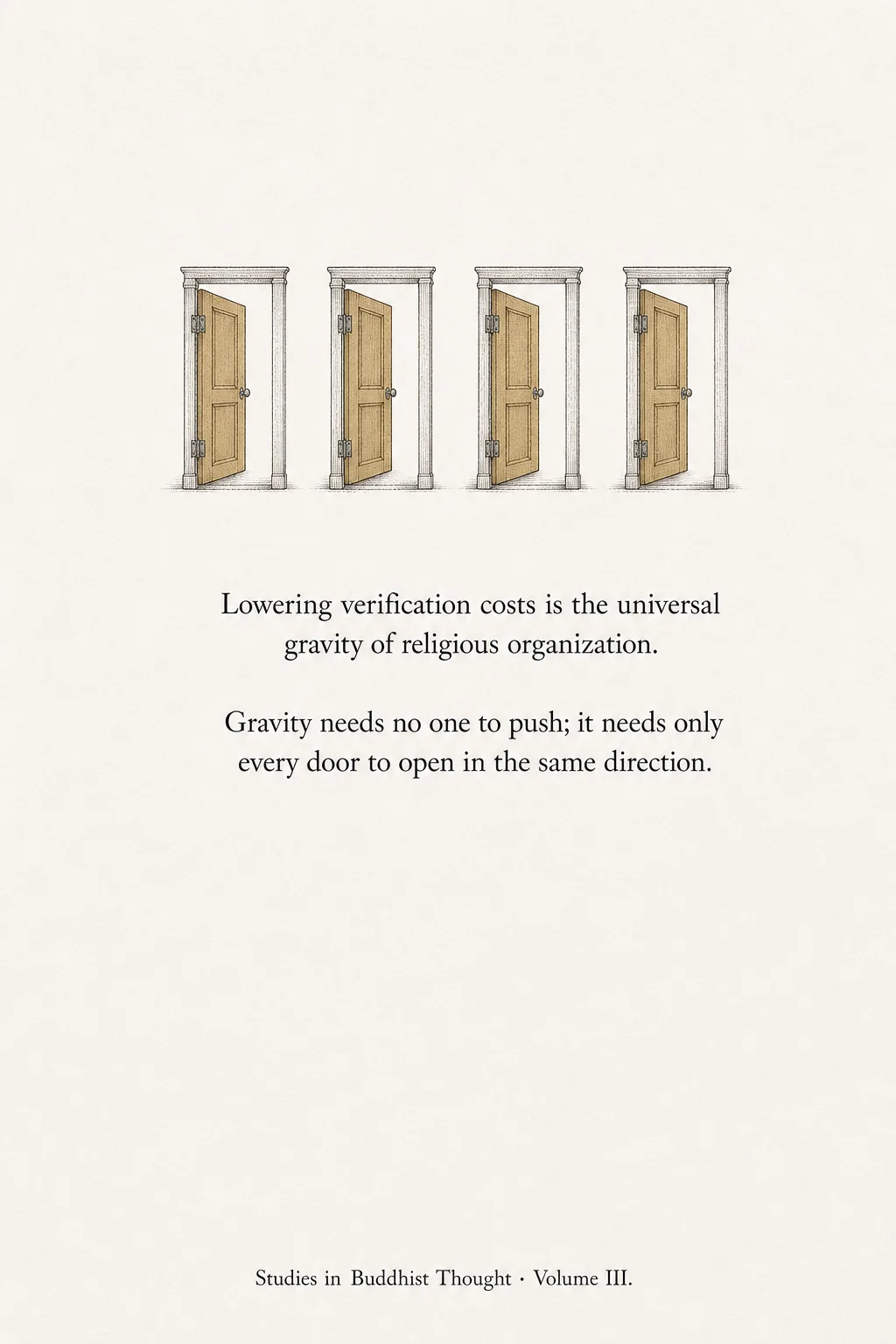
Chapter 1: Does Transformation Have a Direction?—The Engine of the Whole Volume
Conclusion: A Candid Account of the Hidden Tools
Back Cover
The English version has not yet been audited. Please use it for reference only.
← Conclusion: A Candid Account of the Hidden Tools
Next →
🇨🇳
简体中文
🇬🇧
English
☀️
🌿
🌙
G
A
T