Conclusion: A Candid Account of the Hidden Tools
At the end of three volumes, it is time to speak candidly. The Preface to this volume left one sentence on record: greed, hatred, and delusion are its hidden tools, not to be used explicitly. Now that the volume is complete, the tools can be placed on the table. The first three of its four questions each have an ancient name. “Who benefits?” asks about greed: chapter by chapter, this volume has listed the beneficiaries at every link—patronage, licenses, titles, and Dharma thrones. “To whose account is the cost charged?” asks about hatred: the texts condemned as heretical, the chains burned through, the reincarnations recognized away, and the renunciation placed in storage. “What is obscured?” asks about delusion: survivor bias, retrospective narratives, and archives that grow more detailed the later they become. This volume avoided those three words because using them would make analysis sound like accusation. Yet what the entire volume has tested is precisely the opposite: no link in the chain requires a bad person, but at every link someone benefits, someone is excluded, and some facts are decorously forgotten. The three poisons do not explain the chain; they are searchlights for inspecting each link. That is the whole use of the hidden tools: they do not convict; they illuminate.
This candid account has a second layer: the searchlight also falls on the writer. This book itself practices doctrinal classification, as the Preface to Volume II already acknowledged and Part X, Chapter 1 repeated. This volume, too, conducts exchanges: it trades the disorder of the sources for narrative neatness and the complexity of cases for the economy of mechanisms. The cleaner the verdict, the thicker the archive it leaves out. The interpretive rule used throughout the volume must therefore finally be applied to the volume itself: read monastic biographies at half weight, read reports of victory at half weight, and please read this volume at half weight as well. Each chapter has supplied the conditions that could overturn it. How much testing it can withstand is simply its duty as a book; wherever it fails is an ore vein for the next writer.
Now the three volumes can be drawn together. Volume I asked what Buddhism said. Volume II asked what it delivered. Volume III asked what it became. The final section of Volume II left four words: suffering still remains. The final chapter of this volume marked one direction: the cost of verification kept falling. Taken together, the two sentences bear the whole weight of this book. A tradition whose original intent was the cessation of suffering remains after 2,500 years, and suffering remains as well. The distance between those two instances of “remains” is the length of these three volumes.1
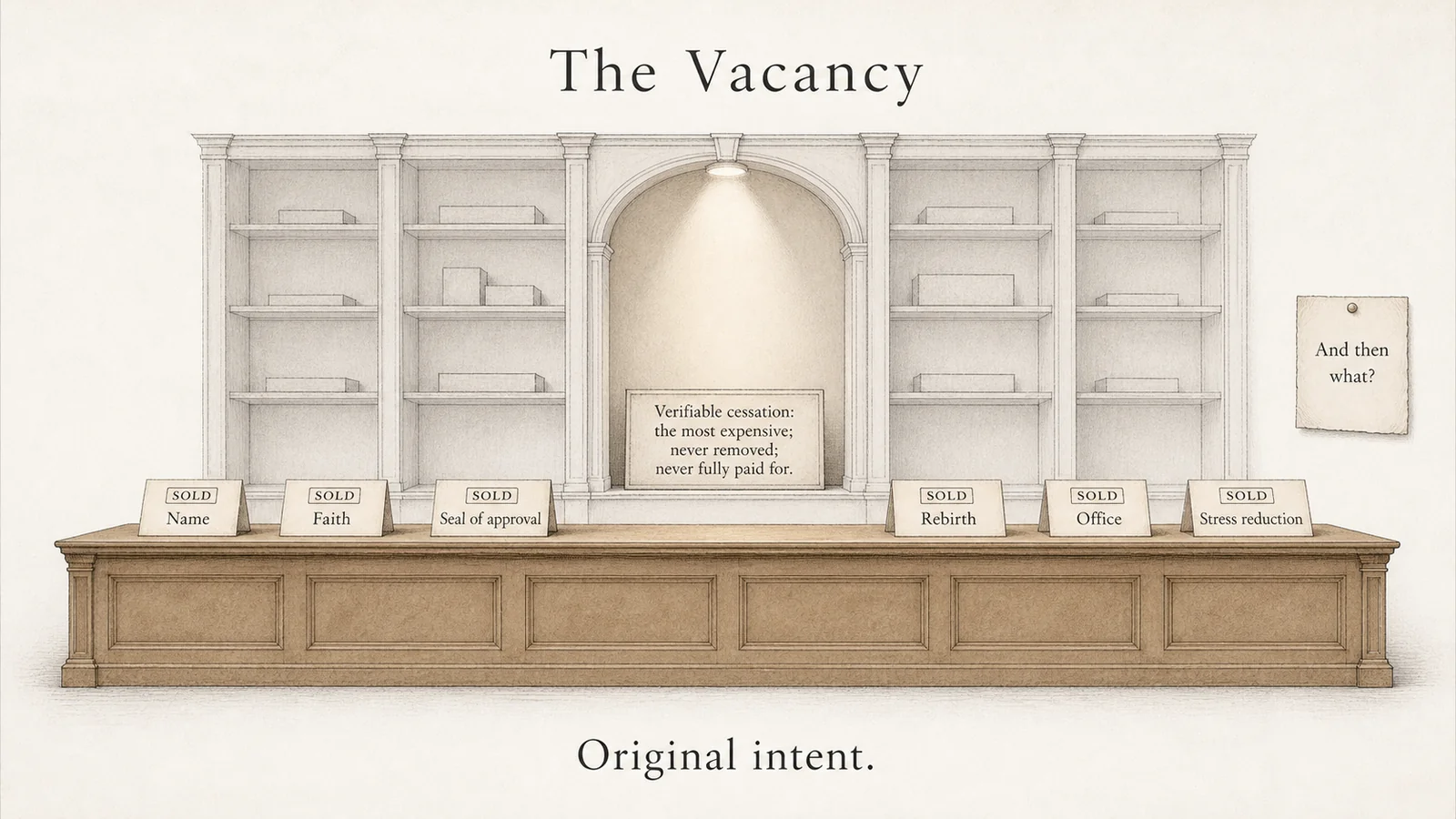
The final paragraph belongs to the vacancy. A history of transformation has finished counting the transactions; it should now say something about the item that always remained on the counter. Every exchange across 2,500 years sold the same thing: verifiable cessation. It could always be sold because it was the most expensive item in the whole system, with the highest threshold and the longest construction schedule, and no one could inspect it on another's behalf. Yet it was never taken off the shelf. When the elders of the Interlude changed their language, they did not say it did not exist. What esoteric Buddhism's gatekeeping locked away was precisely its name. When Pure Land moved it to the other shore, it preserved its address in full. The mindfulness classroom removed it from the examination paper, but between classes someone always asks the superfluous question: and then what? Every recurrence of that question proves that the vacancy behind the shelf remains. Twenty-five hundred years of transformation have revolved around this vacancy. It was never the object of any single transaction; it is the capital behind every transaction that no one has ever fully paid up. Together, the three volumes trace the fate of that capital. Buddhism itself gave it the name shared by all three volumes: the original intent.
References
References
-
See the conclusion of Volume I; the final section of Volume II, Part VII, “Suffering Still Remains”; and Volume III from its opening chapter to this point. ↩