Chapter 1: The Ritual Takeover—From Protective Charms to Deity Yoga
Part VI ended at a vacancy. The debate arena had given Buddhism its most precise minds, and the true-and-eternal had given it its most reassuring promise. The market still lacked one thing: efficacy that could be seen. This part examines how that last square was filled. By the eighth century, a tradition that began by condemning fire sacrifice had made homa one of its own central rites. Volume I, Part VIII, Chapter 4 already presented the full history of Vajrayāna, the classification of the four tantra systems, and the siddha lineages.1 Volume II's part on esoteric practice has already delivered the soteriological judgment.2 This chapter asks only the four questions of a history of transformation, and supplies a history of how Volume II's “rehearsal” became established.
First establish the starting archive; otherwise the completeness of the reversal disappears. Early Buddhism's stance toward ritual was not indifference but definitional rejection. A stream-enterer has broken three fetters, one of which is attachment to rites and observances (the view that ritual and vows can bring purification), placing it among the first three obstacles on the path to liberation. The major list of precepts in the Brahmajāla Sutta classifies fire offerings, spells, and divination as forms of wrong livelihood improper for renunciants. A religion that wrote the rejection of ritual into its definition of attainment made ritual the vehicle of attainment a thousand years later. Empowerment, mantra, and contemplative ritual became means of attaining buddhahood in this very body. There is no more complete exchange of status in the history of this transformation.3
The door did not open in a day, and its geometry is familiar: a soft gate followed by a staircase, as in Part IV, Chapter 1. The Vinaya and canonical discourses already left an opening for protective formulas. The Khandha Paritta guarded against snakebite, and the tradition of paritta remains part of the Theravāda daily liturgy. Protection meets a human need that no one can easily prohibit. Once the back door opened, steps grew by themselves: from curing snakebite to warding off disaster, from warding off disaster to securing blessings, from blessings to protecting the state, and from protecting the state to buddhahood. Each step was only slightly broader than the one below. Mahāyāna sutras themselves completed the promotion of spells. The Lotus Sūtra devoted an entire chapter to dhāraṇīs, and Prajñāpāramitā summarized itself as “the great divine mantra, the great luminous mantra.” The moment a wisdom scripture packaged itself as a spell, the elevation of spells was already prepared.4 Systematization arrived in the seventh century. The Mahāvairocana Sūtra and Vajraśekhara corpus elevated ritual from service to the substance of the path. Correspondence with the three mysteries and deity yoga became core technologies. Their institutional fittings arrived at the same time: empowerment, adapted from royal coronation as a credential of entry; transmission from an ācārya; and secrecy, under which the uninitiated could not hear the teaching.5
An old line from this volume lies hidden in those institutional fittings. Part II established the Vinaya's two statuses, provision and chain. Part IV recorded that the gate of scripture had no chain to inspect; anyone could submit a text. Esoteric Buddhism for the first time installed a chain lock on the side of Dharma. Doctrine no longer traveled merely with manuscripts. It had to be bestowed face to face by a living person through empowerment, link by link; a broken chain could not renew itself. The market effect was immediate. The credentialing vacuum was filled for a third time. Attainment could not be examined, as the Interlude showed; the number of treatises could be counted, as Part V showed; and one could stand in line for empowerment. Artificial scarcity is the foundation of every licensing regime. Turning public scripture into secret instruction was the most thorough repair this tradition ever made to its own soft gate, except that the benefit of the repair accrued not to verification but to lineage.
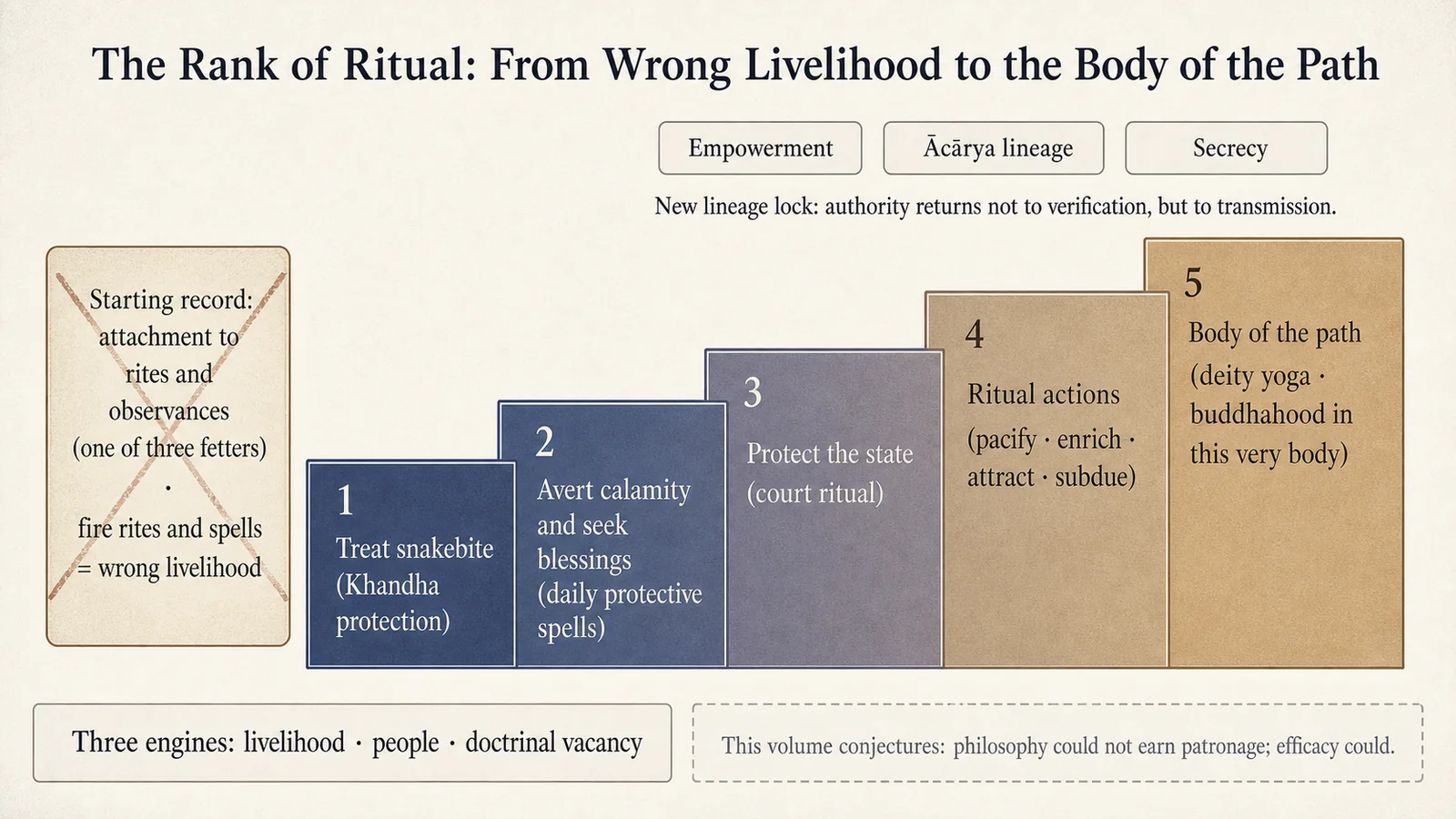
On the demand side, three lines now converged. Part V, Chapter 2 left a vacancy: Buddhism had no indispensable daily function in the village. Patronage was a matter of goodwill rather than necessity. Esoteric Buddhism filled precisely that square. Averting calamity, summoning rain, curing disease, and halting war were written directly into the ritual system as four classes of rites: pacifying, enriching, magnetizing, and subjugating.6 Look at this list for a moment. Not one of the four aims at the cessation of suffering; all aim at welfare within this life. This is not a catalogue of liberation but a survey of demand. Part VI said that the designers of the true-and-eternal knew what their customers feared. These designers knew what their customers wanted. Part VI, Chapter 2 left another gap. The true-and-eternal issued the license “you are originally a buddha”; esoteric Buddhism supplied the operating manual. Deity yoga made that promise into an executable technique. Orders arrived from kings as well. State-protection and military rites became regular palace purchases, while the Pāla dynasty made esoteric Buddhism the advanced curriculum of its flagship monasteries, as Volume I, Part VIII, Chapter 5 recorded.
Now take inventory through the four questions. What changed? The status of ritual completed a three-stage leap: wrong livelihood, expedient service, substance of the path. The criterion changed with it. Siddhi and signs of attainment began to displace cessation and skill in debate; the next two chapters continue this line. What force pushed the change? Demand for a ritual layer and for manifest efficacy, competitive pressure from Śaivite technology (the subject of the next chapter), and royal orders for state protection. Who benefited? The ācārya, holder of the new chain; the monastery, which acquired stable service income and a curricular product; the king, who received a suite of religious technologies; and the village, which finally found a Buddhism willing to act for its crops, its sick, and its dead.
The plain half must be said fully. Averting disasters and conducting funerals are legitimate religious labor everywhere. Early Buddhism's refusal to participate was the exceptional position in comparative religious history, and maintaining it for a thousand years was already extraordinary. The tantric takeover also brought real doctrinal engineering. Every rite was explicitly operated within the framework of the two truths, and the deity arose from emptiness. Volume II recorded three forms of the system's self-awareness: the exoteric-esoteric interlock, the division between shared and unshared attainments, and awareness of risk. This volume judges structural consequences, never the sincerity of practitioners.
Under the rules, what follows is explicitly this volume's conjecture. This time the conjecture must be plural. A single motive cannot explain so complete a reversal: services could have been outsourced, so why rewrite soteriology? Separate the engines.
The first engine is livelihood, installed on the side of patronage. Tantricization was Buddhism's return to the religious service industry. Philosophy could not earn patronage; efficacy could. The economy of visibility in Part V, Chapter 2 worked only for courts and fellow scholars, not for villages. The visibility villages wanted was manifest efficacy. After the Gupta period, urban and guild patrons declined, and large and small courts became the chief buyers. Their purchase orders specified protection of the state, averting disaster, success in war, and astrology, while Śaivism already occupied the counter. Buddhism restocked according to its rival's template.7 Draw two boundaries around this engine. The geographical boundary: Buddhism could compete for the court-ritual contract. The Pāla dynasty is a case in which it won—and precisely the place where Buddhism survived longest in India. But it never captured the general market in marriage, funerals, and domestic rites, a hereditary caste business closed to outsiders. This was the “no membrane” problem of Part V, Chapter 2 appearing again. The explanatory boundary: livelihood explains opening the business, not elevating ritual into the path itself. Theravāda is the control. It has sprinkled purifying water and chanted paritta for a thousand years without promoting protective spells into the path to arahantship. Service work does not require rewriting soteriology. If service revenue and palace orders can be shown to have been mere by-products after the doctrinal elevation was complete (doctrine first, business later), this engine should be discounted.
The second engine is people, installed on the side of entry. During the centuries of Brahmanization described in Part VI, the median member of the community was born into a ritual-saturated society, and habits entered with people. Siddhas moved between religions, and the traffic ran both ways. Saraha was called the “Great Brahmin”; born a Brahmin, he entered Buddhism and then entered esoteric practice. Nāropa moved in the opposite social direction, leaving a post as gatekeeper-scholar to become a siddha, as the third chapter records. Add the distribution of temperaments. Every population contains a segment whose religiosity naturally favors ritual and magic. Early Buddhism barred this segment or lost it to competitors. Tantricization brought both its customers and its practitioners inside. If the social origins of late monastics and siddhas can be shown not to differ from those of preceding generations, this engine should be discounted.
The third engine is doctrinal vacancy, installed within the system itself. It chiefly explains why ritual became the substance of the path. Esoteric Buddhism filled three holes dug by exoteric Buddhism. The first was a hole in the schedule. After buddhahood was pushed three incalculable eons away, as Part IV, Chapter 2 showed, the path had a magnificent destination but no executable timetable. The slogan “buddhahood in this very body” aimed exactly at this internally produced despair. Volume II recorded that a promise of speed is an advertisement of efficacy, and an advertisement is a receipt acknowledging demand. The second was an interface hole. After the elevation of buddha-body theory was complete, as Part IV, Chapter 3 showed, the Dharma-body was magnificent but inaccessible. Deity yoga made buddha-body theory into an operational interface; the true-and-eternal supplied the license and esoteric Buddhism the manual. The third concerned body and death. Madhyamaka and Yogācāra were cognition-centered systems with no place on the path for the body, emotion, or the process of dying. Channels, winds, and drops recruited the body as the instrument of the path, while transference of consciousness and intermediate-state practices made death itself a window for cultivation—the technical version of Part VI's sickbed scene. Set the three holes in a line, and esoteric Buddhism avoids none of them. It fills each directly. If the core esoteric practices can be shown to predate the formation of these three vacancies, or if their own promotion can be shown not to emphasize these three selling points, this engine should be discounted.
The three engines converge, each governing one layer. Livelihood explains why Buddhism returned to the service counter. People explain the channel through which technologies and habits entered. Doctrinal vacancy explains why the things that entered ultimately occupied the status of the path itself. It is true that philosophy could not earn patronage. Yet if patronage were the only aim, Buddhism needed only to open a branch office, not amend its constitution. Wherever the constitution changed, there was an internal hole.
The technologies are now on the shelf. The next chapter inspects the goods, item by item, against the rival's inventory.
References
References
-
For the history of Vajrayāna (from dhāraṇī and miscellaneous esotericism to Highest Yoga Tantra), the four tantra classes, core practices, integration with Madhyamaka and Yogācāra, siddha traditions, and transmission, see Volume I, Part VIII, Chapter 4. This chapter takes its factual layer directly from there. ↩
-
For the structural judgment of tantric soteriology—the claim of buddhahood in this very body; the path of empowerment, deity, channels, and winds; taking the fruit as the path; signs of attainment and the guru's authority; attachment to results; and the system's three forms of self-awareness—see both halves of Volume II, Part V. ↩
-
The three fetters broken by a stream-enterer (identity view, doubt, and attachment to rites and observances) are common to the schools; see the stream-entry discourses in the Saṃyutta Nikāya and Saṃyukta Āgama. Fire offerings, spells, and divination appear as forms of wrong livelihood obstructing the path in the sections on the aggregate of ethics in Dīgha Nikāya 1, the Brahmajāla Sutta, and its Chinese parallel, the Brahmajāla Sūtra of the Dīrgha Āgama. ↩
-
For the Khandha Paritta against snakebite, see Aṅguttara Nikāya 4.67 and the Cullavagga of the Vinaya. See also the “Dhāraṇī” chapter of the Lotus Sūtra. “The great divine mantra, the great luminous mantra” appears in the Heart Sūtra, while praise of the illuminating spell already appears in the larger Prajñāpāramitā. ↩
-
The Mahāvairocana Sūtra was probably composed around the middle of the seventh century; see the introduction to Stephen Hodge, The Mahā-Vairocana-Abhisambodhi Tantra (London: RoutledgeCurzon, 2003). The Vajraśekhara corpus followed several decades later. For the centuries of accumulation in miscellaneous esoteric rites, see Volume I, Part VIII, Chapter 4. ↩
-
For the four rites of pacifying, enriching, magnetizing, and subjugating, see the Mahāvairocana Sūtra, the Susiddhikara Sūtra, and the general prescriptions of esoteric ritual manuals. Reading the list as a “survey of demand” is this volume's interpretation. ↩
-
On the post-Gupta decline of guild patrons, medieval courts as major buyers, and esoteric Buddhism's adaptation, see Ronald M. Davidson, Indian Esoteric Buddhism (2002), also cited in Chapter 2. On Śaivism's prior occupation of the royal ritual market, see Alexis Sanderson, “The Śaiva Age” (2009), cited in Part V, Chapter 2. ↩