Chapter 2: Borrowed Technology—The Problem of Shared Origins with Śaivism
The preceding chapter watched ritual take command. This one inspects the source of its inventory. Scholarship gives the question a dignified name, the problem of shared origins. In this volume's language: who manufactured the machinery of esoteric Buddhism? The method is unchanged. Inspect every item, determine the direction of borrowing, and then examine the modification.
The comparison produces a long list. Homa is a direct descendant of Vedic fire sacrifice, and even the name was unchanged. Empowerment is the religious version of royal coronation, carrying over the name and the complete rite of pouring water. The maṇḍala is a cosmic diagram and ritual ground sharing geometry and a pantheonic framework with Hindu rites. Channels, drops, and inner heat belong to a yogic physiology shared among traditions, with the foundations of channel theory already present in late Upaniṣads. Sexual yoga was a signature practice of Kaula traditions. Charnel-ground practice, skull vessels, and bone ornaments formed the complete equipment of Kāpālika ascetics. The iconography of wrathful deities (many arms, flames, garlands of skulls, and animal skins) used the visual language of Śaivite gods in wrathful form. The preceding chapter watched esoteric Buddhism take over ritual in its own house. Turn over its inventory item by item, and almost every piece has a counterpart on a Śaivite shelf.1
The inspection list appears below. Only the final row bears the mark “made in-house.”
| Equipment | Form in esoteric Buddhism | Counterpart and source | Buddhist modification |
|---|---|---|---|
| Homa | Four fire offerings: pacifying, enriching, magnetizing, and subjugating | Direct descendant of Vedic fire sacrifice; name unchanged | Visualize the deity receiving the offering; efficacy tied to the three mysteries |
| Empowerment | Credential of entry and rank | Royal coronation (abhiṣeka) | Investiture becomes Dharma transmission, accompanied by samaya vows |
| Maṇḍala | Ritual palace: spatial architecture of the rite | Geometry of Hindu ritual grounds; structure of medieval feudal polity, in Davidson's reading | A buddha occupies the center, with retinue arranged by degree of realization |
| Mantra | The mystery of speech among the three mysteries | Vedic sacrificial formulas and Śaivite traditions of spells | Power tied to deity and contemplation of emptiness, not activated independently |
| Channels and drops | Yogic physiology of the completion stage | Shared among traditions; late Upaniṣads already supply a basis for channel theory | Joined to Buddhist theories of mind as the basis for bliss and emptiness |
| Sexual union | Consort practice in Highest Yoga Tantra | Sexual yoga of Kaula and Vidyāpīṭha traditions | Classified as esoteric meaning and exegetically rendered as method and wisdom |
| Charnel-ground equipment | Skull vessels and bone ornaments in rites of wrathful deities | Equipment of Kāpālika ascetics | Converted into symbolic implements of contemplation |
| Wrathful iconography | Wisdom kings and Heruka | Visual language of wrathful Śaivite gods | Supplied with narratives of incorporation, such as Trailokyavijaya trampling Maheśvara |
| Yoginī and ḍākinī | Chief deities and retinues of Yoginī tantras | Śaivite Vidyāpīṭha worship of yoginīs | Textual passages adopted in blocks, as Sanderson's comparisons show, and reassigned to Heruka |
| Grammar of the resultant vehicle | Taking buddhahood as the path; buddhahood in this very body | No counterpart; made in-house | The true-and-eternal supplies the license and emptiness the firmware: the invention is at the software layer |
The direction of borrowing can be established more firmly than mere “resemblance.” On the side of textual comparison, Sanderson's series of studies demonstrates that passages in a group of Yoginī tantras were adopted in blocks from Śaivite Vidyāpīṭha literature. Editorial traces are clearly visible: divine names are replaced with Heruka while the framing language remains intact. These comparisons provide the hardest evidence in the problem of shared origins. The counterarguments and qualifications in scholarship must also be registered. Siddhas moved among religions; borderlands such as Oḍḍiyāna and Bengal were shared laboratories; elementary technologies need not have had a single owner. Davidson's social history adds another layer. The structure of the maṇḍala itself was a blueprint of medieval feudal polity: the central deity resembled a lord, the four-directional retinue his vassals, and empowerment an investiture. Political form supplied a structure for imagination. This volume adopts a mixed judgment: the principal inventory was borrowed, the underlying layer was shared, and disputes over direction are recorded one by one.2
One item came with its receipt and deserves separate display. The Sarvatathāgatatattvasaṃgraha contains a full episode. Mahāvairocana teaches, but Maheśvara, lord of the three realms (that is, Śiva), refuses to submit. Vajrapāṇi assumes a wrathful form, subdues and tramples him to death, revives him with a mantra, incorporates him into the retinue, gives him a new name, and places him on the maṇḍala's periphery. In the standard image of the wisdom king Trailokyavijaya, the left foot tramples Maheśvara and the right his consort. Trample the rival's supreme god underfoot, then incorporate him into your own organizational chart. This is the assimilative exclusion introduced in Chapter 2 of the Introduction. Part III, Chapter 2 saw it incorporate minor gods; Part VI watched Viṣṇu incorporate the Buddha in reverse. Here it appears for a third time, now with gunpowder in the air: the image is a battle report. Competition between the two traditions requires no conjecture. It was cast in bronze.3
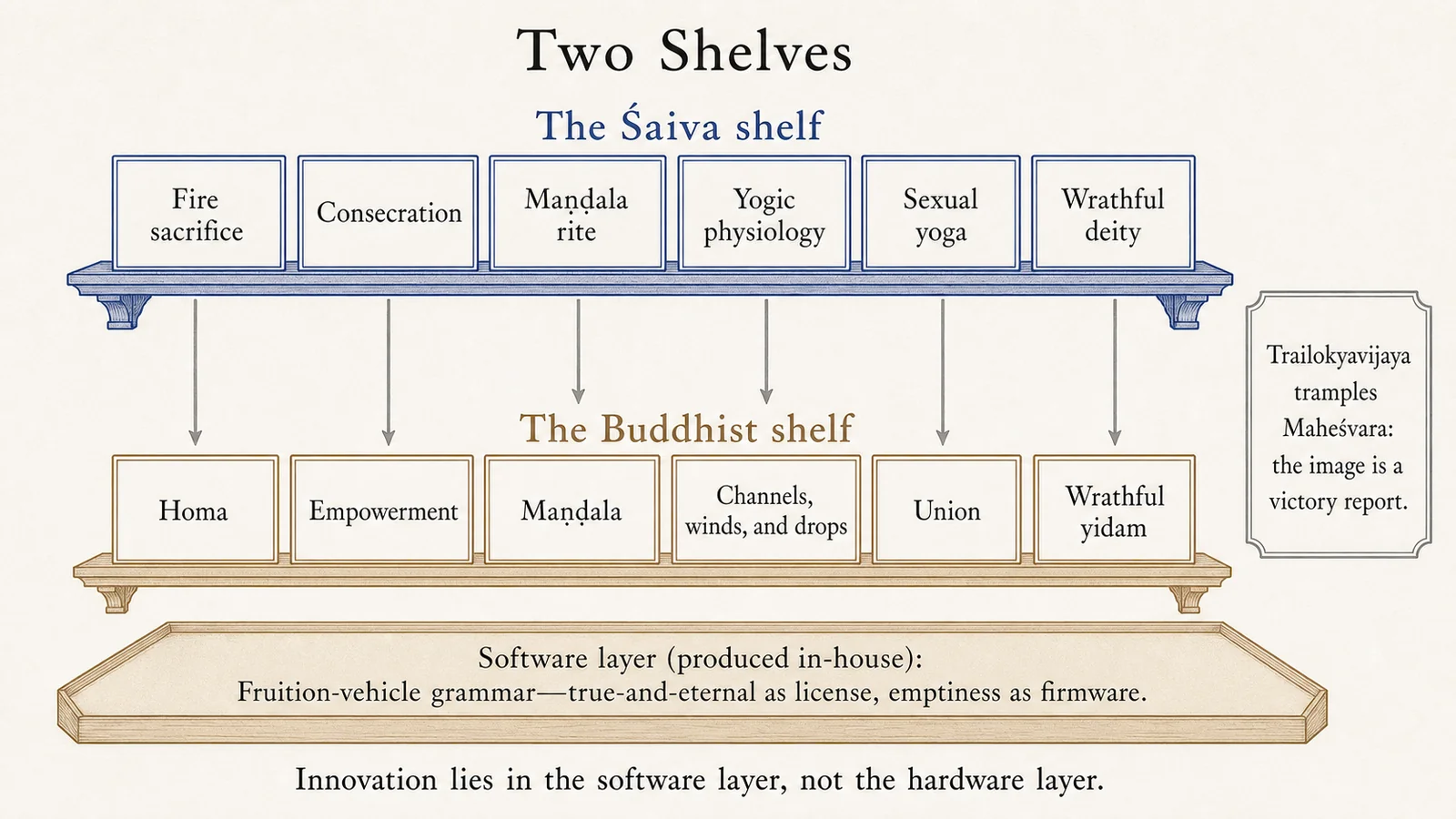
The plain half is this: borrowing was not photocopying. Every piece of machinery received Buddhist firmware on entering. The deity had to arise from emptiness—first dissolve into emptiness, then reappear as the deity. The first operation of the generation stage was a lesson in Madhyamaka. Ritual efficacy was situated within the framework of the two truths: ultimately nothing is attained, conventionally effects occur. Vows were bound to bodhicitta. The grammar packaging the whole system was called the resultant vehicle. A causal vehicle proceeds through practices at the causal stage toward buddhahood; the resultant vehicle takes buddhahood itself directly as the path. Because you are originally a buddha, you can visualize yourself as one. Readers of Part VI will recognize the sentence: tathāgatagarbha issued the license and esoteric Buddhism wrote the operating manual. Without the foundation of the true-and-eternal, the grammar of the resultant vehicle could not stand. The originality is real, but it lies in the software rather than the machinery.
Take inventory through the four questions. What changed? Control over product form. Part V, Chapter 1 established the iron law of an arms race: to remain in the arena, one must arm according to its rules; once armed, one's shape is given by the enemy. In that arena Buddhism borrowed the procedures of epistemology. Here it borrowed ritual machinery, and this time “shape” was literal: Buddhist deities grew multiple arms and flames. What force pushed the change? The line of religious competition ran at full power. From the sixth through twelfth centuries the great flow of royal patronage moved toward Śaivism, as Part V, Chapter 2 recorded, and Buddhism restocked according to its rival's bestseller list. Who benefited? Borderlands and new social strata. Laboratories in Oḍḍiyāna and Bengal lay far from Nālandā's orthodox inspection. Innovation always begins where inspection is thinnest; the manuscript window of Part IV, Chapter 1 was an earlier application of the same rule. The price was recorded in recognizability. To ordinary observers Heruka and Bhairava became products on the same shelf. Volume I, Part VIII, Chapter 6 judged that “tantricization made Buddhism and Hinduism increasingly difficult to distinguish on the surface.” This volume supplies the mechanism. Convergence was not an accident; it was inevitable when both answered the same demand sheet and stocked their shelves from the same warehouse. The cost of guarding the boundary, introduced in Part VI, Chapter 1, had now become unaffordable.
The machinery and its place of origin have been inspected. One question remains. Who operated it, where did they come from, and where did they eventually go? The next chapter turns to siddhas and universities.
References
References
-
On the adoption of whole passages by Buddhist Yoginī tantras from Śaivite Vidyāpīṭha literature and on the visible traces of editing, see Alexis Sanderson, “History through Textual Criticism in the Study of Śaivism, the Pañcarātra and the Buddhist Yoginītantras,” in François Grimal, ed., Les Sources et le temps (Pondicherry: EFEO, 2001), and “The Śaiva Age” (2009), cited in Part V, Chapter 2. For a systematic account of the individual technologies, see Volume I, Part VIII, Chapter 4. ↩
-
Ronald M. Davidson, Indian Esoteric Buddhism: A Social History of the Tantric Movement (New York: Columbia University Press, 2002), reads the maṇḍala and empowerment politically in relation to medieval feudal forms, the sāmanta system, and investiture. See the same book on siddha social strata and the role of borderlands. ↩
-
For the subjugation of Maheśvara, see the subjugation section of the Sarvatathāgatatattvasaṃgraha in the Vajraśekhara corpus. Trailokyavijaya's trampling of Maheśvara and his consort is standard in iconographic manuals. See Davidson 2002 and Volume I, Part VIII, Chapter 4. ↩